Web3 Research MCP
MCP de investigación Web3
Investigación profunda para cripto: gratuita y totalmente local 🧠
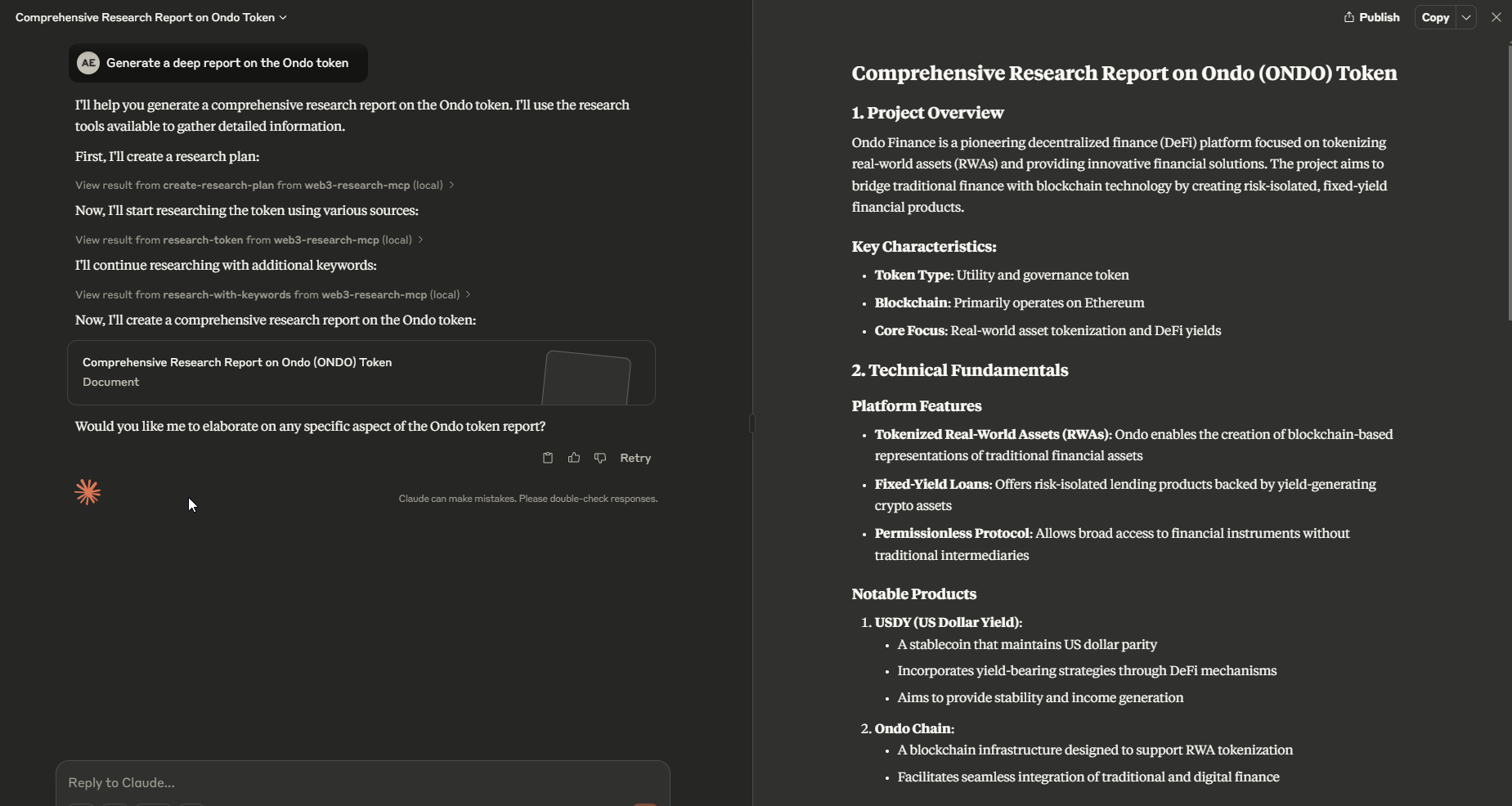
🚀 Vista previa

Related MCP server: deeplook
🧠 Características
Investigación exhaustiva: Recopila información detallada sobre cualquier token de criptomoneda
Análisis multifuente: Investiga a través de múltiples fuentes, incluyendo CoinGecko, CoinMarketCap, DeFiLlama y más
Informes estructurados: Genera informes detallados que cubren fundamentos técnicos, datos de mercado, sentimiento social y más
Gestión de recursos: Almacena automáticamente los resultados de búsqueda y el contenido para referencia
Seguimiento de estado: Realiza un seguimiento del progreso de la investigación a través de diferentes etapas y secciones
📋 Requisitos
Node.js (v16 o superior)
🔧 Instalación y configuración
Instalación a través de Smithery
Para instalar web3-research-mcp para Claude Desktop automáticamente a través de Smithery:
npx -y @smithery/cli install web3-research-mcp --client claude🔌 Uso con Claude Desktop
Edita tu archivo de configuración de Claude Desktop
Windows: %APPDATA%\Claude\claude_desktop_config.json
macOS: ~/Library/Application Support/Claude/claude_desktop_config.json
Añade esto a tu archivo de configuración de Claude Desktop:
{
"mcpServers": {
"web3-research-mcp": {
"command": "npx",
"args": ["-y", "web3-research-mcp@latest"]
}
}
}Luego reinicia Claude Desktop
🔌 Uso con Cursor
Ve a: Settings -> Cursor Settings -> MCP -> Add new global MCP server Pega esto en tu archivo Cursor ~/.cursor/mcp.json. Consulta la documentación de MCP de Cursor para más información.
{
"mcpServers": {
"web3-research-mcp": {
"command": "npx",
"args": ["-y", "web3-research-mcp@latest"]
}
}
}Luego reinicia Cursor
🛠️ Herramientas
create-research-plan
Crea un plan de investigación estructurado para un token.
Parámetros:
tokenName: Nombre completo del token
tokenTicker: Símbolo del ticker del token
search
Realiza una búsqueda web y devuelve los resultados.
Parámetros:
query: Consulta de búsqueda
searchType: Tipo de búsqueda (web, noticias, imágenes, vídeos)
research-with-keywords
Busca un token con palabras clave específicas y guarda los resultados.
Parámetros:
tokenName: Nombre del token
tokenTicker: Símbolo del ticker
keywords: Matriz de palabras clave para buscar
update-status
Actualiza el estado de una sección de investigación.
Parámetros:
section: Nombre de la sección a actualizar (ej., 'projectInfo', 'technicalFundamentals')
status: Nuevo estado para la sección (planned, in_progress, completed)
fetch-content
Obtiene contenido de una URL y lo guarda como un recurso.
Parámetros:
url: URL de la que obtener el contenido
format: Formato de salida (text, html, markdown, json)
list-resources
Enumera todos los recursos disponibles que se han guardado.
search-source
Busca información sobre un token desde una fuente específica.
Parámetros:
tokenName: Nombre del token
tokenTicker: Símbolo del ticker
source: Fuente a buscar (ej., 'CoinGecko', 'DeFiLlama', 'News')
coingecko-data
Obtiene datos de mercado en vivo directamente de la API pública de CoinGecko: precio, capitalización de mercado, cambios en 24h/7d/30d, ATH/ATL, suministro circulante, direcciones de contrato en diferentes cadenas y enlaces sociales/de desarrollo. Evita los problemas 403 del scraping HTML.
Parámetros:
tokenName: Nombre completo del token (ej., 'Bitcoin')
tokenTicker: Símbolo del ticker (ej., 'BTC')
No se requiere clave API. Utiliza el nivel público gratuito (~30 req/min).
Opcional: establece COINGECKO_API_KEY en el entorno para usar una clave API de CoinGecko Pro. Cuando se establece, las solicitudes se envían a https://pro-api.coingecko.com/api/v3 con el encabezado x-cg-pro-api-key. Las solicitudes expiran después de 15s.
coingecko-search
Busca en el índice de monedas de CoinGecko y devuelve coincidencias candidatas con sus IDs de CoinGecko. Útil cuando el ticker es ambiguo (ej., múltiples tokens con el mismo símbolo).
Parámetros:
query: Consulta de búsqueda: nombre, ticker o dirección de contrato
defillama-data
Obtiene datos de protocolo directamente de la API pública de DeFiLlama: TVL total, desglose de TVL por cadena, comisiones (24h/7d/30d/histórico), direcciones de token, rondas de financiación y enlaces. Evita el scraping HTML para la búsqueda de protocolos DeFi más comunes.
Parámetros:
tokenName: Nombre completo del protocolo/token (ej., 'Uniswap')
tokenTicker: Símbolo del ticker (ej., 'UNI')
No se requiere clave API. Utiliza la API pública gratuita. Las solicitudes expiran después de 15s. El índice de protocolos se almacena en caché durante 5 minutos por proceso para evitar saturar /protocols en cada llamada.
defillama-search
Busca en el índice de protocolos de DeFiLlama y devuelve coincidencias candidatas con sus slugs, TVL y categoría. Útil cuando el ticker es ambiguo (ej., múltiples protocolos con nombres similares).
Parámetros:
query: Consulta de búsqueda: nombre del protocolo, ticker o slug
📝 Prompts
token-research
Inicia una investigación exhaustiva sobre un token de criptomoneda.
Parámetros:
tokenName: Nombre completo del token de criptomoneda
tokenTicker: Símbolo del ticker del token (ej., BTC, ETH)
🧠 Cómo funciona
Cuando comienza la investigación, se crea un plan estructurado que cubre todos los aspectos del token
El servidor realiza búsquedas en múltiples fuentes para obtener información
Los resultados de búsqueda se almacenan como recursos que pueden ser referenciados
La investigación avanza a través de diferentes secciones, con seguimiento de estado
Se genera un informe exhaustivo que cubre todos los aspectos del token
⚠️ Limitaciones
Algunos sitios web bloquean el web scraping, por lo que la obtención directa de contenido puede fallar con errores 403
Depende de los resultados de búsqueda, que no siempre pueden ser exhaustivos
Pueden aplicarse límites de tasa a las operaciones de búsqueda
📄 Licencia
Este proyecto está bajo la Licencia Apache 2.0 - consulta el archivo LICENSE para más detalles.
Available Tools
14 toolscoingecko-dataD
| Name | Required | Description | Default |
|---|---|---|---|
| tokenName | Yes | Full name of the token (e.g., 'Bitcoin') | |
| tokenTicker | Yes | Ticker symbol (e.g., 'BTC') |
TDQS
Does the description disclose side effects, auth requirements, rate limits, or destructive behavior?
Tool has no description.
Agents need to know what a tool does to the world before calling it. Descriptions should go beyond structured annotations to explain consequences.
Is the description appropriately sized, front-loaded, and free of redundancy?
Tool has no description.
Shorter descriptions cost fewer tokens and are easier for agents to parse. Every sentence should earn its place.
Given the tool's complexity, does the description cover enough for an agent to succeed on first attempt?
Tool has no description.
Complex tools with many parameters or behaviors need more documentation. Simple tools need less. This dimension scales expectations accordingly.
Does the description clarify parameter syntax, constraints, interactions, or defaults beyond what the schema provides?
Tool has no description.
Input schemas describe structure but not intent. Descriptions should explain non-obvious parameter relationships and valid value ranges.
Does the description clearly state what the tool does and how it differs from similar tools?
Tool has no description.
Agents choose between tools based on descriptions. A clear purpose with a specific verb and resource helps agents select the right tool.
Does the description explain when to use this tool, when not to, or what alternatives exist?
Tool has no description.
Agents often have multiple tools that could apply. Explicit usage guidance like "use X instead of Y when Z" prevents misuse.
coingecko-searchD
| Name | Required | Description | Default |
|---|---|---|---|
| query | Yes | Search query — name, ticker, or contract address. Returns candidate CoinGecko IDs. |
TDQS
Does the description disclose side effects, auth requirements, rate limits, or destructive behavior?
Tool has no description.
Agents need to know what a tool does to the world before calling it. Descriptions should go beyond structured annotations to explain consequences.
Is the description appropriately sized, front-loaded, and free of redundancy?
Tool has no description.
Shorter descriptions cost fewer tokens and are easier for agents to parse. Every sentence should earn its place.
Given the tool's complexity, does the description cover enough for an agent to succeed on first attempt?
Tool has no description.
Complex tools with many parameters or behaviors need more documentation. Simple tools need less. This dimension scales expectations accordingly.
Does the description clarify parameter syntax, constraints, interactions, or defaults beyond what the schema provides?
Tool has no description.
Input schemas describe structure but not intent. Descriptions should explain non-obvious parameter relationships and valid value ranges.
Does the description clearly state what the tool does and how it differs from similar tools?
Tool has no description.
Agents choose between tools based on descriptions. A clear purpose with a specific verb and resource helps agents select the right tool.
Does the description explain when to use this tool, when not to, or what alternatives exist?
Tool has no description.
Agents often have multiple tools that could apply. Explicit usage guidance like "use X instead of Y when Z" prevents misuse.
coingecko-tickersD
| Name | Required | Description | Default |
|---|---|---|---|
| limit | No | How many top venues to return (sorted by 24h USD volume) | |
| tokenName | Yes | Full name of the token (e.g., 'Bitcoin') | |
| tokenTicker | Yes | Ticker symbol (e.g., 'BTC') |
TDQS
Does the description disclose side effects, auth requirements, rate limits, or destructive behavior?
Tool has no description.
Agents need to know what a tool does to the world before calling it. Descriptions should go beyond structured annotations to explain consequences.
Is the description appropriately sized, front-loaded, and free of redundancy?
Tool has no description.
Shorter descriptions cost fewer tokens and are easier for agents to parse. Every sentence should earn its place.
Given the tool's complexity, does the description cover enough for an agent to succeed on first attempt?
Tool has no description.
Complex tools with many parameters or behaviors need more documentation. Simple tools need less. This dimension scales expectations accordingly.
Does the description clarify parameter syntax, constraints, interactions, or defaults beyond what the schema provides?
Tool has no description.
Input schemas describe structure but not intent. Descriptions should explain non-obvious parameter relationships and valid value ranges.
Does the description clearly state what the tool does and how it differs from similar tools?
Tool has no description.
Agents choose between tools based on descriptions. A clear purpose with a specific verb and resource helps agents select the right tool.
Does the description explain when to use this tool, when not to, or what alternatives exist?
Tool has no description.
Agents often have multiple tools that could apply. Explicit usage guidance like "use X instead of Y when Z" prevents misuse.
create-research-planD
| Name | Required | Description | Default |
|---|---|---|---|
| tokenName | Yes | Token name | |
| tokenTicker | Yes | Token ticker symbol |
TDQS
Does the description disclose side effects, auth requirements, rate limits, or destructive behavior?
Tool has no description.
Agents need to know what a tool does to the world before calling it. Descriptions should go beyond structured annotations to explain consequences.
Is the description appropriately sized, front-loaded, and free of redundancy?
Tool has no description.
Shorter descriptions cost fewer tokens and are easier for agents to parse. Every sentence should earn its place.
Given the tool's complexity, does the description cover enough for an agent to succeed on first attempt?
Tool has no description.
Complex tools with many parameters or behaviors need more documentation. Simple tools need less. This dimension scales expectations accordingly.
Does the description clarify parameter syntax, constraints, interactions, or defaults beyond what the schema provides?
Tool has no description.
Input schemas describe structure but not intent. Descriptions should explain non-obvious parameter relationships and valid value ranges.
Does the description clearly state what the tool does and how it differs from similar tools?
Tool has no description.
Agents choose between tools based on descriptions. A clear purpose with a specific verb and resource helps agents select the right tool.
Does the description explain when to use this tool, when not to, or what alternatives exist?
Tool has no description.
Agents often have multiple tools that could apply. Explicit usage guidance like "use X instead of Y when Z" prevents misuse.
defillama-dataD
| Name | Required | Description | Default |
|---|---|---|---|
| tokenName | Yes | Full protocol/token name (e.g., 'Uniswap') | |
| tokenTicker | Yes | Ticker symbol (e.g., 'UNI') |
TDQS
Does the description disclose side effects, auth requirements, rate limits, or destructive behavior?
Tool has no description.
Agents need to know what a tool does to the world before calling it. Descriptions should go beyond structured annotations to explain consequences.
Is the description appropriately sized, front-loaded, and free of redundancy?
Tool has no description.
Shorter descriptions cost fewer tokens and are easier for agents to parse. Every sentence should earn its place.
Given the tool's complexity, does the description cover enough for an agent to succeed on first attempt?
Tool has no description.
Complex tools with many parameters or behaviors need more documentation. Simple tools need less. This dimension scales expectations accordingly.
Does the description clarify parameter syntax, constraints, interactions, or defaults beyond what the schema provides?
Tool has no description.
Input schemas describe structure but not intent. Descriptions should explain non-obvious parameter relationships and valid value ranges.
Does the description clearly state what the tool does and how it differs from similar tools?
Tool has no description.
Agents choose between tools based on descriptions. A clear purpose with a specific verb and resource helps agents select the right tool.
Does the description explain when to use this tool, when not to, or what alternatives exist?
Tool has no description.
Agents often have multiple tools that could apply. Explicit usage guidance like "use X instead of Y when Z" prevents misuse.
defillama-searchD
| Name | Required | Description | Default |
|---|---|---|---|
| query | Yes | Search query — protocol name, ticker, or slug. Returns candidate DeFiLlama protocols with their slugs. |
TDQS
Does the description disclose side effects, auth requirements, rate limits, or destructive behavior?
Tool has no description.
Agents need to know what a tool does to the world before calling it. Descriptions should go beyond structured annotations to explain consequences.
Is the description appropriately sized, front-loaded, and free of redundancy?
Tool has no description.
Shorter descriptions cost fewer tokens and are easier for agents to parse. Every sentence should earn its place.
Given the tool's complexity, does the description cover enough for an agent to succeed on first attempt?
Tool has no description.
Complex tools with many parameters or behaviors need more documentation. Simple tools need less. This dimension scales expectations accordingly.
Does the description clarify parameter syntax, constraints, interactions, or defaults beyond what the schema provides?
Tool has no description.
Input schemas describe structure but not intent. Descriptions should explain non-obvious parameter relationships and valid value ranges.
Does the description clearly state what the tool does and how it differs from similar tools?
Tool has no description.
Agents choose between tools based on descriptions. A clear purpose with a specific verb and resource helps agents select the right tool.
Does the description explain when to use this tool, when not to, or what alternatives exist?
Tool has no description.
Agents often have multiple tools that could apply. Explicit usage guidance like "use X instead of Y when Z" prevents misuse.
fetch-contentD
| Name | Required | Description | Default |
|---|---|---|---|
| url | Yes | URL to fetch content from (can be a resource:// URL) | |
| format | No | Output format | markdown |
TDQS
Does the description disclose side effects, auth requirements, rate limits, or destructive behavior?
Tool has no description.
Agents need to know what a tool does to the world before calling it. Descriptions should go beyond structured annotations to explain consequences.
Is the description appropriately sized, front-loaded, and free of redundancy?
Tool has no description.
Shorter descriptions cost fewer tokens and are easier for agents to parse. Every sentence should earn its place.
Given the tool's complexity, does the description cover enough for an agent to succeed on first attempt?
Tool has no description.
Complex tools with many parameters or behaviors need more documentation. Simple tools need less. This dimension scales expectations accordingly.
Does the description clarify parameter syntax, constraints, interactions, or defaults beyond what the schema provides?
Tool has no description.
Input schemas describe structure but not intent. Descriptions should explain non-obvious parameter relationships and valid value ranges.
Does the description clearly state what the tool does and how it differs from similar tools?
Tool has no description.
Agents choose between tools based on descriptions. A clear purpose with a specific verb and resource helps agents select the right tool.
Does the description explain when to use this tool, when not to, or what alternatives exist?
Tool has no description.
Agents often have multiple tools that could apply. Explicit usage guidance like "use X instead of Y when Z" prevents misuse.
list-resourcesD
| Name | Required | Description | Default |
|---|---|---|---|
No parameters | |||
TDQS
Does the description disclose side effects, auth requirements, rate limits, or destructive behavior?
Tool has no description.
Agents need to know what a tool does to the world before calling it. Descriptions should go beyond structured annotations to explain consequences.
Is the description appropriately sized, front-loaded, and free of redundancy?
Tool has no description.
Shorter descriptions cost fewer tokens and are easier for agents to parse. Every sentence should earn its place.
Given the tool's complexity, does the description cover enough for an agent to succeed on first attempt?
Tool has no description.
Complex tools with many parameters or behaviors need more documentation. Simple tools need less. This dimension scales expectations accordingly.
Does the description clarify parameter syntax, constraints, interactions, or defaults beyond what the schema provides?
Tool has no description.
Input schemas describe structure but not intent. Descriptions should explain non-obvious parameter relationships and valid value ranges.
Does the description clearly state what the tool does and how it differs from similar tools?
Tool has no description.
Agents choose between tools based on descriptions. A clear purpose with a specific verb and resource helps agents select the right tool.
Does the description explain when to use this tool, when not to, or what alternatives exist?
Tool has no description.
Agents often have multiple tools that could apply. Explicit usage guidance like "use X instead of Y when Z" prevents misuse.
research-sourceD
| Name | Required | Description | Default |
|---|---|---|---|
| source | Yes | Single source to research | |
| tokenName | Yes | Name of the token | |
| tokenTicker | Yes | Ticker symbol of the token |
TDQS
Does the description disclose side effects, auth requirements, rate limits, or destructive behavior?
Tool has no description.
Agents need to know what a tool does to the world before calling it. Descriptions should go beyond structured annotations to explain consequences.
Is the description appropriately sized, front-loaded, and free of redundancy?
Tool has no description.
Shorter descriptions cost fewer tokens and are easier for agents to parse. Every sentence should earn its place.
Given the tool's complexity, does the description cover enough for an agent to succeed on first attempt?
Tool has no description.
Complex tools with many parameters or behaviors need more documentation. Simple tools need less. This dimension scales expectations accordingly.
Does the description clarify parameter syntax, constraints, interactions, or defaults beyond what the schema provides?
Tool has no description.
Input schemas describe structure but not intent. Descriptions should explain non-obvious parameter relationships and valid value ranges.
Does the description clearly state what the tool does and how it differs from similar tools?
Tool has no description.
Agents choose between tools based on descriptions. A clear purpose with a specific verb and resource helps agents select the right tool.
Does the description explain when to use this tool, when not to, or what alternatives exist?
Tool has no description.
Agents often have multiple tools that could apply. Explicit usage guidance like "use X instead of Y when Z" prevents misuse.
research-tokenD
| Name | Required | Description | Default |
|---|---|---|---|
| source | Yes | Source to research (e.g., 'IQ Wiki', 'CoinMarketCap') | |
| tokenName | Yes | Name of the token | |
| tokenTicker | Yes | Ticker symbol of the token |
TDQS
Does the description disclose side effects, auth requirements, rate limits, or destructive behavior?
Tool has no description.
Agents need to know what a tool does to the world before calling it. Descriptions should go beyond structured annotations to explain consequences.
Is the description appropriately sized, front-loaded, and free of redundancy?
Tool has no description.
Shorter descriptions cost fewer tokens and are easier for agents to parse. Every sentence should earn its place.
Given the tool's complexity, does the description cover enough for an agent to succeed on first attempt?
Tool has no description.
Complex tools with many parameters or behaviors need more documentation. Simple tools need less. This dimension scales expectations accordingly.
Does the description clarify parameter syntax, constraints, interactions, or defaults beyond what the schema provides?
Tool has no description.
Input schemas describe structure but not intent. Descriptions should explain non-obvious parameter relationships and valid value ranges.
Does the description clearly state what the tool does and how it differs from similar tools?
Tool has no description.
Agents choose between tools based on descriptions. A clear purpose with a specific verb and resource helps agents select the right tool.
Does the description explain when to use this tool, when not to, or what alternatives exist?
Tool has no description.
Agents often have multiple tools that could apply. Explicit usage guidance like "use X instead of Y when Z" prevents misuse.
research-with-keywordsD
| Name | Required | Description | Default |
|---|---|---|---|
| keywords | Yes | Keywords to search for | |
| tokenName | Yes | Name of the token | |
| tokenTicker | Yes | Ticker symbol of the token |
TDQS
Does the description disclose side effects, auth requirements, rate limits, or destructive behavior?
Tool has no description.
Agents need to know what a tool does to the world before calling it. Descriptions should go beyond structured annotations to explain consequences.
Is the description appropriately sized, front-loaded, and free of redundancy?
Tool has no description.
Shorter descriptions cost fewer tokens and are easier for agents to parse. Every sentence should earn its place.
Given the tool's complexity, does the description cover enough for an agent to succeed on first attempt?
Tool has no description.
Complex tools with many parameters or behaviors need more documentation. Simple tools need less. This dimension scales expectations accordingly.
Does the description clarify parameter syntax, constraints, interactions, or defaults beyond what the schema provides?
Tool has no description.
Input schemas describe structure but not intent. Descriptions should explain non-obvious parameter relationships and valid value ranges.
Does the description clearly state what the tool does and how it differs from similar tools?
Tool has no description.
Agents choose between tools based on descriptions. A clear purpose with a specific verb and resource helps agents select the right tool.
Does the description explain when to use this tool, when not to, or what alternatives exist?
Tool has no description.
Agents often have multiple tools that could apply. Explicit usage guidance like "use X instead of Y when Z" prevents misuse.
searchD
| Name | Required | Description | Default |
|---|---|---|---|
| query | Yes | Search query | |
| searchType | No | Type of search | web |
TDQS
Does the description disclose side effects, auth requirements, rate limits, or destructive behavior?
Tool has no description.
Agents need to know what a tool does to the world before calling it. Descriptions should go beyond structured annotations to explain consequences.
Is the description appropriately sized, front-loaded, and free of redundancy?
Tool has no description.
Shorter descriptions cost fewer tokens and are easier for agents to parse. Every sentence should earn its place.
Given the tool's complexity, does the description cover enough for an agent to succeed on first attempt?
Tool has no description.
Complex tools with many parameters or behaviors need more documentation. Simple tools need less. This dimension scales expectations accordingly.
Does the description clarify parameter syntax, constraints, interactions, or defaults beyond what the schema provides?
Tool has no description.
Input schemas describe structure but not intent. Descriptions should explain non-obvious parameter relationships and valid value ranges.
Does the description clearly state what the tool does and how it differs from similar tools?
Tool has no description.
Agents choose between tools based on descriptions. A clear purpose with a specific verb and resource helps agents select the right tool.
Does the description explain when to use this tool, when not to, or what alternatives exist?
Tool has no description.
Agents often have multiple tools that could apply. Explicit usage guidance like "use X instead of Y when Z" prevents misuse.
search-sourceD
| Name | Required | Description | Default |
|---|---|---|---|
| source | Yes | Source to search (e.g., 'Dune', 'IQ Wiki', 'News') | |
| tokenName | Yes | Name of the token | |
| tokenTicker | Yes | Ticker symbol of the token |
TDQS
Does the description disclose side effects, auth requirements, rate limits, or destructive behavior?
Tool has no description.
Agents need to know what a tool does to the world before calling it. Descriptions should go beyond structured annotations to explain consequences.
Is the description appropriately sized, front-loaded, and free of redundancy?
Tool has no description.
Shorter descriptions cost fewer tokens and are easier for agents to parse. Every sentence should earn its place.
Given the tool's complexity, does the description cover enough for an agent to succeed on first attempt?
Tool has no description.
Complex tools with many parameters or behaviors need more documentation. Simple tools need less. This dimension scales expectations accordingly.
Does the description clarify parameter syntax, constraints, interactions, or defaults beyond what the schema provides?
Tool has no description.
Input schemas describe structure but not intent. Descriptions should explain non-obvious parameter relationships and valid value ranges.
Does the description clearly state what the tool does and how it differs from similar tools?
Tool has no description.
Agents choose between tools based on descriptions. A clear purpose with a specific verb and resource helps agents select the right tool.
Does the description explain when to use this tool, when not to, or what alternatives exist?
Tool has no description.
Agents often have multiple tools that could apply. Explicit usage guidance like "use X instead of Y when Z" prevents misuse.
update-statusD
| Name | Required | Description | Default |
|---|---|---|---|
| status | Yes | New status for the section | |
| section | Yes | Section name to update (e.g., 'projectInfo', 'technicalFundamentals') |
TDQS
Does the description disclose side effects, auth requirements, rate limits, or destructive behavior?
Tool has no description.
Agents need to know what a tool does to the world before calling it. Descriptions should go beyond structured annotations to explain consequences.
Is the description appropriately sized, front-loaded, and free of redundancy?
Tool has no description.
Shorter descriptions cost fewer tokens and are easier for agents to parse. Every sentence should earn its place.
Given the tool's complexity, does the description cover enough for an agent to succeed on first attempt?
Tool has no description.
Complex tools with many parameters or behaviors need more documentation. Simple tools need less. This dimension scales expectations accordingly.
Does the description clarify parameter syntax, constraints, interactions, or defaults beyond what the schema provides?
Tool has no description.
Input schemas describe structure but not intent. Descriptions should explain non-obvious parameter relationships and valid value ranges.
Does the description clearly state what the tool does and how it differs from similar tools?
Tool has no description.
Agents choose between tools based on descriptions. A clear purpose with a specific verb and resource helps agents select the right tool.
Does the description explain when to use this tool, when not to, or what alternatives exist?
Tool has no description.
Agents often have multiple tools that could apply. Explicit usage guidance like "use X instead of Y when Z" prevents misuse.
Tool Schema Changelog
Recent tool additions, removals, and schema changes observed during successful MCP inspections.
5 tool updates
v1.0.4- Added
coingecko-data - Added
coingecko-search - Added
coingecko-tickers - Added
defillama-data - Added
defillama-search
1 tool update
v1.0.0- Changed
list-resources1 field changed- removed
Input schema / additionalPropertiesRemoved value: -false
9 tool updates
- First observed
create-research-plan - First observed
fetch-content - First observed
list-resources - First observed
research-source - First observed
research-token - First observed
research-with-keywords - First observed
search - First observed
search-source - First observed
update-status
TDQS
Scored across 14 tools
Multiple tools appear to serve overlapping purposes: 'search', 'search-source', 'coingecko-search', and 'defillama-search' are hard to distinguish by name alone. Similarly, 'research-source', 'research-token', and 'research-with-keywords' blur together without descriptions to clarify their exact roles.
Tool names mix kebab-case verbs like 'fetch-content' and 'create-research-plan' with noun-only names like 'coingecko-data' and 'defillama-search', plus a bare generic 'search'. There is no consistent verb_noun or domain-prefixed pattern across the set.
Fourteen tools is within a reasonable range for a research-oriented server, but several names appear to cover nearly identical actions, making the set feel padded. The count itself is not extreme, but the apparent duplication reduces the sense that each tool earns its place.
The set covers a plausible web3 research workflow: planning, searching, fetching content, researching tokens/sources, status updates, and pulling market data. However, there are notable gaps in explicit output/result management and no clear end-to-end lifecycle, making completeness mediocre.
Maintenance
Related MCP Connectors
Multi-LLM AI Research & Analysis — smart routing, consensus analysis, due diligence reports
Evidence-backed crypto due diligence with sources, freshness, and a runtime receipt on every call.
Agentic AI runtime: persistent memory, vault, autonomous agents, deep research, DeFi execution.
Signed BTC and macro market intelligence for autonomous research, risk, and trading agents.
Related MCP Servers
- AlicenseDqualityDmaintenanceEnables deep research into cryptocurrency tokens by gathering data from multiple sources like CoinGecko and DeFiLlama to generate structured reports. It allows users to track research progress, fetch web content, and manage resources locally for comprehensive crypto analysis.927 npm4Apache 2.0
- AlicenseAqualityCmaintenanceResearches any company in ~10 seconds using 10 data sources. Returns structured reports with bull/bear verdict for stocks, crypto, and private companies.212AGPL 3.0
- FlicenseAqualityDmaintenanceProvides real-time Web3 research digest with macro news, KOL sentiment, market data, and personalized on-chain wallet analysis through four AI tools.4-
- AlicenseBqualityDmaintenanceProvides AI agents with research tools for AI agent ecosystem analysis, DeFi protocol analysis, and general market research.329 npmMIT