
The AWS MCP server enables AI assistants like Claude to interact with and manage AWS resources using natural language queries. With this server, you can:
Query and manage AWS resources: Execute natural language commands to list, inspect, and modify AWS resources (EC2 instances, S3 buckets, Lambda functions, ECS clusters)
Run AWS code: Execute JavaScript code using AWS SDK V2 for programmatic AWS operations
Manage AWS profiles: List and select profiles, with support for SSO authentication and multi-region operations
Secure local execution: Use locally configured AWS credentials without exposing them to external services
Integrate with Claude: Seamlessly interact with AWS resources through the Claude Desktop app
Click on "Install Server".
Wait a few minutes for the server to deploy. Once ready, it will show a "Started" state.
In the chat, type
@followed by the MCP server name and your instructions, e.g., "@aws-mcplist all EC2 instances in my account"
That's it! The server will respond to your query, and you can continue using it as needed.
Here is a step-by-step guide with screenshots.
AWS MCP
A Model Context Protocol (MCP) server that enables AI assistants like Claude to interact with your AWS environment. This allows for natural language querying and management of your AWS resources during conversations. Think of better Amazon Q alternative.

Features
🔍 Query and modify AWS resources using natural language
☁️ Support for multiple AWS profiles and SSO authentication
🌐 Multi-region support
🔐 Secure credential handling (no credentials are exposed to external services, your local credentials are used)
🏃♂️ Local execution with your AWS credentials
Related MCP server: AWS Model Context Protocol Server
Prerequisites
AWS credentials configured locally (
~/.aws/directory)
Installation
Clone the repository:
git clone https://github.com/RafalWilinski/aws-mcp
cd aws-mcp
Install dependencies:
pnpm install
# or
npm install
Usage
Open Claude desktop app and go to Settings -> Developer -> Edit Config
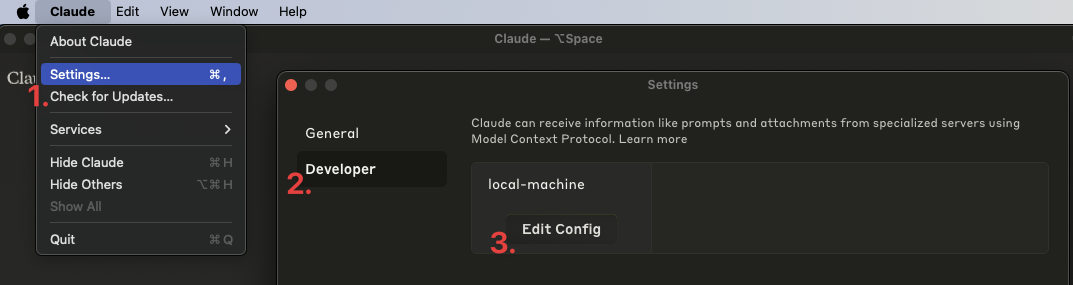
Add the following entry to your
claude_desktop_config.json:
{
  "mcpServers": {
    "aws": {
      "command": "npm", // OR pnpm
      "args": [
        "--silent",
        "--prefix",
        "/Users/<YOUR USERNAME>/aws-mcp",
        "start"
      ]
    }
  }
}
Important: Replace /Users/<YOUR USERNAME>/aws-mcp with the actual path to your project directory.
Restart Claude desktop app. You should see this:
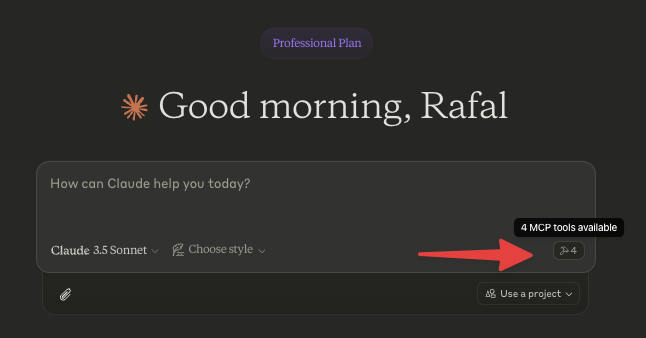
Start by selecting an AWS profile or jump to action by asking:
"List available AWS profiles"
"List all EC2 instances in my account"
"Show me S3 buckets with their sizes"
"What Lambda functions are deployed in us-east-1?"
"List all ECS clusters and their services"
Using with nvm
Build from source first and add following config:
{
  "mcpServers": {
    "aws": {
      "command": "/Users/<USERNAME>/.nvm/versions/node/v20.10.0/bin/node",
      "args": [
        "<WORKSPACE_PATH>/aws-mcp/node_modules/tsx/dist/cli.mjs",
        "<WORKSPACE_PATH>/aws-mcp/index.ts",
        "--prefix",
        "<WORKSPACE_PATH>/aws-mcp",
        "start"
      ]
    }
  }
}
Troubleshooting
To see logs:
tail -n 50 -f ~/Library/Logs/Claude/mcp-server-aws.log
# or
tail -n 50 -f ~/Library/Logs/Claude/mcp.log
Features in Development
MFA support
Cache SSO credentials to prevent from refreshing them too eagerly
Resources
Unclaimed servers have limited discoverability.
Looking for Admin?
If you are the server author, to access and configure the admin panel.