WebEvalAgent MCP Server
OfficialThe WebEvalAgent MCP Server enables autonomous testing, debugging, and evaluation of web applications directly in your code editor.
Key capabilities:
Navigate web applications: Drive and interact with your web app in an actual browser (2x faster with operative backend)
Evaluate UX/UI: Perform detailed evaluations based on specified tasks, providing observations, issues, and improvement recommendations
Autonomous debugging: Test and debug web application code to ensure it works as expected
Data collection: Capture screenshots, network traffic, console logs and errors for comprehensive analysis
Maintain state: Preserve browser state (cookies, local storage) across evaluation runs, eliminating repeated logins for authenticated testing
Generate reports: Create detailed summaries of steps taken, observations, console logs, network requests, and a chronological timeline
Provides operating system compatibility for running the WebEvalAgent MCP Server, enabling autonomous web app execution and debugging capabilities.
Click on "Deploy Server".
Wait a few minutes for the server to deploy. Once ready, it will show a "Started" state.
In the chat, type
@followed by the MCP server name and your instructions, e.g., "@WebEvalAgent MCP Server test my app at http://localhost:3000 with the task 'try the signup flow and report any UX issues'"
That's it! The server will respond to your query, and you can continue using it as needed.
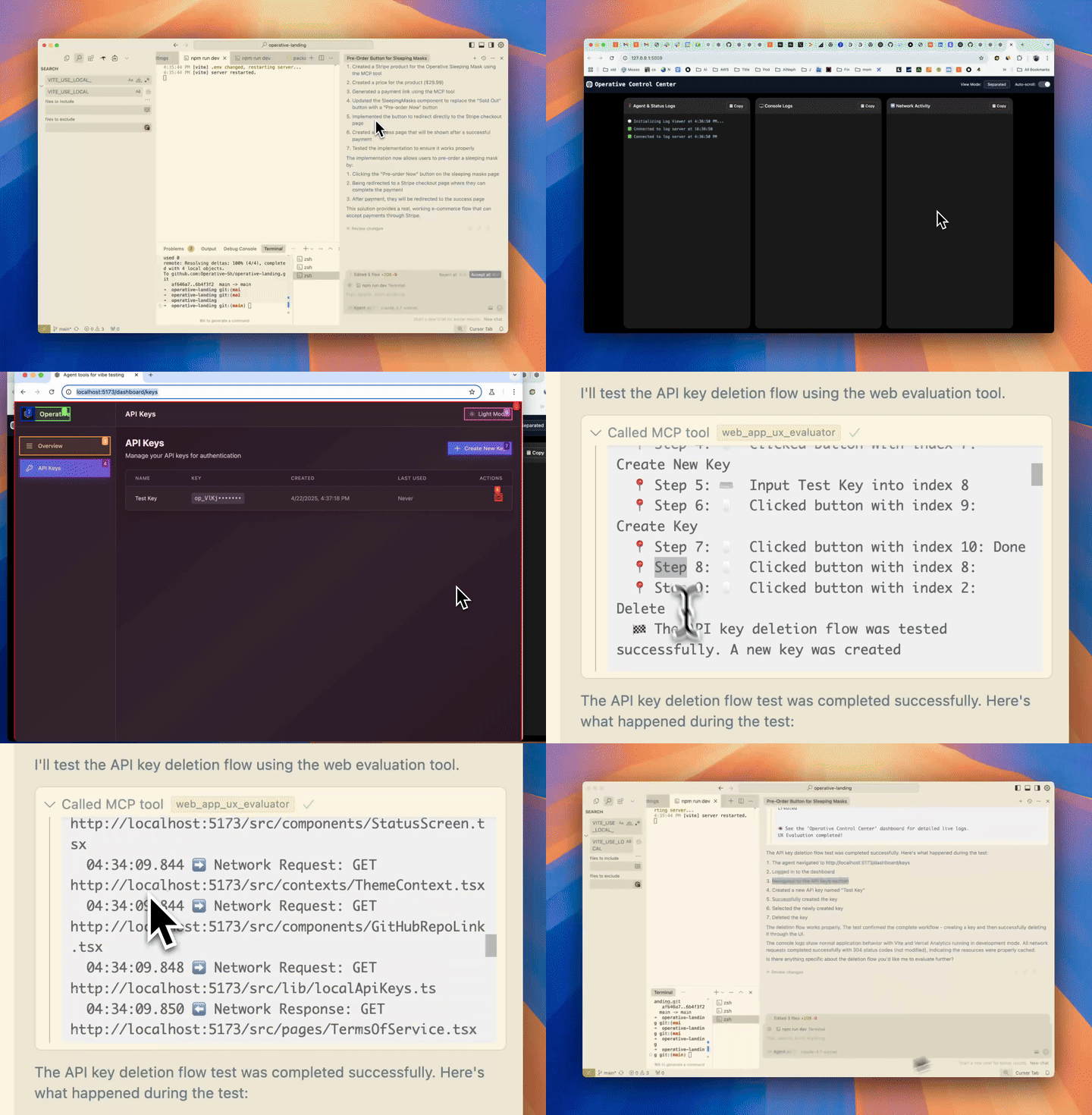
Here is a step-by-step guide with screenshots.
β οΈ PROJECT HAS BEEN SUNSET β οΈ
This project has been discontinued. We're building something new at withrefresh.com
π operative.sh web-eval-agent MCP Server
Let the coding agent debug itself, you've got better things to do.

Related MCP server: agnt
π₯ Supercharge Your Debugging
operative.sh's MCP Server launches a browser-use powered agent to autonomously execute and debug web apps directly in your code editor.
β‘ Features
π Navigate your webapp using BrowserUse (2x faster with operative backend)
π Capture network traffic - requests are intelligently filtered and returned into the context window
π¨ Collect console errors - captures logs & errors
π€ Autonomous debugging - the Cursor agent calls the web QA agent mcp server to test if the code it wrote works as epected end-to-end.
π§° MCP Tool Reference
Tool | Purpose |
| π€ Automated UX evaluator that drives the browser, captures screenshots, console & network logs, and returns a rich UX report. |
| π Opens an interactive (non-headless) browser so you can sign in once; the saved cookies/local-storage are reused by subsequent |
Key arguments
web_eval_agenturl(required) β address of the running app (e.g.http://localhost:3000)task(required) β natural-language description of what to test ("run through the signup flow and note any UX issues")headless_browser(optional, defaultfalse) β set totrueto hide the browser window
setup_browser_stateurl(optional) β page to open first (handy to land directly on a login screen)
You can trigger these tools straight from your IDE chat, for example:
Evaluate my app at http://localhost:3000 β run web_eval_agent with the task "Try the full signup flow and report UX issues".π Quick Start
Easy Setup with One-Click Integration
Get your API key (free) - when you create your API key, you'll see:
"Add to Cursor" button with a deeplink for instant Cursor installation
Prefilled Claude Code command with your API key automatically included
Manual Setup (macOS/Linux)
Pre-requisites (typically not needed):
brew:
/bin/bash -c "$(curl -fsSL https://raw.githubusercontent.com/Homebrew/install/HEAD/install.sh)"npm: (
brew install npm)jq:
brew install jq
Run the installer after getting an api key (free)
Installs playwright
Inserts JSON into your code editor (Cursor/Cline/Windsurf) for you!
curl -LSf https://operative.sh/install.sh -o install.sh && bash install.sh && rm install.shVisit your favorite IDE and restart to apply the changes
Send a prompt in chat mode to call the web eval agent tool! e.g.
Test my app on http://localhost:3000. Use web-eval-agent.π οΈ Manual Installation
Get your API key at operative.sh/mcp
curl -LsSf https://astral.sh/uv/install.sh | shSource environment variables after installing UV
Mac
source ~/.zshrcLinux
source ~/.bashrc Install playwright:
npm install -g chromium playwright && uvx --with playwright playwright install --with-depsAdd below JSON to your relevant code editor with api key
Restart your code editor
π Updating
uv cache cleanrefresh MCP server
"web-eval-agent": {
"command": "uvx",
"args": [
"--refresh-package",
"webEvalAgent",
"--from",
"git+https://github.com/Operative-Sh/web-eval-agent.git",
"webEvalAgent"
],
"env": {
"OPERATIVE_API_KEY": "<YOUR_KEY>"
}
}Operative Discord Server
π οΈ Manual Installation (Mac + Cursor/Cline/Windsurf)
Get your API key at operative.sh/mcp
curl -LsSf https://astral.sh/uv/install.sh | sh)Install playwright:
npm install -g chromium playwright && uvx --with playwright playwright install --with-depsAdd below JSON to your relevant code editor with api key
Restart your code editor
Manual Installation (Windows + Cursor/Cline/Windsurf)
We're refining this, please open an issue if you have any issues!
Do all this in your code editor terminal
curl -LSf https://operative.sh/install.sh -o install.sh && bash install.sh && rm install.shGet your API key at operative.sh/mcp
Install uv
(curl -LsSf https://astral.sh/uv/install.sh | sh)uvx --from git+https://github.com/Operative-Sh/web-eval-agent.git playwright installRestart code editor
π¨ Issues
Updates aren't being received in code editors, update or reinstall for latest version: Run
uv cache cleanfor latestAny issues feel free to open an Issue on this repo or in the discord!
5/5 - static apps without changes weren't screencasting, fixed!
uv clean+ restart to get fix
Changelog
4/29 - Agent overlay update - pause/play/stop agent run in the browser
π Example MCP Server Output Report
π Web Evaluation Report for http://localhost:5173 complete!
π Task: Test the API-key deletion flow by navigating to the API Keys section, deleting a key, and judging the UX.
π Agent Steps
π 1. Navigate β http://localhost:5173
π 2. Click "Login" (button index 2)
π 3. Click "API Keys" (button index 4)
π 4. Click "Create Key" (button index 9)
π 5. Type "Test API Key" (input index 2)
π 6. Click "Done" (button index 3)
π 7. Click "Delete" (button index 10)
π 8. Click "Delete" (confirm index 3)
π Flow tested successfully β UX felt smooth and intuitive.
π₯οΈ Console Logs (10)
1. [debug] [vite] connectingβ¦
2. [debug] [vite] connected.
3. [info] Download the React DevTools β¦
β¦
π Network Requests (10)
1. GET /src/pages/SleepingMasks.tsx 304
2. GET /src/pages/MCPRegistryRegistry.tsx 304
β¦
β±οΈ Chronological Timeline
01:16:23.293 π₯οΈ Console [debug] [vite] connectingβ¦
01:16:23.303 π₯οΈ Console [debug] [vite] connected.
01:16:23.312 β‘οΈ GET /src/pages/SleepingMasks.tsx
01:16:23.318 β¬
οΈ 304 /src/pages/SleepingMasks.tsx
β¦
01:17:45.038 π€ π Flow finished β deletion verified
01:17:47.038 π€ π Conclusion repeated above
ποΈ See the "Operative Control Center" dashboard for live logs.Star History
Built with <3 @ operative.sh
Available Tools
2 toolssetup_browser_stateA
Sets up and saves browser state for future use.
This tool should only be called in one scenario:
The user explicitly requests to set up browser state/authentication
Launches a non-headless browser for user interaction, allows login/authentication, and saves the browser state (cookies, local storage, etc.) to a local file.
Args: url: Optional URL to navigate to upon opening the browser. ctx: The MCP context (used for progress reporting, not directly here).
Returns: list[TextContent]: Confirmation of state saving or error messages.
Inputs: url.
web_eval_agentA
Evaluate the user experience / interface of a web application.
This tool allows the AI to assess the quality of user experience and interface design of a web application by performing specific tasks and analyzing the interaction flow.
Before this tool is used, the web application should already be running locally on a port.
Args: url: Required. The localhost URL of the web application to evaluate, including the port number. Example: http://localhost:3000, http://localhost:8080, http://localhost:4200, http://localhost:5173, etc. Try to avoid using the path segments of the URL, and instead use the root URL. task: Required. The specific UX/UI aspect to test (e.g., "test the checkout flow", "evaluate the navigation menu usability", "check form validation feedback") Be as detailed as possible in your task description. It could be anywhere from 2 sentences to 2 paragraphs. headless_browser: Optional. Whether to hide the browser window popup during evaluation. If headless_browser is True, only the operative control center browser will show, and no popup browser will be shown.
Returns: list[list[TextContent, ImageContent]]: A detailed evaluation of the web application's UX/UI, including observations, issues found, and recommendations for improvement and screenshots of the web application during the evaluation
Inputs: url (required), task (required), headless_browser.
Tool Schema Changelog
Recent tool additions, removals, and schema changes observed during successful MCP inspections.
Loading tool schema changelogβ¦
TDQS
Scored across 2 tools
The two tools have completely distinct purposes with no overlap. setup_browser_state handles browser authentication and state saving, while web_eval_agent performs UX/UI evaluation of web applications. An agent would never confuse these tools as they serve different phases of the workflow.
Both tools follow a consistent verb_noun pattern with snake_case naming. setup_browser_state and web_eval_agent use clear action-oriented verbs followed by descriptive nouns, creating a predictable naming convention throughout the server.
With only 2 tools, this server feels severely under-equipped for its apparent purpose of web evaluation. A comprehensive web evaluation system would typically need tools for navigation, interaction simulation, accessibility testing, performance measurement, and result analysis beyond just setup and evaluation.
The tool surface is severely incomplete for web evaluation. While setup and evaluation are covered, there are significant gaps: no tools for configuring evaluation parameters, managing browser sessions, analyzing results programmatically, testing specific components, or handling different evaluation methodologies. The server provides only basic endpoints without supporting the full evaluation workflow.
Maintenance
Related MCP Connectors
Browser-based QA for AI-built software. Test pages with real browsers via agents.
AI-powered web automation. Navigate websites using AI agents for one page or a thousand
Autonomous cloud agent tasks: real browser + your tools, structured evidence-backed results.
Related MCP Servers
- AlicenseNot gradedqualityCmaintenanceEnables AI assistants to debug frontend applications by providing direct access to browser DevTools, React state, DOM inspection, and runtime debugging capabilities. Bridges the gap between AI and complex web applications for autonomous debugging and issue resolution.1MIT
- AlicenseNot gradedqualityBmaintenanceBridges AI coding agents with the browser to provide visual debugging, real-time error capture, screenshot capabilities, DOM inspection, and interactive wireframing through a reverse proxy with injected developer tools.53 npm22Apache 2.0
- FlicenseNot gradedqualityDmaintenanceEnables AI agents to automate and debug real Chromium browsers with capabilities like screenshots, video recording, performance analysis, visual regression testing, and OCR text extraction.13-
- AlicenseNot gradedqualityDmaintenanceEnables AI coding agents to access live console logs, errors, and network requests from web applications via a local WebSocket connection, without copying data to chat.9 npm19MIT
Appeared in Searches
- Tools for enabling LLMs to interact with web pages and perform end-to-end testing
- IDE extensions and AI coding assistants like GitHub Copilot and ChatGPT
- Browser automation and control for Codex CLI
- MCP servers for curated context in Cursor IDE to plan, debug, and iterate on features
- Web page automation tools for form submission and queries