
-
licenseNot graded
qualityA
maintenanceMCP Server for the Google Maps API.
11,868 npm
91,276
MIT

Mapbox API 用の MCP サーバー。
mapbox_directions
座標間の道順を取得する
入力:
coordinates ({緯度: 数値, 経度: 数値}[])
profile (オプション): 「運転中の交通」、「運転」、「歩行」、「サイクリング」
返される値: 歩数、距離、所要時間を含むルートの詳細
mapbox_directions_by_places
場所の名前を使って場所間の道順を取得します
入力:
places (string[]): 地名の配列
profile (オプション): 「運転中の交通」、「運転」、「歩行」、「サイクリング」
language (オプション): 2文字の言語コード(例:「zh」、「en」)
戻り値:
各場所のジオコーディング結果
歩数、距離、所要時間を含むルートの詳細
処理中に発生したエラー
mapbox_matrix
座標間の移動時間と距離行列を計算する
入力:
coordinates ({緯度: 数値, 経度: 数値}[])
profile (オプション):「運転」、「徒歩」、「サイクリング」
annotations (オプション): 「duration」、「distance」、「duration,distance」
sources (オプション): ソース座標のインデックス
destinations (オプション): 目的地の座標のインデックス
戻り値: 点間の期間および/または距離の行列
mapbox_matrix_by_places
場所の名前を使用して、場所間の移動時間と距離のマトリックスを計算します
入力:
places (string[]): 地名の配列(2~25か所)
profile (オプション):「運転」、「徒歩」、「サイクリング」
annotations (オプション): 「duration」、「distance」、「duration,distance」
language (オプション): 2文字の言語コード
sources (オプション): ソースの場所のインデックス
destinations (オプション): 目的地のインデックス
戻り値:
各場所のジオコーディング結果
期間および/または距離のマトリックス
処理中に発生したエラー
mapbox_geocoding
場所を検索し、住所を座標に変換する
入力:
searchText (文字列): 検索する場所または住所
limit (オプション): 結果の最大数 (1-10)
types (オプション):場所の種類(国、地域、場所など)でフィルタリングします。
language (オプション): 2文字の言語コード
fuzzyMatch (オプション): あいまい一致を有効/無効にする
戻り値: 座標やプロパティを含む詳細な位置情報
Related MCP server: Overture Maps MCP
この構成を Claude Desktop 構成ファイル (通常は~/Library/Application Support/Claude/claude_desktop_config.jsonにあります) に追加します。
{
  "mcpServers": {
    "mapbox-mcp-server": {
      "command": "node",
      "args": ["/absolute/path/to/mapbox-mcp-server/build/index.js"],
      "env": {
        "MAPBOX_ACCESS_TOKEN": "your-api-key"
      }
    }
  }
}Node.js 16以上
TypeScript 4.5以上
有効なMapbox APIキー
ここの指示に従って Mapbox API キーを取得します。
API キーを環境変数として設定します。
export MAPBOX_ACCESS_TOKEN=your_api_key_hereDirections API: 1 分あたり 300 リクエスト
マトリックスAPI:
運転/歩行/自転車で1分あたり60件のリクエスト
運転中の交通量に対する1分あたり30件のリクエスト
ジオコーディング API: 1 分あたり 600 リクエスト
mapbox-mcp-server では、次の構造を使用してサーバーのハンドラーを管理します。
src/server/handlers/base.ts : すべてのハンドラーの基本クラス
src/server/registry.ts : すべてのハンドラーのレジストリ
src/server/main.ts : サーバーのメインエントリポイント
各機能モジュールは次の構造に従います。
src/
├── types/          # Type definitions
├── schemas/        # Zod schemas for validation
├── tools/
│   ├── definitions/  # Tool definitions
│   └── handlers/     # Tool implementations
└── server/
└── handlers/ # Handler classesクラス図: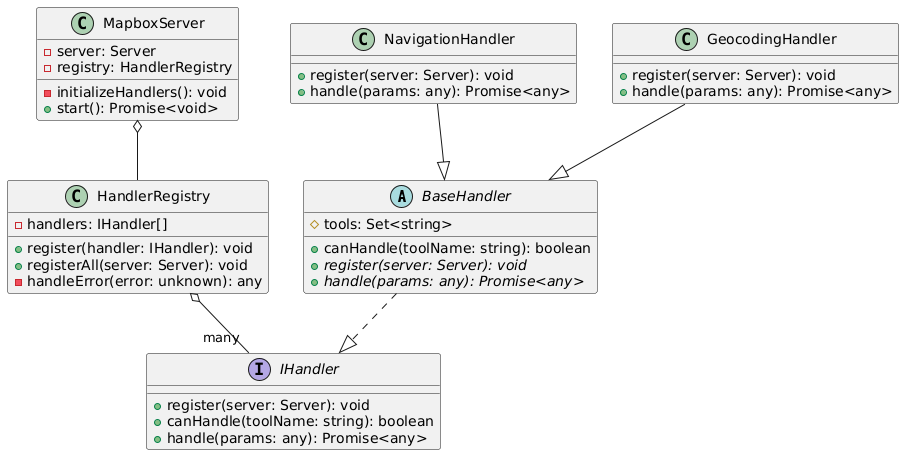
プロセス図:
すべてのツールは包括的なエラー処理を実装しています。
入力検証エラー
APIリクエストの失敗
レート制限エラー
サービス固有のエラー(例:ルートが見つからない、座標が無効)
このMCPサーバーはMITライセンスに基づいてライセンスされています。つまり、MITライセンスの条件に従って、ソフトウェアを自由に使用、改変、配布することができます。詳細については、プロジェクトリポジトリのLICENSEファイルをご覧ください。
Get navigation route between two points
| Name | Required | Description | Default |
|---|---|---|---|
| coordinates | Yes | Array of coordinates | |
| profile | No | Navigation mode | driving-traffic |
Does the description disclose side effects, auth requirements, rate limits, or destructive behavior?
With no annotations provided, the description carries full burden for behavioral disclosure. While 'Get navigation route' implies a read-only operation, it doesn't address authentication requirements, rate limits, error conditions, response format, or whether this is a real-time vs. cached service. The description provides minimal behavioral context beyond the basic operation.
Agents need to know what a tool does to the world before calling it. Descriptions should go beyond structured annotations to explain consequences.
Is the description appropriately sized, front-loaded, and free of redundancy?
The description is extremely concise at just 5 words, front-loading the core purpose without any wasted language. Every word earns its place in communicating the essential function.
Shorter descriptions cost fewer tokens and are easier for agents to parse. Every sentence should earn its place.
Given the tool's complexity, does the description cover enough for an agent to succeed on first attempt?
For a navigation API tool with no annotations and no output schema, the description is insufficient. It doesn't explain what a 'navigation route' includes (distance, duration, steps, geometry), error handling, authentication needs, or how results differ from sibling tools. The minimal description leaves too many contextual gaps for effective agent use.
Complex tools with many parameters or behaviors need more documentation. Simple tools need less. This dimension scales expectations accordingly.
Does the description clarify parameter syntax, constraints, interactions, or defaults beyond what the schema provides?
With 100% schema description coverage, the schema already documents both parameters thoroughly. The description adds no additional parameter semantics beyond what's in the schema - it doesn't explain coordinate ordering (origin to destination), minimum/maximum points, or practical usage of the profile parameter. This meets the baseline for high schema coverage.
Input schemas describe structure but not intent. Descriptions should explain non-obvious parameter relationships and valid value ranges.
Does the description clearly state what the tool does and how it differs from similar tools?
The description clearly states the verb ('Get') and resource ('navigation route between two points'), making the purpose immediately understandable. However, it doesn't differentiate this tool from its sibling 'mapbox_directions_by_places', which likely serves a similar purpose with different input parameters.
Agents choose between tools based on descriptions. A clear purpose with a specific verb and resource helps agents select the right tool.
Does the description explain when to use this tool, when not to, or what alternatives exist?
The description provides no guidance on when to use this tool versus alternatives. With sibling tools like 'mapbox_directions_by_places', 'mapbox_geocoding', and 'mapbox_matrix' available, there's no indication of when this coordinate-based directions tool is preferred over place-based or matrix alternatives.
Agents often have multiple tools that could apply. Explicit usage guidance like "use X instead of Y when Z" prevents misuse.
Get navigation route between multiple places using their names
| Name | Required | Description | Default |
|---|---|---|---|
| places | Yes | Array of place names to route between | |
| profile | No | Navigation mode | driving |
| language | No | Language for geocoding results |
Does the description disclose side effects, auth requirements, rate limits, or destructive behavior?
With no annotations provided, the description carries full burden for behavioral disclosure but offers minimal information. It mentions geocoding ('using their names') which implies place name resolution, but doesn't disclose rate limits, authentication needs, error handling, or what the route output includes (e.g., distance, duration, geometry). For a navigation tool with zero annotation coverage, this is inadequate.
Agents need to know what a tool does to the world before calling it. Descriptions should go beyond structured annotations to explain consequences.
Is the description appropriately sized, front-loaded, and free of redundancy?
The description is a single, efficient sentence that directly states the tool's purpose without unnecessary words. It's appropriately sized and front-loaded, with every word contributing to understanding the core functionality.
Shorter descriptions cost fewer tokens and are easier for agents to parse. Every sentence should earn its place.
Given the tool's complexity, does the description cover enough for an agent to succeed on first attempt?
For a navigation routing tool with no annotations and no output schema, the description is incomplete. It doesn't explain what the route output contains (e.g., waypoints, instructions, polyline), performance characteristics, or common failure modes. The geocoding aspect is hinted at but not elaborated, leaving significant gaps for agent understanding.
Complex tools with many parameters or behaviors need more documentation. Simple tools need less. This dimension scales expectations accordingly.
Does the description clarify parameter syntax, constraints, interactions, or defaults beyond what the schema provides?
Schema description coverage is 100%, so the schema fully documents all three parameters. The description adds no additional parameter semantics beyond implying that 'places' are resolved via geocoding. Since the schema does the heavy lifting, the baseline score of 3 is appropriate.
Input schemas describe structure but not intent. Descriptions should explain non-obvious parameter relationships and valid value ranges.
Does the description clearly state what the tool does and how it differs from similar tools?
The description clearly states the action ('Get navigation route') and resource ('between multiple places using their names'), making the purpose understandable. However, it doesn't explicitly differentiate from sibling tools like 'mapbox_directions' or 'mapbox_matrix_by_places', which likely have overlapping functionality with different input approaches.
Agents choose between tools based on descriptions. A clear purpose with a specific verb and resource helps agents select the right tool.
Does the description explain when to use this tool, when not to, or what alternatives exist?
The description provides no guidance on when to use this tool versus alternatives like 'mapbox_directions' (which might use coordinates instead of place names) or 'mapbox_matrix_by_places' (which might handle multiple routes). There's no mention of prerequisites, limitations, or typical use cases beyond the basic functionality.
Agents often have multiple tools that could apply. Explicit usage guidance like "use X instead of Y when Z" prevents misuse.
Search for places and convert addresses into coordinates
| Name | Required | Description | Default |
|---|---|---|---|
| searchText | Yes | The search text to geocode | |
| limit | No | Limit the number of results | |
| types | No | Filter results by feature types | |
| language | No | Language of the search results | |
| fuzzyMatch | No | Enable/disable fuzzy matching |
Does the description disclose side effects, auth requirements, rate limits, or destructive behavior?
With no annotations provided, the description carries the full burden of behavioral disclosure. It mentions the core functionality but omits critical details such as rate limits, authentication requirements, error handling, response format, or whether this is a read-only operation. For a geocoding tool with external API dependencies, this is a significant gap.
Agents need to know what a tool does to the world before calling it. Descriptions should go beyond structured annotations to explain consequences.
Is the description appropriately sized, front-loaded, and free of redundancy?
The description is extremely concise (one sentence) and front-loaded with the core purpose. Every word earns its place, with no redundant or unnecessary information, making it easy for an agent to parse quickly.
Shorter descriptions cost fewer tokens and are easier for agents to parse. Every sentence should earn its place.
Given the tool's complexity, does the description cover enough for an agent to succeed on first attempt?
Given the tool's complexity (geocoding with 5 parameters), lack of annotations, and no output schema, the description is incomplete. It doesn't address behavioral aspects like API constraints, response structure, or error conditions, which are essential for proper tool invocation in a real-world context.
Complex tools with many parameters or behaviors need more documentation. Simple tools need less. This dimension scales expectations accordingly.
Does the description clarify parameter syntax, constraints, interactions, or defaults beyond what the schema provides?
The schema description coverage is 100%, providing clear documentation for all 5 parameters. The description adds no additional parameter semantics beyond what's in the schema, so it meets the baseline score of 3. It doesn't explain how parameters interact or provide usage examples.
Input schemas describe structure but not intent. Descriptions should explain non-obvious parameter relationships and valid value ranges.
Does the description clearly state what the tool does and how it differs from similar tools?
The description clearly states the tool's purpose with specific verbs ('Search for places' and 'convert addresses into coordinates') and identifies the resource (geographic data). It distinguishes from sibling tools by focusing on geocoding rather than directions or matrix calculations, though it doesn't explicitly name those alternatives.
Agents choose between tools based on descriptions. A clear purpose with a specific verb and resource helps agents select the right tool.
Does the description explain when to use this tool, when not to, or what alternatives exist?
The description provides no guidance on when to use this tool versus the sibling tools (mapbox_directions, mapbox_directions_by_places, mapbox_matrix, mapbox_matrix_by_places). It doesn't mention use cases, prerequisites, or exclusions, leaving the agent to infer usage from the purpose alone.
Agents often have multiple tools that could apply. Explicit usage guidance like "use X instead of Y when Z" prevents misuse.
Calculate travel time and distance matrices between coordinates
| Name | Required | Description | Default |
|---|---|---|---|
| coordinates | Yes | Array of coordinates | |
| profile | No | Navigation mode | driving |
| annotations | No | Type of matrix to return | duration,distance |
| approaches | No | Approaches to coordinates | |
| bearings | No | Bearings for coordinates | |
| sources | No | Indices of source coordinates | |
| destinations | No | Indices of destination coordinates | |
| fallback_speed | No | Speed for direct path calculation when no route exists | |
| depart_at | No | Departure time in ISO 8601 format |
Does the description disclose side effects, auth requirements, rate limits, or destructive behavior?
With no annotations provided, the description carries the full burden of behavioral disclosure. It mentions what the tool does but fails to describe critical behaviors such as rate limits, authentication requirements, error handling, or output format. For a tool with 9 parameters and no output schema, this leaves significant gaps in understanding its operation.
Agents need to know what a tool does to the world before calling it. Descriptions should go beyond structured annotations to explain consequences.
Is the description appropriately sized, front-loaded, and free of redundancy?
The description is a single, efficient sentence that directly states the tool's function without unnecessary words. It's appropriately sized and front-loaded, making it easy to understand at a glance.
Shorter descriptions cost fewer tokens and are easier for agents to parse. Every sentence should earn its place.
Given the tool's complexity, does the description cover enough for an agent to succeed on first attempt?
Given the complexity (9 parameters, no annotations, no output schema), the description is insufficient. It doesn't explain the return values, error conditions, or practical usage scenarios. For a matrix calculation tool with multiple configuration options, more context is needed to guide effective use.
Complex tools with many parameters or behaviors need more documentation. Simple tools need less. This dimension scales expectations accordingly.
Does the description clarify parameter syntax, constraints, interactions, or defaults beyond what the schema provides?
Schema description coverage is 100%, so the schema already documents all parameters thoroughly. The description doesn't add any meaningful semantic context beyond what the schema provides, such as explaining relationships between parameters or typical use cases. The baseline score of 3 reflects adequate but minimal value addition.
Input schemas describe structure but not intent. Descriptions should explain non-obvious parameter relationships and valid value ranges.
Does the description clearly state what the tool does and how it differs from similar tools?
The description clearly states the verb ('calculate') and resource ('travel time and distance matrices between coordinates'), providing a specific purpose. However, it doesn't differentiate from sibling tools like 'mapbox_matrix_by_places', which likely serves a similar function with different input types.
Agents choose between tools based on descriptions. A clear purpose with a specific verb and resource helps agents select the right tool.
Does the description explain when to use this tool, when not to, or what alternatives exist?
No guidance is provided on when to use this tool versus alternatives like 'mapbox_matrix_by_places' or other sibling tools. The description lacks context about use cases, prerequisites, or exclusions, offering only a basic functional statement.
Agents often have multiple tools that could apply. Explicit usage guidance like "use X instead of Y when Z" prevents misuse.
Calculate travel time and distance matrices between places using their names
| Name | Required | Description | Default |
|---|---|---|---|
| places | Yes | Array of place names | |
| profile | No | Navigation mode | driving |
| annotations | No | Type of matrix to return | duration,distance |
| language | No | Language for geocoding results | |
| sources | No | Indices of source places | |
| destinations | No | Indices of destination places | |
| fallback_speed | No | Speed for direct path calculation when no route exists | |
| depart_at | No | Departure time in ISO 8601 format |
Does the description disclose side effects, auth requirements, rate limits, or destructive behavior?
With no annotations provided, the description carries the full burden of behavioral disclosure. It mentions what the tool does but doesn't describe important behavioral traits: whether it requires authentication, rate limits, what happens when place names are ambiguous, error handling, or the format of returned matrices. For a complex tool with 8 parameters, this is a significant gap.
Agents need to know what a tool does to the world before calling it. Descriptions should go beyond structured annotations to explain consequences.
Is the description appropriately sized, front-loaded, and free of redundancy?
The description is a single, efficient sentence that clearly states the tool's core functionality. It's appropriately sized and front-loaded with the essential information. There's no wasted verbiage or unnecessary elaboration.
Shorter descriptions cost fewer tokens and are easier for agents to parse. Every sentence should earn its place.
Given the tool's complexity, does the description cover enough for an agent to succeed on first attempt?
For a complex matrix calculation tool with 8 parameters, no annotations, and no output schema, the description is insufficient. It doesn't explain what the output looks like (matrix format), doesn't mention authentication requirements, doesn't discuss rate limits or costs, and doesn't provide context about when this tool is appropriate versus alternatives. The description should do more given the tool's complexity.
Complex tools with many parameters or behaviors need more documentation. Simple tools need less. This dimension scales expectations accordingly.
Does the description clarify parameter syntax, constraints, interactions, or defaults beyond what the schema provides?
Schema description coverage is 100%, so the schema already documents all 8 parameters thoroughly. The description adds minimal value beyond the schema - it mentions 'using their names' which hints at the 'places' parameter, but doesn't provide additional context about parameter interactions or usage patterns. Baseline 3 is appropriate when the schema does the heavy lifting.
Input schemas describe structure but not intent. Descriptions should explain non-obvious parameter relationships and valid value ranges.
Does the description clearly state what the tool does and how it differs from similar tools?
The description clearly states the tool's purpose: 'Calculate travel time and distance matrices between places using their names.' It specifies the verb ('calculate'), resource ('travel time and distance matrices'), and method ('using their names'). However, it doesn't explicitly differentiate from sibling tools like 'mapbox_matrix' (which likely uses coordinates rather than place names).
Agents choose between tools based on descriptions. A clear purpose with a specific verb and resource helps agents select the right tool.
Does the description explain when to use this tool, when not to, or what alternatives exist?
The description provides no guidance on when to use this tool versus alternatives. It doesn't mention sibling tools like 'mapbox_matrix' (which might use coordinates instead of place names) or 'mapbox_directions_by_places' (which might provide route details rather than matrices). There's no context about appropriate use cases or exclusions.
Agents often have multiple tools that could apply. Explicit usage guidance like "use X instead of Y when Z" prevents misuse.
Recent tool additions, removals, and schema changes observed during successful MCP inspections.
v1.0.0mapbox_directionsmapbox_directions_by_placesmapbox_geocodingmapbox_matrixmapbox_matrix_by_placesScored across 5 tools
The tools are mostly distinct, with clear purposes like routing, geocoding, and matrix calculations. However, the two directions tools (mapbox_directions and mapbox_directions_by_places) and two matrix tools (mapbox_matrix and mapbox_matrix_by_places) could cause minor confusion as they overlap in functionality but differ in input types (coordinates vs. place names). Descriptions help clarify this distinction.
All tool names follow a consistent 'mapbox_' prefix with descriptive suffixes (e.g., directions, geocoding, matrix), using snake_case uniformly. The naming pattern is predictable and readable, making it easy for agents to understand the tool's purpose at a glance.
With 5 tools, the server is well-scoped for its mapping and navigation domain. Each tool serves a distinct function (e.g., routing, geocoding, matrix calculations), and the count is neither too sparse nor overwhelming, fitting typical use cases effectively.
The tool set covers core mapping operations like routing, geocoding, and travel time calculations, with good coverage for the domain. A minor gap might be the lack of tools for additional Mapbox services (e.g., static maps or spatial analysis), but the provided tools enable key workflows without significant dead ends.
The official MCP Server for the Mux API
MCP server for the Seline Analytics API