
A
licenseNot graded
qualityD
maintenanceA Model Context Protocol server that downloads watermark-free videos from Douyin (TikTok China) share links, extracts audio, and transcribes speech to text using ASR APIs.
29 PyPI
2
MIT

The douyin-mcp-server downloads watermark-free videos from Douyin (Chinese TikTok) share links and extracts AI-generated transcripts from the audio content.
Core Features:
Parse Video Information - Extract metadata (title, ID) from share links without requiring an API key
Download Watermark-Free Videos - Obtain high-quality video download URLs without watermarks
AI Speech-to-Text Transcription - Automatically transcribe video audio using SenseVoice/Paraformer models (requires DASHSCOPE_API_KEY)
Handle Large Files - Automatically segments audio files longer than 1 hour or larger than 50MB for processing
Access Methods:
WebUI browser interface for easy interaction
MCP integration with Claude Desktop for direct tool calls
Command-line interface for developers and batch processing
Output Options:
Export transcripts as Markdown files with formatted metadata (video ID, timestamp, download links)
Configure API keys via WebUI or environment variables
Extracts audio from downloaded Douyin videos, enabling the conversion of video content to audio format for text transcription.
Supports repository access for development and contribution purposes, allowing users to clone the source code and submit issues or pull requests.
Click on "Deploy Server".
Wait a few minutes for the server to deploy. Once ready, it will show a "Started" state.
In the chat, type @ followed by the MCP server name and your instructions, e.g., "@douyin-mcp-server extract text from this Douyin video: https://v.douyin.com/example123"
That's it! The server will respond to your query, and you can continue using it as needed.
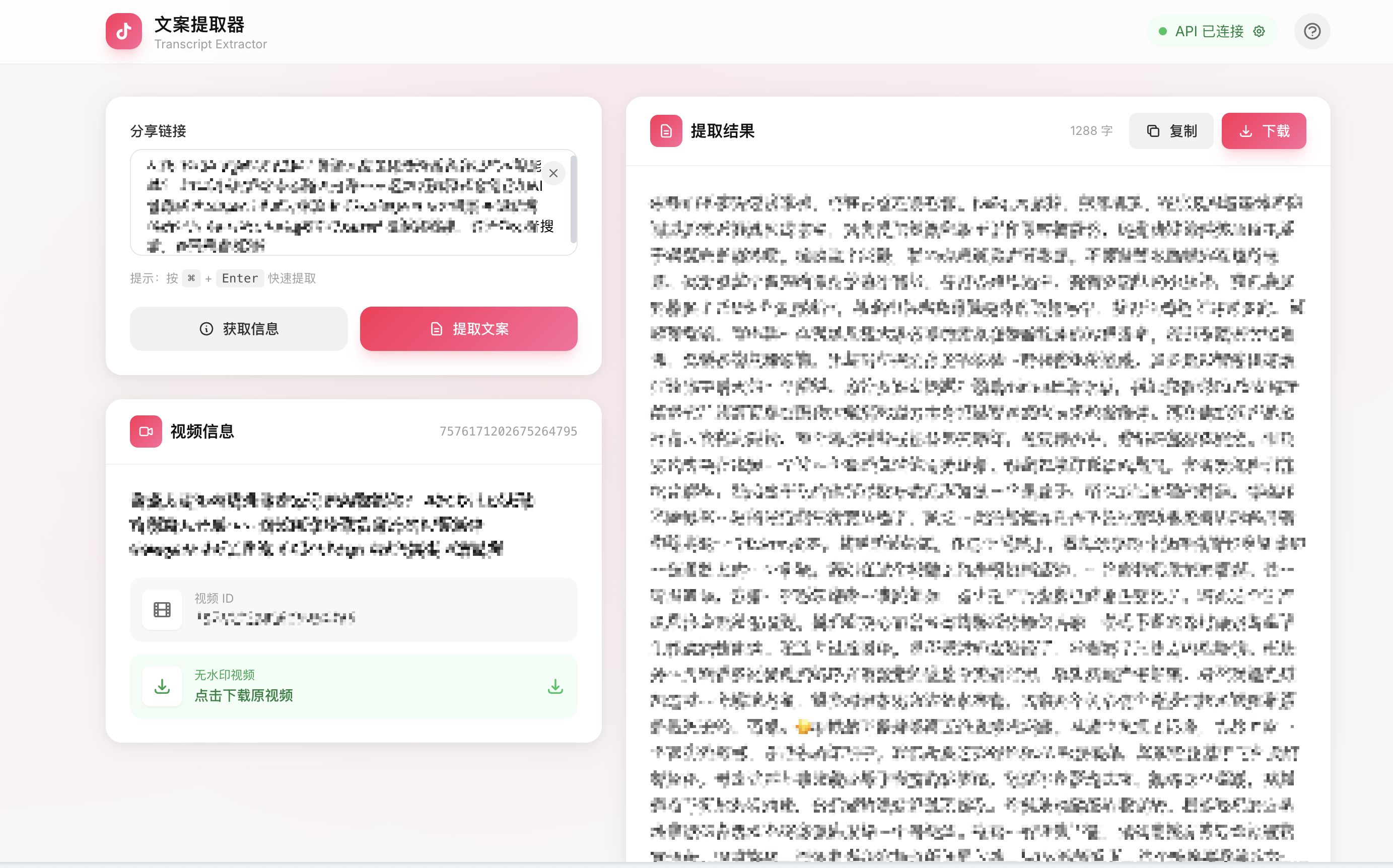
Here is a step-by-step guide with screenshots.



从短视频分享链接下载无水印视频,AI 自动提取语音文案。
🎬 无水印视频 - 获取高质量无水印视频下载链接
🎙️ AI 语音识别 - 使用硅基流动 SenseVoice 自动提取文案
📑 大文件支持 - 自动分段处理超过 1 小时或 50MB 的音频
🌐 WebUI - 现代化浏览器界面,无需命令行
🔌 MCP 集成 - 支持 Claude Desktop 等 AI 应用
Related MCP server: video-studio-mcp
方式 | 适用场景 | 特点 |
普通用户 | 浏览器操作,最简单 | |
Claude Desktop 用户 | AI 对话中直接调用 | |
开发者 | 批量处理,脚本集成 |
最简单的使用方式,打开浏览器即可使用。
# 1. 克隆项目
git clone https://github.com/yzfly/douyin-mcp-server.git
cd douyin-mcp-server

# 2. 安装依赖
uv sync

# 3. 启动服务
uv run python web/app.py
打开浏览器访问 http://localhost:8080
有两种方式配置 API Key:
方式一:浏览器内配置(推荐)
打开 WebUI 页面
点击顶部的「API 未配置」按钮
在弹窗中输入 API Key 并保存
API Key 保存在浏览器本地,刷新页面后仍有效
方式二:环境变量
export API_KEY="sk-xxxxxxxxxxxxxxxx"
uv run python web/app.py
💡 获取免费 API Key:硅基流动(新用户有免费额度)
操作 | 说明 | 需要 API |
获取信息 | 解析视频标题、ID,获取无水印下载链接 | ❌ |
提取文案 | 下载视频 → 提取音频 → AI 语音识别 | ✅ |
下载视频 | 点击下载链接保存无水印视频 | ❌ |
复制/下载文案 | 一键复制或下载 Markdown 格式文案 | - |
粘贴链接 - 将分享链接粘贴到输入框
点击按钮 - 选择「获取信息」或「提取文案」
查看结果 - 右侧显示视频信息和提取的文案
导出 - 复制文案或下载 Markdown 文件
在 Claude Desktop、Cherry Studio 等支持 MCP 的应用中使用。
编辑 MCP 配置文件,添加:
{
  "mcpServers": {
    "douyin-mcp": {
      "command": "uvx",
      "args": ["douyin-mcp-server"],
      "env": {
        "API_KEY": "sk-xxxxxxxxxxxxxxxx"
      }
    }
  }
}
💡
API_KEY填写硅基流动的密钥。也兼容旧版配置:设置DASHSCOPE_API_KEY(阿里云百炼密钥)同样可用,两者设其一即可。
工具名 | 功能 | 需要 API |
| 解析视频信息 | ❌ |
| 获取下载链接 | ❌ |
| 提取视频文案 | ✅ |
| 识别本地音频文件 | ✅ (百炼) |
| 识别在线音频链接 | ✅ (百炼) |
用户:帮我提取这个视频的文案 https://v.douyin.com/xxxxx/

Claude:我来帮你提取视频文案...
[调用 extract_douyin_text 工具]
提取完成,文案内容如下:
...适合开发者和批量处理场景。
git clone https://github.com/yzfly/douyin-mcp-server.git
cd douyin-mcp-server
uv sync# 查看帮助
uv run python douyin-video/scripts/douyin_downloader.py --help
# 获取视频信息(无需 API)
uv run python douyin-video/scripts/douyin_downloader.py -l "分享链接" -a info
# 下载无水印视频
uv run python douyin-video/scripts/douyin_downloader.py -l "分享链接" -a download -o ./videos
# 提取文案(需要 API_KEY)
export API_KEY="sk-xxx"
uv run python douyin-video/scripts/douyin_downloader.py -l "分享链接" -a extract -o ./output
# 提取文案并保存视频
uv run python douyin-video/scripts/douyin_downloader.py -l "分享链接" -a extract -o ./output --save-videooutput/
└── 7600361826030865707/
├── transcript.md # 文案文件
└── *.mp4 # 视频文件(可选)transcript.md 内容:
# 视频标题

| 属性 | 值 |
|------|-----|
| 视频ID | `7600361826030865707` |
| 提取时间 | 2026-01-30 14:19:00 |
| 下载链接 | [点击下载](url) |

---

## 文案内容

这里是 AI 识别的语音文案...依赖 | 说明 | 安装方式 |
uv | Python 包管理 |
|
Python | 3.10+ |
|
FFmpeg | 音视频处理 |
|
当音频文件超过 API 限制时(1 小时或 50MB),自动执行:
检测音频时长和文件大小
使用 FFmpeg 分割成 9 分钟的片段
逐段调用 API 转录
合并所有文本结果
语音识别使用 硅基流动 SenseVoice API:
模型:FunAudioLLM/SenseVoiceSmall
限制:单次最大 1 小时 / 50MB(已自动处理)
费用:新用户有免费额度
🔧 MCP Server 修复 - API_KEY 现在正确对应硅基流动密钥,与文档一致;同时兼容旧版 DASHSCOPE_API_KEY 配置
♻️ 恢复工具 - 恢复 recognize_audio_file / recognize_audio_url 工具及 extract_douyin_text 的 context 参数
🛡️ WebUI 安全加固 - 下载接口不再代理任意 URL,默认仅监听本机
⚡ WebUI 性能 - 提取文案不再阻塞其他请求
📦 依赖精简 - WebUI 依赖改为可选安装(pip install "douyin-mcp-server[web]")
🌐 WebUI - 新增浏览器可视化界面
🔑 浏览器配置 API Key - 无需环境变量
📑 大文件支持 - 自动分段处理长音频
✨ Claude Code Skill 支持
📄 Markdown 格式输出
🔄 API 升级
🎉 首次发布
本项目仅供学习和研究使用
使用者需遵守相关法律法规
禁止用于侵犯知识产权的行为
作者不对使用本项目产生的损失承担责任
Apache License 2.0
从抖音分享链接提取视频中的文本内容

参数:
- share_link: 抖音分享链接或包含链接的文本
- model: 语音识别模型(可选,默认使用paraformer-v2)

返回:
- 提取的文本内容

注意: 需要设置环境变量 DASHSCOPE_API_KEY
| Name | Required | Description | Default |
|---|---|---|---|
| share_link | Yes | ||
| model | No |
| Name | Required | Description |
|---|---|---|
| result | Yes |
Does the description disclose side effects, auth requirements, rate limits, or destructive behavior?
With no annotations provided, the description carries full burden for behavioral disclosure. It successfully reveals several important behavioral traits: the tool performs text extraction from video content, requires an API key (DASHSCOPE_API_KEY environment variable), uses speech recognition (implied by the model parameter), and has an optional model parameter with a default. However, it doesn't mention rate limits, error conditions, or authentication details beyond the API key requirement.
Agents need to know what a tool does to the world before calling it. Descriptions should go beyond structured annotations to explain consequences.
Is the description appropriately sized, front-loaded, and free of redundancy?
The description is well-structured with clear sections (purpose, parameters, returns, notes) and uses only essential sentences. Each section earns its place by providing distinct information. The Chinese text is concise and direct, though the formatting with section headers could be slightly more polished.
Shorter descriptions cost fewer tokens and are easier for agents to parse. Every sentence should earn its place.
Given the tool's complexity, does the description cover enough for an agent to succeed on first attempt?
Given the tool's moderate complexity (2 parameters, speech recognition functionality) and the presence of an output schema (which handles return values), the description provides good contextual coverage. It explains the core functionality, parameters, authentication requirement, and basic workflow. The main gap is lack of error handling information and more detailed model options.
Complex tools with many parameters or behaviors need more documentation. Simple tools need less. This dimension scales expectations accordingly.
Does the description clarify parameter syntax, constraints, interactions, or defaults beyond what the schema provides?
With 0% schema description coverage, the description must compensate. It provides meaningful semantic context for both parameters: 'share_link' accepts Douyin share links or text containing links, and 'model' specifies the speech recognition model with a default value. This adds substantial value beyond the bare schema, though it could provide more detail about valid model options or link formats.
Input schemas describe structure but not intent. Descriptions should explain non-obvious parameter relationships and valid value ranges.
Does the description clearly state what the tool does and how it differs from similar tools?
The description clearly states the specific action ('从抖音分享链接提取视频中的文本内容' - extract text content from Douyin share links) and the resource (Douyin video content). It distinguishes itself from sibling tools like 'get_douyin_download_link' and 'parse_douyin_video_info' by focusing specifically on text extraction rather than downloading or general video information parsing.
Agents choose between tools based on descriptions. A clear purpose with a specific verb and resource helps agents select the right tool.
Does the description explain when to use this tool, when not to, or what alternatives exist?
The description implies usage context through the mention of Douyin share links and the optional model parameter, but doesn't explicitly state when to use this tool versus the sibling tools. There's no guidance about alternative approaches or specific scenarios where this tool is preferred over 'parse_douyin_video_info' which might also provide text information.
Agents often have multiple tools that could apply. Explicit usage guidance like "use X instead of Y when Z" prevents misuse.
获取抖音视频的无水印下载链接

参数:
- share_link: 抖音分享链接或包含链接的文本

返回:
- 包含下载链接和视频信息的JSON字符串
| Name | Required | Description | Default |
|---|---|---|---|
| share_link | Yes |
| Name | Required | Description |
|---|---|---|
| result | Yes |
Does the description disclose side effects, auth requirements, rate limits, or destructive behavior?
No annotations are provided, so the description carries the full burden of behavioral disclosure. While it mentions the tool returns '包含下载链接和视频信息的JSON字符串' (JSON string containing download link and video information), it doesn't disclose important behavioral traits like whether this requires authentication, rate limits, error conditions, or what happens with invalid links. The description provides basic output information but lacks crucial operational context.
Agents need to know what a tool does to the world before calling it. Descriptions should go beyond structured annotations to explain consequences.
Is the description appropriately sized, front-loaded, and free of redundancy?
The description is appropriately sized and well-structured with clear sections for purpose, parameters, and return value. Each sentence earns its place by providing essential information. The Chinese text is direct and avoids unnecessary elaboration, though it could be slightly more front-loaded by stating the core purpose more prominently.
Shorter descriptions cost fewer tokens and are easier for agents to parse. Every sentence should earn its place.
Given the tool's complexity, does the description cover enough for an agent to succeed on first attempt?
Given the tool's moderate complexity (single parameter, specific purpose) and the presence of an output schema (which handles return value documentation), the description is reasonably complete. It covers the core functionality, parameter semantics, and output format. The main gap is the lack of behavioral context that would normally come from annotations, but the description provides adequate information for basic usage.
Complex tools with many parameters or behaviors need more documentation. Simple tools need less. This dimension scales expectations accordingly.
Does the description clarify parameter syntax, constraints, interactions, or defaults beyond what the schema provides?
With 0% schema description coverage, the description must compensate for the lack of parameter documentation in the schema. It successfully adds semantic meaning by explaining that the 'share_link' parameter accepts '抖音分享链接或包含链接的文本' (Douyin share link or text containing a link), which clarifies the parameter's purpose beyond what the bare schema provides. This is valuable context for a single-parameter tool.
Input schemas describe structure but not intent. Descriptions should explain non-obvious parameter relationships and valid value ranges.
Does the description clearly state what the tool does and how it differs from similar tools?
The description clearly states the tool's purpose with a specific verb ('获取' meaning 'get') and resource ('抖音视频的无水印下载链接' meaning 'Douyin video watermark-free download link'). It distinguishes from sibling tools like 'extract_douyin_text' and 'parse_douyin_video_info' by focusing specifically on obtaining download links rather than text extraction or video information parsing.
Agents choose between tools based on descriptions. A clear purpose with a specific verb and resource helps agents select the right tool.
Does the description explain when to use this tool, when not to, or what alternatives exist?
The description implies usage context through the parameter description ('抖音分享链接或包含链接的文本' meaning 'Douyin share link or text containing a link'), suggesting this tool should be used when you have a share link. However, it doesn't explicitly state when to use this tool versus the sibling tools, nor does it provide any exclusion criteria or alternative scenarios.
Agents often have multiple tools that could apply. Explicit usage guidance like "use X instead of Y when Z" prevents misuse.
解析抖音分享链接,获取视频基本信息

参数:
- share_link: 抖音分享链接或包含链接的文本

返回:
- 视频信息(JSON格式字符串)
| Name | Required | Description | Default |
|---|---|---|---|
| share_link | Yes |
| Name | Required | Description |
|---|---|---|
| result | Yes |
Does the description disclose side effects, auth requirements, rate limits, or destructive behavior?
No annotations are provided, so the description carries the full burden of behavioral disclosure. It mentions parsing links and returning JSON-formatted video information, but lacks details on error handling, rate limits, authentication needs, or what specific video fields are included. For a tool with no annotation coverage, this leaves significant gaps in understanding its operational behavior.
Agents need to know what a tool does to the world before calling it. Descriptions should go beyond structured annotations to explain consequences.
Is the description appropriately sized, front-loaded, and free of redundancy?
The description is appropriately sized and front-loaded, with a clear purpose statement followed by brief sections for parameters and returns. Each sentence adds value without redundancy. Minor improvements could include bullet points or more structured formatting, but it remains efficient and well-organized.
Shorter descriptions cost fewer tokens and are easier for agents to parse. Every sentence should earn its place.
Given the tool's complexity, does the description cover enough for an agent to succeed on first attempt?
Given the tool's low complexity (1 parameter, no nested objects) and the presence of an output schema (which handles return values), the description is reasonably complete. It covers the purpose, parameter semantics, and output format. However, it lacks behavioral details like error cases or performance considerations, which would enhance completeness for a tool with no annotations.
Complex tools with many parameters or behaviors need more documentation. Simple tools need less. This dimension scales expectations accordingly.
Does the description clarify parameter syntax, constraints, interactions, or defaults beyond what the schema provides?
The description adds meaningful context beyond the input schema, which has 0% coverage. It explains that 'share_link' can be a Douyin share link or text containing a link, clarifying the parameter's purpose and acceptable formats. With only one parameter and no schema descriptions, this compensation is effective, though not exhaustive (e.g., no examples or validation rules).
Input schemas describe structure but not intent. Descriptions should explain non-obvious parameter relationships and valid value ranges.
Does the description clearly state what the tool does and how it differs from similar tools?
The description clearly states the tool's purpose: '解析抖音分享链接,获取视频基本信息' (Parse Douyin share links to obtain basic video information). It specifies the verb ('解析' - parse) and resource ('抖音分享链接' - Douyin share links), and distinguishes from siblings like 'extract_douyin_text' and 'get_douyin_download_link' by focusing on video metadata rather than text extraction or download links. However, it doesn't explicitly contrast with siblings, keeping it at 4 instead of 5.
Agents choose between tools based on descriptions. A clear purpose with a specific verb and resource helps agents select the right tool.
Does the description explain when to use this tool, when not to, or what alternatives exist?
The description provides no guidance on when to use this tool versus alternatives. It doesn't mention sibling tools ('extract_douyin_text' or 'get_douyin_download_link') or specify scenarios where this tool is preferred, such as for metadata retrieval versus content extraction. Usage is implied by the purpose but lacks explicit context or exclusions.
Agents often have multiple tools that could apply. Explicit usage guidance like "use X instead of Y when Z" prevents misuse.
Recent tool additions, removals, and schema changes observed during successful MCP inspections.
extract_douyin_textget_douyin_download_linkparse_douyin_video_infoScored across 3 tools
Each tool has a clearly distinct purpose: extract_douyin_text extracts text content from videos, get_douyin_download_link retrieves download links, and parse_douyin_video_info gets video metadata. There is no overlap in functionality, and an agent can easily distinguish between them based on their specific operations.
All tool names follow a consistent verb_noun pattern with snake_case: extract_douyin_text, get_douyin_download_link, and parse_douyin_video_info. The naming is predictable and readable, using clear verbs (extract, get, parse) paired with descriptive nouns.
With only 3 tools, the server feels slightly thin for a comprehensive Douyin (TikTok) integration. While the tools cover key operations like text extraction, download links, and video info, more advanced features (e.g., user data, comments, or upload capabilities) are missing, making it borderline for the domain's potential scope.
The server covers basic video processing tasks (text extraction, download links, and metadata parsing), but there are notable gaps. It lacks CRUD operations for user interactions, content management, or broader platform features, which limits agents from performing a full range of Douyin-related workflows.
Publish and schedule videos to TikTok, YouTube Shorts, Instagram, Facebook, LinkedIn, Pinterest, Bluesky, Threads and X from Claude, Cursor or any MCP client. Upload once, post everywhere, track views in unified analytics, and retry failed posts. Official platform APIs only, free plan available. Docs: https://docs.multi-upload-tool.com/mcp
MCP server for Hailuo (MiniMax) AI video generation
MCP server for Kling AI video generation
MCP server: AI-agent access to Chinese social & trend signals — Douyin, Weibo, Xiaohongshu/RedNote,