
sysplant
by x42en
README.md
<!-- markdownlint-disable MD033 MD041 -->
<h1 align="center">
..:: SysPlant ::..
</h1>
<p align="center">
<strong>Your Syscall Factory</strong> <i>(feat. Canterlot's Gate)</i>
</p>
<p align="center">
<img src="http://sysplant.readthedocs.io/en/main/assets/canterlot.jpeg" alt="Canterlot's Gate"/>
</p>
[](https://pypi.org/project/sysplant/)
[](https://pypi.org/project/sysplant/)
[](https://github.com/x42en/sysplant)
[](https://github.com/x42en/sysplant/blob/main/LICENSE)
[](https://pypistats.org/packages/sysplant)
[](https://www.codefactor.io/repository/github/x42en/sysplant)
[](https://modelcontextprotocol.io)
[](https://github.com/psf/black)
[](https://sysplant.readthedocs.io/en/latest/?badge=latest)
SysPlant is a python generation tool of the currently known syscall hooking methods. It currently supports following gates (aka: iterators):
- [Hell's Gate](https://github.com/am0nsec/HellsGate) : Lookup syscall by first opcodes
- [Halos's Gate](https://blog.sektor7.net/#!res/2021/halosgate.md) : Lookup syscall by first opcodes and search nearby if first instruction is a JMP
- [Tartarus' Gate](https://github.com/trickster0/TartarusGate) : Lookup syscall by first opcodes and search nearby if first or third instruction is a JMP
- [FreshyCalls](https://github.com/crummie5/FreshyCalls) : Lookup syscall by name (start with Nt and not Ntdll), sort addresses to retrieve syscall number
- [SysWhispers2](https://github.com/jthuraisamy/SysWhispers2) : Lookup syscall by name (start with Zw), sort addresses to retrieve syscall number
- [SysWhispers3](https://github.com/klezVirus/SysWhispers3) : SysWhispers2 style but introduce direct/indirect/random jump with static offset
- **Canterlot's Gate ! :unicorn: :rainbow:** _(from an initial idea of [MDSEC article](https://www.mdsec.co.uk/2022/04/resolving-system-service-numbers-using-the-exception-directory/)) but who was missing a pony name_ : Lookup syscall using Runtime Exception Table (sorted by syscall number) and detect offset to syscall instruction for random jumps.
- **Custom** Allows you to choose an iterator and a syscall stub method (direct / indirect / random / egg_hunter) which describe the way your NtFunctions will be effectively called.
> :warning: **DISCLAIMER**
> Please only use this tool on systems you have permission to access.
> Usage is restricted to Pentesting or Education only.
> All credits are based on my own research, please feel free to claim any method if I made mistakes...
---
## Introduction
This personal project aims to be a simple tool to better understand & generate different syscall retrieval methods, and being able to play with direct / indirect / egg_hunter syscall stub. The first goal was to get my hands into NIM and then it overflow to C, C++ and Rust :wink: ...
SysPlant has been developped for Linux users, some stuff might be broken within Windows or Mac. PR are welcome if you found anything that does not work as expected.
### Supported Languages
| Language | Status | Cross-compile from Linux |
| -------- | ------------------------- | --------------------------------------------------------------------- |
| NIM | :white_check_mark: Stable | `nim c -d=release -d=danger -d=strip --opt=size -d=mingw --cpu=amd64` |
| C | :white_check_mark: Stable | `x86_64-w64-mingw32-gcc -Wall -s -static -masm=intel` |
| C++ | :white_check_mark: Stable | `x86_64-w64-mingw32-g++ -Wall -s -static -masm=intel` |
| Rust | :white_check_mark: Stable | `cargo build --release --target x86_64-pc-windows-gnu` |
### MCP Server
SysPlant ships with a built-in **[Model Context Protocol (MCP)](https://modelcontextprotocol.io/)** server, allowing AI coding assistants (Claude Code, Cursor, Windsurf, etc.) to generate syscall code directly from their chat interface.
```bash
# stdio (default — plug into your AI client)
python bridge_mcp_sysplant.py
# SSE or Streamable HTTP for web-based clients
python bridge_mcp_sysplant.py --transport sse --port 9090
```
See the full guide: **[Sysplant as a MCP server](http://sysplant.readthedocs.io/en/main/usage/mcp)**
### General usage
```
$ sysplant -h
usage: main.py [-h] [--debug | --verbose | --quiet] {list,generate} ...
..:: SysPlant - Your Syscall Factory ::..
positional arguments:
{list,generate}
options:
-h, --help show this help message and exit
Output options:
--debug Display all DEBUG messages upon execution
--verbose Display all INFO messages upon execution
--quiet Remove all messages upon execution
```
```sh
$ sysplant generate -h
usage: main.py generate [-h] [-x86 | -wow | -x64] [-nim | -c | -cpp | -rust]
[-p {all,donut,common} | -f FUNCTIONS] [-x] -o OUTPUT
{hell,halo,tartarus,freshy,syswhispers,syswhispers3,canterlot,custom}
...
options:
-h, --help show this help message and exit
-x, --scramble Randomize internal function names to evade static analysis
-o OUTPUT, --output OUTPUT
Output path for generated file
Architecture options:
-x86 Set mode to 32bits
-wow Set mode to WoW64 (execution of 32bits on 64bits)
-x64 Set mode to 64bits (Default True)
Language options:
-nim Generate NIM code (Default: true)
-c Generate C code
-cpp Generate C++ code
-rust Generate Rust code
Syscall options:
-p {all,donut,common}, --preset {all,donut,common}
Preset functions to generate (Default: common)
-f FUNCTIONS, --functions FUNCTIONS
Comma-separated functions
```
### Example output
Here is an example of C syscall generation using **Canterlot's Gate** iterator:
```sh
$ sysplant generate -c -o syscalls.c canterlot
⠀⠀⠀⠀⠀⠀⠀⠀⠀⠀⠀⠀⠀⠀⠀⠀⠀⢠⠶⢤⡀⠀⠀⠀⠀⠀⠀⠀⠀⠀⠀⠀⠀⠀⠀⠀⠀⠀⠀⠀⠀⠀⠀⠀⠀⠀⠀⠀⠀⠀⠀
⠀⢀⣀⡀⠀⢀⣠⣤⣴⣶⣶⡦⠤⢤⣤⣀⣀⣼⠀⠀⡽⣄⠀⠀⠀⠀⠀⠀⠀⠀⠀⠀⠀⠀⠀⠀⠀⠀⠀⠀⠀⠀⠀⠀⠀⠀⠀⠀⠀⠀⠀
⠀⠈⠫⣯⠙⡟⢿⣿⣿⡿⠁⠀⢠⣾⣿⣿⣿⡿⠀⠀⢹⠘⡆⠀⠀⠀⠀⠀⠀⠀⠀⠀⠀⠀⠀⠀⠀⠀⠀⠀⠀⠀⠀⠀⠀⠀⠀⠀⠀⠀⠀
⠀⠀⣼⣿⣷⣧⡀⢱⠈⠀⠀⠀⣿⣿⣿⣿⣿⡀⠀⠀⢸⠀⢳⠀⠀⠀⠀⠀⠀⠀⠀⠀⠀⠀⠀⠀⠀⠀⠀ ⠀⠀..:: SysPlant - Your Syscall Factory ::..
⠀⣼⣿⣿⣿⣿⣿⣿⡄⢀⣀⣠⣿⣿⣿⠿⢿⣷⣤⡀⠈⠀⡟⠀⠀⠀⠀⠀⠀⠀⠀⠀⠀⠀⠀⠀⠀⠀⠀⠀⠀⠀⠀⠀⠀⠀⠀⠀⠀⠀⠀
⢠⣿⣿⣿⣿⣿⣿⠿⠛⠉⠉⠀⡇⣾⣿⣦⣀⣿⡄⠀⠀⢰⠃⠀⠀⠀⠀⠀⠀⠀⠀⠀⠀ ⠀⠀⠀⠀⠀⠀⠀⠀⠀ Sysplant (2023) - 0x42en
⢸⣿⣿⣿⠿⢯⣷⢄⠀⠀⠀⠀⡄⢻⣿⣯⣻⣿⡧⠄⠀⢸⠀
⠘⣿⠟⠁⠀⠚⢻⣦⣱⣄⠀⠀⢣⠈⠛⣽⣿⠿⠭⠀⣠⣿⠀⠀⠀⠀⠀⠀⠀⠀⠀⠀⠀⢀⣠⡤⠶⠶⠶⠶⢤⣄⡀⠀⠀⠀⠀⠀ Canterlot's Gate (2022) - @MDSecLabs
⠀⠁⠀⠀⠀⠀⠀⠻⣿⣿⠀⠀⠈⠂⠀⠀⢀⣄⣠⣴⣿⣿⠀⠀⠀⠀⠀⠀⠀⠀⠀⣠⠶⠋⠁⠀⠀⠀⠀⠀⠀⠀⠉⠳⢦⡀⠀ @0x42en
⠀⠀⠀⠀⠀⠀⠀⠀⣸⠋⠄⢠⠀⠀⠀⠀⣾⣿⣿⣿⣿⣿⡀⠀⠀⠀⠀⠀⠀⠀⡴⠃⠀⣠⣤⣶⣶⣾⣶⣶⣦⣄⠀⠀⠀⠹⣆⠀⠀⠀⠀ Syswhispers3 (2022) - @klezVirus
⠀⠀⠀⠀⠀⠀⠀⠀⠈⠲⠴⠯⠤⠤⢶⢾⣿⣿⣿⣿⣿⠏⠷⣄⢀⣀⣀⣀⡀⣼⣠⣴⣿⣿⣿⣿⣿⣿⣿⣿⣿⣿⣷⡀⠀⠀⠸⣧⠀⠀ Syswhispers2 (2021) - @Jackson_T
⠀⠀⠀⠀⠀⠀⠀⠀⠀⠀⠀⠀⠀⢠⠏⠈⠉⣡⣾⣿⠏⠀⢰⣿⠉⣩⠀⠉⢙⣿⡿⠛⠉⠉⠙⠛⢿⣿⣿⣿⣿⣿⣿⣷⠀⠀⠀⢻⣇⠀ @modexpblog
⠀⠀⠀⠀⠀⠀⠀⠀⠀⠀⠀⠀⢀⡟⠀⠀⣿⣿⡿⠋⠀⢀⣾⡿⠀⣉⣀⣇⠘⠋⣿⠀⠀⠀⠀⠀⠀⠙⣿⣿⣿⣿⣿⣿⡆⠀⠀⢸⣿⡆ Tartarus' Gate (2021) - @trickster0
⠀⠀⠀⠀⠀⠀⠀⠀⠀⠀⠀⠀⢸⠃⠀⠀⠘⢯⡀⠀⢀⣾⣿⠇⣴⠨⣿⣿⡯⠀⢸⠀⠀⠀⠀⠀⠀⠀⠘⣿⣿⣿⣿⣿⡇⠀⠀⢸⣿⣷ Halo's Gate (2021) - @Sektor7net
⠀⠀⠀⠀⠀⠀⠀⠀⠀⠀⠀⠀⠸⡆⠀⠀⠀⠈⠻⢦⣾⣿⠏⠀⠈⢈⣝⡟⠁⣶⣾⠀⠀⠀⠀⠀⠀⠀⠀⢹⣿⣿⣿⣿⡇⠀⠀⢸⣿⣿⡀ FreshyCalls (2020) - @crummie5
⠀⠀⠀⠀⠀⠀⠀⠀⠀⠀⠀⠀⠀⢻⡀⢄⣀⡀⠀⠀⠉⠁⠀⠰⣄⠀⠁⠀⠀⢀⡏⠀⠀⠀⠀⠀⠀⠀⠀⠈⣿⣿⣿⣿⠃⠀⠀⣸⣿⣿⡇ Hell's Gate (2020) - @RtlMateusz
⠀⠀⠀⠀⠀⠀⠀⠀⠀⠀⠀⠀⠀⠈⢷⡀⢹⠁⠀⢠⠶⠤⠤⢴⡾⢦⡀⠀⠀⣼⠦⡄⠀⠀⠀⠀⠀⠀⠀⠀⣿⣿⣿⣿⠀⠀⠀⣿⣿⣿⠇ @am0nsec
⠀⠀⠀⠀⠀⠀⠀⠀⠀⠀⠀⠀⠀⠀⠈⣷⠇⠀⠀⢸⡄⠀⠀⠀⠙⢆⠙⢦⡀⠀⠀⠙⣦⠀⠀⠀⠀⠀⠀⠀⣿⣿⣿⡇⠀⠀⢰⣿⡿⠋⠀
⠀⠀⠀⠀⠀⠀⠀⠀⠀⠀⠀⠀⠀⠀⢀⡟⠀⠀⠀⡟⢻⡀⠀⠀⠀⠈⢳⡀⢳⡀⠀⠀⠈⢧⡀⠀⠀⠀⠀⠀⣿⣿⣿⠁⠀⢀⣼⠟⠁⠀⠀
⠀⠀⠀⠀⠀⠀⠀⠀⠀⠀⠀⠀⠀⢀⡞⠀⠀⠀⠀⡇⠀⢧⠀⠀⠀⠀⠀⢷⠀⢳⠀⠀⠀⠈⢧⠀⠀⠀⠀⢀⣿⣿⡏⢀⣴⠟⠁⠀⠀⠀⠀
⠀⠀⠀⠀⠀⠀⠀⠀⠀⠀⠀⠀⢀⡞⠀⠀⠀⠀⢸⠇⠀⠸⡆⠀⠀⠀⠀⢸⠀⢸⡇⠀⠀⠀⠘⣧⠀⠀⠀⢸⣿⣿⡷⠛⠁⠀⠀⠀⠀⠀⠀
⠀⠀⠀⠀⠀⠀⠀⠀⠀⠀⠀⢀⡞⠀⠀⠀⠀⠀⣾⠀⠀⠀⣧⠀⠀⠀⠀⢸⠀⠀⡇⠀⠀⠀⠀⢸⡆⠀⠀⣿⠿⠋⠀⠀⠀⠀⠀⠀⠀⠀⠀
⠀⠀⠀⠀⠀⠀⠀⠀⠀⠀⢠⠎⠀⠀⠀⠀⠀⣰⠇⠀⠀⠀⣿⠀⠀⠀⠀⣏⣀⣸⠇⠀⠀⠀⠀⠀⣷⠀⠈⠁⠀⠀⠀⠀⠀⠀⠀⠀⠀⠀⠀
⠀⠀⠀⠀⠀⠀⠀⠀⠀⠀⠻⠤⣤⣤⣤⡤⠴⠛⠛⠛⠛⠉⠁⠀⠀⠀⠀⠈⠉⢿⣄⣀⣠⣤⡤⠶⠋⠀⠀⠀⠀⠀⠀⠀⠀
[+] Summary of params used
. Language: C
. Architecture: x64
. Selected syscall iterator: canterlot
. Selected syscall caller stub: random
. Common supported functions selected
. Randomize internal function: False
[+] Syscall file written to syscalls.c.h
```
## What is `iterator` option ?
Sysplant is based on existing mechanisms for syscall number and addresses retrieval. I do not claim any of their discovery, I just harmonize all this methods in a single tool to be able to generate them easily using templates. These mechanisms are called `iterator`, if you look at the code you'll probably understand why :wink:
If you want to go further in the explanations of _what is a syscall ?_ you should check [@Alice Climent blogpost about syscalls techniques](https://alice.climent-pommeret.red/posts/direct-syscalls-hells-halos-syswhispers2/)
## What is `method` option ?
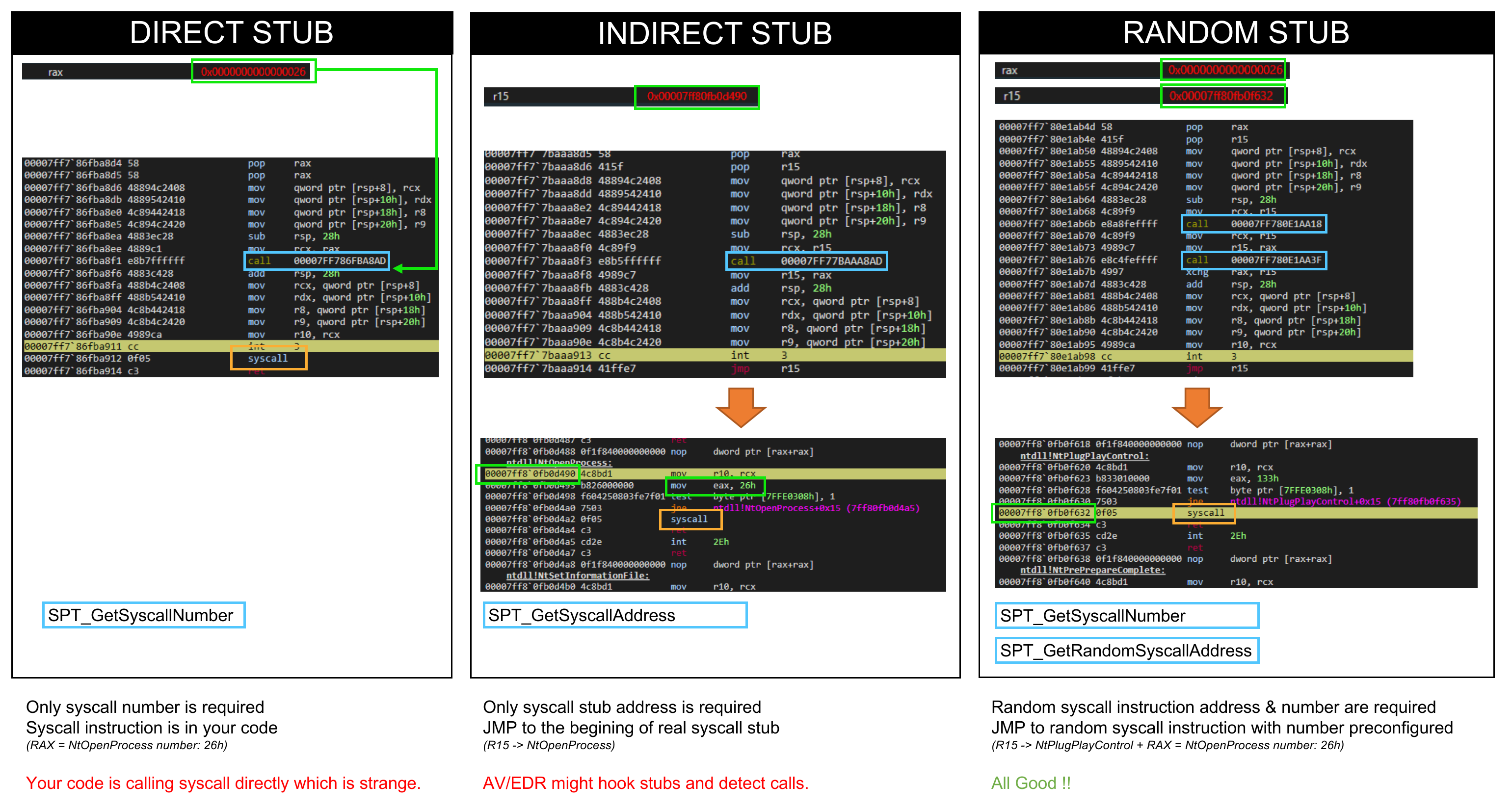
Once your `iterator` has been choosen you can then specify a `method` option based on the existing way to call syscalls. All the iterator are supported which let you select whatever you want as a final syscall stub.
1. **Direct:** the syscall is made directly in the Sysplant ASM call. You only need the syscall number but AV/EDR might see you...
2. **Indirect:** the Sysplant ASM call jump to the begining of Ntdll stub. You only need syscall address and no longer call syscall in your code but AV/EDR might hook these functions
3. **Random:** the Sysplant ASM call jump to a random syscall instruction of Ntdll stubs. You need the syscall number and 1 syscall instruction address. You then no longer call syscall in your code and can avoid hooked functions.
4. **Egg Hunter:** the inline `syscall` instruction is replaced by a random 8-byte marker (the _egg_). At runtime, call `SPT_SanitizeSyscalls()` **before any Nt\* function** to scan the `.text` section and patch every egg back to `syscall; ret`. This avoids static signatures on the `0F 05` opcode while keeping direct-call performance.
[](http://sysplant.readthedocs.io/en/main/assets/sysplant_stubs.png)
## Documentation
I've tried to keep an up to date documentation, so please **[READ THE DOC](http://sysplant.readthedocs.io/en/main/)**. You will find there many information about the tool's usages and a complete description of the classes and methods.
Some specifics usages are described:
- [Sysplant as a CLI tool](http://sysplant.readthedocs.io/en/main/usage/cli)
- [Sysplant as a Python's module](http://sysplant.readthedocs.io/en/main/usage/lib)
- [Sysplant as a MCP server](http://sysplant.readthedocs.io/en/main/usage/mcp)
## Credits
Massive shout-out to these useful projects that helps me during this journey, or individuals for their reviews
- [@alice blogpost about syscalls techniques](https://alice.climent-pommeret.red/posts/direct-syscalls-hells-halos-syswhispers2/)
- [@redops blogpost about direct vs indirect syscalls](https://redops.at/en/blog/direct-syscalls-a-journey-from-high-to-low)
- [@Jackson_T & @modexpblog for Syswhispers2](https://github.com/jthuraisamy/SysWhispers2)
- [@klezvirus for syswhispers3](https://github.com/klezVirus/SysWhispers3)
## :construction: TODO
This project is in WIP state...
Some PR & reviews are more than welcome :tada: !
- [x] Add internal names randomization
- [x] Setup documentation
- [x] Setup tests
- [ ] Add x86 support
- [ ] Add WoW64 support
- [x] Setup NIM templates
- [x] Setup C templates
- [x] Setup Rust templates
- [x] Setup C++ templates
- [ ] Setup Go / C# / Whatever templates
## License
This project is licensed under the [GPLv3 License](https://www.gnu.org/licenses/quick-guide-gplv3.en.html), for individuals only. If you want to integrate this work in your commercial project please contact me through `0x42en[at]gmail.com`
This server cannot be deployed
Maintenance
ActivitySlowing
ResponsivenessNo issues