F
licenseC
qualityD
maintenanceEnables web search capabilities through the Tavily API, allowing users to search the internet for information using natural language queries. Demonstrates MCP server implementation with external API integration.
3
-

Enables building LangGraph applications that can interact with the MCP server for enhanced workflow capabilities
Click on "Deploy Server".
Wait a few minutes for the server to deploy. Once ready, it will show a "Started" state.
In the chat, type @ followed by the MCP server name and your instructions, e.g., "@Tavily Web Search MCP Server find recent news about AI advancements in healthcare"
That's it! The server will respond to your query, and you can continue using it as needed.
Here is a step-by-step guide with screenshots.
This project is a demonstration of the MCP (Model Context Protocol) server, which utilizes the Tavily API for web search capabilities. The server is designed to run in a standard input/output (stdio) transport mode.
Related MCP server: Tavily Web Search MCP Server
The MCP server is set up to handle web search queries using the Tavily API. It is built with the following key components:
TavilyClient: A client for interacting with the Tavily API to perform web searches.
Python 3.13 or higher
A valid Tavily API key
You'll need to install this on the Windows side of your OS.
This will require getting two CLI tool for Powershell, which you can do as follows:
winget install astral-sh.uv
winget install --id Git.Git -e --source winget
After you have those CLI tools, please open Cursor into Windows.
Then, you can clone the repository using the following command in your Cursor terminal:
git clone https://AI-Maker-Space/AIE7-MCP-Session.gitAfter that, you can follow from Step 2. below!
Clone the repository:
git clone <repository-url>
cd <repository-directory>
Configure environment variables:
Copy the .env.sample to .env and add your Tavily API key:
TAVILY_API_KEY=your_api_key_here🏗️ Add a new tool to your MCP Server 🏗️
Create a new tool in the server.py file, that's it!
To start the MCP server, you will need to add the following to your MCP Profile in Cursor:
NOTE: To get to your MCP config. you can use the Command Pallete (CMD/CTRL+SHIFT+P) and select "View: Open MCP Settings" and replace the contents with the JSON blob below.
{
    "mcpServers":  {
        "mcp-server": {
            "command" : "uv",
            "args" : ["--directory", "/PATH/TO/REPOSITORY", "run", "server.py"]
        }
    }
}
The server will start and listen for commands via standard input/output.
The server provides a web_search tool that can be used to search the web for information about a given query. This is achieved by calling the web_search function with the desired query string.
There are a few activities for this assignment!
Choose an API that you enjoy using - and build an MCP server for it!
Check server.py
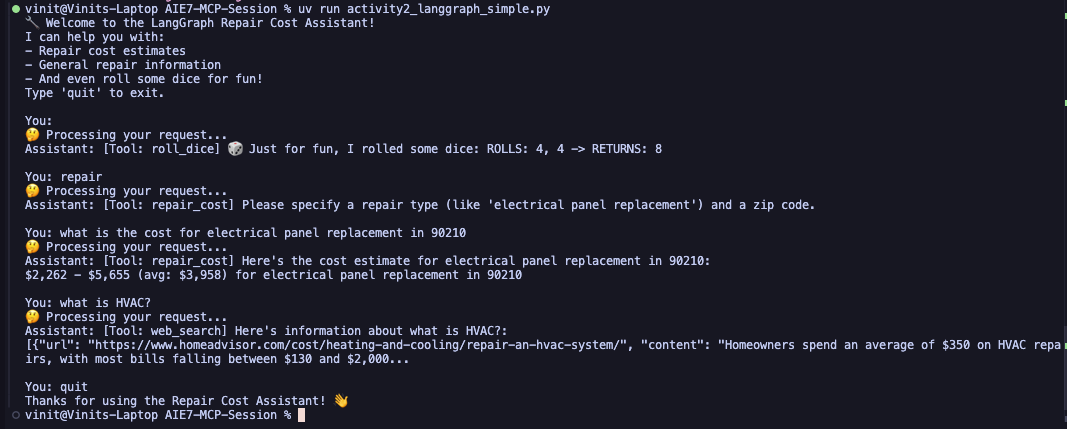
Build a simple LangGraph application that interacts with your MCP Server.
You can find details here!
Get repair cost estimate for home repairs
| Name | Required | Description | Default |
|---|---|---|---|
| repair_type | Yes | ||
| zip_code | Yes |
Does the description disclose side effects, auth requirements, rate limits, or destructive behavior?
No annotations are provided, so the description carries full burden for behavioral disclosure. While 'Get' implies a read operation, the description doesn't disclose important behavioral traits like whether this is an estimate vs. actual cost, data source, accuracy limitations, rate limits, authentication needs, or what happens when invalid inputs are provided. This is inadequate for a tool with no annotation coverage.
Agents need to know what a tool does to the world before calling it. Descriptions should go beyond structured annotations to explain consequences.
Is the description appropriately sized, front-loaded, and free of redundancy?
The description is a single, efficient sentence with zero waste. It's appropriately sized for a simple tool and front-loads the core purpose immediately. Every word earns its place in communicating the essential function.
Shorter descriptions cost fewer tokens and are easier for agents to parse. Every sentence should earn its place.
Given the tool's complexity, does the description cover enough for an agent to succeed on first attempt?
Given the complexity (2 required parameters, no annotations, no output schema), the description is incomplete. It doesn't explain what the tool returns, how estimates are calculated, error conditions, or parameter requirements. For a tool with no structured metadata, the description should provide more contextual information to guide proper usage.
Complex tools with many parameters or behaviors need more documentation. Simple tools need less. This dimension scales expectations accordingly.
Does the description clarify parameter syntax, constraints, interactions, or defaults beyond what the schema provides?
With 0% schema description coverage, the description must compensate by explaining parameter semantics, but it provides no information about the two required parameters (repair_type, zip_code). It doesn't explain what values are expected, formats, constraints, or examples. The description adds no value beyond what the bare schema provides.
Input schemas describe structure but not intent. Descriptions should explain non-obvious parameter relationships and valid value ranges.
Does the description clearly state what the tool does and how it differs from similar tools?
The description clearly states the tool's purpose with a specific verb ('Get') and resource ('repair cost estimate for home repairs'), making it immediately understandable. It doesn't distinguish from siblings (roll_dice, web_search), but those are unrelated tools, so differentiation isn't needed here.
Agents choose between tools based on descriptions. A clear purpose with a specific verb and resource helps agents select the right tool.
Does the description explain when to use this tool, when not to, or what alternatives exist?
The description provides no guidance on when to use this tool versus alternatives. It doesn't mention prerequisites, limitations, or scenarios where this tool is appropriate versus other approaches. With no annotations to provide context, this leaves the agent with insufficient usage context.
Agents often have multiple tools that could apply. Explicit usage guidance like "use X instead of Y when Z" prevents misuse.
Roll the dice with the given notation
| Name | Required | Description | Default |
|---|---|---|---|
| notation | Yes | ||
| num_rolls | No |
Does the description disclose side effects, auth requirements, rate limits, or destructive behavior?
No annotations are present, so the description must disclose behavioral traits. It only says 'Roll the dice,' which is a direct restatement of the tool name and adds no depth about random generation, validation, error handling, or return format. This is effectively a tautology with no added transparency.
Agents need to know what a tool does to the world before calling it. Descriptions should go beyond structured annotations to explain consequences.
Is the description appropriately sized, front-loaded, and free of redundancy?
The description is a single concise sentence with no waste, which is positive. However, it is under-specified: it front-loads little useful information and does not structure any context for the parameters. It cannot be considered 'appropriately sized' because it omits essential detail.
Shorter descriptions cost fewer tokens and are easier for agents to parse. Every sentence should earn its place.
Given the tool's complexity, does the description cover enough for an agent to succeed on first attempt?
For a tool with two parameters, no output schema, and no annotations, the description is severely inadequate. It does not explain dice notation, the meaning of num_rolls, or any behaviors/limitations. Even the sibling context (web_search) offers no help in situating this tool, making the description insufficient for reliable tool invocation.
Complex tools with many parameters or behaviors need more documentation. Simple tools need less. This dimension scales expectations accordingly.
Does the description clarify parameter syntax, constraints, interactions, or defaults beyond what the schema provides?
Schema description coverage is 0%, so the description must compensate. 'Given notation' loosely aligns with the 'notation' parameter but fails to define its format or semantics. The 'num_rolls' parameter is entirely absent from the description, leaving its purpose unexplained. Overall, minimal added meaning beyond the schema titles.
Input schemas describe structure but not intent. Descriptions should explain non-obvious parameter relationships and valid value ranges.
Does the description clearly state what the tool does and how it differs from similar tools?
The description states a clear verb ('Roll') and resource ('dice'), indicating the tool's primary action. However, it does not specify what 'notation' means (e.g., standard dice notation like '2d6'), which leaves some ambiguity. It is distinct from the sibling web_search, but not explicitly differentiated.
Agents choose between tools based on descriptions. A clear purpose with a specific verb and resource helps agents select the right tool.
Does the description explain when to use this tool, when not to, or what alternatives exist?
No guidance is provided on when to use this tool vs alternatives. The sibling list includes web_search, but the description gives no context for when dice rolling is appropriate or any exclusions. Users are left to infer usage from the name alone.
Agents often have multiple tools that could apply. Explicit usage guidance like "use X instead of Y when Z" prevents misuse.
Search the web for information about the given query
| Name | Required | Description | Default |
|---|---|---|---|
| query | Yes |
Does the description disclose side effects, auth requirements, rate limits, or destructive behavior?
No annotations are provided, so the description carries the full burden of behavioral disclosure. It only says 'search the web' without explaining what the tool returns, any limitations (e.g., freshness, pagination), or side effects. This lack of detail leaves the agent uncertain about the tool's behavior beyond the obvious.
Agents need to know what a tool does to the world before calling it. Descriptions should go beyond structured annotations to explain consequences.
Is the description appropriately sized, front-loaded, and free of redundancy?
The description is a single sentence, ten words long, and front-loaded with the core action. There is no wasted text or redundancy. It is appropriately concise for a simple tool, and every word earns its place.
Shorter descriptions cost fewer tokens and are easier for agents to parse. Every sentence should earn its place.
Given the tool's complexity, does the description cover enough for an agent to succeed on first attempt?
The tool is low-complexity with one parameter and no output schema. The description fails to explain the return value, result format, or any constraints/edge cases. Since there is no output schema, the description should cover what the agent can expect after invocation, but it does not. This makes the description incomplete for an agent to use correctly.
Complex tools with many parameters or behaviors need more documentation. Simple tools need less. This dimension scales expectations accordingly.
Does the description clarify parameter syntax, constraints, interactions, or defaults beyond what the schema provides?
The schema has one parameter 'query' with a string type, and the description mentions 'the given query,' which is redundant. Since schema description coverage is 0%, the description should add meaning about the query format, examples, or constraints, but it does not. The parameter is self-explanatory, but the description adds no extra value.
Input schemas describe structure but not intent. Descriptions should explain non-obvious parameter relationships and valid value ranges.
Does the description clearly state what the tool does and how it differs from similar tools?
The description clearly states the tool's function: 'Search the web for information about the given query.' It uses a specific verb ('search') and resource ('web'), and the query is self-evident. While it doesn't explicitly distinguish from siblings, the only sibling is 'roll_dice,' which is clearly unrelated, so no differentiation is needed.
Agents choose between tools based on descriptions. A clear purpose with a specific verb and resource helps agents select the right tool.
Does the description explain when to use this tool, when not to, or what alternatives exist?
The description implies usage: use this tool when you need web information. However, it provides no explicit guidance on when to prefer this tool over alternatives, when not to use it, or any prerequisites. There is no mention of exclusions or comparison with the sibling tool, so it remains at an implied level.
Agents often have multiple tools that could apply. Explicit usage guidance like "use X instead of Y when Z" prevents misuse.
Recent tool additions, removals, and schema changes observed during successful MCP inspections.
v1.0.0repair_cost1 field changedInput schema / titleAdded value: +"repair_costArguments"roll_dice1 field changedInput schema / titleAdded value: +"roll_diceArguments"web_search1 field changedInput schema / titleAdded value: +"web_searchArguments"repair_costroll_diceweb_searchScored across 3 tools
The three tools have completely distinct purposes: home repair cost estimation, dice rolling, and web searching. There is no overlap in functionality, and an agent would have no difficulty selecting the correct tool for any given task.
The naming is inconsistent with mixed conventions: 'repair_cost' and 'web_search' follow a noun_verb pattern, while 'roll_dice' uses verb_noun. This lack of a predictable naming pattern could cause confusion in automated tool selection.
With only three tools, the server appears severely under-scoped for a 'Tavily Web Search MCP Server', as web search is just one of three unrelated functions. The tools do not form a coherent set for the stated server purpose.
For a web search server, the tool surface is severely incomplete, lacking essential operations like advanced search filters, result pagination, or domain-specific searches. The inclusion of unrelated tools (repair_cost, roll_dice) further fragments the domain coverage.
Scrape, crawl and search the web for AI agents via MCP.
Web search and clean-text fetch MCP server (Tavily-powered, SSRF-guarded).
Serper MCP — wraps the Serper Google Search API (serper.dev)