
mattermost-mcp
# mattermost-mcp
[](https://github.com/toffguy77/mattermost-mcp/actions/workflows/test.yml)
[](https://pypi.org/project/mattermost-mcp-server/)
[](LICENSE)
[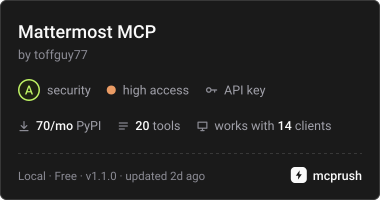](https://mcprush.com/to/toffguy77-mattermost-mcp?ref=badge)
A [Model Context Protocol](https://modelcontextprotocol.io) server for
[Mattermost](https://mattermost.com). It lets an AI agent (Claude, Cursor,
VS Code, any MCP client) catch up on your unreads and mentions, read channels,
threads and DMs, and search. If you switch write mode on, the agent can also
post, reply, send DMs, edit its own messages and react.
- **Read-only by default.** Write tools are not even registered until you set
`MATTERMOST_ENABLE_WRITE=1`. Even then, the agent can only edit posts
written by your own account.
- **Sees what you see.** Unread counts match the client badge (muted
channels are skipped, collapsed-thread counts are used) and sidebar
categories work as filters. Mentions from muted channels are still shown.
- **Works where personal access tokens don't.** Use a personal access token
(PAT) or bot token if you can. If an admin has disabled PATs (common with
SSO), run `mattermost-mcp-server login`: sign in once in a browser window
and the server picks up the session cookies itself, and picks them up again
when they expire.
- **Fast.** Channel metadata is fetched once, across teams in parallel, and
cached briefly. No per-channel requests.
## Quick start
1. Create a personal access token in Mattermost: **Profile → Security →
Personal Access Tokens → Create Token**. If that section is missing, an
admin must enable **System Console → Integrations → Integration Management
→ Enable Personal Access Tokens**, or skip the token and
[sign in with your browser](#sign-in-with-your-browser) instead.
2. Install [uv](https://docs.astral.sh/uv/getting-started/installation/).
3. Add the server to your client.
**Claude Code**
```sh
claude mcp add mattermost \
-e MATTERMOST_URL=https://mattermost.example.com \
-e MATTERMOST_ACCESS_TOKEN=your-token \
-- uvx mattermost-mcp-server
```
**Claude Desktop** (`claude_desktop_config.json`), **Cursor**
(`~/.cursor/mcp.json`) and other clients that use `mcpServers`:
```json
{
"mcpServers": {
"mattermost": {
"command": "uvx",
"args": ["mattermost-mcp-server"],
"env": {
"MATTERMOST_URL": "https://mattermost.example.com",
"MATTERMOST_ACCESS_TOKEN": "your-token"
}
}
}
}
```
**VS Code** (`.vscode/mcp.json`):
```json
{
"inputs": [
{ "type": "promptString", "id": "mm-token", "description": "Mattermost access token", "password": true }
],
"servers": {
"mattermost": {
"command": "uvx",
"args": ["mattermost-mcp-server"],
"env": {
"MATTERMOST_URL": "https://mattermost.example.com",
"MATTERMOST_ACCESS_TOKEN": "${input:mm-token}"
}
}
}
}
```
Then try asking: *"What did I miss in Mattermost today?"* or *"Summarize the
thread about the release in #engineering."*
To let the agent post, add `"MATTERMOST_ENABLE_WRITE": "1"` to `env` (see
[Write mode](#write-mode)).
## Tools
| Tool | Kind | What it does |
|---|---|---|
| `get_unread` | read | Unread and mention counts per channel; skips muted channels by default, like the client badge |
| `get_mentions` | read | Posts that mention you, newest first; `since`, `limit` |
| `list_channels` | read | Your channels with `unread_count`, mute state and sidebar category; filter by team, category, DMs, muted |
| `get_channel_posts` | read | Recent posts in a channel; `since` (ISO 8601) or `before` (post ID) to page back |
| `get_thread` | read | A root post and all its replies |
| `search_posts` | read | Full-text search with Mattermost syntax (`from:`, `in:`, `after:`…), optionally scoped to one channel or a sidebar category; skips muted channels by default |
| `get_direct_messages` | read | DM history with a user; `since`, `before` |
| `get_user` | read | A user's profile by username |
| `search_users` | read | Find users by name, username or email prefix |
| `get_me` | read | Your profile, the auth mode, and whether write mode is on |
| `list_teams` | read | Your teams |
| `get_post` | read | One post by ID |
| `get_channel` | read | A channel by ID or by name (`town-square`), with header and purpose |
| `get_pinned_posts` | read | Pinned posts of a channel |
| `get_file_info` | read | Name, type and size of an attached file (content is not downloaded) |
| `create_post` | write | Post in a channel, or reply in a thread with `root_id` |
| `send_direct_message` | write | DM a user by username |
| `update_post` | write | Edit one of **your own** posts; refuses anyone else's |
| `add_reaction` | write | React with an emoji (`thumbsup` or `:thumbsup:`) |
| `remove_reaction` | write | Remove your reaction; no error if it was not there |
Every tool carries MCP annotations (`readOnlyHint`, `destructiveHint`,
`idempotentHint`), so clients can auto-approve reads and ask before writes.
Nothing can delete posts, change channels or perform admin actions.
## Write mode
Write mode is off unless `MATTERMOST_ENABLE_WRITE` is `1`, `true`, `yes` or
`on`. When it is off:
- the five write tools are not registered, so the model never sees them;
- the HTTP client refuses every request that is not a GET or one of the
read-only POSTs (user lookup, user search, post search), before anything is
sent.
The one server-side effect of read-only mode is the same as in any
Mattermost client: `get_direct_messages` with someone you have never
messaged creates the (empty) DM channel between you.
When write mode is on, `update_post` checks the post's author and refuses
any post that is not yours, even if your account has permission to edit
other people's posts. Posts are written as the authenticated user (or bot),
so consider a dedicated bot account for agents that post on their own.
## Configuration
| Variable | Default | Meaning |
|---|---|---|
| `MATTERMOST_URL` | — (required) | Base URL of your server, e.g. `https://mattermost.example.com` |
| `MATTERMOST_ACCESS_TOKEN` | — | Personal access token or bot token; selects token auth |
| `MATTERMOST_ENABLE_WRITE` | off | `1` enables the write tools |
| `MATTERMOST_AUTH_MODE` | auto | `token` or `cookie`, to force a mode (see below) |
| `MATTERMOST_TOKEN` | — | Cookie auth: value of the `MMAUTHTOKEN` cookie |
| `MATTERMOST_CSRF` | — | Cookie auth: value of the `MMCSRF` cookie; required for write tools |
| `MATTERMOST_USER_ID` | — | Cookie auth: value of the `MMUSERID` cookie (optional) |
| `MATTERMOST_AUTO_LOGIN` | off | `1` opens the browser sign-in automatically when the saved session expires |
| `MATTERMOST_LOGIN_TIMEOUT` | `300` | Seconds to wait for an automatic sign-in |
| `MATTERMOST_BROWSER` | auto | Path of the Chromium-family browser used by `login` |
| `MATTERMOST_BROWSER_ARGS` | — | Extra browser flags for `login`, e.g. `--proxy-server=…` |
| `MATTERMOST_BROWSER_PROFILE` | `~/.config/mattermost-mcp/browser-profile` | Sign-in browser profile (mode 0700) |
| `MATTERMOST_SESSION_FILE` | `~/.config/mattermost-mcp/session.env` | Where `login` saves the session (mode 0600) |
| `MATTERMOST_CACHE_TTL` | `60` | Seconds to cache channel metadata; `0` disables the cache |
| `MATTERMOST_TRUST_ENV` | `1` | `0` ignores `HTTP(S)_PROXY`/`ALL_PROXY` and connects to Mattermost directly |
| `MATTERMOST_AUTH_HELP` | — | Extra text appended to the 401 error, e.g. how credentials are rotated in your setup |
| `MATTERMOST_KEYCHAIN_SERVICE` | `mattermost-mcp` | Keychain service name (see [Credential sources](#credential-sources)) |
| `MATTERMOST_COOKIE_HOST` | off | Cookie host: ssh alias, or `local` |
| `MATTERMOST_COOKIE_PATH` | `.config/mattermost-mcp/cookie.env` | Cookie host: file path, relative to `$HOME` on the host |
| `MATTERMOST_COOKIE_CACHE` | `~/.cache/mattermost-mcp/cookie.cache` | Cookie host: local cache file (mode 0600) |
| `MATTERMOST_COOKIE_TTL` | `900` | Cookie host: cache lifetime, seconds |
| `MATTERMOST_COOKIE_SSH_TIMEOUT` | `10` | Cookie host: ssh connect timeout, seconds |
**Choosing the auth mode.** If `MATTERMOST_AUTH_MODE` is unset, the first
credential source that has any credential decides. The sources are checked
in order: env, then cookie host, then the saved `login` session, then
keychain. `MATTERMOST_ACCESS_TOKEN` in
that source means token mode. `MATTERMOST_TOKEN` alone means cookie mode. A
lower-priority source never overrides a higher one.
## Sign in with your browser
No personal access tokens on your server? Sign in once the way you always do
(password, SSO, MFA), and the server uses your session:
```sh
uvx mattermost-mcp-server login --url https://mattermost.example.com
```
A browser window opens at your server's login page and closes by itself as
soon as you are signed in. Any installed Chrome, Chromium, Edge or Brave
works; set `MATTERMOST_BROWSER` to use a specific one. The session cookies
are checked against the server and saved to
`~/.config/mattermost-mcp/session.env` (mode 0600). From then on the server
needs no credentials in its configuration at all:
```sh
claude mcp add mattermost -- uvx mattermost-mcp-server
```
Other ways to sign in:
```sh
mattermost-mcp-server login --password # username/email + password (+ MFA code); the password is not stored
mattermost-mcp-server login --from-firefox # reuse the session of a Firefox where you are signed in
mattermost-mcp-server status # which server, user and credential source is in use
mattermost-mcp-server logout # revoke and delete the saved session (--forget-browser: also the browser profile)
```
**When the session expires.** Sessions expire after the time your admin
configured. Run `login` again; running servers pick the new session up on
their next call, without a restart. With `MATTERMOST_AUTO_LOGIN=1` in the
server's `env`, the server opens the sign-in window itself when it gets a
401. The browser profile remembers your identity provider, so with SSO this
often completes without typing anything. Several running servers share one
window.
The sign-in browser uses its own profile in
`~/.config/mattermost-mcp/browser-profile`, separate from your everyday
browser. On macOS and Linux the server talks to it over a private pipe, not
a network port.
## Cookie auth
To use session cookies directly, without `login`: log in to Mattermost in a
browser, open DevTools → Application → Cookies, and copy `MMAUTHTOKEN`,
`MMCSRF` and (optionally) `MMUSERID` into `MATTERMOST_TOKEN`,
`MATTERMOST_CSRF` and `MATTERMOST_USER_ID`. This is also the way to go when a
reverse proxy strips the `Authorization` header.
Session cookies expire. When they do, tool calls fail with a 401 error. Put
fresh cookies wherever the server reads them from, then restart it, because
env is read only once. If something rotates cookies for you, describe it in
`MATTERMOST_AUTH_HELP` so the agent knows what to do.
## Credential sources
The server resolves each field separately. The first source that has a value
wins:
1. **Environment variables**, as above.
2. **Cookie host** (off by default). A plain `KEY=VALUE` file with the same
variable names, kept on another machine and read over ssh. Use this when
one machine rotates the credential and others just consume it. The result
is cached locally. On a 401 the server pulls the file again and retries
once. ssh runs with `BatchMode=yes`, so a locked key fails fast instead of
hanging the MCP handshake, and the reason goes to stderr. The file may
only supply `MATTERMOST_URL`, `MATTERMOST_ACCESS_TOKEN`,
`MATTERMOST_TOKEN`, `MATTERMOST_CSRF` and `MATTERMOST_USER_ID`. Nothing
else is read from it, not even the auth or write mode.
3. **Saved session** from `mattermost-mcp-server login`. It is used only as
a whole (URL, cookies and CSRF together), only in cookie mode, and only
when it belongs to the same server as any `MATTERMOST_URL` you set.
4. **OS keychain**: accounts `url`, `access_token`, `token`, `csrf` and
`user_id` under the service `MATTERMOST_KEYCHAIN_SERVICE`.
```sh
# macOS
security add-generic-password -s mattermost-mcp -a url -w https://mattermost.example.com
security add-generic-password -s mattermost-mcp -a access_token -w <personal access token>
# Linux (pass)
pass insert mattermost-mcp/url
pass insert mattermost-mcp/access_token
```
## Troubleshooting
- **`Mattermost rejected the access token (401)`**: the token was revoked
or mistyped. Create a new one, or check whether your account is still
allowed to use personal access tokens.
- **`Mattermost rejected the session cookies (401)`**: the browser session
expired. Run `mattermost-mcp-server login` again (or set
`MATTERMOST_AUTO_LOGIN=1`). If you set the cookies by hand, copy fresh ones
and restart the server.
- **`No Chromium-family browser found`**: install Chrome, Chromium, Edge or
Brave, point `MATTERMOST_BROWSER` at one, or use `login --password` or
`login --from-firefox`.
- **`Write tools in cookie mode need the MMCSRF cookie`**: set
`MATTERMOST_CSRF`. Mattermost requires it for any change made with cookie
auth.
- **`write mode is disabled`**: set `MATTERMOST_ENABLE_WRITE=1` and restart
the client.
- **Requests time out behind a corporate proxy**: the server honours
`HTTPS_PROXY`/`ALL_PROXY`, including SOCKS. If that proxy should not be
used for Mattermost, set `MATTERMOST_TRUST_ENV=0`.
- **Nothing happens in Claude Desktop**: GUI apps do not inherit your shell
`PATH`. Use the full path to `uvx` (`which uvx`) as `command`.
## Development
```sh
git clone https://github.com/toffguy77/mattermost-mcp.git
cd mattermost-mcp
uv sync
uv run pytest
uv run ruff check
```
Run your local checkout from a client with
`uv run --project /path/to/mattermost-mcp mattermost-mcp`.
`python -m mattermost_mcp` works too. The tests never touch the network or
ssh: HTTP is mocked with `respx`. See [CONTRIBUTING.md](CONTRIBUTING.md),
[CHANGELOG.md](CHANGELOG.md) and [SECURITY.md](SECURITY.md).
## License
MIT
<!-- mcp-name: io.github.toffguy77/mattermost-mcp -->
TDQS
Scored across 15 tools
Each tool targets a distinct resource and retrieval path: single post (get_post), thread with replies (get_thread), channel history (get_channel_posts), DMs (get_direct_messages), mentions (get_mentions), and search (search_posts) are all clearly differentiated. Channel, user, and team lookups are similarly well-separated, leaving an agent little room for misselection.
Consistent snake_case with predictable verb_noun patterns: get_*, list_*, and search_* throughout. The only quirk, get_me, is an idiomatic convenience that still reads as a getter and doesn't break the pattern.
Fifteen tools is a natural fit for a chat workspace, spanning channels, users, teams, posts, search, and files. Every tool has a clear place and none look like filler.
Read coverage is thorough (posts, threads, channels, users, teams, files, search), but the surface is entirely read-only: there is no send_post, edit_post, delete_post, or channel-management operation. This is a notable gap for a messaging client, and get_me's write_enabled flag implies posting/editing tools are expected to exist.