
onenote-mcp
by seanGSISG
README.md
# OneNote MCP Server
A stdio [Model Context Protocol](https://modelcontextprotocol.io/) server for Microsoft OneNote. It uses Microsoft Graph delegated permissions and Microsoft device-code authentication.
## Requirements
- Node.js 20 or newer
- A Microsoft account with OneNote access
- An MCP client such as Codex
## Install
### Option 1: Add from the desktop GUI
1. Open the Codex desktop app, select **Plugins**, open **Create**, and select
**Add marketplace**.
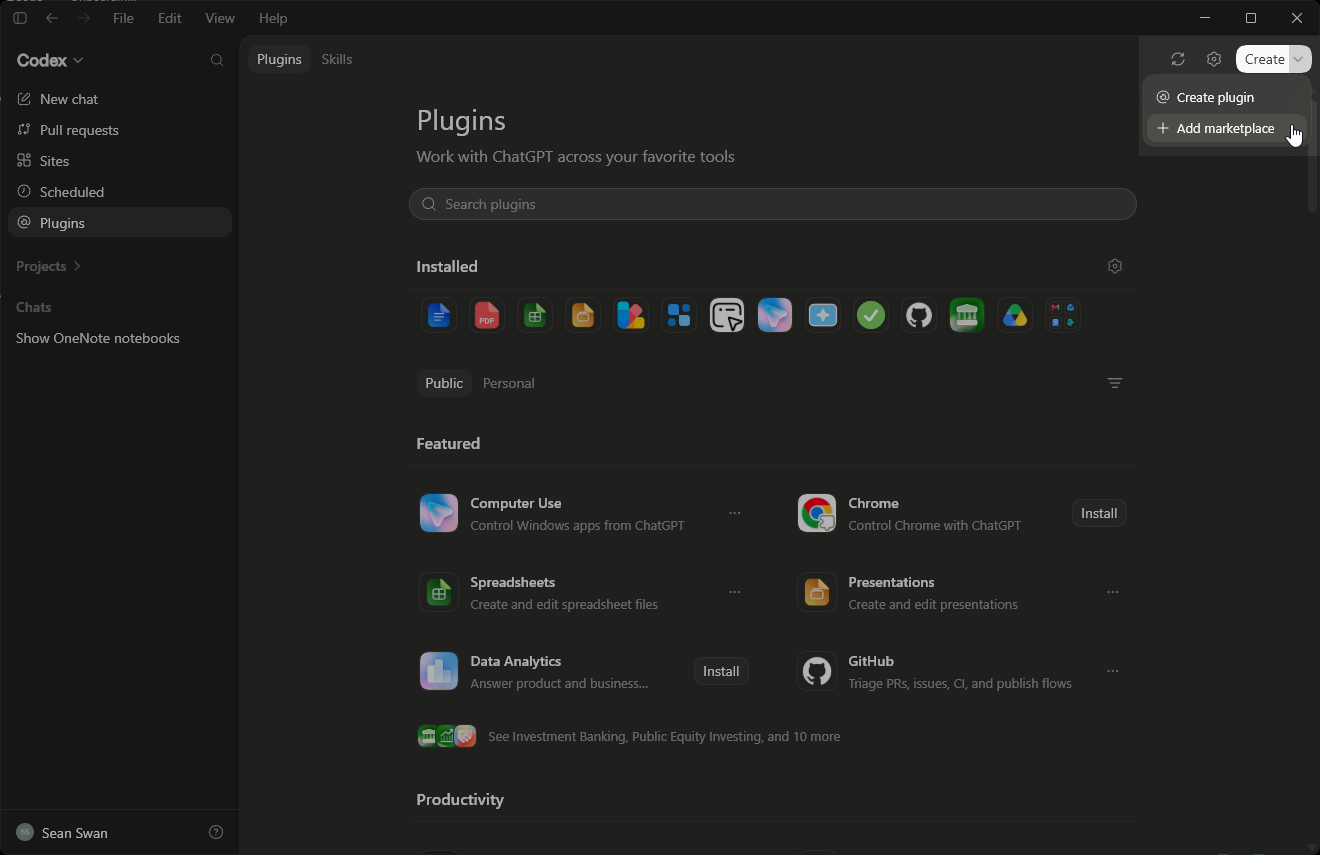
2. Select **Add plugin marketplace** and enter:
- **Source:** `https://github.com/seanGSISG/onenote-mcp.git`
- **Git ref:** `main`
- **Sparse paths:** leave blank
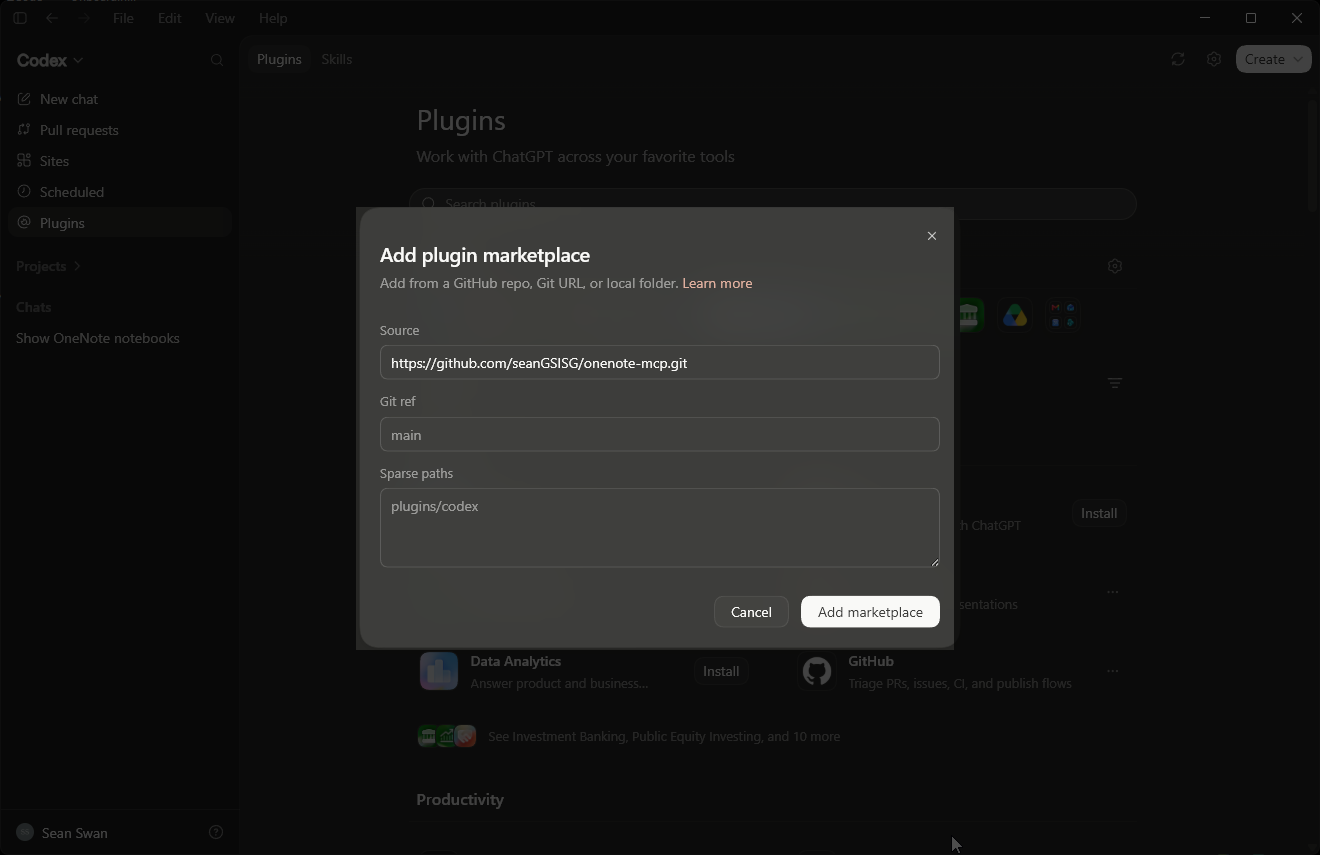
3. Select **Add marketplace**, return to **Plugins**, and select the
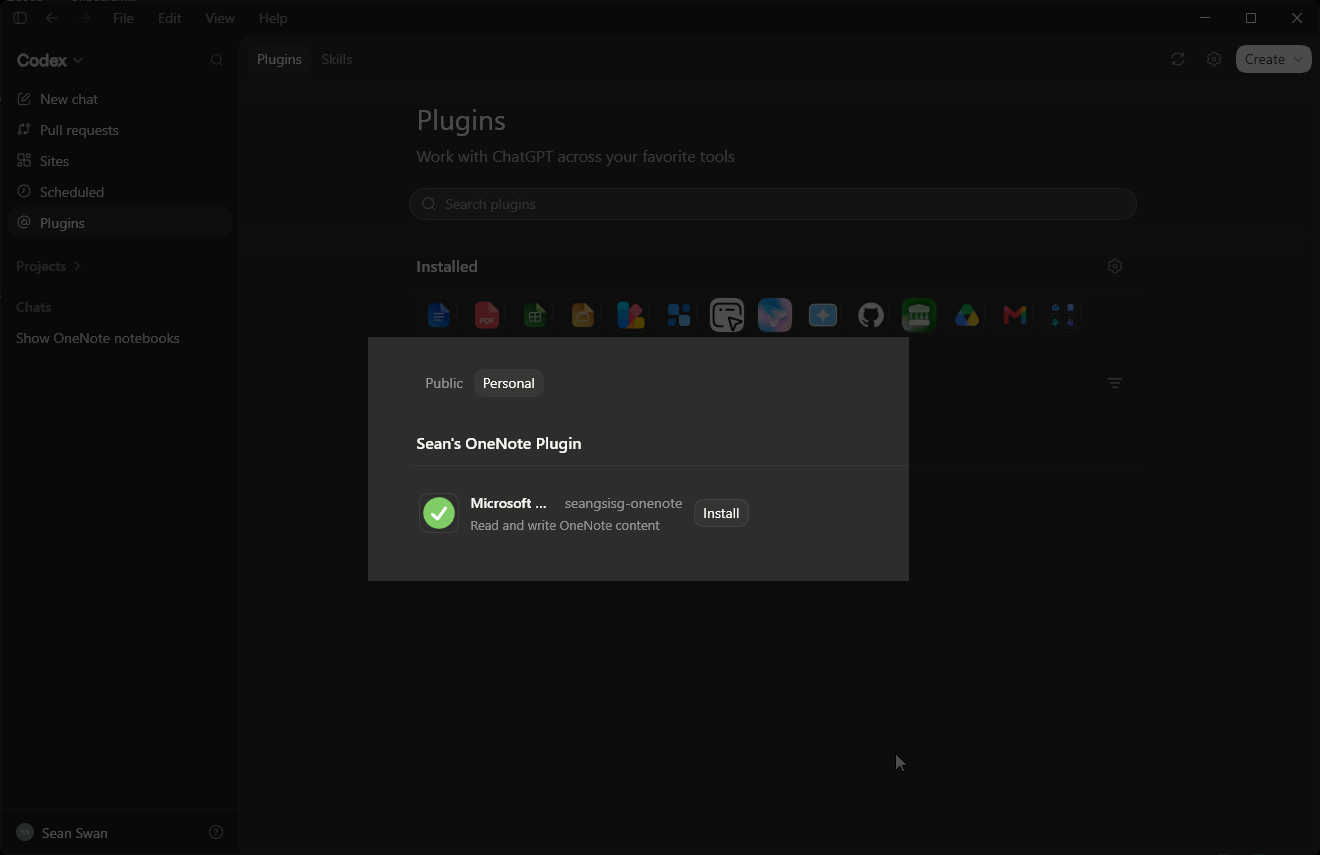
**Personal** tab. If the new marketplace does not appear, completely restart
the desktop app and return to **Plugins**.
4. Select **Sean's OneNote Plugin** and choose **Install** beside
**Microsoft OneNote**.
5. Restart the desktop app again, open a new task, and ask:
`Authenticate with OneNote.`
### Option 2: Let Codex configure it
Paste this into a Codex desktop task—no clone is required:
> Read https://raw.githubusercontent.com/seanGSISG/onenote-mcp/main/AGENTS.md and follow it to install the complete OneNote plugin in the Codex desktop app.
Codex will add this repository as a plugin marketplace, install the complete
OneNote plugin, verify its MCP server, and explain when a desktop-app restart or
new task is required. Users do not need to clone the repository or edit MCP JSON
or TOML files.
### Option 3: Install for development
```powershell
git clone https://github.com/seanGSISG/onenote-mcp.git
cd onenote-mcp
npm install
npm test
```
The MCP SDK is installed from npm. A separate SDK checkout and build are no longer required.
## Advanced: MCP-only configuration
Add this to `~/.codex/config.toml`, replacing the path with the absolute path to `onenote-mcp.mjs`:
```toml
[mcp_servers.onenote]
type = "stdio"
command = "node"
args = ["C:/absolute/path/to/onenote-mcp.mjs"]
enabled = true
startup_timeout_sec = 30
```
Restart Codex after changing MCP configuration.
## Authentication
1. Call `authenticationStatus`.
2. If unauthenticated, call `authenticate`.
3. Open the returned Microsoft device-login URL and enter the returned code. Use `force: true` to replace a stale or unwanted login.
4. Call `authenticationStatus` again to confirm completion.
Authentication starts in the background, so the `authenticate` tool returns the device code immediately. The delegated access token is stored at `~/.onenote-mcp/access-token.json`. Set `ONENOTE_TOKEN_PATH` to override that location, or supply `GRAPH_ACCESS_TOKEN` in the server environment. `ONENOTE_CLIENT_ID` and `ONENOTE_TENANT_ID` override the default public client and `common` tenant.
The server requests the delegated `Notes.ReadWrite` and `User.Read` scopes.
## Tools
| Tool | Purpose |
| --- | --- |
| `authenticationStatus` | Check authentication state and expiration |
| `authenticate` | Start device-code authentication |
| `listNotebooks` | List up to `maxResults` notebooks |
| `getNotebook` | Get one notebook by exact ID |
| `listSections` | List up to `maxResults` sections, optionally in a notebook |
| `listPages` | List up to `maxResults` pages, optionally in a section |
| `getPage` | Get page metadata and optionally its HTML |
| `createPage` | Create a titled XHTML page in an exact section |
| `searchPages` | Search page titles |
All resource-specific operations use explicit IDs. The server never silently chooses the first notebook, section, or page.
## Development
```powershell
npm run check
npm test
npm audit
```
The test suite covers token migration and expiration, asynchronous device-code flow, Graph request construction and errors, XHTML title escaping, and a real MCP stdio handshake.
TDQS
A3.5/5.0
Scored across 9 tools
Disambiguation5/5
Each tool has a clear, distinct purpose: authentication, listing/getting notebooks/sections/pages, creating pages, and searching. No overlap or ambiguity.
Naming Consistency4/5
Most tools follow a verb_noun pattern (e.g., listNotebooks, createPage). 'authenticationStatus' is a noun phrase but fits the context. Minor deviation is acceptable.
Tool Count5/5
9 tools cover the core OneNote operations (auth, notebooks, sections, pages) without being excessive. Perfectly scoped for the domain.
Completeness3/5
Covers read and create operations for pages and notebooks, but lacks update and delete for pages and notebooks. Search is present. Notable gaps exist for full CRUD.
Maintenance
ActivityInactive
ResponsivenessNo issues