
Remembra
by remembra-ai
README.md
<p align="center">
<picture>
<source media="(prefers-color-scheme: dark)" srcset="landing/brand/lockup-horizontal-dark.svg">
<img src="landing/brand/lockup-horizontal.svg" alt="Remembra" width="320">
</picture>
</p>
<h1 align="center">Remembra Relay</h1>
<p align="center">
<strong>One agent stops. The next one already knows.</strong><br>
When a connected agent's session ends, Remembra Relay saves a handoff (a session that did nothing leaves none).<br>
With the session hooks it is built from git and, for Claude Code and Codex, the session transcript.<br>
An agent that closes through MCP reports its own facts, marked unverified.<br>
The next agent, on another machine, from another vendor, or next week, starts from it.
</p>
<p align="center">
<a href="https://pypi.org/project/remembra/"><img src="https://img.shields.io/pypi/v/remembra?color=blue&label=PyPI" alt="PyPI"></a>
<a href="https://github.com/remembra-ai/remembra/stargazers"><img src="https://img.shields.io/github/stars/remembra-ai/remembra?style=social" alt="GitHub Stars"></a>
<a href="https://opensource.org/licenses/MIT"><img src="https://img.shields.io/badge/License-MIT-yellow.svg" alt="License: MIT"></a>
<a href="https://docs.remembra.dev"><img src="https://img.shields.io/badge/docs-remembra.dev-blue" alt="Documentation"></a>
</p>
<p align="center">
<a href="https://remembra.dev">Website</a> •
<a href="https://docs.remembra.dev/guides/relay/">Relay guide</a> •
<a href="https://docs.remembra.dev">Docs</a> •
<a href="https://remembra.dev/changelog">Changelog</a> •
<a href="https://discord.gg/mPYQRKzXz5">Discord</a>
</p>
<!-- mcp-name: io.github.remembra-ai/remembra -->
---
## Install
First get a free key at [app.remembra.dev](https://app.remembra.dev/signup), then run:
```bash
pipx install --force 'remembra[mcp]>=0.16'
remembra-install --all
remembra-relay connect --apply
```
`remembra-install` asks for the key at a hidden prompt (or reads `REMEMBRA_API_KEY`) and shows its changes before it writes.
`connect --apply` writes the hooks and keeps a backup of each file; run `remembra-relay connect` alone first to see every
change without writing. Codex runs the hooks only after you trust them: Settings > Hooks > Trust in the Codex app, or
`/hooks` in the Codex CLI. When a hook's command changes, Codex skips it until you trust it again.
[Hosting the server yourself](https://docs.remembra.dev/getting-started/docker/)? Add `--url <your server>` to `remembra-install`.
`remembra-relay` ships in remembra 0.16.0.
**Handoffs not arriving?** `remembra-relay doctor` says where the baton dropped, from this machine's files and your
trail, with one fix per problem; it only reads. Inside your agent the local MCP server has the same checks as
read-only tools: `remembra_doctor`, `remembra_setup` (the install steps for this machine) and `remembra_help`.
See [Doctor](https://docs.remembra.dev/guides/relay/#doctor).
## What the next agent sees
Claude Code finished a session and wrote in its summary that the work was done and pushed. Git disagreed. The next agent's brief includes this line:
<!-- readme-brief: generated by remembra.relay.handoff.render_last_session; tests/test_readme_relay.py keeps it true -->
```text
Last session: claude-code (key-verified), 12m ago, on feat/pdf-export@a41f2c9: done: a41f2c9 Add PDF export for invoices; 77c01aa Embed fonts in exported PDFs; tests passing: pytest tests/test_pdf.py (12 passed); changed 3 file(s): invoices/pdf.py, invoices/fonts.py, tests/test_pdf.py / NOT done: 2 commit(s) not pushed to origin/feat/pdf-export / failing: none / next (derived from the recorded facts): push 2 commit(s) to origin/feat/pdf-export (facts reported as collected by remembra-relay from git and the session transcript (not checked)) (the agent's summary contradicts these recorded facts)
```
With the session hooks, `remembra-relay` builds the done, not done and failing sections from git and, for Claude Code and Codex, the session's test runs, never from an LLM. The server does not check where the facts came from; the brief says they were reported by remembra-relay. The agent's own summary is optional; it is checked against those facts and shown as unverified, or, as here, contradicted. A handoff written through the `close_session` MCP tool holds the facts the agent declares, labeled "declared by the agent (not checked)".
## How it works
1. **Close.** When a session ends, `remembra-relay close` reads the branch, commits, changed and uncommitted files and unpushed commits from git, and, for Claude Code and Codex, the commands, test runs and open items in the local transcript (Codex's is its rollout file). The transcript itself stays on your machine. Secrets that match Remembra's patterns are redacted from what is sent.
2. **Brief.** When the next session starts, in the same tool or another, `remembra-relay brief` (run by the verified session hooks) or the `session_brief` MCP tool (any MCP agent can call it) gives the agent who worked last, what is done, what is failing and the next step. The text brief is capped at about 1,500 tokens (6,000 characters). `session_brief` returns only that text with `compact=true`; by default it also returns the full brief as JSON, which is larger. Everything another agent recorded is wrapped as untrusted data.
3. **Trail.** Every handoff stays in order: `remembra-relay trail`, or the Trail page in the dashboard. A git log for your agents.
The same repository on a laptop, a server or in a worktree is one project, because it is identified by its git remote. Give each agent its own scoped key and its handoffs show as key-verified.
## Agents
| Agent | Session hooks | How it reads and writes handoffs today |
|---|---|---|
| Claude Code | **verified** | Hooks: brief at start, close at end, with test results from the transcript |
| Codex | **verified** (codex-cli 0.155.0-alpha.16.4, a prerelease) | Hooks: brief at start, close at end, with commands and test runs from the rollout; trust them in Codex (Settings > Hooks, or `/hooks` in the CLI), and again when one changes |
| Gemini CLI | **verified** (Gemini CLI 0.61.0) | Hooks: brief at start (after `/clear`, with the first prompt), close at end; they run only in folders you trust |
| Qwen Code | **verified** (Qwen Code 0.24.6) | Hooks: brief at start, close at end, on a rate-limit or billing stop and before `/compress`; `qwen -p` writes no handoff |
| Kimi Code | **verified** (Kimi Code 2.1.1) | Hooks: brief with the first prompt, close when the TUI exits; `kimi -p` writes no handoff |
| Cursor | unverified | MCP tools (`session_brief`, `close_session`) |
| Any other MCP agent | none | MCP tools |
Claude Code's and Codex's session hooks are verified (Codex with codex-cli 0.155.0-alpha.16.4, a prerelease, and the same tests also pass on the stable 0.157.1). The Gemini CLI, Qwen Code and Kimi Code hooks are verified too: each was run against the real tool at the version in the table, with a local stand-in for the model, and put the brief in the model's request and posted the handoff; other versions have not been run. The Cursor hooks are unverified: Cursor's own hook runner ran them, but no logged-in Cursor session has yet. `connect` leaves them out unless you add `--include-unverified`. Until they are tested, Cursor reads the brief and writes its handoff through Remembra's MCP tools, as does any MCP agent.
## Crew mode
Several agents in one repository at once, without one undoing another's work. Name the areas of the repo in
`.remembra/zones.yml` and commit it on the default branch:
```yaml
version: 1
zones:
api:
include: ["src/api/**"]
web:
include: ["src/web/**"]
```
Then, at a terminal (it shows every change and asks before writing):
```bash
remembra-crew connect --apply # Claude Code
remembra-crew connect --agent codex --include-unverified --apply
remembra-crew verify --agent codex # one round trip on your machine; Codex then enforces
```
The first agent to write in a zone holds it. Another agent's write there is stopped before it happens and the
agent is told who holds it; it can ask for a handover with `crew_say`, or you hand it over from the dashboard.
| Agent | Writes to a held zone |
|---|---|
| Claude Code | **stopped** before every write (hooks verified) |
| Codex | **stopped** after `remembra-crew verify --agent codex` passes: shell commands and every file an `apply_patch` names (checked live on codex-cli 0.157.1) |
| Gemini CLI, Qwen Code, Kimi Code | stopped once `verify` passes on your machine; until then, read-only fence |
| Cursor and other agents | read-only fence in their own worktree; MCP-only agents are advisory |
Git hooks (`connect --git-hooks`) also stop a commit or push that touches a held zone, for every agent. The
honest limit: these local layers stop cooperating agents' mistakes, not a deliberately hostile agent on the same
machine. Crew mode needs a server that runs it (`REMEMBRA_CREW_MODE`; on for Remembra Cloud). The guide is
[Crew mode](https://docs.remembra.dev/relay/crew/).
## How it compares
| | Remembra Relay | Vendor memory (Claude Code, Codex, Copilot, Windsurf) | Local handoff tools | Memory APIs (Mem0, Zep, Letta) |
|---|---|---|---|---|
| Works across machines | Yes, by git remote | Mostly no | No | Yes |
| Works across vendors | Yes | No, one vendor each | Yes | Through their API |
| Handoff facts from git | Yes, with the summary checked | No | Transcript or diff | No |
| Durable trail of sessions | Yes | No | No | No |
| Enforced coordination between agents | Crew mode (Claude Code; Codex once verified) | Claude-only agent teams | No | No |
Details, with a source and date, for claude-mem, agentmemory, the local handoff tools and Claude Code's own features: [Remembra and other handoff tools](docs/comparisons/handoff-tools.md). claude-mem and agentmemory are larger projects that also carry memory between sessions; the comparison says where each is the better pick.
## Pricing
Handoffs, briefs, the inbox, the trail and search are free on every plan. Remembra Cloud: Free, Solo $12/mo, Pro $29/mo, Team $15/seat/mo ([pricing](https://remembra.dev/pricing)). Self-hosting is free under the MIT license.
---
# The memory API underneath
Remembra Relay runs on Remembra's memory layer, which you can also use directly: store facts, recall them by meaning, and let it pull out the people, projects and relationships in them.
```python
from remembra import Memory
memory = Memory(user_id="user_123")
memory.store("Had a meeting with Sarah from Acme Corp. She prefers email over Slack.")
result = memory.recall("How should I contact Sarah?")
print(result.context)
# "Sarah from Acme Corp prefers email over Slack."
```
Since v0.16.0 the memory layer also keeps the exact text that facts were derived from and points each fact back to it. By default a fact that does not match its source is not stored: the store response lists it under `dropped_facts`. With `REMEMBRA_GROUNDING_ACTION=flag` such a fact is stored and marked unverified instead.
## Self-host the server
### One Command Install
```bash
curl -sSL https://raw.githubusercontent.com/remembra-ai/remembra/main/quickstart.sh | bash
```
This starts Remembra, Qdrant and Ollama locally, with auth off and local embeddings, so the server needs no API key. The first start downloads the images and the embedding model, so how long it takes depends on your connection.
**Or with Docker Compose directly:**
```bash
git clone https://github.com/remembra-ai/remembra && cd remembra
docker compose -f docker-compose.quickstart.yml up -d
```
**Try it:**
```bash
# Store a memory
curl -X POST http://localhost:8787/api/v1/memories \
-H "Content-Type: application/json" \
-d '{"content": "Alice is CEO of Acme Corp", "user_id": "demo"}'
# Recall it
curl -X POST http://localhost:8787/api/v1/memories/recall \
-H "Content-Type: application/json" \
-d '{"query": "Who runs Acme?", "user_id": "demo"}'
```
### Connect your agents (since v0.10.0)
**Configure the agents it detects, then add the session hooks:**
```bash
pipx install --force 'remembra[mcp]>=0.16'
REMEMBRA_API_KEY=local remembra-install --all --url http://localhost:8787
remembra-relay connect --apply
```
`remembra-install` needs a key value. The quickstart server runs with auth off and accepts any value, so `local` is
only a placeholder; for a server with auth on, leave `REMEMBRA_API_KEY=local` out and give a real key at the hidden
prompt. It auto-detects and configures Claude Code, Codex CLI, Cursor and Gemini CLI, and Claude Desktop on macOS only
(the Windows config is not detected or written). Windsurf is unverified: `remembra-install --agent windsurf` writes
it, `--all` does not. `remembra-relay connect --apply` writes the session hooks that save and read handoffs.
**Verify setup:**
```bash
remembra-doctor all
```
<details>
<summary>Manual MCP Config (if needed)</summary>
**Claude Desktop** — add to `~/Library/Application Support/Claude/claude_desktop_config.json`:
```json
{
"mcpServers": {
"remembra": {
"command": "remembra-mcp",
"env": {
"REMEMBRA_URL": "http://localhost:8787",
"REMEMBRA_USER_ID": "default"
}
}
}
}
```
</details>
**Claude Code:**
```bash
claude mcp add remembra -e REMEMBRA_URL=http://localhost:8787 -- remembra-mcp
```
**Cursor** — add to `.cursor/mcp.json`:
```json
{
"mcpServers": {
"remembra": {
"command": "remembra-mcp",
"env": {
"REMEMBRA_URL": "http://localhost:8787"
}
}
}
}
```
Now ask Claude: *"Remember that Alice is CEO of Acme Corp"* — then later: *"Who runs Acme?"*
### Python SDK
```bash
pip install remembra
```
```python
from remembra import Memory
memory = Memory(user_id="user_123")
memory.store("Had a meeting with Sarah from Acme Corp. She prefers email over Slack.")
result = memory.recall("How should I contact Sarah?")
print(result.context) # "Sarah from Acme Corp prefers email over Slack."
```
### TypeScript SDK
```bash
npm install remembra
```
```typescript
import { Remembra } from 'remembra';
const memory = new Remembra({ url: 'http://localhost:8787' });
await memory.store('User prefers dark mode');
const result = await memory.recall('preferences');
```
---
## Memory features
🧠 **Smart Extraction** — LLM-powered fact extraction from raw text
👥 **Entity Resolution** — an LLM matcher merges name variants that fit the context ("Mr. Smith" and "John Smith"); resolving "my husband" to a named person is best-effort and untested
⏱️ **Temporal Memory** — TTL, decay curves, historical queries
🔍 **Hybrid Search** — Semantic + keyword for accurate recall
🔒 **Security** — PII detection and redaction, secret redaction, audit logs
📊 **Dashboard** — Visual memory browser, entity graphs, analytics
---
## 📊 Benchmarks
No valid benchmark result has been published yet. In March 2026 we ran 1 of the 10 [LoCoMo](https://github.com/snap-research/locomo) conversations (199 questions), but that run's scores are not valid: its judge counted every INCORRECT verdict as correct, and it scored the raw recall context instead of an answer. Both bugs are fixed in the runner (commit a19fb29); a fresh run has not been done yet.
Run it yourself: `python benchmarks/locomo_runner.py --data /tmp/locomo/data/locomo10.json`
---
## 📖 Documentation
| Resource | Description |
|----------|-------------|
| [Quick Start](https://docs.remembra.dev/getting-started/quickstart/) | Get running in minutes |
| [Python SDK](https://docs.remembra.dev/guides/python-sdk/) | Full Python reference |
| [TypeScript SDK](https://docs.remembra.dev/guides/javascript-sdk/) | JavaScript/TypeScript guide |
| [Remembra Relay](https://docs.remembra.dev/guides/relay/) | Handoffs, briefs and the trail across agents |
| [MCP Server](https://docs.remembra.dev/integrations/mcp-server/) | Tool reference and setup guides for the 31 tools |
| [REST API](https://docs.remembra.dev/guides/rest-api/) | API reference |
| [Self-Hosting](https://docs.remembra.dev/getting-started/docker/) | Docker deployment guide |
---
## 🛠️ MCP Server
Give an MCP-capable coding agent persistent memory. A standard MCP server (stdio, SSE, streamable HTTP), with setup guides for **Claude Code**, **Cursor**, **VS Code + Copilot**, **JetBrains**, **Zed** and **OpenAI Codex**. It should work with any MCP-compatible client. Windsurf has a guide but is unverified.
```bash
pip install remembra[mcp]
claude mcp add remembra -e REMEMBRA_URL=http://localhost:8787 -- remembra-mcp
```
**Available tools (31):**
| Group | Tools |
|------|-------|
| Remembra Relay | `session_brief`, `close_session`, `resolve_project`, `store_status`, `list_status` |
| Inbox between agents | `send_to_inbox`, `get_inbox`, `ack_inbox` |
| Memory | `store_memory`, `recall_memories`, `update_memory`, `forget_memories`, `list_memories`, `ingest_conversation` |
| Entities and time | `search_entities`, `timeline`, `relationships_at` |
| Sharing | `share_memory`, `list_spaces`, `create_space` |
| Connection | `health_check` |
| Setup and diagnosis (read-only) | `remembra_doctor`, `remembra_setup`, `remembra_help` |
| Crew mode (when the server runs it) | `crew_status`, `crew_claim`, `crew_guard`, `crew_task`, `crew_say`, `crew_checkpoint`, `crew_report` |
---
## 🏗️ Architecture
```
┌─────────────────────────────────────────────────────────────┐
│ Your Application │
├──────────┬──────────────┬───────────────────────────────────┤
│ Python │ TypeScript │ MCP Server (Claude/Cursor) │
│ SDK │ SDK │ remembra-mcp │
├──────────┴──────────────┴───────────────────────────────────┤
│ Remembra REST API │
├──────────────┬──────────────┬───────────────┬───────────────┤
│ Extraction │ Entities │ Retrieval │ Security │
│ (LLM) │ (Graph) │ (Hybrid) │ (PII/Audit) │
├──────────────┴──────────────┴───────────────┴───────────────┤
│ Storage Layer │
│ Qdrant (vectors) + SQLite (metadata/graph) │
└─────────────────────────────────────────────────────────────┘
```
---
## 🤝 Contributing
We welcome contributions! See [CONTRIBUTING.md](CONTRIBUTING.md) for guidelines.
```bash
# Clone
git clone https://github.com/remembra-ai/remembra
cd remembra
# Install dev dependencies
pip install -e ".[dev]"
# Run tests
pytest
# Start dev server
remembra-server --reload
```
---
## 📄 License
MIT License — Use it however you want.
---
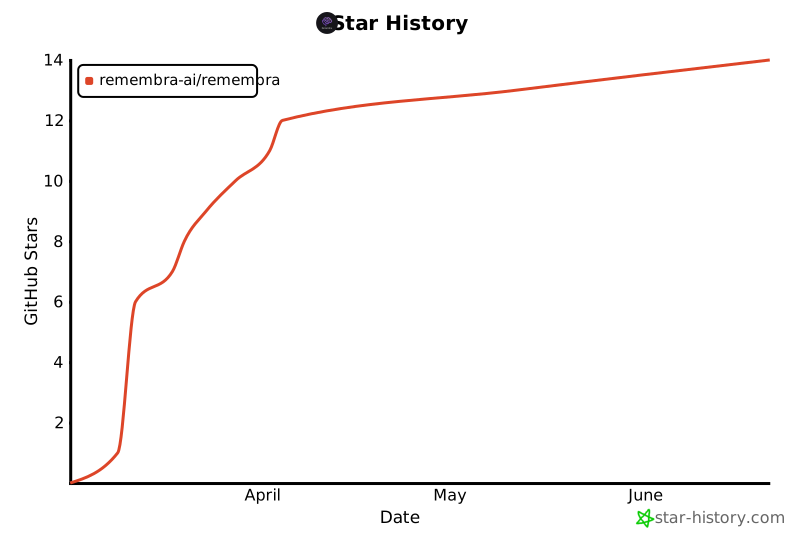
## ⭐ Star History
If Remembra helps you, please star the repo! It helps others discover the project.
[](https://star-history.com/#remembra-ai/remembra&Date)
---
<p align="center">
Built with ❤️ by <a href="https://dolphytech.com">DolphyTech</a><br>
<a href="https://remembra.dev">remembra.dev</a> • <a href="https://docs.remembra.dev">docs</a> • <a href="https://twitter.com/remembradev">twitter</a> • <a href="https://discord.gg/mPYQRKzXz5">discord</a>
</p>
This server cannot be deployed
Maintenance
ActivityActive
ResponsivenessNo issues