OpenSCAD MCP Server
Click on "Install Server".
Wait a few minutes for the server to deploy. Once ready, it will show a "Started" state.
In the chat, type
@followed by the MCP server name and your instructions, e.g., "@OpenSCAD MCP Serverrender a cube with a sphere next to it and save as /tmp/shapes.png"
That's it! The server will respond to your query, and you can continue using it as needed.
Here is a step-by-step guide with screenshots.
OpenSCAD MCP Server
A Model Context Protocol (MCP) server that provides OpenSCAD rendering capabilities. This server allows you to render OpenSCAD code to PNG images through a standardized MCP interface.
Features
Headless OpenSCAD Rendering: Execute OpenSCAD code and generate PNG images without a GUI
Flexible Camera Control: Support for custom camera positioning and orientation
Cross-Platform: Configurable OpenSCAD binary path for different operating systems
Related MCP server: OpenSCAD MCP Server
Prerequisites
Node.js: Version 18 or higher
OpenSCAD: Nightly (dev) version must be installed on your system. Download and install from OpenSCAD.org.
Installation
Clone this repository:
git clone https://github.com/rahulgarg123/openscad-mcp.git cd openscad-mcpInstall dependencies:
npm installBuild the project:
npm run build
Configuration
OpenSCAD Binary Path
By default, the server looks for OpenSCAD at /Applications/OpenSCAD.app/Contents/MacOS/OpenSCAD (macOS path). You can customize this by setting the OPENSCAD_BINARY environment variable.
Usage as MCP Server in Gemini-cli
In your gemini settings.json file, e.g., ~/.gemini/settings.json, add the following:
"mcpServers": {
"openscad": {
"command": "node",
"args": ["/path/to/openscad-mcp/dist/index.js"],
"env": {
"OPENSCAD_BINARY": "/path/to/OpenSCAD/binary"
}
}
}Use included GEMINI.md file in the folder you want to generate openSCAD code in.
Available Tools
render_openscad
Renders OpenSCAD code to a PNG image file.
Parameters:
code(string, required): The OpenSCAD code to renderoutput_path(string, required): Path where the rendered PNG image should be savedcamera(string, optional): Camera parameters in one of these formats:translate_x,y,z,rot_x,y,z,dist- Translation, rotation, and distanceeye_x,y,z,center_x,y,z- Eye position and center point
Example Request:
{
"jsonrpc": "2.0",
"id": 1,
"method": "tools/call",
"params": {
"name": "render_openscad",
"arguments": {
"code": "cube([20, 30, 10]); translate([25, 0, 0]) sphere(r=8);",
"output_path": "/tmp/my_render.png",
"camera": "0,0,0,60,0,315,100"
}
}
}Response:
{
"jsonrpc": "2.0",
"id": 1,
"result": {
"content": [
{
"type": "text",
"text": "OpenSCAD rendering completed successfully\n\nOutput:\n...\n\nRendered image saved to: /tmp/my_render.png"
}
]
}
}Examples with gemini-cli
Prompt:
Generate openscad code for a very beautiful and unique planter. Iterate as many times as possible on the design, looking at the rendering in each iteration and improving it. The goal is to generate a unique and aesthetic planter design amenable for 3D printing.
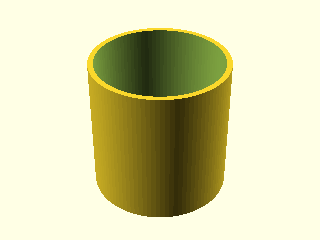
|
First Iteration |

|
Final Iteration |
Generated OpenSCAD code:
module unique_planter(
height = 100,
width = 50,
wall_thickness = 4,
twist = 90,
freq = 8,
amp = 2,
drainage_hole_rad = 5
) {
$fn=100;
difference() {
linear_extrude(height = height, scale = 1.2, twist = twist, slices = 200) {
polygon([
for (a = [0:360/$fn:359])
let (r = width/2 + amp*sin(a*freq) + amp*sin(a*freq/2))
[r*cos(a), r*sin(a)]
]);
}
translate([0,0,wall_thickness]) {
linear_extrude(height = height, scale = 1.2, twist = twist, slices = 200) {
polygon([
for (a = [0:360/$fn:359])
let (r = width/2 - wall_thickness + amp*sin(a*freq) + amp*sin(a*freq/2))
[r*cos(a), r*sin(a)]
]);
}
}
translate([0,0,-1]) {
cylinder(h = wall_thickness+2, r = drainage_hole_rad);
}
}
}
unique_planter();Testing
Run the included tests to verify everything works:
node test_client.jsDevelopment
Scripts
npm run build: Compile TypeScript to JavaScriptnpm run start: Start the MCP servernpm run dev: Watch mode for development
Project Structure
openscad-mcp/
├── src/
│ └── index.ts # Main MCP server implementation
├── dist/ # Compiled JavaScript output
├── test_client.js # Basic test client
├── test.scad # Sample OpenSCAD file
├── package.json # Node.js dependencies and scripts
├── tsconfig.json # TypeScript configuration
└── README.md # This fileTroubleshooting
OpenSCAD Not Found
Error: spawn /Applications/OpenSCAD.app/Contents/MacOS/OpenSCAD ENOENTSolution: Verify OpenSCAD is installed and set the correct OPENSCAD_BINARY path.
Permission Denied
Error: EACCES: permission denied, open '/path/to/output.png'Solution: Ensure the output directory exists and is writable.
Rendering Timeout
Error: Command failed: timeoutSolution: Simplify your OpenSCAD code or increase the timeout in the source code.
Contributing
Fork the repository
Create a feature branch
Make your changes
Add tests for new functionality
Submit a pull request
Links
Available Tools
1 toolrender_openscadC
Render OpenSCAD code to PNG using OpenSCAD in headless mode
| Name | Required | Description | Default |
|---|---|---|---|
| code | Yes | The OpenSCAD code to render | |
| output_path | Yes | Path where the rendered PNG image should be saved | |
| camera | No | Camera parameters: translate_x,y,z,rot_x,y,z,dist or eye_x,y,z,center_x,y,z |
TDQS
Does the description disclose side effects, auth requirements, rate limits, or destructive behavior?
No annotations are provided, so the description carries the full burden of behavioral disclosure. It mentions 'headless mode', which implies no GUI, but doesn't cover critical aspects like performance (e.g., rendering time, resource usage), error handling, file system interactions, or dependencies. For a tool that generates files and executes code, this is a significant gap in transparency.
Agents need to know what a tool does to the world before calling it. Descriptions should go beyond structured annotations to explain consequences.
Is the description appropriately sized, front-loaded, and free of redundancy?
The description is a single, efficient sentence that directly states the tool's purpose without unnecessary words. It's front-loaded with the core action and includes relevant technical details (headless mode). Every part of the sentence contributes meaning, making it highly concise and well-structured.
Shorter descriptions cost fewer tokens and are easier for agents to parse. Every sentence should earn its place.
Given the tool's complexity, does the description cover enough for an agent to succeed on first attempt?
Given the complexity of rendering code to an image file, the lack of annotations, and no output schema, the description is incomplete. It doesn't explain what happens on success (e.g., file creation details) or failure, nor does it cover behavioral traits like side effects or limitations. For a tool with 3 parameters and no structured safety hints, more context is needed.
Complex tools with many parameters or behaviors need more documentation. Simple tools need less. This dimension scales expectations accordingly.
Does the description clarify parameter syntax, constraints, interactions, or defaults beyond what the schema provides?
Schema description coverage is 100%, so the schema already documents all three parameters (code, output_path, camera) with clear descriptions. The description adds no additional parameter semantics beyond what's in the schema, such as format details or examples. Baseline 3 is appropriate when the schema does the heavy lifting.
Input schemas describe structure but not intent. Descriptions should explain non-obvious parameter relationships and valid value ranges.
Does the description clearly state what the tool does and how it differs from similar tools?
The description clearly states the verb ('Render') and resource ('OpenSCAD code to PNG'), specifying the action and output format. It also mentions the execution mode ('using OpenSCAD in headless mode'), which adds useful context. However, with no sibling tools, it doesn't need to differentiate from alternatives, so it doesn't reach the highest score.
Agents choose between tools based on descriptions. A clear purpose with a specific verb and resource helps agents select the right tool.
Does the description explain when to use this tool, when not to, or what alternatives exist?
The description provides no guidance on when to use this tool versus alternatives, prerequisites, or constraints. It lacks any context about typical use cases, limitations, or comparisons to other rendering methods. This leaves the agent with minimal usage direction beyond the basic function.
Agents often have multiple tools that could apply. Explicit usage guidance like "use X instead of Y when Z" prevents misuse.
TDQS
With only one tool, there is no possibility of ambiguity or overlap between tools. The single tool 'render_openscad' has a clear and distinct purpose, making it impossible for an agent to misselect between tools.
A single tool inherently has perfect naming consistency, as there are no other tools to compare it against. The tool name 'render_openscad' follows a clear verb_noun pattern, but consistency cannot be assessed across multiple tools in this case.
A single tool is generally too few for most server purposes, as it limits functionality and may indicate an incomplete or overly narrow scope. While it might be appropriate for a very specific task, it feels thin and could hinder agent workflows that require more operations.
The server appears to target OpenSCAD rendering, but with only a render tool, there are significant gaps. For example, there are no tools for creating, editing, or managing OpenSCAD code, which are core operations in this domain. This severely limits the surface and will likely cause agent failures.
Maintenance
Resources
Unclaimed servers have limited discoverability.
Looking for Admin?
If you are the server author, to access and configure the admin panel.
Related MCP Connectors
Cloud Blender for AI agents: scenes, assets, renders, MP4, STL, GLB — over hosted remote MCP.
Agent-first CAD: editable .kcad.ts source, deterministic review, OpenCASCADE kernel.
Deterministic image rendering for agents: JSON template in, on-brand PNG out.
DXF and PDF/X-4 for AI agents: structured facts, PNG renders, an interactive in-chat viewer.
Related MCP Servers
- AlicenseAqualityAmaintenanceEnables AI assistants to render 3D models from OpenSCAD code, generating single views or multiple perspectives with full camera control. Supports animations, custom parameters, and returns base64-encoded PNG images for seamless integration.15128MIT
- AlicenseNot gradedqualityNot gradedmaintenanceEnables AI assistants to render 3D models by providing tools to execute OpenSCAD code and generate single or multi-perspective views. It returns high-quality PNG renderings directly to LLM applications for visual feedback and 3D model visualization.
- AlicenseNot gradedqualityCmaintenanceEnables editing of STL 3D model files through the Model Context Protocol, providing tools for reading, writing, transforming, and creating primitive shapes.MIT
- AlicenseNot gradedqualityCmaintenanceExposes OpenSCAD CLI as MCP tools for validating, rendering, and exporting parametric 3D models. Enables LLM clients to interactively create and manipulate OpenSCAD designs.3MIT
Appeared in Searches
Latest Blog Posts
- Who's Calling? MCP Hosts Are an Identity Blind Spot (And the Spec Knows It)By Om-Shree-0709 on .mcpAgent IdentityOAuth 2.1
- Your AI Chatbot Just Exposed Your CEO's Salary to an InternBy Om-Shree-0709 on .Agent IdentityMCP SecurityOAuth Delegation
- Why MCP Servers Need Execution Sandboxing (And Why Your Current Stack Isn't Enough)By Om-Shree-0709 on .Agentic AiPrompt InjectionWebAssembly
MCP directory API
We provide all the information about MCP servers via our MCP API.
curl -X GET 'https://glama.ai/api/mcp/v1/servers/rahulgarg123/openscad-mcp'
If you have feedback or need assistance with the MCP directory API, please join our Discord server

