
AI Dev Assistant
Server Quality Checklist
Latest release: v1.0.0
- Disambiguation5/5
Each tool has a clearly distinct purpose with no overlap: code_executor runs code snippets, doc_search searches documents, github_repo_reader reads repository files, and terminal_commander executes system commands. The descriptions make it easy to differentiate between them, as they target different resources and use cases.
Naming Consistency4/5The naming follows a consistent snake_case pattern with descriptive names (e.g., code_executor, doc_search), but there is a minor deviation with github_repo_reader using a compound term that could be more aligned (e.g., repo_reader). Overall, the naming is readable and mostly predictable.
Tool Count5/5With 4 tools, the count is well-scoped for an AI Dev Assistant, covering key development tasks like code execution, documentation search, repository reading, and terminal commands. Each tool earns its place without feeling excessive or insufficient for the server's purpose.
Completeness4/5The tool set covers essential development workflows, including code execution, documentation, repository management, and system operations. A minor gap exists in not having tools for more advanced tasks like debugging or version control beyond basic commands, but agents can work around this with the provided tools.
Average 4/5 across 4 of 4 tools scored. Lowest: 3.4/5.
See the Tool Scores section below for per-tool breakdowns.
- No community issues in the last 6 months
- No commit activity data available
- No stable releases found
- No critical vulnerability alerts
- No high-severity vulnerability alerts
- No code scanning findings
- CI status not available
Add a LICENSE file by following GitHub's guide. Once GitHub recognizes the license, the system will automatically detect it within a few hours.
If the license does not appear after some time, you can manually trigger a new scan using the MCP server admin interface.
MCP servers without a LICENSE cannot be installed.
This repository includes a README.md file.
No tool usage detected in the last 30 days. Usage tracking helps demonstrate server value.
Tip: use the "Try in Browser" feature on the server page to seed initial usage.
Add a glama.json file to provide metadata about your server.
If you are the author, simply .
If the server belongs to an organization, first add
glama.jsonto the root of your repository:{ "$schema": "https://glama.ai/mcp/schemas/server.json", "maintainers": [ "your-github-username" ] }Then . Browse examples.
Add related servers to improve discoverability.
How to sync the server with GitHub?
Servers are automatically synced at least once per day, but you can also sync manually at any time to instantly update the server profile.
To manually sync the server, click the "Sync Server" button in the MCP server admin interface.
How is the quality score calculated?
The overall quality score combines two components: Tool Definition Quality (70%) and Server Coherence (30%).
Tool Definition Quality measures how well each tool describes itself to AI agents. Every tool is scored 1–5 across six dimensions: Purpose Clarity (25%), Usage Guidelines (20%), Behavioral Transparency (20%), Parameter Semantics (15%), Conciseness & Structure (10%), and Contextual Completeness (10%). The server-level definition quality score is calculated as 60% mean TDQS + 40% minimum TDQS, so a single poorly described tool pulls the score down.
Server Coherence evaluates how well the tools work together as a set, scoring four dimensions equally: Disambiguation (can agents tell tools apart?), Naming Consistency, Tool Count Appropriateness, and Completeness (are there gaps in the tool surface?).
Tiers are derived from the overall score: A (≥3.5), B (≥3.0), C (≥2.0), D (≥1.0), F (<1.0). B and above is considered passing.
Tool Scores
- Behavior2/5
Does the description disclose side effects, auth requirements, rate limits, or destructive behavior?
No annotations are provided, so the description carries the full burden. It discloses some behavioral traits like case-insensitive search, multi-keyword AND logic, and supported file extensions, but misses critical details such as error handling (e.g., invalid paths), performance limits, output format specifics, or whether it's read-only/destructive. This leaves gaps for an agent to use it correctly.
Agents need to know what a tool does to the world before calling it. Descriptions should go beyond structured annotations to explain consequences.
Conciseness4/5Is the description appropriately sized, front-loaded, and free of redundancy?
The description is appropriately sized and front-loaded, starting with the core purpose. It uses two sentences efficiently, though the second sentence is slightly dense with file extension details. Overall, it avoids unnecessary repetition and wastes little space.
Shorter descriptions cost fewer tokens and are easier for agents to parse. Every sentence should earn its place.
Completeness3/5Given the tool's complexity, does the description cover enough for an agent to succeed on first attempt?
Given no annotations and no output schema, the description is moderately complete for a search tool but has gaps. It covers what the tool does and some behavioral aspects, but lacks details on output format, error conditions, and performance constraints, which are important for an agent to invoke it effectively without structured output guidance.
Complex tools with many parameters or behaviors need more documentation. Simple tools need less. This dimension scales expectations accordingly.
Parameters3/5Does the description clarify parameter syntax, constraints, interactions, or defaults beyond what the schema provides?
Schema description coverage is 100%, so the schema already documents all parameters thoroughly. The description adds minimal value beyond the schema, mentioning 'case-insensitive' (covered by case_sensitive default) and 'searchable extensions' (implied by file_extension_filter), but does not provide additional syntax or format details. Baseline 3 is appropriate as the schema does the heavy lifting.
Input schemas describe structure but not intent. Descriptions should explain non-obvious parameter relationships and valid value ranges.
Purpose5/5Does the description clearly state what the tool does and how it differs from similar tools?
The description clearly states the tool's purpose with specific verbs ('searches all documents') and resources ('local docs/ folder'), and distinguishes it from siblings by specifying it searches documents rather than executing code, reading repos, or running terminal commands. It provides concrete details about supported file types and search behavior.
Agents choose between tools based on descriptions. A clear purpose with a specific verb and resource helps agents select the right tool.
Usage Guidelines3/5Does the description explain when to use this tool, when not to, or what alternatives exist?
The description implies usage for searching documents in a folder, but does not explicitly state when to use this tool versus alternatives like sibling tools (e.g., github_repo_reader for remote repos). It mentions the default directory ('docs/') but lacks explicit guidance on prerequisites or exclusions.
Agents often have multiple tools that could apply. Explicit usage guidance like "use X instead of Y when Z" prevents misuse.
- Behavior4/5
Does the description disclose side effects, auth requirements, rate limits, or destructive behavior?
With no annotations provided, the description carries the full burden of behavioral disclosure. It effectively describes key behaviors: recursive traversal, automatic ignoring of specific directories and file types, handling of binary and large files, and the return format (directory tree and file contents). This gives the agent clear expectations without contradictions.
Agents need to know what a tool does to the world before calling it. Descriptions should go beyond structured annotations to explain consequences.
Conciseness5/5Is the description appropriately sized, front-loaded, and free of redundancy?
The description is front-loaded with the core purpose in the first sentence, followed by essential behavioral details in a compact form. Every sentence adds value (e.g., filtering rules and return format), with no redundant or vague language, making it highly efficient and easy to parse.
Shorter descriptions cost fewer tokens and are easier for agents to parse. Every sentence should earn its place.
Completeness4/5Given the tool's complexity, does the description cover enough for an agent to succeed on first attempt?
Given the tool's moderate complexity (recursive file reading with filters), no annotations, and no output schema, the description does a good job covering behavior and output. It explains what is returned (directory tree and file contents) and key constraints, though it could benefit from mentioning error handling or performance implications for large repositories.
Complex tools with many parameters or behaviors need more documentation. Simple tools need less. This dimension scales expectations accordingly.
Parameters3/5Does the description clarify parameter syntax, constraints, interactions, or defaults beyond what the schema provides?
Schema description coverage is 100%, so the schema already documents both parameters thoroughly. The description does not add any additional meaning or context beyond what the schema provides for 'repo_path' and 'max_files', such as usage examples or constraints not in the schema. Baseline 3 is appropriate as the schema handles parameter documentation.
Input schemas describe structure but not intent. Descriptions should explain non-obvious parameter relationships and valid value ranges.
Purpose5/5Does the description clearly state what the tool does and how it differs from similar tools?
The description clearly states the tool's purpose with specific verbs ('reads', 'returns') and resources ('all source files in a local repository directory'). It distinguishes itself from potential siblings by specifying recursive reading with automatic filtering of common directories and file types, which is not implied by the tool name alone.
Agents choose between tools based on descriptions. A clear purpose with a specific verb and resource helps agents select the right tool.
Usage Guidelines3/5Does the description explain when to use this tool, when not to, or what alternatives exist?
The description implies usage context through details like 'local repository directory' and filtering of '.git', 'node_modules', etc., suggesting it's for analyzing codebases. However, it does not explicitly state when to use this tool versus alternatives like 'doc_search' or 'code_executor', nor does it provide exclusions or prerequisites for usage.
Agents often have multiple tools that could apply. Explicit usage guidance like "use X instead of Y when Z" prevents misuse.
- Behavior4/5
Does the description disclose side effects, auth requirements, rate limits, or destructive behavior?
With no annotations provided, the description carries the full burden and effectively discloses key behavioral traits: it specifies hard limits (15-second timeout, 64 KB output cap), isolation (runs in isolated temp file), and statelessness (no persistent state between calls). It does not cover aspects like error handling or security implications, but provides substantial operational context.
Agents need to know what a tool does to the world before calling it. Descriptions should go beyond structured annotations to explain consequences.
Conciseness5/5Is the description appropriately sized, front-loaded, and free of redundancy?
The description is front-loaded with core functionality and efficiently structured in three sentences: the first states purpose and constraints, the second details isolation, and the third provides usage context. Every sentence adds value without redundancy, making it appropriately sized and zero-waste.
Shorter descriptions cost fewer tokens and are easier for agents to parse. Every sentence should earn its place.
Completeness4/5Given the tool's complexity, does the description cover enough for an agent to succeed on first attempt?
Given the tool's moderate complexity (code execution with constraints), no annotations, and no output schema, the description is largely complete: it covers purpose, behavioral limits, and usage context. However, it lacks details on return values or error responses, which would be helpful for an agent invoking the tool.
Complex tools with many parameters or behaviors need more documentation. Simple tools need less. This dimension scales expectations accordingly.
Parameters3/5Does the description clarify parameter syntax, constraints, interactions, or defaults beyond what the schema provides?
Schema description coverage is 100%, so the schema already documents both parameters thoroughly. The description adds minimal value beyond the schema, mentioning 'self-contained' for the code parameter but not elaborating on syntax or constraints. Baseline 3 is appropriate as the schema does the heavy lifting.
Input schemas describe structure but not intent. Descriptions should explain non-obvious parameter relationships and valid value ranges.
Purpose5/5Does the description clearly state what the tool does and how it differs from similar tools?
The description clearly states the tool executes code snippets in specific languages (Python/Node.js) in a sandboxed environment, distinguishing it from sibling tools like doc_search or terminal_commander by focusing on code execution rather than document retrieval or system commands. It specifies the action ('executes'), resource ('code snippet'), and context ('sandboxed child process').
Agents choose between tools based on descriptions. A clear purpose with a specific verb and resource helps agents select the right tool.
Usage Guidelines4/5Does the description explain when to use this tool, when not to, or what alternatives exist?
The description provides clear context for when to use this tool ('ideal for quick calculations, data transformations, and API-free logic'), but does not explicitly state when not to use it or name alternatives among siblings. It implies usage for small, stateless tasks but lacks explicit exclusions or comparisons to other tools.
Agents often have multiple tools that could apply. Explicit usage guidance like "use X instead of Y when Z" prevents misuse.
- Behavior4/5
Does the description disclose side effects, auth requirements, rate limits, or destructive behavior?
With no annotations provided, the description carries the full burden and does an excellent job disclosing key behavioral traits: safety mechanisms (strict allowlist, blocked dangerous patterns), platform specifics (Windows CMD/PowerShell), and examples of allowed commands. It doesn't cover error handling or output format, but provides substantial operational context.
Agents need to know what a tool does to the world before calling it. Descriptions should go beyond structured annotations to explain consequences.
Conciseness4/5Is the description appropriately sized, front-loaded, and free of redundancy?
The description is appropriately sized and front-loaded with the core purpose and safety constraints, followed by specific examples. Every sentence adds value, though the list of allowed commands could be slightly more concise.
Shorter descriptions cost fewer tokens and are easier for agents to parse. Every sentence should earn its place.
Completeness4/5Given the tool's complexity, does the description cover enough for an agent to succeed on first attempt?
For a tool with no annotations and no output schema, the description provides excellent context about safety constraints, allowed commands, and usage examples. It doesn't describe the return format or error behavior, but covers most essential operational aspects given the complexity.
Complex tools with many parameters or behaviors need more documentation. Simple tools need less. This dimension scales expectations accordingly.
Parameters3/5Does the description clarify parameter syntax, constraints, interactions, or defaults beyond what the schema provides?
Schema description coverage is 100%, so the schema already fully documents all three parameters. The description adds no additional parameter information beyond what's in the schema, meeting the baseline expectation when schema coverage is complete.
Input schemas describe structure but not intent. Descriptions should explain non-obvious parameter relationships and valid value ranges.
Purpose5/5Does the description clearly state what the tool does and how it differs from similar tools?
The description clearly states the tool's purpose with specific verbs ('executes') and resources ('Windows CMD or PowerShell command on the local machine'), and distinguishes it from siblings by focusing on safe command execution rather than code execution, document search, or GitHub operations.
Agents choose between tools based on descriptions. A clear purpose with a specific verb and resource helps agents select the right tool.
Usage Guidelines5/5Does the description explain when to use this tool, when not to, or what alternatives exist?
It explicitly defines when to use this tool ('to run git status, dir, npm install, tsc --noEmit, etc.') and provides clear alternatives by naming sibling tools (code_executor, doc_search, github_repo_reader), though it doesn't explicitly state when not to use it beyond the allowlist constraints.
Agents often have multiple tools that could apply. Explicit usage guidance like "use X instead of Y when Z" prevents misuse.
GitHub Badge
Glama performs regular codebase and documentation scans to:
- Confirm that the MCP server is working as expected.
- Confirm that there are no obvious security issues.
- Evaluate tool definition quality.
Our badge communicates server capabilities, safety, and installation instructions.
Card Badge
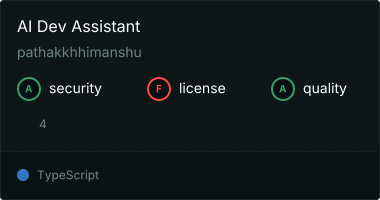
Copy to your README.md:
Score Badge

Copy to your README.md:
Latest Blog Posts
- Who's Calling? MCP Hosts Are an Identity Blind Spot (And the Spec Knows It)By Om-Shree-0709 on .mcpAgent IdentityOAuth 2.1
- Your AI Chatbot Just Exposed Your CEO's Salary to an InternBy Om-Shree-0709 on .Agent IdentityMCP SecurityOAuth Delegation
- Why MCP Servers Need Execution Sandboxing (And Why Your Current Stack Isn't Enough)By Om-Shree-0709 on .Agentic AiPrompt InjectionWebAssembly
MCP directory API
We provide all the information about MCP servers via our MCP API.
curl -X GET 'https://glama.ai/api/mcp/v1/servers/pathakkhhimanshu/MCP'
If you have feedback or need assistance with the MCP directory API, please join our Discord server