Voyp MCP Server
The Voyp MCP server lets AI assistants make and monitor real phone calls through the Voyp API.
Start a call (
start_call) to any number in E.164 format with a context brief (e.g. "Order a pizza") and optional language, returning a call ID and tracking URLHang up a call (
hangup_call) by call IDTrack a call (
get_call) to retrieve call details and progressSearch for businesses (
search_places) by free-text query and location, e.g. "italian restaurants in New York City, US"Look up a specific place (
search_place) by name and location for detailsReverse-lookup a number (
search_place_by_number) to find the place name and address behind a phone numberRead your profile (
get_user) to retrieve Voyp account detailsUse it conversationally — book appointments, reservations or inquiries via calls, with the bundled Voyp skill guiding number checks, briefings, and user confirmation before dialing
Links to demonstration videos showing how the Voyp MCP server works with Claude Desktop and Goose
Click on "Deploy Server".
Wait a few minutes for the server to deploy. Once ready, it will show a "Started" state.
In the chat, type
@followed by the MCP server name and your instructions, e.g., "@Voyp MCP Server call my dentist to schedule a cleaning appointment for next week"
That's it! The server will respond to your query, and you can continue using it as needed.
Here is a step-by-step guide with screenshots.
Voyp Model Context Protocol server
The Model Context Protocol (MCP) is an open standard that enables AI systems to interact seamlessly with various data sources and tools, facilitating secure, two-way connections.
Developed by Anthropic, the Model Context Protocol (MCP) enables AI assistants like Claude to seamlessly integrate with VOYP's calling capabilities. This integration provides AI models with possibility of making phone calls and monitor their progress.
The Voyp MCP server allows you to:
Construct robust call contexts to use when making calls
Search for business information when calling restaurants, dentists, etc...
Call and make appointments, reservations, consultations, inquiries, etc...
Provide status of the call
Hangup call
Voyp skill for AI agents 🧠
This repository includes a Voyp skill (skills/voyp) in the
Agent Skills format. The MCP server gives an agent the tools to make calls.
The skill teaches it how to use them well: find and check the number, write a full call
briefing, ask the user before every call, follow the call live, and report the result.
It works in Claude Code, the Claude apps, the Claude API, and other agents that support skills.
Quick install for Claude Code (installs the skill and the hosted Voyp MCP server):
/plugin install voyp --marketplace paulotaylor/voyp-mcpOn older Claude Code versions, run /plugin marketplace add paulotaylor/voyp-mcp, then /plugin install voyp@voyp.
Afterwards run /mcp and sign in to Voyp.
For other agents:
npx skills add paulotaylor/voyp-mcpSee docs/SKILL.md for every install method (Claude Code, claude.ai and Claude Desktop, Claude API, Codex, Cursor and other agents), usage, and troubleshooting.
Related MCP server: bubblyphone-agents
Prerequisites 🔧
Before you use Voyp, you need:
You will also need to buy credits to spend while making calls. You can also buy credits here
Claude Desktop, Goose or other compatible clients
Node.js (v20 or higher)
You can verify your Node.js installation by running:
node --version
Git installed (only needed if using Git installation method)
On macOS:
brew install gitOn Linux:
Debian/Ubuntu:
sudo apt install gitRedHat/CentOS:
sudo yum install git
On Windows: Download Git for Windows
Remote Voyp MCP server (Http Streamable)
You can connect directly to the stream-enabled endpoint here:
https://api.voyp.app/mcp/stream
It accepts two kinds of credentials in the Authorization header:
OAuth 2.1 (recommended for apps such as Claude, ChatGPT or Claude Code): connect without a token and the client signs you in to Voyp in the browser. The server publishes its OAuth metadata at
https://api.voyp.app/.well-known/oauth-protected-resource.Voyp API key: for clients that let you set headers (Goose, Cursor, scripts, agent SDKs). Get your key at voyp.app:
Authorization: Bearer sk_xyzAn API key gives full access to your Voyp account, so keep it secret.
Example client config with an API key:
{
"mcpServers": {
"voyp": {
"type": "http",
"url": "https://api.voyp.app/mcp/stream",
"headers": { "Authorization": "Bearer sk_xyz" }
}
}
}Voyp MCP server installation for Goose ⚡ (Stdio)
To install the voyp-mcp server you will need to add the extension manually.
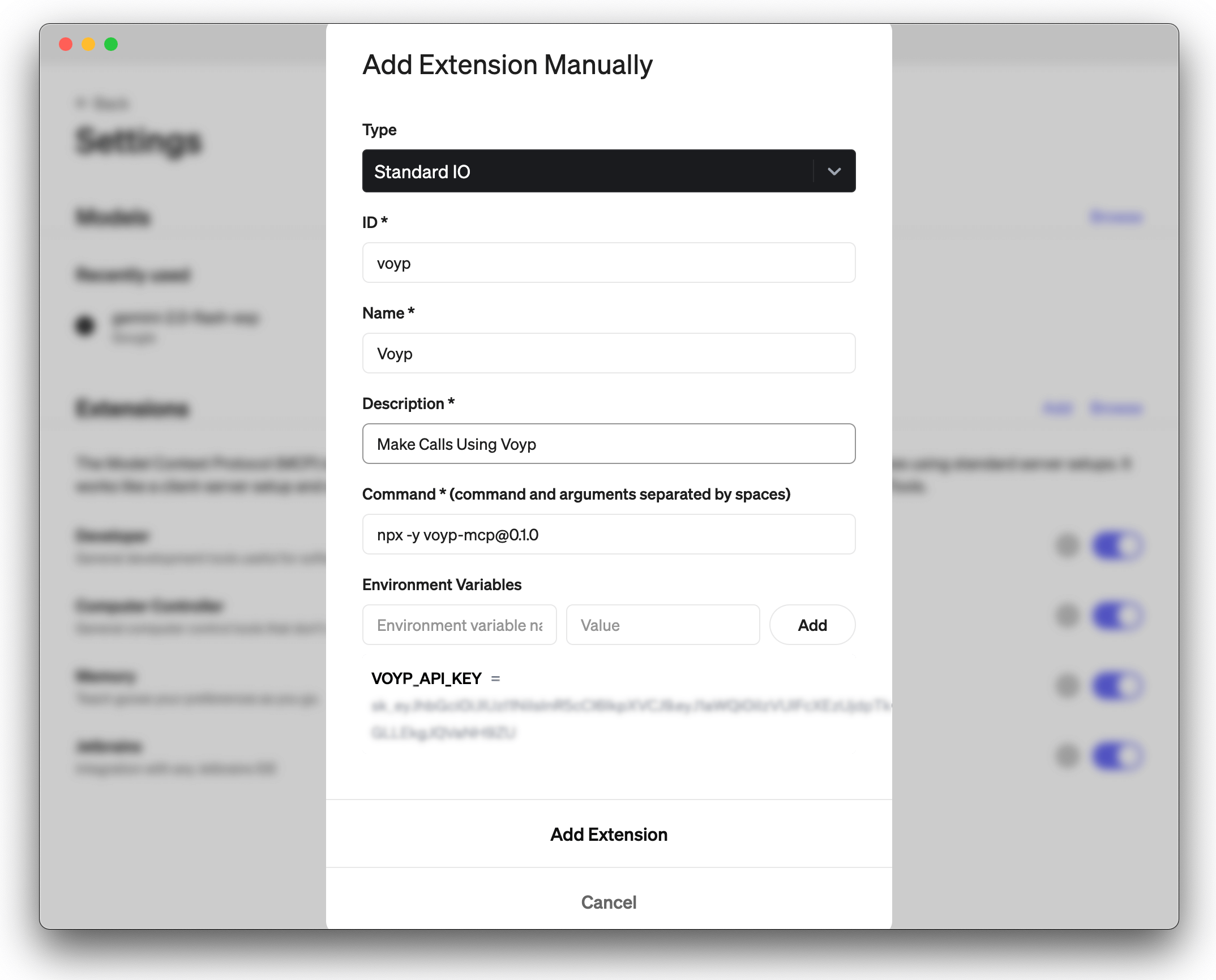
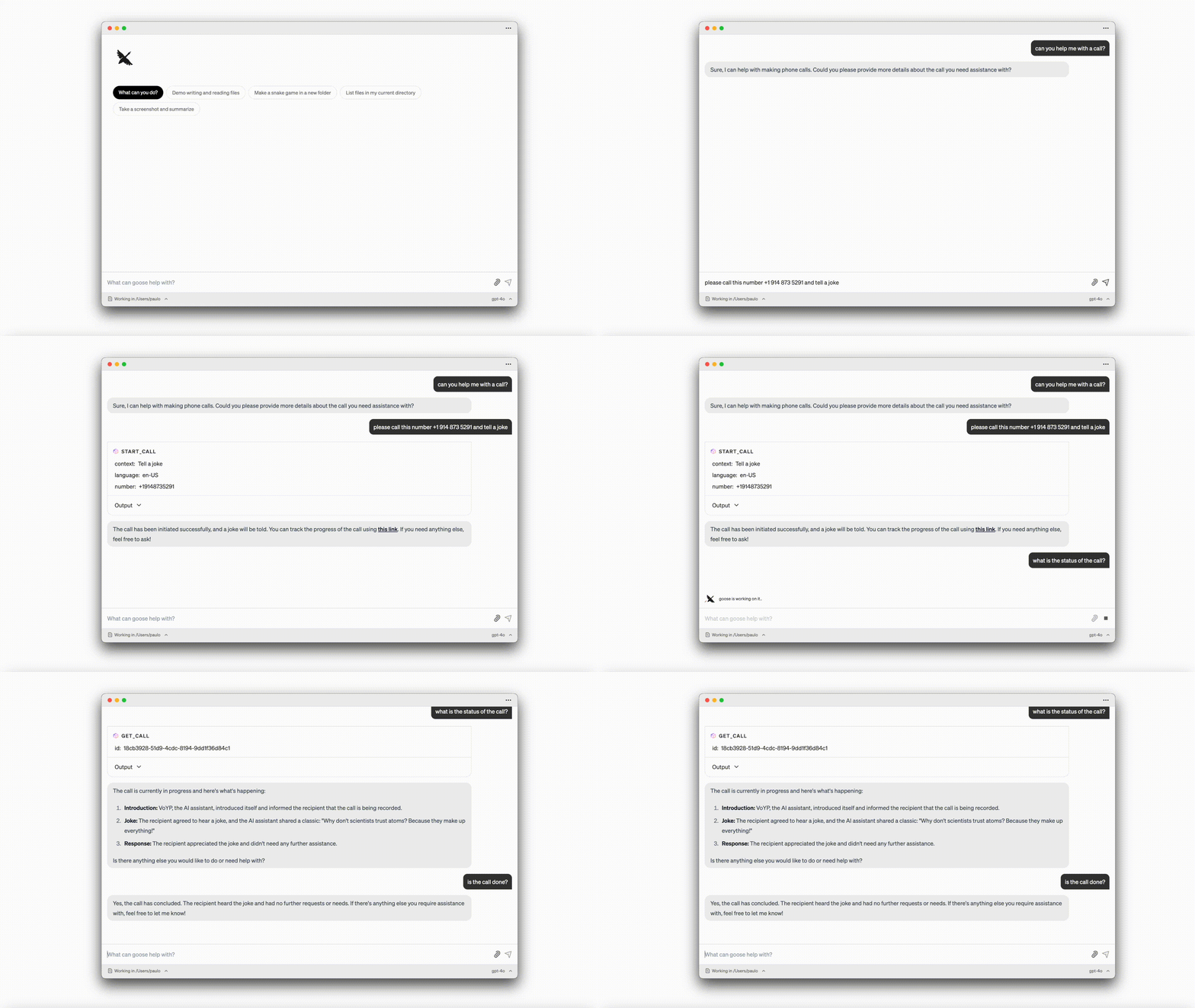
Voyp + Goose Demo:
Voyp MCP server installation for Claude Desktop ⚡ (Stdio)
To install the voyp-mcp server, you can use the following methods:
Installing via Smithery
Running with NPX
Git installation
1. Installing via Smithery
To install Voyp Model Context Protocol server for Claude Desktop automatically via Smithery:
npx -y @smithery/cli install @paulotaylor/voyp-mcp --client claude2. Running with NPX
npx -y voyp-mcp@0.1.0 Although you can launch a server on its own, it's not particularly helpful in isolation. Instead, you should integrate it into an MCP client. Below is an example of how to configure the Claude Desktop app to work with the voyp-mcp server.
Configuring the Claude Desktop app ⚙️
For macOS:
# Create the config file if it doesn't exist
touch "$HOME/Library/Application Support/Claude/claude_desktop_config.json"
# Opens the config file in TextEdit
open -e "$HOME/Library/Application Support/Claude/claude_desktop_config.json"
# Alternative method using Visual Studio Code (requires VS Code to be installed)
code "$HOME/Library/Application Support/Claude/claude_desktop_config.json"For Windows:
code %APPDATA%\Claude\claude_desktop_config.jsonAdd the Voyp server configuration:
Replace your-VOYP-api-key with your actual VOYP API key.
{
"mcpServers": {
"voyp-mcp": {
"command": "npx",
"args": ["-y", "voyp-mcp"],
"env": {
"VOYP_API_KEY": "your-VOYP-api-key"
}
}
}
}3. Git Installation
Clone the repository:
git clone https://github.com/paulotaylor/voyp-mcp.git
cd voyp-mcpInstall dependencies:
npm installBuild the project:
npm run buildConfiguring the Claude Desktop app ⚙️
Follow the configuration steps outlined in the Configuring the Claude Desktop app section above, using the below JSON configuration.
Replace your-VOYP-api-key-here with your actual VOYP API key and /path/to/voyp-mcp with the actual path where you cloned the repository on your system.
{
"mcpServers": {
"voyp": {
"command": "npx",
"args": ["/path/to/voyp-mcp/build/index.js"],
"env": {
"VOYP_API_KEY": "your-VOYP-api-key"
}
}
}
}Usage in Claude Desktop App 🎯
Once the installation is complete, and the Claude desktop app is configured, you must completely close and re-open the Claude desktop app to see the voyp-mcp server. You should see a hammer icon in the bottom left of the app, indicating available MCP tools, you can click on the hammer icon to see more details on the start_call and hangup_call tools.
Now claude will have complete access to the voyp-mcp server, including the start_call and hangup_call tools.
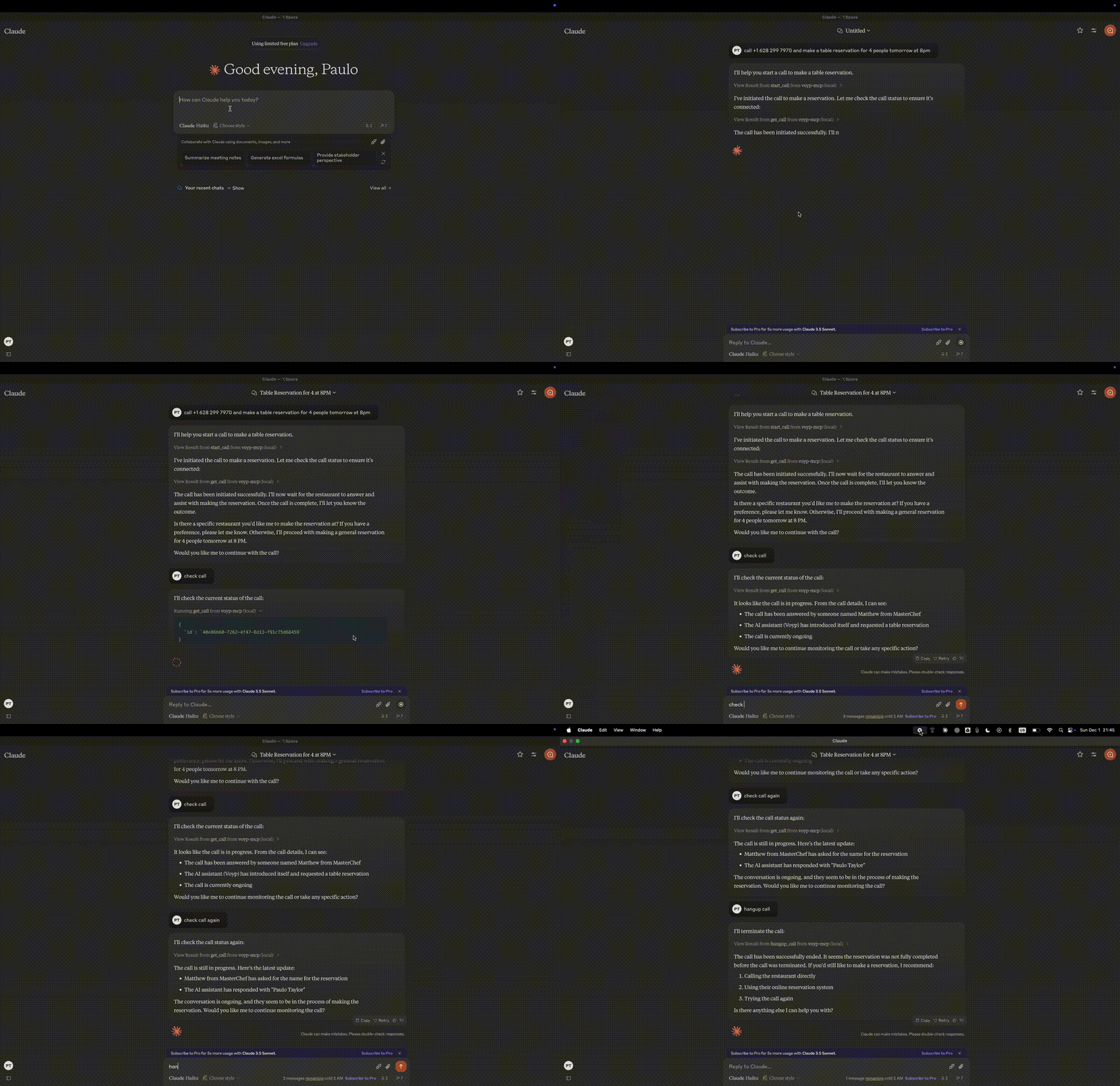
Voyp + Claude Desktop Demo:
Troubleshooting 🛠️
Common Issues
Server Not Found
Verify the npm installation by running
npm --verisonCheck Claude Desktop configuration syntax by running
code ~/Library/Application\ Support/Claude/claude_desktop_config.jsonEnsure Node.js is properly installed by running
node --version
NPX related issues
If you encounter errors related to
npx, you may need to use the full path to the npx executable instead.You can find this path by running
which npxin your terminal, then replace the"command": "npx"line with"command": "/full/path/to/npx"in your configuration.
API Key Issues
Confirm your VOYP API key is valid
Check the API key is correctly set in the config
Verify no spaces or quotes around the API key
Acknowledgments ✨
Model Context Protocol for the MCP specification
Anthropic for Claude Desktop
Available Tools
7 toolsget_callC
Retrieve call details
Inputs: id (required).
get_userB
Retrieve user profile
Inputs: no named parameters.
hangup_callC
Hangup an existing call
Inputs: id (required).
search_placeC
Search place details in a given location
Inputs: place (required), location (required).
search_place_by_numberB
Find place name and address by phone number
Inputs: number (required).
search_placesC
Search places in a given location
Inputs: search (required).
start_callC
Start a new phone call via Voyp API. The API returns the call id and a URL where users can track the progress of the call
Inputs: number (required), context (required), language.
Tool Schema Changelog
Recent tool additions, removals, and schema changes observed during successful MCP inspections.
Loading tool schema changelog…
TDQS
Scored across 7 tools
The tools have some clear distinctions, such as get_call vs. hangup_call vs. start_call for call operations, but there is significant overlap between search_place, search_places, and search_place_by_number, which could cause confusion about which to use for location-based searches. The descriptions help clarify, but the boundaries are not perfectly distinct.
Most tools follow a consistent verb_noun pattern (e.g., get_call, get_user, hangup_call, start_call), with clear and readable naming. However, the search tools have minor deviations (search_place, search_places, search_place_by_number), which slightly disrupts the pattern but remains mostly consistent.
With 7 tools, the count is well-scoped for a server focused on phone calls and place searches. Each tool appears to serve a specific purpose without unnecessary duplication, fitting within the typical 3-15 range for a coherent toolset.
For call operations, there is good coverage with get, start, and hangup, but missing update or list operations for calls or users could be a gap. For place searches, the tools cover various search methods, but without create or delete operations, the surface feels incomplete for a full lifecycle in the domain.
Maintenance
Related MCP Connectors
The Telnyx MCP server is an official implementation of the Model Context Protocol that enables AI clients (like Claude Desktop, Cursor, and OpenAI Agents) to interact with Telnyx's telephony, messaging, and AI assistant APIs. It provides comprehensive capabilities including making and managing phone calls, sending SMS/MMS messages, purchasing and configuring phone numbers, creating AI assistants with custom instructions, managing cloud storage buckets, scraping and embedding website content, and handling integration secrets. The server exists as both a local implementation and a remotely hosted version, allowing developers to integrate real-world communication infrastructure directly into AI applications.
Phone call MCP server: AI agents place and answer real calls, text, email and WhatsApp via KaiCalls.
Lets Claude, Cursor or any MCP client build voice agents and place real phone calls.
JooVoice lets your AI assistant make real phone calls for you through MCP. Ask it to book a table or appointment, change a reservation, cancel a subscription, request a refund, or check stock and opening hours. Get the outcome back in your chat, with the call recording and transcript. You choose when calls need your approval. Personal calls, such as birthday wishes or family check-ins, use a recipient consent link. Learn more at https://joovoice.com.
Related MCP Servers
- AlicenseNot gradedqualityDmaintenanceA Model Context Protocol server that enables AI models to interact with VoIPBin's VoIP services, supporting features like call management, agent management, campaigns, conferences, and chat functionality.4MIT
- AlicenseAqualityDmaintenanceMCP server for BubblyPhone that lets AI assistants make real phone calls, manage AI voice agents, buy phone numbers in 30+ countries, and track billing. Supports 20 tools for full telephony control.201MIT
- AlicenseAqualityDmaintenanceMCP server for Vapi.ai that enables AI coding assistants to manage voice assistants, make outbound calls, and access call history directly from their development environment.165 npm2MIT

oitvoip-mcp-serverofficial
AlicenseBqualityDmaintenanceA Model Context Protocol (MCP) server that provides AI agents with seamless access to the NetSapiens VoIP platform for user management, call analytics, and system administration.235MIT