A
licenseA
qualityD
maintenanceECB data for AI agents — rates, yields, inflation, money supply, and 100+ datasets. No API key.
8
64 npm
4
MIT

Europäische Finanzdaten für KI-Agenten EZB-Zinssätze · Eurostat-Inflation · BIP · Arbeitslosigkeit · Kein API-Schlüssel erforderlich


Claude Code — ein Befehl:
claude mcp add eu-finance -- npx -y @nexusforgetools/eu-financeClaude Desktop / Cursor / Windsurf — zur MCP-Konfiguration hinzufügen:
{
  "mcpServers": {
    "eu-finance": {
      "command": "npx",
      "args": ["-y", "@nexusforgetools/eu-finance"]
    }
  }
}
Related MCP server: publicfinance
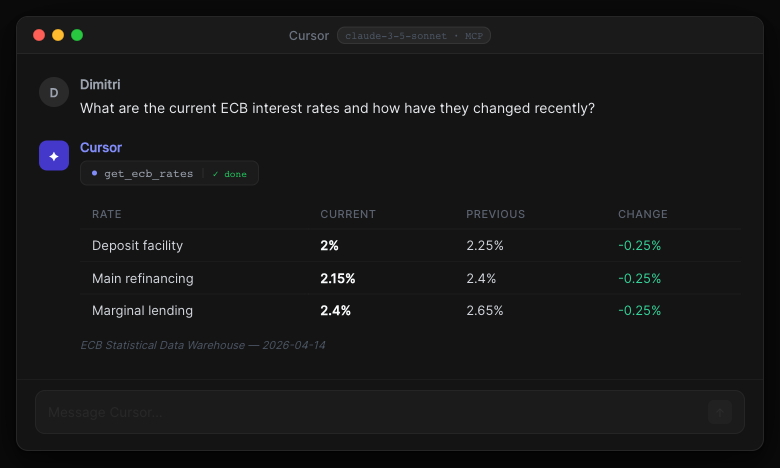
"Wie hoch ist der aktuelle Einlagenzinssatz der EZB und wie ist er im Vergleich zum Vorjahr?"
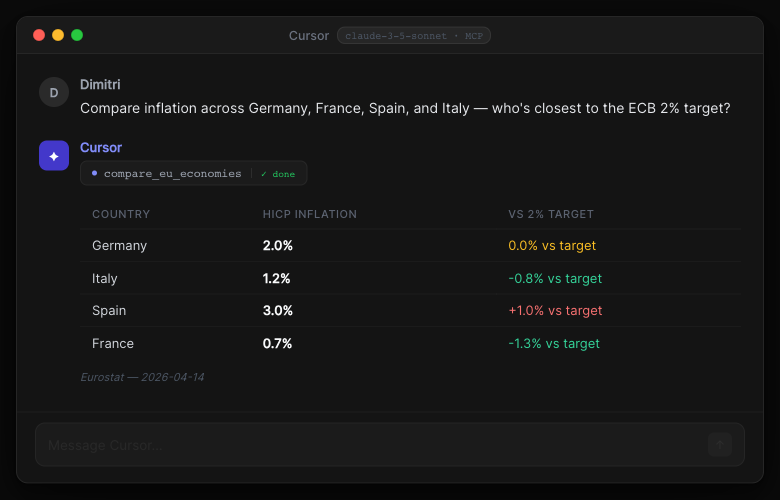
"Vergleiche die Inflation in Deutschland, Frankreich, Spanien und Italien – wer liegt am nächsten am 2%-Ziel?"
"Zeige mir das BIP-Wachstum im 4. Quartal für die Eurozone im Vergleich zum EU-27-Durchschnitt."
"Wie ist der EUR/USD-Kurs heute? Wie war er am 15.01.2024?"
Tool | Beschreibung | Quelle |
| EZB-Leitzinsen: Einlagefazilität, Hauptrefinanzierung, Spitzenrefinanzierung | EZB SDW |
| EUR-Wechselkurse gegenüber jeder Währung — aktuell oder historisch nach Datum | EZB / Frankfurter |
| HVPI-Inflationsraten für alle EU-Länder — jährliche %-Änderung | Eurostat |
| Quartalsweise BIP-Daten — Wachstumsrate oder absoluter Wert, alle EU-Länder | Eurostat |
| Monatliche Arbeitslosenquoten — saisonbereinigt, nach Altersgruppen | Eurostat |
| Vergleichs-Snapshot: Inflation + BIP + Arbeitslosigkeit für 2-10 Länder | Eurostat |
eu-finance ist während der Beta-Phase kostenlos. Pro erscheint im zweiten Monat mit höheren Ratenlimits und allen gebündelten NexusForge-Servern.
Paket | Beschreibung | Status |
| Scraping & strukturierte Datenanreicherung | Demnächst |
| Marktgrößen, Wettbewerber, Trends | Demnächst |
Fetches the latest inflation, GDP growth, and unemployment for 2-10 EU countries in a single parallel call to Eurostat. Returns a JSON object with: countries (array of per-country snapshots, each containing country as full name, country_code, inflation as {rate, period} or null, gdp_growth as {rate, period} or null, unemployment as {rate, period} or null), source, and retrieved_at as ISO 8601. Each indicator returns the single most recent available value. Inflation period is YYYY-MM; GDP period is YYYY-Qq; unemployment period is YYYY-MM. Data is cached 24 hours. USAGE: Prefer this tool over calling get_eu_inflation, get_eu_gdp, and get_eu_unemployment separately when building dashboards or running multi-indicator comparisons — it reduces latency by parallelizing the three Eurostat requests. Each indicator's period may differ due to different Eurostat release schedules (inflation lags ~30 days, GDP ~90 days). An indicator field is null when Eurostat has not published recent data — always handle null gracefully. Use the indicators parameter to skip unneeded metrics and reduce API calls.
Inputs: countries (required), indicators.
Fetches the three ECB key interest rates from the ECB Statistical Data Warehouse (SDMX). Returns a JSON object with rates containing three entries — deposit_facility, main_refinancing, and marginal_lending — each with date (YYYY-MM-DD of the last rate change) and value (percentage as a number). Also includes source and retrieved_at as ISO 8601. Results are cached for 1 hour. USAGE: These are ECB policy rates, not real-time market rates — they only change at Governing Council meetings (roughly every 6 weeks). The date field indicates when the current rate was set, not today's date. For currency conversion use get_euro_exchange; these rates are not applicable for forex calculations. Use get_eu_inflation alongside this tool to assess the real interest rate (nominal rate minus inflation).
Inputs: no named parameters.
Fetches quarterly GDP data for EU/Eurozone countries from Eurostat (dataset: namq_10_gdp). Returns a JSON object with: data (array of objects, each containing country as a full name string, period in YYYY-Qq format e.g. "2024-Q3", value as a number, and unit as a string label), source, and retrieved_at as ISO 8601. Defaults to year-on-year growth rate (%) for EA20, EU27_2020, DE, FR, IT, ES over the last 4 quarters. Data is cached 24 hours. Missing periods are omitted from the array (not returned as null). USAGE: Use unit=CLV_PCH_SM (default) for cross-country growth comparisons. Use unit=CP_MEUR to compare absolute GDP size. Use unit=CLV_PCH_PRE for quarter-on-quarter momentum. Use unit=CLV10_MEUR for real GDP volume excluding price effects. Typical Eurostat data lag is 60-90 days after quarter end — the most recent quarter may be absent. Request quarters=8 or more for recession analysis or multi-year trend charts.
Inputs: countries, unit, quarters.
Fetches HICP (Harmonised Index of Consumer Prices) annual inflation rates for EU countries from Eurostat (dataset: prc_hicp_manr). Returns a JSON object with: data (array of objects containing country as full name, period in YYYY-MM format, and rate as a numeric annual percentage change), unit ("Annual rate of change (%)"), source, and retrieved_at as ISO 8601. Defaults to the latest single month for all 29 EU members and aggregates. Data is cached 24 hours. USAGE: HICP is the EU-harmonised inflation standard used by the ECB for monetary policy — use it (not national CPI) for cross-country comparisons. Use country code EA for the Eurozone aggregate or EU27_2020 for the full EU-27 aggregate. Typical data lag is 30-45 days after the reference month. Set periods=12 to retrieve a 12-month trend. Pair with get_ecb_rates to contextualize how the ECB policy rate relates to current inflation.
Inputs: countries, periods.
Fetches EUR exchange rates against other currencies from the ECB via Frankfurter API. Returns a JSON object with: base ("EUR"), date (YYYY-MM-DD of the rate), rates (object mapping 3-letter currency codes to numeric values representing how many units of that currency equal 1 EUR), source, and retrieved_at as ISO 8601. Latest rates are cached 1 hour; historical rates are cached permanently. USAGE: Supports 33 currencies including USD, GBP, JPY, CHF, CNY, SEK, PLN, and others. Omit date for the latest available rates. Provide date in YYYY-MM-DD format for historical rates (available from 1999-01-04). These are ECB reference rates published at ~16:00 CET — not real-time mid-market rates; expect small spreads vs live quotes. Requests for weekends or ECB holidays return the previous business day's rates. Returns an error for dates before 1999-01-04 or future dates.
Inputs: currencies, date.
Fetches monthly unemployment rates for EU countries from Eurostat (dataset: une_rt_m), seasonally adjusted, as a percentage of the active population. Returns a JSON object with: data (array of objects containing country as full name, period in YYYY-MM format, rate as a numeric percentage, age_group, and sex), unit ("Percentage of active population (%)"), source, and retrieved_at as ISO 8601. Defaults to TOTAL age group for EA20, EU27_2020, DE, FR, IT, ES, PL, NL over the last 3 months. Data is cached 24 hours. USAGE: Use age=Y15-24 for youth unemployment, which is typically 2-3x the overall rate. Data is seasonally adjusted (SA) — do not apply additional seasonal correction. Typical Eurostat lag is 30-60 days after the reference month. Set months=12 or more for trend and cyclical analysis. Non-EU countries (e.g. US, UK) are not available — use this tool only for EU member states and EA20/EU27_2020 aggregates.
Inputs: countries, months, age.
Recent tool additions, removals, and schema changes observed during successful MCP inspections.
Loading tool schema changelog…
Scored across 6 tools
Each tool has a clearly distinct purpose. The `compare_eu_economies` tool is designed for multi-country, multi-indicator comparisons, while the individual getter tools allow for more detailed, single-indicator queries. Their descriptions clearly delineate when to use each, preventing confusion.
All tool names follow a consistent `verb_noun` pattern using lowercase and underscores (e.g., `compare_eu_economies`, `get_ecb_rates`, `get_eu_gdp`). The verbs are specific and the nouns precisely describe the resource, making the naming predictable and easy to understand.
With 6 tools, the set is well-scoped for a server focused on EU economic data and exchange rates. It provides sufficient functionality without being overwhelming, covering the core indicators requested by users interested in European finance.
The tool set covers the major EU economic indicators (inflation, GDP, unemployment, ECB rates, exchange rates) and offers a convenient multi-indicator comparison. Minor gaps exist, such as the absence of tools for other ECB policy tools or more granular GDP components, but the essential lifecycle is covered for its stated purpose.
Official statistics for AI agents: Eurostat, World Bank, OECD, IMF and WHO data for 150+ countries.
Macro data for AI agents: GDP, inflation, unemployment and more (World Bank, US BLS). No keys.
Macro data for AI agents: GDP, inflation, unemployment and more (World Bank, US BLS). No keys.
Macroeconomic and market data for AI agents: rates, credit, volatility, calendars and screeners.
