
datasaudi-mcp
<!-- mcp-name: io.github.mohsinmshabbir/datasaudi-mcp -->
<div align="center">
# datasaudi-mcp
*Ask Claude, Cursor, or any MCP client about the Saudi economy —*
*in plain English **or Arabic**. No API key. No database.*
[](https://pypi.org/project/datasaudi-mcp/)
[](https://registry.modelcontextprotocol.io/v0/servers?search=datasaudi)
[](LICENSE)
[](https://www.python.org/)
[](https://github.com/mohsinmshabbir/datasaudi-mcp/actions)
<br/>
**[Ask it](#ask-it-anything)** · **[Coverage](#what-you-can-ask-about)** · **[Install](#install)** · **[العربية](#arabic-support)** · **[Tools](#the-tools)**
</div>
---
GDP, inflation, trade, population, the real‑estate price index — **277 official
[GASTAT](https://www.stats.gov.sa) datasets**, live from [DataSaudi](https://datasaudi.sa),
answered right inside your AI client. You never name a dataset; the model finds it.
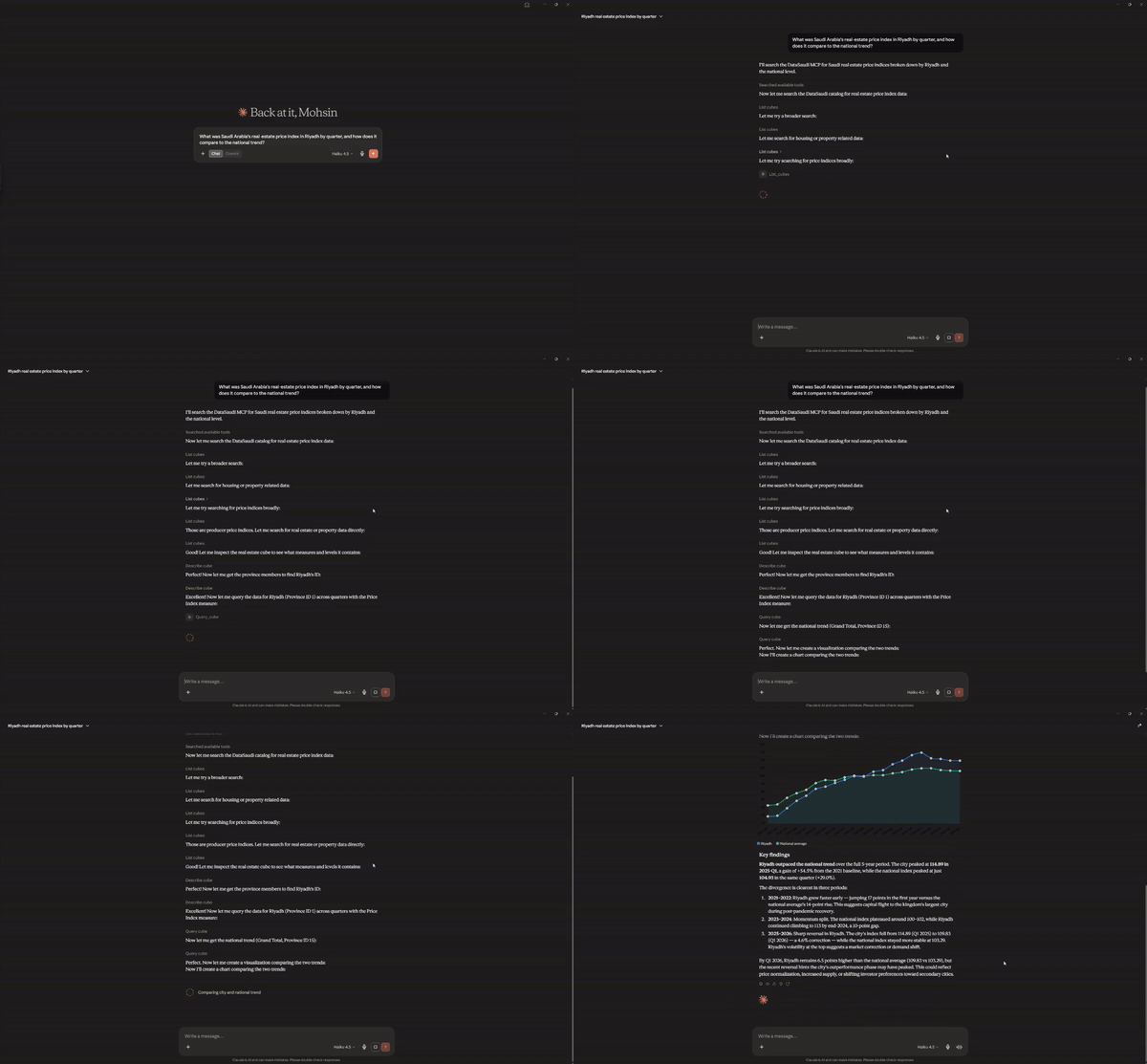
Here it is in Claude Desktop — one plain‑English question, and the model finds the dataset,
pulls Riyadh's real‑estate price index against the national trend, and charts it:
---
## Ask it anything
Connect it in about 2 minutes ([Install](#install)), then just ask:
> 💬 *"What was the real‑estate price index in Riyadh by quarter, and how does it
> compare to the national trend?"*
> 💬 *"Who are Saudi Arabia's top trading partners? Break foreign trade down by
> country and exports vs. imports."*
> 🇸🇦 *"اعرض الرقم القياسي لأسعار العقارات في الرياض حسب الربع"*
> — ask in Arabic, get Arabic back (`الرياض`, `مكة المكرمة`). See [Arabic support](#arabic-support).
The model discovers the right dataset, pulls the numbers, and answers. **You don't need to
know any dataset names or query syntax.**
<details>
<summary><b>More example prompts</b></summary>
<br/>
- *"Show me inflation and the CPI by province for the latest year — which regions were highest?"*
- *"How has the real‑estate price index differed between villas and apartments over time?"*
- *"What's the population by province, split by sex and nationality (Saudi vs. non‑Saudi)?"*
- *"Show me real GDP by economic sector, quarter over quarter, with year‑on‑year growth."*
- *"Compare average monthly wages: Saudi vs. non‑Saudi, and men vs. women."*
</details>
---
## What you can ask about
277 curated GASTAT / DataSaudi datasets. Every query hits the **live** API, so the numbers
are as current as GASTAT publishes.
<table>
<tr>
<td width="50%" valign="top">
**📈 Economy**
GDP (sector / expenditure / activity), CPI & inflation (national + by province), the
Producer Price Index, FDI, foreign trade (country / product / flow), the trade balance,
business & consumer confidence.
</td>
<td width="50%" valign="top">
**👥 Society**
Population (province / sex / nationality / age), households & dwellings, wages, employment
& participation rates, education, health, disability.
</td>
</tr>
<tr>
<td width="50%" valign="top">
**🏗️ Real estate**
The price **index** by province and property type (villa / apartment / land), building
permits, the construction cost index, housing tenure & type.
</td>
<td width="50%" valign="top">
**🌍 More**
Tourism & hotel occupancy, energy & water, Hajj & Umrah, SAMA financial series,
internationally‑reported (World Bank / UN) indicators.
</td>
</tr>
</table>
> [!IMPORTANT]
> **Where it stops — on purpose.** A data tool you can trust tells you its edges.
> - Serves the real‑estate **price index** (base‑year 100) — **not per‑deal prices in riyals** (those live in MoJ / Srem).
> - No MoJ transaction volumes, no REGA, no municipal / ZATCA / CMA data, no microdata. This is the ~277‑series *headline‑indicator* layer, not the full national corpus.
> - Geographic detail stops at the **province** level for most series — no city / district breakdown.
>
> Ask for something outside this and the server says so plainly, rather than guessing.
---
## Install
No API key, nothing to configure — DataSaudi is keyless. You'll need
[`uv`](https://docs.astral.sh/uv/getting-started/installation/) installed.
**Claude Code** — one line, no file editing:
```bash
claude mcp add datasaudi -- uvx datasaudi-mcp
```
<details>
<summary><b>Claude Desktop</b></summary>
<br/>
`Settings → Developer → Edit Config`, add the block below, then **completely quit and reopen**
Claude Desktop (fully quit from the tray — not just close the window):
```json
{
"mcpServers": {
"datasaudi": {
"command": "uvx",
"args": ["datasaudi-mcp"]
}
}
}
```
</details>
<details>
<summary><b>Cursor</b></summary>
<br/>
`Settings → Tools & MCP → New MCP Server` (or edit `~/.cursor/mcp.json`), same block:
```json
{
"mcpServers": {
"datasaudi": {
"command": "uvx",
"args": ["datasaudi-mcp"]
}
}
}
```
</details>
Then ask one of the questions above.
---
## Arabic support
Saudi data in Arabic, as a first‑class feature — not an afterthought.
- **Ask in Arabic, get Arabic back.** Member names return in Arabic script: `الرياض` for
Riyadh, `مكة المكرمة` for Makkah, `المنطقة الشرقية` for the Eastern Region.
- **Catalog search works in Arabic too** — an Arabic term matches the datasets' Arabic
topic / source annotations.
- **Numbers and structure are identical** across languages — only the human‑readable
captions change.
---
## The tools
Three tools do the work; the model calls them for you.
| Tool | What it does |
|---|---|
| `list_cubes` | Search the 277‑dataset catalog by keyword (English or Arabic). |
| `describe_cube` | Show one dataset's breakdown dimensions and measures. |
| `query_cube` | Run a validated query and return tidy rows — with the query echoed back and honest paging. |
<details>
<summary><b>Troubleshooting — "datasaudi" doesn't show up</b></summary>
<br/>
- Did you **fully quit and reopen** the app? (Closing the window isn't enough — quit from the tray.)
- Is your config valid JSON? A stray comma breaks the whole file — paste it into a JSON validator.
- Is `uv` installed and on your PATH? Run `uvx --version` in a terminal.
- Check the client's MCP / tools panel for an error message next to `datasaudi`.
</details>
<details>
<summary><b>Data source & freshness</b></summary>
<br/>
Data comes live from `api.datasaudi.sa` (the DataSaudi Tesseract API, operated by the
Ministry of Economy & Planning; data produced by GASTAT). The server holds **no local copy**
— every query is fetched fresh, so results are always as current as DataSaudi itself. Only
the lightweight dataset *catalog* is cached in memory for the session.
DataSaudi's data‑usage terms are set by its operator; this project is an independent
open‑source client and attributes GASTAT / MEP as the source. Please review DataSaudi's
terms for your use case.
</details>
---
## Contributing
Contributions welcome — see [`CONTRIBUTING.md`](CONTRIBUTING.md). To develop locally:
```bash
git clone https://github.com/mohsinmshabbir/datasaudi-mcp
cd datasaudi-mcp
uv sync --all-extras
uv run pytest -m "not live" # offline test suite
uv run pytest -m live # optional: hits the real API
```
## License
MIT — see [LICENSE](LICENSE).
TDQS
Scored across 3 tools
Each tool has a clearly distinct purpose: describe_cube for metadata of a specific cube, list_cubes for searching the catalog, and query_cube for fetching data. There is no overlap or ambiguity in their functions.
All tool names follow a consistent verb_noun pattern in snake_case: describe_cube, list_cubes, query_cube. This is perfectly regular and predictable.
Three tools is appropriate for a focused data catalog server covering discovery, schema exploration, and data retrieval. While minimal, each tool earns its place and the set feels complete.
The tool set fully covers the main workflows: listing cubes, describing their structure, and querying with drilldowns and measures. Pagination and filtering are well addressed through parameters, leaving no obvious gaps.