
Mnemosure
by jsiksn
README.md
# Mnemosure
**English** | [한국어](README.ko.md)
> An AI memory layer that says *"I don't know"* when it doesn't, and cites its source when it does.
Across many sessions of AI-assisted work, two failures compound: the assistant **forgets** decisions that were made, and it **hallucinates** ones that were not. Mnemosure is a source-grounded memory layer that attacks both.
Its core claim: **it does not invent what it cannot remember, and it does not drop what it remembers.**
One API key ([OpenRouter](https://openrouter.ai)) drives the whole pipeline — pick any chat, embedding, and rerank model you like (Claude, GPT, Qwen, …), or compute embeddings locally with no key at all.
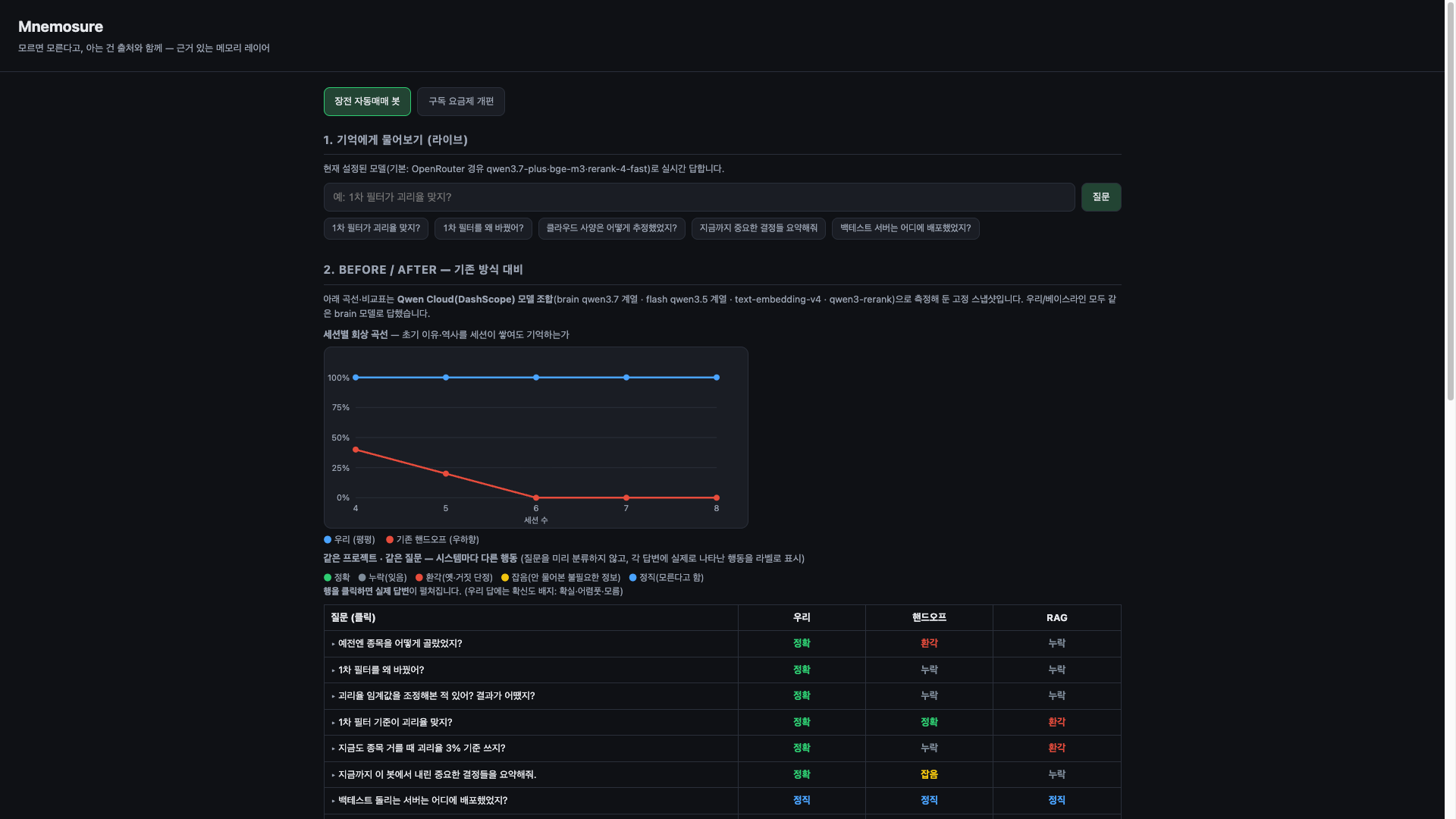
*Demo UI (Korean). In the recall curve, Mnemosure (blue) keeps answering early questions correctly as sessions pile up, while summary-handoff (red) decays to zero. The table labels each system's actual answer per question — green = accurate, red = hallucination, gray = omission.*
---
## What it does
- **Stores** durable facts from a conversation — decisions, changes, failures, established facts — and throws away the chatter.
- **Links** memories over time: when a new decision overrides an old one, the old one is marked `superseded`; the *reason* for a change is linked back to the failure that caused it (`because`).
- **Recalls** with a confidence level and citations. When the evidence overrides an old memory, the answer *corrects* the old fact instead of repeating it. When there is no evidence, it answers *"not in the record"* instead of guessing.
Every answer comes back as one of three confidence levels — **certain / vague / unknown** — with the source of each cited memory.
## Architecture
```mermaid
flowchart TB
MCP["MCP server · stdio<br/>recall · remember · list_memories"]
WEB["Demo web · FastAPI<br/>/ask · /memories · /results"]
subgraph Ingest["Ingest (remember)"]
direction TB
S["Session text"] --> EX["Extract · flash chat model<br/>decision / change / failure / fact"]
EX --> EMB1["Embed · bge-m3 · 1024d"]
EMB1 --> LINK["Link associations<br/>supersedes: cosine ≥ 0.35 → flash verdict<br/>because: failure, cosine ≥ 0.15 → flash is_cause"]
LINK --> STORE[("memories.json<br/>(JSON warehouse)")]
end
subgraph Recall["Recall (recall)"]
direction TB
Q["Query"] --> EMB2["Embed query"]
EMB2 --> COS["Cosine top-6<br/>superseded included"]
COS --> RR["Rerank (optional)<br/>top score under floor → 'unknown'"]
RR --> EXP["Associative expand<br/>supersedes / because · 2 hops"]
EXP --> ANS["Answer · brain chat model · temp 0<br/>confidence + answer + citations"]
end
MCP --> S
MCP --> Q
WEB --> Q
STORE -. retrieve .-> COS
STORE -. expand .-> EXP
```
**Ingest** (`mnemosure/memory/store.py`): a session is passed to the flash chat model, which extracts only what will matter later. Each memory is embedded, then two kinds of association are drawn — a lexical prefilter (cosine similarity) proposes candidates and the flash model makes the final call, so nothing is linked on surface similarity alone. Failures are never superseded (lessons are kept forever).
**Recall** (`mnemosure/memory/recall.py`): the query is embedded and the top candidates are pulled — *including superseded ones*, because correcting a stale belief requires finding it first. The rerank model re-orders by relevance; if even the best hit is too weak, the answer is **unknown** rather than a guess. The surviving seeds are expanded two hops along their `supersedes`/`because` links, and the brain model composes the final answer **grounded only in that evidence** (temperature 0). Broad "summarize everything" questions bypass top-K and ground on all active memories so nothing is dropped.
## Models — four roles, the heavy ones run on your machine
| Role | Default model | Runs where | Key |
|---|---|---|---|
| Index (embedding, 1024-dim) | `intfloat/multilingual-e5-large` | **your machine** | not needed |
| Precision rerank | `jinaai/jina-reranker-v2-base-multilingual` | **your machine** | not needed |
| Brain (answer generation) | `qwen/qwen3.7-plus` | OpenRouter | needed |
| Flash (extraction, link judgement) | `qwen/qwen3.7-flash` | OpenRouter | needed |
**Your raw conversations never leave the machine.** Turning memories into vectors and
searching them happens locally; the only outbound call is the one that composes an answer
to a question. The high-volume side is local, so actual spend is near zero.
On first use about 3.4GB of weights (2.24 embedding + 1.11 rerank) is fetched once from
Hugging Face and cached — after that it runs offline.
**Speed depends on your hardware.** fastembed defaults to CPU. Measured on a laptop CPU,
embedding runs at 2.8 texts/sec, so a large store takes a while to index the first time —
roughly 6 minutes for 1,000 memories, 2 hours for 20,000. Three ways to address it:
```bash
MNEMOSURE_LOCAL_THREADS=8 # more CPU threads (when there is no GPU)
MNEMOSURE_LOCAL_CUDA=1 # use CUDA (requires onnxruntime-gpu)
MNEMOSURE_LOCAL_DEVICE_IDS=0,1 # which GPUs to use
```
Non-CUDA accelerators (AMD/ROCm and friends) are not covered by the standard onnxruntime
build, so on those machines it is better to **send only embedding to that machine's
inference server** — `MNEMOSURE_EMBED_PROVIDER=api` plus `MNEMOSURE_EMBED_BASE_URL` (see
"send only embedding elsewhere" below). Indexing still runs on your own hardware and
nothing leaves it.
To hand it all to the gateway instead, see "everything through the gateway" below.
### Choosing where each role runs
| What | env | Default | Other value |
|---|---|---|---|
| Where embedding runs | `MNEMOSURE_EMBED_PROVIDER` | `local` | `api` → gateway |
| Where rerank runs | `MNEMOSURE_RERANK_PROVIDER` | `local` | `api` → gateway |
| Gateway URL | `MNEMOSURE_BASE_URL` | OpenRouter | any OpenAI-compatible server |
| Gateway key | `MNEMOSURE_API_KEY` | — | (`OPENROUTER_API_KEY` also read) |
Model names are per-role, and `local` / `api` read **different variables**:
| Role | when `local` | when `api` |
|---|---|---|
| Embedding | `MNEMOSURE_MODEL_EMBED_LOCAL` | `MNEMOSURE_MODEL_EMBED` |
| Rerank | `MNEMOSURE_MODEL_RERANK_LOCAL` | `MNEMOSURE_MODEL_RERANK` |
| Brain | — | `MNEMOSURE_MODEL_BRAIN` |
| Flash | — | `MNEMOSURE_MODEL_FLASH` |
### Four setups
**1. As shipped** — one key and you are done. Index local, answers via gateway.
```bash
OPENROUTER_API_KEY=sk-or-...
```
**2. Entirely on your own hardware (no key)** — point at an OpenAI-compatible server
(Ollama, vLLM, …) holding a chat model. Embedding and rerank are already local, so
**outbound calls drop to zero.**
```bash
MNEMOSURE_BASE_URL=http://<your-gpu-host>:11434/v1
MNEMOSURE_API_KEY=ollama # the SDK wants a value even if the server ignores it
MNEMOSURE_MODEL_BRAIN=<model you loaded>
MNEMOSURE_MODEL_FLASH=<model you loaded>
```
**3. Everything through the gateway** — when you have no GPU and the first index is slow.
This reproduces the pre-0.4.0 default.
```bash
MNEMOSURE_EMBED_PROVIDER=api
MNEMOSURE_RERANK_PROVIDER=api
OPENROUTER_API_KEY=sk-or-...
```
**4. Free mode (no credits)** — an OpenRouter account with no purchased credits can still
call the models marked `:free`. One switch swaps the brain/flash defaults to free models:
```bash
MNEMOSURE_FREE=1
OPENROUTER_API_KEY=sk-or-...
```
Per-role `MNEMOSURE_MODEL_BRAIN` / `MNEMOSURE_MODEL_FLASH` still override the free
defaults. Two caveats: free models are **rate-limited per day** (50 requests/day without
purchased credits — one `remember` makes several calls, so an active day can hit it), and
the free roster **rotates** — if a default disappears, pick another from
[openrouter.ai/models](https://openrouter.ai/models?q=free) and set it per-role.
> **Changing the embedding provider means re-embedding the warehouse once**, because the
> `local` and `api` defaults are different models producing different vectors. Running it
> prints the instructions; `python -m mnemosure.reembed` does the move — see
> "Switching embedding models" below.
### Two things to know
**If rerank is `api` and you only repoint `BASE_URL` at a local server, rerank breaks.**
The OpenAI-compatible spec has no rerank route, so mnemosure calls `/rerank` on the same
host directly (Cohere convention), and ordinary local inference servers do not serve it.
When moving `BASE_URL`, leave rerank on `local` (the default). To skip rerank entirely use
`MNEMOSURE_RERANK=off` — ranking and the honesty gate then use the first-pass cosine score.
**The honesty-gate floor belongs to whichever model produced the score.** Recall stops
before calling the answer model — replying "not in the record" — when the best candidate's
score falls below the floor. **Which model's score that is depends on whether rerank is
on**, so there are two floors, with different conditions for re-tuning.
| Rerank | Score the floor reads | Variable | Default |
|---|---|---|---|
| on (default) | relevance from the **rerank model** | `MNEMOSURE_RERANK_FLOOR` | `local` 0.20 · `api` 0.15 |
| off (`MNEMOSURE_RERANK=off`) | cosine from the **embedding model** | `MNEMOSURE_COSINE_FLOOR` | `local` 0.85 · `api` 0.35 |
Those two defaults differ sharply because cosine distributions differ wildly per model. e5
(the local default) scores **0.83 even for unrelated pairs** — measured on 1,503 chunks
(top score among 40 candidates), the median was 0.88 with the answer present and 0.83
without. A 0.35 floor filters nothing there (100% false answers). Nor is 0.85 comfortable:
the distributions overlap heavily, so even there it is 23% false "not in the record" and
13% false answers. **Cosine alone is a weak gate, which is why rerank is on by default.**
**When to re-tune:**
| What you changed | What to re-tune |
|---|---|
| Rerank model (`MODEL_RERANK` / `MODEL_RERANK_LOCAL`) | `RERANK_FLOOR` |
| Rerank provider (`RERANK_PROVIDER`) | `RERANK_FLOOR` — the default differs per provider, so revisit any value you set explicitly |
| Embedding model — **with rerank on** | **Nothing.** Rerank scores read the question and document together, so they are independent of the embedding |
| Embedding model — **with rerank off** | `COSINE_FLOOR` — the floor is reading embedding cosines, whose distribution shifts with the model |
So **if you plan to change the embedding model, leave rerank on** — there is then no floor
to re-tune. Conversely, changing the embedding while rerank is off leaves the floor and the
model mismatched.
Too high a floor answers "not in the record" for memories you actually have; too low a
floor answers from irrelevant evidence. Which way it is wrong is visible in the candidate
scores — `recall` returns the top score alongside the answer.
The two default rerank models genuinely differ in scale: the gateway model returns 0–1
relevance, while the local cross-encoder returns logits (measured -3.7 to +3.4). The local
path therefore maps them through a sigmoid onto 0–1 so both read the same ruler, and even
then the distributions differ, so each provider carries its own measured floor.
**e5 prefixes are off by default.** e5 models are trained with `query: ` before questions
and `passage: ` before documents, and the model card says to use them. Measured on the same
data, however, retrieval got **worse**:
| Candidates | without prefix | with prefix |
|---|---|---|
| top 6 | 72.8% | 66.0% |
| top 40 | 85.4% | 81.6% |
All six candidate counts got worse, and the 75th-percentile rank of the answer slipped from
9th to 20th. It is not a double-prefix artifact either — fastembed applies no prefix
preprocessing to e5 (it only mean-pools). Hence the default is off.
That said, the "queries" in that measurement were refined conclusion summaries, closer to
statements than questions. Real recall queries are questions, so the result may differ. To
test on your own questions, set `MNEMOSURE_E5_PREFIX=on` — turning it on changes the
vectors, so the warehouse id is marked and mixing is refused.
### Retrieval candidate count
`MNEMOSURE_CANDIDATE_K` (default 40) is how many candidates the first pass keeps.
**Anything cut here is invisible to both rerank and the honesty gate** — set it too narrow
and, as the warehouse grows, more answers become "I have it but cannot find it", which
then leaves as "not in the record" and is indistinguishable from honest ignorance.
Measured on 7,340 chunks of research notes (share of questions whose answer was retrieved):
| Warehouse size | 6 candidates | 40 candidates | 100 candidates |
|---|---|---|---|
| 19 chunks | 95.8% | 100.0% | 100.0% |
| 1,000 chunks | 75.7% | 86.1% | 93.2% |
| 7,340 chunks | 60.2% | 75.7% | 82.5% |
The bigger the warehouse, the more a wider candidate set is worth. Raise it past tens of
thousands of memories; lower it if you want faster responses on a very small warehouse.
API keys are read **only** from the environment (or `.env`) and never hardcoded.
Defaults live in `mnemosure/config.py` (single source of truth).
## Install
```bash
pip install mnemosure # the core product: memory library + MCP server
```
Then provide your [OpenRouter key](https://openrouter.ai/keys) and run the MCP server:
```bash
export OPENROUTER_API_KEY=sk-or-...
mnemosure-mcp # stdio MCP server
```
- **Where memories are stored:** an installed copy starts with an *empty* warehouse at `~/.mnemosure/memories.json`. Override the directory with `MNEMOSURE_DATA_DIR`, or pick a scope with `MNEMOSURE_SCOPE` — `user` shares one warehouse at `~/.mnemosure` across every project; `project` keeps a separate `.mnemosure/` per project (the folder the server was launched from). Handy when registering the MCP server: match it to the registration scope.
- The pip package ships **only the product** (`config`, `llm`, `mcp_server`, `reembed`, `memory/`). The web demo and evaluation harness live in this repository (clone it to run them).
### Local models (default · nothing extra to install)
Embedding and rerank are computed on your machine with
[fastembed](https://github.com/qdrant/fastembed). It is a base dependency, so
`pip install mnemosure` is all it takes.
```
embedding intfloat/multilingual-e5-large 2.24GB · 1024-dim
rerank jinaai/jina-reranker-v2-base-multilingual 1.11GB · multilingual
```
Weights are **not bundled** — they are fetched once from Hugging Face on first use and
cached, after which it runs without network (on an air-gapped host, place them in the
fastembed cache directory manually).
To run these through the gateway instead: `MNEMOSURE_EMBED_PROVIDER=api` /
`MNEMOSURE_RERANK_PROVIDER=api`.
### Switching embedding models (migration)
Vectors from different embedding models don't mix — the warehouse records which model built it, and Mnemosure refuses to run on a mismatch instead of failing silently. To switch models (including api↔local), re-embed once:
```bash
python -m mnemosure.reembed # default warehouse
python -m mnemosure.reembed path/to/memories.json
```
## Quick start (from source)
```bash
# 1) create and activate a project virtual environment
python3 -m venv .venv
source .venv/bin/activate
# 2) install dependencies
pip install -r requirements.txt
# 3) provide a key for answer generation (embedding/rerank are local — no key needed)
cp .env.example .env # then edit .env and set OPENROUTER_API_KEY
# 4) verify all four model roles are reachable
python scripts/check_models.py
```
## Run the demo
The repository **ships with precomputed demo snapshots** (under `data/scenarios/<key>/`), so the demo works right after cloning:
```bash
python scripts/run_demo.py # → http://127.0.0.1:8000
```
It includes **two scenarios** — a pre-market trading bot and a SaaS subscription-pricing revamp — that you can switch between. Each scenario also lets you expand its **source conversations**, so you can confirm the memories were *extracted* from real multi-session chats, not hardcoded. The memory warehouse and the before/after evaluation panels render straight from the snapshot — **no API key needed** to browse them. Only `/ask` (live grounded recall) calls the models and therefore needs a key. To regenerate a scenario's snapshot from scratch (consumes credits):
```bash
python scripts/gen_demo_data.py # all scenarios (only missing ones)
python scripts/gen_demo_data.py pricing # a specific scenario
```
## Use it as an MCP server
Mnemosure exposes the memory layer over the **Model Context Protocol**, so any MCP-capable agent (Claude Desktop, Claude Code, Codex, …) can call it as a tool.
```bash
mnemosure-mcp # if installed via pip
python -m mnemosure.mcp_server # equivalent, from a source checkout
```
Register it in your agent's `.mcp.json` (or equivalent). After `pip install mnemosure`, the console command is enough:
```json
{
"mcpServers": {
"mnemosure": {
"command": "mnemosure-mcp",
"env": { "OPENROUTER_API_KEY": "sk-or-..." }
}
}
}
```
The `.mcp.json` above works with any MCP client. **Claude Code** users can skip the hand-editing and register it in one line:
```bash
claude mcp add mnemosure --env OPENROUTER_API_KEY=sk-or-... -- mnemosure-mcp
```
**Zero-install with [uv](https://docs.astral.sh/uv/)** — run it straight from PyPI without `pip install` (the console script `mnemosure-mcp` differs from the package name `mnemosure`, so pass `--from`):
```json
{
"mcpServers": {
"mnemosure": {
"command": "uvx",
"args": ["--from", "mnemosure", "mnemosure-mcp"],
"env": { "OPENROUTER_API_KEY": "sk-or-..." }
}
}
}
```
> Running from a source checkout instead of an install? Use `"command": "/abs/path/.venv/bin/python"`, `"args": ["-m", "mnemosure.mcp_server"]`, and add `"PYTHONPATH": "/abs/path/to/repo"` so the package is importable regardless of the launcher's working directory.
Tools:
| Tool | Signature | Returns |
|---|---|---|
| `recall` | `recall(query: str)` | `{confidence, answer, cited}` — grounded answer with source-cited memory ids |
| `remember` | `remember(session_text: str, date="", title="")` | `{stored: [...], count}` — extracts decisions/changes/failures and auto-links supersedes/because |
| `list_memories` | `list_memories(include_superseded=False)` | list of active (or all) memories with source |
> Note: the server itself calls the configured models for classification, recall, and grounding — it is agent-agnostic but **assumes an API key** is present (via env or `.env`).
## Evaluation approach
Quality is measured by labeling each answer's **behavior** — accurate / omission / hallucination / noise / honest — alongside our three-way **confidence** (certain / vague / unknown), rather than a single opaque score. The whole pipeline (extraction, supersession judgment, scoring) runs at **temperature 0** for reproducibility. The demo serves a fixed snapshot so results are stable across viewings.
On the two built-in scenarios (19 questions total — trading bot 8, subscription pricing 11), the snapshot labels out as:
| Behavior | Mnemosure | Summary handoff | Plain RAG |
|---|---|---|---|
| accurate | **17** | 4 | 4 |
| honest ("not in the record") | **2** | 2 | 2 |
| omission (forgot it) | 0 | 11 | 7 |
| hallucination (made it up) | 0 | 1 | 6 |
| noise (didn't answer the question) | 0 | 1 | 0 |
Read this as a demo, not a benchmark: the scenarios and answer keys are our own (fictional, in Korean), behaviors are labeled by an LLM judge, and the snapshot was measured on a Qwen Cloud model mix (stated in the demo UI). All three systems answered with the same brain model — only the memory in front of it differs.
See `mnemosure/evaluation/` (`harness.py`, `judge.py`, `label.py`, `baseline.py`, `answer_key.py`).
## Project structure
```
mnemosure/
config.py # gateway, models, key loading — single source of truth
llm.py # the only gateway to models (chat / embed / rerank, local embeddings)
mcp_server.py # MCP tools: recall · remember · list_memories (stdio)
reembed.py # one-shot warehouse re-embedding (embedding-model migration)
memory/
store.py # ingest: extract → embed → link supersedes/because → save
recall.py # recall: embed → rerank → associative expand → grounded answer
forget.py # forgetting / relevance handling
storage.py # JSON-file memory warehouse (records its embedding model)
models.py # Memory / Association / Source dataclasses
evaluation/ # harness · judge · label · baseline · answer_key
demo/
server.py # FastAPI: /ask · /memories · /results · /sessions · /scenarios
index.html # single-page demo UI (scenario switcher + source-transcript viewer)
scenarios.py # scenario registry (sessions + answer keys + snapshot paths)
sample_sessions.py# fictional scenarios (trading bot, subscription pricing) for demo & eval
scripts/ # check_models · gen_demo_data · run_demo · demo_* helpers
data/scenarios/<key>/ # per-scenario memories.json + results.json (demo snapshots, committed)
```
## Deployment
The demo ships with a `Dockerfile` (single container, source + precomputed
snapshots; the API key is injected at run time, never baked in). It runs on any
Docker host. Quick local run:
```bash
docker build -t mnemosure-demo .
docker run -p 8000:8000 -e OPENROUTER_API_KEY=sk-or-... mnemosure-demo
# → http://127.0.0.1:8000 (health: /health)
```
## Upgrading from 0.4.0
0.4.1 **leaves existing warehouses alone.** Anything built with 0.4.0 still opens.
- **Fixed the cosine floor on the rerank-off path.** 0.4.0 switched the embedding default to
e5 but left the floor at 0.35, which was calibrated for bge-m3. Since e5 scores 0.83 even
for unrelated pairs, anyone running `MNEMOSURE_RERANK=off` had **an honesty gate that never
closed**. The default now varies by provider (`local` 0.85 · `api` 0.35). The default path
(rerank on) is unaffected.
- **Added an e5 prefix switch** (`MNEMOSURE_E5_PREFIX`, default off). Turning it on measured
*worse* retrieval, hence the default — see "Two things to know" above.
## Upgrading from 0.3.x (breaking changes)
0.4.0 moves **embedding and rerank to your machine by default** (both were gateway-only before).
- **An existing warehouse will not open as-is.** The default embedding model changed from `baai/bge-m3` to `intfloat/multilingual-e5-large`, so the vectors differ. Running it prints exactly which variables to set. Pick one:
- **Keep it** — `MNEMOSURE_EMBED_PROVIDER=api` and `MNEMOSURE_MODEL_EMBED=baai/bge-m3` (same as 0.3.x)
- **Move it** — `python -m mnemosure.reembed` once
- **Rerank now defaults to local too.** For the gateway, set `MNEMOSURE_RERANK_PROVIDER=api`.
- **The honesty-gate floor default now differs per provider** — `api` 0.15, `local` 0.20, because the two models produce different score scales. An explicit `MNEMOSURE_RERANK_FLOOR` still wins.
- **Retrieval candidate count default is 6 → 40** (`MNEMOSURE_CANDIDATE_K`), to reduce "I have it but cannot find it" answers as the warehouse grows.
- **fastembed is now a base dependency** — `pip install "mnemosure[local]"` is no longer needed (`[local]` remains as an empty alias). About 3.4GB of weights is fetched once on first use.
## Upgrading from 0.2.x (breaking changes)
0.3.0 replaces the Qwen Cloud (DashScope) integration with a single OpenAI-compatible gateway (default: OpenRouter):
- **Key**: `DASHSCOPE_API_KEY` is no longer read — set `OPENROUTER_API_KEY` (or `MNEMOSURE_BASE_URL` + `MNEMOSURE_API_KEY` for another gateway).
- **Confidence tokens** in `recall` responses are now English: `certain` / `vague` / `unknown` (were 확실/어렴풋/모름).
- **Warehouses** built with 0.2.x (`text-embedding-v4` vectors) must be re-embedded once: `python -m mnemosure.reembed`.
## License
[MIT](LICENSE).
TDQS
A4/5.0
Scored across 3 tools
Disambiguation5/5
Each tool serves a distinct purpose: listing memories, answering questions from memories, and storing new memories. There is no functional overlap.
Naming Consistency5/5
All tool names follow a consistent verb or verb_noun pattern in lowercase with underscores: list_memories, recall, remember.
Tool Count4/5
Three tools cover the core memory operations (list, query, store) well, but a few more (e.g., delete, update) might be expected for full lifecycle management.
Completeness3/5
The tool set lacks explicit delete and update operations. While remember can supersede old memories, there is no way to independently modify or remove memories.
Maintenance
ActivitySlowing
ResponsivenessNo issues