

A
licenseA
qualityC
maintenanceConnects 3D Slicer with AI assistants through the Model Context Protocol, enabling medical image processing and scene manipulation using natural language.
3
56 PyPI
41
MIT

Click on "Deploy Server".
Wait a few minutes for the server to deploy. Once ready, it will show a "Started" state.
In the chat, type @ followed by the MCP server name and your instructions, e.g., "@Flow-Registration MCP apply motion correction to the 2P microscopy video 'sample_scan.tif'"
That's it! The server will respond to your query, and you can continue using it as needed.
Here is a step-by-step guide with screenshots.
This project is still in an alpha stage. Implementation is not complete. Expect rapid changes and incomplete features.
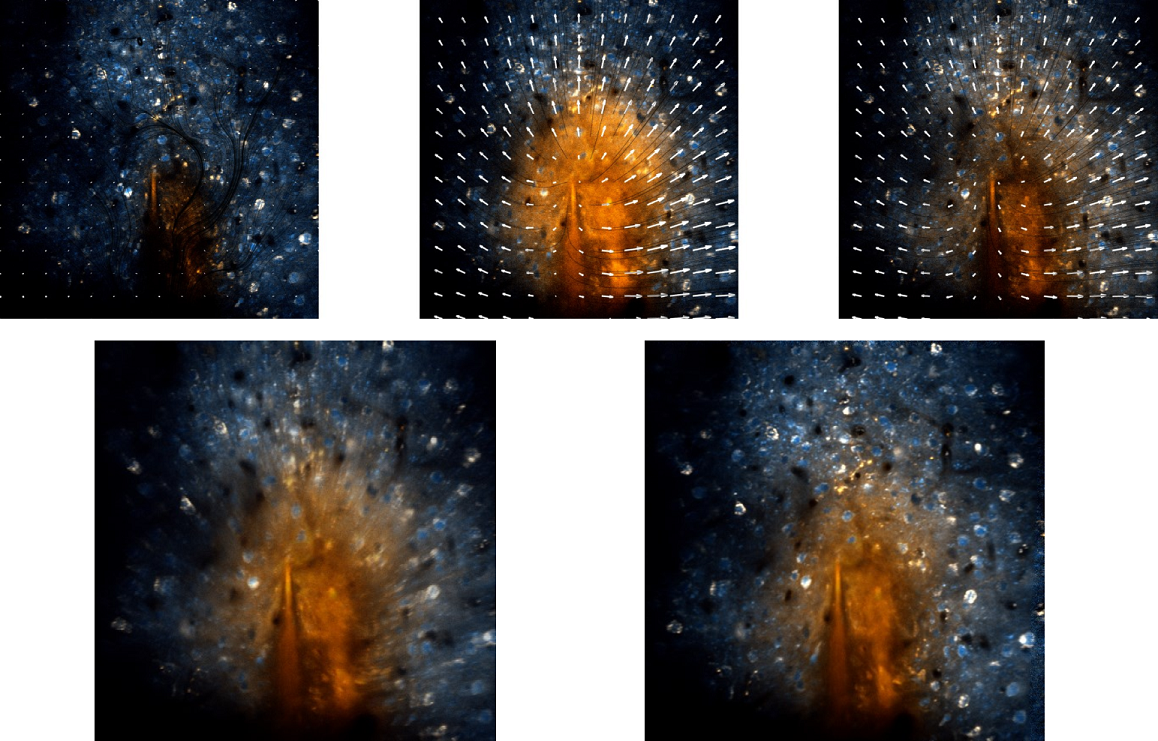
Model Context Protocol (MCP) server for Flow-Registration - variational optical-flow motion correction for 2-photon (2P) microscopy videos and volumetric 3D scans.
This MCP server provides programmatic access to Flow-Registration functionality through the Model Context Protocol, enabling AI assistants and other MCP clients to perform motion correction on microscopy data.
Related projects
Original Flow-Registration repo: https://github.com/FlowRegSuite/flow_registration
Python implementation: https://github.com/FlowRegSuite/pyflowreg
ImageJ/Fiji plugin: https://github.com/FlowRegSuite/flow_registration_IJ
Napari plugin: https://github.com/FlowRegSuite/napari-flowreg
Related MCP server: Scanpy-MCP
Python 3.10 or higher
FastMCP framework
Clone the repository and install dependencies:
git clone https://github.com/FlowRegSuite/flowreg-mcp.git
cd flowreg-mcp
pip install -r requirements.txtTo use this as an MCP server with Claude Desktop or other MCP clients:
Install the MCP server:
pip install -e .Configure your MCP client (e.g., Claude Desktop) to connect to the server:
{
  "mcpServers": {
    "flowreg": {
      "command": "python",
      "args": ["-m", "flowreg_mcp"],
      "cwd": "/path/to/flowreg-mcp"
    }
  }
}Once configured, the MCP server exposes Flow-Registration functionality through standard MCP tools and resources. The server provides motion correction capabilities for microscopy data through a programmatic interface.
The dataset which we used for our evaluations is available as 2-Photon Movies with Motion Artifacts.
Details on the original method and video results can be found here.
If you use parts of this code or the plugin for your work, please cite
“Pyflowreg,” (in preparation), 2025.
and for Flow-Registration
P. Flotho, S. Nomura, B. Kuhn and D. J. Strauss, “Software for Non-Parametric Image Registration of 2-Photon Imaging Data,” J Biophotonics, 2022. doi:https://doi.org/10.1002/jbio.202100330
BibTeX entry
@article{flotea2022a,
    author = {Flotho, P. and Nomura, S. and Kuhn, B. and Strauss, D. J.},
    title = {Software for Non-Parametric Image Registration of 2-Photon Imaging Data},
    year = {2022},
  journal = {J Biophotonics},
  doi = {https://doi.org/10.1002/jbio.202100330}
}This server cannot be deployed
Design, save, and run outcome-aligned AI workflows and verifiers, with reliable image output.
Plan, compare, price, generate, and recover AI video from compatible MCP clients.
Build editable 3D scenes, direct characters and cameras, and export AI video references with MCP.
OCR, transcription, file extraction, and image generation for AI agents via MCP.