Glama
infiniV

Android UI Assist MCP Server

by infiniV

Real-Time Android UI Development with AI Agents - MCP Server

npm version License: MIT TypeScript Node.js

Model Context Protocol server that enables AI coding agents to see and analyze your Android app UI in real-time during development. Perfect for iterative UI refinement with Expo, React Native, Flutter, and native Android development workflows. Connect your AI agent to your running app and get instant visual feedback on UI changes.

Keywords: android development ai agent, real-time ui feedback, expo development tools, react native ui assistant, flutter development ai, android emulator screenshot, ai powered ui testing, visual regression testing ai, mobile app development ai, iterative ui development, ai code assistant android

Quick Demo

See the MCP server in action with real-time Android UI analysis:

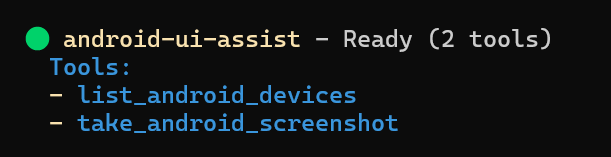
MCP Server Status

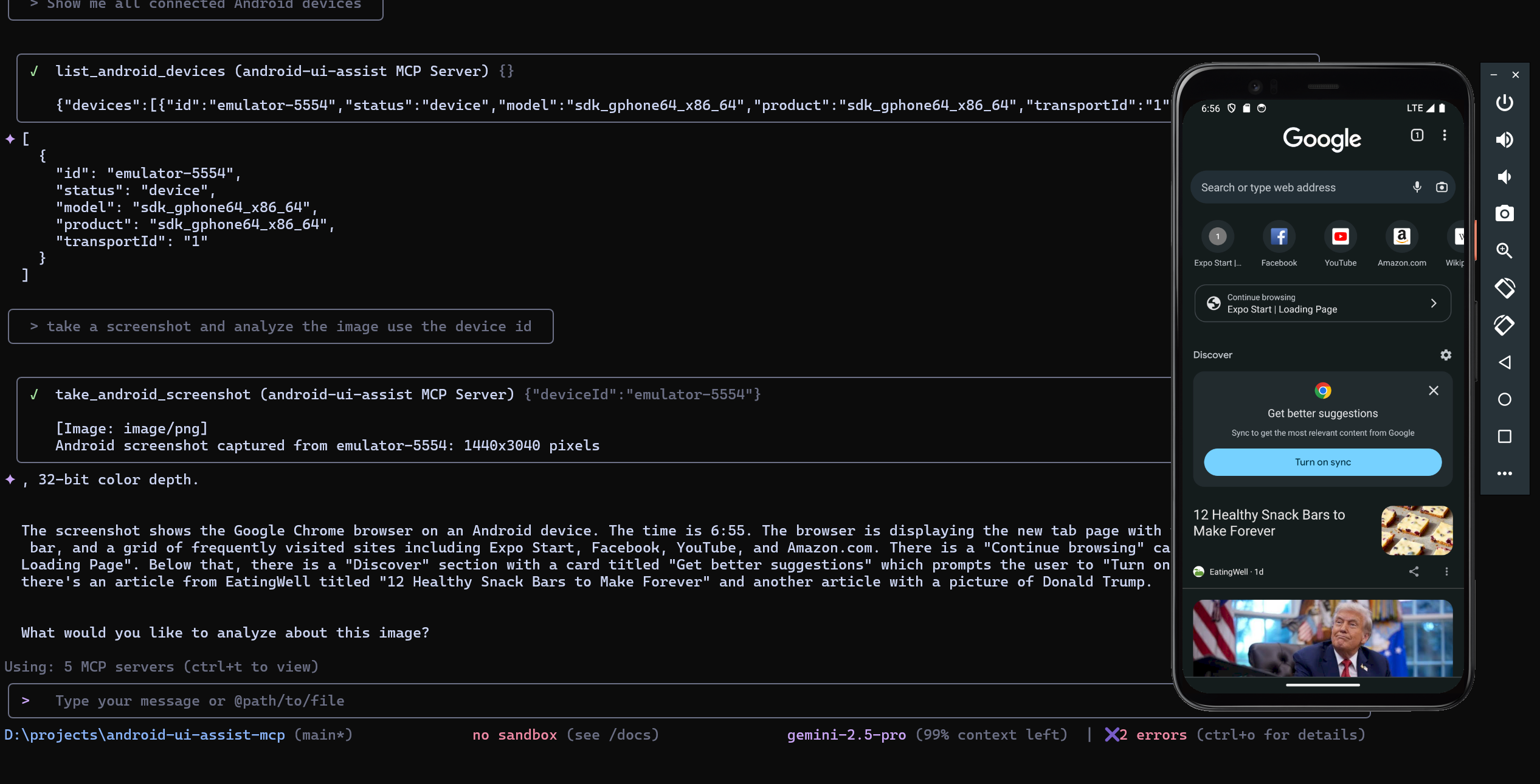
Live Development Workflow

Tools

Usage

Server ready with 2 tools available

AI agent analyzing Android UI in real-time

Related MCP server: Android ADB MCP Server

Features

Real-Time Development Workflow

  • Live screenshot capture during app development with Expo, React Native, Flutter

  • Instant visual feedback for AI agents on UI changes and iterations

  • Seamless integration with development servers and hot reload workflows

  • Support for both physical devices and emulators during active development

AI Agent Integration

  • MCP protocol support for Claude Desktop, GitHub Copilot, and Gemini CLI

  • Enable AI agents to see your app UI and provide contextual suggestions

  • Perfect for iterative UI refinement and design feedback loops

  • Visual context for AI-powered code generation and UI improvements

Developer Experience

  • Zero-configuration setup with running development environments

  • Docker deployment for team collaboration and CI/CD pipelines

  • Comprehensive error handling with helpful development suggestions

  • Secure stdio communication with timeout management

Table of Contents

AI Agent Configuration

This MCP server works with AI agents that support the Model Context Protocol. Configure your preferred agent to enable real-time Android UI analysis:

Claude Code

# CLI Installation
claude mcp add android-ui-assist -- npx android-ui-assist-mcp

# Local Development
claude mcp add android-ui-assist -- node "D:\\projects\\android-ui-assist-mcp\\dist\\index.js"

Claude Desktop

Add to %APPDATA%\Claude\claude_desktop_config.json:

{
  "mcpServers": {
    "android-ui-assist": {
      "command": "npx",
      "args": ["android-ui-assist-mcp"],
      "timeout": 10000
    }
  }
}

GitHub Copilot (VS Code)

Add to .vscode/settings.json:

{
  "github.copilot.enable": {
    "*": true
  },
  "mcp.servers": {
    "android-ui-assist": {
      "command": "npx",
      "args": ["android-ui-assist-mcp"],
      "timeout": 10000
    }
  }
}

Gemini CLI

# CLI Installation
gemini mcp add android-ui-assist npx android-ui-assist-mcp

# Configuration
# Create ~/.gemini/settings.json with:
{
  "mcpServers": {
    "android-ui-assist": {
      "command": "npx",
      "args": ["android-ui-assist-mcp"]
    }
  }
}

Installation

Package Manager Installation

npm install -g android-ui-assist-mcp

Source Installation

git clone https://github.com/yourusername/android-ui-assist-mcp
cd android-ui-assist-mcp
npm install && npm run build

Installation Verification

After installation, verify the package is available:

android-ui-assist-mcp --version
# For npm installation
npx android-ui-assist-mcp --version

Development Workflow

This MCP server transforms how you develop Android UIs by giving AI agents real-time visual access to your running application. Here's the typical workflow:

  1. Start Your Development Environment: Launch Expo, React Native Metro, Flutter, or Android Studio with your app running

  2. Connect the MCP Server: Configure your AI agent (Claude, Copilot, Gemini) to use this MCP server

  3. Iterative Development: Ask your AI agent to analyze the current UI, suggest improvements, or help implement changes

  4. Real-Time Feedback: The AI agent takes screenshots to see the results of code changes immediately

  5. Refine and Repeat: Continue the conversation with visual context for better UI development

Perfect for:

  • Expo development with live preview and hot reload

  • React Native development with Metro bundler

  • Flutter development with hot reload

  • Native Android development with instant run

  • UI testing and visual regression analysis

  • Collaborative design reviews with AI assistance

  • Accessibility testing with visual context

  • Cross-platform UI consistency checking

Prerequisites

Component

Version

Installation

Node.js

18.0+

Download

npm

8.0+

Included with Node.js

ADB

Latest

Android SDK Platform Tools

Android Device Setup

  1. Enable Developer Options: Settings > About Phone > Tap "Build Number" 7 times

  2. Enable USB Debugging: Settings > Developer Options > USB Debugging

  3. Verify connection: adb devices

Development Environment Setup

Expo Development

  1. Start your Expo development server:

npx expo start
# or
npm start
  1. Open your app on a connected device or emulator

  2. Ensure your device appears in adb devices

  3. Your AI agent can now take screenshots during development

React Native Development

  1. Start Metro bundler:

npx react-native start
  1. Run on Android:

npx react-native run-android
  1. Enable hot reload for instant feedback with AI analysis

Flutter Development

  1. Start Flutter in debug mode:

flutter run
  1. Use hot reload (r) and hot restart (R) while getting AI feedback

  2. The AI agent can capture UI states after each change

Native Android Development

  1. Open project in Android Studio

  2. Run app with instant run enabled

  3. Connect device or start emulator

  4. Enable AI agent integration for real-time UI analysis

Docker Deployment

Docker Compose

cd docker
docker-compose up --build -d

Configure AI platform for Docker:

{
  "mcpServers": {
    "android-ui-assist": {
      "command": "docker",
      "args": ["exec", "android-ui-assist-mcp", "node", "/app/dist/index.js"],
      "timeout": 15000
    }
  }
}

Manual Docker Build

docker build -t android-ui-assist-mcp .
docker run -it --rm --privileged -v /dev/bus/usb:/dev/bus/usb android-ui-assist-mcp

Available Tools

MCP Tools Available

Tool

Description

Parameters

take_android_screenshot

Captures device screenshot

deviceId (optional)

list_android_devices

Lists connected devices

None

Tool Schemas

take_android_screenshot

{
  "name": "take_android_screenshot",
  "description": "Capture a screenshot from an Android device or emulator",
  "inputSchema": {
    "type": "object",
    "properties": {
      "deviceId": {
        "type": "string",
        "description": "Optional device ID. If not provided, uses the first available device"
      }
    }
  }
}

list_android_devices

{
  "name": "list_android_devices",
  "description": "List all connected Android devices and emulators with detailed information",
  "inputSchema": {
    "type": "object",
    "properties": {}
  }
}

Usage Examples

Real-Time Development Workflow

Example: AI agent listing devices, capturing screenshots, and providing detailed UI analysis in real-time

Real-Time UI Development

With your development environment running (Expo, React Native, Flutter, etc.), interact with your AI agent:

Initial Analysis:

  • "Take a screenshot of my current app UI and analyze the layout"

  • "Show me the current state of my login screen and suggest improvements"

  • "Capture the app and check for accessibility issues"

Iterative Development:

  • "I just changed the button color, take another screenshot and compare"

  • "Help me adjust the spacing - take a screenshot after each change"

  • "Take a screenshot and tell me if the new navigation looks good"

Cross-Platform Testing:

  • "Capture screenshots from both my phone and tablet emulator"

  • "Show me how the UI looks on device emulator-5554 vs my physical device"

Development Debugging:

  • "List all connected devices and their status"

  • "Take a screenshot from the specific emulator running my debug build"

  • "Capture the current error state and help me fix the UI issue"

Troubleshooting

ADB Issues

  • ADB not found: Verify ADB is installed and in PATH

  • No devices: Check USB connection and debugging authorization

  • Device unauthorized: Disconnect/reconnect USB, check device authorization prompt

  • Screenshot failed: Ensure device is unlocked and properly connected

Connection Issues

  • Verify adb devices shows your device as "device" status

  • Restart ADB server: adb kill-server && adb start-server

  • Check USB debugging permissions on device

Development

Build Commands

npm run build     # Production build
npm test          # Run tests
npm run lint      # Code linting
npm run format    # Code formatting

Project Structure

src/
├── server.ts         # MCP server implementation
├── types.ts          # Type definitions
├── utils/
│   ├── adb.ts        # ADB command utilities
│   ├── screenshot.ts # Screenshot processing
│   └── error.ts      # Error handling
└── index.ts          # Entry point

Performance

  • 5-second timeout on ADB operations

  • In-memory screenshot processing

  • Stdio communication for security

  • Minimal privilege execution

License

MIT License - see LICENSE file for details.

Available Tools

2 tools
list_android_devicesB

List all connected Android devices and emulators

ParametersJSON Schema
NameRequiredDescriptionDefault

No parameters

TDQS

B3.1/5.0
Behavior2/5

Does the description disclose side effects, auth requirements, rate limits, or destructive behavior?

No annotations are provided, so the description carries full burden for behavioral disclosure. It mentions listing devices but doesn't describe what 'connected' means, whether this includes offline devices, how results are formatted, or any rate limits or permissions required. This leaves significant gaps in understanding the tool's behavior.

Agents need to know what a tool does to the world before calling it. Descriptions should go beyond structured annotations to explain consequences.

Conciseness5/5

Is the description appropriately sized, front-loaded, and free of redundancy?

The description is a single, efficient sentence that directly states the tool's function without any fluff. It is front-loaded with the core action and resource, making it easy to parse and understand immediately.

Shorter descriptions cost fewer tokens and are easier for agents to parse. Every sentence should earn its place.

Completeness2/5

Given the tool's complexity, does the description cover enough for an agent to succeed on first attempt?

Given the lack of annotations and output schema, the description is incomplete for a tool that likely returns a list of devices. It doesn't explain the return format, what data is included for each device, or any error conditions, leaving the agent with insufficient context for proper use.

Complex tools with many parameters or behaviors need more documentation. Simple tools need less. This dimension scales expectations accordingly.

Parameters4/5

Does the description clarify parameter syntax, constraints, interactions, or defaults beyond what the schema provides?

The input schema has 0 parameters with 100% coverage, so no parameter documentation is needed. The description appropriately doesn't discuss parameters, and since there are none, it meets the baseline of 4 for not adding unnecessary information.

Input schemas describe structure but not intent. Descriptions should explain non-obvious parameter relationships and valid value ranges.

Purpose4/5

Does the description clearly state what the tool does and how it differs from similar tools?

The description clearly states the verb ('List') and resource ('all connected Android devices and emulators'), making the purpose immediately understandable. It doesn't differentiate from its sibling tool 'take_android_screenshot' which performs a different action, but the purpose is specific enough for this tool alone.

Agents choose between tools based on descriptions. A clear purpose with a specific verb and resource helps agents select the right tool.

Usage Guidelines2/5

Does the description explain when to use this tool, when not to, or what alternatives exist?

The description provides no guidance on when to use this tool versus alternatives or any contextual prerequisites. It simply states what the tool does without indicating scenarios for its application or exclusions, leaving the agent to infer usage from the tool name alone.

Agents often have multiple tools that could apply. Explicit usage guidance like "use X instead of Y when Z" prevents misuse.

take_android_screenshotC

Capture a screenshot from an Android device or emulator

ParametersJSON Schema
NameRequiredDescriptionDefault
deviceIdNoThe ID of the Android device to capture a screenshot from. If not provided, uses the first available device.
formatNoThe image format for the screenshot. Currently only PNG is supported.png

TDQS

C2.9/5.0
Behavior2/5

Does the description disclose side effects, auth requirements, rate limits, or destructive behavior?

With no annotations provided, the description carries the full burden of behavioral disclosure. While it states what the tool does, it doesn't mention important behavioral aspects like whether this requires specific device states (unlocked, active display), what permissions are needed, whether it affects device operation, or what happens on failure. The description is minimal and lacks operational context.

Agents need to know what a tool does to the world before calling it. Descriptions should go beyond structured annotations to explain consequences.

Conciseness5/5

Is the description appropriately sized, front-loaded, and free of redundancy?

The description is a single, efficient sentence that states the core purpose without any wasted words. It's appropriately sized for a straightforward tool and gets directly to the point with no unnecessary elaboration.

Shorter descriptions cost fewer tokens and are easier for agents to parse. Every sentence should earn its place.

Completeness2/5

Given the tool's complexity, does the description cover enough for an agent to succeed on first attempt?

For a device interaction tool with no annotations and no output schema, the description is insufficient. It doesn't explain what the tool returns (image data, file path, error conditions), doesn't mention operational constraints or prerequisites, and provides minimal context for a tool that interacts with physical/virtual devices. The completeness is inadequate given the complexity implied by device interaction.

Complex tools with many parameters or behaviors need more documentation. Simple tools need less. This dimension scales expectations accordingly.

Parameters3/5

Does the description clarify parameter syntax, constraints, interactions, or defaults beyond what the schema provides?

With 100% schema description coverage, the input schema already fully documents both parameters (deviceId with fallback behavior, format with enum constraint). The description adds no additional parameter semantics beyond what's already in the schema, so it meets the baseline for high schema coverage without adding value.

Input schemas describe structure but not intent. Descriptions should explain non-obvious parameter relationships and valid value ranges.

Purpose4/5

Does the description clearly state what the tool does and how it differs from similar tools?

The description clearly states the action ('capture a screenshot') and target resource ('from an Android device or emulator'), providing a specific verb+resource combination. However, it doesn't differentiate from the sibling tool 'list_android_devices' - both work with Android devices but serve different purposes.

Agents choose between tools based on descriptions. A clear purpose with a specific verb and resource helps agents select the right tool.

Usage Guidelines2/5

Does the description explain when to use this tool, when not to, or what alternatives exist?

The description provides no guidance about when to use this tool versus alternatives. It doesn't mention the sibling tool 'list_android_devices' which could be a prerequisite for obtaining device IDs, nor does it provide any context about when this operation is appropriate versus other device interaction methods.

Agents often have multiple tools that could apply. Explicit usage guidance like "use X instead of Y when Z" prevents misuse.

TDQS

B3.1/5.0
Disambiguation5/5

The two tools have completely distinct purposes with no overlap: one lists devices, the other captures screenshots. An agent can easily differentiate between them based on their clear, specific functions.

Naming Consistency5/5

Both tools follow a consistent verb_noun pattern (list_android_devices, take_android_screenshot) with the same prefix 'android_' for domain specificity. The naming is perfectly uniform and predictable.

Tool Count2/5

With only two tools, the server feels under-scoped for an 'Android UI Assist' purpose, which typically implies broader UI interaction capabilities like clicking, typing, or inspecting elements. The count is too low for the apparent domain.

Completeness2/5

For an Android UI assistance server, there are significant gaps: no tools for interacting with UI elements (e.g., tap, input text), navigating apps, or retrieving UI hierarchies. The current tools only cover device listing and screenshot capture, leaving core UI automation workflows incomplete.

Maintenance

ActivityInactive
ResponsivenessSyncing

Resources

Unclaimed servers have limited discoverability.

Looking for Admin?

If you are the server author, to access and configure the admin panel.

Related MCP Connectors

Related MCP Servers

  • F
    license
    A
    quality
    C
    maintenance
    Enables AI agents to interact with Android devices through UI manipulation, screen capture, touch gestures, text input, and app management via ADB. Provides comprehensive mobile automation capabilities including element detection, navigation, and application control for Android device testing and interaction.
    9
    4
  • A
    license
    Not graded
    quality
    D
    maintenance
    Enables programmatic control of Android devices via ADB, supporting UI automation, app management, screen capture with OCR, and file transfers through the Model Context Protocol. It allows MCP-compatible clients like Claude Desktop and Cursor to interact directly with physical or emulated Android devices.
    3
    Apache 2.0
  • A
    license
    B
    quality
    B
    maintenance
    Enables AI assistants to interact with Android devices and emulators via ADB, providing tools for screenshots, UI inspection, touch and text input, app management, and device control.
    42
    67
    17
    MIT
  • A
    license
    B
    quality
    B
    maintenance
    Enables AI agents to control Android TV/Android devices through ADB, including screen capture, remote control, app management, and more.
    24
    44
    MIT

Latest Blog Posts

MCP directory API

We provide all the information about MCP servers via our MCP API.

curl -X GET 'https://glama.ai/api/mcp/v1/servers/infiniV/Android-Ui-MCP'

If you have feedback or need assistance with the MCP directory API, please join our Discord server