

A
licenseNot graded
qualityC
maintenanceWraps the Hunter.io email finder and verification API, enabling email lookup and verification via MCP.
2 npm
MIT

该 MCP(模型上下文协议)服务器提供 Hunter API 与任何支持 MCP 协议的 LLM 提供商(例如,Claude for Desktop)之间的集成,允许您使用自然语言与 Hunter B2B 数据进行交互。
使用自然语言使用 Hunter API 端点
获取有关人员和公司的 B2B 数据
通过对话界面将它们保存到您的潜在客户中
Related MCP server: @louis030195/apollo-io-mcp
这是一个示例配置文件,您可以用它来设置 Hunter MCP。
{
  "mcpServers": {
    "hunter-mcp": {
      "command": "uv",
      "args": [
        "run",
        "--with",
        "mcp[cli]",
        "mcp",
        "run",
        "PATH_TO_hunter-mcp/main.py"
      ],
      "env": {
        "HUNTER_API_KEY": "YOUR_HUNTER_API_KEY"
      }
    }
  }
}
对于 Claude Desktop,您可以通过运行以下命令立即安装并与其交互:
mcp install main.py -v HUNTER_API_KEY=YOUR_HUNTER_API_KEY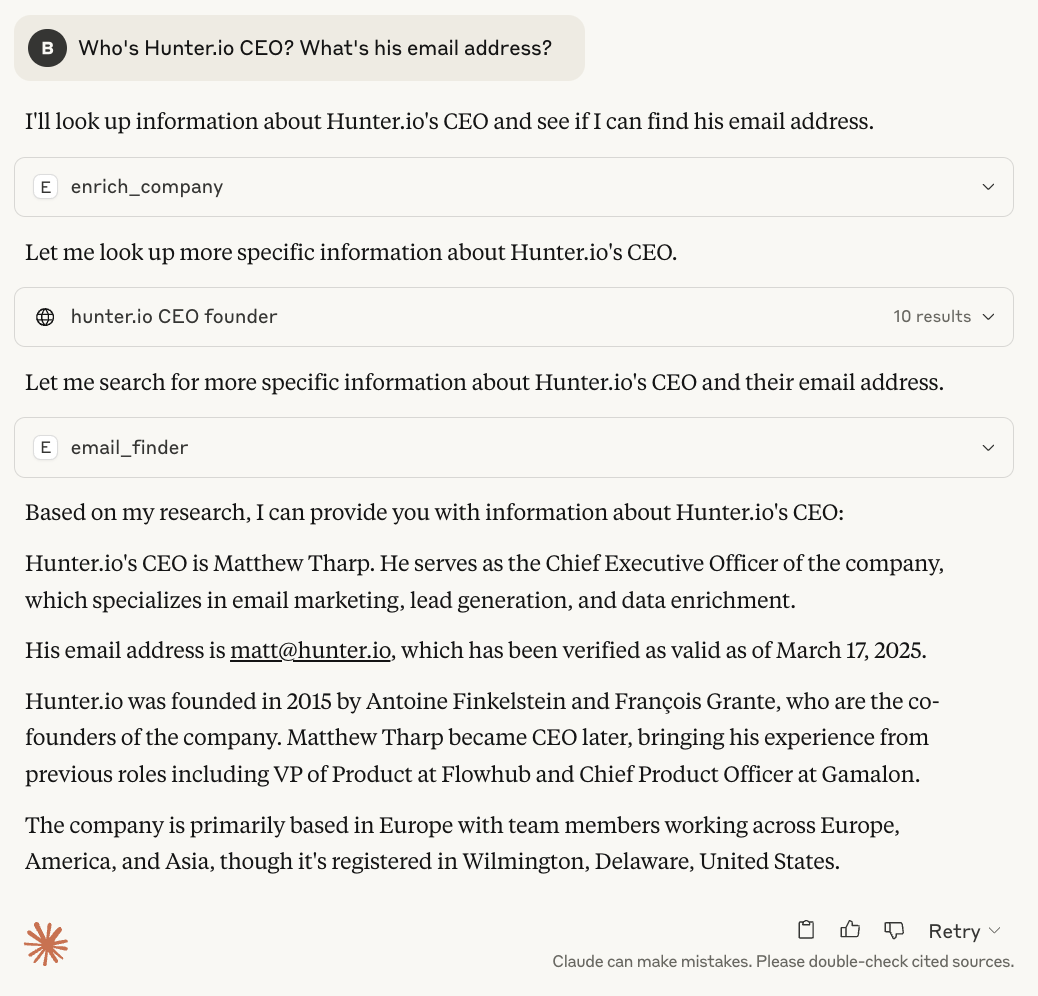
Hunter MCP 服务器提供对各种 Hunter API 端点作为工具的访问。
当前版本提供以下工具:
域名搜索
电子邮件查找器
电子邮件验证器
电子邮件丰富
公司充实
潜在客户创建
**注意:**目前并非所有 Hunter API 端点都受支持。此问题将在后续版本中解决。
该项目根据 MIT 许可证获得许可;有关详细信息,请参阅LICENSE.md文件。
Create a lead in user's account.
| Name | Required | Description | Default |
|---|---|---|---|
| Yes |
Does the description disclose side effects, auth requirements, rate limits, or destructive behavior?
With no annotations provided, the description carries the full burden of behavioral disclosure. It states 'Create a lead', implying a write operation, but does not disclose any behavioral traits such as permissions required, whether the operation is idempotent, rate limits, or what happens on failure (e.g., duplicate emails). This is a significant gap for a mutation tool with zero annotation coverage.
Agents need to know what a tool does to the world before calling it. Descriptions should go beyond structured annotations to explain consequences.
Is the description appropriately sized, front-loaded, and free of redundancy?
The description is a single, efficient sentence that is front-loaded with the core action. There is no wasted verbiage, and it avoids redundancy. However, it is overly concise to the point of under-specification, which slightly detracts from its effectiveness.
Shorter descriptions cost fewer tokens and are easier for agents to parse. Every sentence should earn its place.
Given the tool's complexity, does the description cover enough for an agent to succeed on first attempt?
Given the complexity of a creation tool with no annotations, 1 parameter (undocumented in schema), and no output schema, the description is incomplete. It does not cover behavioral aspects, parameter details, or expected outcomes, making it inadequate for the agent to understand the tool's full context and usage.
Complex tools with many parameters or behaviors need more documentation. Simple tools need less. This dimension scales expectations accordingly.
Does the description clarify parameter syntax, constraints, interactions, or defaults beyond what the schema provides?
The input schema has 1 parameter with 0% description coverage, and the tool description does not add any meaning beyond the schema. It does not explain what the 'email' parameter represents (e.g., the lead's email address), its format, or constraints. With low schema coverage, the description fails to compensate, leaving the parameter semantics unclear.
Input schemas describe structure but not intent. Descriptions should explain non-obvious parameter relationships and valid value ranges.
Does the description clearly state what the tool does and how it differs from similar tools?
The description states the action ('Create') and resource ('a lead in user's account'), which provides a basic understanding of purpose. However, it lacks specificity about what constitutes a lead or how it differs from sibling tools like 'enrich_email' or 'enrich_company', making it somewhat vague. It avoids tautology by not merely restating the tool name.
Agents choose between tools based on descriptions. A clear purpose with a specific verb and resource helps agents select the right tool.
Does the description explain when to use this tool, when not to, or what alternatives exist?
The description offers no guidance on when to use this tool versus alternatives. It does not mention prerequisites, context (e.g., when a lead should be created), or exclusions, nor does it reference sibling tools like 'email_finder' or 'enrich_email' that might be related. This leaves the agent without direction on appropriate usage scenarios.
Agents often have multiple tools that could apply. Explicit usage guidance like "use X instead of Y when Z" prevents misuse.
Return the top 10 emails on a given domain.
| Name | Required | Description | Default |
|---|---|---|---|
| domain | Yes |
Does the description disclose side effects, auth requirements, rate limits, or destructive behavior?
No annotations are provided, so the description carries the full burden of behavioral disclosure. It mentions returning 'top 10 emails' but doesn't explain criteria for 'top' (e.g., by relevance, recency), potential rate limits, authentication needs, or data sources. This leaves significant gaps in understanding the tool's behavior.
Agents need to know what a tool does to the world before calling it. Descriptions should go beyond structured annotations to explain consequences.
Is the description appropriately sized, front-loaded, and free of redundancy?
The description is a single, direct sentence with zero waste, front-loading the core functionality. It efficiently communicates the tool's purpose without unnecessary details, making it highly concise and well-structured.
Shorter descriptions cost fewer tokens and are easier for agents to parse. Every sentence should earn its place.
Given the tool's complexity, does the description cover enough for an agent to succeed on first attempt?
Given the lack of annotations, output schema, and low parameter coverage, the description is incomplete. It doesn't address behavioral aspects like how emails are ranked, data freshness, or error handling, which are crucial for a search tool with no structured support.
Complex tools with many parameters or behaviors need more documentation. Simple tools need less. This dimension scales expectations accordingly.
Does the description clarify parameter syntax, constraints, interactions, or defaults beyond what the schema provides?
The description adds minimal meaning beyond the input schema, which has 0% description coverage. It implies the 'domain' parameter is used to search for emails, but doesn't specify format (e.g., 'example.com'), validation, or examples. With low schema coverage, this provides some compensation but is insufficient for full clarity.
Input schemas describe structure but not intent. Descriptions should explain non-obvious parameter relationships and valid value ranges.
Does the description clearly state what the tool does and how it differs from similar tools?
The description clearly states the action ('Return') and resource ('top 10 emails on a given domain'), making the purpose specific and understandable. However, it doesn't explicitly differentiate from sibling tools like 'email_finder' or 'email_verifier', which may have overlapping functionality, preventing a perfect score.
Agents choose between tools based on descriptions. A clear purpose with a specific verb and resource helps agents select the right tool.
Does the description explain when to use this tool, when not to, or what alternatives exist?
The description provides no guidance on when to use this tool versus alternatives such as 'email_finder' or 'enrich_email', nor does it mention any prerequisites or exclusions. It simply states what the tool does without contextual usage information.
Agents often have multiple tools that could apply. Explicit usage guidance like "use X instead of Y when Z" prevents misuse.
Return the most likely email address for a given domain and full name.
| Name | Required | Description | Default |
|---|---|---|---|
| domain | Yes | ||
| full_name | Yes |
Does the description disclose side effects, auth requirements, rate limits, or destructive behavior?
With no annotations provided, the description carries full burden but only states what the tool does without disclosing behavioral traits such as rate limits, accuracy, data sources, or error handling. It mentions 'most likely' email but doesn't explain confidence levels or fallback behaviors.
Agents need to know what a tool does to the world before calling it. Descriptions should go beyond structured annotations to explain consequences.
Is the description appropriately sized, front-loaded, and free of redundancy?
The description is a single, efficient sentence that front-loads the core purpose with zero waste. It is appropriately sized for a simple tool and avoids unnecessary elaboration.
Shorter descriptions cost fewer tokens and are easier for agents to parse. Every sentence should earn its place.
Given the tool's complexity, does the description cover enough for an agent to succeed on first attempt?
Given no annotations, 0% schema coverage, and no output schema, the description is incomplete for a tool that infers emails—it lacks details on return values (e.g., email format, confidence scores), error cases, or integration context with siblings. It provides minimal context beyond the basic action.
Complex tools with many parameters or behaviors need more documentation. Simple tools need less. This dimension scales expectations accordingly.
Does the description clarify parameter syntax, constraints, interactions, or defaults beyond what the schema provides?
Schema description coverage is 0%, so the description must compensate but only mentions parameters generically ('domain and full name') without adding meaning like format examples (e.g., 'example.com' for domain, 'John Doe' for full name) or constraints. It fails to provide semantic details beyond the bare schema.
Input schemas describe structure but not intent. Descriptions should explain non-obvious parameter relationships and valid value ranges.
Does the description clearly state what the tool does and how it differs from similar tools?
The description clearly states the tool's purpose with specific verb ('Return') and resource ('most likely email address'), specifying the input parameters ('domain and full name'). It distinguishes from siblings like 'email_verifier' (which likely verifies rather than finds) and 'domain_search' (which may search domains without names).
Agents choose between tools based on descriptions. A clear purpose with a specific verb and resource helps agents select the right tool.
Does the description explain when to use this tool, when not to, or what alternatives exist?
The description provides no guidance on when to use this tool versus alternatives like 'enrich_email' or 'create_lead', nor does it mention prerequisites or exclusions. It implies usage for finding emails but lacks explicit context for tool selection.
Agents often have multiple tools that could apply. Explicit usage guidance like "use X instead of Y when Z" prevents misuse.
Return the validity of a given email address.
| Name | Required | Description | Default |
|---|---|---|---|
| Yes |
Does the description disclose side effects, auth requirements, rate limits, or destructive behavior?
No annotations are provided, so the description carries the full burden of behavioral disclosure. It states the tool returns validity but doesn't explain what that entails (e.g., format of return, error handling, rate limits, or authentication needs). This leaves significant gaps in understanding how the tool behaves beyond its basic function.
Agents need to know what a tool does to the world before calling it. Descriptions should go beyond structured annotations to explain consequences.
Is the description appropriately sized, front-loaded, and free of redundancy?
The description is a single, efficient sentence that directly states the tool's function without any unnecessary words. It is appropriately sized and front-loaded, making it easy to parse quickly.
Shorter descriptions cost fewer tokens and are easier for agents to parse. Every sentence should earn its place.
Given the tool's complexity, does the description cover enough for an agent to succeed on first attempt?
Given the lack of annotations, output schema, and low schema description coverage, the description is incomplete. It doesn't address behavioral aspects like return format, error cases, or usage context, which are crucial for a tool that performs validation. This leaves the agent with insufficient information to use the tool effectively.
Complex tools with many parameters or behaviors need more documentation. Simple tools need less. This dimension scales expectations accordingly.
Does the description clarify parameter syntax, constraints, interactions, or defaults beyond what the schema provides?
The schema description coverage is 0%, so the description must compensate for the lack of parameter documentation. It implies the parameter is an email address but doesn't add any meaning beyond what the schema's title ('Email') and type ('string') provide. With only one parameter, the baseline is higher, but the description doesn't elaborate on format or constraints.
Input schemas describe structure but not intent. Descriptions should explain non-obvious parameter relationships and valid value ranges.
Does the description clearly state what the tool does and how it differs from similar tools?
The description clearly states the tool's purpose with a specific verb ('Return') and resource ('validity of a given email address'), making it easy to understand what it does. However, it doesn't explicitly distinguish this tool from potential sibling tools like 'enrich_email' or 'email_finder', which might have overlapping or related functionality.
Agents choose between tools based on descriptions. A clear purpose with a specific verb and resource helps agents select the right tool.
Does the description explain when to use this tool, when not to, or what alternatives exist?
The description provides no guidance on when to use this tool versus alternatives. It doesn't mention any context, prerequisites, or exclusions, leaving the agent to infer usage based on the tool name alone, which is insufficient for optimal tool selection.
Agents often have multiple tools that could apply. Explicit usage guidance like "use X instead of Y when Z" prevents misuse.
Return all the information associated with a domain, such as the industry, the description, or headquarters' location.
| Name | Required | Description | Default |
|---|---|---|---|
| domain | Yes |
Does the description disclose side effects, auth requirements, rate limits, or destructive behavior?
No annotations are provided, so the description carries the full burden of behavioral disclosure. It states this is a read operation ('Return'), but doesn't mention permissions, rate limits, error conditions, or what 'all the information' entails (e.g., format, completeness). For a tool with zero annotation coverage, this leaves significant gaps in understanding its behavior.
Agents need to know what a tool does to the world before calling it. Descriptions should go beyond structured annotations to explain consequences.
Is the description appropriately sized, front-loaded, and free of redundancy?
The description is a single, efficient sentence that front-loads the core purpose. It avoids unnecessary words, though it could be slightly more structured (e.g., by explicitly listing parameters). Every part of the sentence contributes to understanding the tool's function.
Shorter descriptions cost fewer tokens and are easier for agents to parse. Every sentence should earn its place.
Given the tool's complexity, does the description cover enough for an agent to succeed on first attempt?
Given the lack of annotations and output schema, the description is incomplete. It doesn't explain what 'all the information' includes (e.g., data structure, fields), potential limitations, or how results are returned. For a tool that presumably returns complex company data, this leaves too much unspecified for effective agent use.
Complex tools with many parameters or behaviors need more documentation. Simple tools need less. This dimension scales expectations accordingly.
Does the description clarify parameter syntax, constraints, interactions, or defaults beyond what the schema provides?
Schema description coverage is 0%, so the description must compensate for undocumented parameters. It mentions 'domain' implicitly but doesn't explain what constitutes a valid domain (e.g., format, examples) or add meaning beyond the schema's basic type. With 1 parameter and low coverage, the description provides minimal additional context.
Input schemas describe structure but not intent. Descriptions should explain non-obvious parameter relationships and valid value ranges.
Does the description clearly state what the tool does and how it differs from similar tools?
The description clearly states the tool's purpose: 'Return all the information associated with a domain' with specific examples ('industry, description, headquarters' location'). It uses a specific verb ('Return') and resource ('information associated with a domain'), though it doesn't explicitly distinguish from sibling tools like 'domain_search' or 'enrich_email'.
Agents choose between tools based on descriptions. A clear purpose with a specific verb and resource helps agents select the right tool.
Does the description explain when to use this tool, when not to, or what alternatives exist?
The description provides no guidance on when to use this tool versus alternatives. It doesn't mention sibling tools like 'domain_search' or 'enrich_email', nor does it specify prerequisites or exclusions for usage. The context is implied (when you need company information from a domain) but not explicitly stated.
Agents often have multiple tools that could apply. Explicit usage guidance like "use X instead of Y when Z" prevents misuse.
Return all the information associated with an email address, such as a person's name, location and social handles.
| Name | Required | Description | Default |
|---|---|---|---|
| Yes |
Does the description disclose side effects, auth requirements, rate limits, or destructive behavior?
With no annotations provided, the description carries the full burden of behavioral disclosure. While it states what the tool returns, it doesn't disclose important behavioral traits such as rate limits, authentication requirements, data sources, accuracy considerations, privacy implications, or what happens when no information is found for an email address. The description is minimal and lacks operational context.
Agents need to know what a tool does to the world before calling it. Descriptions should go beyond structured annotations to explain consequences.
Is the description appropriately sized, front-loaded, and free of redundancy?
The description is extremely concise - a single sentence that gets straight to the point. There's no wasted language or unnecessary elaboration. It's appropriately sized for a simple lookup tool with one parameter.
Shorter descriptions cost fewer tokens and are easier for agents to parse. Every sentence should earn its place.
Given the tool's complexity, does the description cover enough for an agent to succeed on first attempt?
Given the lack of annotations and output schema, the description is insufficiently complete. For an enrichment tool that presumably queries external data sources, the description should address data freshness, source reliability, privacy considerations, and what the return structure looks like. The single sentence description leaves too many operational questions unanswered.
Complex tools with many parameters or behaviors need more documentation. Simple tools need less. This dimension scales expectations accordingly.
Does the description clarify parameter syntax, constraints, interactions, or defaults beyond what the schema provides?
The description doesn't add any meaningful information about the single parameter beyond what's obvious from the parameter name 'email'. With 0% schema description coverage and only one parameter, the baseline would be 4, but the description fails to provide any additional context about email format requirements, validation, or examples that would be helpful for proper usage.
Input schemas describe structure but not intent. Descriptions should explain non-obvious parameter relationships and valid value ranges.
Does the description clearly state what the tool does and how it differs from similar tools?
The description clearly states the tool's purpose: to return information associated with an email address, specifically mentioning person's name, location, and social handles. It uses a specific verb ('return') and resource ('information associated with an email address'), but doesn't explicitly distinguish from sibling tools like 'email_verifier' or 'email_finder'.
Agents choose between tools based on descriptions. A clear purpose with a specific verb and resource helps agents select the right tool.
Does the description explain when to use this tool, when not to, or what alternatives exist?
The description provides no guidance on when to use this tool versus alternatives. There are several sibling tools that might overlap (email_verifier, email_finder, domain_search), but the description doesn't indicate when enrich_email is appropriate versus these other tools, nor does it mention any prerequisites or constraints.
Agents often have multiple tools that could apply. Explicit usage guidance like "use X instead of Y when Z" prevents misuse.
Recent tool additions, removals, and schema changes observed during successful MCP inspections.
create_leaddomain_searchemail_finderemail_verifierenrich_companyenrich_emailScored across 6 tools
Each tool has a clearly distinct purpose with no ambiguity: creating leads, domain-based email searches, email finding for specific names, email verification, company enrichment, and email enrichment. The descriptions clearly differentiate their functions, making misselection unlikely.
All tool names follow a consistent snake_case pattern with clear verb_noun combinations (e.g., create_lead, domain_search, email_finder). The naming is predictable and readable throughout the set.
With 6 tools, this server is well-scoped for its purpose in lead generation and contact enrichment. Each tool earns its place by covering distinct aspects of the workflow, from lead creation to data verification and enrichment.
The tool set provides strong coverage for lead and contact management, including creation, search, verification, and enrichment. A minor gap might be the lack of update or delete operations for leads, but agents can likely work around this for core workflows.
Hunter.io MCP — wraps the Hunter.io email finder & verification API (hunter.io)
Model Context Protocol server for the Apideck Unified API. Connect any MCP-compatible agent framework to 100+ accounting systems, HRIS platforms, file storage providers, and more through one integration. More information https://www.apideck.com/mcp-server
Managed LinkedIn MCP server for AI agents: search, connect, message and enrich on accounts you own.
API-first CRM for LLMs - contacts, companies, deals and activities over a native MCP server.