
Veridge MCP Server
by galimar
README.md
# Veridge
[](https://github.com/galimar/veridge/actions/workflows/ci.yml)
[](LICENSE)
[](pyproject.toml)
[](pyproject.toml)
**The always-fresh, low-token map of a *whole* project** — documents, code (down to the
function/class), decisions and work sessions — unified in one typed graph, **ranked by what
matters**, and served both to an AI assistant (as the minimal relevant context) and to a human.
> *Veridge* fuses **veridical** (truthful, verified) with **ridge** — the crest line that runs
> through and connects a whole terrain. That's what it builds: the *true, always-fresh backbone*
> of how a project fits together — the structural through-line you and your assistant navigate by.
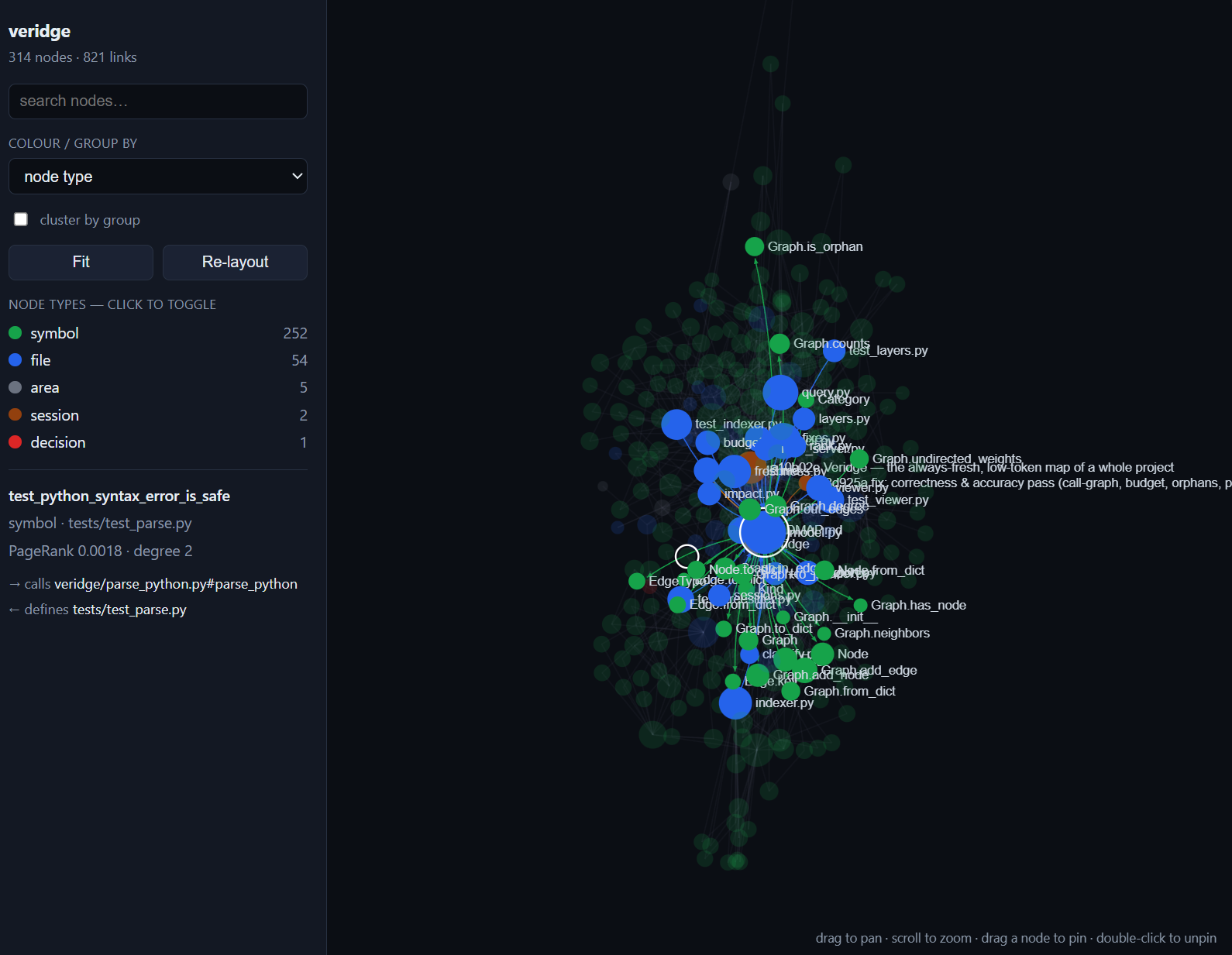
<sub>`veridge view .` — the self-contained offline viewer (no CDN, no server) on Veridge's own
codebase: files, symbols, areas and sessions in one graph.</sub>
---
## Why it exists
A project's knowledge lives in three places that drift apart: the **code**, the **documents**
(designs, decisions, notes) and the **history** of how it got here. As it grows, keeping a
mental model of how everything connects gets harder — and an AI assistant loses the thread
between one session and the next, so every session restarts by re-reading and re-searching
files. That is slow, incomplete, and burns tokens repeatedly.
Veridge builds the project's graph **once** and keeps it fresh, then answers questions about it
in a few hundred tokens. It unifies documents, code (down to the symbol), decisions and sessions
in one map, **ranks** it so an answer is the *relevant* slice rather than everything, and serves
that slice within a token budget — to an AI assistant and to a human alike.
## What makes it different
| Pillar | What it means |
|---|---|
| **One unified graph** | files **+ symbols** (functions/classes) **+ areas + decisions + git sessions** — code, docs and history in a single map. |
| **Symbol-level, with a real call graph** | Python is parsed with the stdlib `ast` into a `defines`/`imports`/`calls` graph. Other languages plug in via the optional `[treesitter]` extra. |
| **Ranked by relevance** | global **PageRank** ("what matters in this project") and **personalised PageRank** ("what matters *for this task*"). |
| **Token-budgeted, task-aware** | `veridge focus "<task>"` returns the **minimal relevant subgraph within a token budget** — relevant context, not the whole repo. |
| **Anti-drift gate** | content-hash freshness: refuses to call the map "fine" while something is stale, broken or orphaned. |
| **Zero infrastructure** | the core runs on the **Python standard library alone** — no DB, no embeddings, no server. Read-only on your sources. |
| **MCP-first** | the same ranked, budgeted queries are exposed to MCP-aware assistants behind an optional extra. |
It is **not a RAG system**: no embeddings, no vector store, no LLM to build the graph. It maps
*structure* and *importance*, which makes it complementary to RAG and purpose-built for one
thing: **the cheapest accurate context for orienting on a project.**
## Local, private, read-only
- **Local & private** — Veridge runs entirely on your machine. **No network calls, no telemetry,
no account**; nothing about your code ever leaves your computer. (The optional `[mcp]` server
talks to your assistant over local stdio; that's it.)
- **Read-only on your sources** — it indexes your files, it never edits them, and it never
duplicates their contents. It writes only *derived* data to `.veridge/` (regenerable — add
`.veridge/` to your `.gitignore`). The optional `veridge integrate` / `install-hook` commands
also write config files, but **only the ones you explicitly ask for**.
## Install
```bash
pip install veridge # core (zero runtime dependencies)
pip install "veridge[mcp]" # + the MCP server (for AI assistants)
pip install "veridge[treesitter]" # + symbol-level JS/TS/Go/Rust/Java/PHP/Vue parsing
```
[On PyPI](https://pypi.org/project/veridge/). Requires Python 3.10+; runs on Linux, macOS and
Windows. The core has **no runtime dependencies** (Python standard library only). From a clone:
`pip install -e ".[dev,mcp,treesitter]"`.
## Quickstart
```bash
veridge build . # index -> .veridge/graph.json (+ manifest)
veridge map . # PageRank-ranked digest: areas, sizes, what matters
veridge focus "<task>" . # the signature query: minimal relevant subgraph, budgeted
veridge impact src/util.py . # blast-radius: what a change here affects (ranked, budgeted)
veridge impact --diff . # blast-radius of your current working changes (vs git HEAD)
veridge tour . # dependency-ordered reading tour of the key files
veridge why src/cli.py src/model.py . # shortest typed path between two nodes
veridge find greet . # find nodes (files or symbols) by name/path
veridge neighbors src/util.py . # a node and its typed connections
veridge view . # write an offline, self-contained graph viewer (HTML)
veridge gate . # anti-drift: broken refs, stale files, orphans
veridge watch . # rebuild automatically when files change (poll loop)
veridge install-hook . # git post-commit hook that keeps the map fresh
veridge export . # export the graph (jgf / dot / native) for other tools
veridge integrate claude . # wire veridge into Claude Code (or: integrate codex)
veridge doctor . # is veridge set up here? index, extras, MCP wiring
veridge stats . # counts by node/edge type
```
`veridge map` also groups files by **architectural layer** (entrypoint / api / service / core /
data / ui / util / tests / config / docs) — inferred heuristically, no LLM.
### The signature query: `focus`
Give it a task, a file, or a symbol name and a token budget. It seeds a **personalised
PageRank** on whatever the query matches, then admits the highest-ranked nodes until the
budget is spent — returning exactly the context worth loading, and nothing else:
```text
$ veridge focus "personalised pagerank ranking" . --budget 400
focus 'personalised pagerank ranking' · 24 nodes · ~391/400 tokens
seeds: veridge/rank.py#pagerank, tests/test_rank_budget.py#test_personalised_pagerank...
0.1487 veridge/rank.py#pagerank [symbol, deg 8]
0.0334 veridge/query.py#focus [symbol, deg 10]
0.0289 veridge/query.py#project_map [symbol, deg 9]
0.0243 veridge/budget.py [file, deg 8]
...
```
### Blast-radius: `impact`
"If I change this, what breaks — and what's the minimal context to review it safely?" That's
*reverse reachability* over the call/import/reference graph, so Veridge answers it **for free
and exactly** — no LLM call, no token cost. The affected set is ranked by a proximity-weighted
PageRank and trimmed to a token budget, so even a hub with hundreds of dependents returns its
most important ones:
```text
$ veridge impact veridge/model.py . --budget 300
impact (dependents) of 'veridge/model.py' · 82 affected by
showing 20 · ~290/300 tokens
0.0256 d2 veridge/query.py#impact [symbol]
0.0239 d1 veridge/query.py [file]
0.0226 d1 veridge/cli.py [file]
...
```
`d1`/`d2` is the propagation distance. Use `--diff` to seed from your working changes
(`git diff --name-only HEAD`) — "the blast-radius of what I'm about to commit" — or `--deps` to
invert the question (what the seed *relies on*).
Same idea over MCP:
```bash
pip install "veridge[mcp]"
veridge-mcp . # serves project_map / focus / impact / find / neighbors / health over stdio
```
### Wire it into your assistant
The MCP server is standard, so one command sets up either assistant — it registers the server
(project-local, never a global config) and drops a short steering note that tells the assistant
to prefer Veridge's ranked, budgeted queries over re-reading files:
```bash
veridge integrate claude # writes .mcp.json + a marked block in CLAUDE.md
veridge integrate codex # writes .codex/config.toml + a marked block in AGENTS.md
```
Both are idempotent and won't clobber existing config. (Needs `pip install "veridge[mcp]"`.)
### Seeing it: the offline viewer
`veridge view .` writes a single **self-contained** `.veridge/view.html` — the graph data is
inlined and the renderer is hand-written vanilla JS on a `<canvas>`, so there's **no CDN, no
bundled library and no server**. Double-click it and it opens straight from disk, offline: nodes
coloured by kind, a toggleable legend, search, drag/zoom, and a click-through detail panel.
```bash
veridge view . # the whole project (auto-backbones large graphs)
veridge view . --focus "auth flow" # render only the relevant subgraph for a task
```
`--focus` renders exactly the slice an assistant would get from `veridge focus` — so a human can
*see* the context the agent works from.
### Build on it: the open graph
Veridge is meant to be a **substrate**, not a silo: the deterministic structural + ranking layer
that other tools — an agent, a notebook, a visualiser, an LLM-comprehension tool — build on. The
graph is a small, **versioned** `.veridge/graph.json` (documented in
[`docs/graph-format.md`](docs/graph-format.md)), and you can export it for anyone to consume:
```bash
veridge export . --format jgf # JSON Graph Format (generic, tool-friendly)
veridge export . --format dot # Graphviz DOT (for rendering)
veridge export . --format native # the canonical graph.json
```
So an LLM-comprehension tool doesn't have to spend tokens re-deriving structure — it can take
Veridge's ranked graph for free and spend its model only on the semantic layer on top.
## How it works
1. **Index** (read-only) — walk the project (honouring **`.gitignore`** in a git repo, plus the
built-in vendor/binary skips and an optional **`.veridgeignore`**); classify each file; extract
**symbols, imports and calls** — Python via the stdlib `ast` (zero-deps core), and
**JS/TS/Go/Rust/Java/PHP/Vue via
the optional `[treesitter]` extra** (Vue's `<script>` is parsed as JS/TS), both feeding one
cross-language call graph; resolve JS/TS/Vue imports including **aliases** (`@/…`, `~`,
`tsconfig`/`jsconfig` `paths`), the **TS/ESM `.js`→`.ts` convention**, and **monorepo
workspace packages** (`@scope/pkg` via each `package.json` name); follow **Laravel's
convention wiring** that calls alone miss
— route files → their controllers and events → their listeners (`X::class` references);
extract **doc references** (markdown links, `[[wikilinks]]`,
and **plain path mentions in prose** — the part generic tools miss); pull out **decision ids**
(`ADR-N`/`RFC-N`/`D-X-N`); add **git sessions**. Everything lands in one typed graph with
indexed adjacency, so queries are
O(degree), not O(edges).
2. **Rank** — PageRank over the type-weighted, undirected graph; personalised PageRank for
task-aware queries.
3. **Serve** — compact, contents-free rows, selected to fit a token budget. An assistant
queries; a human reads the digest.
4. **Stay fresh** — a content-hash manifest diffs the tree, so drift is loud (`gate`) and can
fix itself: `veridge watch` rebuilds on change, and `veridge install-hook` keeps the map
current after every commit.
The graph never duplicates file contents; `.veridge/` is derived and always regenerable.
## Design principles (please keep these intact)
**read-only · zero-deps core · low-token · ranked · deterministic.** Determinism matters: nodes
and edges are sorted on serialization, so `graph.json` is reproducible and diffs are clean.
## Status & roadmap
Alpha. Working today: the unified graph (files + symbols + areas + decisions + sessions),
**multi-language symbols** (Python in the core; JS/TS/Go/Rust/Java/PHP/Vue via the optional
`[treesitter]` extra), the PageRank ranking, the token-budgeted `focus` query, **`veridge
impact`** (deterministic blast-radius, incl. `--diff` mode), **deterministic comprehension**
(`map` layers, `veridge tour`, `veridge why`), the **offline graph viewer** (`veridge view`,
with `--focus` mode), the anti-drift gate with **live freshness** (`veridge watch` /
`install-hook`), the CLI and the optional MCP server. The functional roadmap (Phases 0–5) is
shipped; see [ROADMAP.md](ROADMAP.md) for what's next.
## FAQ
**`veridge-mcp: command not found`** — install the MCP extra: `pip install "veridge[mcp]"`.
**No symbols for my JS/TS/Go/Rust/Java/PHP/Vue files** — install the parsing extra:
`pip install "veridge[treesitter]"`. Python needs no extra (stdlib `ast`); other languages do.
**The viewer looks blank** — open the written `.veridge/view.html` in a real browser
(double-click it). It's a fully offline, self-contained file; some embedded preview panes pause
the canvas animation.
**Should I commit `.veridge/`?** — no. It's derived and regenerable; add `.veridge/` to your
`.gitignore`. (`graph.json` is small and deterministic if you ever *do* want to track it.)
**How often should I rebuild?** — `veridge gate` reports if it's stale; `veridge watch` or
`veridge install-hook` keep it fresh automatically.
**How do I remove it?** — delete `.veridge/`; if you ran `integrate`, remove the marked
`<!-- veridge:start -->…<!-- veridge:end -->` block from `CLAUDE.md`/`AGENTS.md` and the
`veridge` entry from `.mcp.json`/`.codex/config.toml`; then `pip uninstall veridge`.
**Does it work on a non-git project?** — yes. Git only adds the `session` nodes and powers
`impact --diff`; everything else works without it.
## Development
```bash
pip install -e ".[dev,mcp,treesitter]"
ruff check veridge tests
pytest -q
```
Contributions are welcome — see [CONTRIBUTING.md](CONTRIBUTING.md) and the design principles
(read-only, zero-deps core, low-token, ranked, deterministic).
## License
MIT.
This server cannot be deployed
Maintenance
ActivityInactive
ResponsivenessNo issues