
rungraph
by fayzan123
README.md
# rungraph
**Ask your agent what happened. Watch the graph answer.**
[fayzan123.github.io/rungraph](https://fayzan123.github.io/rungraph/) embeds a
real run you can click around.
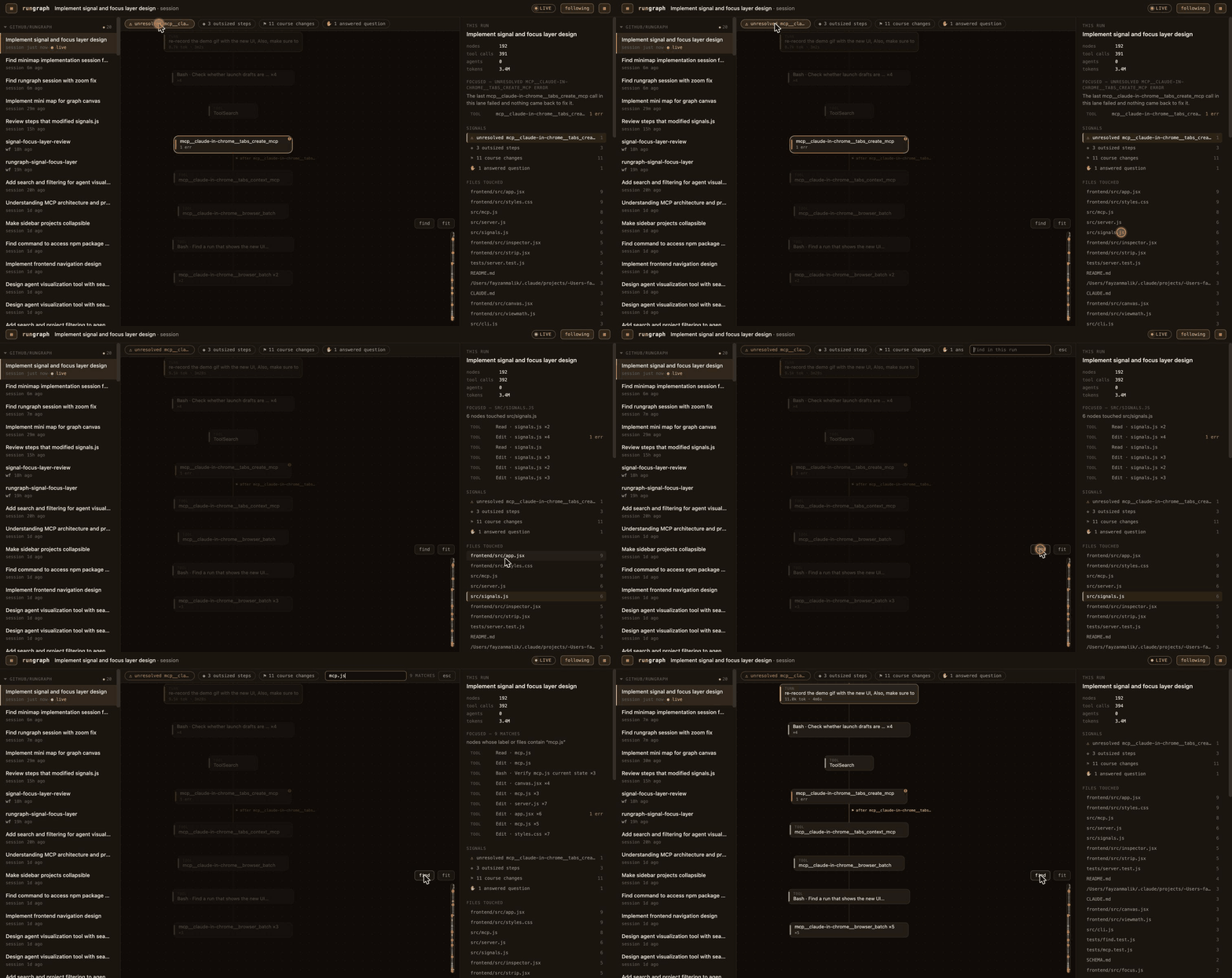
Your agent already wrote down everything it did. `rungraph` turns those
transcripts into an interactive graph — orchestrator, subagents and tools as
nodes, spawn/return edges, the moments a human said no marked on the path — and
hands your agent the same graph over MCP. Ask *"why did the Edit on `token.js`
keep failing?"* in your terminal: the answer arrives there, from your own model,
and the graph you have open **lights up the exact nodes the answer is about**.
```
npx rungraph
```
That's the whole quickstart. It finds every Claude Code, Codex, Hermes Agent,
opencode and Cursor run still on your disk, starts a local server and opens
your browser. No hooks, no wrappers, no telemetry — it works retroactively, and
a run that's happening right now grows live as the agent works.
> Hermes, opencode and Cursor runs need Node ≥ 22.13 for the built-in SQLite
> reader. On older Nodes they're skipped with a warning; everything else works.
**New here?** [docs/GUIDE.md](docs/GUIDE.md) walks through reading the graph,
what each signal means, wiring it to your agent, and what to do when something
looks broken.
## What you see
- **Time flows down.** Your prompts are the backbone; parallel agents fan out
into lanes and return to the turn that collected their result.
- **Tool nodes say what ran:** `Bash · npm test ×12`, `Edit · canvas.jsx`.
Consecutive calls of the same tool collapse into one node, so a test-fix loop
isn't a hairball.
- **Click any node** for the full story — prompt and response for turns; every
call's inputs, outputs, errors and timing for tools; the complete transcript
for subagents; and the agent's own narration from just before a call.
- **Human interventions are nodes.** A denied permission, an answered question,
an interrupt — and the edges after them carry the reason (`after permission
denial`, `retry after failure`).
- **Workflow runs** appear as single nodes you can drill into, phase boxes and
all.
- **Tokens, durations and models** annotate nodes; whole-run totals in the
header.
## What went wrong
A graph that renders everything with equal weight points at nothing, so
rungraph has an opinion. It derives **signals** from the run and puts them in a
strip above the canvas — and on a clean run the strip costs zero height,
because a marker you can't trust is worse than no marker.
| | fires when |
|---|---|
| ⟳ **retry storm** | the same tool kept failing in one place |
| ⚠ **unresolved error** | something failed and nothing ever came back to fix it |
| ✋ **intervention** | you denied a permission, interrupted a turn, or answered a question |
| ◆ **outlier** | a step that cost far more tokens or wall-clock than the rest of the run |
| ⚑ **course change** | the run's own recorded reason for changing direction |
Click a signal and the graph **focuses**: those nodes light up, everything
else dims — never hides, so the shape you already memorized stays put. The
same focus backs **find** (`/`, substring over labels *and the files each node
touched*, no model or network), **files** (click any path the run touched,
subagent work included, to see the steps behind it), and your agent's answers.
Signals re-derive on every live update, so the strip goes loud only when
something new has actually gone wrong.
Every run also carries **coverage** — how many records rungraph examined and
how many it couldn't interpret. Transcript formats are undocumented and
unversioned; when a vendor adds a record type, the strip says `read 95% of this
run` and names what it didn't understand, instead of letting an empty strip
pass for a clean run. Your agent gets the same numbers.
## Ask your agent about a run
```
npx rungraph mcp --install # one time, then restart your agent
npx rungraph mcp --check # is it working? prints exactly what to fix
```
Bare `--install` registers with every agent whose runs rungraph has already
read — Claude Code, Codex, Hermes, opencode, Cursor — by delegating to each
vendor's own `mcp add`; it never edits a config file itself. Where it can't
delegate (`cursor-agent mcp` has no `add`) it prints the block to paste and a
`cursor://` install link. `--client <name>` targets one agent, `--client all`
does all five. [GUIDE §6](docs/GUIDE.md#6-ask-your-agent) has the full
walkthrough; the `--json` shapes are in [SCHEMA.md](SCHEMA.md#mcp-rungraph-mcp).
Then ask the kinds of questions a transcript can actually answer:
- *which edits in my last run failed — and did any stay broken?*
- *which steps touched `src/auth.js`, subagents included?*
- *what did the "audit auth module" agent find?*
- *did it actually run the tests, or just say it did?*
Your agent calls `find_nodes` / `get_graph` / `get_detail` and **answers in
your terminal** — your model, your session, fully inspectable. Then it calls
`focus_nodes`, and **the open dashboard lights up the nodes the answer is
about**, switching runs or opening a tab if it has to, and hands back a deep
link you can paste into a PR. The inspector writes starter questions for you
from the run you're looking at.
| tool | does |
|---|---|
| `list_runs` | the run index |
| `get_graph` | one run's graph, compact by default (signals + files + coverage) |
| `find_nodes` | narrow before you pull — a big graph is 20k+ tokens |
| `get_detail` | the actual error text behind one node |
| `focus_nodes` | light up the open dashboard; returns a pastable deep link |
| `get_current_view` | what the dashboard is showing right now |
| `open_visualization` | open the browser on a run |
The read-only tools work with no server running. With more than one dashboard
live — yours plus a bundle someone sent you — the tools route by run id.
## Sharing a run
```
rungraph export --last 2 --as Bilal
# rungraph: export inventory (full content):
# 2 runs · 143 nodes · 12 of your prompts included
# files touched: 24
# rungraph: wrote acme-2026-08-15.rungraph (412,882 bytes)
```
The inventory prints every time, because transcripts log file **reads**
verbatim: when an agent merely opens your `.env`, every key it saw is sitting
in the session file with no diff to catch it. Export **blocks** on
high-confidence secrets (AWS keys, GitHub/Slack/API tokens, private-key
blocks), naming where each one is. Resolve with `--redact-secrets`,
`--structure-only` (shape, tool names, files and timings — no prompts, no
outputs), or `--allow-secrets`. *share…* in the runs pane does the same from
the dashboard.
Send the `.rungraph` file over whatever you already trust; rungraph never
touches a network. The recipient runs `npx rungraph open team-work.rungraph`:
an ephemeral dashboard, nothing copied, every run labelled *shared by Bilal*,
and their own agent can be asked about your runs. Bundles carry the
vendor-neutral IR, so a Codex run opens identically to a Claude Code one.
*copy link* in the header — and `focus_nodes` — produce a URL that restores the
run, selection and focus; a link that lands on the wrong dashboard offers a
jump to the one that has the run.
## Getting around
| Input | Action |
|---|---|
| Two-finger scroll / click-drag | Pan |
| Pinch / cmd+scroll | Zoom at the cursor |
| Click node or edge | Inspect it |
| Double-click node | Zoom to 100%, centered |
| `j` / `k` | Walk nodes in run order, inspector follows |
| `f` | Fit the whole graph |
| `/` | Find by label or file |
| `r` | Open / close replay |
| `←` / `→` | Step one event (replay open) |
| `space` | Play / pause (replay open) |
| `Esc` | Deselect and clear the focus (pauses replay, never closes it) |
A **minimap** shows the whole run with errors as red beacons, and `r` opens a
**replay** bar: scrub or play the run and watch the graph happen, with your
agent's `focus_nodes` moving the playhead to the moment its answer was true.
The **runs pane** groups sessions by project, filters by agent and by title,
and gathers runs with no project (deleted worktrees, home-directory chats)
under `✦ loose runs`.
**Resume from the dashboard:** every local run carries the exact
`claude --resume` / `codex resume` / `hermes --resume` / `opencode --session` /
`cursor-agent --resume` command, or on macOS opens a Terminal window with the
session loading (`RUNGRAPH_TERMINAL=iTerm` for iTerm2). A live Claude run
pre-checks **fork** so you don't interleave with the running session.
## For agents
Everything the UI can do, an agent can do over the CLI — JSON on stdout, logs
on stderr, exit codes `0` ok / `1` error / `2` no runs found, no prompts:
```bash
npx rungraph list --json # run index
npx rungraph graph <runId> --json # full Graph IR: nodes, edges, signals, coverage
npx rungraph find <runId> token.js --json # narrow first — a big graph is 20k+ tokens
npx rungraph serve --no-open # {"url":"http://127.0.0.1:4321"}, SSE live tail
```
The IR is versioned, vendor-neutral and documented in [SCHEMA.md](SCHEMA.md).
Everything downstream — UI, CLI, HTTP API, bundles — consumes only the IR.
| adapter | reads | point it elsewhere |
|---|---|---|
| Claude Code | `~/.claude/projects` — sessions, subagents, Workflow runs | |
| Codex CLI | `~/.codex/sessions` — rollout threads and spawned subagents | |
| Hermes Agent | `~/.hermes/state.db` | `RUNGRAPH_HERMES_HOME` |
| opencode | `~/.local/share/opencode/opencode.db` (`XDG_DATA_HOME` honoured) | `RUNGRAPH_OPENCODE_HOME` |
| Cursor IDE | `~/Library/Application Support/Cursor/User/globalStorage/state.vscdb` (macOS) | `RUNGRAPH_CURSOR_GLOBAL_STORAGE` |
| `cursor-agent` | `~/.cursor/chats` (`CURSOR_DATA_DIR` honoured) | `RUNGRAPH_CURSOR_CLI_HOME` |
The SQLite stores are read with Node's built-in `node:sqlite` — readonly, live,
no dependency added. The Cursor adapter skips cloud agents (not local), lists
but doesn't parse pre-`_v:9` conversations (shown as 0% read), offers no
resume for IDE conversations, and reports no token totals because Cursor
records none; Linux and Windows IDE paths are unverified.
Built to survive real transcripts: unknown record types are skipped and
counted, never a crash; a half-written last line is retried on the next tick;
liveness comes from watching the run's own files, with stable node ids so
deltas merge. Zero runtime dependencies; the frontend ships prebuilt.
## Privacy
Everything is local. The server binds `127.0.0.1` only and every request is
Host-header-guarded, so a hostile page can't DNS-rebind its way into your
transcripts. rungraph makes no network requests.
Content leaves the machine at exactly two boundaries, and both redact:
`rungraph export` prints an inventory and hard-stops on detected secrets; the
MCP server redacts every tool result on the way out — node labels included —
and reports how many values it replaced, so a redacted run is never mistaken
for a clean one. The dashboard shows the real values: they never leave
loopback, and reading a key is how you rotate it.
## CLI reference
```
rungraph scan, serve, open browser (human default)
rungraph list [--json] run index, newest first
rungraph graph <runId> Graph IR for one run (JSON on stdout)
rungraph find <runId> <query> nodes whose label or files match a substring
rungraph serve [--no-open] start server; prints {"url": …}
rungraph export <runId…> write a shareable .rungraph bundle (see --help)
rungraph open <bundle…> serve bundle files, ephemerally
rungraph mcp [--install] MCP server on stdio; --install registers it once
rungraph mcp --check verify the agent side end to end
--project <path> only runs for this project directory
--port <n> preferred port (auto-increments if taken)
--last <n> export: the n most recent runs of this project
--client <c> mcp --install: claude | codex | hermes | opencode | cursor | all
(default: every agent detected on this machine)
--scope <s> mcp --install --client claude: user (default) | project | local
```
Requires Node ≥ 20.
## Roadmap
- **Annotations** — mark nodes before exporting a bundle.
- **Cross-run questions** — "what else touched this file?"
- **Run comparison** — diff two runs of the same task.
- **Cost estimates** — per-node tokens into dollars.
## Contributing
Adapters for other agent CLIs are the most valuable thing you can add; bug
reports with a `--structure-only` bundle attached are the most useful kind.
[CONTRIBUTING.md](CONTRIBUTING.md) has the repo map and the non-negotiables.
Security reports: [SECURITY.md](SECURITY.md), privately please.
## License
[MIT](LICENSE)
This server cannot be deployed
Maintenance
ActivitySlowing
ResponsivenessUnresponsive