
Armor Crypto MCP
# Armor Crypto MCP
*Alpha Test version 0.1.24*
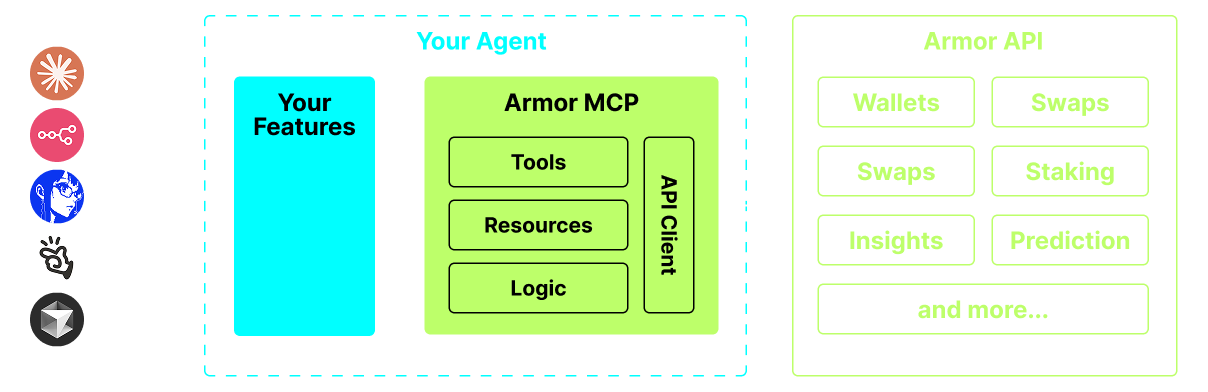
A single source for integrating AI Agents with the Crypto ecosystem. This includes Wallet creation and management, swaps, transfers, event-based trades like DCA, stop loss and take profit, and much more. The Armor MCP supports Solana in Alpha and, when in beta, will support more than a dozen blockchains, including Ethereum. Base, Avalanche, Bitcoin, Sui, Berachain, megaETH, Optimism, Ton, BNB, and Arbitrum, among others. Using Armor's MCP you can bring all of crypto into your AI Agent with unified logic and a complete set of tools.
<br />
<br />
<br />
<br />
<br />
<br />
# Features
🧠 AI Native
📙 Wallet Management
🔃 Swaps
🌈 Specialized trades (DCA, Stop Loss etc.)
⛓️ Multi-chain
↔️ Cross-chain transations
🥩 Staking
🤖 Fast intergration to Agentic frameworks
👫 Social Sentiment
🔮 Prediction
<br />
<br />
<br />
<br />
<br />
<br />
<br />
<br />
# Requirements
### 1. Make sure you have python installed
<br />
### 2. Install `uv`
*Linux / Windows*
```sh
pip install uv
```
*Mac*
```sh
brew install uv
```
<br />
### 3. Claude Desktop or your AI Agent will run the MCP
See [Usage & Configuration](#usage--configuration) for details.
<br />
<br />
<br />
<br />
<br />
# Alpha Testing
We are currently in pre-alpha, and we are testing the capabilities of various agents and agentic frameworks like Claude Desktop, Cline, Cursor, n8n, etc.
## Current Features & Tools
- Wallet Management
- Grouping & Organization
- Archiving
- Swap & Trades
- Normal swap
- DCA (place / list / cancel)
- Scheduled Orders
- Limit Orders (place / list / cancel)
- Staking and Unstaking
- Token Search and Trending Tokens
- Statistical Calculator for accurate Analysis
- Supports Solana blockchain
## Coming Soon
- More Blockchain Support
- Minting
- Armor Agents as a Tool (or A2A)
## MCP Setup
Currently you need to have the Armor NFT to get an API Key.
Get it [here](https://codex.armorwallet.ai/)
## Usage & Configuration
To use the Armor MCP with your agent, you need the following configuration, replace `<PUT-YOUR-KEY-HERE>` with your API key:
```json
{
"mcpServers": {
"armor-crypto-mcp": {
"command": "uvx",
"args": ["armor-crypto-mcp@latest", "--version"],
"env": {
"ARMOR_API_KEY": "<PUT-YOUR-KEY-HERE>"
}
}
}
}
```
<br />
<br />
<br />
<br />
<br />
<br />
# Use in Claude Desktop
1. Must have Developer Mode enabled
2. Open Claude Desktop's File Menu top left of the window.
3. Go to File > Settings
4. Under Developer, click Edit Configuration
5. In the config file, insert the `armor-wallet-mcp` section from above
6. Make sure to replace the placeholder with your API key
7. Save the file and start a new Chat in Claude Desktop
## Use in Cline
1. Click on the `MCP Servers` button in the Cline tab in VSCode on the left panel
2. Scroll to the bottom of the left panel and click on `Configure MCP Servers`
3. In the config file, insert `armor-wallet-mcp` section from above
4. Make sure to replace the placeholder with your API key
5. Save the file, click `Done` under the `MCP Servers` tab and start chatting with Cline
## Use in n8n
1. Open the n8n app
2. Bottom-left of screen click `...` next to your username and click `Settings`
3. On the left panel, click `Community nodes` and then `Install a Community Node` button
4. In the search field for `npm Package Name` type in *mcp*
5. Install `MCP Nodes`
6. Add any MCP node, for example: `List Tools`
7. In the MCP Client `Parameters` tab, click `Select Credential` and click `Create new credential`
8. Under `Command` enter `uvx`
9. Under `Arguments` enter `armor-crypto-mcp`
10. Under `Environments` enter `ARMOR_API_KEY=eyJhbGciOiJIUzI1NiIsIn...` paste the full API Key value after the `=`
11. Back in the `Parameters` tab you can choose the MCP `Operation` for that Node
<br />
<br />
<br />
<br />
<br />
<br />
# Using Armor MCP
Once you have setup the Armor MCP [here are some prompts you can use to get started](https://github.com/armorwallet/armor-crypto-mcp/blob/main/README_prompts.md)
<br />
<br />
<br />
TDQS
Scored across 37 tools
The tools cover distinct areas like wallets, groups, orders, swaps, and staking, but there is some overlap. For example, 'search_official_token_address' and 'search_token_details' both search for token information, and 'cancel_dca_order' and 'cancel_order' both cancel orders, which could cause confusion. However, the descriptions help clarify their specific purposes.
Most tools follow a consistent verb_noun pattern (e.g., 'create_wallet', 'list_groups', 'archive_wallets'), but there are minor deviations like 'calculator' (noun only) and 'wait_a_moment' (verb phrase). Overall, the naming is predictable and readable, with only a few inconsistencies.
With 37 tools, the count is excessive for a crypto wallet server, making it heavy and potentially overwhelming. While the domain is broad, many tools could be consolidated (e.g., multiple archive/unarchive tools) or omitted (e.g., 'get_current_time', 'wait_a_moment'), leading to a bloated interface.
The tool set provides comprehensive coverage for crypto wallet management, including CRUD operations for wallets and groups, trading (orders, swaps), staking, and token analysis. Minor gaps exist, such as no direct tool for editing wallet details beyond renaming, but agents can work around this with existing tools.