
yandex-wiki-search-mcp
**English** | [Русский](README_ru.md)
<div align="center">
<img src="https://raw.githubusercontent.com/dlbolshov/yandex-wiki-search-mcp/main/docs/assets/logo/logo-primary.svg" alt="yandex-wiki-search-mcp logo" width="120">
# Yandex Wiki Search MCP
[](https://glama.ai/mcp/servers/dlbolshov/yandex-wiki-search-mcp)
[](https://pypi.org/project/yandex-wiki-search-mcp/)
[](https://pypi.org/project/yandex-wiki-search-mcp/)
[](https://github.com/dlbolshov/yandex-wiki-search-mcp/actions/workflows/test.yml)
[](https://app.codecov.io/gh/dlbolshov/yandex-wiki-search-mcp)
[](LICENSE)
[](https://github.com/dlbolshov/yandex-wiki-search-mcp/pkgs/container/yandex-wiki-search-mcp)
</div>
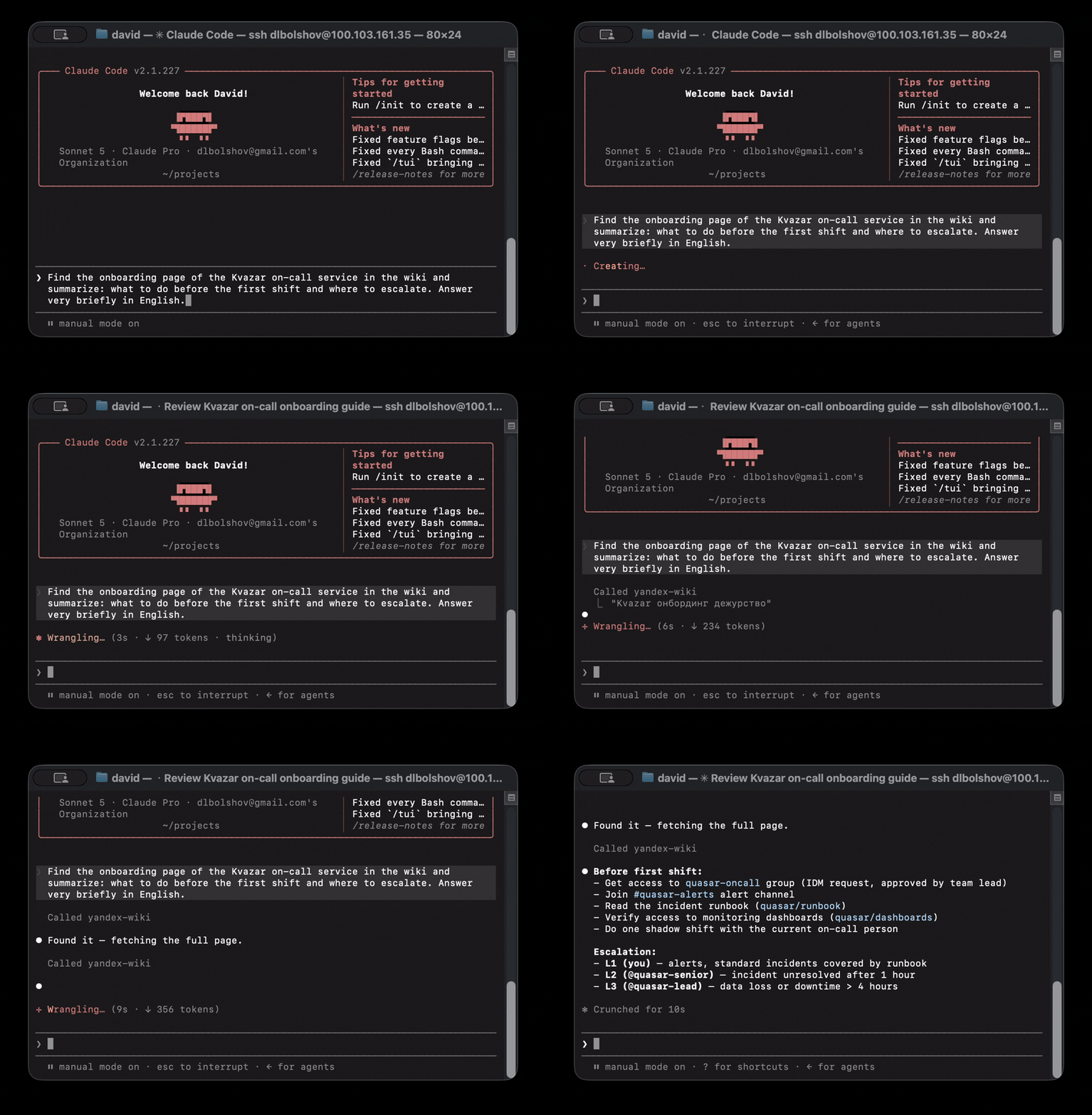
Connect Claude, Cursor, Windsurf, or any MCP client to **Yandex Wiki**: full-text search,
pages, comments, attachments, and dynamic tables ("grids") — **33 tools** with typed schemas.
*An unofficial project — not affiliated with or endorsed by Yandex.*
- 🔍 **Full-text search** across the entire wiki — the same backend that powers the Wiki web search bar, up to 50 results per query
- 📄 **Full page lifecycle** — create, update, append (top / bottom / anchor), clone, delete with a recovery token, comments, file uploads
- 📊 **Dynamic tables (grids)** — 11 write tools: rows, columns, cells, copy, sort
- 🔒 **Server-side read-only mode** — `WIKI_READ_ONLY=true` simply doesn't register write tools, so the agent can't bypass it
- 🧩 **Typed tool surface** — every tool ships input *and* output JSON schemas plus safety annotations (read-only / destructive / idempotent hints)
- 🐳 **Runs anywhere** — stdio for desktop clients, streamable-http + Docker (with optional multi-user OAuth) for teams
## Quick start
1. Get a Yandex OAuth token with Wiki access ([official guide](https://yandex.ru/support/wiki/ru/api-ref/access)) and your organization ID.
2. Install into your client:
[](https://cursor.com/install-mcp?name=yandex-wiki-search&config=eyJjb21tYW5kIjoidXZ4IiwiYXJncyI6WyJ5YW5kZXgtd2lraS1zZWFyY2gtbWNwIl0sImVudiI6eyJXSUtJX1RPS0VOIjoiWU9VUl9UT0tFTiIsIldJS0lfT1JHX0lEIjoiWU9VUl9PUkdfSUQiLCJXSUtJX1JFQURfT05MWSI6InRydWUifX0=)
[](https://insiders.vscode.dev/redirect/mcp/install?name=yandex-wiki-search&config=%7B%22name%22%3A%22yandex-wiki-search%22%2C%22command%22%3A%22uvx%22%2C%22args%22%3A%5B%22yandex-wiki-search-mcp%22%5D%2C%22env%22%3A%7B%22WIKI_TOKEN%22%3A%22YOUR_TOKEN%22%2C%22WIKI_ORG_ID%22%3A%22YOUR_ORG_ID%22%2C%22WIKI_READ_ONLY%22%3A%22true%22%7D%7D)
[](https://lmstudio.ai/install-mcp?name=yandex-wiki-search&config=eyJjb21tYW5kIjoidXZ4IiwiYXJncyI6WyJ5YW5kZXgtd2lraS1zZWFyY2gtbWNwIl0sImVudiI6eyJXSUtJX1RPS0VOIjoiWU9VUl9UT0tFTiIsIldJS0lfT1JHX0lEIjoiWU9VUl9PUkdfSUQiLCJXSUtJX1JFQURfT05MWSI6InRydWUifX0=)
[](https://github.com/dlbolshov/yandex-wiki-search-mcp/releases/latest/download/yandex-wiki-search-mcp.mcpb)
The Claude Desktop badge downloads the `.mcpb` bundle of the latest release —
double-click it and Claude Desktop installs the server, prompting for the token
and org ID ([uv](https://docs.astral.sh/uv/) must be installed).
<details>
<summary><b>Claude Desktop / Windsurf / any JSON-config client (uvx)</b></summary>
```json
{
"mcpServers": {
"yandex-wiki-search": {
"command": "uvx",
"args": ["yandex-wiki-search-mcp"],
"env": {
"WIKI_TOKEN": "YOUR_TOKEN",
"WIKI_ORG_ID": "YOUR_ORG_ID",
"WIKI_READ_ONLY": "true"
}
}
}
}
```
</details>
<details>
<summary><b>Claude Code (CLI)</b></summary>
```bash
claude mcp add yandex-wiki-search \
-e WIKI_TOKEN=YOUR_TOKEN -e WIKI_ORG_ID=YOUR_ORG_ID -e WIKI_READ_ONLY=true \
-- uvx yandex-wiki-search-mcp
```
</details>
<details>
<summary><b>Docker (no Python required)</b></summary>
```json
{
"mcpServers": {
"yandex-wiki-search": {
"command": "docker",
"args": ["run","--rm","-i",
"-e","WIKI_TOKEN","-e","WIKI_ORG_ID","-e","WIKI_READ_ONLY=true",
"ghcr.io/dlbolshov/yandex-wiki-search-mcp:latest"],
"env": {"WIKI_TOKEN":"YOUR_TOKEN","WIKI_ORG_ID":"YOUR_ORG_ID"}
}
}
}
```
</details>
> [!TIP]
> Start with `WIKI_READ_ONLY=true` — the server won't even register write tools.
> Flip it to `false` once you trust your agent with edits.
3. Ask your agent something — see below.
<details>
<summary><b>Need the old MCP SDK (1.x)?</b></summary>
The server runs on MCP Python SDK v2. That is invisible to clients — one v2 server
answers every protocol revision back to `2024-11-05` as well as the current one, so
there is nothing to change on your side and nothing to reinstall.
The only reason to hold back is a shared environment that pins `mcp<2` for something
else. `1.0.1` is the last release built on the 1.x SDK and stays on PyPI:
```bash
pip install "yandex-wiki-search-mcp<1.1"
```
</details>
## What can it do
> *"Find our onboarding docs and summarize the key steps."*
>
> *"What do we have on incident response? Open the most relevant page."*
>
> *"Create a page `team/weekly-notes` and append today's standup summary."*
>
> *"Add a row to the on-call rotation grid: alice, next week."*
>
> *"Upload this PDF to the project page and link it at the bottom."*
>
> *"Delete the draft page, but keep the recovery token in case I change my mind."*
## Tools
33 tools. All write tools disappear when `WIKI_READ_ONLY=true`.
### Search & read (10)
| Tool | What it does |
|---|---|
| `page_search` | Full-text search across the entire Wiki (pages and files), ranked results with a text excerpt each; server-side filters, and cursor paging through ~100 results in the `highlight` mode (up to 50 in one call otherwise) |
| `page_get` | Get a page by `page_id` or `slug` (accepts full Wiki URLs too) |
| `page_get_descendants` | Traverse a page subtree — one flat list of `{id, slug}` from all nesting levels; `from_root=true` walks the whole Wiki; `fetch_all` drains the cursor in one call |
| `page_get_comments` | List page comments (`fetch_all` supported) |
| `page_get_resources` | List page resources (attachments + grids) with server-side title search (`fetch_all` supported) |
| `page_get_attachments` | List page attachments (`fetch_all` supported) |
| `page_read_attachment` | Read an attachment's content straight into the conversation (nothing is saved anywhere) — PNG/JPEG/GIF/WebP as a native image block that vision-capable clients render, text as text (SVG included: it is XML, and an image block a vision API cannot decode fails the host's next call), other binaries as a base64 blob. The format is decided by the file's magic bytes, not by the wire's claim. Capped to protect the model's context window: 128 KiB for text/binary, 2 MiB for images; anything larger is refused with a pointer to `page_download_attachment` or `download_url` from `page_get_attachments` |
| `page_get_grids` | List grids attached to a page (`fetch_all` supported) |
| `grid_get` | Get a grid by `grid_id` with row/column/revision filters |
| `user_get_current` | Who am I — `username` and `home_cluster` (the caller's personal-section slug) |
### Pages: write (12)
| Tool | What it does |
|---|---|
| `page_create` | Create a page |
| `page_update` | Update page title and/or full content; set or clear a redirect to another page |
| `page_edit` | Edit content by exact-text replacements without resending the whole page; a missing or ambiguous match fails the call before anything is written; writes back with `allow_merge` so a concurrent edit is merged, not overwritten |
| `page_append_content` | Append content to top, bottom, or a named anchor |
| `page_clone` | Copy a page to a new slug — the copy gets a new id; children, comments, and history stay with the original; occupied slugs are refused. The API has no true move/rename ([details](docs/api-notes.md#pages)) |
| `page_add_comment` | Add a comment or reply in a thread |
| `page_delete_comment` | Delete a comment; returns the page's updated comment count |
| `page_delete_attachment` | Delete an attachment from a page |
| `page_delete` | Delete a page and receive a recovery token |
| `page_recover` | Recover a deleted page by recovery token |
| `page_upload_attachment` | Upload a local file in chunks and attach it to a page — not registered under `OAUTH_ENABLED=true`, where "local" would mean the shared server's filesystem |
| `page_download_attachment` | Download an attachment to a local file — streamed to disk with no size cap, nothing enters the conversation. Written atomically (`.part` → fsync → rename), refuses to overwrite unless asked, and lands with the permissions a normal write would give (`0666 & ~umask`, never executable); replacing a file keeps that file's own mode. The directory fsync that makes the rename itself crash-durable, and the mode inheritance, are POSIX-only. Gated the same way as `page_upload_attachment` under OAuth |
### Grids: write (11)
<details>
<summary>Expand the table</summary>
| Tool | What it does |
|---|---|
| `grid_create` | Create a grid on a page |
| `grid_update` | Update grid title and/or default sort |
| `grid_copy` | Copy a grid to an existing target page (async operation) |
| `grid_delete` | Delete a grid |
| `grid_add_rows` | Add rows at a position or after a given row |
| `grid_update_cells` | Update individual cells by row + column |
| `grid_delete_rows` | Delete rows |
| `grid_move_row` | Move a row |
| `grid_add_columns` | Add typed columns |
| `grid_delete_columns` | Delete columns by slug |
| `grid_move_column` | Move a column |
Grid specifics:
- Mutations use optimistic locking — fetch the grid first and pass the latest `revision`.
- `grid_update.default_sort` takes `[{"column": "status", "direction": "asc"}]` entries; the server converts them to the wire format the API expects.
- `grid_add_columns` requires `required` on every column because the real API validates it.
- `grid_copy` returns operation metadata, not a ready copied grid object.
</details>
## How it compares
Facts verified against the alternatives' docs and published code, July–August 2026;
the official hosted server's tool list captured live from `mcp.wiki.yandex.net`
(`wiki-mcp-server` 1.28.1, 2026-08-11).
| | **yandex-wiki-search-mcp** | [Yandex's official MCP](https://yandex.ru/support/wiki/en/mcp) (hosted) | [ya-yandex-wiki-mcp](https://github.com/APonkratov/yandex-wiki-mcp) | [slartus/mcp-yandex-wiki](https://github.com/slartus/mcp-yandex-wiki) | [ya-wiki-mcp](https://github.com/imdeniil/ya-wiki-mcp) |
|---|---|---|---|---|---|
| Full-text search | ✅ up to 50 results, server-side filters + highlighting | ❌ no search tool | ❌ | ✅ up to 10 results | ❌ |
| Pages: create / update / append / delete + recover | ✅ all, plus partial edits via text replacement (`page_edit`) | partial — no append / recover; has partial edits via text replacement | ✅ all | partial — no append / recover | partial — no recover |
| Pages: clone to a new slug | ✅ `page_clone` | ❌ | ❌ | ❌ | ✅ |
| Grids: write tools | ✅ 11 | ✅ 12, incl. column update + row pin/color | ✅ 11 | ❌ read-only | ✅ 11, incl. clone |
| Comments, attachment upload | ✅ incl. deletion, inline image preview, and download to disk | comments ✅ / upload ❌ (download + preview instead) | ✅ | ❌ | ❌ |
| Server-side read-only mode | ✅ | ❌ | ✅ | ❌ | ❌ |
| Typed output schemas + tool annotations | ✅ | ❌ | ❌ | ❌ | ❌ tools return plain strings |
| YFM helpers | ✅ syntax cheat sheet resource + `yfm_warnings` in write tools | ❌ | ❌ | ❌ | ✅ Markdown→YFM converter + page-tree cache, prompt templates |
| Docker / PyPI / MCP Registry | ✅ / ✅ / ✅ | — hosted service, closed source, nothing to install | ✅ / ✅ / ✅ | ❌ manual install | ❌ / ✅ / ❌ |
| Multi-user OAuth for HTTP deployments | ✅ | ❌ per-user token pasted into static headers, no OAuth flow | ✅ | ❌ | ❌ |
Also worth knowing:
- [best-doctor/mcp-yandex-wiki](https://github.com/best-doctor/mcp-yandex-wiki) (Python) — page create / update plus reads, with a separate `-ro` read-only entry point; no delete / recover, no grids, no search; PyPI only
- [brekhov-ilya/yandex-wiki-mcp](https://github.com/brekhov-ilya/yandex-wiki-mcp) (npm) — pages read / write / move, grids read-only; interactive PKCE token flow with auto-refresh, no full-text search
- [n-r-w/yandex-mcp](https://github.com/n-r-w/yandex-mcp) (Go) — Yandex Tracker + Wiki in one server, read-only by design (5 wiki read tools), no search; auth via IAM tokens from the `yc` CLI only — Yandex OAuth tokens are not supported
- [bim-ba/ycli](https://github.com/bim-ba/ycli) (Python) — one toolkit for Tracker + Wiki + Forms: a CLI, a Python SDK, a Claude Code plugin, and an MCP server whose Wiki surface is 42 `wiki_*` tools (15 read / 27 write, annotated, with a `--read-only` flag); no full-text search tool, and attachment downloads stay CLI/SDK-only
As of August 2026, full-text search exists only here (up to 50 results) and in slartus
(up to 10) — Yandex's own hosted server ships without a search tool — and the
combination of search, grid writes, server-side read-only mode, and typed schemas is
unique to this project.
This project is a fork of `ya-yandex-wiki-mcp` and builds on findings from
`slartus/mcp-yandex-wiki` — see [Credits](#credits).
## Full-text search
`page_search` wraps the `POST /v1/search` endpoint — the same backend that powers the
Wiki web search bar, undocumented until Yandex published its
[API reference](https://yandex.ru/support/wiki/ru/api-ref/search/search__search) in
August 2026. Search first, then open a result with `page_get` by its `slug`.
- Two wire modes. By default: up to **50** results in one call (`limit` is clamped to
1–50; the API rejects anything else) and no pagination — the response cursors are
always `null`. With `highlight=true`: pages are hard-capped at **10** results
regardless of `limit`, matches come wrapped in `<em>`, and `cursor` (the page number
echoed back in `next_cursor`) walks up to **~100** results. The set ends when
`results` comes back empty or `next_cursor` is `null` on a non-empty page — past the
end `next_cursor` keeps counting up over empty pages, so it alone does not mean
"more exists".
- **Filters run server-side, before the limit** — a filtered search does not lose matches to it: `slug_prefix` (section filter, deep prefixes like `tech-doc/ml` are fine), `result_type` (`page`/`file`), `authors` (page owners by `uid`/`cloud_uid` — `user_get_current` supplies your own, turning "find my pages about X" into two calls), and `created_between`/`modified_between` date intervals (both bounds required — the API rejects open ones).
- Quoted `"exact phrase"` queries work; `page` results get absolute `https://wiki.yandex.ru/...` links, `file` results get direct download links.
- `content` is a **~510-character excerpt, not the page and not a summary**: it is cut from wherever the match sits, the query terms need not be inside it, and its line breaks and tabs are the page's own layout (table cells arrive tab-separated) rather than separators between fragments. Pass `highlight=true` to get matches wrapped in `<em>` tags. Read the page with `page_get` before answering from it. Empty for `file` results.
## Traversing the tree
`page_get_descendants` returns a subtree as one flat list of `{id, slug}` from every
nesting level. Passing `from_root=true` instead of `page_id`/`slug` walks the **whole
Wiki** — the way in when no starting slug is known, so search is not the only entry
point. Prefer a section slug when you have one: wikis run to thousands of pages, and
`fetch_all` stops at its ~500-item cap with `truncated: true`.
More verified API behavior (scopes, 403 semantics, error envelopes, limits): [docs/api-notes.md](docs/api-notes.md).
## Configuration
| Variable | Required | Default | Description |
|---|---|---|---|
| `WIKI_TOKEN` | one of the two | — | Yandex OAuth token (takes precedence when both are set) |
| `WIKI_IAM_TOKEN` | | — | IAM token (Yandex Cloud organizations) |
| `WIKI_ORG_ID` | exactly one of the two | — | Yandex 360 organization ID (`X-Org-Id`) |
| `WIKI_CLOUD_ORG_ID` | | — | Yandex Cloud organization ID (`X-Cloud-Org-Id`) |
| `WIKI_READ_ONLY` | no | `false` | `true` disables all write tools server-side |
| `TRANSPORT` | no | `stdio` | `stdio` \| `sse` \| `streamable-http` |
| `HOST` / `PORT` | no | `0.0.0.0` / `8000` | HTTP transports only |
| `STATELESS_HTTP` / `JSON_RESPONSE` | no | `true` / `true` | `streamable-http` only: keep no per-session state / answer with JSON instead of SSE |
| `LOG_LEVEL` | no | `INFO` | Logs go to stderr; `DEBUG` additionally logs Wiki API requests (method, path, status, duration — never headers or bodies) |
| `WIKI_API_BASE_URL` | no | `https://api.wiki.yandex.net` | Wiki API endpoint |
| `WIKI_WEB_BASE_URL` | no | `https://wiki.yandex.ru` | Base for absolute page links in `page_search` results |
| `WIKI_AUTH_SCHEME` | no | `OAuth` | `Authorization` header scheme for `WIKI_TOKEN` (`OAuth` \| `Bearer`) |
| `WIKI_MAX_RETRIES` | no | `2` | Retries for dropped connections and `429`/`502`/`503`/`504` on read requests; `0` disables them |
| `TOOL_RESULT_TEXT` | no | `pretty` | Text duplicate of structured tool results: `pretty` (indent=2) \| `compact` (single line, 10-30% off the text block) \| `none` (structured only — check your client renders `structuredContent` first) |
<details>
<summary><b>Multi-user OAuth + Redis (HTTP deployments only)</b></summary>
With `OAUTH_ENABLED=true` the server becomes an OAuth provider: each MCP user
authorizes with their own Yandex account, and requests to the Wiki API are made with
their personal token. `page_upload_attachment` and `page_download_attachment` are
not registered in this mode: they read and write files on the machine the server
runs on, which is not the caller's machine in a shared deployment.
| Variable | Default | Description |
|---|---|---|
| `OAUTH_ENABLED` | `false` | Enable the OAuth provider |
| `OAUTH_STORE` | `memory` | `memory` \| `redis` |
| `OAUTH_SERVER_URL` | `https://oauth.yandex.ru` | Yandex OAuth server |
| `OAUTH_USE_SCOPES` | `true` | Request Wiki scopes during authorization |
| `OAUTH_CLIENT_ID` / `OAUTH_CLIENT_SECRET` | — | Your Yandex OAuth app credentials |
| `OAUTH_CLIENT_SECRET_EXPIRY_SECONDS` | `2592000` (30 days) | Lifetime of a dynamically registered MCP client. Registration is unauthenticated by protocol design, so without an expiry every registration is kept forever; clients are told the deadline at registration and re-register when it passes. Empty disables it |
| `MCP_SERVER_PUBLIC_URL` | — | Public URL of this server (OAuth callbacks) |
| `OAUTH_ENCRYPTION_KEYS` | — | Comma-separated base64 32-byte keys (required for `redis` store) |
| `REDIS_ENDPOINT` / `REDIS_PORT` / `REDIS_DB` / `REDIS_PASSWORD` / `REDIS_POOL_MAX_SIZE` | `localhost` / `6379` / `0` / — / `10` | Redis connection |
**Choosing the organization per user.** `WIKI_ORG_ID` / `WIKI_CLOUD_ORG_ID` are optional
under OAuth, because each request can name its own organization: append `?orgId=...` (or
`?cloudOrgId=...`) to the MCP server URL your client connects to. A query parameter wins
over the server-wide setting, so one deployment can serve several organizations. If a
request carries neither, the tool call fails with a message pointing at both options —
set the environment variable as the default if all your users share one organization.
See [`.env.example`](.env.example) for the full annotated list and [`compose.yaml`](compose.yaml) for a Redis baseline.
</details>
## Deployment
```mermaid
flowchart LR
C["MCP client<br/>Claude / Cursor / Windsurf / VS Code"]
S["yandex-wiki-search-mcp"]
W["Yandex Wiki API"]
R[("Redis<br/>optional OAuth token store")]
C -- "stdio (local, single user)" --> S
C -- "streamable-http (+ OAuth, multi-user)" --> S
S --> W
S -.-> R
```
**HTTP server via Docker** (the MCP endpoint is `http://localhost:8000/mcp`):
```bash
docker run --env-file .env -e TRANSPORT=streamable-http -p 8000:8000 \
--log-opt max-size=10m --log-opt max-file=3 \
ghcr.io/dlbolshov/yandex-wiki-search-mcp:latest
```
> [!NOTE]
> The server writes no log files of its own — everything goes to stderr, which
> Docker's default `json-file` driver stores **without a size limit**. The
> `--log-opt` flags above cap it; drop them only if your daemon already sets a
> default.
<details>
<summary><b>Docker Compose</b></summary>
```yaml
services:
mcp-wiki:
image: ghcr.io/dlbolshov/yandex-wiki-search-mcp:latest # or: build: .
ports:
- "8000:8000"
environment:
- WIKI_TOKEN=${WIKI_TOKEN}
- WIKI_ORG_ID=${WIKI_ORG_ID}
- TRANSPORT=streamable-http
logging:
driver: json-file
options:
max-size: "10m"
max-file: "3"
```
For Redis-backed OAuth storage, use the existing [`compose.yaml`](compose.yaml) as the baseline.
</details>
## Security
- **Read-only is server-side**: with `WIKI_READ_ONLY=true` write tools are never registered — there is nothing for a confused agent to call.
- **Wiki API does not enforce OAuth scopes** (re-verified 2026-08-11, after Yandex documented the scopes — see [docs/api-notes.md](docs/api-notes.md)): a `wiki:read` token can still write, so use the read-only mode rather than relying on token scopes.
- Secrets are `SecretStr` throughout — masked in logs and `repr`; `DEBUG` HTTP logging never includes headers or bodies.
- Deletion is recoverable: `page_delete` returns a recovery token for `page_recover`.
- Unrelated keys in a shared `.env` are ignored, but a misspelled setting (`WIKI_READ_ONL`) stops the server instead of silently falling back to a default you did not choose.
## Development
```bash
uv sync --dev
uv run yandex-wiki-search-mcp # run locally
uv run pytest # tests
```
Before committing, run the full verification set from [CONTRIBUTING.md](CONTRIBUTING.md).
How the server is put together — the layers, the code map, testing seams, CI and the
release process — is described in [docs/architecture.md](docs/architecture.md).
Verified API behavior and probe scripts are documented in [docs/api-notes.md](docs/api-notes.md).
The Wiki API drifts (the search endpoint silently changed contract once already, back
when it was undocumented) — `scripts/contract_sweep.py` re-verifies every client method
against a live organization and reports validation mismatches and undeclared keys:
```bash
uv run python scripts/contract_sweep.py users/YOU/contract-sweep # ~30 live checks
uv run python scripts/contract_sweep.py users/YOU/contract-sweep --cleanup # remove fixtures
```
With `SWEEP_SLUG=users/YOU/contract-sweep` in `.env` (see `.env.example`) the slug argument
can be omitted; the server itself never reads that variable.
The [API drift check](.github/workflows/api-drift.yml) workflow runs the same sweep
weekly when the `DRIFT_*` repository secrets are configured
(instructions in the workflow header); without them it skips quietly.
## Credits
This project began as a fork of [APonkratov/yandex-wiki-mcp](https://github.com/APonkratov/yandex-wiki-mcp)
(`ya-yandex-wiki-mcp`) by Aleksandr Ponkratov, an excellent, well-tested Python MCP server
for the Yandex Wiki API, licensed under Apache-2.0. It has since grown its own surface —
full-text search, typed input *and* output schemas across all 33 tools, YFM helpers,
cursor draining, multi-user OAuth and a live contract sweep against the API — while the
original copyright and license are preserved (see [LICENSE](LICENSE) and [NOTICE](NOTICE)).
The idea and key API findings behind full-text search come from
[slartus/mcp-yandex-wiki](https://github.com/slartus/mcp-yandex-wiki) (JavaScript, MIT):
it was the first to discover the then-undocumented `POST /v1/search` endpoint (Yandex
published a reference for it only in August 2026) and to report that OAuth scopes are
not enforced. No code was taken from it — only findings and ideas, independently
re-verified against a live organization and extended here.
## Trademarks
"Yandex" and "Yandex Wiki" are trademarks of YANDEX LLC. This is an unofficial,
community-built project: not affiliated with, sponsored, or endorsed by Yandex — the
names are used nominatively, to state which service the server talks to. The logo is
an original mark that reproduces neither Yandex Wiki nor MCP branding
([design notes](docs/assets/logo/README.md)).
---
`mcp-name: io.github.dlbolshov/yandex-wiki-search-mcp`
TDQS
Scored across 33 tools
Most tools target distinct resources or actions, and the detailed descriptions make choices clear. However, page_get_resources overlaps with page_get_attachments and page_get_grids, and grid_update vs grid_update_cells could be confused at first glance.
All tools follow a consistent resource-prefixed snake_case pattern (page_, grid_, user_) with clear verbs and optional objects. Even related mutations like grid_add_rows, grid_delete_rows, and grid_move_column are predictable.
At 33 tools, the surface is well beyond the 16-25 range and feels heavy for an agent to navigate. While the coverage is broad, several operations could likely be consolidated or grouped to reduce cognitive load.
The server covers the full page lifecycle, search and hierarchy navigation, comments, attachments, and dynamic tables with CRUD and row/column operations. The only gaps (e.g., move/rename) are explicitly acknowledged with documented workarounds, so agents are not left at dead ends.