

F
licenseNot graded
qualityD
maintenanceAn MCP server to retrieve train schedules from National Rail using the Realtime Trains API, providing tools for live departures and arrivals.
7
-

The repository is hosted on GitHub and can be cloned from there for installation.
Used for dependency management and running the application.
Click on "Deploy Server".
Wait a few minutes for the server to deploy. Once ready, it will show a "Started" state.
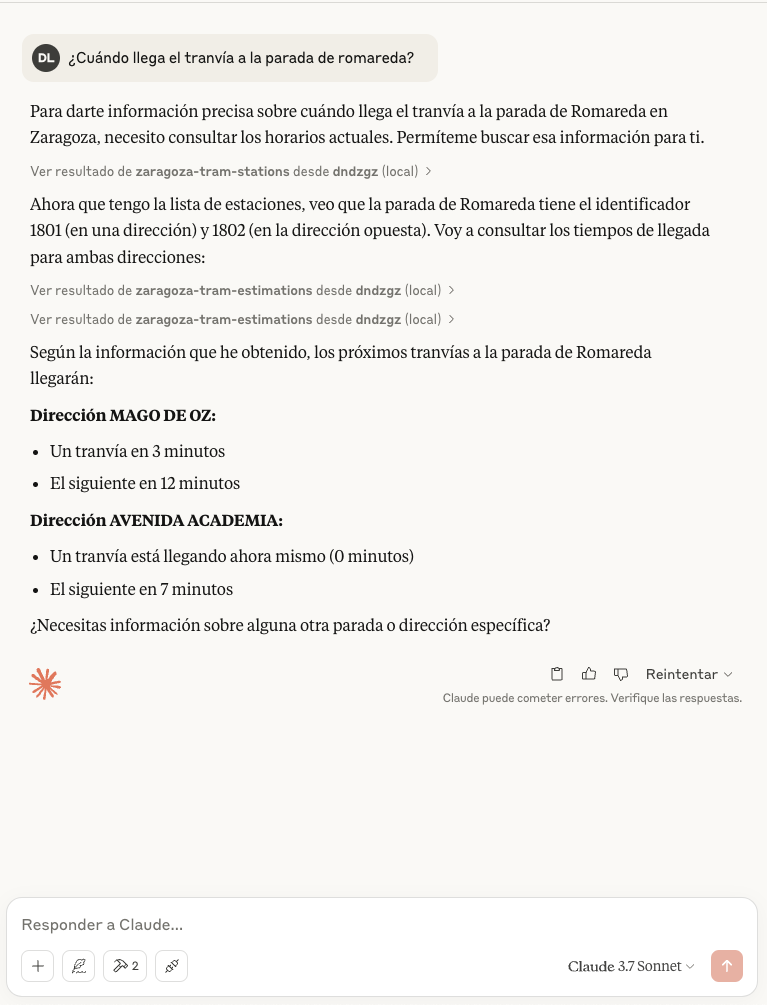
In the chat, type @ followed by the MCP server name and your instructions, e.g., "@DNDzgz MCP Server when is the next tram arriving at Romareda station?"
That's it! The server will respond to your query, and you can continue using it as needed.
Here is a step-by-step guide with screenshots.
This is an MCP (Model Context Protocol) server that provides information about the Zaragoza tram system, including real-time tram arrival estimations and station information using the DNDzgz API.
Clone the repository:
git clone https://github.com/danilat/mcp-dndzgz.git
cd mcp-dndzgz
Install dependencies:
npm installRelated MCP server: MCP Trenitalia
Add a the environment variable with a valid google maps api key and run it with the http transport
GOOGLE_MAPS_API_KEY=your-api-key npm start:httpThe server will start you should configure yout MCP client to connect.
Or start the server using stdio trasport:
Configure in your MCP client using npx, for example:
{
    "mcpServers": {
      "dndzgz": {
        "command": "npx @dndzgz/mcp",
        "env": {
          "GOOGLE_MAPS_API_KEY": "your-api-key"
        }
      }
    }
}
The server will start and connect to the MCP server.
The server provides the following tools:
zaragoza-tram-estimations: Get real-time arrival estimations for a specific tram station
Parameters:
station (number): ID of the tram station
Returns: JSON with estimated arrival times for both directions
zaragoza-tram-stations: Get a list of all tram stations in Zaragoza
Parameters:
latitude (number): Latitude to sort stations by proximity
longitude (number): Longitude to sort stations by proximity
Returns: JSON with station information including location, name, and ID
zaragoza-bus-stops: Get all bus stops in Zaragoza
Parameters:
latitude (number): Latitude to sort stops by proximity
longitude (number): Longitude to sort stops by proximity
Returns: JSON with bus stop locations, names, IDs, and lines
zaragoza-bus-estimations: Get real-time arrival estimations for a specific bus stop
Parameters:
stop (number): ID of the bus stop
Returns: JSON with estimated arrival times for each line serving that stop
zaragoza-bizi-stations: Get all Bizi stations in Zaragoza (public bicycle rental service)
Parameters:
latitude (number): Latitude to sort stations by proximity
longitude (number): Longitude to sort stations by proximity
Returns: JSON with Bizi station locations, names, and IDs
zaragoza-bizi-estimations: Get real-time availability of bikes and free slots in a Bizi station
Parameters:
station (number): ID of the Bizi station
Returns: JSON with bikes and parking slot availability
google-maps-link: Get a Google Maps link for a specific location
Parameters:
latitude (number): Latitude of the location
longitude (number): Longitude of the location
Returns: Google Maps URL showing the specified location
geolocation-from-address: Get the geolocation (latitude and longitude) from an address and the formatted address that was found
Parameters:
address (string): The address to geolocate (e.g., "Plaza de San Francisco, Zaragoza, Spain")
Returns: JSON with latitude, longitude, confidence level, and formatted address
@modelcontextprotocol/sdk: ^1.9.0
There is an screenshot with example using Claude Desktop
Get the geolocation (latitude and longitude) from an address and the formatted address that was found, only for Zaragoza. Can be used to find a bus stops, tram stations or bizi stations
| Name | Required | Description | Default |
|---|---|---|---|
| address | Yes |
Does the description disclose side effects, auth requirements, rate limits, or destructive behavior?
No annotations are provided, so the description carries the full burden of behavioral disclosure. It mentions the tool returns 'geolocation (latitude and longitude)' and 'formatted address,' but doesn't cover other important aspects like error handling, rate limits, authentication needs, or what happens with invalid addresses. For a tool with zero annotation coverage, this is a significant gap.
Agents need to know what a tool does to the world before calling it. Descriptions should go beyond structured annotations to explain consequences.
Is the description appropriately sized, front-loaded, and free of redundancy?
The description is appropriately sized and front-loaded: the first sentence states the core purpose, and the second adds usage context. Every sentence earns its place with no wasted words, making it efficient and easy to parse.
Shorter descriptions cost fewer tokens and are easier for agents to parse. Every sentence should earn its place.
Given the tool's complexity, does the description cover enough for an agent to succeed on first attempt?
Given the tool's complexity (simple geocoding with 1 parameter), no annotations, and no output schema, the description is somewhat complete but has gaps. It covers purpose and usage but lacks details on behavior, parameters, and return values. For a tool with no structured support, this is adequate but not fully comprehensive.
Complex tools with many parameters or behaviors need more documentation. Simple tools need less. This dimension scales expectations accordingly.
Does the description clarify parameter syntax, constraints, interactions, or defaults beyond what the schema provides?
The input schema has 1 parameter with 0% description coverage, so the description must compensate. It mentions 'address' as the input but doesn't add details beyond what's implied (e.g., format, examples, or constraints like 'only for Zaragoza' addresses). This provides minimal semantic value, aligning with the baseline when schema coverage is low but not fully compensating.
Input schemas describe structure but not intent. Descriptions should explain non-obvious parameter relationships and valid value ranges.
Does the description clearly state what the tool does and how it differs from similar tools?
The description clearly states the tool's purpose: 'Get the geolocation (latitude and longitude) from an address and the formatted address that was found, only for Zaragoza.' It specifies the verb ('Get'), resource ('geolocation'), and scope ('only for Zaragoza'). However, it doesn't explicitly differentiate from sibling tools like 'google-maps-link' or other geospatial tools, which would require a 5.
Agents choose between tools based on descriptions. A clear purpose with a specific verb and resource helps agents select the right tool.
Does the description explain when to use this tool, when not to, or what alternatives exist?
The description provides clear context for usage: 'only for Zaragoza' and 'Can be used to find a bus stops, tram stations or bizi stations.' This gives practical guidance on when to use it. However, it doesn't explicitly state when not to use it or name alternatives (e.g., 'google-maps-link' for broader geocoding), which would be needed for a score of 5.
Agents often have multiple tools that could apply. Explicit usage guidance like "use X instead of Y when Z" prevents misuse.
Get a Google Maps link from coordinates to help people to find a station o stop
| Name | Required | Description | Default |
|---|---|---|---|
| latitude | Yes | ||
| longitude | Yes |
Does the description disclose side effects, auth requirements, rate limits, or destructive behavior?
No annotations are provided, so the description carries the full burden of behavioral disclosure. It states the tool generates a link but doesn't describe what the link looks like (e.g., URL format, whether it opens in a browser), any rate limits, error handling, or authentication needs. For a tool with zero annotation coverage, this leaves significant gaps in understanding its behavior.
Agents need to know what a tool does to the world before calling it. Descriptions should go beyond structured annotations to explain consequences.
Is the description appropriately sized, front-loaded, and free of redundancy?
The description is concise and front-loaded: the first part clearly states the core function. The additional context about helping find stations or stops is useful but could be more integrated. It avoids unnecessary words, though it could be slightly more structured for clarity.
Shorter descriptions cost fewer tokens and are easier for agents to parse. Every sentence should earn its place.
Given the tool's complexity, does the description cover enough for an agent to succeed on first attempt?
Given the tool's simplicity (2 parameters, no output schema, no annotations), the description is incomplete. It lacks details on output format (e.g., what the link looks like), error cases, or usage constraints. For a tool that generates external links, more context on behavior and results would be helpful for an AI agent to use it effectively.
Complex tools with many parameters or behaviors need more documentation. Simple tools need less. This dimension scales expectations accordingly.
Does the description clarify parameter syntax, constraints, interactions, or defaults beyond what the schema provides?
The description mentions 'coordinates' but doesn't specify the parameters (latitude and longitude) or their semantics (e.g., decimal degrees, range constraints). With 0% schema description coverage, the description adds minimal value beyond implying coordinate input. It doesn't compensate for the coverage gap, but since there are only 2 parameters, the baseline is slightly higher than minimal.
Input schemas describe structure but not intent. Descriptions should explain non-obvious parameter relationships and valid value ranges.
Does the description clearly state what the tool does and how it differs from similar tools?
The description clearly states the tool's purpose: 'Get a Google Maps link from coordinates' specifies the action (get) and resource (Google Maps link). It adds context about helping people find stations or stops, which clarifies the use case. However, it doesn't explicitly differentiate from sibling tools like 'geolocation-from-address', which serves a related but different purpose.
Agents choose between tools based on descriptions. A clear purpose with a specific verb and resource helps agents select the right tool.
Does the description explain when to use this tool, when not to, or what alternatives exist?
The description provides minimal usage guidance: it mentions helping people find stations or stops, which implies a navigation context. However, it doesn't specify when to use this tool versus alternatives (e.g., 'geolocation-from-address' for reverse geocoding) or any prerequisites like coordinate format. No explicit when-not or alternative guidance is given.
Agents often have multiple tools that could apply. Explicit usage guidance like "use X instead of Y when Z" prevents misuse.
Get the estimation of bikes and free slots in a Bizi station in Zaragoza in realtime
| Name | Required | Description | Default |
|---|---|---|---|
| station | Yes |
Does the description disclose side effects, auth requirements, rate limits, or destructive behavior?
With no annotations provided, the description carries the full burden of behavioral disclosure. It mentions 'realtime' estimation, which is useful, but fails to cover critical aspects like rate limits, error handling, data freshness, or authentication requirements. For a tool that likely queries an external API, this omission leaves significant gaps in understanding its operational behavior.
Agents need to know what a tool does to the world before calling it. Descriptions should go beyond structured annotations to explain consequences.
Is the description appropriately sized, front-loaded, and free of redundancy?
The description is a single, well-structured sentence that efficiently conveys the core functionality without unnecessary words. It's front-loaded with the key action ('Get the estimation'), making it easy to parse quickly. Every part of the sentence adds value, achieving optimal conciseness.
Shorter descriptions cost fewer tokens and are easier for agents to parse. Every sentence should earn its place.
Given the tool's complexity, does the description cover enough for an agent to succeed on first attempt?
Given the tool's complexity (real-time data query), lack of annotations, no output schema, and low schema description coverage, the description is incomplete. It doesn't explain the return format (e.g., JSON structure), error cases, or how to interpret 'bikes and free slots' data. This leaves the agent with insufficient information to handle the tool robustly in various scenarios.
Complex tools with many parameters or behaviors need more documentation. Simple tools need less. This dimension scales expectations accordingly.
Does the description clarify parameter syntax, constraints, interactions, or defaults beyond what the schema provides?
The input schema has 1 parameter with 0% description coverage, so the description must compensate. It only implies a 'station' parameter without explaining what it represents (e.g., station ID, name, or how to obtain valid values). This lack of semantic detail makes it harder for an agent to use the tool correctly, as the parameter's meaning and format are unclear.
Input schemas describe structure but not intent. Descriptions should explain non-obvious parameter relationships and valid value ranges.
Does the description clearly state what the tool does and how it differs from similar tools?
The description clearly states the tool's purpose: 'Get the estimation of bikes and free slots in a Bizi station in Zaragoza in realtime.' It specifies the verb ('Get'), resource ('bikes and free slots'), and context ('Bizi station in Zaragoza'), making it easy to understand. However, it doesn't explicitly differentiate from its sibling 'zaragoza-bizi-stations', which might list stations rather than provide real-time availability estimates.
Agents choose between tools based on descriptions. A clear purpose with a specific verb and resource helps agents select the right tool.
Does the description explain when to use this tool, when not to, or what alternatives exist?
The description provides no guidance on when to use this tool versus alternatives. It doesn't mention sibling tools like 'zaragoza-bizi-stations' (which might list stations) or other estimation tools (e.g., 'zaragoza-bus-estimations'), leaving the agent to infer usage based on context alone. This lack of explicit comparison reduces effectiveness in tool selection.
Agents often have multiple tools that could apply. Explicit usage guidance like "use X instead of Y when Z" prevents misuse.
Get all Bizi stations in Zaragoza, the bicycle rental public service
| Name | Required | Description | Default |
|---|---|---|---|
| latitude | Yes | ||
| longitude | Yes |
Does the description disclose side effects, auth requirements, rate limits, or destructive behavior?
With no annotations provided, the description carries the full burden of behavioral disclosure. It states the tool retrieves data ('Get all Bizi stations'), implying a read-only operation, but doesn't clarify whether it requires authentication, has rate limits, returns real-time or static data, or what format the output takes. The description is minimal and lacks essential behavioral context.
Agents need to know what a tool does to the world before calling it. Descriptions should go beyond structured annotations to explain consequences.
Is the description appropriately sized, front-loaded, and free of redundancy?
The description is a single, efficient sentence that directly states the tool's purpose without unnecessary words. It's appropriately sized for a simple data retrieval tool and front-loads the core functionality.
Shorter descriptions cost fewer tokens and are easier for agents to parse. Every sentence should earn its place.
Given the tool's complexity, does the description cover enough for an agent to succeed on first attempt?
Given the tool's apparent simplicity (2 parameters, no output schema, no annotations), the description is incomplete. It doesn't explain the purpose of the required latitude/longitude parameters, what data is returned, or how it differs from sibling tools. For a tool with undocumented parameters and no output schema, more context is needed.
Complex tools with many parameters or behaviors need more documentation. Simple tools need less. This dimension scales expectations accordingly.
Does the description clarify parameter syntax, constraints, interactions, or defaults beyond what the schema provides?
The input schema has 2 required parameters (latitude, longitude) with 0% description coverage, and the tool description provides no information about these parameters. It doesn't explain what the latitude and longitude represent (e.g., center point for search, user location), their expected format, units, or valid ranges, leaving parameters undocumented.
Input schemas describe structure but not intent. Descriptions should explain non-obvious parameter relationships and valid value ranges.
Does the description clearly state what the tool does and how it differs from similar tools?
The description clearly states the tool's purpose: 'Get all Bizi stations in Zaragoza, the bicycle rental public service.' It specifies the verb ('Get'), resource ('Bizi stations'), and location context ('in Zaragoza'), though it doesn't explicitly differentiate from sibling tools like 'zaragoza-bus-stops' or 'zaragoza-tram-stations' beyond the bicycle rental focus.
Agents choose between tools based on descriptions. A clear purpose with a specific verb and resource helps agents select the right tool.
Does the description explain when to use this tool, when not to, or what alternatives exist?
The description provides no guidance on when to use this tool versus alternatives. It doesn't mention sibling tools like 'zaragoza-bizi-estimations' (which might provide availability or timing data) or other transportation tools, nor does it specify any prerequisites or exclusions for usage.
Agents often have multiple tools that could apply. Explicit usage guidance like "use X instead of Y when Z" prevents misuse.
Get the estimation of when a bus arrives to a stop in Zaragoza in realtime
| Name | Required | Description | Default |
|---|---|---|---|
| stop | Yes |
Does the description disclose side effects, auth requirements, rate limits, or destructive behavior?
No annotations are provided, so the description carries the full burden of behavioral disclosure. It states the tool provides 'realtime' estimations, which hints at dynamic data, but does not cover critical aspects such as data freshness, rate limits, error handling, authentication needs, or response format. For a real-time data tool with zero annotation coverage, this is a significant gap.
Agents need to know what a tool does to the world before calling it. Descriptions should go beyond structured annotations to explain consequences.
Is the description appropriately sized, front-loaded, and free of redundancy?
The description is a single, efficient sentence that directly states the tool's purpose without unnecessary words. It is front-loaded and appropriately sized, with every part contributing to understanding the core function.
Shorter descriptions cost fewer tokens and are easier for agents to parse. Every sentence should earn its place.
Given the tool's complexity, does the description cover enough for an agent to succeed on first attempt?
Given the tool's complexity (real-time data retrieval), lack of annotations, no output schema, and incomplete parameter documentation, the description is insufficient. It does not address how estimations are returned, what data is included, or potential limitations, making it inadequate for effective agent use.
Complex tools with many parameters or behaviors need more documentation. Simple tools need less. This dimension scales expectations accordingly.
Does the description clarify parameter syntax, constraints, interactions, or defaults beyond what the schema provides?
The input schema has 1 parameter with 0% description coverage, and the description does not add any semantic information about the 'stop' parameter. It does not explain what 'stop' represents (e.g., stop ID, name, or code), valid ranges, or examples. With low schema coverage, the description fails to compensate, leaving the parameter poorly documented.
Input schemas describe structure but not intent. Descriptions should explain non-obvious parameter relationships and valid value ranges.
Does the description clearly state what the tool does and how it differs from similar tools?
The description clearly states the tool's purpose: 'Get the estimation of when a bus arrives to a stop in Zaragoza in realtime.' It specifies the action ('get the estimation'), resource ('bus'), and scope ('Zaragoza'), distinguishing it from sibling tools like zaragoza-bizi-estimations (bikes) and zaragoza-tram-estimations (trams). However, it doesn't explicitly differentiate from zaragoza-bus-stops, which might be related but serves a different function.
Agents choose between tools based on descriptions. A clear purpose with a specific verb and resource helps agents select the right tool.
Does the description explain when to use this tool, when not to, or what alternatives exist?
The description provides no guidance on when to use this tool versus alternatives. It does not mention sibling tools like zaragoza-bus-stops (which might list stops) or other estimation tools for different transport modes, nor does it specify prerequisites or exclusions. Usage is implied by the purpose but lacks explicit context.
Agents often have multiple tools that could apply. Explicit usage guidance like "use X instead of Y when Z" prevents misuse.
Get all bus stops in Zaragoza
| Name | Required | Description | Default |
|---|---|---|---|
| latitude | Yes | ||
| longitude | Yes |
Does the description disclose side effects, auth requirements, rate limits, or destructive behavior?
With no annotations provided, the description carries full burden for behavioral disclosure. It states what the tool does but doesn't describe how it behaves: whether it returns all stops globally or filtered by proximity, what format the results are in, whether there are rate limits, or any error conditions. This leaves significant gaps for an agent to understand the tool's operation.
Agents need to know what a tool does to the world before calling it. Descriptions should go beyond structured annotations to explain consequences.
Is the description appropriately sized, front-loaded, and free of redundancy?
The description is extremely concise at just one sentence with no wasted words. It's front-loaded with the core purpose and uses clear, straightforward language. Every word earns its place in this minimal description.
Shorter descriptions cost fewer tokens and are easier for agents to parse. Every sentence should earn its place.
Given the tool's complexity, does the description cover enough for an agent to succeed on first attempt?
For a tool with 2 required parameters, 0% schema description coverage, no annotations, and no output schema, the description is insufficiently complete. It doesn't explain the parameter purpose, result format, or behavioral characteristics. The agent would struggle to use this tool effectively without additional context or experimentation.
Complex tools with many parameters or behaviors need more documentation. Simple tools need less. This dimension scales expectations accordingly.
Does the description clarify parameter syntax, constraints, interactions, or defaults beyond what the schema provides?
The schema has 0% description coverage for its two required parameters (latitude, longitude), and the description provides no information about what these parameters mean or how they affect the results. The description says 'Get all bus stops' which seems to contradict the need for location parameters, creating confusion about whether filtering occurs.
Input schemas describe structure but not intent. Descriptions should explain non-obvious parameter relationships and valid value ranges.
Does the description clearly state what the tool does and how it differs from similar tools?
The description clearly states the action ('Get') and resource ('all bus stops in Zaragoza'), making the purpose immediately understandable. However, it doesn't explicitly differentiate from sibling tools like 'zaragoza-bus-estimations' or 'zaragoza-bizi-stations', which prevents a perfect score.
Agents choose between tools based on descriptions. A clear purpose with a specific verb and resource helps agents select the right tool.
Does the description explain when to use this tool, when not to, or what alternatives exist?
The description provides no guidance on when to use this tool versus alternatives. It doesn't mention whether it's for general listing, proximity-based queries (implied by latitude/longitude parameters but not stated), or how it differs from other Zaragoza transportation tools like 'zaragoza-bus-estimations' or 'zaragoza-tram-stations'.
Agents often have multiple tools that could apply. Explicit usage guidance like "use X instead of Y when Z" prevents misuse.
Get the estimation of when arrives to a tram station in Zaragoza in realtime
| Name | Required | Description | Default |
|---|---|---|---|
| station | Yes |
Does the description disclose side effects, auth requirements, rate limits, or destructive behavior?
With no annotations provided, the description carries the full burden of behavioral disclosure. It mentions 'realtime' estimation, which hints at dynamic data, but fails to describe other traits like potential rate limits, error handling, data freshness, or response format, leaving significant gaps in understanding the tool's behavior.
Agents need to know what a tool does to the world before calling it. Descriptions should go beyond structured annotations to explain consequences.
Is the description appropriately sized, front-loaded, and free of redundancy?
The description is a single, efficient sentence that directly states the tool's purpose without unnecessary words. It's appropriately sized and front-loaded, making it easy to parse quickly.
Shorter descriptions cost fewer tokens and are easier for agents to parse. Every sentence should earn its place.
Given the tool's complexity, does the description cover enough for an agent to succeed on first attempt?
Given the tool's complexity (real-time data retrieval), lack of annotations, no output schema, and incomplete parameter documentation, the description is insufficient. It doesn't cover key aspects like response structure, error cases, or data sources, leaving the agent poorly equipped to use the tool effectively.
Complex tools with many parameters or behaviors need more documentation. Simple tools need less. This dimension scales expectations accordingly.
Does the description clarify parameter syntax, constraints, interactions, or defaults beyond what the schema provides?
The input schema has 1 parameter with 0% description coverage, and the tool description adds no information about the 'station' parameter. It doesn't explain what the number represents (e.g., station ID, code), valid ranges, or examples, failing to compensate for the schema's lack of detail.
Input schemas describe structure but not intent. Descriptions should explain non-obvious parameter relationships and valid value ranges.
Does the description clearly state what the tool does and how it differs from similar tools?
The description clearly states the tool's purpose with a specific verb ('Get') and resource ('estimation of when arrives to a tram station in Zaragoza in realtime'), making it easy to understand what it does. However, it doesn't explicitly differentiate from sibling tools like 'zaragoza-bus-estimations' or 'zaragoza-bizi-estimations', which prevents a perfect score.
Agents choose between tools based on descriptions. A clear purpose with a specific verb and resource helps agents select the right tool.
Does the description explain when to use this tool, when not to, or what alternatives exist?
The description provides no guidance on when to use this tool versus alternatives. It doesn't mention sibling tools or contextual factors that might influence tool selection, such as comparing tram estimations to bus or bizi estimations, leaving the agent without usage direction.
Agents often have multiple tools that could apply. Explicit usage guidance like "use X instead of Y when Z" prevents misuse.
Get all tram stations in Zaragoza
| Name | Required | Description | Default |
|---|---|---|---|
| latitude | Yes | ||
| longitude | Yes |
Does the description disclose side effects, auth requirements, rate limits, or destructive behavior?
With no annotations provided, the description carries the full burden of behavioral disclosure. It states what the tool does but doesn't describe how it behaves—e.g., whether it returns a list, how it handles errors, if it requires authentication, or if there are rate limits. This leaves significant gaps for an agent to understand operational traits.
Agents need to know what a tool does to the world before calling it. Descriptions should go beyond structured annotations to explain consequences.
Is the description appropriately sized, front-loaded, and free of redundancy?
The description is a single, efficient sentence with zero waste. It's front-loaded with the core purpose, making it easy to parse quickly, and every word earns its place without redundancy.
Shorter descriptions cost fewer tokens and are easier for agents to parse. Every sentence should earn its place.
Given the tool's complexity, does the description cover enough for an agent to succeed on first attempt?
Given the complexity (a tool with two required parameters and no output schema) and the lack of annotations, the description is incomplete. It doesn't explain what the tool returns (e.g., a list of station objects), how parameters influence results, or behavioral aspects like error handling, leaving the agent with insufficient context for reliable use.
Complex tools with many parameters or behaviors need more documentation. Simple tools need less. This dimension scales expectations accordingly.
Does the description clarify parameter syntax, constraints, interactions, or defaults beyond what the schema provides?
The schema has 0% description coverage, so the two required parameters (latitude, longitude) are undocumented in the schema. The description doesn't add any meaning beyond the schema—it doesn't explain what these parameters represent (e.g., a center point for filtering stations) or how they affect the output, failing to compensate for the low coverage.
Input schemas describe structure but not intent. Descriptions should explain non-obvious parameter relationships and valid value ranges.
Does the description clearly state what the tool does and how it differs from similar tools?
The description clearly states the verb ('Get') and resource ('all tram stations in Zaragoza'), making the purpose immediately understandable. However, it doesn't differentiate from sibling tools like 'zaragoza-tram-estimations' or 'zaragoza-bus-stops', which prevents a perfect score.
Agents choose between tools based on descriptions. A clear purpose with a specific verb and resource helps agents select the right tool.
Does the description explain when to use this tool, when not to, or what alternatives exist?
The description provides no guidance on when to use this tool versus alternatives. It doesn't mention when to choose it over 'zaragoza-tram-estimations' (which likely provides real-time data) or 'zaragoza-bus-stops' (which covers a different transit mode), nor does it specify any prerequisites or exclusions.
Agents often have multiple tools that could apply. Explicit usage guidance like "use X instead of Y when Z" prevents misuse.
Recent tool additions, removals, and schema changes observed during successful MCP inspections.
v1.0.0geolocation-from-address1 field changedInput schema / additionalPropertiesRemoved value: -falsegoogle-maps-link1 field changedInput schema / additionalPropertiesRemoved value: -falsezaragoza-bizi-estimations1 field changedInput schema / additionalPropertiesRemoved value: -falsezaragoza-bizi-stations1 field changedInput schema / additionalPropertiesRemoved value: -falsezaragoza-bus-estimations1 field changedInput schema / additionalPropertiesRemoved value: -falsezaragoza-bus-stops1 field changedInput schema / additionalPropertiesRemoved value: -falsezaragoza-tram-estimations1 field changedInput schema / additionalPropertiesRemoved value: -falsezaragoza-tram-stations1 field changedInput schema / additionalPropertiesRemoved value: -falsegeolocation-from-addressgoogle-maps-linkzaragoza-bizi-estimationszaragoza-bizi-stationszaragoza-bus-estimationszaragoza-bus-stopszaragoza-tram-estimationszaragoza-tram-stationsScored across 8 tools
Every tool has a clearly distinct purpose with no ambiguity. The tools are organized by transport mode (Bizi, bus, tram) and function (stations/stops vs. estimations), and the geolocation and Google Maps tools serve unique supporting roles. An agent can easily distinguish between them based on their specific targets.
All tool names follow a consistent pattern of 'zaragoza-[transport]-[function]' or a descriptive prefix like 'geolocation-from-address' and 'google-maps-link'. This verb-noun or noun-noun structure is uniform throughout, making the set predictable and readable.
With 8 tools, the count is well-scoped for the server's purpose of providing Zaragoza transport information. Each tool earns its place by covering distinct aspects like stations, real-time estimations, and location utilities, without being overwhelming or insufficient.
The tool set offers complete coverage for the domain of Zaragoza transport. It includes CRUD-like operations (list stations and get estimations) for all major modes (Bizi, bus, tram), plus supporting tools for geolocation and maps, ensuring no gaps in the workflow for finding and using transport services.
MCP server for China Railway 12306 ticket availability: schedules and seats by Chinese station name.
An MCP server that exposes functionalities to use Zomato's services.
An MCP server that provides congressional transcripts
MCP server providing attendance data queries via the CloudTime API.