

A
licenseNot graded
qualityD
maintenanceAI-driven task management application that operates via MCP, enabling autonomous creation, organization, and execution of tasks with support for subtasks, priorities, and progress tracking.
2
MIT

The Shrimp Task Manager provides an intelligent task management system for AI-assisted programming workflows by breaking down tasks, planning, executing, and verifying them systematically.
Core Functionality:
Task Planning: Initialize and detail workflows with clear goals and success criteria
Task Analysis: Assess requirements, technical feasibility, and risks, providing pseudocode where needed
Task Decomposition: Break complex tasks into manageable subtasks with dependencies and priorities
Task Execution & Verification: Execute plans and verify completion against defined criteria
Task Management: List, update, delete, or complete tasks while maintaining system integrity
Advanced Features:
Project Standards: Initialize or update rules for consistency across projects
Task Search: Query tasks by keyword or retrieve specific task details by ID
Thought Processing: Support structured, iterative thinking for problem analysis
Memory & History: Store execution history for reference and knowledge accumulation
Customization: Fine-tune AI assistant responses via environment variables and templates
Integration: Support for Model Context Protocol (MCP) compatible clients and optional web GUI
Supports configuration through environment variables, allowing customization of prompts and system behavior without modifying code.
Leverages Node.js as the runtime environment for the task management system, enabling efficient execution of the MCP server and its task management capabilities.
Uses TypeScript to provide a type-safe development environment for the task management system, enhancing code reliability and maintainability.
Click on "Deploy Server".
Wait a few minutes for the server to deploy. Once ready, it will show a "Started" state.
In the chat, type @ followed by the MCP server name and your instructions, e.g., "@Shrimp Task Manager plan task: implement user authentication with OAuth"
That's it! The server will respond to your query, and you can continue using it as needed.
Here is a step-by-step guide with screenshots.
🇺🇸 English | 🇩🇪 Deutsch | 🇪🇸 Español | 🇫🇷 Français | 🇮🇹 Italiano | 🇮🇳 हिन्दी | 🇰🇷 한국어 | 🇧🇷 Português | 🇷🇺 Русский | 🇨🇳 中文
🦐 Intelligent task management for AI-powered development - Break down complex projects into manageable tasks, maintain context across sessions, and accelerate your development workflow.
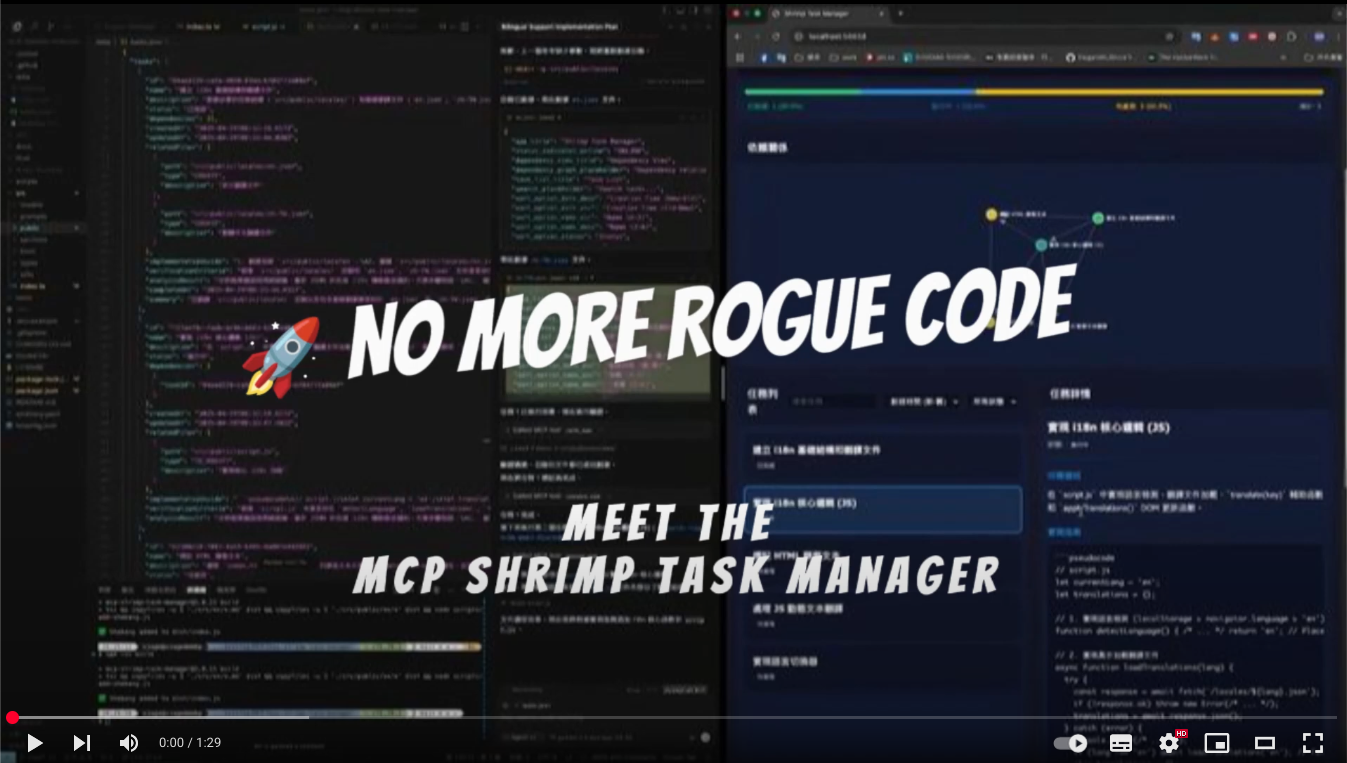
Watch Demo Video • Quick Start • Documentation
Node.js 18+
npm or yarn
MCP-compatible AI client (Claude Code, etc.)
Windows 11 (with WSL2):
# First, ensure WSL2 is installed (in PowerShell as Administrator)
wsl --install

# Enter Ubuntu/WSL environment
wsl -d Ubuntu

# Install Claude Code globally
npm install -g @anthropic-ai/claude-code

# Start Claude Code
claude
macOS/Linux:
# Install Claude Code globally
npm install -g @anthropic-ai/claude-code

# Start Claude Code
claude# Clone the repository
git clone https://github.com/cjo4m06/mcp-shrimp-task-manager.git
cd mcp-shrimp-task-manager
# Install dependencies
npm install
# Build the project
npm run buildCreate a .mcp.json file in your project directory:
{
  "mcpServers": {
    "shrimp-task-manager": {
      "command": "node",
      "args": ["/path/to/mcp-shrimp-task-manager/dist/index.js"],
      "env": {
        "DATA_DIR": "/path/to/your/shrimp_data",
        "TEMPLATES_USE": "en",
        "ENABLE_GUI": "false"
      }
    }
  }
}
Example configuration:
{
  "mcpServers": {
    "shrimp-task-manager": {
      "command": "node",
      "args": ["/home/fire/claude/mcp-shrimp-task-manager/dist/index.js"],
      "env": {
        "DATA_DIR": "/home/fire/claude/project/shrimp_data",
        "TEMPLATES_USE": "en",
        "ENABLE_GUI": "false"
      }
    }
  }
}
Then start Claude Code with your custom MCP configuration:
claude --dangerously-skip-permissions --mcp-config .mcp.jsonCline (VS Code Extension): A VS Code extension for AI-assisted coding. Add to VS Code settings.json under cline.mcpServers
Claude Desktop: Add to ~/Library/Application Support/Claude/claude_desktop_config.json (macOS) or %APPDATA%\Claude\claude_desktop_config.json (Windows)
Initialize your project: "init project rules"
Plan a task: "plan task: implement user authentication"
Execute tasks: "execute task" or "continuous mode"
Related MCP server: Vibe Coder MCP
Shrimp Task Manager is an MCP (Model Context Protocol) server that transforms how AI agents approach software development. Instead of losing context or repeating work, Shrimp provides:
🧠 Persistent Memory: Tasks and progress persist across sessions
📋 Structured Workflows: Guided processes for planning, execution, and verification
🔄 Smart Decomposition: Automatically breaks complex tasks into manageable subtasks
🎯 Context Preservation: Never lose your place, even with token limits
Intelligent Planning: Deep analysis of requirements before implementation
Task Decomposition: Break down large projects into atomic, testable units
Dependency Tracking: Automatic management of task relationships
Progress Monitoring: Real-time status tracking and updates
🔬 Research Mode: Systematic exploration of technologies and solutions
🤖 Agent System: Assign specialized AI agents to specific tasks (Learn more)
📏 Project Rules: Define and maintain coding standards across your project
💾 Task Memory: Automatic backup and restoration of task history
Modern React interface for visual task management with drag-and-drop, real-time search, and multi-profile support.
Quick Setup:
cd tools/task-viewer
npm install
npm run start:all
# Access at http://localhost:5173
📖 Full Task Viewer Documentation
Optional lightweight web interface for quick task overview.
Enable in .env: ENABLE_GUI=true
Agent: "plan task: add user authentication with JWT"
# Agent analyzes codebase, creates subtasks

Agent: "execute task"
# Implements authentication step by step
Agent: "plan task: fix memory leak in data processing"
# Agent researches issue, creates fix plan
Agent: "continuous mode"
# Executes all fix tasks automaticallyAgent: "research: compare React vs Vue for this project"
# Systematic analysis with pros/cons
Agent: "plan task: migrate component to chosen framework"
# Creates migration plan based on researchCreate a .env file:
# Required
DATA_DIR=/path/to/data/storage

# Optional
ENABLE_GUI=true          # Enable web GUI
WEB_PORT=3000           # Custom web port
PROMPT_LANGUAGE=en # Prompt language (en, zh, etc.)Command | Description |
| Initialize project standards |
| Create a task plan |
| Execute specific task |
| Execute all tasks sequentially |
| Show all tasks |
| Enter research mode |
| Review and improve task |
We welcome contributions! Please see our Contributing Guide for details.
This project is licensed under the MIT License - see the LICENSE file for details.
Created by cjo4m06 and maintained by the community.
深入分析任務需求並系統性檢查代碼庫,評估技術可行性與潛在風險,如果需要提供程式碼請使用 pseudocode 格式且盡量精簡只保留核心實現部分
| Name | Required | Description | Default |
|---|---|---|---|
| summary | Yes | 結構化的任務摘要,包含任務目標、範圍與關鍵技術挑戰,最少10個字符 | |
| initialConcept | Yes | 初步解答構想,包含技術方案、架構設計和實施策略,如果需要提供程式碼請使用 pseudocode 格式且盡量精簡只保留核心實現部分,最少50個字符 | |
| previousAnalysis | No | 前次迭代的分析結果,用於持續改進方案(僅在重新分析時需提供) |
Does the description disclose side effects, auth requirements, rate limits, or destructive behavior?
No annotations are provided, so the description carries the full burden. It mentions systematic codebase checking and risk evaluation but does not disclose any behavioral traits such as side effects, required permissions, or state changes. The agent learns the tool's function but not its operational impact.
Agents need to know what a tool does to the world before calling it. Descriptions should go beyond structured annotations to explain consequences.
Is the description appropriately sized, front-loaded, and free of redundancy?
The description is a single sentence that combines purpose and a usage note. It is adequately concise but not front-loaded; the pseudocode instruction could be separate. No wasted words, but structure could be improved.
Shorter descriptions cost fewer tokens and are easier for agents to parse. Every sentence should earn its place.
Given the tool's complexity, does the description cover enough for an agent to succeed on first attempt?
Given no output schema, the description should clarify what the tool returns. It mentions analysis and codebase checking but does not specify output format. The parameter details are covered by schema. Completeness is adequate but missing return value behavior.
Complex tools with many parameters or behaviors need more documentation. Simple tools need less. This dimension scales expectations accordingly.
Does the description clarify parameter syntax, constraints, interactions, or defaults beyond what the schema provides?
Schema coverage is 100%, so the schema already documents all parameters. The description adds no new meaning beyond the schema, except repeating the pseudocode hint. Baseline score of 3 is appropriate as the schema handles parameter semantics.
Input schemas describe structure but not intent. Descriptions should explain non-obvious parameter relationships and valid value ranges.
Does the description clearly state what the tool does and how it differs from similar tools?
The description clearly states the tool's action: analyzing task requirements, checking codebase, evaluating feasibility and risks. It uses specific verbs like '分析' and '檢查', and it distinguishes from siblings by focusing on analysis and risk assessment, though it could be more explicit.
Agents choose between tools based on descriptions. A clear purpose with a specific verb and resource helps agents select the right tool.
Does the description explain when to use this tool, when not to, or what alternatives exist?
The description provides a guideline to use pseudocode format for code output, but it does not specify when to use this tool instead of siblings like plan_task or reflect_task. There is no explicit context or exclusions.
Agents often have multiple tools that could apply. Explicit usage guidance like "use X instead of Y when Z" prevents misuse.
刪除系統中所有未完成的任務,該指令必須由用戶明確確認才能執行
| Name | Required | Description | Default |
|---|---|---|---|
| confirm | Yes | 確認刪除所有未完成的任務(此操作不可逆) |
Does the description disclose side effects, auth requirements, rate limits, or destructive behavior?
The description indicates a destructive action via 'delete' and a confirmation requirement, but it lacks explicit disclosure of irreversibility or side effects. The parameter description (in schema) adds 'irreversible,' but the main description does not.
Agents need to know what a tool does to the world before calling it. Descriptions should go beyond structured annotations to explain consequences.
Is the description appropriately sized, front-loaded, and free of redundancy?
The description is a single sentence that front-loads the action and includes the confirmation requirement. Every word is purposeful with no redundancy.
Shorter descriptions cost fewer tokens and are easier for agents to parse. Every sentence should earn its place.
Given the tool's complexity, does the description cover enough for an agent to succeed on first attempt?
For a simple destructive tool with one parameter and no output schema, the description is fairly complete: it states what it does and the confirmation need. It could mention irreversibility explicitly, but the parameter description covers that.
Complex tools with many parameters or behaviors need more documentation. Simple tools need less. This dimension scales expectations accordingly.
Does the description clarify parameter syntax, constraints, interactions, or defaults beyond what the schema provides?
The schema covers the sole parameter 'confirm' with a description of its role. The main description adds that the command requires user confirmation, which is a slight addition. With 100% schema coverage, baseline is 3.
Input schemas describe structure but not intent. Descriptions should explain non-obvious parameter relationships and valid value ranges.
Does the description clearly state what the tool does and how it differs from similar tools?
The description specifies 'delete all incomplete tasks,' clearly stating the action and resource. It distinguishes itself from sibling tools like 'delete_task' by targeting all incomplete tasks versus a single task.
Agents choose between tools based on descriptions. A clear purpose with a specific verb and resource helps agents select the right tool.
Does the description explain when to use this tool, when not to, or what alternatives exist?
The description explicitly requires user confirmation before execution, providing a clear usage condition. However, it does not contrast with alternatives like 'delete_task' for individual tasks.
Agents often have multiple tools that could apply. Explicit usage guidance like "use X instead of Y when Z" prevents misuse.
正式標記任務為完成狀態,生成詳細的完成報告,並更新關聯任務的依賴狀態
| Name | Required | Description | Default |
|---|---|---|---|
| taskId | Yes | 待標記為完成的任務唯一標識符,必須是狀態為「進行中」的有效任務ID | |
| summary | No | 任務完成摘要,簡潔描述實施結果和重要決策(選填,如未提供將自動生成) |
Does the description disclose side effects, auth requirements, rate limits, or destructive behavior?
With no annotations, the description carries the burden of disclosing behavioral traits. It mentions side effects (report generation, dependency updates) but omits details like permissions, reversibility, or what happens if the task is not in progress. The auto-generation of 'summary' is only in the schema, not repeated here.
Agents need to know what a tool does to the world before calling it. Descriptions should go beyond structured annotations to explain consequences.
Is the description appropriately sized, front-loaded, and free of redundancy?
The description is a single sentence, efficient and front-loaded with the verb '正式標記'. It packs three actions without excess, though the density slightly reduces readability. Every sentence earns its place.
Shorter descriptions cost fewer tokens and are easier for agents to parse. Every sentence should earn its place.
Given the tool's complexity, does the description cover enough for an agent to succeed on first attempt?
The description lacks information about return values (no output schema) and does not clarify what the agent receives after completion (e.g., the report content or status). Given the complexity of a mutation tool that updates dependencies, more context is needed for the agent to understand the full effect.
Complex tools with many parameters or behaviors need more documentation. Simple tools need less. This dimension scales expectations accordingly.
Does the description clarify parameter syntax, constraints, interactions, or defaults beyond what the schema provides?
Schema description coverage is 100%, so baseline is 3. The description adds no extra meaning beyond the schema: it does not explain taskId format or summary constraints, merely restating the concept of a completion summary. The tool description's mention of 'detailed completion report' is not a parameter.
Input schemas describe structure but not intent. Descriptions should explain non-obvious parameter relationships and valid value ranges.
Does the description clearly state what the tool does and how it differs from similar tools?
The description clearly states the tool's action: marking a task as completed, generating a completion report, and updating dependency status. This distinguishes it from siblings like 'delete_task' or 'update_task', though no explicit sibling differentiation is provided.
Agents choose between tools based on descriptions. A clear purpose with a specific verb and resource helps agents select the right tool.
Does the description explain when to use this tool, when not to, or what alternatives exist?
No explicit guidance on when to use this tool versus alternatives. The description implicitly assumes use for tasks in progress (constraint on taskId), but does not specify when not to use or mention alternative tools like 'update_task' for partial updates.
Agents often have multiple tools that could apply. Explicit usage guidance like "use X instead of Y when Z" prevents misuse.
刪除未完成的任務,但不允許刪除已完成的任務,確保系統記錄的完整性
| Name | Required | Description | Default |
|---|---|---|---|
| taskId | Yes | 待刪除任務的唯一標識符,必須是系統中存在且未完成的任務ID |
Does the description disclose side effects, auth requirements, rate limits, or destructive behavior?
With no annotations, the description carries full burden. It discloses the key behavioral constraint of only allowing deletion of incomplete tasks, but does not mention other behaviors such as irreversibility, authorization needs, or error handling, leaving some gaps.
Agents need to know what a tool does to the world before calling it. Descriptions should go beyond structured annotations to explain consequences.
Is the description appropriately sized, front-loaded, and free of redundancy?
The description is a single sentence that immediately conveys the core action and constraint with no extraneous words. It is front-loaded and highly efficient.
Shorter descriptions cost fewer tokens and are easier for agents to parse. Every sentence should earn its place.
Given the tool's complexity, does the description cover enough for an agent to succeed on first attempt?
For a simple tool with one parameter and no output schema, the description covers the essential constraint. It could mention return format or error cases, but is otherwise adequate for use.
Complex tools with many parameters or behaviors need more documentation. Simple tools need less. This dimension scales expectations accordingly.
Does the description clarify parameter syntax, constraints, interactions, or defaults beyond what the schema provides?
Schema description coverage is 100% and the schema already provides a detailed description of taskId including the constraint. The tool description adds no new parameter information beyond what the schema states, so baseline 3 is appropriate.
Input schemas describe structure but not intent. Descriptions should explain non-obvious parameter relationships and valid value ranges.
Does the description clearly state what the tool does and how it differs from similar tools?
The description clearly states 'Delete incomplete tasks, but does not allow deletion of completed tasks,' which is a specific verb+resource with a scope constraint. It distinguishes from siblings like complete_task and update_task by focusing on deletion of incomplete tasks only.
Agents choose between tools based on descriptions. A clear purpose with a specific verb and resource helps agents select the right tool.
Does the description explain when to use this tool, when not to, or what alternatives exist?
The description explicitly states when to use (for incomplete tasks) and when not to use (not for completed tasks). However, it does not name alternative tools for handling completed tasks, which would improve guidance.
Agents often have multiple tools that could apply. Explicit usage guidance like "use X instead of Y when Z" prevents misuse.
按照預定義計劃執行特定任務,確保每個步驟的輸出符合質量標準
| Name | Required | Description | Default |
|---|---|---|---|
| taskId | Yes | 待執行任務的唯一標識符,必須是系統中存在的有效任務ID |
Does the description disclose side effects, auth requirements, rate limits, or destructive behavior?
No annotations are present, and the description lacks details on safety, failure modes, side effects, or whether the tool is idempotent. For a mutation tool, this is insufficient.
Agents need to know what a tool does to the world before calling it. Descriptions should go beyond structured annotations to explain consequences.
Is the description appropriately sized, front-loaded, and free of redundancy?
A single sentence that is efficient and front-loaded, though it could benefit from a brief usage caveat.
Shorter descriptions cost fewer tokens and are easier for agents to parse. Every sentence should earn its place.
Given the tool's complexity, does the description cover enough for an agent to succeed on first attempt?
Given the complexity of task execution and the presence of 14 sibling tools, the description does not sufficiently distinguish its role or clarify return values.
Complex tools with many parameters or behaviors need more documentation. Simple tools need less. This dimension scales expectations accordingly.
Does the description clarify parameter syntax, constraints, interactions, or defaults beyond what the schema provides?
Schema coverage is 100% with a clear parameter description. The description adds no extra meaning beyond the schema's existing field documentation.
Input schemas describe structure but not intent. Descriptions should explain non-obvious parameter relationships and valid value ranges.
Does the description clearly state what the tool does and how it differs from similar tools?
The description clearly states the tool executes a task according to a predefined plan and ensures quality, but does not differentiate from siblings like complete_task or verify_task.
Agents choose between tools based on descriptions. A clear purpose with a specific verb and resource helps agents select the right tool.
Does the description explain when to use this tool, when not to, or what alternatives exist?
No guidance is provided on when to use this tool versus alternatives such as analyze_task, plan_task, or verify_task.
Agents often have multiple tools that could apply. Explicit usage guidance like "use X instead of Y when Z" prevents misuse.
根據任務ID獲取任務的完整詳細信息,包括未截斷的實現指南和驗證標準等
| Name | Required | Description | Default |
|---|---|---|---|
| taskId | Yes | 欲檢視詳情的任務ID |
Does the description disclose side effects, auth requirements, rate limits, or destructive behavior?
No annotations provided, so description carries full burden. It hints at providing untruncated data (implying other tools may truncate), but does not state read-only nature, permissions, or rate limits. Adequate for a simple read operation but lacks explicit behavioral details.
Agents need to know what a tool does to the world before calling it. Descriptions should go beyond structured annotations to explain consequences.
Is the description appropriately sized, front-loaded, and free of redundancy?
Single sentence that front-loads the action and resource. In Chinese, concise but could be restructured for better readability. No fluff.
Shorter descriptions cost fewer tokens and are easier for agents to parse. Every sentence should earn its place.
Given the tool's complexity, does the description cover enough for an agent to succeed on first attempt?
Given no output schema, the description covers expected content (full details, implementation guide, verification standards). Could specify additional fields like status or timestamps, but sufficient for a get-detail tool among many siblings.
Complex tools with many parameters or behaviors need more documentation. Simple tools need less. This dimension scales expectations accordingly.
Does the description clarify parameter syntax, constraints, interactions, or defaults beyond what the schema provides?
Schema coverage is 100% with parameter description '欲檢視詳情的任務ID'. The description adds context about what the returned details include (implementation guide, verification standards), providing value beyond the schema.
Input schemas describe structure but not intent. Descriptions should explain non-obvious parameter relationships and valid value ranges.
Does the description clearly state what the tool does and how it differs from similar tools?
The description clearly states the action (獲取) and resource (任務的完整詳細信息), and specifies what includes (未截斷的實現指南和驗證標準). It distinguishes from siblings like list_tasks and update_task.
Agents choose between tools based on descriptions. A clear purpose with a specific verb and resource helps agents select the right tool.
Does the description explain when to use this tool, when not to, or what alternatives exist?
The description implies usage when needing full task details including implementation guides, but does not explicitly state when to use vs alternatives like list_tasks or query_task. No exclusions or prerequisites mentioned.
Agents often have multiple tools that could apply. Explicit usage guidance like "use X instead of Y when Z" prevents misuse.
生成結構化任務清單,包含完整狀態追蹤、優先級和依賴關係
| Name | Required | Description | Default |
|---|---|---|---|
| status | Yes | 要列出的任務狀態,可選擇 'all' 列出所有任務,或指定具體狀態 |
Does the description disclose side effects, auth requirements, rate limits, or destructive behavior?
With no annotations, the description should disclose behavioral traits. It does not mention that the tool is read-only, has no side effects, or any authorization requirements. The description only covers output structure, leaving behavioral aspects unclear.
Agents need to know what a tool does to the world before calling it. Descriptions should go beyond structured annotations to explain consequences.
Is the description appropriately sized, front-loaded, and free of redundancy?
The description is a single concise sentence that covers the core functionality. It is front-loaded and efficient, though it lacks structural elements like bullet points that might improve scanability.
Shorter descriptions cost fewer tokens and are easier for agents to parse. Every sentence should earn its place.
Given the tool's complexity, does the description cover enough for an agent to succeed on first attempt?
For a simple tool with one parameter and no output schema, the description provides adequate context about the output (status, priority, dependencies). However, it could be improved by noting that the list is filterable by status and clarifying the scope (e.g., all tasks belonging to the current context).
Complex tools with many parameters or behaviors need more documentation. Simple tools need less. This dimension scales expectations accordingly.
Does the description clarify parameter syntax, constraints, interactions, or defaults beyond what the schema provides?
The schema already provides full description of the status parameter (enum values and meaning). The tool description adds no further parameter semantics beyond showing that the returned list includes additional fields (priority, dependencies), which is about output, not parameter meaning. Baseline 3 is appropriate due to high schema coverage.
Input schemas describe structure but not intent. Descriptions should explain non-obvious parameter relationships and valid value ranges.
Does the description clearly state what the tool does and how it differs from similar tools?
The description clearly states the tool generates a structured task list with status tracking, priority, and dependencies, which precisely defines its purpose. It distinguishes from sibling tools like get_task_detail (single task) and query_task (general query) by focusing on listing with filtering by status.
Agents choose between tools based on descriptions. A clear purpose with a specific verb and resource helps agents select the right tool.
Does the description explain when to use this tool, when not to, or what alternatives exist?
The description implies usage for listing tasks filtered by status but does not explicitly state when to use this tool versus siblings like query_task or analyze_task. No when-not-to-use or alternative guidance is provided.
Agents often have multiple tools that could apply. Explicit usage guidance like "use X instead of Y when Z" prevents misuse.
初始化並詳細規劃任務流程,建立明確的目標與成功標準,可選擇參考現有任務進行延續規劃
| Name | Required | Description | Default |
|---|---|---|---|
| description | Yes | 完整詳細的任務問題描述,應包含任務目標、背景及預期成果 | |
| requirements | No | 任務的特定技術要求、業務約束條件或品質標準(選填) | |
| existingTasksReference | No | 是否參考現有任務作為規劃基礎,用於任務調整和延續性規劃 |
Does the description disclose side effects, auth requirements, rate limits, or destructive behavior?
No annotations provided, so the description carries full burden. It mentions establishing goals but does not disclose behavioral traits such as whether the tool modifies state, requires authentication, or has side effects (e.g., creating a plan object). The return value is not mentioned.
Agents need to know what a tool does to the world before calling it. Descriptions should go beyond structured annotations to explain consequences.
Is the description appropriately sized, front-loaded, and free of redundancy?
The description is a single concise sentence in Chinese, covering purpose and optional reference. It is appropriately front-loaded and efficient, though slightly dense due to missing punctuation.
Shorter descriptions cost fewer tokens and are easier for agents to parse. Every sentence should earn its place.
Given the tool's complexity, does the description cover enough for an agent to succeed on first attempt?
Given no output schema and a complex domain (task planning), the description should explain what the tool returns or how it affects state. It lacks information on prerequisites, success criteria format, or the planning output, making it incomplete for agent selection.
Complex tools with many parameters or behaviors need more documentation. Simple tools need less. This dimension scales expectations accordingly.
Does the description clarify parameter syntax, constraints, interactions, or defaults beyond what the schema provides?
Schema description coverage is 100%, so baseline is 3. The description adds some context (e.g., '參考現有任務進行延續規劃' for `existingTasksReference`), but does not significantly extend beyond the schema descriptions.
Input schemas describe structure but not intent. Descriptions should explain non-obvious parameter relationships and valid value ranges.
Does the description clearly state what the tool does and how it differs from similar tools?
The description clearly states it initializes and plans task flow, establishes goals and success criteria, and allows referencing existing tasks. This differentiates it from sibling tools like `execute_task` or `analyze_task`, though it does not explicitly name alternatives.
Agents choose between tools based on descriptions. A clear purpose with a specific verb and resource helps agents select the right tool.
Does the description explain when to use this tool, when not to, or what alternatives exist?
The description implies usage for initial planning by mentioning '初始化' and '延續規劃', but does not explicitly state when to use vs. alternatives like `split_tasks` or `update_task`. No 'when not to use' guidance is provided.
Agents often have multiple tools that could apply. Explicit usage guidance like "use X instead of Y when Z" prevents misuse.
你可以透過靈活的、可適應和發展的思考過程來分析問題,隨著理解的加深,每個想法都可以建立、質疑或修改先前的見解。你可以質疑想法、假設想法、驗證想法,並且可以建立新的想法。你將重複這個過程,直到你對問題有足夠的理解,並且能夠提出有效的解決方案。如果你覺得思考已經充分可以把 nextThoughtNeeded 設為 false 並且停止思考。
| Name | Required | Description | Default |
|---|---|---|---|
| tags | No | 思維標籤,是一個陣列字串 | |
| stage | Yes | 思考階段,可以選擇的階段有:問題定義、收集資訊、研究、分析、綜合、結論、質疑、規劃 | |
| thought | Yes | 思維內容 | |
| axioms_used | No | 使用的公理,是一個陣列字串 | |
| thought_number | Yes | 當前思維編號 | |
| total_thoughts | Yes | 預計總思維數量 | |
| next_thought_needed | Yes | 是否需要下一步思維 | |
| assumptions_challenged | No | 挑戰的假設,是一個陣列字串 |
Does the description disclose side effects, auth requirements, rate limits, or destructive behavior?
No annotations are provided, so the description carries the full burden. It describes the iterative reasoning process but does not disclose potential side effects, logging, or safety implications beyond the cognitive process.
Agents need to know what a tool does to the world before calling it. Descriptions should go beyond structured annotations to explain consequences.
Is the description appropriately sized, front-loaded, and free of redundancy?
The description is a single block of Chinese text that efficiently conveys the tool's purpose and usage, though it could be slightly more condensed. It is front-loaded with the core idea.
Shorter descriptions cost fewer tokens and are easier for agents to parse. Every sentence should earn its place.
Given the tool's complexity, does the description cover enough for an agent to succeed on first attempt?
Given the 8 parameters (5 required) and no output schema, the description provides a comprehensive overview of the thinking process. It lacks explanation of specific parameter values like stage enums, but schema covers those.
Complex tools with many parameters or behaviors need more documentation. Simple tools need less. This dimension scales expectations accordingly.
Does the description clarify parameter syntax, constraints, interactions, or defaults beyond what the schema provides?
Schema coverage is 100%, so parameters are well-documented. The description does not add additional semantics beyond the process explanation, earning the baseline score of 3.
Input schemas describe structure but not intent. Descriptions should explain non-obvious parameter relationships and valid value ranges.
Does the description clearly state what the tool does and how it differs from similar tools?
The description clearly states the tool's purpose: an adaptive thinking process to analyze problems by building, questioning, and modifying insights. It effectively distinguishes from sibling task management tools like 'analyze_task' or 'execute_task' by focusing on internal reasoning.
Agents choose between tools based on descriptions. A clear purpose with a specific verb and resource helps agents select the right tool.
Does the description explain when to use this tool, when not to, or what alternatives exist?
While the description explains the iterative process and when to stop (set next_thought_needed to false), it does not explicitly state when to use this tool over alternatives, nor does it provide exclusion criteria or prerequisites.
Agents often have multiple tools that could apply. Explicit usage guidance like "use X instead of Y when Z" prevents misuse.
根據關鍵字或ID搜尋任務,顯示省略版的任務資訊
| Name | Required | Description | Default |
|---|---|---|---|
| isId | No | 指定是否為ID查詢模式,默認為否(關鍵字模式) | |
| page | No | 分頁頁碼,默認為第1頁 | |
| query | Yes | 搜尋查詢文字,可以是任務ID或多個關鍵字(空格分隔) | |
| pageSize | No | 每頁顯示的任務數量,默認為5筆,最大20筆 |
Does the description disclose side effects, auth requirements, rate limits, or destructive behavior?
No annotations are provided, so the description must disclose behavioral traits. It mentions 'abbreviated' results but does not define what fields are excluded. No mention of read-only nature, side effects, or auth requirements.
Agents need to know what a tool does to the world before calling it. Descriptions should go beyond structured annotations to explain consequences.
Is the description appropriately sized, front-loaded, and free of redundancy?
The description is a single concise sentence, front-loading the core purpose. However, it could be more structured by adding usage context or output details without becoming verbose.
Shorter descriptions cost fewer tokens and are easier for agents to parse. Every sentence should earn its place.
Given the tool's complexity, does the description cover enough for an agent to succeed on first attempt?
There is no output schema, and the description does not explain the return value format or fields in the 'abbreviated' results. For a search tool with 4 parameters, more detail on pagination and result structure is needed.
Complex tools with many parameters or behaviors need more documentation. Simple tools need less. This dimension scales expectations accordingly.
Does the description clarify parameter syntax, constraints, interactions, or defaults beyond what the schema provides?
Schema description coverage is 100%, so the baseline is 3. The description adds no extra meaning beyond the schema for parameters; it only describes the output.
Input schemas describe structure but not intent. Descriptions should explain non-obvious parameter relationships and valid value ranges.
Does the description clearly state what the tool does and how it differs from similar tools?
The description clearly states the tool's purpose: search tasks by keyword or ID and display abbreviated information. It uses specific verb and resource, and distinguishes from siblings like get_task_detail (full detail) and list_tasks (list all).
Agents choose between tools based on descriptions. A clear purpose with a specific verb and resource helps agents select the right tool.
Does the description explain when to use this tool, when not to, or what alternatives exist?
The description implies usage by keyword or ID search, but does not explicitly state when not to use or mention alternative tools like get_task_detail for full details. No guidance on when to prefer this over list_tasks or other siblings.
Agents often have multiple tools that could apply. Explicit usage guidance like "use X instead of Y when Z" prevents misuse.
批判性審查分析結果,評估方案完整性並識別優化機會,確保解決方案符合最佳實踐,如果需要提供程式碼請使用 pseudocode 格式且盡量精簡只保留核心實現部分
| Name | Required | Description | Default |
|---|---|---|---|
| summary | Yes | 結構化的任務摘要,保持與分析階段一致以確保連續性 | |
| analysis | Yes | 完整詳盡的技術分析結果,包括所有技術細節、依賴組件和實施方案,如果需要提供程式碼請使用 pseudocode 格式且盡量精簡只保留核心實現部分 |
Does the description disclose side effects, auth requirements, rate limits, or destructive behavior?
No annotations are provided, so the description fully carries the burden of behavioral disclosure. It fails to state whether the tool is read-only, modifies state, or has any side effects. While it describes the action, it omits crucial behavioral traits like permissions or output characteristics.
Agents need to know what a tool does to the world before calling it. Descriptions should go beyond structured annotations to explain consequences.
Is the description appropriately sized, front-loaded, and free of redundancy?
The description is a single dense sentence that combines purpose and a code format instruction. It is not overly long but lacks structure and could be better organized with bullet points or separate sentences for clarity.
Shorter descriptions cost fewer tokens and are easier for agents to parse. Every sentence should earn its place.
Given the tool's complexity, does the description cover enough for an agent to succeed on first attempt?
The description does not explain the return value or side effects, which is problematic since there is no output schema. It also fails to place the tool within the task workflow, leaving the agent unsure of its role among siblings like 'verify_task'.
Complex tools with many parameters or behaviors need more documentation. Simple tools need less. This dimension scales expectations accordingly.
Does the description clarify parameter syntax, constraints, interactions, or defaults beyond what the schema provides?
Schema description coverage is 100% with detailed descriptions of 'summary' and 'analysis' parameters. The tool description repeats the pseudocode instruction but does not add new meaning beyond the schema. Baseline 3 is appropriate.
Input schemas describe structure but not intent. Descriptions should explain non-obvious parameter relationships and valid value ranges.
Does the description clearly state what the tool does and how it differs from similar tools?
The description clearly states the tool's purpose: critically review analysis results, evaluate completeness, and identify optimization opportunities. It uses specific verbs ('review', 'evaluate', 'identify') and a specific resource ('analysis results'), distinguishing it from sibling tools like 'analyze_task' which likely focuses on initial analysis.
Agents choose between tools based on descriptions. A clear purpose with a specific verb and resource helps agents select the right tool.
Does the description explain when to use this tool, when not to, or what alternatives exist?
The description implies usage after analysis but provides no explicit when-to-use or when-not-to-use guidance. It does not mention alternatives or exclusions, leaving the agent to infer context from the tool name alone.
Agents often have multiple tools that could apply. Explicit usage guidance like "use X instead of Y when Z" prevents misuse.
將複雜任務分解為獨立且可追蹤的子任務,建立明確的依賴關係和優先順序。支援四種任務更新模式:追加(append)、覆蓋(overwrite)、選擇性更新(selective)和清除所有任務(clearAllTasks),其中覆蓋模式只會刪除未完成的任務並保留已完成任務,選擇性更新模式可根據任務名稱智能匹配更新現有任務,同時保留其他任務,如果你需要規劃全新的任務請使用清除所有任務模式會清除所有任務並創建備份。請優先使用清除所有任務模式,只有用戶要求變更或修改計畫內容才使用其他模式。
**請參考之前的分析結果提供 pseudocode
**如果任務太多或內容過長,請分批使用「split_tasks」工具,每次只提交一小部分任務
| Name | Required | Description | Default |
|---|---|---|---|
| tasks | Yes | 結構化的任務清單,每個任務應保持原子性且有明確的完成標準 | |
| updateMode | Yes | 任務更新模式選擇:'append'(保留所有現有任務並添加新任務)、'overwrite'(清除所有未完成任務並完全替換,保留已完成任務)、'selective'(智能更新:根據任務名稱匹配更新現有任務,保留不在列表中的任務,推薦用於任務微調)、'clearAllTasks'(清除所有任務並創建備份)。 預設為'clearAllTasks'模式,只有用戶要求變更或修改計劃內容才使用其他模式 | |
| globalAnalysisResult | No | 全局分析結果:來自 reflect_task 的完整分析結果,適用於所有任務的通用部分 |
Does the description disclose side effects, auth requirements, rate limits, or destructive behavior?
With no annotations, the description explains each update mode's behavior (e.g., overwrite deletes only unfinished tasks, clearAllTasks creates a backup). This discloses key behavioral traits, though it could mention error handling or idempotency.
Agents need to know what a tool does to the world before calling it. Descriptions should go beyond structured annotations to explain consequences.
Is the description appropriately sized, front-loaded, and free of redundancy?
The description is front-loaded with purpose, followed by mode details and usage priority. Some redundancy exists (e.g., repeated mode explanations), but overall it is well-structured and informative.
Shorter descriptions cost fewer tokens and are easier for agents to parse. Every sentence should earn its place.
Given the tool's complexity, does the description cover enough for an agent to succeed on first attempt?
Given 3 parameters, no output schema, and moderate complexity, the description covers all necessary aspects: mode behaviors, usage priority, and batch splitting instructions. It is sufficient for an agent to use the tool correctly.
Complex tools with many parameters or behaviors need more documentation. Simple tools need less. This dimension scales expectations accordingly.
Does the description clarify parameter syntax, constraints, interactions, or defaults beyond what the schema provides?
Schema coverage is 100%, so baseline is 3. The description adds value by explaining the updateMode parameter's usage context (when each mode is appropriate) and the tasks' atomicity requirement, enhancing meaning beyond schema.
Input schemas describe structure but not intent. Descriptions should explain non-obvious parameter relationships and valid value ranges.
Does the description clearly state what the tool does and how it differs from similar tools?
Clearly states the verb 'split' (分解) and resource 'tasks', and specifies the outcome: creating independent sub-tasks with dependencies and priorities. This distinguishes it from sibling tools like update_task or execute_task.
Agents choose between tools based on descriptions. A clear purpose with a specific verb and resource helps agents select the right tool.
Does the description explain when to use this tool, when not to, or what alternatives exist?
Explicitly recommends prioritizing the 'clearAllTasks' mode and only using other modes when user requests changes. Also provides guidelines on batching and referencing previous analysis, giving clear when-to-use instructions.
Agents often have multiple tools that could apply. Explicit usage guidance like "use X instead of Y when Z" prevents misuse.
更新任務內容,包括名稱、描述和注記,但不允許修改已完成的任務
| Name | Required | Description | Default |
|---|---|---|---|
| name | No | 任務的新名稱(選填) | |
| notes | No | 任務的新補充說明(選填) | |
| taskId | Yes | 待更新任務的唯一標識符,必須是系統中存在且未完成的任務ID | |
| description | No | 任務的新描述內容(選填) | |
| dependencies | No | 任務的新依賴關係(選填) | |
| relatedFiles | No | 與任務相關的文件列表,用於記錄與任務相關的代碼文件、參考資料、要建立的檔案等(選填) | |
| implementationGuide | No | 任務的新實現指南(選填) | |
| verificationCriteria | No | 任務的新驗證標準(選填) |
Does the description disclose side effects, auth requirements, rate limits, or destructive behavior?
With no annotations, the description adds key behavioral info (cannot modify completed tasks) but is incomplete. It does not mention authentication, side effects, or that other schema fields (e.g., dependencies) are actually updatable, potentially misleading the agent.
Agents need to know what a tool does to the world before calling it. Descriptions should go beyond structured annotations to explain consequences.
Is the description appropriately sized, front-loaded, and free of redundancy?
The description is a single concise sentence that front-loads the action. However, it could be structured to list all updatable fields or reference the schema for completeness.
Shorter descriptions cost fewer tokens and are easier for agents to parse. Every sentence should earn its place.
Given the tool's complexity, does the description cover enough for an agent to succeed on first attempt?
Given the complexity (8 parameters, no output schema) and the presence of 14 sibling tools, the description is insufficient. It lacks details on return value, error handling (e.g., for completed tasks), and the full scope of updatable fields.
Complex tools with many parameters or behaviors need more documentation. Simple tools need less. This dimension scales expectations accordingly.
Does the description clarify parameter syntax, constraints, interactions, or defaults beyond what the schema provides?
Schema coverage is 100%, so parameter descriptions in the schema are complete. The tool description adds minimal value, only mentioning three fields (name, description, notes) while the schema includes many more, such as dependencies and relatedFiles.
Input schemas describe structure but not intent. Descriptions should explain non-obvious parameter relationships and valid value ranges.
Does the description clearly state what the tool does and how it differs from similar tools?
The description clearly states the tool updates task content, listing specific fields (name, description, notes) and includes a constraint (cannot modify completed tasks). However, it does not explicitly distinguish from sibling tools like 'complete_task' or 'update_task_files'.
Agents choose between tools based on descriptions. A clear purpose with a specific verb and resource helps agents select the right tool.
Does the description explain when to use this tool, when not to, or what alternatives exist?
The description provides implicit usage context (when to update tasks) and a when-not condition (completed tasks). However, it lacks explicit guidance on when to use this tool versus alternatives like 'update_task_files' or 'complete_task'.
Agents often have multiple tools that could apply. Explicit usage guidance like "use X instead of Y when Z" prevents misuse.
更新任務相關文件列表,用於記錄與任務相關的代碼文件、參考資料等
| Name | Required | Description | Default |
|---|---|---|---|
| taskId | Yes | 待更新任務的唯一標識符,必須是系統中存在且未完成的任務ID | |
| relatedFiles | Yes | 與任務相關的文件列表 |
Does the description disclose side effects, auth requirements, rate limits, or destructive behavior?
No annotations are provided, so the description carries the full burden for behavioral disclosure. It only says 'update', implying mutation, but does not describe whether the update replaces or appends files, whether the task must exist and be incomplete, or any side effects. The schema includes validations, but the description adds no additional context.
Agents need to know what a tool does to the world before calling it. Descriptions should go beyond structured annotations to explain consequences.
Is the description appropriately sized, front-loaded, and free of redundancy?
The description is a single concise sentence in Chinese. It is front-loaded and contains no unnecessary words. However, it could be restructured to include more detail without losing conciseness.
Shorter descriptions cost fewer tokens and are easier for agents to parse. Every sentence should earn its place.
Given the tool's complexity, does the description cover enough for an agent to succeed on first attempt?
Given the tool has two required parameters and no output schema, the description should provide more context about behavior (e.g., whether the file list is replaced or appended, what happens if taskId is invalid) and return values. The current description is too minimal for a mutation tool.
Complex tools with many parameters or behaviors need more documentation. Simple tools need less. This dimension scales expectations accordingly.
Does the description clarify parameter syntax, constraints, interactions, or defaults beyond what the schema provides?
Schema description coverage is 100%: both 'taskId' and 'relatedFiles' have detailed descriptions in the schema. The tool description does not add new meaning beyond confirming that files are related to the task. With full schema coverage, the baseline is 3.
Input schemas describe structure but not intent. Descriptions should explain non-obvious parameter relationships and valid value ranges.
Does the description clearly state what the tool does and how it differs from similar tools?
The description clearly states that the tool updates the task-related file list for recording code files and references. The verb 'update' and resource 'file list' are specific, and the tool is differentiated from sibling tools like 'update_task' which likely updates task metadata.
Agents choose between tools based on descriptions. A clear purpose with a specific verb and resource helps agents select the right tool.
Does the description explain when to use this tool, when not to, or what alternatives exist?
The description provides no guidance on when to use this tool versus alternatives like 'update_task' or 'add_file'. There is no mention of prerequisites, context, or conditions that would influence the decision to use this tool.
Agents often have multiple tools that could apply. Explicit usage guidance like "use X instead of Y when Z" prevents misuse.
全面驗證任務完成度,確保所有需求與技術標準都已滿足,並無遺漏細節
| Name | Required | Description | Default |
|---|---|---|---|
| taskId | Yes | 待驗證任務的唯一標識符,必須是系統中存在的有效任務ID |
Does the description disclose side effects, auth requirements, rate limits, or destructive behavior?
With no annotations provided, the description must disclose behavioral traits. It does not indicate whether the tool is read-only, modifies state, requires special permissions, or what happens upon failure. The phrase 'comprehensively verify' implies a check, but side effects or output behavior are not described.
Agents need to know what a tool does to the world before calling it. Descriptions should go beyond structured annotations to explain consequences.
Is the description appropriately sized, front-loaded, and free of redundancy?
The description is one concise sentence that immediately conveys the tool's purpose. It is front-loaded with the verb 'verify' and the object 'task completion', with no wasted words.
Shorter descriptions cost fewer tokens and are easier for agents to parse. Every sentence should earn its place.
Given the tool's complexity, does the description cover enough for an agent to succeed on first attempt?
Given the absence of an output schema and annotations, the description should explain what the tool returns or any behavioral details. It does not mention whether it returns a boolean, a detailed report, or throws errors. For a verification tool, this lack of completeness leaves the agent guessing about the outcome.
Complex tools with many parameters or behaviors need more documentation. Simple tools need less. This dimension scales expectations accordingly.
Does the description clarify parameter syntax, constraints, interactions, or defaults beyond what the schema provides?
The input schema has 100% coverage with a single parameter 'taskId' documented as a UUID for a valid task ID. The description adds no further semantic value beyond the schema, so the baseline score of 3 is appropriate.
Input schemas describe structure but not intent. Descriptions should explain non-obvious parameter relationships and valid value ranges.
Does the description clearly state what the tool does and how it differs from similar tools?
The description clearly states the tool's purpose: to comprehensively verify task completion, ensuring all requirements and technical standards are met. It uses a specific verb ('verify') and resource ('task'), and distinguishes itself from sibling tools like 'complete_task' (marking done) and 'analyze_task' (analysis).
Agents choose between tools based on descriptions. A clear purpose with a specific verb and resource helps agents select the right tool.
Does the description explain when to use this tool, when not to, or what alternatives exist?
The description does not provide any guidance on when to use this tool versus alternatives, nor does it mention prerequisites or when not to use it. For a verification tool, context on typical usage (e.g., after task execution) would be helpful but is absent.
Agents often have multiple tools that could apply. Explicit usage guidance like "use X instead of Y when Z" prevents misuse.
Recent tool additions, removals, and schema changes observed during successful MCP inspections.
v1.0.0analyze_taskclear_all_taskscomplete_taskdelete_taskexecute_taskget_task_detaillist_tasksplan_taskprocess_thoughtquery_taskreflect_tasksplit_tasksupdate_taskupdate_task_filesverify_taskScored across 15 tools
Most tools have distinct purposes (e.g., delete_task vs complete_task), but analyze_task and reflect_task both involve analysis and could cause confusion. process_thought is a generic cognitive tool that doesn't fit the task management domain. Overall, descriptions help differentiate.
All tools follow a consistent verb_noun pattern (e.g., list_tasks, update_task, complete_task). Even process_thought adheres to this pattern. No mixing of conventions like camelCase or inconsistent verb styles.
With 15 tools, the server is well-scoped for a task manager. Each tool serves a clear role in the task lifecycle, and the count falls within the optimal 3-15 range without feeling overly heavy or thin.
The tool set covers core task management operations: create (plan_task, split_tasks), read (list_tasks, get_task_detail, query_task), update (update_task, update_task_files), delete (delete_task, clear_all_tasks), and completion (complete_task, verify_task). Missing explicit dependency management or prioritization, but analysis tools (analyze, reflect, execute) add depth. process_thought is an outlier.
Task management your AI agents can actually run. One line becomes a context-ready task over MCP.
Task & board management for AI agents + humans. Kanban, comments, digests via MCP.
GodPrompt MCP + Agent Skill for coding agents with TDD, debugging, verification, and task routing.
Work management where AI agents are first-class members: tasks, projects, memory over hosted MCP