
DevSpace
by chenchihcu
README.md
<p align="center">
<picture>
<img src="https://raw.githubusercontent.com/Waishnav/devspace/main/docs/assets/devspace-logo-light.png" alt="DevSpace logo" width="140">
</picture>
</p>
<h1 align="center">DevSpace</h1>
<p align="center">Bring a Codex-style coding workflow to ChatGPT.</p>
<p align="center">
<a href="https://www.npmjs.com/package/@waishnav/devspace"><img alt="npm" src="https://img.shields.io/npm/v/%40waishnav%2Fdevspace?style=flat-square" /></a>
<a href="https://github.com/Waishnav/devspace/actions/workflows/ci.yml"><img alt="CI" src="https://img.shields.io/github/actions/workflow/status/Waishnav/devspace/ci.yml?style=flat-square&branch=main" /></a>
<a href="https://github.com/Waishnav/devspace/blob/main/LICENSE"><img alt="License" src="https://img.shields.io/npm/l/%40waishnav%2Fdevspace?style=flat-square" /></a>
</p>
[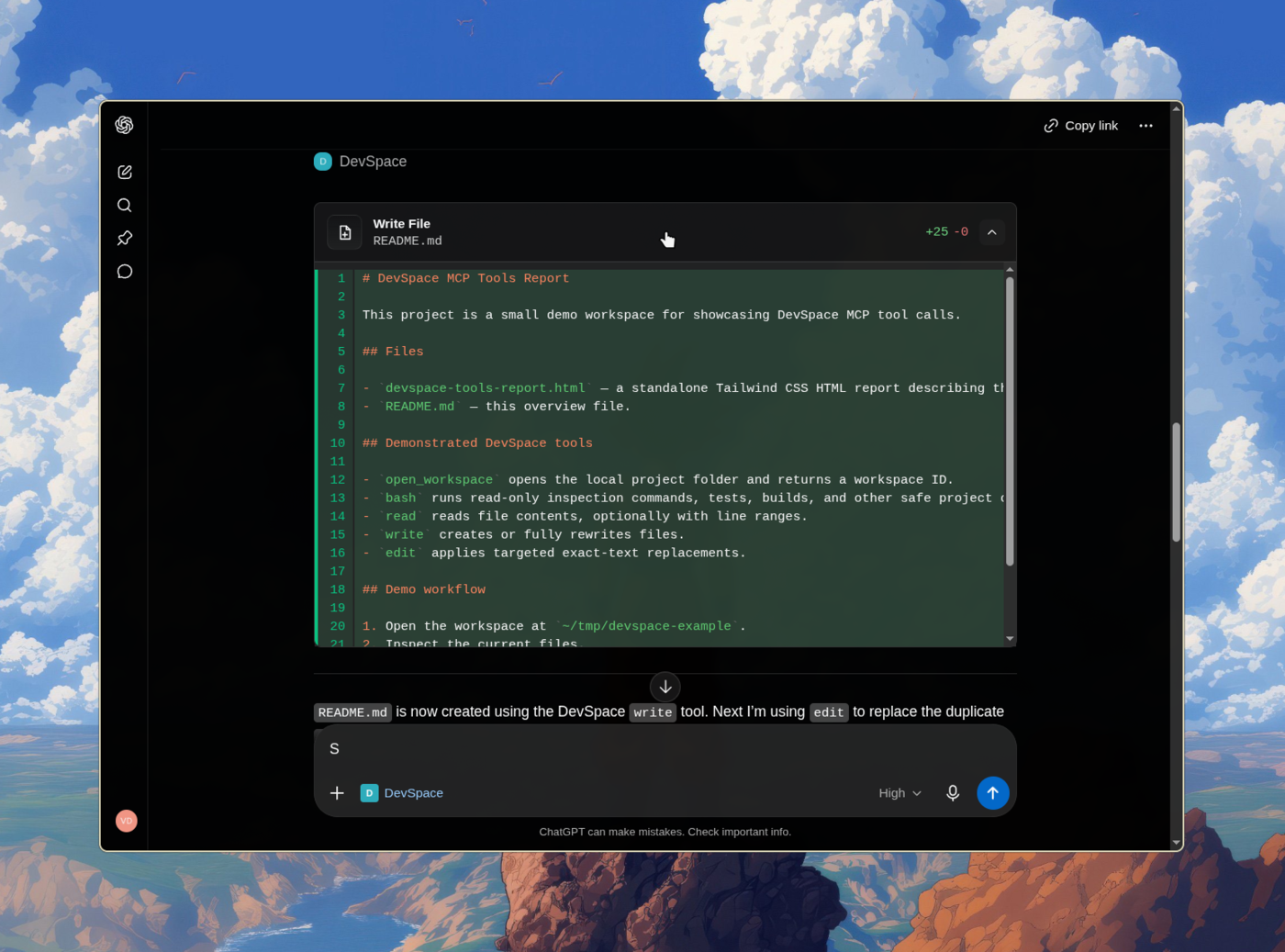](https://raw.githubusercontent.com/Waishnav/devspace/main/docs/assets/devspace-screenshot.png)
**Give ChatGPT a secure connection to your own machine and Turn ChatGPT into Codex**
DevSpace is a self-hosted MCP server that lets ChatGPT read, edit, search, and run code in your real local projects — your files, your tools, your terminal — without uploading anything to a third party. You run it on your machine, expose it through a tunnel you control, and approve the connection with a password only you have.
## Sponsors and Special Thanks
<table>
<thead>
<tr>
<th>Sponsor</th>
<th>About</th>
</tr>
</thead>
<tbody>
<tr>
<td align="center" width="220">
<a href="https://rebates.ai/">
<img
src="https://app.rebates.ai/brand/rebates-lockup.svg"
alt="Rebates"
width="170"
>
</a>
</td>
<td>
<strong>The ads in your terminal pay you.</strong><br><br>
<a href="https://rebates.ai/">Rebates</a> adds one optional
sponsored footer to your coding agent and pays you cash back for every
session in which it is shown. Turn it off at any time.
</td>
</tr>
</tbody>
</table>
<p>
DevSpace is open to new sponsors.
<a href="https://x.com/wshxnv">Get in touch to become one.</a>
</p>
## Installation
DevSpace requires Node `>=22.19 <27`.
Install the DevSpace CLI:
```bash
npm install -g @waishnav/devspace
```
Then initialize and start the server:
```bash
devspace init
devspace serve
```
Or run it without a global install:
```bash
npx @waishnav/devspace init
npx @waishnav/devspace serve
```
During setup, DevSpace asks for:
- the local project folders ChatGPT is allowed to open through DevSpace
- the local port, usually `7676`
- your public HTTPS base URL from Cloudflare Tunnel, ngrok, Pinggy, Tailscale Funnel, or
another reverse proxy
Use the public origin without `/mcp` during setup:
```text
https://your-tunnel-host.example.com
```
You will configure your MCP client with the public `/mcp` URL after setup.
When the client connects, DevSpace opens an Owner password approval page. Enter
the Owner password printed by `devspace init`. It is also stored in:
```text
~/.devspace/auth.json
```
Keep that password private.
## Connect Your MCP Client
The default local endpoint is:
```text
http://127.0.0.1:7676/mcp
```
Most users should connect through a public HTTPS tunnel:
```text
https://your-tunnel-host.example.com/mcp
```
## What ChatGPT Can Do
Once connected, ChatGPT can open one of your approved project folders as a
workspace. From there, it can inspect the repo, make scoped edits, run commands,
and show you what changed.
DevSpace gives ChatGPT tools to:
- read, write, and edit files inside the opened workspace
- search code and inspect directories
- run shell commands for tests, builds, git, and package scripts
- use isolated Git worktrees for parallel coding sessions
- follow project instructions from `AGENTS.md` and `CLAUDE.md`
- discover built-in, workspace, and custom skills through a managed registry
- show tool cards and optional change summaries in ChatGPT Apps-compatible hosts
## Mental Model
DevSpace is remote access to selected local folders.
You decide which roots are allowed. The MCP client still has powerful local
capabilities inside an opened workspace, including shell execution. Treat a
connected client like a trusted coding partner with access to your machine.
For a normal ChatGPT coding session:
1. Start your tunnel.
2. Run `devspace serve`.
3. Connect the MCP client to your public `/mcp` URL.
4. Approve the connection with the Owner password.
5. Ask ChatGPT to open a project inside one of your allowed roots.
## Platform Support
DevSpace supports Linux, macOS, and Windows. Bash remains the most compatible
shell path, while Windows can fall back to direct Git execution and an
allowlisted native shell path for safe verification commands and read-only
runtime probes.
| Platform | Status | Notes |
| ------------------------------------------------- | --------- | ----- |
| Linux | Supported | Requires Node, npm, Git, and Bash. |
| macOS | Supported | Requires Node, npm, Git, and Bash. |
| Windows with Git Bash, WSL, MSYS2, or Cygwin Bash | Supported | Git Bash is the simplest native Windows setup. |
| Windows PowerShell or `cmd.exe` only | Partial | Safe fallback supports direct Git, allowed verification commands, and read-only runtime probes; install Git Bash or WSL for broader shell compatibility. |
Run this to inspect your local setup:
```bash
devspace doctor
```
## Documentation
- [Setup Guide](https://github.com/Waishnav/devspace/blob/main/docs/setup.md)
- [ChatGPT Coding Workflow](https://github.com/Waishnav/devspace/blob/main/docs/chatgpt-coding-workflow.md)
- [Configuration Reference](https://github.com/Waishnav/devspace/blob/main/docs/configuration.md)
- [Security Model](https://github.com/Waishnav/devspace/blob/main/docs/security.md)
- [Troubleshooting Gotchas](https://github.com/Waishnav/devspace/blob/main/docs/gotchas.md)
## Philosophy
Every piece of software is becoming conversational. Natural language is
redefining how we interact with tools, workflows, and systems.
My bet is that ChatGPT becomes the operating system for everything. Once we
reach AGI, we will simply talk to ChatGPT, and it will prompt, coordinate, and
orchestrate sub-agents that set up the right loops for us.
We are not there yet.
DevSpace is one attempt to fast-forward that future: a way for MCP-capable
hosts like ChatGPT and Claude to work directly with local project files through
explicit, inspectable tools.
## Built by Waishnav
I'm Waishnav, I like building opinionated products and tools, and DevSpace is one example of that.
This year, I started my journey to build a single-person and multiple-agents company doing multiple millions in
revenue. If you want to watch the failures, wins, lessons, and everything in
between, come hang out with me on [X](https://x.com/wshxnv).
## More from me
<table>
<thead>
<tr>
<th>Project</th>
<th>About</th>
</tr>
</thead>
<tbody>
<tr>
<td align="center" width="220">
<a href="https://gitcms.dev/">
<img
src="https://gitcms.dev/brand/gitcms-logo.svg"
alt="GitCMS"
width="48"
/><br />
<strong>GitCMS</strong>
</a>
</td>
<td>
<strong>Modern CMS and tooling for markdown based content sites — built for agents and humans.</strong><br><br>
Visual editing, editorial workflow, and ChatGPT/Claude content agents, with
every post and page stored as files in your repo.
<a href="https://gitcms.dev/">Learn more</a>.
</td>
</tr>
</tbody>
</table>
## Local Development
For working on DevSpace itself:
```bash
npm install --include=dev
npm run dev
npm run typecheck
npm test
npm run build
npm run start
```
This server cannot be deployed
Maintenance
ActivityInactive
ResponsivenessNo issues