
plainontology
# PlainOntology
[](https://github.com/cfuracao-academic/plainontology/actions/workflows/ci.yml)
[](https://pypi.org/project/plainontology/)
[](pyproject.toml)
[](LICENSE)
[](https://doi.org/10.5281/zenodo.24562420)
**Write down the ontology your system already has, as one plain text file that people can edit and AI agents can read.**
**Try it:** `pip install plainontology`, then `plainonto init my.onto --from sqlite:my.db`
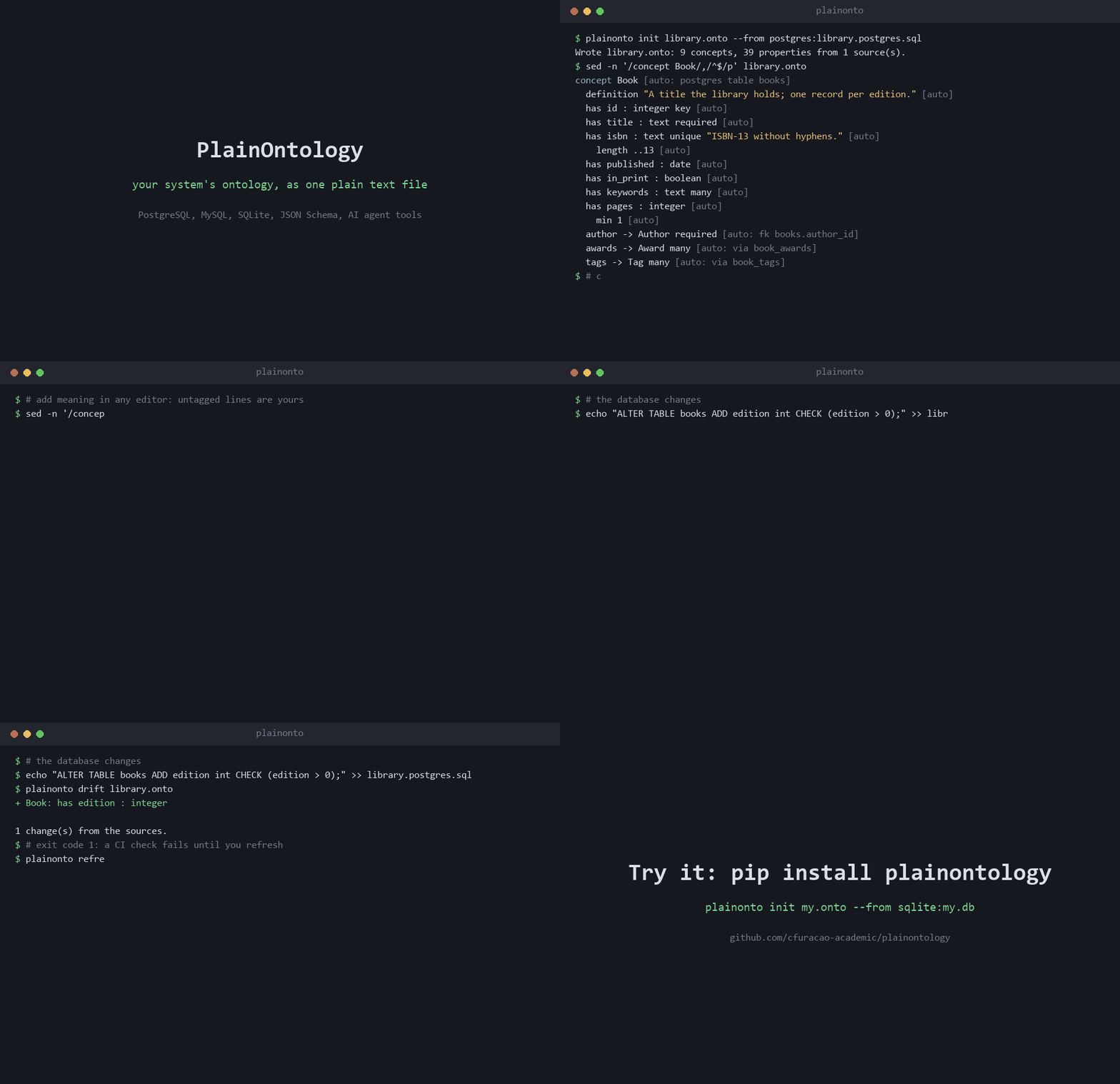
Every running system carries an implicit ontology: tables and foreign keys, JSON schemas, the tool definitions an LLM agent calls. Its meaning (what a "loan" is, that a "Title" is a "Book", that `member` holds personal data) usually lives in people's heads. PlainOntology extracts the structure into a readable text file, keeps your hand-written meaning next to it, and tells you when the system drifts away from it.
```text
concept Book [auto: postgres table books]
definition "A title the library holds; one record per edition." [auto]
has id : integer key [auto]
has title : text required [auto]
has isbn : text unique "ISBN-13 without hyphens." [auto]
length ..13 [auto]
label "ISBN"
has pages : integer [auto]
min 1 [auto]
author -> Author required [auto: fk books.author_id]
tags -> Tag many [auto: via book_tags]
label "Livre"@fr
synonym "Title"
same_as schema:Book
```
The definition and the description come from comments in the database, `length ..13` from `varchar(13)`, and `min 1` from `CHECK (pages > 0)`.
Lines tagged `[auto]` come from the sources and are refreshed. **Every other line is yours and is never overwritten.**
## What it does
| | |
|---|---|
| **Extract** | PostgreSQL, MySQL and SQLite (live databases, dumps or migration scripts), JSON Schema (draft 7 and 2020-12, across files), OpenAPI 3.x and Swagger 2.0, dbt manifests, and AI agent tool definitions (Anthropic, OpenAI Chat and Responses, MCP `tools/list`) |
| **Keep your edits** | Refresh replaces `[auto]` lines only. If you rewrite an extracted line, your version wins and is reported |
| **Follow renames** | A renamed table or column keeps your lines; `plainonto rename` handles the cases it cannot guess, and `--no-renames` turns the guessing off |
| **Report drift** | `plainonto drift` exits 1 when the sources changed; a GitHub Action and pre-commit hooks put it in CI. It also warns when two sources define the same concept |
| **Check** | Duplicate lines, unknown targets, undeclared prefixes, misplaced rules, proposals waiting for review |
| **Validate** | Check JSON records (for example an agent's structured output) against a concept: types, enums, required fields, min, max, length, pattern, format |
| **Multilingual** | Labels, definitions and synonyms in any language (`label "Livre"@fr`) |
| **Export** | RDF Turtle (OWL structure, SKOS meaning), SHACL shapes for validating RDF data, and LinkML YAML |
| **Serve to agents** | An MCP server so agents look concepts up, validate their output, and propose new lines for a person to review |
The core has no dependencies beyond the Python standard library. Extras: `mcp` for the MCP server, `postgres` and `mysql` for those databases, `openapi` for YAML OpenAPI files, `all` for everything.
**Documentation:** [tutorial, sources, CI, agents and the file format](docs/index.md) (also built as a site with `mkdocs serve`).
## Quick start
```bash
pip install "plainontology[all]" # or just [mcp], [postgres], [mysql], [openapi]
cd examples
plainonto init mine.onto --from sqlite:library.sql --from tools:agent-tools.json
# edit mine.onto: add definitions, synonyms, same_as mappings
plainonto refresh mine.onto # re-extract; your lines stay
plainonto drift mine.onto # report only; exit 1 on drift
plainonto check mine.onto
plainonto export mine.onto --to turtle -o library.ttl
plainonto export mine.onto --to shacl -o library.shapes.ttl
plainonto export mine.onto --to linkml -o library.yaml
plainonto validate mine.onto Loan record.json
plainonto rename mine.onto Member Patron # after a table rename that refresh did not detect
```
The command is `plainonto` (short for `plainontology`; both work).
Sources are written `KIND:LOCATION` and stored in the file; file paths are relative to it:
| Kind | Location |
|---|---|
| `postgres` | a schema dump (`pg_dump --schema-only`), or a live database: `env:VARIABLE` holding the URL |
| `mysql` | a schema dump (`mysqldump --no-data`), or a live MySQL or MariaDB database: `env:VARIABLE` |
| `sqlite` | a SQLite database, or a SQLite-compatible `.sql` file (loaded into memory) |
| `jsonschema` | a JSON Schema file; `$defs` and nested objects become concepts. For Pydantic, dump `Model.model_json_schema()` first |
| `openapi` | an OpenAPI 3.x or Swagger 2.0 file (JSON, or YAML with the `openapi` extra): schemas become concepts, operations become concepts with their parameters, body and `returns` |
| `dbt` | a dbt manifest (`target/manifest.json`) or the project folder: models and sources become concepts; `not_null`, `unique`, `accepted_values`, `relationships` and `accepted_range` tests carry over; lineage and semantic-layer measures become notes |
| `tools` | a JSON list of tool definitions, or an object with a `tools` list |
**Databases.** Dumps are read in their own dialect, and live databases through SQLAlchemy, read-only. Both give the same result (CI checks this against real PostgreSQL 16 and MySQL 8.4 servers):
| From the database | In the file |
|---|---|
| tables, views | concepts (views get a note); tables outside `public` keep their schema: `archive.orders` becomes `ArchiveOrder` |
| table and column comments | the concept's definition, the property's description |
| primary and foreign keys, unique constraints | `key`, relations, `unique`, `unique (a, b)` |
| `CHECK (x IN (...))`, `CHECK (x >= 0)`, `CHECK (x ~ 'regex')`, `varchar(n)` | an enum, `min`, `pattern`, `length ..n`; other checks become notes |
| enums, domains, arrays, `tinyint(1)` | `enum(...)`, the domain's type, its CHECKs and NOT NULL, `many`, `boolean` |
| `LIKE other`, `CREATE TABLE ... AS SELECT`, `INHERITS (parent)` | the copied columns (and keys and checks with `INCLUDING`); the query's columns; `is_a Parent` |
| join tables | a `many` relation; a join table with extra columns also stays a concept |
| triggers | notes |
| `ALTER TABLE` (add, drop, rename and change columns, rename tables) | applied in order, so a folder of migration scripts concatenated into one file works as a dump |
| partitions | fold into the parent table with a note; foreign keys declared on partitions carry up |
| anything the parser cannot read | reported as a `?` warning, never dropped silently; a table is read column by column so one odd column cannot hide it |
Everything else in a dump (`SET`, data, functions) is skipped. For a live database:
```bash
export LIBRARY_DB="postgresql://reader@db.internal/library" # password via ~/.pgpass, or in this variable
plainonto init library.onto --from postgres:env:LIBRARY_DB
```
A URL with a password is refused, because the source line is saved in the ontology file.
## Use it in CI and git hooks
```yaml
# .github/workflows/ontology.yml
on: [pull_request]
permissions: { contents: read, pull-requests: write }
jobs:
drift:
runs-on: ubuntu-latest
steps:
- uses: actions/checkout@v4
- uses: cfuracao-academic/plainontology@v0.2.0
with:
file: ontology/library.onto
install: plainontology[postgres]
comment: "true" # post the drift report on the pull request
```
```yaml
# .pre-commit-config.yaml
repos:
- repo: https://github.com/cfuracao-academic/plainontology
rev: v0.2.0
hooks:
- id: plainonto-check
- id: plainonto-drift # runs on every commit, so a schema-only change is caught
```
`plainonto drift` and `plainonto check` with no file check every `.onto` file under the current folder. All inputs are in [docs/ci.md](docs/ci.md). Editors: a [VS Code extension](editors/vscode) highlights `.onto` files.
## Tried on real schemas
CI extracts two public sample databases at pinned versions on every push:
| Schema | Result |
|---|---|
| [Pagila](https://github.com/devrimgunduz/pagila) (PostgreSQL) | 25 concepts from 71 tables and 8 views (one materialized): 55 monthly partitions fold into `Payment`, foreign keys declared on partitions carry up, a PostgreSQL 18 virtual column is read; no warnings, `check --strict` clean |
| [Sakila](https://github.com/jOOQ/sakila) (MySQL) | 23 concepts (16 tables, 7 views); no warnings, `check --strict` clean |
Each takes about 0.4 seconds.
## Performance
1,000 tables (13,500 lines) extract or refresh in about 1.5 seconds; 5,000 tables in about 7; `check` and the exports take under a second. Time grows linearly. Details and the script in [docs/performance.md](docs/performance.md).
## Use it from an AI agent (MCP)
```bash
plainonto mcp path/to/library.onto # read-only tools
plainonto mcp path/to/library.onto --allow-proposals # also lets agents propose lines
```
Claude Code:
```bash
claude mcp add plainontology -- plainonto mcp /absolute/path/to/library.onto
```
Claude Desktop or any MCP client (`mcpServers` in the client's config):
```json
{
"mcpServers": {
"plainontology": { "command": "plainonto", "args": ["mcp", "/absolute/path/to/library.onto"] }
}
}
```
| Tool | What it does |
|---|---|
| `list_concepts` | every concept with its definition |
| `describe_concept` | a concept's lines, inherited properties and who points to it |
| `search` | find concepts by name, label, synonym, definition or property |
| `validate_record` | check a JSON object against a concept before acting on it |
| `drift` | compare the file with its sources now |
| `propose` | only with `--allow-proposals`: add a line tagged `[proposed]`; a person accepts it by deleting the tag |
The file is re-read on every call, so edits show up at once. Agents can never change or delete an existing line.
## Why a text file
* **Diffable.** Ontology changes go through pull requests like code.
* **Two layers in one place.** Structure (`has`, `->`, `is_a`) and meaning (`label`, `definition`, `synonym`, `same_as`, `note`) sit together, so neither drifts from the other.
* **Interoperable.** Export to OWL/SKOS and LinkML when you need the standard toolchains.
## How it compares
| | PlainOntology | LinkML | OWL editors (Protégé) | Data catalogues (DataHub, OpenMetadata) |
|---|---|---|---|---|
| Direction | extracts from a running system | you write the schema, it generates | you write the ontology | ingests metadata |
| Format | one plain text file | YAML | RDF/OWL | database behind a server |
| Keeps hand edits across re-extraction | yes | n/a | n/a | partly |
| LLM tool schemas and MCP | yes | no | no | no |
| Setup | `pip install` | `pip install` | desktop app | servers |
PlainOntology does not replace these. It exports to LinkML and OWL so you can move to them when you need more.
## Format
The full grammar and refresh rules are in [SPEC.md](SPEC.md). In short:
```text
prefix : <https://example.org/library#>
source sqlite:library.sql
concept NAME [auto: where it came from]
has PROPERTY : TYPE [FLAGS] ["description"]
label "..." (also synonym, note: about the property)
min N (also max N, length LOW..HIGH, pattern "regex", format email)
PROPERTY -> CONCEPT [FLAGS] ["description"]
is_a CONCEPT
unique (PROPERTY, PROPERTY)
label "..."@fr (also definition, synonym, note; language tag optional)
same_as prefix:Term
```
Types: `text integer decimal boolean date datetime binary json any enum(a|b)`. Flags: `key required unique many`. The empty prefix line sets the base IRI for exports.
## Scope
PlainOntology reads schemas by parsing their syntax, not by asking a running database. It is tested on output from pg_dump, mysqldump and SQLite, on Django, Rails, Laravel, Prisma and Flyway migrations, and on public schemas such as Pagila and Sakila. Hand-written SQL in unusual forms, vendor extensions and edge cases may fall outside what it reads. When a statement or column cannot be read, the report says so with a `?` warning rather than guessing. For the exact picture, point it at a live database or a fresh dump from your database tool.
## Known limitations
* To give an extracted concept a friendlier name, add a `label`; the concept name follows the source.
* Concept names are made with English singular rules (`books` becomes `Book`, `people` becomes `Person`).
* The MCP server searches by keyword, runs locally over stdio, and does not lock the file while an agent proposes a line.
* JSON Schema references to web URLs are not fetched; `plainonto check` flags the missing concept.
* CHECK constraints more complex than a list, a comparison, a range or a regex are kept as notes, not enforced by `validate`.
* Field names that are not valid property names (`first name`, `@id`) become `first_name` and `_id`; `validate` accepts either form in a record.
* Patterns are Python regular expressions. `validate`, pyshacl and LinkML use them as they are; other SHACL engines (XPath regex) may not accept `\b`, look-arounds or `(?i)`.
* Views are read for their columns and types; the meaning of the query itself is not.
## Development
```bash
python -m venv .venv && .venv/bin/pip install -e ".[dev]"
pytest
```
See [CONTRIBUTING.md](CONTRIBUTING.md) and [ROADMAP.md](ROADMAP.md).
## Citing
If you use PlainOntology in research, please cite it using [CITATION.cff](CITATION.cff). The DOI [10.5281/zenodo.24562420](https://doi.org/10.5281/zenodo.24562420) always points to the latest version; each release also has its own DOI on Zenodo.
## Licence
MIT
TDQS
Scored across 5 tools
Each tool targets a distinct operation: enumeration (list_concepts), per-concept detail (describe_concept), lookup by criteria (search), record validation (validate_record), and change comparison (drift). The only mild overlap is list_concepts vs. search, since both surface concepts, but their scope (all vs. filtered) is clear from the descriptions.
Three tools follow a verb_noun snake_case pattern (list_concepts, describe_concept, validate_record), but 'search' is a bare verb and 'drift' is a bare noun with no object. The convention is readable but not uniform across the set.
Five tools is a tight, well-scoped surface for an ontology inspection/validation server; each tool covers a distinct need. It is on the lean side, but nothing feels redundant or padded.
The read/inspect/validate lifecycle is covered, but there is no way to create, update, or remove concepts, and 'drift' explicitly reports changes 'without writing' — implying a apply/sync counterpart that is absent. Agents hitting drift findings or ontology gaps have no tool to act on them.