
mcp-codemap
by breca
README.md
# mcp-codemap
[](https://github.com/breca/mcp-codemap/actions/workflows/release.yml)
[](https://github.com/breca/mcp-codemap/releases/latest)
MCP server that gives coding agents a mental map of your codebase with
progressive disclosure - like foldable code sections in an IDE, but for
LLMs.
The first run parses every source file using tree-sitter and builds a
graph of entities (classes, functions, interfaces, etc.) and their
relationships (imports, extends, implements). This is stored in a local
SQLite database (`.codemap/graph.db`) so subsequent sessions read from
the index instantly - no re-parsing needed.
It exposes three tools. `map` builds the big picture - every file, class,
and function at a chosen detail level, from a quick outline to full
signatures with docstrings and dependency edges. `query` zooms into
a single entity for its source code, members, and relationships without
a separate file read. `reindex` keeps things fresh after edits,
auto-detecting changes via git diff.
**Supported languages:**\


## Why
Typical exploration to understand a backend directory (44 files, ~420 entities):
**Without codemap** - Glob/Read/Grep or an Explore subagent:
| Step | Tool calls | Chars consumed |
|---|---|---|
| Glob to find files | 1 | ~500 |
| Read models.py (572 lines) | 1 | ~15K |
| Read world_service.py (628 lines) | 1 | ~18K |
| Read ws.py (570 lines) | 1 | ~15K |
| Read events.py (299 lines) | 1 | ~8K |
| Read 4-5 API route files | 4-5 | ~60K |
| Grep for cross-file imports/usage | 3-5 | ~10K |
| **Total** | **~12-15 calls** | **~125K+** |
And that's optimistic - an Explore subagent often does 15-25 tool calls
across multiple turns, each with its own overhead, and still misses things.
**With codemap** - one or two calls:
| Level | Tool calls | Chars consumed |
|---|---|---|
| `names` (quick orient) | 1 | ~6K |
| `signatures` (working knowledge) | 1 | ~25K |
That's **5-6x fewer tokens**, **12-20x fewer tool calls**, and complete
coverage - every entity in every file, not just the ones the agent guessed to read.
## Setup
### Claude Code
```bash
# npx
claude mcp add codemap -- npx mcp-codemap
# docker
claude mcp add codemap -- docker run --rm -i -v .:/project:z ghcr.io/breca/mcp-codemap
```
The project directory is auto-detected via [MCP roots](https://modelcontextprotocol.io/specification/2025-06-18/client/roots). To set it explicitly:
```bash
npx mcp-codemap serve -p /path/to/your/project
```
The first run indexes the project automatically. The index is stored in
`.codemap/graph.db` inside the project directory. Subsequent calls to `map`
or `query` auto-detect changed files via `git diff` and refresh the index
before returning results — no manual reindexing needed.
### Other clients
Add the MCP server config to your client's config file:
| Client | Config file |
|---|---|
| Claude Code | `.mcp.json` in project root |
| Cursor | `.cursor/mcp.json` in project root |
| Crush | `.crush.json` in project root |
| Continue | `.continue/config.yaml` |
| OpenCode | `opencode.json` in project root |
**.mcp.json** (Claude Code, Cursor):
```json
{
"mcpServers": {
"codemap": {
"command": "npx",
"args": ["mcp-codemap"]
}
}
}
```
```json
{
"mcpServers": {
"codemap": {
"command": "docker",
"args": ["run", "--rm", "-i", "-v", ".:/project:z", "ghcr.io/breca/mcp-codemap"]
}
}
}
```
<details>
<summary>Crush / OpenCode / Continue configs</summary>
**.crush.json:**
```json
{
"mcp": {
"codemap": {
"type": "stdio",
"command": "npx",
"args": ["mcp-codemap"]
}
}
}
```
```json
{
"mcp": {
"codemap": {
"type": "stdio",
"command": "docker",
"args": ["run", "--rm", "-i", "-v", ".:/project:z", "ghcr.io/breca/mcp-codemap"]
}
}
}
```
**opencode.json:**
```json
{
"mcp": {
"codemap": {
"type": "local",
"command": ["npx", "mcp-codemap"]
}
}
}
```
```json
{
"mcp": {
"codemap": {
"type": "local",
"command": ["docker", "run", "--rm", "-i", "-v", ".:/project:z", "ghcr.io/breca/mcp-codemap"]
}
}
}
```
**.continue/config.yaml:**
```yaml
mcpServers:
- name: codemap
command: npx
args:
- mcp-codemap
```
```yaml
mcpServers:
- name: codemap
command: docker
args:
- run
- --rm
- -i
- -v
- .:/project:z
- ghcr.io/breca/mcp-codemap
```
</details>
## Tools
**Response structure:**
| Element | Meaning |
|---|---|
| Header line | `PROJECT: <files> \| <entities> \| <languages>` - project summary |
| `=== dir/ [N files, M entities] ===` | Directory section with aggregate counts |
| `C`/`F`/`M`/`I`/`P`/`E` | Kind prefix: Class, Function, Method, Interface, Property, Enum |
| `:10-342` | Line range (start-end) |
| `exp` | Exported / public symbol |
| `> imports:` | Files this file imports from (resolved paths) |
| `> used-by:` | Files that import from this file |
### `map` - structural overview
Returns files, entities, signatures, and relationships as a compact text map.
```
map(scope?, detail?, max_depth?)
```
**`detail`** controls output density (default: `"signatures"`):
| Level | Content | Relative size |
|---|---|---|
| `"outline"` | Files + entity counts | ~1% |
| `"names"` | Entity names, kinds, line ranges + docstrings on top-level entities | ~8% |
| `"signatures"` | Full signatures, docstrings, imports/used-by | ~25% |
| `"full"` | Signatures + cross-file relationships | ~40% |
**`scope`** limits output to a directory or file prefix (e.g., `"src/api"`).
Typical workflow:
```
map(detail="names") # orient on the whole project
map(scope="src/api", detail="signatures") # drill into a module
map(detail="full") # inspect dependency graph
```
#### Example: `map(scope="src/tools", detail="names")`
```
PROJECT: 53 files | 642 entities | csharp/go/java/javascript/kotlin/php/python/ruby/rust/typescript
INDEXED: just now
C=class F=function M=method I=interface P=property E=enum V=variable T=type N=namespace
=== src/tools/ [5 files, 13 entities] ===
src/tools/describe-entity.ts
I DescribeEntityParams :6-9
"Parameters for the describe-entity tool."
F describeEntity :12-27
"Generate or retrieve a natural-language description for a named entity."
F formatDescribeResult :29-37
src/tools/get-context.ts
I GetContextParams :5-9
"Parameters for the map tool: optional scope, depth limit, and detail level."
F getContext :12-18
"Build and return the compact text map of the codebase."
src/tools/query.ts
I QueryParams :6-8
"Parameters for the query tool: entity name or qualified name."
F queryEntity :11-104
"Deep-dive on a single entity: signature, source, callers, callees, and members."
src/tools/reindex.ts
I ReindexParams :6-9
"Parameters for the reindex tool: optional file paths and force flag."
F reindex :12-52
"Re-index changed files; auto-detects via git diff when no paths given."
src/tools/update-context.ts
I UpdateContextParams :6-10
"Parameters for the update-context tool."
F updateContext :13-55
"Incrementally update the index; falls back to full rescan if requested."
```
#### Detail levels
**`outline`** - file list with entity counts:
```
PROJECT: 53 files | 642 entities | csharp/go/java/javascript/kotlin/php/python/ruby/rust/typescript
INDEXED: just now
C=class F=function M=method I=interface P=property E=enum V=variable T=type N=namespace
=== src/parser/languages/ [11 files, 162 entities] ===
src/parser/languages/base.ts (10 entities)
src/parser/languages/python.ts (12 entities)
src/parser/languages/typescript.ts (10 entities)
```
**`names`** - adds entity names with kind prefix, line ranges, and docstrings on top-level entities:
```
src/parser/languages/base.ts
I ExtractedEntity :4-17
"A code entity (class, function, variable, etc.) extracted from a parse tree."
I FileParseResult :29-33
"Complete extraction output for a single source file."
I LanguageExtractor :45-50
"Contract for language-specific extractors that turn parse trees into entities."
F getDocComment :53-68
"Extract a JSDoc-style comment immediately preceding a node."
F getSignature :82-140
"Build a human-readable signature string from a class, function, or interface node."
```
**`signatures`** - adds full signatures, docstrings, export markers, and dependency info:
```
src/parser/languages/python.ts
C class PythonExtractor implements LanguageExtractor :11-343 exp
"Extracts classes, functions, and imports from Python source files."
P language :12-12
P extensions :13-13
M extract(tree: Parser.Tree, sourceCode: string, filePath: string): FileParseResult :15-23
M walkNode(
node: Parser.SyntaxNode,
sourceCode: string,
filePath: string,
entities: ExtractedEntity[],
...
): void :25-97
M extractEntity(...): ExtractedEntity | null :99-171
> imports: src/parser/languages/base.ts
src/parser/languages/typescript.ts
C class TypeScriptExtractor implements LanguageExtractor :15-352 exp
"Extracts classes, functions, interfaces, and relationships from TypeScript/TSX files."
...
> imports: src/parser/languages/base.ts
> used-by: src/parser/languages/javascript.ts
```
**`full`** - adds a cross-file relationships section:
```
=== RELATIONSHIPS ===
src/parser/languages/javascript.ts -> src/parser/languages/typescript.ts [extends: TypeScriptExtractor]
src/parser/languages/python.ts -> src/parser/languages/base.ts [implements: LanguageExtractor]
src/parser/languages/typescript.ts -> src/parser/languages/base.ts [implements: LanguageExtractor]
```
### `query` - deep dive on one entity
Returns signature, source code, callers, callees, and members for a single
class, function, or method. Accepts simple or qualified names.
```
query(entity)
```
```
query(entity="UserService") # find by name
query(entity="UserService.createUser") # find by qualified name
```
Output includes the actual source code, so the agent doesn't need a separate
file read to see the implementation.
#### Example output
```
class PythonExtractor [exported]
src/parser/languages/python.ts:10-342
SIGNATURE: class PythonExtractor implements LanguageExtractor
MEMBERS:
property language :11-11
property extensions :12-12
method extract(tree, sourceCode, filePath): FileParseResult :14-22
method walkNode(...): void :24-96
method extractEntity(...): ExtractedEntity | null :98-170
method extractDocstring(...): string | null :172-187
DEPENDS ON:
imports ExtractedEntity (src/parser/languages/base.ts:3)
imports FileParseResult (src/parser/languages/base.ts:26)
implements LanguageExtractor (src/parser/languages/base.ts:40)
USED BY:
imports ScanResult (src/parser/pipeline.ts:15)
SOURCE:
10 | export class PythonExtractor implements LanguageExtractor {
11 | language = 'python';
12 | extensions = ['.py'];
...
```
**Response structure:**
| Section | Content |
|---|---|
| Header | Entity kind, name, export status, file location |
| `SIGNATURE` | Full type signature |
| `MEMBERS` | Properties and methods with signatures and line ranges |
| `DEPENDS ON` | Entities this one imports, extends, or implements (with source locations) |
| `USED BY` | Entities that depend on this one |
| `SOURCE` | Full source code with line numbers |
### `reindex` - refresh after edits
Note: `map` and `query` automatically refresh the index before returning
results, so explicit reindexing is only needed for a forced full rescan.
Re-indexes changed files. Auto-detects changes via git diff when called
with no arguments.
```
reindex(paths?, force?)
```
```
reindex() # auto-detect via git diff
reindex(paths=["src/foo.ts"]) # specific files
reindex(force=true) # full rescan, ignore cache
```
#### Example output
```
Git diff update (30 changed files)
Processed: 18
Skipped (unchanged): 11
Errors: 1
src/broken.js: TypeError: Cannot read properties of undefined
```
## Configuration
Place a `config.json` in the `.codemap/` directory to override defaults:
```json
{
"excludePatterns": [
"**/node_modules/**",
"**/dist/**",
"**/build/**",
"**/.git/**",
"**/vendor/**",
"**/__pycache__/**",
"**/target/**",
"**/*.min.js",
"**/*.bundle.js",
"**/*.generated.*",
"**/.codemap/**"
],
"maxFileSize": 1000000
}
```
| Option | Type | Default | Description |
|---|---|---|---|
| `excludePatterns` | `string[]` | See above | Glob patterns for files/directories to skip |
| `includePatterns` | `string[]` | `["**/*.{ts,tsx,js,...,c,h,cpp,hpp,...}"]` | Glob patterns for files to include (non-git repos only) |
| `languages` | `string[]` | `[]` (all supported) | Restrict parsing to specific languages |
| `maxFileSize` | `number` | `1000000` | Skip files larger than this (bytes) |
| `updateGitignore` | `boolean` | `true` | Auto-add `.codemap/` to `.gitignore` on init |
In git repos, file discovery uses `git ls-files` and respects `.gitignore`
automatically - `includePatterns` is only used in non-git repos as a
fallback. The exclude patterns act as a secondary filter in both cases.
## CLI
The same binary works as a standalone CLI:
```bash
# npx
npx mcp-codemap map [-s scope] [--detail level] # print the map
npx mcp-codemap query <entity> # inspect an entity
npx mcp-codemap reindex [paths...] # re-index
npx mcp-codemap stats # show project stats
npx mcp-codemap web [--port 3333] # interactive web UI
npx mcp-codemap install-hooks # git hooks for auto re-indexing
npx mcp-codemap uninstall-hooks # remove installed git hooks
# docker (mount your project at /project)
docker run --rm -v .:/project:z ghcr.io/breca/mcp-codemap map -p /project
docker run --rm -v .:/project:z ghcr.io/breca/mcp-codemap stats -p /project
docker run --rm -v .:/project:z ghcr.io/breca/mcp-codemap query <entity> -p /project
docker run --rm -v .:/project:z -p 3333:3333 ghcr.io/breca/mcp-codemap web -p /project
```
## Web UI
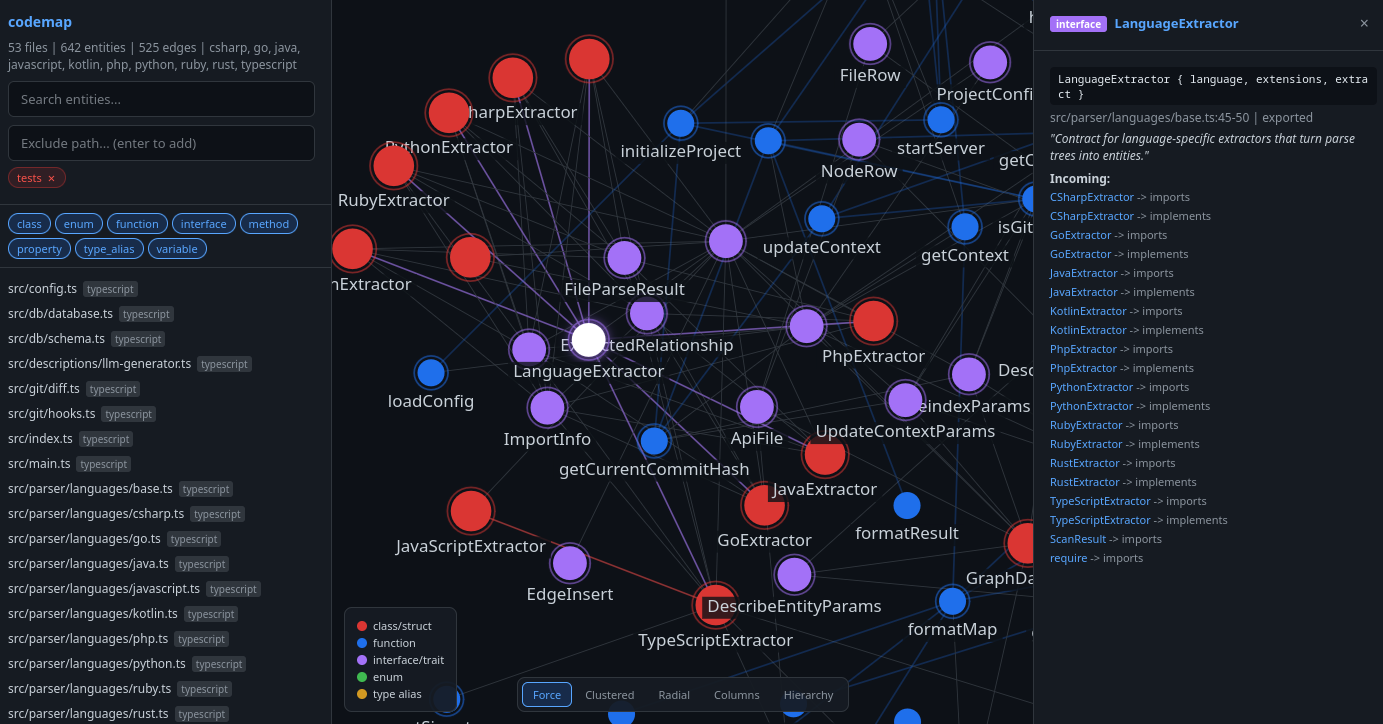
`codemap web` launches an interactive graph explorer in your browser - a
visualization of every entity and relationship in the index.
```
codemap web [--port 3333]
```
Features:
- **Graph canvas** - entities rendered as color-coded nodes (red = class,
blue = function, purple = interface, green = enum), sized by kind, with
edges drawn between them. Pan, zoom, and drag nodes to explore.
- **Layout modes** - switch between five layouts via the top-right toolbar:
**Force** (default), **Clustered** (grouped by file), **Radial**
(most-connected at center), **Columns** (by directory), and
**Hierarchy** (dependency depth top-to-bottom). Transitions are animated.
- **Sidebar** - searchable file tree with kind filters. Type a path prefix
in the exclude input to hide irrelevant directories (e.g., `tests`).
- **Detail panel** - click any node or file to open a right-side panel
showing its signature, file location, docstring, members, and
incoming/outgoing edges. Click linked entities to navigate the graph.
## Design decisions
Only path-resolved relationships (imports, extends, implements) are included
in output. Name-based "calls" edges are excluded because global name lookup
produces too many false positives (`get`, `split`, etc. matching unrelated
symbols). See [CONSTRAINTS.md](CONSTRAINTS.md) for details.
TDQS
A4.1/5.0
Scored across 3 tools
Disambiguation5/5
Each tool has a clearly distinct purpose: map provides an overview, query inspects a specific entity, and reindex refreshes the index. There is no functional overlap.
Naming Consistency4/5
All tool names are single lowercase verbs, which is consistent in style. However, they don't follow a verb_noun pattern, which is common in MCP tools, but still predictable and clear.
Tool Count5/5
With only 3 tools, the server is highly focused on codebase exploration and indexing. Each tool serves a necessary role without redundancy, making the set well-scoped.
Completeness4/5
The tools cover orientation, deep inspection, and index refreshing. Minor gaps exist, such as lacking a search tool, but the core workflows are complete for the stated purpose.
Maintenance
ActivityInactive
ResponsivenessSyncing