SNC Cribl MCP




A Model Context Protocol (MCP) server that provides tools for querying Cribl deployments.
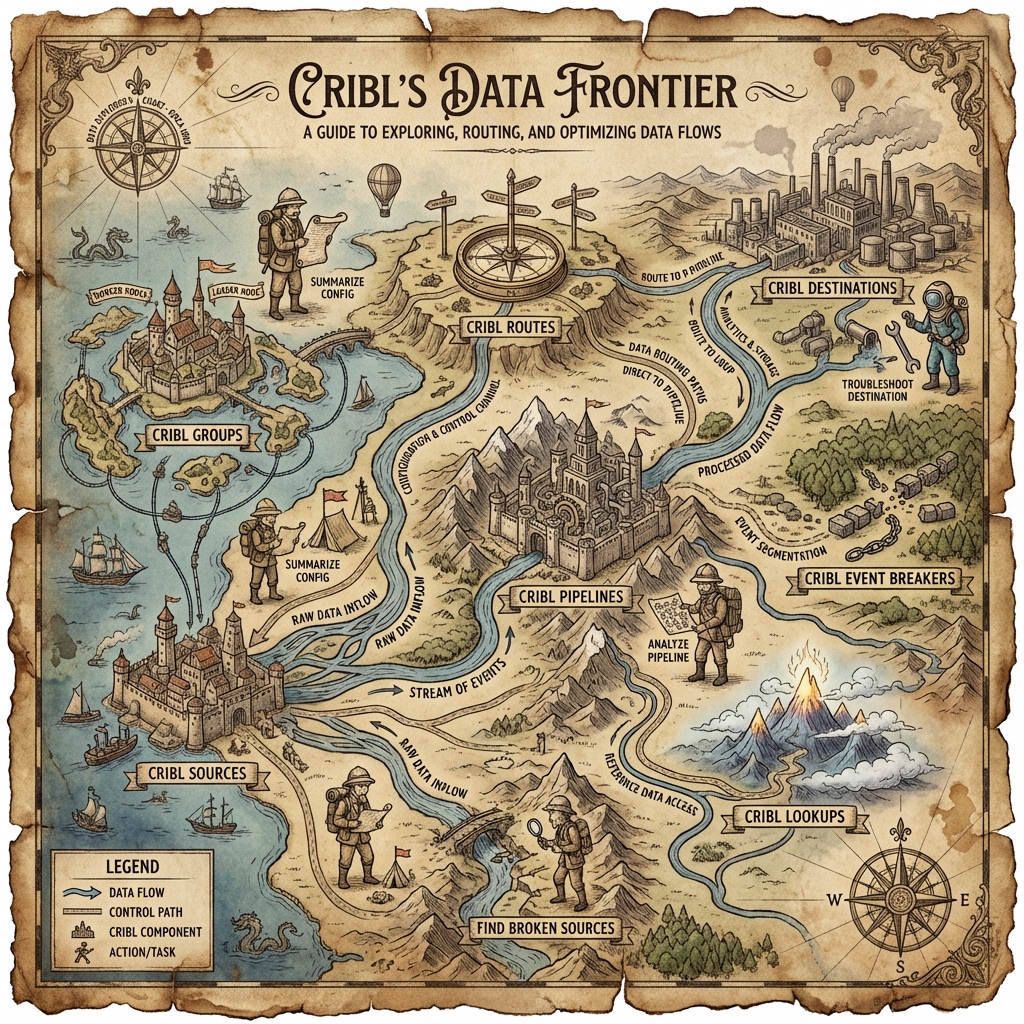
Table of Contents
Related MCP server: Splunk MCP Server
What It Does
This MCP server connects to Cribl Stream and Edge deployments to retrieve and compare metadata about leaders, worker groups, fleets, sources, destinations, pipelines, routes, variables, and Packs. It also supports targeted cross-leader copy and validation workflows for local users, group/fleet contents, and global system settings so AI assistants can help keep multiple leaders aligned without passing entire configs through context.
The server handles authentication with bearer tokens, manages token refresh automatically, and provides a clean JSON interface for exploring your Cribl infrastructure.
Features
Comprehensive Discovery: List all worker groups (Stream) and fleets (Edge) in your deployment.
Configuration Retrieval:
Retrieve configured sources across all products and groups.
Retrieve configured destinations across all products and groups.
Retrieve configured pipelines across all products and groups, with full function configuration details.
Retrieve configured routes across all products and groups.
Retrieve configured event breakers across all products and groups.
Retrieve configured lookups across all products and groups.
Retrieve configured variables across all products and groups.
Pack Management:
List and inspect installed Packs.
Install Packs from IDs, URLs, Git repositories, or previously uploaded Pack files.
Upload, upgrade, and uninstall Packs through the cribl-control-plane SDK.
Cross-Leader Sync Workflows:
Copy supported resources between configured leaders.
Validate whether supported resources are in sync between configured leaders.
Resolve different source and target group selectors during copy and validation workflows.
Create or replicate local users, using explicit or environment-sourced passwords because Cribl does not return passwords from the API.
Replicate and validate complete Stream worker groups or Edge fleets, including group/fleet settings, variables, event breakers, lookups, destinations, pipelines, sources, and routes.
Replicate and validate global system settings from the Global Settings page.
Typed Pipeline Models: 41 Pydantic models for pipeline function configurations (eval, mask, sampling, regex_extract, etc.) with full type safety.
Typed Collector Models: 9 Pydantic models for collector source configurations (S3, REST, database, Splunk, Azure Blob, GCS, filesystem, script, health check) with full type safety.
Graceful Error Handling: SDK validation errors return structured, user-friendly responses with actionable guidance instead of crashing.
Robust Authentication: Automatic token management and refresh for customer-managed deployments.
FastMCP Integration: Built with FastMCP 3.x for easy integration with Claude and other AI assistants.
Quality Assurance: Comprehensive unit test coverage with full typing support.
Installation
Prerequisites:
The server is designed to run from a source checkout. It reads config.toml and optional .env values from the checkout root, so keep the checkout in place and point your MCP client at that directory.
Install from source:
git clone https://github.com/atree1023/snc-cribl-mcp.git
cd snc-cribl-mcp

# Optional once the release tag exists:
# git checkout v0.3.0

uv sync
cp config.example.toml config.toml
Edit config.toml with your Cribl leaders, then verify the server starts:
For MCP clients, use the checkout path directly with uv run --directory; see Example Integration with Claude.
Configuration
Create a config.toml file in the project root with your Cribl server definitions:
[defaults]
verify_ssl = true
timeout_ms = 10_000
oauth_token_url = "https://login.cribl.cloud/oauth/token"
oauth_audience = "https://api.cribl.cloud"
# Optional for on-prem; defaults to snc-cribl-mcp:<server-name>.
# keychain_name = "shared-cribl-login"

[golden.oak]
url = "http://localhost:19000"
# Optional for on-prem; defaults to your local macOS user.
# username = "admin"
# Optional for on-prem; overrides the default Keychain service name.
# keychain_name = "golden-oak-login"

[cribl.cloud]
url = "https://<workspace>-<org>.cribl.cloud"
client_id = "your-client-id"
client_secret = "${CRIBL_CLOUD_SECRET}"
For on-prem servers, omit password to use the local credential chain:
Use the configured username, or default to the locally logged-in macOS user.
Read the password from the macOS Keychain via Python keyring, using service
keychain_name when configured in [defaults] or the server section. If omitted, the service defaults to
snc-cribl-mcp:<server-name> and the resolved username. For [golden.oak], the default service is
snc-cribl-mcp:golden.oak. A server-level keychain_name overrides [defaults].
Fall back to per-server environment variables loaded from .env or your shell. For [golden.oak],
the resolver checks SNC_CRIBL_MCP_GOLDEN_OAK_PASSWORD, CRIBL_GOLDEN_OAK_PASSWORD,
GOLDEN_OAK_PASSWORD, then GOLDEN_OAK_PASS.
To store a local Keychain password:
uv run keyring set snc-cribl-mcp:golden.oak "$(whoami)"
If you use ${VAR} placeholders, set the values in a .env file (or your shell environment). Explicit
placeholder values still take precedence over keychain lookup and must exist when referenced.
When a tool call omits a server name, the first non-[defaults] section in config.toml is used.
Logging is still controlled via the LOG_LEVEL environment variable (default: INFO).
Configuration Options:
Section | Key | Description | Required |
[defaults]
| verify_ssl
| Verify SSL certificates | No |
[defaults]
| timeout_ms
| API request timeout in milliseconds | No |
[defaults]
| oauth_token_url
| OAuth token URL for Cribl.Cloud | No |
[defaults]
| oauth_audience
| OAuth audience for Cribl.Cloud | No |
[defaults]
| keychain_name
| Shared macOS Keychain service name for on-prem passwords | No |
[server]
| url
| Base URL of your Cribl deployment (auto-appends /api/v1) | Yes |
[server]
| username
| On-prem username; defaults to local macOS user | No* |
[server]
| password
| On-prem password; defaults to Keychain/env lookup | No* |
[server]
| keychain_name
| Per-server macOS Keychain service name override | No |
[server]
| client_id
| Cribl.Cloud client ID | Yes* |
[server]
| client_secret
| Cribl.Cloud client secret | Yes* |
*Cribl.Cloud URLs (ending in .cribl.cloud) require client_id/client_secret. On-prem URLs ultimately require a
resolved username/password pair, but the password can come from macOS Keychain or a per-server environment fallback.
Usage
Running the MCP Server
Start the server directly:
Or using the Python module:
uv run python -m snc_cribl_mcp.server
Available MCP Tools
The server exposes twenty-four MCP tools, and also mirrors the read-oriented data as MCP resources (e.g., cribl://groups, cribl://sources, cribl://destinations, cribl://pipelines, cribl://routes, cribl://breakers, cribl://lookups, cribl://variables, cribl://packs):
get_leader_overview
Returns a compact operational overview for a configured Cribl leader.
Returns: JSON containing leader health, Cribl version, Stream/Edge aggregate node counts, active worker groups and Edge fleets with node counts, and source/destination runtime health summaries for groups or fleets with nodes.
list_groups
Lists all Stream worker groups and Edge fleets from your Cribl deployment.
Returns: JSON containing groups organized by product (Stream and Edge), with metadata including group IDs, names, descriptions, and configuration.
list_sources
Lists all configured sources across all groups and products, including both regular sources (from /system/inputs) and collector sources (from /lib/jobs).
Returns: JSON containing sources organized by product and group, including source IDs, types, and configurations. Collector sources (S3, REST, database, etc.) are merged with regular sources per group.
list_destinations
Lists all configured destinations across all groups and products.
Returns: JSON containing destinations organized by product and group, including destination IDs, types, and configurations.
list_pipelines
Lists all configured pipelines across all groups and products.
Returns: JSON containing pipelines organized by product and group, including pipeline IDs, names, and configurations.
list_routes
Lists all configured routes across all groups and products.
Returns: JSON containing routes organized by product and group, including route IDs, names, filters, destinations, and referenced pipelines.
list_breakers
Lists all configured event breakers across all groups and products.
Returns: JSON containing event breakers organized by product and group, including ruleset IDs, rules, and configurations.
list_lookups
Lists all configured lookups across all groups and products.
Returns: JSON containing lookups organized by product and group, including lookup IDs, file info, and configurations.
list_variables
Lists all configured variables across all groups and products.
list_packs
Lists installed Packs. Optionally pass with_="inputs", with_="outputs", or with_="inputs,outputs" to include Pack input/output counts. For distributed environments, pass product="stream" or product="edge" and group="<group id, name, or description>" to scope the request to /m/{group}.
Returns: JSON containing Pack IDs, sources, versions, metadata, and any requested counts.
get_pack
Gets one installed Pack by Pack ID. By default, this returns the Pack metadata plus a bounded summary of the Pack's sources, destinations, pipelines, routes, knowledge categories, and settings categories. Pass kind to drill into one concrete section or category, object_id to fetch one object, detail="full" to include raw payloads from that selected section/category, and cursor/limit to page that selected section/category.
Supported kind values: sources, destinations, pipelines, routes, knowledge, knowledge.lookups, knowledge.breakers, knowledge.parsers, knowledge.variables, knowledge.samples, knowledge.regexes, knowledge.grok, knowledge.schemas, knowledge.functions, knowledge.hmac_functions, knowledge.appscope_configs, knowledge.database_connections, settings, settings.system, settings.cribl, settings.conf, settings.auth, settings.git.
Returns: JSON containing Pack metadata and either section summaries or the requested Pack object details.
Distributed scope: Supports the same optional product and group arguments as list_packs.
install_pack
Installs a Pack using the SDK Pack request body. The request can create an empty Pack by ID, install from a URL, install from a git+ repository URL, or install from an uploaded Pack source returned by upload_pack.
upload_pack
Uploads a local .crbl Pack file.
update_pack
Upgrades an installed Pack from a source URL or uploaded source ID.
delete_pack
Uninstalls an installed Pack by Pack ID.
get_config_objects
Queries supported config objects through one bounded read tool: groups, sources, destinations, pipelines, routes, breakers, lookups, and variables.
Returns: Compact summaries by default, including product, group, ID, type, enabled state, optional dependency references, truncation state, and a cursor for follow-up calls. Use detail="full" with filters such as selector, product, and group_id to retrieve selected payloads without flooding the MCP response.
validate_config_objects
Semantically compares groups, sources, destinations, pipelines, routes, breakers, lookups, or variables between two configured leaders.
Returns: Functional validation results that classify differences as blocking functional drift, non-blocking environment identity differences, or volatile metadata differences. Hostnames, endpoint server lists, generated IDs, credential references, and timestamps are reported but do not count as functional drift.
copy_resource_config
Copies groups, sources, destinations, pipelines, routes, breakers, lookups, or variables from one configured leader to another.
Returns: JSON describing the copy actions taken, including created, updated, appended, skipped, and unsupported items. For group-scoped resources, the response includes both the requested source and target group selectors and the resolved group IDs used on each leader.
validate_resource_sync
Compares groups, sources, destinations, pipelines, routes, breakers, lookups, or variables between two configured leaders.
Returns: JSON describing whether the selected item or scope is in sync, along with per-item status and differing paths. For group-scoped resources, the response includes both the requested source and target group selectors and the resolved group IDs used on each leader.
sync_user
Creates or replicates a local Cribl user on a target leader. When source_server is provided, profile fields and roles are copied from the source leader.
Password handling: Cribl does not return user passwords from the API, so pass password, pass password_env, or provide one of the automatic .env/environment fallbacks such as SNC_CRIBL_MCP_<TARGET_SERVER>_<USERNAME>_PASSWORD, CRIBL_USER_<USERNAME>_PASSWORD, or <USERNAME>_PASSWORD.
Transport note: For on-prem leaders configured with http:// URLs, password create/update requests are sent over cleartext HTTP. Use HTTPS for production user sync.
Returns: JSON describing whether the target user was created, updated, skipped, or validated. Password values are never returned.
replicate_group_config
Replicates a complete Stream worker group or Edge fleet between configured leaders.
Includes: Group/fleet settings plus variables, event breakers, lookups, destinations, pipelines, sources, and routes by default.
Returns: JSON describing each replicated section and optional post-copy validation.
validate_group_config
Validates a complete Stream worker group or Edge fleet between configured leaders.
Returns: JSON with group/fleet setting status and per-section sync status for variables, event breakers, lookups, destinations, pipelines, sources, and routes.
replicate_system_settings
Replicates global Cribl system settings from one configured leader to another.
validate_system_settings
Validates global Cribl system settings between two configured leaders.
Example Integration with Claude
Add this server to your Claude desktop app configuration. Use an absolute path to the source checkout that contains config.toml:
{
  "mcpServers": {
    "snc-cribl-mcp": {
      "command": "uv",
      "args": [
        "run",
        "--directory",
        "/absolute/path/to/snc-cribl-mcp",
        "snc-cribl-mcp"
      ],
      "env": {
        "LOG_LEVEL": "INFO"
      }
    }
  }
}
Project Structure
snc_cribl_mcp/
├── src/snc_cribl_mcp/     # Main package (src-layout)
│   ├── client/           # Cribl client and token management
│   │   ├── cribl_client.py   # Control plane client factory
│   │   └── token_manager.py  # Bearer token lifecycle management
│   ├── models/           # Pydantic models for Cribl data structures
│   │   ├── collectors.py     # Typed models for 9 collector source types
│   │   └── pipeline_functions.py  # Typed models for 41 pipeline function types
│   ├── operations/       # Core business logic
│   │   ├── common.py         # Shared utilities and generic collectors
│   │   ├── groups.py         # Group collection and serialization
│   │   ├── sources.py        # Source collection helpers
│   │   ├── destinations.py   # Destination collection helpers
│   │   ├── pipelines.py      # Pipeline collection helpers
│   │   ├── routes.py         # Route collection helpers
│   │   ├── breakers.py       # Event breaker collection helpers
│   │   ├── lookups.py        # Lookup collection helpers
│   │   ├── variables.py      # Variable collection helpers
│   │   ├── users.py          # Local user create/replicate helpers
│   │   ├── group_sync.py     # Whole group/fleet copy and validation helpers
│   │   ├── system_settings.py # Global system setting sync helpers
│   │   ├── packs.py          # Top-level Pack management helpers
│   │   ├── config_objects.py # Consolidated config object response shaping
│   │   ├── resource_actions.py  # Context-free CRUD helpers over the SDK
│   │   ├── semantic_diff.py  # Functional vs environment identity comparison
│   │   ├── sync.py           # Cross-leader copy and validation helpers
│   │   └── validation_errors.py  # SDK validation error handling
│   ├── tools/            # MCP tool registrations
│   │   ├── common.py         # Shared tool registration utilities
│   │   ├── copy_resource_config.py
│   │   ├── list_groups.py
│   │   ├── list_sources.py
│   │   ├── list_destinations.py
│   │   ├── list_pipelines.py
│   │   ├── list_routes.py
│   │   ├── list_breakers.py
│   │   ├── list_lookups.py
│   │   ├── list_variables.py
│   │   ├── users.py
│   │   ├── group_sync.py
│   │   ├── system_settings.py
│   │   ├── packs.py
│   │   ├── get_config_objects.py
│   │   ├── validate_config_objects.py
│   │   ├── sync_common.py
│   │   └── validate_resource_sync.py
│   ├── config.py         # Configuration management
│   ├── prompts.py        # MCP prompt definitions
│   ├── resources.py      # MCP resource definitions
│   └── server.py         # FastMCP app entry point
├── tests/
│   └── unit/             # Unit tests with pytest
├── docs/                 # Additional documentation
├── pyproject.toml        # Project dependencies and tool config
└── .env                  # Local configuration (not committed)
Development
Running Tests
# Run all tests
uv run pytest

# Run with coverage
uv run pytest --cov=src/snc_cribl_mcp

# Run specific test file
uv run pytest tests/unit/test_server.py
Code Quality
# Type checking
uv run pyright

# Linting and formatting
uv run ruff check
uv run ruff format
Adding a New Tool
Create the implementation logic in src/snc_cribl_mcp/operations/.
Create a new tool file in src/snc_cribl_mcp/tools/ following the existing pattern.
Register the tool in src/snc_cribl_mcp/server.py in the _register_capabilities() function.
Add corresponding tests in tests/unit/.
Authentication
The server retrieves bearer tokens automatically based on the configured server type:
Cribl.Cloud: Uses OAuth client credentials (client_id/client_secret) and refreshes tokens automatically.
On-prem: Uses a resolved username/password pair to fetch bearer tokens, defaulting to the local macOS user and
macOS Keychain before falling back to per-server environment variables. It refreshes using the JWT exp claim when
available.
Tokens expire based on your Cribl settings (default: 1 hour on-prem, 24 hours on Cribl.Cloud). For production use, configure TLS and use HTTPS.
Contributing
Contributions are welcome! Here's how to get started:
Fork the repository.
Create a feature branch (git checkout -b feature/amazing-feature).
Make your changes and add tests.
Run the test suite (uv run pytest).
Run type checking and linting (uv run pyright && uv run ruff check).
Commit your changes with a descriptive message.
Push to your branch (git push origin feature/amazing-feature).
Open a Pull Request.
Please ensure all tests pass and maintain code coverage before submitting a PR.
License
This project is licensed under the MIT No Attribution License (MIT-0). See the LICENSE file for details.
Support
For issues, questions, or feature requests, please open an issue in the repository.


