
Intervals.icu MCP Server
<!-- mcp-name: io.github.hhopke/intervals-icu-mcp -->
# Intervals.icu MCP Server
> **About this fork.** Upstream [hhopke/intervals-icu-mcp](https://github.com/hhopke/intervals-icu-mcp) was retired at v5.10.0 and archived; Intervals.icu now offers an official hosted connector for Supporters ([intervals.icu/connector](https://www.intervals.icu/connector/)). This fork keeps the MIT-licensed server alive and adds what remote use was missing: **Google sign-in with an email allowlist**, plus a ready-to-run **Google Cloud Run** deployment. See [docs/cloud-run.md](docs/cloud-run.md). HTTP mode now refuses to start without sign-in unless you opt out explicitly.
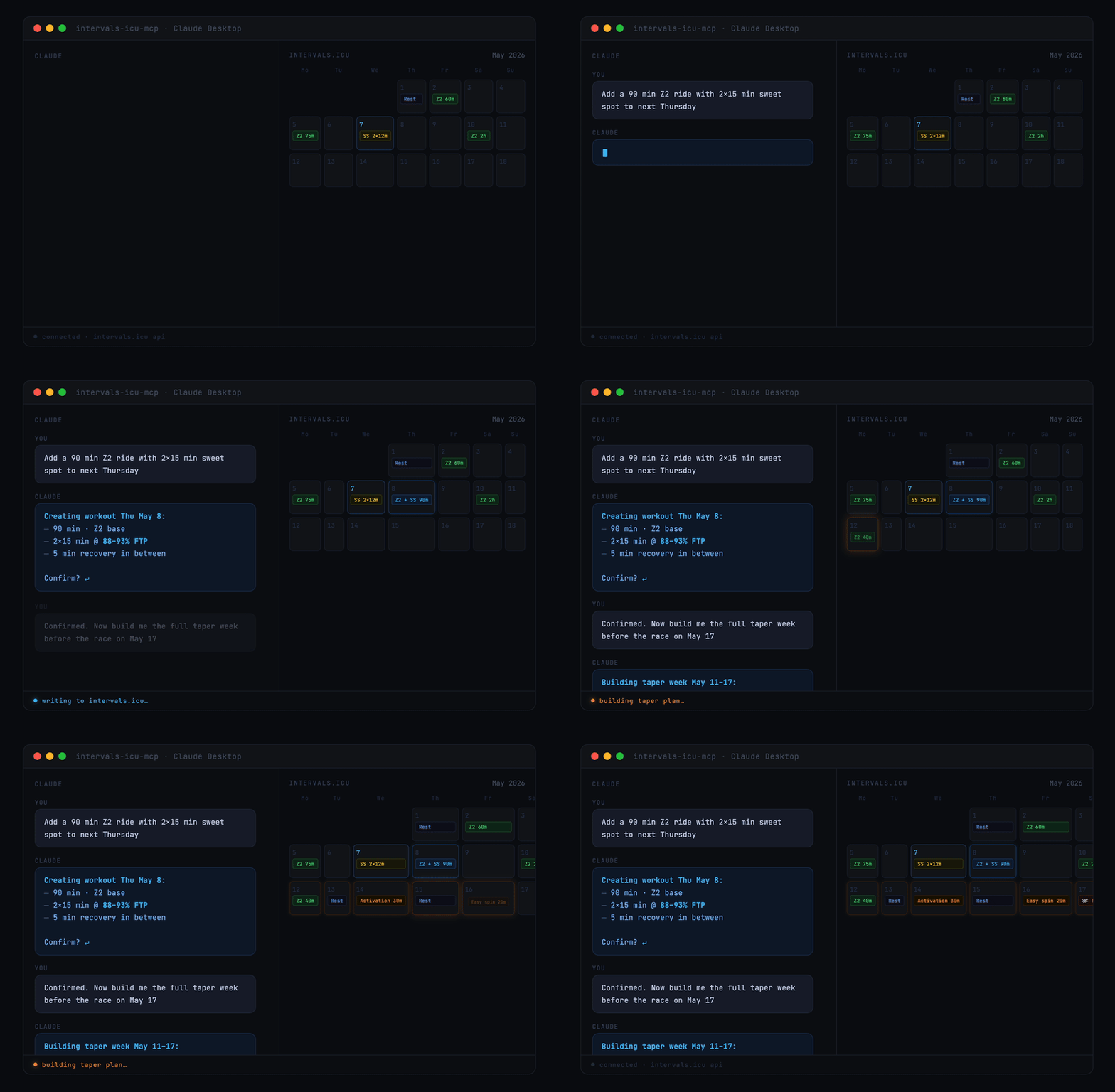
A Model Context Protocol (MCP) server for Intervals.icu integration. Access your training data, wellness metrics, and performance analysis through Claude, ChatGPT, and other LLMs.
> Originally based on [eddmann/intervals-icu-mcp](https://github.com/eddmann/intervals-icu-mcp) (MIT licensed). This project is an independent continuation with significant bug fixes and new features — see the [release notes](https://github.com/hhopke/intervals-icu-mcp/releases) for details.
[](https://github.com/hhopke/intervals-icu-mcp/actions/workflows/test.yml)
[](https://glama.ai/mcp/servers/hhopke/intervals-icu-mcp)
[](https://github.com/hhopke/intervals-icu-mcp/blob/main/LICENSE)
[](https://github.com/hhopke/intervals-icu-mcp/pkgs/container/intervals-icu-mcp)
## Overview
73 tools spanning activities, activity analysis, activity messages, athlete profile, wellness, events/calendar, performance curves, workout library, gear, sport settings, and custom items — plus 4 MCP Resources (athlete profile, workout syntax, event categories, custom item schemas) and 9 MCP Prompts (training analysis, recovery check, weekly planning, and more). See [Available Tools](#available-tools) for the per-category breakdown.
## Quick Start
<a href="https://cursor.com/en/install-mcp?name=intervals-icu&config=eyJjb21tYW5kIjoidXZ4IiwiYXJncyI6WyJpbnRlcnZhbHMtaWN1LW1jcCJdLCJlbnYiOnsiSU5URVJWQUxTX0lDVV9BUElfS0VZIjoiIiwiSU5URVJWQUxTX0lDVV9BVEhMRVRFX0lEIjoiIn19"><picture><source media="(prefers-color-scheme: dark)" srcset="https://cursor.com/deeplink/mcp-install-dark.svg"><img alt="Install in Cursor" src="https://cursor.com/deeplink/mcp-install-light.svg"></picture></a>
Or for Claude Desktop, in 30 seconds:
1. Get your [API key and athlete ID](#intervalsicu-api-key-setup)
2. Add this to your Claude Desktop config:
```json
{
"mcpServers": {
"intervals-icu": {
"command": "uvx",
"args": ["intervals-icu-mcp"],
"env": {
"INTERVALS_ICU_API_KEY": "your-api-key-here",
"INTERVALS_ICU_ATHLETE_ID": "i123456"
}
}
}
}
```
3. Restart Claude and ask *"Show me my activities from the last 7 days."*
Prefer Claude Code, Cursor, or ChatGPT? See [Client Configuration](#client-configuration). Want to run from source or with Docker? See [Installation & Setup](#installation--setup).
## Prerequisites
Install [uv](https://github.com/astral-sh/uv) — it handles Python, dependencies, and execution in one tool. `curl -LsSf https://astral.sh/uv/install.sh | sh` on macOS/Linux (or `brew install uv`; Homebrew no longer installs on Intel Macs), or `powershell -c "irm https://astral.sh/uv/install.ps1 | iex"` on Windows. From there, `uvx` fetches Python and the package automatically. If your MCP client can't find `uvx`, set `command` to the full path that `which uvx` prints. Docker is also supported as an alternative.
## Intervals.icu API Key Setup
Before installation, obtain your Intervals.icu API key:
1. Go to https://intervals.icu/settings → **Developer** → **Create API Key**.
2. Copy the key, and note your **Athlete ID** from your profile URL (format: `i123456`).
## Installation & Setup
**Nothing to install separately if you use the recommended setup.** `uvx` (which ships with `uv`) automatically downloads and caches the `intervals-icu-mcp` package the first time your MCP client launches it — just paste the config snippet from [Client Configuration](#client-configuration) into your client and you're done.
<details>
<summary><b>Alternative: from source</b> — for development or local modifications</summary>
```bash
git clone https://github.com/hhopke/intervals-icu-mcp.git
cd intervals-icu-mcp
uv sync
uv run intervals-icu-mcp-auth # interactive credential setup; or create .env manually:
# INTERVALS_ICU_API_KEY=your_api_key_here
# INTERVALS_ICU_ATHLETE_ID=i123456
```
Then point your MCP client at this checkout — see the **From source** snippet inside each client below.
</details>
<details>
<summary><b>Alternative: Docker</b></summary>
```bash
docker build -t intervals-icu-mcp .
# Interactive credential setup (creates intervals-icu-mcp.env in the current directory):
touch intervals-icu-mcp.env # pre-create the file so Docker mounts it as a file, not a dir
docker run -it --rm \
-v "$(pwd)/intervals-icu-mcp.env:/app/.env" \
--entrypoint= intervals-icu-mcp:latest \
python -m intervals_icu_mcp.scripts.setup_auth
```
Or create `intervals-icu-mcp.env` manually (same format as the `.env` above).
Then point your MCP client at the Docker image — see the **Docker** snippet inside each client below.
</details>
## Client Configuration
The server speaks MCP over stdio and works with any compliant client. Click a client to expand. If you followed Quick Start (uvx), use the first config block; if you used the source or Docker alternative above, use the matching variant inside the same collapsible.
<details>
<summary><b>Claude Desktop</b></summary>
Add to your configuration file:
- macOS: `~/Library/Application Support/Claude/claude_desktop_config.json`
- Windows: `%APPDATA%\Claude\claude_desktop_config.json`
```json
{
"mcpServers": {
"intervals-icu": {
"command": "uvx",
"args": ["intervals-icu-mcp"],
"env": {
"INTERVALS_ICU_API_KEY": "your-api-key-here",
"INTERVALS_ICU_ATHLETE_ID": "i123456"
}
}
}
}
```
**From source** (requires `git clone` + `uv sync` + `uv run intervals-icu-mcp-auth`):
```json
{
"mcpServers": {
"intervals-icu": {
"command": "uv",
"args": ["run", "--directory", "/ABSOLUTE/PATH/TO/intervals-icu-mcp", "intervals-icu-mcp"]
}
}
}
```
**Docker**:
```json
{
"mcpServers": {
"intervals-icu": {
"command": "docker",
"args": ["run", "-i", "--rm", "-v", "/ABSOLUTE/PATH/TO/intervals-icu-mcp.env:/app/.env", "intervals-icu-mcp:latest"]
}
}
}
```
</details>
<details>
<summary><b>Claude Code</b></summary>
Register the server as a user-scoped MCP server:
```bash
claude mcp add intervals-icu --scope user \
--env INTERVALS_ICU_API_KEY=your-key \
--env INTERVALS_ICU_ATHLETE_ID=i123456 \
-- uvx intervals-icu-mcp
```
Then in any Claude Code session, run `/mcp` to confirm `intervals-icu` is connected.
</details>
<details>
<summary><b>Cursor</b></summary>
Add to `~/.cursor/mcp.json` (or the project-local `.cursor/mcp.json`):
```json
{
"mcpServers": {
"intervals-icu": {
"command": "uvx",
"args": ["intervals-icu-mcp"],
"env": {
"INTERVALS_ICU_API_KEY": "your-api-key-here",
"INTERVALS_ICU_ATHLETE_ID": "i123456"
}
}
}
}
```
Restart Cursor and open *Settings → MCP* to verify the server is listed.
</details>
<details>
<summary><b>ChatGPT</b> — requires a paid plan, Developer Mode, and a publicly reachable URL <em>(walkthrough not yet verified end-to-end)</em></summary>
ChatGPT's custom MCP connector flow requires running the server over HTTP and exposing it via a tunnel, then registering the URL in ChatGPT's Developer Mode settings. See [docs/chatgpt-connector.md](https://github.com/hhopke/intervals-icu-mcp/blob/main/docs/chatgpt-connector.md) for the full walkthrough, plan-tier requirements, and security notes.
</details>
## Usage
Ask Claude to interact with your Intervals.icu data in natural language. A few starter prompts:
```
"Show me my activities from the last 30 days"
"Am I overtraining? Check my CTL, ATL, and TSB"
"How's my recovery this week? Show HRV and sleep trends"
"Create a sweet spot cycling workout for tomorrow"
"What's my 20-minute power and FTP?"
```
For the full catalogue of example prompts by category, see [docs/examples.md](https://github.com/hhopke/intervals-icu-mcp/blob/main/docs/examples.md).
## Available Tools
73 tools, 4 resources, and 9 prompt templates. One-line summary below — full reference in [docs/tools.md](https://github.com/hhopke/intervals-icu-mcp/blob/main/docs/tools.md).
| Category | Tools | Summary |
|---|---|---|
| [Activities](https://github.com/hhopke/intervals-icu-mcp/blob/main/docs/tools.md#activities-13-tools) | 13 | Query, search, update, delete, download activities |
| [Activity Analysis](https://github.com/hhopke/intervals-icu-mcp/blob/main/docs/tools.md#activity-analysis-9-tools) | 9 | Streams, window stats, intervals, best efforts, histograms |
| [Activity Messages](https://github.com/hhopke/intervals-icu-mcp/blob/main/docs/tools.md#activity-messages-4-tools) | 4 | Read, post, edit, and delete notes/comments/coach feedback on activities |
| [Athlete](https://github.com/hhopke/intervals-icu-mcp/blob/main/docs/tools.md#athlete-5-tools) | 5 | Accessible athletes, profile and athlete notes, CTL/ATL/TSB analysis, fitness chart time-series |
| [Wellness](https://github.com/hhopke/intervals-icu-mcp/blob/main/docs/tools.md#wellness-3-tools) | 3 | HRV, sleep, recovery metrics |
| [Events / Calendar](https://github.com/hhopke/intervals-icu-mcp/blob/main/docs/tools.md#events--calendar-13-tools) | 13 | Planned workouts, races, notes, ATP periodization (bulk ops supported) |
| [Performance / Curves](https://github.com/hhopke/intervals-icu-mcp/blob/main/docs/tools.md#performance--curves-3-tools) | 3 | Power, HR, and pace curves with zones |
| [Workout Library](https://github.com/hhopke/intervals-icu-mcp/blob/main/docs/tools.md#workout-library-8-tools) | 8 | Browse, create, and delete folders and training plans; create (incl. bulk), update, and delete library workouts |
| [Gear Management](https://github.com/hhopke/intervals-icu-mcp/blob/main/docs/tools.md#gear-management-6-tools) | 6 | Track equipment and maintenance reminders |
| [Sport Settings](https://github.com/hhopke/intervals-icu-mcp/blob/main/docs/tools.md#sport-settings-4-tools) | 4 | FTP, FTHR, pace thresholds, and zones |
| [Custom Items](https://github.com/hhopke/intervals-icu-mcp/blob/main/docs/tools.md#custom-items-5-tools) | 5 | User customizations: custom charts, fields, zones, dashboard panels |
## Delete Safety Mode
Destructive tools are gated by the optional `INTERVALS_ICU_DELETE_MODE` env var (`safe` / `full` / `none`, default `safe`) — a server-side gate outside the model's reach, so unregistered tools can't be invoked. See [docs/tools.md](https://github.com/hhopke/intervals-icu-mcp/blob/main/docs/tools.md#delete-safety-mode) for the full mode table, response envelope, and TZ-buffer rationale.
## Remote Deployment (HTTP / SSE)
The server runs over **stdio** by default — the right transport for local clients like Claude Desktop, Claude Code, and Cursor. HTTP and SSE transports are available for remote or hosted use.
> ⚠️ MCP has **no built-in authentication** — never expose an HTTP-mode server to an untrusted network without a tunnel (Tailscale, Cloudflare Tunnel) or an authenticating reverse proxy.
See [docs/remote-deployment.md](https://github.com/hhopke/intervals-icu-mcp/blob/main/docs/remote-deployment.md) for transport flags and the full security model.
## Documentation
- [Example prompts](https://github.com/hhopke/intervals-icu-mcp/blob/main/docs/examples.md) — full catalogue of natural-language prompts by category
- [Tool reference](https://github.com/hhopke/intervals-icu-mcp/blob/main/docs/tools.md) — complete tool, resource, and prompt inventory
- [Architecture overview](https://github.com/hhopke/intervals-icu-mcp/blob/main/docs/architecture.md) — how the server, middleware, client, and tools fit together
- [Remote deployment (HTTP/SSE)](https://github.com/hhopke/intervals-icu-mcp/blob/main/docs/remote-deployment.md) — transports, flags, and the security model for hosted/remote setups
- [Testing guide](https://github.com/hhopke/intervals-icu-mcp/blob/main/docs/testing.md) — conventions for pytest + respx, fixtures, and running the suite
- [Releases](https://github.com/hhopke/intervals-icu-mcp/releases) — release notes ([CHANGELOG.md](CHANGELOG.md) covers releases up to 5.8.0)
## Contributing
This project no longer accepts issues or pull requests. You are welcome to fork it under the MIT License.
## License
MIT License - see the [LICENSE](https://github.com/hhopke/intervals-icu-mcp/blob/main/LICENSE) file for details.
## Disclaimer
This project is not affiliated with, endorsed by, or sponsored by Intervals.icu. All product names, logos, and brands are property of their respective owners.
TDQS
Scored across 70 tools
Nearly every tool carries explicit 'different from X' cross-references (e.g. histogram vs curves, get_activity_details vs get_activity_intervals vs get_activity_streams, calendar events vs workout library vs upcoming workouts), which resolves most potential overlap. Residual ambiguity remains in the activity-listing cluster (get_recent_activities / get_activities_by_date / search_activities / search_activities_full / get_activities_around) and the curve/histogram families, where an agent must read the descriptions closely to pick correctly.
All 70 tools share the icu_ prefix and a snake_case verb_noun convention (get_/list_/search_/create_/update_/delete_/bulk_/download_), which is highly predictable. Minor deviations: singular/plural drift (get_power_histogram vs get_power_curves, get_seasons), read tools that are noun-first (icu_get_gear_list), and the add/update message verbs breaking the create pattern.
70 tools is far beyond a well-scoped surface and forces the agent to navigate a large, multi-domain catalog (activities, calendar, wellness, library, gear, sport settings, custom items). While each tool maps to a real API capability, the sheer count makes selection error-prone and pushes well past the 15-tool benchmark.
Coverage is broad and near-CRUD across domains: activities (read + update + streams), calendar events (create/update/delete/bulk/duplicate), workout library folders and workouts, gear and reminders, sport settings, messages, and custom items. Notable gaps: no delete_activity, no delete_custom_item (create/read/update exist but no removal), and no single-workout fetch or gear-reminder delete outside gear deletion.