
agent-utils-mcp
Server Quality Checklist
Latest release: v0.1.0
- Disambiguation5/5
Each tool performs a distinct operation, with clear separation between encoding/decoding, validation/formatting, conversion pairs, and parsing utilities. No overlapping responsibilities would confuse an agent.
Naming Consistency4/5Names follow a consistent lowercase snake_case pattern with a uniform 'tool_' prefix and typically include the target data type, but verb placement varies (e.g., tool_text_stats vs tool_json_validate) and conversion pairs use 'to' rather than a strict verb_noun scheme.
Tool Count4/518 tools is slightly above the typical well-scoped range, but the broad utility-toolkit purpose justifies the number since each tool addresses a distinct text, data, or time operation.
Completeness4/5The set covers a wide range of common agent utilities (JSON, base64, hashing, UUID, datetime, CSV, Markdown, diff). Minor gaps such as URL encoding/decoding or more advanced string operations are missing, but the surface is generally complete for its stated purpose.
Average 3.5/5 across 18 of 18 tools scored. Lowest: 2.8/5.
See the Tool Scores section below for per-tool breakdowns.
- 0 of 1 community issues answered or closed in the last 6 months
- 0 commits in the last 12 weeks
- Last stable release on
- No critical vulnerability alerts
- No high-severity vulnerability alerts
- No code scanning findings
- CI status not available
Add a LICENSE file by following GitHub's guide. Once GitHub recognizes the license, the system will automatically detect it within a few hours.
If the license does not appear after some time, you can manually trigger a new scan using the MCP server admin interface.
MCP servers without a LICENSE cannot be installed.
This repository includes a README.md file.
No tool usage detected in the last 30 days. Usage tracking helps demonstrate server value.
Tip: use the "Try in Browser" feature on the server page to seed initial usage.
Add a glama.json file to provide metadata about your server.
If you are the author, simply .
If the server belongs to an organization, first add
glama.jsonto the root of your repository:{ "$schema": "https://glama.ai/mcp/schemas/server.json", "maintainers": [ "your-github-username" ] }Then . Browse examples.
Add related servers to improve discoverability.
How to sync the server with GitHub?
Servers are automatically synced at least once per day, but you can also sync manually at any time to instantly update the server profile.
To manually sync the server, click the "Sync Server" button in the MCP server admin interface.
How is the quality score calculated?
The overall quality score combines two components: Tool Definition Quality (70%) and Server Coherence (30%).
Tool Definition Quality measures how well each tool describes itself to AI agents. Every tool is scored 1–5 across six dimensions: Purpose Clarity (25%), Usage Guidelines (20%), Behavioral Transparency (20%), Parameter Semantics (15%), Conciseness & Structure (10%), and Contextual Completeness (10%). The server-level definition quality score is calculated as 60% mean TDQS + 40% minimum TDQS, so a single poorly described tool pulls the score down.
Server Coherence evaluates how well the tools work together as a set, scoring four dimensions equally: Disambiguation (can agents tell tools apart?), Naming Consistency, Tool Count Appropriateness, and Completeness (are there gaps in the tool surface?).
Tiers are derived from the overall score: A (≥3.5), B (≥3.0), C (≥2.0), D (≥1.0), F (<1.0). B and above is considered passing.
Tool Scores
- Behavior1/5
Does the description disclose side effects, auth requirements, rate limits, or destructive behavior?
No annotations are provided and the description discloses no behavioral details. It does not mention side effects, error handling, invalid input behavior, or whether the conversion is pure and non-destructive.
Agents need to know what a tool does to the world before calling it. Descriptions should go beyond structured annotations to explain consequences.
Conciseness5/5Is the description appropriately sized, front-loaded, and free of redundancy?
The description is a single, front-loaded sentence with no redundant words or filler. It states the core transformation immediately and avoids unnecessary detail.
Shorter descriptions cost fewer tokens and are easier for agents to parse. Every sentence should earn its place.
Completeness3/5Given the tool's complexity, does the description cover enough for an agent to succeed on first attempt?
For a one-argument pure conversion tool, the description covers the essential purpose, but it leaves gaps in parameter explanation and edge-case behavior. It is probably sufficient for a simple call, yet it relies heavily on the parameter name and tool name to complete the context.
Complex tools with many parameters or behaviors need more documentation. Simple tools need less. This dimension scales expectations accordingly.
Parameters1/5Does the description clarify parameter syntax, constraints, interactions, or defaults beyond what the schema provides?
The schema provides only the parameter name 'md_text' with no description coverage, and the tool description does not elaborate on expected values, format, or constraints. The only clue to the parameter's meaning comes from the tool name and purpose, not from explicit parameter documentation.
Input schemas describe structure but not intent. Descriptions should explain non-obvious parameter relationships and valid value ranges.
Purpose5/5Does the description clearly state what the tool does and how it differs from similar tools?
The description uses a specific verb ('Convert') and names both source and target formats ('Markdown to HTML'), making the tool's function unambiguous. It also clearly distinguishes the tool from its sibling tool_html_to_markdown, which performs the inverse operation.
Agents choose between tools based on descriptions. A clear purpose with a specific verb and resource helps agents select the right tool.
Usage Guidelines2/5Does the description explain when to use this tool, when not to, or what alternatives exist?
The description only restates the conversion function and does not explicitly say when to choose this tool over alternatives. There is no mention of use cases, constraints on input, or comparison with the sibling html-to-markdown tool.
Agents often have multiple tools that could apply. Explicit usage guidance like "use X instead of Y when Z" prevents misuse.
- Behavior2/5
Does the description disclose side effects, auth requirements, rate limits, or destructive behavior?
With no annotations provided, the description carries the full burden of disclosing behavior. It states the core conversion capability but does not disclose important behaviors such as how Unix timestamps are detected or converted, what happens when from_format or to_format is null, whether invalid datetimes cause errors, or how the defaults of UTC are applied. This is a meaningful gap for a conversion utility with non-obvious edge cases.
Agents need to know what a tool does to the world before calling it. Descriptions should go beyond structured annotations to explain consequences.
Conciseness4/5Is the description appropriately sized, front-loaded, and free of redundancy?
The description is a single concise sentence with no filler or redundancy. It is appropriately front-loaded with the primary action and resource. It loses a point because it is so brief that it omits useful context, but as a concise summary it is effective.
Shorter descriptions cost fewer tokens and are easier for agents to parse. Every sentence should earn its place.
Completeness2/5Given the tool's complexity, does the description cover enough for an agent to succeed on first attempt?
Although an output schema exists, the description is too sparse for a 5-parameter conversion tool. It does not explain timezone input formats, datetime format syntax, the role of from_format and to_format, the direction of Unix timestamp conversion, or default behavior. An agent would need external knowledge about common timezone/format handling to confidently use this tool correctly.
Complex tools with many parameters or behaviors need more documentation. Simple tools need less. This dimension scales expectations accordingly.
Parameters2/5Does the description clarify parameter syntax, constraints, interactions, or defaults beyond what the schema provides?
Schema description coverage is 0% and the description adds no parameter-specific meaning. The phrase 'timezones/formats' weakly maps to from_tz/to_tz/from_format/to_format, and 'including Unix timestamps' hints that dt_string may accept a Unix timestamp, but it does not explain how the parameters interact or which formats are accepted. The description does not compensate for the complete lack of schema descriptions.
Input schemas describe structure but not intent. Descriptions should explain non-obvious parameter relationships and valid value ranges.
Purpose4/5Does the description clearly state what the tool does and how it differs from similar tools?
The description uses a clear verb ('Convert') and a specific resource ('datetime'), and explicitly names the two key operations: timezone conversion and format conversion, including Unix timestamps. It is distinguishable from all sibling tools, none of which involve datetime manipulation, though it doesn't explicitly name a sibling it is not.
Agents choose between tools based on descriptions. A clear purpose with a specific verb and resource helps agents select the right tool.
Usage Guidelines3/5Does the description explain when to use this tool, when not to, or what alternatives exist?
The description implies when to use the tool: whenever a datetime needs conversion between timezones or formats. However, it provides no explicit guidance about when not to use it, no mention of alternative tools (though none are obvious among siblings), and no context on use cases such as parsing user-supplied datetimes or normalizing stored timestamps.
Agents often have multiple tools that could apply. Explicit usage guidance like "use X instead of Y when Z" prevents misuse.
- Behavior2/5
Does the description disclose side effects, auth requirements, rate limits, or destructive behavior?
No annotations are provided, so the description must disclose behavioral details on its own. It states the output shape but does not explain how object keys are derived, whether values are parsed or kept as strings, how the delimiter option affects parsing, or how malformed or empty CSV input is handled.
Agents need to know what a tool does to the world before calling it. Descriptions should go beyond structured annotations to explain consequences.
Conciseness4/5Is the description appropriately sized, front-loaded, and free of redundancy?
The description is one short, front-loaded sentence with no filler. However, it is almost too minimal, skipping important behavioral details that an agent would need for a robust invocation, so it is not a perfect example of concise completeness.
Shorter descriptions cost fewer tokens and are easier for agents to parse. Every sentence should earn its place.
Completeness3/5Given the tool's complexity, does the description cover enough for an agent to succeed on first attempt?
For a simple two-parameter utility with an output schema, the description covers the primary intent and return shape at a high level. But it leaves key conversion semantics unstated, and with no annotations or parameter-level documentation, the agent must infer a lot from the tool name and schema defaults.
Complex tools with many parameters or behaviors need more documentation. Simple tools need less. This dimension scales expectations accordingly.
Parameters1/5Does the description clarify parameter syntax, constraints, interactions, or defaults beyond what the schema provides?
Schema description coverage is 0%, so the description must compensate for the lack of parameter documentation. It does not: the only reference is 'CSV text,' which merely echoes the csv_text parameter name, and the delimiter parameter is never mentioned or given any semantic context.
Input schemas describe structure but not intent. Descriptions should explain non-obvious parameter relationships and valid value ranges.
Purpose5/5Does the description clearly state what the tool does and how it differs from similar tools?
The description states a specific transformation: 'Convert CSV text to a JSON array of objects.' This clearly identifies the input, the output format, and the direction of conversion, and it is easily distinguishable from the sibling tool tool_json_to_csv, which does the reverse.
Agents choose between tools based on descriptions. A clear purpose with a specific verb and resource helps agents select the right tool.
Usage Guidelines3/5Does the description explain when to use this tool, when not to, or what alternatives exist?
The description implies when to use the tool: when you have CSV text and want a JSON array of objects. However, it provides no explicit guidance about when not to use it or which alternative tool might be better for related tasks, such as validating JSON or converting JSON back to CSV.
Agents often have multiple tools that could apply. Explicit usage guidance like "use X instead of Y when Z" prevents misuse.
- Behavior2/5
Does the description disclose side effects, auth requirements, rate limits, or destructive behavior?
Without annotations, the description carries the burden of explaining behavior. It only says 'URL-safe slug' without detailing transformations (e.g., case normalization, allowed characters, handling of non-ASCII). No side effects are mentioned, but the minimal description leaves much unspecified.
Agents need to know what a tool does to the world before calling it. Descriptions should go beyond structured annotations to explain consequences.
Conciseness5/5Is the description appropriately sized, front-loaded, and free of redundancy?
The description is a single, concise sentence that directly communicates the purpose without unnecessary words. It is well-structured and to the point.
Shorter descriptions cost fewer tokens and are easier for agents to parse. Every sentence should earn its place.
Completeness3/5Given the tool's complexity, does the description cover enough for an agent to succeed on first attempt?
For a simple string transformation, the description is adequate to understand the core operation. However, the lack of output schema and details about edge cases (e.g., empty strings, special character handling) makes it incomplete for complex usage scenarios, though it covers the basic use case.
Complex tools with many parameters or behaviors need more documentation. Simple tools need less. This dimension scales expectations accordingly.
Parameters2/5Does the description clarify parameter syntax, constraints, interactions, or defaults beyond what the schema provides?
The schema has no descriptions for parameters, so the description must compensate. It clarifies 'text' as input, but 'separator' is not described beyond its name and default value. The description does not explain how the separator affects output, leaving the parameter semantics insufficient.
Input schemas describe structure but not intent. Descriptions should explain non-obvious parameter relationships and valid value ranges.
Purpose5/5Does the description clearly state what the tool does and how it differs from similar tools?
The description clearly states the tool's function: generating a URL-safe slug from text. The verb 'generate' and resource 'slug' are specific, and it stands out from sibling tools like JSON or CSV converters.
Agents choose between tools based on descriptions. A clear purpose with a specific verb and resource helps agents select the right tool.
Usage Guidelines2/5Does the description explain when to use this tool, when not to, or what alternatives exist?
No explicit guidance on when to use this tool versus alternatives, or any prerequisites or context. The description is purely functional and lacks usage conditions or scenarios.
Agents often have multiple tools that could apply. Explicit usage guidance like "use X instead of Y when Z" prevents misuse.
- Behavior2/5
Does the description disclose side effects, auth requirements, rate limits, or destructive behavior?
No annotations are provided, so the description carries full responsibility for disclosing behavior. It only states that it parses a URL into components, but does not mention whether the operation is read-only, what the output structure looks like, or how errors are handled. This lack of detail limits transparency.
Agents need to know what a tool does to the world before calling it. Descriptions should go beyond structured annotations to explain consequences.
Conciseness5/5Is the description appropriately sized, front-loaded, and free of redundancy?
The description is a single, concise sentence that leads with the action and directly states the resource and output. There is no unnecessary wording or redundant information, making it highly efficient.
Shorter descriptions cost fewer tokens and are easier for agents to parse. Every sentence should earn its place.
Completeness3/5Given the tool's complexity, does the description cover enough for an agent to succeed on first attempt?
The description lists examples of components but does not specify the complete set of returned fields or the output schema. Although an output schema is indicated as existing, it is not provided here, so the description alone leaves some ambiguity about the exact return structure. It is sufficiently complete for a simple utility, but not fully detailed.
Complex tools with many parameters or behaviors need more documentation. Simple tools need less. This dimension scales expectations accordingly.
Parameters3/5Does the description clarify parameter syntax, constraints, interactions, or defaults beyond what the schema provides?
The schema only provides the parameter name and type (string), with no description. The tool description implies that the parameter is the URL to parse, which adds some meaning beyond the schema. However, it does not elaborate on expected format (e.g., full URL, relative, encoded) or constraints, so the compensation is minimal.
Input schemas describe structure but not intent. Descriptions should explain non-obvious parameter relationships and valid value ranges.
Purpose5/5Does the description clearly state what the tool does and how it differs from similar tools?
The description clearly states the tool's function with a specific verb ('Parse') and resource ('a URL'), and enumerates example components (scheme, host, path, params). It is distinct from all sibling tools, which handle JSON, encoding, hashing, etc., so there is no ambiguity.
Agents choose between tools based on descriptions. A clear purpose with a specific verb and resource helps agents select the right tool.
Usage Guidelines2/5Does the description explain when to use this tool, when not to, or what alternatives exist?
The description does not provide any guidance on when to use this tool versus alternatives. It does not mention specific scenarios, prerequisites, or conditions that would trigger its use. Since none of the sibling tools parse URLs, the need is implicit, but no explicit usage context is given.
Agents often have multiple tools that could apply. Explicit usage guidance like "use X instead of Y when Z" prevents misuse.
- Behavior2/5
Does the description disclose side effects, auth requirements, rate limits, or destructive behavior?
No annotations are provided, so the description must carry the behavioral burden. It only names the transformations and does not disclose how invalid JSON input is handled, whether output indentation follows a specific style, or any side effects or errors.
Agents need to know what a tool does to the world before calling it. Descriptions should go beyond structured annotations to explain consequences.
Conciseness5/5Is the description appropriately sized, front-loaded, and free of redundancy?
The description is a single concise sentence with clear, front-loaded terms and no redundant wording. Every word contributes meaning, though some behavioral detail is sacrificed for brevity.
Shorter descriptions cost fewer tokens and are easier for agents to parse. Every sentence should earn its place.
Completeness3/5Given the tool's complexity, does the description cover enough for an agent to succeed on first attempt?
For a low-complexity tool with an output schema and clear parameter schema, the description is adequate but not fully complete. Missing context includes invalid-input behavior and explicit clarification of the default output mode beyond the schema's default value.
Complex tools with many parameters or behaviors need more documentation. Simple tools need less. This dimension scales expectations accordingly.
Parameters2/5Does the description clarify parameter syntax, constraints, interactions, or defaults beyond what the schema provides?
Schema description coverage is 0% and the description does not explain the parameters in detail. It implicitly maps the minify boolean to minify vs pretty-print behavior but leaves json_string semantics and default behavior to be inferred from parameter names and schema defaults.
Input schemas describe structure but not intent. Descriptions should explain non-obvious parameter relationships and valid value ranges.
Purpose5/5Does the description clearly state what the tool does and how it differs from similar tools?
The description uses specific verbs 'Pretty-print' and 'minify' with a clear resource, 'a JSON string', making the tool's purpose immediately understandable. It also distinguishes from sibling tools like tool_json_validate, which validates rather than formats JSON.
Agents choose between tools based on descriptions. A clear purpose with a specific verb and resource helps agents select the right tool.
Usage Guidelines3/5Does the description explain when to use this tool, when not to, or what alternatives exist?
The description implies usage: call this when a JSON string needs to be formatted for readability or compactness. However, it does not explicitly state when not to use it or compare it with alternatives such as tool_json_validate.
Agents often have multiple tools that could apply. Explicit usage guidance like "use X instead of Y when Z" prevents misuse.
- Behavior2/5
Does the description disclose side effects, auth requirements, rate limits, or destructive behavior?
No annotations are provided, so the description carries the full burden of behavioral disclosure. It only states the conversion direction and does not mention edge-case handling, quoting/escaping behavior, or requirements beyond 'JSON array'.
Agents need to know what a tool does to the world before calling it. Descriptions should go beyond structured annotations to explain consequences.
Conciseness4/5Is the description appropriately sized, front-loaded, and free of redundancy?
One concise sentence with no filler, and the core conversion is front-loaded. It is efficient but slightly under-specified.
Shorter descriptions cost fewer tokens and are easier for agents to parse. Every sentence should earn its place.
Completeness4/5Given the tool's complexity, does the description cover enough for an agent to succeed on first attempt?
For a simple two-parameter conversion tool, the description plus schema (required json_data, optional delimiter with default ',') is nearly complete. The output schema covers the return shape, so missing edge-case details are the only gap.
Complex tools with many parameters or behaviors need more documentation. Simple tools need less. This dimension scales expectations accordingly.
Parameters2/5Does the description clarify parameter syntax, constraints, interactions, or defaults beyond what the schema provides?
Schema description coverage is 0%, so the description must compensate. It adds meaning to json_data by specifying it must be a JSON array, but it says nothing about the delimiter parameter or its default behavior, leaving a parameter gap.
Input schemas describe structure but not intent. Descriptions should explain non-obvious parameter relationships and valid value ranges.
Purpose5/5Does the description clearly state what the tool does and how it differs from similar tools?
Description uses a specific verb ('Convert') and resource ('a JSON array' to 'CSV text'), and the direction clearly differentiates it from the sibling tool_csv_to_json. The word 'JSON array' gives a concrete input constraint.
Agents choose between tools based on descriptions. A clear purpose with a specific verb and resource helps agents select the right tool.
Usage Guidelines3/5Does the description explain when to use this tool, when not to, or what alternatives exist?
The use case is implied: call this when you have a JSON array and want CSV text. However, there is no explicit when-to-use, when-not-to-use, or mention of the reverse sibling tool_csv_to_json.
Agents often have multiple tools that could apply. Explicit usage guidance like "use X instead of Y when Z" prevents misuse.
- Behavior3/5
Does the description disclose side effects, auth requirements, rate limits, or destructive behavior?
With no annotations, the description carries the burden of behavioral disclosure. It does state that all matches are returned, which is useful, but it does not disclose behavior for invalid regex patterns, zero matches, or how flags alter matching semantics. The description is adequate but not transparent about edge cases.
Agents need to know what a tool does to the world before calling it. Descriptions should go beyond structured annotations to explain consequences.
Conciseness5/5Is the description appropriately sized, front-loaded, and free of redundancy?
The description is a single focused sentence with no filler. It front-loads the core action and result, making the tool's purpose immediately clear. Every word contributes value.
Shorter descriptions cost fewer tokens and are easier for agents to parse. Every sentence should earn its place.
Completeness3/5Given the tool's complexity, does the description cover enough for an agent to succeed on first attempt?
The tool is a simple stateless utility and an output schema is present, so return-value shape is already covered. However, the description still lacks guidance on flags formatting, error behavior, and usage context. These are gaps, but the presence of the output schema and simple parameter names keep the description minimally viable.
Complex tools with many parameters or behaviors need more documentation. Simple tools need less. This dimension scales expectations accordingly.
Parameters2/5Does the description clarify parameter syntax, constraints, interactions, or defaults beyond what the schema provides?
Schema description coverage is 0%, so the description must compensate for the undocumented parameters. It clarifies that 'pattern' is applied to 'text', but it does not explain the format or allowed values of the 'flags' parameter, nor does it describe any constraints on the pattern or text. This leaves a meaningful semantic gap.
Input schemas describe structure but not intent. Descriptions should explain non-obvious parameter relationships and valid value ranges.
Purpose5/5Does the description clearly state what the tool does and how it differs from similar tools?
The description states a specific action ('Test a regex pattern'), a clear resource ('against text'), and an observable outcome ('return all matches'). It is immediately distinguishable from all listed sibling tools, none of which perform regex matching.
Agents choose between tools based on descriptions. A clear purpose with a specific verb and resource helps agents select the right tool.
Usage Guidelines2/5Does the description explain when to use this tool, when not to, or what alternatives exist?
The description implies when the tool would be used, but it provides no explicit guidance about when to reach for this tool over alternatives, no mention of prerequisites, and no exclusion criteria. There is no advice about handling edge cases or what kinds of regex tasks this tool is best suited for.
Agents often have multiple tools that could apply. Explicit usage guidance like "use X instead of Y when Z" prevents misuse.
- Behavior3/5
Does the description disclose side effects, auth requirements, rate limits, or destructive behavior?
No annotations are provided, so the description carries the full burden of behavioral disclosure. It states the core transformation but does not explain behavior on invalid input, whether URL-safe base64 is accepted, or how the decoded output is encoded. Since the tool is a pure transformation, this is minimal but not completely opaque.
Agents need to know what a tool does to the world before calling it. Descriptions should go beyond structured annotations to explain consequences.
Conciseness5/5Is the description appropriately sized, front-loaded, and free of redundancy?
The description is a single concise sentence with no filler words. Every word contributes meaning, and the core action is front-loaded. This is appropriately sized for such a simple utility tool.
Shorter descriptions cost fewer tokens and are easier for agents to parse. Every sentence should earn its place.
Completeness4/5Given the tool's complexity, does the description cover enough for an agent to succeed on first attempt?
Given the tool's low complexity, single parameter, and presence of an output schema, the description is adequate for correct invocation. It clearly identifies the input and operation. The lack of error-handling details is a minor gap for this simple pure-function tool.
Complex tools with many parameters or behaviors need more documentation. Simple tools need less. This dimension scales expectations accordingly.
Parameters3/5Does the description clarify parameter syntax, constraints, interactions, or defaults beyond what the schema provides?
Schema description coverage is 0%, so the description must compensate for the bare parameter definition. It does add meaning by indicating that 'encoded' must be a base64-encoded string, which is useful. However, it does not elaborate on accepted format, padding, or edge cases, leaving the parameter semantics only minimally enriched.
Input schemas describe structure but not intent. Descriptions should explain non-obvious parameter relationships and valid value ranges.
Purpose4/5Does the description clearly state what the tool does and how it differs from similar tools?
The verb 'Decode' and object 'base64 string' clearly state a specific operation and resource. It is inherently distinguishable from sibling tool_base64_encode, though it does not explicitly reference or differentiate itself from any sibling by name.
Agents choose between tools based on descriptions. A clear purpose with a specific verb and resource helps agents select the right tool.
Usage Guidelines3/5Does the description explain when to use this tool, when not to, or what alternatives exist?
The description gives no explicit guidance on when to use this tool versus alternatives, and it states no exclusions or prerequisites. However, the intended usage is fairly implied by the action 'Decode a base64 string,' making the gap moderate rather than severe.
Agents often have multiple tools that could apply. Explicit usage guidance like "use X instead of Y when Z" prevents misuse.
- Behavior3/5
Does the description disclose side effects, auth requirements, rate limits, or destructive behavior?
No annotations are provided, so the description must carry behavioral information. It accurately states the core computation and implies a pure, read-only operation, but it does not mention how context_lines affects output, whether diffing is line-based, or what the exact return structure is. The existence of an output schema mitigates the return-format gap.
Agents need to know what a tool does to the world before calling it. Descriptions should go beyond structured annotations to explain consequences.
Conciseness5/5Is the description appropriately sized, front-loaded, and free of redundancy?
The description is a single, front-loaded sentence with no filler or redundant information. Every word contributes to stating what the tool does.
Shorter descriptions cost fewer tokens and are easier for agents to parse. Every sentence should earn its place.
Completeness3/5Given the tool's complexity, does the description cover enough for an agent to succeed on first attempt?
The tool is simple and has an output schema to cover return values, so the description does not need to explain that aspect. However, key contextual details such as the meaning of context_lines and any assumptions about text handling are absent, making the description adequate but not fully complete.
Complex tools with many parameters or behaviors need more documentation. Simple tools need less. This dimension scales expectations accordingly.
Parameters2/5Does the description clarify parameter syntax, constraints, interactions, or defaults beyond what the schema provides?
Schema description coverage is 0%, and the description adds only minimal semantics by referring to 'two texts', which maps to text1 and text2. It does not explain the order or role of the two text parameters in the diff, nor does it describe context_lines, leaving a meaningful gap in parameter understanding.
Input schemas describe structure but not intent. Descriptions should explain non-obvious parameter relationships and valid value ranges.
Purpose5/5Does the description clearly state what the tool does and how it differs from similar tools?
The description uses a specific verb ('compute') and a specific resource ('unified diff') scoped to 'two texts'. This clearly identifies the tool's function and distinguishes it from all listed sibling tools, none of which perform text diffing.
Agents choose between tools based on descriptions. A clear purpose with a specific verb and resource helps agents select the right tool.
Usage Guidelines3/5Does the description explain when to use this tool, when not to, or what alternatives exist?
The intended usage is implied by the description: use when a unified diff between two texts is needed. However, there is no explicit guidance about when not to use it, prerequisites, or alternatives, though no sibling tool directly competes for this task.
Agents often have multiple tools that could apply. Explicit usage guidance like "use X instead of Y when Z" prevents misuse.
- Behavior2/5
Does the description disclose side effects, auth requirements, rate limits, or destructive behavior?
No annotations are provided, so the description must carry the behavioral burden. It only restates the purpose and gives no information about handling malformed HTML, full documents vs fragments, or other edge cases.
Agents need to know what a tool does to the world before calling it. Descriptions should go beyond structured annotations to explain consequences.
Conciseness5/5Is the description appropriately sized, front-loaded, and free of redundancy?
The description is a single sentence with no wasted words. It directly and efficiently expresses the tool's function.
Shorter descriptions cost fewer tokens and are easier for agents to parse. Every sentence should earn its place.
Completeness4/5Given the tool's complexity, does the description cover enough for an agent to succeed on first attempt?
This is a simple one-parameter transformation with an output schema, so the description and property title are enough for basic invocation. It lacks deeper behavioral context, but the low complexity reduces the need for it.
Complex tools with many parameters or behaviors need more documentation. Simple tools need less. This dimension scales expectations accordingly.
Parameters3/5Does the description clarify parameter syntax, constraints, interactions, or defaults beyond what the schema provides?
Schema description coverage is 0%, and the description adds no parameter-specific details. However, html_text is the only required parameter and its meaning is clear from the property title and the overall conversion purpose.
Input schemas describe structure but not intent. Descriptions should explain non-obvious parameter relationships and valid value ranges.
Purpose5/5Does the description clearly state what the tool does and how it differs from similar tools?
The description states the exact transformation: 'Convert HTML to Markdown.' It uses a specific verb and resource, and clearly differentiates this from the sibling tool_markdown_to_html by specifying direction.
Agents choose between tools based on descriptions. A clear purpose with a specific verb and resource helps agents select the right tool.
Usage Guidelines3/5Does the description explain when to use this tool, when not to, or what alternatives exist?
The description implies when to use the tool but does not explicitly say when not to use it or mention alternatives. The sibling tool_markdown_to_html exists, but the description does not route the agent between them.
Agents often have multiple tools that could apply. Explicit usage guidance like "use X instead of Y when Z" prevents misuse.
- Behavior3/5
Does the description disclose side effects, auth requirements, rate limits, or destructive behavior?
With no annotations, the description carries the burden of behavioral disclosure. It correctly implies a stateless generator with no destructive side effects and it names the v4/v7 variants. However, it does not explain behavioral differences such as v4 randomness versus v7 time-ordering, or whether the output is canonical lowercase hyphenated.
Agents need to know what a tool does to the world before calling it. Descriptions should go beyond structured annotations to explain consequences.
Conciseness5/5Is the description appropriately sized, front-loaded, and free of redundancy?
The description is a single sentence with no filler: it front-loads the action 'Generate' and then states the relevant variant scope. Every word earns its place.
Shorter descriptions cost fewer tokens and are easier for agents to parse. Every sentence should earn its place.
Completeness4/5Given the tool's complexity, does the description cover enough for an agent to succeed on first attempt?
For a low-complexity, one-parameter, side-effect-free generator with an output schema, this description is nearly complete: it identifies the operation, the valid version variants, and the schema supplies the default. The remaining gaps are version semantics and explicit usage guidance, but those are minor for this simple tool.
Complex tools with many parameters or behaviors need more documentation. Simple tools need less. This dimension scales expectations accordingly.
Parameters3/5Does the description clarify parameter syntax, constraints, interactions, or defaults beyond what the schema provides?
The schema only provides 'integer version with default 4' and no description. The phrase '(v4 or v7)' adds meaning by implying the accepted version values, but it never explicitly connects that phrase to the 'version' parameter or explains the difference between versions. This partially compensates for the 0% schema description coverage.
Input schemas describe structure but not intent. Descriptions should explain non-obvious parameter relationships and valid value ranges.
Purpose5/5Does the description clearly state what the tool does and how it differs from similar tools?
The description uses the specific verb 'Generate' and names the resource 'UUID', then narrows the scope to v4 or v7. This makes the tool's function immediately unambiguous, and none of the sibling tools overlap with UUID generation.
Agents choose between tools based on descriptions. A clear purpose with a specific verb and resource helps agents select the right tool.
Usage Guidelines2/5Does the description explain when to use this tool, when not to, or what alternatives exist?
The description provides no guidance about when to use this tool versus alternatives such as hash_generate or slug_generate, and gives no exclusions or selection criteria. Usage must be inferred entirely from the tool name and the one-line description.
Agents often have multiple tools that could apply. Explicit usage guidance like "use X instead of Y when Z" prevents misuse.
- Behavior3/5
Does the description disclose side effects, auth requirements, rate limits, or destructive behavior?
With no annotations, the description carries the full burden of behavioral disclosure. It communicates the output shape but omits behavior for invalid cron expressions, timezone assumptions, and the fact that the operation is read-only. The parse-only nature makes side effects easy to infer, so this is adequate yet incomplete.
Agents need to know what a tool does to the world before calling it. Descriptions should go beyond structured annotations to explain consequences.
Conciseness5/5Is the description appropriately sized, front-loaded, and free of redundancy?
The description is a single front-loaded sentence stating the action and outputs with no filler. Every word contributes to understanding what the tool does.
Shorter descriptions cost fewer tokens and are easier for agents to parse. Every sentence should earn its place.
Completeness3/5Given the tool's complexity, does the description cover enough for an agent to succeed on first attempt?
For a simple utility with an output schema, the core purpose is covered, but important invocation details are missing, such as timezone treatment, error handling for invalid expressions, and how count maps to N. The output schema likely covers return shape, but these gaps could still lead to incorrect assumptions.
Complex tools with many parameters or behaviors need more documentation. Simple tools need less. This dimension scales expectations accordingly.
Parameters3/5Does the description clarify parameter syntax, constraints, interactions, or defaults beyond what the schema provides?
Schema description coverage is 0%, so the description must compensate. It ties 'cron expression' to cron_expression and 'N' to the count parameter, adding some meaning beyond bare schema titles. However, it does not explicitly explain count's semantics, accepted cron format, or any constraints.
Input schemas describe structure but not intent. Descriptions should explain non-obvious parameter relationships and valid value ranges.
Purpose5/5Does the description clearly state what the tool does and how it differs from similar tools?
Description uses the specific verb 'Parse' with the resource 'cron expression' and explicitly states the output: a human-readable description plus next N run times. This is unambiguous and clearly differentiates the tool from all sibling utilities, none of which relate to cron.
Agents choose between tools based on descriptions. A clear purpose with a specific verb and resource helps agents select the right tool.
Usage Guidelines3/5Does the description explain when to use this tool, when not to, or what alternatives exist?
The description implies when to use the tool—whenever a cron expression needs parsing—but provides no explicit guidance, exclusions, or alternative tools. Since none of the siblings overlap with cron parsing, the lack of alternatives is a minor gap, but there is no direct 'use this when' statement.
Agents often have multiple tools that could apply. Explicit usage guidance like "use X instead of Y when Z" prevents misuse.
- Behavior3/5
Does the description disclose side effects, auth requirements, rate limits, or destructive behavior?
No annotations are provided, so the description carries the burden of behavioral disclosure. It clearly identifies a stateless read-only computation (calculating statistics), which does not imply side effects or destructive behavior. However, it does not disclose assumptions such as reading-speed calculations, how sentences are detected, or handling of edge cases like empty or very long text.
Agents need to know what a tool does to the world before calling it. Descriptions should go beyond structured annotations to explain consequences.
Conciseness5/5Is the description appropriately sized, front-loaded, and free of redundancy?
The description is a single, focused sentence that front-loads the action and then lists the concrete outputs. Every word earns its place, and there is no redundant or vague filler.
Shorter descriptions cost fewer tokens and are easier for agents to parse. Every sentence should earn its place.
Completeness4/5Given the tool's complexity, does the description cover enough for an agent to succeed on first attempt?
This is a simple tool with one parameter and an output schema, so the description does not need to explain return values. The listing of computed metrics is sufficient for a basic utility. Minor missing context around statistical assumptions prevents a perfect score.
Complex tools with many parameters or behaviors need more documentation. Simple tools need less. This dimension scales expectations accordingly.
Parameters2/5Does the description clarify parameter syntax, constraints, interactions, or defaults beyond what the schema provides?
Schema description coverage is 0%, so the description needed to compensate, but it adds no direct explanation of the 'text' parameter beyond restating that text is the input. The schema already shows 'text' as a string, so the description provides no additional semantics such as length limits, language assumptions, or formatting requirements.
Input schemas describe structure but not intent. Descriptions should explain non-obvious parameter relationships and valid value ranges.
Purpose5/5Does the description clearly state what the tool does and how it differs from similar tools?
The description uses a specific verb ('Compute') and a specific resource ('text statistics'), and it enumerates the exact metrics produced: word count, char count, sentences, reading time. This clearly distinguishes the tool from all sibling utilities like diff_text or regex_test.
Agents choose between tools based on descriptions. A clear purpose with a specific verb and resource helps agents select the right tool.
Usage Guidelines3/5Does the description explain when to use this tool, when not to, or what alternatives exist?
The description implies usage whenever an agent needs summary metrics about a text string, but it provides no explicit when-to-use or when-not-to-use guidance. No sibling tool overlaps significantly with text statistics, so the lack of alternatives is not a major problem, but the guidance is still only implicit.
Agents often have multiple tools that could apply. Explicit usage guidance like "use X instead of Y when Z" prevents misuse.
- Behavior3/5
Does the description disclose side effects, auth requirements, rate limits, or destructive behavior?
No annotations are provided, so the description carries the full burden. It is accurate and conveys the core operation, but does not disclose output format (e.g., hex digest case/encoding), determinism, or error behavior. These are fairly standard for a hash tool, but the description does not add behavioral context beyond the meaning of 'hash'.
Agents need to know what a tool does to the world before calling it. Descriptions should go beyond structured annotations to explain consequences.
Conciseness5/5Is the description appropriately sized, front-loaded, and free of redundancy?
One concise, front-loaded sentence with no waste. It states the operation, the resource, and the supported variants immediately, earning its place.
Shorter descriptions cost fewer tokens and are easier for agents to parse. Every sentence should earn its place.
Completeness5/5Given the tool's complexity, does the description cover enough for an agent to succeed on first attempt?
For a simple pure function with two parameters and an output schema, the description covers the essential invocation information. The output schema handles return-value details, and the description names algorithms and input, making it complete enough for correct invocation.
Complex tools with many parameters or behaviors need more documentation. Simple tools need less. This dimension scales expectations accordingly.
Parameters3/5Does the description clarify parameter syntax, constraints, interactions, or defaults beyond what the schema provides?
Schema description coverage is 0%, so the description must compensate. It names the 'input text' and lists the three algorithm options, which maps to both parameters. However, it does not explicitly indicate that 'text' is required or that the algorithm defaults to sha256 (the schema does carry that). The description adds meaning but does not fully detail parameter semantics.
Input schemas describe structure but not intent. Descriptions should explain non-obvious parameter relationships and valid value ranges.
Purpose5/5Does the description clearly state what the tool does and how it differs from similar tools?
The description uses a specific verb 'Generate' and a clear resource 'input text', names the exact algorithms (md5, sha256, sha512) and is immediately distinguishable from siblings like base64_encode, base64_decode, or uuid_generate. An agent can understand exactly what action this tool performs.
Agents choose between tools based on descriptions. A clear purpose with a specific verb and resource helps agents select the right tool.
Usage Guidelines3/5Does the description explain when to use this tool, when not to, or what alternatives exist?
The description clearly states what the tool does, so its use case is implied: hash text with one of three algorithms. However, it does not explicitly contrast with sibling tools or state when not to use it, leaving alternative-selection to inference.
Agents often have multiple tools that could apply. Explicit usage guidance like "use X instead of Y when Z" prevents misuse.
- Behavior4/5
Does the description disclose side effects, auth requirements, rate limits, or destructive behavior?
Annotations are absent, so the description carries full responsibility. It discloses both success behavior ('Returns parsed object') and failure behavior ('or detailed error'), which is sufficient for a pure validation tool. No side effects or prerequisites are mentioned, but none are expected.
Agents need to know what a tool does to the world before calling it. Descriptions should go beyond structured annotations to explain consequences.
Conciseness5/5Is the description appropriately sized, front-loaded, and free of redundancy?
The description is a single sentence with a clear subject and outcome. Every word contributes, and the core information is front-loaded. No filler or redundancy.
Shorter descriptions cost fewer tokens and are easier for agents to parse. Every sentence should earn its place.
Completeness4/5Given the tool's complexity, does the description cover enough for an agent to succeed on first attempt?
For a one-parameter, read-only utility, the description covers the core behavior and both possible return states. The existence of an output schema covers return-value details. It lacks only explicit usage guidance, which is already penalized in that dimension.
Complex tools with many parameters or behaviors need more documentation. Simple tools need less. This dimension scales expectations accordingly.
Parameters2/5Does the description clarify parameter syntax, constraints, interactions, or defaults beyond what the schema provides?
The input schema has no description and 0% coverage. The description's 'JSON string' essentially restates the parameter name 'json_string' and adds no extra meaning about syntax, edge cases, or expected format. For a single self-descriptive parameter this is minimally viable, but the description does not compensate for the schema gap.
Input schemas describe structure but not intent. Descriptions should explain non-obvious parameter relationships and valid value ranges.
Purpose5/5Does the description clearly state what the tool does and how it differs from similar tools?
The description uses a specific verb and resource: 'Validate a JSON string.' It clearly states the outcome ('Returns parsed object or detailed error'), so an agent can immediately understand what this tool does and distinguish it from formatters or converters.
Agents choose between tools based on descriptions. A clear purpose with a specific verb and resource helps agents select the right tool.
Usage Guidelines3/5Does the description explain when to use this tool, when not to, or what alternatives exist?
The description implies a clear use case—validating a JSON string—but it provides no explicit when-to-use vs. alternatives, such as tool_json_format or tool_json_to_csv. The context is inferable, but there is no direct guidance or exclusion.
Agents often have multiple tools that could apply. Explicit usage guidance like "use X instead of Y when Z" prevents misuse.
- Behavior4/5
Does the description disclose side effects, auth requirements, rate limits, or destructive behavior?
With no annotations, the description carries the behavioral burden, and 'Encode a string to base64' clearly communicates a deterministic, side-effect-free transformation. It does not specify the character encoding (e.g., UTF-8) or Base64 variant, but for a pure conversion utility the core behavior is transparent.
Agents need to know what a tool does to the world before calling it. Descriptions should go beyond structured annotations to explain consequences.
Conciseness5/5Is the description appropriately sized, front-loaded, and free of redundancy?
The entire description is one short, front-loaded sentence. Every word contributes to meaning and no redundant phrasing is present.
Shorter descriptions cost fewer tokens and are easier for agents to parse. Every sentence should earn its place.
Completeness4/5Given the tool's complexity, does the description cover enough for an agent to succeed on first attempt?
For a one-parameter utility with an output schema and no side effects, the description covers the essential behavior. It could be slightly richer by clarifying whether standard or URL-safe Base64 is produced, but nothing critical is missing for correct invocation.
Complex tools with many parameters or behaviors need more documentation. Simple tools need less. This dimension scales expectations accordingly.
Parameters4/5Does the description clarify parameter syntax, constraints, interactions, or defaults beyond what the schema provides?
Schema description coverage is 0%, so the description must clarify the parameter. 'Encode a string to base64' maps the single required 'text' parameter to the string being encoded, which is sufficient given the parameter's self-descriptive name and simple string type.
Input schemas describe structure but not intent. Descriptions should explain non-obvious parameter relationships and valid value ranges.
Purpose5/5Does the description clearly state what the tool does and how it differs from similar tools?
The description is specific: it names the exact operation (encode) and the resource (a string to base64). This clearly distinguishes it from sibling tool_base64_decode, which performs the inverse operation.
Agents choose between tools based on descriptions. A clear purpose with a specific verb and resource helps agents select the right tool.
Usage Guidelines3/5Does the description explain when to use this tool, when not to, or what alternatives exist?
The phrase 'Encode a string to base64' gives an implied use case, but there is no explicit guidance about when to prefer this tool over alternatives, no exclusions, and no mention of the decode sibling. For a simple utility the implication is adequate, but the guidance is not fully explicit.
Agents often have multiple tools that could apply. Explicit usage guidance like "use X instead of Y when Z" prevents misuse.
- Behavior4/5
Does the description disclose side effects, auth requirements, rate limits, or destructive behavior?
With no annotations provided, the description carries the behavioral disclosure burden. It transparently states that verification is not performed, which is the most important behavioral limitation. It does not describe failure modes for malformed tokens, but the output schema may cover edge cases.
Agents need to know what a tool does to the world before calling it. Descriptions should go beyond structured annotations to explain consequences.
Conciseness5/5Is the description appropriately sized, front-loaded, and free of redundancy?
The description is a single, front-loaded sentence with no filler. Every word adds value: 'Decode', 'JWT payload', 'without verification', and 'inspection only' all convey essential information.
Shorter descriptions cost fewer tokens and are easier for agents to parse. Every sentence should earn its place.
Completeness4/5Given the tool's complexity, does the description cover enough for an agent to succeed on first attempt?
For a simple, single-parameter utility with an output schema present, the description covers the core context: what the tool does and what it does not do. It could add explicit cancellation of verification against a signing key, but the 'without verification' phrase adequately fills that gap.
Complex tools with many parameters or behaviors need more documentation. Simple tools need less. This dimension scales expectations accordingly.
Parameters3/5Does the description clarify parameter syntax, constraints, interactions, or defaults beyond what the schema provides?
The input schema has 0% description coverage, so the description must compensate. It clarifies that the 'token' parameter is a JWT and that the payload is the decoded result, which gives partial meaning. However, it does not specify whether the full JWT or just the payload part should be passed, leaving some ambiguity.
Input schemas describe structure but not intent. Descriptions should explain non-obvious parameter relationships and valid value ranges.
Purpose5/5Does the description clearly state what the tool does and how it differs from similar tools?
The description states a specific verb ('Decode'), a specific resource ('JWT payload'), and a critical scope qualifier ('without verification, inspection only'). It clearly distinguishes this from any verification or encoding tool.
Agents choose between tools based on descriptions. A clear purpose with a specific verb and resource helps agents select the right tool.
Usage Guidelines4/5Does the description explain when to use this tool, when not to, or what alternatives exist?
The description implicitly tells the agent when to use this tool: when JWT inspection is needed without signature verification. It does not explicitly mention alternatives or exclusions, but the 'inspection only' phrase provides enough context for a simple utility.
Agents often have multiple tools that could apply. Explicit usage guidance like "use X instead of Y when Z" prevents misuse.
GitHub Badge
Glama performs regular codebase and documentation scans to:
- Confirm that the MCP server is working as expected.
- Confirm that there are no obvious security issues.
- Evaluate tool definition quality.
Our badge communicates server capabilities, safety, and installation instructions.
Card Badge
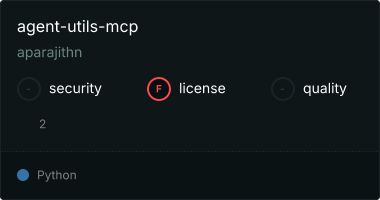
Copy to your README.md:
Score Badge

Copy to your README.md:
Latest Blog Posts
- Who's Calling? MCP Hosts Are an Identity Blind Spot (And the Spec Knows It)By Om-Shree-0709 on .mcpAgent IdentityOAuth 2.1
- Your AI Chatbot Just Exposed Your CEO's Salary to an InternBy Om-Shree-0709 on .Agent IdentityMCP SecurityOAuth Delegation
- Why MCP Servers Need Execution Sandboxing (And Why Your Current Stack Isn't Enough)By Om-Shree-0709 on .Agentic AiPrompt InjectionWebAssembly
MCP directory API
We provide all the information about MCP servers via our MCP API.
curl -X GET 'https://glama.ai/api/mcp/v1/servers/aparajithn/agent-utils-mcp'
If you have feedback or need assistance with the MCP directory API, please join our Discord server