

A
licenseA
qualityC
maintenanceMakes Claude a real operator for Adobe Premiere Pro 2025, providing 59 tools to control projects, timelines, media, exports, and even create cinematic intros with beat detection and style presets.
59
MIT

Provides tools for AI voiceover generation using the ElevenLabs API, including voice selection, speech synthesis, and voice-to-caption generation directly within Premiere Pro.
Includes specialized tools for creating TikTok-style captions and graphic elements within Premiere Pro sequences.
Enables exporting video sequences to the Final Cut Pro XML format to facilitate project interchange between different editing platforms.
Click on "Deploy Server".
Wait a few minutes for the server to deploy. Once ready, it will show a "Started" state.
In the chat, type @ followed by the MCP server name and your instructions, e.g., "@Premiere Pro MCP Server Generate TikTok style captions for the active sequence."
That's it! The server will respond to your query, and you can continue using it as needed.
Here is a step-by-step guide with screenshots.
Control Adobe Premiere Pro from Claude/Codex using the Model Context Protocol. 170+ tools for editing, effects, captions, export, and more.
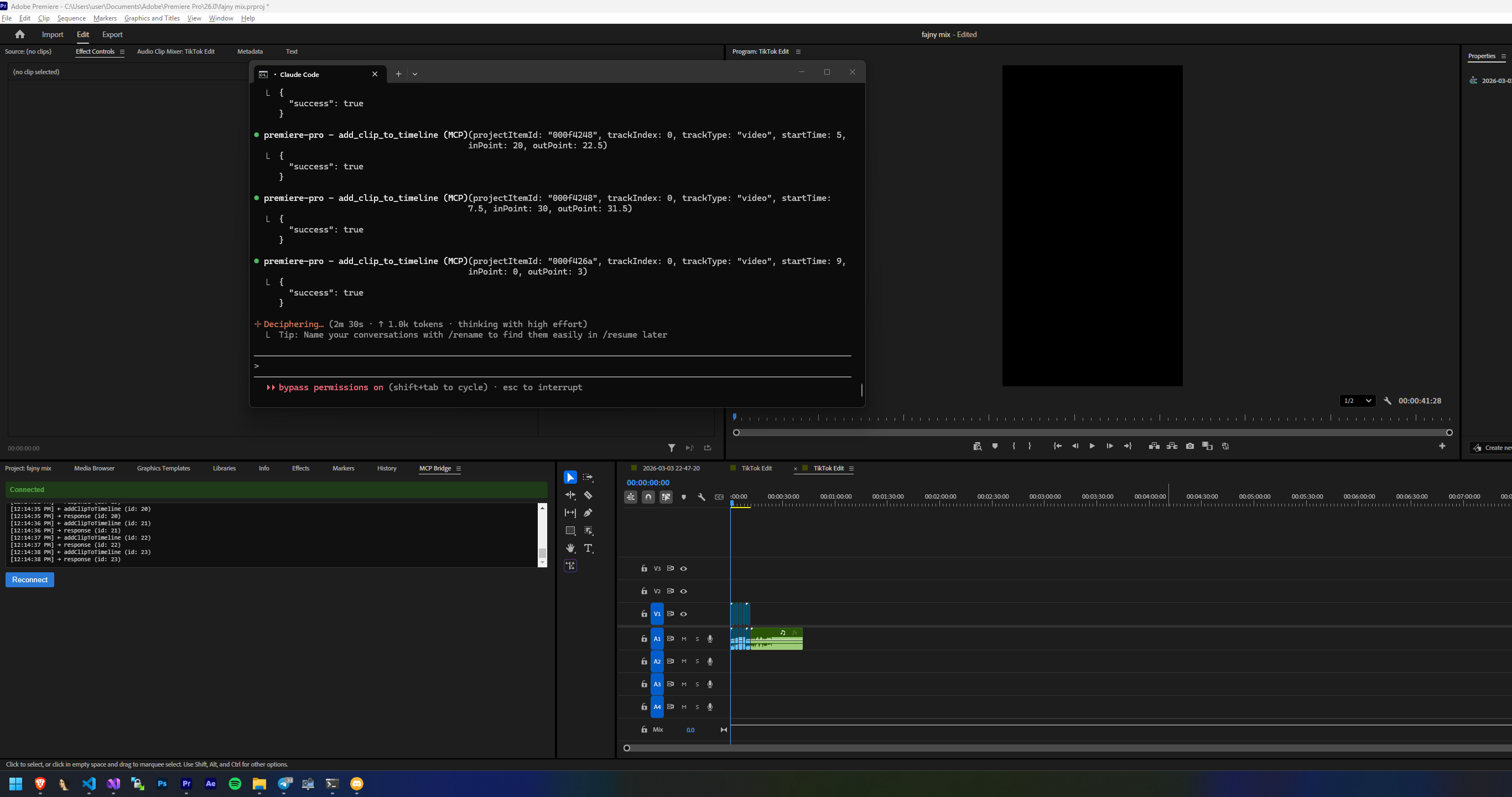
LLM ←→ MCP Server (Node.js) ←→ WebSocket ←→ CEP Panel ←→ ExtendScript ←→ Premiere ProRelated MCP server: Premiere Pro MCP Server
Adobe Premiere Pro 2023+ (tested on 2026)
Node.js 18+
Claude Desktop/Code or Codex
Windows
git clone https://github.com/antipaster/Adobe-Premiere-Pro-MCP.git
cd Adobe-Premiere-Pro-MCP
install.bat
The installer will:
Enable unsigned CEP extensions (debug mode)
Symlink the CEP panel into Premiere Pro's extensions folder
Install dependencies and build
Configure Claude Desktop and Claude Code or Codex
Open Premiere Pro
Go to Window > Extensions > MCP Bridge
The panel should show "Connected"
Start Claude/Codex and use Premiere Pro tools
Copy config.example.json to config.json and edit:
{
  "port": 8097,
  "elevenlabs": {
    "api_key": "your-elevenlabs-api-key",
    "default_voice_id": "21m00Tcm4TlvDq8ikWAM",
    "default_model": "eleven_multilingual_v2"
  }
}
Setting | Description | Default |
| WebSocket port for CEP bridge |
|
| ElevenLabs API key for AI voiceover |
|
| Default voice (Rachel) |
|
| TTS model |
|
open_project save_project close_project import_media create_bin find_project_items get_project_info get_project_items create_proxy attach_proxy toggle_proxy_mode create_sub_clip relink_media refresh_media import_ae_comps import_sequences flush_cache delete_project_items consolidate_duplicates set_project_settings set_project_item_in_out clear_project_item_in_out rename_project_item get_project_item_info get_project_item_type_info set_override_frame_rate set_override_pixel_aspect_ratio move_project_item
create_sequence create_sequence_from_clip clone_sequence delete_sequence set_active_sequence get_active_sequence get_sequences get_sequence_settings add_tracks remove_track rename_track get_track_info set_track_locked set_track_muted create_subsequence nest_clips auto_reframe_sequence scene_edit_detection set_sequence_in_out clear_sequence_in_out get_work_area set_work_area deselect_all
add_clip_to_timeline overwrite_clip_to_timeline remove_clip move_clip_to_track set_clip_position set_clip_in_out set_clip_speed razor_clip razor_all_tracks ripple_delete enable_disable_clip set_timeline_clip_label rename_clip link_clips unlink_clip duplicate_clip freeze_frame slip_clip slide_clip get_clip_info get_clip_speed get_selection select_clips set_scale_to_frame_size
apply_effect remove_effect get_clip_effects set_effect_enabled get_effect_property set_effect_property get_video_effects_list get_audio_effects_list apply_transition remove_transition get_video_transitions_list get_audio_transitions_list set_default_transition add_keyframe remove_keyframe get_keyframes set_keyframe_interpolation get_clip_transform set_clip_transform
add_marker get_markers remove_marker clear_all_markers update_marker add_clip_marker get_clip_markers add_project_item_marker
set_clip_volume get_clip_volume set_track_volume set_track_pan solo_track get_audio_channel_mapping set_audio_channel_mapping apply_audio_crossfade add_audio_keyframe set_clip_mute
export_sequence export_direct export_frame export_aaf export_omf export_edl export_final_cut_xml export_captions get_encoder_presets
add_text_graphic add_tiktok_caption add_caption_sequence style_text_graphic get_available_mogrts import_mogrt add_mogrt_to_timeline get_mogrt_properties set_mogrt_property add_color_matte add_black_video add_bars_and_tone add_caption_track get_caption_tracks get_captions add_caption update_caption remove_caption
elevenlabs_list_voices elevenlabs_generate_speech elevenlabs_generate_captions_voice
play stop step_forward step_backward go_to_start go_to_end go_to_next_edit go_to_previous_edit go_to_in_point go_to_out_point set_playhead get_playhead set_workspace open_in_source_monitor get_source_monitor_clip set_source_in_out execute_extendscript execute_qe_script get_app_version undo redo get_connection_status
get_clip_metadata set_clip_metadata get_file_metadata get_xmp_metadata set_xmp_metadata get_clip_color_space set_clip_description set_project_item_label set_label_defaults set_scale_to_frame_size
premiere-pro-mcp/
├── src/                    # MCP server (TypeScript)
│   ├── server.ts           # Entry point
│   ├── bridge.ts           # WebSocket bridge to CEP
│   ├── config.ts           # Config loader
│   └── tools/              # 14 tool modules
│       ├── index.ts
│       ├── project.ts      # Project management
│       ├── sequence.ts     # Sequence operations
│       ├── timeline.ts     # Timeline editing
│       ├── effects.ts      # Effects & transitions
│       ├── markers.ts      # Markers
│       ├── audio.ts        # Audio controls
│       ├── export.ts       # Export & render
│       ├── metadata.ts     # Metadata & XMP
│       ├── captions.ts     # Captions & subtitles
│       ├── graphics.ts     # Graphics, MOGRTs, text
│       ├── playback.ts     # Playback & navigation
│       ├── scripting.ts    # Raw ExtendScript & QE
│       ├── ai.ts           # ElevenLabs TTS
│       └── connection.ts   # Connection status
├── cep/                    # CEP extension (runs inside Premiere)
│   ├── CSXS/manifest.xml   # Extension manifest
│   ├── index.html          # Panel UI
│   ├── js/
│   │   ├── CSInterface.js  # Adobe CSInterface v11
│   │   └── main.js         # WebSocket client + JSX loader
│   └── jsx/                # ExtendScript modules
│       ├── premiere.jsx    # Entry point
│       ├── utils.jsx       # Shared helpers
│       ├── project.jsx     # Project functions
│       ├── sequence.jsx    # Sequence functions
│       ├── timeline.jsx    # Timeline functions
│       ├── effects.jsx     # Effects functions
│       ├── markers.jsx     # Marker functions
│       ├── audio.jsx       # Audio functions
│       ├── export.jsx      # Export functions
│       ├── metadata.jsx    # Metadata functions
│       ├── captions.jsx    # Caption functions
│       ├── graphics.jsx    # Graphics functions
│       └── playback.jsx    # Playback functions
├── config.json             # Configuration
├── install.bat             # Auto-installer
├── package.json
└── tsconfig.jsonMIT
Add an adjustment layer to a video track
| Name | Required | Description | Default |
|---|---|---|---|
| name | No | Name for the adjustment layer | |
| duration | Yes | Duration in seconds | |
| startTime | Yes | Start time in seconds | |
| trackIndex | Yes | Video track index |
Does the description disclose side effects, auth requirements, rate limits, or destructive behavior?
No annotations are provided, so the description carries the full burden of behavioral disclosure, and it offers none: nothing about required project/sequence state, whether the track must already exist or be unlocked, whether the layer is placed at the playhead or at startTime, whether the operation is undoable, or what is returned. Only the 'video track' constraint is conveyed.
Agents need to know what a tool does to the world before calling it. Descriptions should go beyond structured annotations to explain consequences.
Is the description appropriately sized, front-loaded, and free of redundancy?
It is a single front-loaded sentence with no filler, which is structurally clean. Its brevity, however, edges into under-specification rather than genuine economy given the density of adjacent sibling tools.
Shorter descriptions cost fewer tokens and are easier for agents to parse. Every sentence should earn its place.
Given the tool's complexity, does the description cover enough for an agent to succeed on first attempt?
For a mutation tool with zero annotation coverage and no output schema, the description should say at minimum what state is required and what the call returns or affects. Neither is present, leaving an agent unable to predict side effects or failure modes before invoking it.
Complex tools with many parameters or behaviors need more documentation. Simple tools need less. This dimension scales expectations accordingly.
Does the description clarify parameter syntax, constraints, interactions, or defaults beyond what the schema provides?
Schema description coverage is 100%, with every parameter (name, duration, startTime, trackIndex) documented including units in seconds, so the schema does the heavy lifting. The description adds only the small clarification that trackIndex refers to a video track; a baseline 3 is appropriate.
Input schemas describe structure but not intent. Descriptions should explain non-obvious parameter relationships and valid value ranges.
Does the description clearly state what the tool does and how it differs from similar tools?
The description states a specific verb and resource ('Add an adjustment layer') plus the target container ('to a video track'), so the basic action is unambiguous. It does not, however, distinguish this from the cluster of sibling creation tools such as add_color_matte, add_black_video, add_bars_and_tone, or apply_effect, which an agent must choose between.
Agents choose between tools based on descriptions. A clear purpose with a specific verb and resource helps agents select the right tool.
Does the description explain when to use this tool, when not to, or what alternatives exist?
There is no guidance on when to use an adjustment layer versus a color matte, an applied effect, or a text graphic, and no stated prerequisites such as an active sequence, an existing video track, or where on the timeline the layer lands. The agent must infer all of this from sibling names alone.
Agents often have multiple tools that could apply. Explicit usage guidance like "use X instead of Y when Z" prevents misuse.
Add an audio volume keyframe to a clip at a specific time
| Name | Required | Description | Default |
|---|---|---|---|
| time | Yes | Time in seconds relative to clip start | |
| volumeDb | Yes | Volume in decibels at this keyframe | |
| clipIndex | Yes | Clip index | |
| trackIndex | Yes | Audio track index |
Does the description disclose side effects, auth requirements, rate limits, or destructive behavior?
No annotations are provided, so the description carries the full burden of behavioral disclosure. It says only that a keyframe is added, without explaining duplicate-keyframe behavior, required permissions, whether changes are undoable, or what the response contains.
Agents need to know what a tool does to the world before calling it. Descriptions should go beyond structured annotations to explain consequences.
Is the description appropriately sized, front-loaded, and free of redundancy?
It is a single front-loaded sentence with no filler. The action, target, and key input concept are all expressed efficiently.
Shorter descriptions cost fewer tokens and are easier for agents to parse. Every sentence should earn its place.
Given the tool's complexity, does the description cover enough for an agent to succeed on first attempt?
For a simple four-parameter mutation tool with fully documented schema fields, the description is adequate to identify the operation. However, with no annotations or output schema, it should say more about mutation behavior and alternatives.
Complex tools with many parameters or behaviors need more documentation. Simple tools need less. This dimension scales expectations accordingly.
Does the description clarify parameter syntax, constraints, interactions, or defaults beyond what the schema provides?
Schema description coverage is 100%, so all four parameters are already documented in the schema. The description reinforces that the operation targets audio volume at a specific time but adds no format, range, or edge-case semantics beyond that.
Input schemas describe structure but not intent. Descriptions should explain non-obvious parameter relationships and valid value ranges.
Does the description clearly state what the tool does and how it differs from similar tools?
The description states a specific verb and resource: adding an audio volume keyframe to a clip at a given time. It is clear what the tool does, though it does not explicitly differentiate itself from sibling tools such as add_keyframe or set_clip_volume.
Agents choose between tools based on descriptions. A clear purpose with a specific verb and resource helps agents select the right tool.
Does the description explain when to use this tool, when not to, or what alternatives exist?
The description provides no guidance on when to use this tool instead of alternatives like add_keyframe or set_clip_volume. It implies usage from the name and purpose but includes no exclusions or routing advice.
Agents often have multiple tools that could apply. Explicit usage guidance like "use X instead of Y when Z" prevents misuse.
Add color bars and tone to the timeline
| Name | Required | Description | Default |
|---|---|---|---|
| duration | Yes | Duration in seconds | |
| startTime | Yes | Start time in seconds | |
| trackIndex | Yes | Video track index |
Does the description disclose side effects, auth requirements, rate limits, or destructive behavior?
No annotations are provided, so the description carries the full disclosure burden, and it discloses nothing beyond the action. It does not say whether the bars land at the playhead or the given startTime, whether existing material is overwritten or rippled, whether audio tone requires an audio track, or whether the operation is undoable. For a timeline-mutating tool with zero annotation coverage this is a real gap.
Agents need to know what a tool does to the world before calling it. Descriptions should go beyond structured annotations to explain consequences.
Is the description appropriately sized, front-loaded, and free of redundancy?
A single tight sentence with no filler, and the action is front-loaded. It is efficient, though efficiency here partly reflects under-specification rather than disciplined editing.
Shorter descriptions cost fewer tokens and are easier for agents to parse. Every sentence should earn its place.
Given the tool's complexity, does the description cover enough for an agent to succeed on first attempt?
Three fully-documented required parameters and no output schema make this a simple tool whose structural fields cover the mechanics. What is missing is the behavioral layer — overwrite semantics and track-type requirements — which matters for an unannotated mutation on a live timeline.
Complex tools with many parameters or behaviors need more documentation. Simple tools need less. This dimension scales expectations accordingly.
Does the description clarify parameter syntax, constraints, interactions, or defaults beyond what the schema provides?
Schema description coverage is 100% — units (seconds) and the meaning of trackIndex are already documented in the schema — so the baseline is 3. The description adds no constraint such as track-type validity or start-time behavior, so it earns nothing above baseline.
Input schemas describe structure but not intent. Descriptions should explain non-obvious parameter relationships and valid value ranges.
Does the description clearly state what the tool does and how it differs from similar tools?
Specific verb (add) plus a specific resource (color bars and tone) and destination (the timeline). This distinguishes it from nearby siblings such as add_color_matte, add_black_video, and add_universal_counting_leader, though it never names those alternatives.
Agents choose between tools based on descriptions. A clear purpose with a specific verb and resource helps agents select the right tool.
Does the description explain when to use this tool, when not to, or what alternatives exist?
No indication of when this should be used versus the other synthetic-media generators in the sibling list, no prerequisites (active sequence required?), and no exclusions. The agent must infer everything about selection context.
Agents often have multiple tools that could apply. Explicit usage guidance like "use X instead of Y when Z" prevents misuse.
Add black video (slug) to the timeline
| Name | Required | Description | Default |
|---|---|---|---|
| duration | Yes | Duration in seconds | |
| startTime | Yes | Start time in seconds | |
| trackIndex | Yes | Video track index |
Does the description disclose side effects, auth requirements, rate limits, or destructive behavior?
With no annotations, the description carries the full behavioral burden. It doesn't say whether the clip is inserted or overwritten, whether it requires an active sequence or unlocked track, what default properties the black video gets, or what is returned. 'Add' implies mutation but nothing about side effects is disclosed.
Agents need to know what a tool does to the world before calling it. Descriptions should go beyond structured annotations to explain consequences.
Is the description appropriately sized, front-loaded, and free of redundancy?
A single short sentence with the verb and target front-loaded; nothing is padded. It is arguably too terse rather than verbose, but every word present earns its place.
Shorter descriptions cost fewer tokens and are easier for agents to parse. Every sentence should earn its place.
Given the tool's complexity, does the description cover enough for an agent to succeed on first attempt?
For a mutation tool with no annotations, no output schema, and three positional parameters, the description leaves key questions open: insertion vs overwrite behavior, required context (active sequence, track state), and the resulting clip's defaults. It is too thin given the complexity.
Complex tools with many parameters or behaviors need more documentation. Simple tools need less. This dimension scales expectations accordingly.
Does the description clarify parameter syntax, constraints, interactions, or defaults beyond what the schema provides?
Schema description coverage is 100% — duration, startTime and trackIndex are each documented in the schema. The description adds nothing about parameter meaning, so the baseline 3 applies.
Input schemas describe structure but not intent. Descriptions should explain non-obvious parameter relationships and valid value ranges.
Does the description clearly state what the tool does and how it differs from similar tools?
Names a specific verb and resource ('Add black video ... to the timeline'), so the action is unambiguous. It doesn't distinguish itself from similarly-generative siblings such as add_color_matte or add_adjustment_layer, and the parenthetical '(slug)' is unexplained jargon that adds no clarity.
Agents choose between tools based on descriptions. A clear purpose with a specific verb and resource helps agents select the right tool.
Does the description explain when to use this tool, when not to, or what alternatives exist?
There is no statement of when to use this versus add_color_matte, add_bars_and_tone, or add_clip_to_timeline, and no prerequisites (e.g. an active sequence must exist). The agent must infer the use case from the name alone.
Agents often have multiple tools that could apply. Explicit usage guidance like "use X instead of Y when Z" prevents misuse.
Add a caption/subtitle segment to a caption track
| Name | Required | Description | Default |
|---|---|---|---|
| text | Yes | Caption text content | |
| endTime | Yes | End time in seconds | |
| startTime | Yes | Start time in seconds | |
| trackIndex | No | Caption track index (default: 0) |
Does the description disclose side effects, auth requirements, rate limits, or destructive behavior?
With no annotations, the description carries the full behavioral burden for a mutation tool. It does not say whether the target track must exist, how overlapping or out-of-order time ranges are handled, whether the change is undoable, or what the response contains.
Agents need to know what a tool does to the world before calling it. Descriptions should go beyond structured annotations to explain consequences.
Is the description appropriately sized, front-loaded, and free of redundancy?
A single efficient sentence with no filler and the action front-loaded. However, that brevity is achieved by omitting useful context rather than by tight writing.
Shorter descriptions cost fewer tokens and are easier for agents to parse. Every sentence should earn its place.
Given the tool's complexity, does the description cover enough for an agent to succeed on first attempt?
For a 4-parameter mutation tool with no annotations and no output schema, the description is too thin. It omits prerequisites (existing caption track), timing/ordering constraints, and any behavioral notes an agent would need to call it safely.
Complex tools with many parameters or behaviors need more documentation. Simple tools need less. This dimension scales expectations accordingly.
Does the description clarify parameter syntax, constraints, interactions, or defaults beyond what the schema provides?
Schema description coverage is 100%, so all four parameters (startTime, endTime, text, trackIndex) are already documented in the schema including units and the default track index. The description adds no meaning beyond those field-level descriptions, making the baseline 3 appropriate.
Input schemas describe structure but not intent. Descriptions should explain non-obvious parameter relationships and valid value ranges.
Does the description clearly state what the tool does and how it differs from similar tools?
The description uses a specific verb+resource pair ('Add a caption/subtitle segment to a caption track'), which clearly separates it from siblings like update_caption, remove_caption, and add_caption_track. It just stops short of explicitly naming how it differs from those siblings.
Agents choose between tools based on descriptions. A clear purpose with a specific verb and resource helps agents select the right tool.
Does the description explain when to use this tool, when not to, or what alternatives exist?
There is no statement of when to use this versus update_caption or add_caption_track, and no prerequisites are given. An agent must infer that a caption track must already exist before a segment can be added.
Agents often have multiple tools that could apply. Explicit usage guidance like "use X instead of Y when Z" prevents misuse.
Add multiple timed text captions in sequence — perfect for word-by-word TikTok-style captions, lyrics sync, or subtitle-like overlays. Each caption has its own text, start time, and duration.
| Name | Required | Description | Default |
|---|---|---|---|
| scale | No | Scale percentage for all captions (default 100) | |
| captions | Yes | Array of caption objects with text, start time, and duration | |
| template | No | MOGRT template style (default: bold). Options: basic, bold, classic, modern, film, lower_third | |
| positionX | No | X position for all captions (0-1, default 0.5) | |
| positionY | No | Y position for all captions (0-1, default 0.75 = lower third area) | |
| trackIndex | Yes | Video track index for all captions |
Does the description disclose side effects, auth requirements, rate limits, or destructive behavior?
No annotations are provided, so the description carries the full behavioral burden. It says nothing about whether a caption track must already exist for trackIndex, whether existing captions are overwritten, whether the operation is undoable, or what is returned — all material for a mutation tool that adds timeline items.
Agents need to know what a tool does to the world before calling it. Descriptions should go beyond structured annotations to explain consequences.
Is the description appropriately sized, front-loaded, and free of redundancy?
Two sentences, front-loaded with the operation and followed by the caption structure. The marketing-flavored 'perfect for' clause is mild filler but does convey legitimate use cases, so little is wasted.
Shorter descriptions cost fewer tokens and are easier for agents to parse. Every sentence should earn its place.
Given the tool's complexity, does the description cover enough for an agent to succeed on first attempt?
The schema fully documents the six parameters and there is no output schema, so the description needn't explain return values. But for a timeline-mutating batch tool with zero annotations, the absence of any note on caption-track prerequisites or overwrite behavior leaves a real gap.
Complex tools with many parameters or behaviors need more documentation. Simple tools need less. This dimension scales expectations accordingly.
Does the description clarify parameter syntax, constraints, interactions, or defaults beyond what the schema provides?
Schema description coverage is 100%, so all six parameters (including defaults for scale, template, positionX/Y) are already documented. The description only restates that each caption has text, start, and duration, adding no semantics beyond the schema.
Input schemas describe structure but not intent. Descriptions should explain non-obvious parameter relationships and valid value ranges.
Does the description clearly state what the tool does and how it differs from similar tools?
States a specific verb and resource ('Add multiple timed text captions in sequence') and clarifies the batch nature versus a single-caption call. It does not, however, distinguish itself from close siblings like add_caption or add_tiktok_caption, even though it explicitly invokes the 'TikTok-style captions' use case that the latter presumably owns.
Agents choose between tools based on descriptions. A clear purpose with a specific verb and resource helps agents select the right tool.
Does the description explain when to use this tool, when not to, or what alternatives exist?
Use cases (word-by-word captions, lyrics sync, subtitle overlays) imply when the tool fits, but there is no explicit when-not guidance and no named alternative for single captions or for the TikTok-specific sibling. The agent must infer routing from the examples.
Agents often have multiple tools that could apply. Explicit usage guidance like "use X instead of Y when Z" prevents misuse.
Add a new caption/subtitle track to the active sequence
| Name | Required | Description | Default |
|---|---|---|---|
| format | No | Caption format (default: open/burned-in) |
Does the description disclose side effects, auth requirements, rate limits, or destructive behavior?
No annotations are provided, so the description carries the full behavioral burden. It reveals only that the target is the active sequence; it does not address what happens if the track already exists, whether an active sequence is required, failure behavior, permissions, or any side effects of adding a track.
Agents need to know what a tool does to the world before calling it. Descriptions should go beyond structured annotations to explain consequences.
Is the description appropriately sized, front-loaded, and free of redundancy?
The description is a single front-loaded sentence with no filler. It states the action and target immediately and wastes no words.
Shorter descriptions cost fewer tokens and are easier for agents to parse. Every sentence should earn its place.
Given the tool's complexity, does the description cover enough for an agent to succeed on first attempt?
The tool is a simple mutation with one optional enum parameter and no output schema. The description adequately states the main action, but without annotations it should do more to explain usage distinctions and behavioral expectations. It is minimum viable rather than complete.
Complex tools with many parameters or behaviors need more documentation. Simple tools need less. This dimension scales expectations accordingly.
Does the description clarify parameter syntax, constraints, interactions, or defaults beyond what the schema provides?
Schema description coverage is 100%, so the single optional format parameter and its enum values are already fully documented in the schema. The description adds no additional parameter semantics, which is consistent with the baseline 3 under high schema coverage.
Input schemas describe structure but not intent. Descriptions should explain non-obvious parameter relationships and valid value ranges.
Does the description clearly state what the tool does and how it differs from similar tools?
The description gives a specific verb and resource: 'Add a new caption/subtitle track' and scopes it to 'the active sequence.' It is clear what the tool does, though it does not explicitly distinguish itself from sibling tools like add_caption or add_caption_sequence.
Agents choose between tools based on descriptions. A clear purpose with a specific verb and resource helps agents select the right tool.
Does the description explain when to use this tool, when not to, or what alternatives exist?
The description states the action but gives no guidance on when to choose it over related tools such as add_caption, import_captions, or add_caption_sequence. There are no exclusions or prerequisite notes beyond the implied requirement of an active sequence.
Agents often have multiple tools that could apply. Explicit usage guidance like "use X instead of Y when Z" prevents misuse.
Add a marker to a specific clip on the timeline
| Name | Required | Description | Default |
|---|---|---|---|
| name | No | Marker name | |
| time | Yes | Time in seconds relative to clip start | |
| color | No | Marker color | |
| comment | No | Marker comment | |
| clipIndex | Yes | Clip index | |
| trackType | Yes | Track type | |
| trackIndex | Yes | Track index |
Does the description disclose side effects, auth requirements, rate limits, or destructive behavior?
No annotations are provided, so the description carries the full behavioral burden. It identifies the operation as an addition but does not disclose permissions, whether the marker persists or is undoable, index expectations, or what happens if the clip does not exist.
Agents need to know what a tool does to the world before calling it. Descriptions should go beyond structured annotations to explain consequences.
Is the description appropriately sized, front-loaded, and free of redundancy?
It is a single front-loaded sentence with no wasted words. The action and target are immediately clear even if further detail is absent.
Shorter descriptions cost fewer tokens and are easier for agents to parse. Every sentence should earn its place.
Given the tool's complexity, does the description cover enough for an agent to succeed on first attempt?
For a mutation tool with seven parameters, no annotations, and no output schema, the description is too thin. It does not explain index conventions, required permissions, return behavior, or how it relates to the other marker tools in the sibling list.
Complex tools with many parameters or behaviors need more documentation. Simple tools need less. This dimension scales expectations accordingly.
Does the description clarify parameter syntax, constraints, interactions, or defaults beyond what the schema provides?
Schema description coverage is 100%, so all seven parameters including time, trackType, trackIndex, and clipIndex are already documented in the schema. The description adds no additional meaning beyond that structured documentation.
Input schemas describe structure but not intent. Descriptions should explain non-obvious parameter relationships and valid value ranges.
Does the description clearly state what the tool does and how it differs from similar tools?
The description states a specific verb and resource: 'Add a marker to a specific clip on the timeline.' This distinguishes it from sequence-level or project-item marker tools by scoping the marker to a clip, but it does not explicitly name the sibling alternatives like add_marker or add_project_item_marker.
Agents choose between tools based on descriptions. A clear purpose with a specific verb and resource helps agents select the right tool.
Does the description explain when to use this tool, when not to, or what alternatives exist?
There is no guidance on when to use this tool versus add_marker, add_project_item_marker, or update_marker. The clip-specific scope is implied by 'specific clip,' but no conditions, exclusions, or alternatives are stated.
Agents often have multiple tools that could apply. Explicit usage guidance like "use X instead of Y when Z" prevents misuse.
Add a project item (clip) to the timeline via insert edit
| Name | Required | Description | Default |
|---|---|---|---|
| inPoint | No | Source in-point in seconds | |
| outPoint | No | Source out-point in seconds | |
| startTime | Yes | Start time in seconds on the timeline | |
| trackType | No | Track type (default: video) | |
| trackIndex | Yes | Track index (0-based) | |
| projectItemId | Yes | The nodeId of the project item to add |
Does the description disclose side effects, auth requirements, rate limits, or destructive behavior?
No annotations are provided, so the description carries the full burden, and it discloses almost nothing. "Insert edit" hints at ripple behavior to an expert, but the description never states that existing clips are pushed downstream, what happens on failure, or whether the operation requires an open sequence.
Agents need to know what a tool does to the world before calling it. Descriptions should go beyond structured annotations to explain consequences.
Is the description appropriately sized, front-loaded, and free of redundancy?
A single, front-loaded sentence with no filler, so nothing is wasted. The terseness borders on under-specification rather than excess, but structurally it is efficient.
Shorter descriptions cost fewer tokens and are easier for agents to parse. Every sentence should earn its place.
Given the tool's complexity, does the description cover enough for an agent to succeed on first attempt?
This is a mutation tool with no annotations and no output schema, and the description supplies no behavioral or contextual detail. Even though the parameters are fully documented in the schema, an agent still lacks information on ripple semantics, required preconditions, and error behavior.
Complex tools with many parameters or behaviors need more documentation. Simple tools need less. This dimension scales expectations accordingly.
Does the description clarify parameter syntax, constraints, interactions, or defaults beyond what the schema provides?
Schema description coverage is 100%, including per-field descriptions and an enum for trackType, so the schema already documents all six parameters. The description adds no additional meaning (e.g., how inPoint/outPoint interact with startTime), which is the baseline-3 case.
Input schemas describe structure but not intent. Descriptions should explain non-obvious parameter relationships and valid value ranges.
Does the description clearly state what the tool does and how it differs from similar tools?
States a specific verb and resource ("Add a project item (clip) to the timeline") and adds an edit mode ("via insert edit") that implicitly distinguishes it from the sibling overwrite_clip_to_timeline. It falls short of a 5 because the insert-vs-overwrite distinction is only implied through jargon rather than stated as a contrast.
Agents choose between tools based on descriptions. A clear purpose with a specific verb and resource helps agents select the right tool.
Does the description explain when to use this tool, when not to, or what alternatives exist?
There is no explicit when-to-use or when-not-to-use guidance. The description never names overwrite_clip_to_timeline or any other alternative, nor does it state prerequisites such as needing an active sequence or the clip already existing in the project.
Agents often have multiple tools that could apply. Explicit usage guidance like "use X instead of Y when Z" prevents misuse.
Add a color matte (solid color) to the timeline
| Name | Required | Description | Default |
|---|---|---|---|
| name | No | Name for the color matte | |
| color | No | Color as hex (e.g. '#000000' for black). Default: black | |
| duration | Yes | Duration in seconds | |
| startTime | Yes | Start time in seconds | |
| trackIndex | Yes | Video track index |
Does the description disclose side effects, auth requirements, rate limits, or destructive behavior?
With no annotations, the description carries the full burden and says nothing about mutation effects: whether the item is created at the playhead or at startTime, whether it can be undone, whether it requires an open sequence, or what it returns. Only the bare action is disclosed.
Agents need to know what a tool does to the world before calling it. Descriptions should go beyond structured annotations to explain consequences.
Is the description appropriately sized, front-loaded, and free of redundancy?
A single front-loaded sentence with no waste, but its brevity comes at the cost of the missing context rather than through efficient compression. Adequate rather than well-crafted.
Shorter descriptions cost fewer tokens and are easier for agents to parse. Every sentence should earn its place.
Given the tool's complexity, does the description cover enough for an agent to succeed on first attempt?
For a mutation tool with five parameters, no annotations, and no output schema, the definition should at least state that an active sequence is required and how placement works. As written, an agent must infer the entire operational context.
Complex tools with many parameters or behaviors need more documentation. Simple tools need less. This dimension scales expectations accordingly.
Does the description clarify parameter syntax, constraints, interactions, or defaults beyond what the schema provides?
Schema description coverage is 100%, so every parameter (name, color hex with default black, duration, startTime, trackIndex) is already documented in the schema. The description adds nothing about placement, defaults, or constraints, which is acceptable at baseline given the schema's completeness.
Input schemas describe structure but not intent. Descriptions should explain non-obvious parameter relationships and valid value ranges.
Does the description clearly state what the tool does and how it differs from similar tools?
Specific verb plus resource ('Add a color matte') with a clarifying gloss ('solid color') and the target ('timeline'). It stops short of distinguishing itself from near-siblings like add_black_video or add_adjustment_layer, which also create generated timeline items.
Agents choose between tools based on descriptions. A clear purpose with a specific verb and resource helps agents select the right tool.
Does the description explain when to use this tool, when not to, or what alternatives exist?
No indication of when to use this versus add_black_video (a black matte is a color matte), add_adjustment_layer, or add_bars_and_tone. No prerequisites such as requiring an active sequence are stated.
Agents often have multiple tools that could apply. Explicit usage guidance like "use X instead of Y when Z" prevents misuse.
Add a keyframe to an effect property at a specific time
| Name | Required | Description | Default |
|---|---|---|---|
| time | Yes | Time in seconds (relative to clip start) | |
| value | Yes | Value at this keyframe | |
| clipIndex | Yes | Clip index | |
| trackType | Yes | Track type | |
| trackIndex | Yes | Track index | |
| effectIndex | Yes | Effect/component index | |
| propertyName | Yes | Property display name |
Does the description disclose side effects, auth requirements, rate limits, or destructive behavior?
With no annotations provided, the description carries the full behavioral burden. It implies a mutation but does not disclose whether an existing keyframe at the same time is overwritten, what the default interpolation is, what permissions are required, or what happens if the property is not keyframable.
Agents need to know what a tool does to the world before calling it. Descriptions should go beyond structured annotations to explain consequences.
Is the description appropriately sized, front-loaded, and free of redundancy?
The description is a single front-loaded sentence with no wasted words. It states the core action and scope immediately, though the resulting brevity leaves behavioral gaps that are better assessed under contextual completeness.
Shorter descriptions cost fewer tokens and are easier for agents to parse. Every sentence should earn its place.
Given the tool's complexity, does the description cover enough for an agent to succeed on first attempt?
For a seven-parameter mutation tool with no annotations and no output schema, the description is too thin. It does not explain keyframe replacement behavior, interpolation defaults, error conditions, or what the tool returns, leaving the agent without enough context to call it confidently.
Complex tools with many parameters or behaviors need more documentation. Simple tools need less. This dimension scales expectations accordingly.
Does the description clarify parameter syntax, constraints, interactions, or defaults beyond what the schema provides?
Schema description coverage is 100%, so the schema already documents all seven parameters, including time units and track type enum. The description only restates the idea of a specific time and adds no syntax or meaning beyond the schema, making the baseline 3 appropriate.
Input schemas describe structure but not intent. Descriptions should explain non-obvious parameter relationships and valid value ranges.
Does the description clearly state what the tool does and how it differs from similar tools?
The description uses a specific verb and resource: it adds a keyframe to an effect property at a given time. This clearly distinguishes it from add_audio_keyframe, but it does not explicitly name or differentiate against siblings like get_keyframes, remove_keyframe, or set_keyframe_interpolation.
Agents choose between tools based on descriptions. A clear purpose with a specific verb and resource helps agents select the right tool.
Does the description explain when to use this tool, when not to, or what alternatives exist?
There is no guidance on when to use this tool versus alternatives such as add_audio_keyframe, set_effect_property, or set_keyframe_interpolation. It also omits prerequisites, such as whether the effect property must already exist or be keyframable.
Agents often have multiple tools that could apply. Explicit usage guidance like "use X instead of Y when Z" prevents misuse.
Add a marker to the active sequence
| Name | Required | Description | Default |
|---|---|---|---|
| url | No | URL for webLink markers | |
| name | No | Marker name | |
| time | Yes | Time in seconds to place the marker | |
| color | No | Marker color (default: green) | |
| comment | No | Marker comment/notes | |
| duration | No | Marker duration in seconds (0 for point marker) | |
| markerType | No | Marker type (default: comment) | |
| frameTarget | No | Frame target for webLink markers |
Does the description disclose side effects, auth requirements, rate limits, or destructive behavior?
With no annotations, the description carries the full behavioral burden and does very little: it doesn't state that this mutates project state, that it fails without an active sequence, whether a time outside sequence bounds is rejected, or what is returned. Only the 'active sequence' target is disclosed.
Agents need to know what a tool does to the world before calling it. Descriptions should go beyond structured annotations to explain consequences.
Is the description appropriately sized, front-loaded, and free of redundancy?
A single front-loaded sentence with no waste, appropriately sized for a simple create operation. It is efficient but borders on under-specified rather than maximally informative.
Shorter descriptions cost fewer tokens and are easier for agents to parse. Every sentence should earn its place.
Given the tool's complexity, does the description cover enough for an agent to succeed on first attempt?
The full parameter schema compensates for the lack of parameter detail, and there is no output schema to explain. However, for a mutation tool with eight parameters and zero annotation coverage, the description leaves behavioral expectations (errors, active-sequence requirement, effect on the timeline) unaddressed.
Complex tools with many parameters or behaviors need more documentation. Simple tools need less. This dimension scales expectations accordingly.
Does the description clarify parameter syntax, constraints, interactions, or defaults beyond what the schema provides?
Schema description coverage is 100% and all eight parameters, including the two enums and the markerType-dependent url/frameTarget fields, are documented in the schema itself. The description adds no parameter meaning beyond that, so the baseline 3 applies.
Input schemas describe structure but not intent. Descriptions should explain non-obvious parameter relationships and valid value ranges.
Does the description clearly state what the tool does and how it differs from similar tools?
States a specific verb and resource ("Add a marker") plus scope ("to the active sequence"), which implicitly separates it from add_clip_marker and add_project_item_marker. It never names those siblings explicitly, so differentiation relies on the agent noticing the scope phrase.
Agents choose between tools based on descriptions. A clear purpose with a specific verb and resource helps agents select the right tool.
Does the description explain when to use this tool, when not to, or what alternatives exist?
The scope phrase implies when this tool applies (a marker on the active sequence rather than on a clip or project item), but there is no explicit when-to-use vs. alternative guidance and no stated prerequisites such as an open project or existing active sequence.
Agents often have multiple tools that could apply. Explicit usage guidance like "use X instead of Y when Z" prevents misuse.
Add a Motion Graphics Template (.mogrt) to the timeline
| Name | Required | Description | Default |
|---|---|---|---|
| duration | Yes | Duration in seconds | |
| mogrtPath | Yes | Full path to the .mogrt file | |
| startTime | Yes | Start time in seconds | |
| trackIndex | Yes | Video track index |
Does the description disclose side effects, auth requirements, rate limits, or destructive behavior?
No annotations are provided, so the description carries the full behavioral burden for a mutation tool. It does not disclose whether the target track must exist, whether insertion overwrites existing clips, permission requirements, or what happens on invalid track indices or paths.
Agents need to know what a tool does to the world before calling it. Descriptions should go beyond structured annotations to explain consequences.
Is the description appropriately sized, front-loaded, and free of redundancy?
The single sentence is front-loaded with the action and resource, and there is no wasted text. Its brevity is appropriate, though the definition is under-specified rather than optimally structured.
Shorter descriptions cost fewer tokens and are easier for agents to parse. Every sentence should earn its place.
Given the tool's complexity, does the description cover enough for an agent to succeed on first attempt?
For a four-parameter mutation tool with no annotations and no output schema, the description is too sparse. It omits prerequisites, side effects, error conditions, and return behavior, leaving the agent to infer how insertion interacts with existing timeline content.
Complex tools with many parameters or behaviors need more documentation. Simple tools need less. This dimension scales expectations accordingly.
Does the description clarify parameter syntax, constraints, interactions, or defaults beyond what the schema provides?
Schema coverage is 100%, and all four required parameters have descriptions in the schema, so the schema already does the heavy lifting. The tool description adds no additional meaning about units, acceptable index ranges, or path format beyond what is in the schema.
Input schemas describe structure but not intent. Descriptions should explain non-obvious parameter relationships and valid value ranges.
Does the description clearly state what the tool does and how it differs from similar tools?
The description states a specific verb (add) and resource (.mogrt) and scopes it to the timeline. It is clear enough to distinguish from import_mogrt by implication, though it does not explicitly name or contrast sibling timeline insertion tools such as add_clip_to_timeline.
Agents choose between tools based on descriptions. A clear purpose with a specific verb and resource helps agents select the right tool.
Does the description explain when to use this tool, when not to, or what alternatives exist?
Usage is implied by 'to the timeline': the agent can infer this inserts a template into an existing sequence rather than importing it. However, there is no explicit guidance on when to use this versus import_mogrt, add_clip_to_timeline, or set_mogrt_property after insertion.
Agents often have multiple tools that could apply. Explicit usage guidance like "use X instead of Y when Z" prevents misuse.
Add a marker to a project item (source clip, not timeline)
| Name | Required | Description | Default |
|---|---|---|---|
| name | No | Marker name | |
| time | Yes | Time in seconds | |
| color | No | Marker color | |
| nodeId | Yes | The nodeId of the project item | |
| comment | No | Marker comment |
Does the description disclose side effects, auth requirements, rate limits, or destructive behavior?
No annotations are provided, so the description carries the full behavioral burden. It says only that a marker is added and does not disclose mutation side effects, permission requirements, duplicate-marker behavior, persistence, or what a successful call returns.
Agents need to know what a tool does to the world before calling it. Descriptions should go beyond structured annotations to explain consequences.
Is the description appropriately sized, front-loaded, and free of redundancy?
The description is a single front-loaded sentence with no wasted words. The important scope clarification is placed immediately after the core action.
Shorter descriptions cost fewer tokens and are easier for agents to parse. Every sentence should earn its place.
Given the tool's complexity, does the description cover enough for an agent to succeed on first attempt?
For a simple add-marker operation with fully documented parameters and no output schema, the description provides enough scope for correct invocation. The main missing context is behavioral rather than structural, which is already reflected in the behavioral transparency score.
Complex tools with many parameters or behaviors need more documentation. Simple tools need less. This dimension scales expectations accordingly.
Does the description clarify parameter syntax, constraints, interactions, or defaults beyond what the schema provides?
Schema description coverage is 100%, so the schema already documents all five parameters including name, time, color, nodeId, and comment. The description adds no parameter-level meaning beyond that, making the baseline 3 appropriate.
Input schemas describe structure but not intent. Descriptions should explain non-obvious parameter relationships and valid value ranges.
Does the description clearly state what the tool does and how it differs from similar tools?
The description uses a specific verb and resource ('Add a marker to a project item') and immediately clarifies scope with '(source clip, not timeline)'. This lets an agent distinguish it from timeline marker siblings such as add_marker and add_clip_marker without opening schemas.
Agents choose between tools based on descriptions. A clear purpose with a specific verb and resource helps agents select the right tool.
Does the description explain when to use this tool, when not to, or what alternatives exist?
It gives clear context by specifying source clip usage and explicitly excludes timeline markers. However, it does not name the alternative tool to use for timeline markers, so it falls short of full when-to-use/when-not/alternatives guidance.
Agents often have multiple tools that could apply. Explicit usage guidance like "use X instead of Y when Z" prevents misuse.
Add a text graphic (Essential Graphics) to the timeline
| Name | Required | Description | Default |
|---|---|---|---|
| text | Yes | Text content | |
| color | No | Text color as hex (e.g. '#FFFFFF') | |
| duration | Yes | Duration in seconds | |
| fontSize | No | Font size in pixels | |
| alignment | No | Text alignment | |
| positionX | No | X position (0-1 normalized, 0.5 = center) | |
| positionY | No | Y position (0-1 normalized, 0.5 = center) | |
| startTime | Yes | Start time in seconds | |
| fontFamily | No | Font family name | |
| trackIndex | Yes | Video track index |
Does the description disclose side effects, auth requirements, rate limits, or destructive behavior?
With no annotations provided, the description carries the full burden of behavioral disclosure and largely drops it. It does not say whether an active sequence is required, whether the tool creates or returns a graphic object whose identifier is needed for later styling, or what happens when trackIndex is invalid or the track is occupied at startTime.
Agents need to know what a tool does to the world before calling it. Descriptions should go beyond structured annotations to explain consequences.
Is the description appropriately sized, front-loaded, and free of redundancy?
A single front-loaded sentence with no filler. It is efficient and easy to parse, though its brevity contributes to the missing context elsewhere rather than being deliberately selective.
Shorter descriptions cost fewer tokens and are easier for agents to parse. Every sentence should earn its place.
Given the tool's complexity, does the description cover enough for an agent to succeed on first attempt?
For a ten-parameter timeline mutation with no annotations and no output schema, the definition is thin. It leaves out sequence prerequisites, the relationship to style_text_graphic (likely the follow-up call on the created graphic), and any hint of the return value, which the agent would need to chain calls.
Complex tools with many parameters or behaviors need more documentation. Simple tools need less. This dimension scales expectations accordingly.
Does the description clarify parameter syntax, constraints, interactions, or defaults beyond what the schema provides?
Schema description coverage is 100%, so the schema already documents all ten parameters including units and coordinate normalization. The description adds no parameter meaning beyond that, which makes the baseline 3 appropriate.
Input schemas describe structure but not intent. Descriptions should explain non-obvious parameter relationships and valid value ranges.
Does the description clearly state what the tool does and how it differs from similar tools?
States a specific verb ('Add') and specific resource ('text graphic / Essential Graphics') with its destination ('to the timeline'). It does not, however, distinguish itself from close siblings like style_text_graphic, add_mogrt_to_timeline, or add_tiktok_caption, so an agent cannot tell from the description alone which of these to reach for.
Agents choose between tools based on descriptions. A clear purpose with a specific verb and resource helps agents select the right tool.
Does the description explain when to use this tool, when not to, or what alternatives exist?
There is no guidance on when to use this versus add_mogrt_to_timeline or style_text_graphic, nor any prerequisite such as needing an active sequence or a valid video track. The agent must infer all of this from the name and schema alone.
Agents often have multiple tools that could apply. Explicit usage guidance like "use X instead of Y when Z" prevents misuse.
Add a TikTok-style text caption to the timeline. Uses built-in Premiere Pro title MOGRTs. Great for adding big bold text overlays, word highlights, or captions.
| Name | Required | Description | Default |
|---|---|---|---|
| text | Yes | Caption text to display | |
| scale | No | Scale percentage (default 100). Use higher values like 150-200 for big TikTok-style text | |
| duration | Yes | Duration in seconds | |
| template | No | MOGRT template style (default: bold). Options: basic, bold, classic, modern, film, lower_third | |
| positionX | No | X position (0-1, default 0.5 = center) | |
| positionY | No | Y position (0-1, default 0.5 = center). Use 0.25 for top, 0.5 for middle, 0.75 for lower | |
| startTime | Yes | Start time in seconds | |
| trackIndex | Yes | Video track index (use a track above your video, e.g. 1 or 2) |
Does the description disclose side effects, auth requirements, rate limits, or destructive behavior?
With no annotations, the description carries the full burden, and it does disclose one genuinely useful trait: this creates a MOGRT-based title graphic rather than a real caption-track entry, which matters for later get_captions/update_caption calls. It says nothing about prerequisites (active sequence, MOGRT availability), return value, or whether the placement is undoable, so the mutation profile is still thin.
Agents need to know what a tool does to the world before calling it. Descriptions should go beyond structured annotations to explain consequences.
Is the description appropriately sized, front-loaded, and free of redundancy?
Three short sentences, purpose front-loaded, zero padding or repetition. The third sentence is slightly promotional ('Great for...') but it does carry use-case signal, so it mostly earns its place.
Shorter descriptions cost fewer tokens and are easier for agents to parse. Every sentence should earn its place.
Given the tool's complexity, does the description cover enough for an agent to succeed on first attempt?
For an 8-parameter timeline-mutating tool with no annotations and no output schema, the description covers what it makes and roughly why, and the schema covers the parameters. What's missing is disambiguation from sibling text/caption tools and any statement of what the call returns or requires, leaving the agent to guess.
Complex tools with many parameters or behaviors need more documentation. Simple tools need less. This dimension scales expectations accordingly.
Does the description clarify parameter syntax, constraints, interactions, or defaults beyond what the schema provides?
Schema description coverage is 100% and every parameter, including the template enum and the positionX/positionY conventions, is documented in the schema. The description adds only a soft hint about 'big bold text' that loosely maps to the scale parameter, so baseline 3 applies.
Input schemas describe structure but not intent. Descriptions should explain non-obvious parameter relationships and valid value ranges.
Does the description clearly state what the tool does and how it differs from similar tools?
States a specific verb and resource ('Add a TikTok-style text caption to the timeline') and even names the mechanism (built-in Premiere Pro title MOGRTs), so the agent knows exactly what gets created. It does not, however, distinguish itself from siblings like add_text_graphic or add_mogrt_to_timeline, which sound like near-equivalents.
Agents choose between tools based on descriptions. A clear purpose with a specific verb and resource helps agents select the right tool.
Does the description explain when to use this tool, when not to, or what alternatives exist?
'Great for adding big bold text overlays, word highlights, or captions' gives use-case context, which is more than nothing. But there is no when-not guidance and no mention of the obvious alternatives (add_text_graphic, add_caption, add_caption_track), so the agent must infer selection criteria on its own.
Agents often have multiple tools that could apply. Explicit usage guidance like "use X instead of Y when Z" prevents misuse.
Add new video or audio tracks to the active sequence
| Name | Required | Description | Default |
|---|---|---|---|
| position | No | Position to insert tracks at (0-based, -1 for end) | |
| audioTracks | No | Number of audio tracks to add | |
| videoTracks | No | Number of video tracks to add |
Does the description disclose side effects, auth requirements, rate limits, or destructive behavior?
No annotations are provided, so the description carries the full behavioral burden. It says the tool adds tracks but does not disclose whether an active sequence is required, whether the operation is undoable, what happens if tracks already exist, or what the response contains.
Agents need to know what a tool does to the world before calling it. Descriptions should go beyond structured annotations to explain consequences.
Is the description appropriately sized, front-loaded, and free of redundancy?
The description is a single, front-loaded sentence with no redundant or wasted text. It states the action and target efficiently.
Shorter descriptions cost fewer tokens and are easier for agents to parse. Every sentence should earn its place.
Given the tool's complexity, does the description cover enough for an agent to succeed on first attempt?
For a mutation tool with no annotations and no output schema, the description is too thin. It omits prerequisites, side effects, undo behavior, and return expectations, leaving key operational context unstated.
Complex tools with many parameters or behaviors need more documentation. Simple tools need less. This dimension scales expectations accordingly.
Does the description clarify parameter syntax, constraints, interactions, or defaults beyond what the schema provides?
Schema description coverage is 100%, so the schema already documents position, audioTracks, and videoTracks. The description adds no parameter-level meaning beyond what the schema provides, making baseline 3 appropriate.
Input schemas describe structure but not intent. Descriptions should explain non-obvious parameter relationships and valid value ranges.
Does the description clearly state what the tool does and how it differs from similar tools?
The description clearly states a specific verb and resource: adding video or audio tracks to the active sequence. This distinguishes it from remove_track and other sequence tools, though it does not explicitly name or contrast with alternatives.
Agents choose between tools based on descriptions. A clear purpose with a specific verb and resource helps agents select the right tool.
Does the description explain when to use this tool, when not to, or what alternatives exist?
It implies the tool operates on an active sequence but gives no explicit when-to-use guidance, prerequisites, or alternatives such as create_sequence. An agent must infer when this is appropriate versus other track or sequence operations.
Agents often have multiple tools that could apply. Explicit usage guidance like "use X instead of Y when Z" prevents misuse.
Add a universal counting leader to the timeline
| Name | Required | Description | Default |
|---|---|---|---|
| startTime | Yes | Start time in seconds | |
| trackIndex | Yes | Video track index |
Does the description disclose side effects, auth requirements, rate limits, or destructive behavior?
No annotations are provided, so the description carries the full behavioral burden. It implies a mutation to the timeline but gives no information about permissions, whether the leader is inserted or overwritten, its default duration, or any side effects.
Agents need to know what a tool does to the world before calling it. Descriptions should go beyond structured annotations to explain consequences.
Is the description appropriately sized, front-loaded, and free of redundancy?
A single front-loaded sentence with no wasted words. The efficiency is appropriate for a simple two-parameter operation, though the result is under-specified rather than overly concise.
Shorter descriptions cost fewer tokens and are easier for agents to parse. Every sentence should earn its place.
Given the tool's complexity, does the description cover enough for an agent to succeed on first attempt?
For a timeline-mutating tool with no annotations and no output schema, the description omits critical context: what the counting leader is, how it is placed on the track, whether it has a fixed duration, and what happens if the track is occupied.
Complex tools with many parameters or behaviors need more documentation. Simple tools need less. This dimension scales expectations accordingly.
Does the description clarify parameter syntax, constraints, interactions, or defaults beyond what the schema provides?
Schema coverage is 100%, with both startTime and trackIndex fully documented in the schema. The description adds no meaning beyond what the schema already provides, so the baseline of 3 is appropriate.
Input schemas describe structure but not intent. Descriptions should explain non-obvious parameter relationships and valid value ranges.
Does the description clearly state what the tool does and how it differs from similar tools?
The description states a specific verb (Add) and a specific resource (universal counting leader) applied to the timeline. The resource name itself differentiates it from siblings like add_bars_and_tone or add_black_video, but it does not explicitly disambiguate its scope versus those alternatives.
Agents choose between tools based on descriptions. A clear purpose with a specific verb and resource helps agents select the right tool.
Does the description explain when to use this tool, when not to, or what alternatives exist?
There is no guidance on when to use this tool versus alternatives such as add_bars_and_tone, add_black_video, or add_adjustment_layer. It only states the action, leaving the agent to infer the appropriate context.
Agents often have multiple tools that could apply. Explicit usage guidance like "use X instead of Y when Z" prevents misuse.
Apply an audio crossfade between two adjacent clips
| Name | Required | Description | Default |
|---|---|---|---|
| type | No | Crossfade type (default: constant_power) | |
| duration | No | Crossfade duration in seconds | |
| clipIndex | Yes | Index of the first clip (crossfade goes between this and next) | |
| trackIndex | Yes | Audio track index |
Does the description disclose side effects, auth requirements, rate limits, or destructive behavior?
No annotations are provided, so the description carries the full behavioral burden. It says nothing about whether the operation is destructive, what happens if a crossfade or transition already exists, whether clip in/out points or durations are modified, or what the response is.
Agents need to know what a tool does to the world before calling it. Descriptions should go beyond structured annotations to explain consequences.
Is the description appropriately sized, front-loaded, and free of redundancy?
A single front-loaded sentence with no filler. It is efficiently written, though the terseness leaves little room for the behavioral context a mutation tool needs.
Shorter descriptions cost fewer tokens and are easier for agents to parse. Every sentence should earn its place.
Given the tool's complexity, does the description cover enough for an agent to succeed on first attempt?
A timeline-mutating audio operation with no annotations and no output schema needs more than one sentence. Missing are the effects on existing transitions, whether the operation is reversible or undoable, and any indication of what is returned on success.
Complex tools with many parameters or behaviors need more documentation. Simple tools need less. This dimension scales expectations accordingly.
Does the description clarify parameter syntax, constraints, interactions, or defaults beyond what the schema provides?
Schema coverage is 100%, so the enum of fade types, durations and both indices are already fully documented in the schema. The phrase 'between two adjacent clips' reinforces that clipIndex refers to the first clip, but adds no syntax or format detail beyond the schema. Baseline 3 applies.
Input schemas describe structure but not intent. Descriptions should explain non-obvious parameter relationships and valid value ranges.
Does the description clearly state what the tool does and how it differs from similar tools?
States a specific verb (apply), resource (audio crossfade) and scope (between two adjacent clips), which separates it from apply_transition and apply_effect in the sibling list. It never names an alternative explicitly, so it stops short of a 5.
Agents choose between tools based on descriptions. A clear purpose with a specific verb and resource helps agents select the right tool.
Does the description explain when to use this tool, when not to, or what alternatives exist?
'Between two adjacent clips' implicitly states the precondition that the clips must be adjacent, which is real usage guidance. However, it never says when to use this versus apply_transition or set_clip_in_out, nor when not to use it, so the guidance is only implied.
Agents often have multiple tools that could apply. Explicit usage guidance like "use X instead of Y when Z" prevents misuse.
Apply a video or audio effect to a clip on the timeline
| Name | Required | Description | Default |
|---|---|---|---|
| clipIndex | Yes | Clip index | |
| trackType | Yes | Track type | |
| effectName | Yes | Name of the effect (e.g. 'Gaussian Blur', 'Lumetri Color', 'Warp Stabilizer') | |
| trackIndex | Yes | Track index |
Does the description disclose side effects, auth requirements, rate limits, or destructive behavior?
With no annotations, the description carries the full burden. It does not disclose that this is a mutating operation, whether it can be undone, whether effectName must match an existing effect (discoverable via get_video_effects_list / get_audio_effects_list), or what happens on failure.
Agents need to know what a tool does to the world before calling it. Descriptions should go beyond structured annotations to explain consequences.
Is the description appropriately sized, front-loaded, and free of redundancy?
A single front-loaded sentence with no waste. It is efficient, though its brevity is partly the reason behavioral gaps remain.
Shorter descriptions cost fewer tokens and are easier for agents to parse. Every sentence should earn its place.
Given the tool's complexity, does the description cover enough for an agent to succeed on first attempt?
For a four-parameter required mutation tool with no annotations and no output schema, the definition is too thin. It omits prerequisites, effect name sourcing, and the relationship to sibling effect-management tools.
Complex tools with many parameters or behaviors need more documentation. Simple tools need less. This dimension scales expectations accordingly.
Does the description clarify parameter syntax, constraints, interactions, or defaults beyond what the schema provides?
Schema coverage is 100%, so parameter meaning is fully documented in the schema. The description only reinforces the video/audio effect domain and adds no format or constraint detail beyond the schema's enum and effect examples.
Input schemas describe structure but not intent. Descriptions should explain non-obvious parameter relationships and valid value ranges.
Does the description clearly state what the tool does and how it differs from similar tools?
States a specific verb and resource — applying a video or audio effect to a timeline clip — which is clear on its own. It stops short of distinguishing itself from nearby siblings like set_effect_property, remove_effect, or get_clip_effects, so an agent must infer the boundary.
Agents choose between tools based on descriptions. A clear purpose with a specific verb and resource helps agents select the right tool.
Does the description explain when to use this tool, when not to, or what alternatives exist?
No guidance on when to use this versus set_effect_property (which modifies an existing effect) or how to discover valid effect names. It implicitly assumes the clip already exists and the effect is valid, but never says so.
Agents often have multiple tools that could apply. Explicit usage guidance like "use X instead of Y when Z" prevents misuse.
Apply a video or audio transition between two adjacent clips or at a clip edge
| Name | Required | Description | Default |
|---|---|---|---|
| duration | No | Transition duration in seconds | |
| position | No | Where to position the transition relative to the cut (default: center) | |
| clipIndex | Yes | Clip index (transition applied at the END of this clip) | |
| trackType | Yes | Track type | |
| trackIndex | Yes | Track index | |
| transitionName | Yes | Name of the transition (e.g. 'Cross Dissolve', 'Dip to Black', 'Film Dissolve') |
Does the description disclose side effects, auth requirements, rate limits, or destructive behavior?
No annotations are provided, so the description carries the full burden, and it discloses almost no behavioral traits. It does not say whether applying over an existing transition replaces or errors, whether the action is undoable, whether track/clip must already be selected or active, what permissions/state are required, or what the call returns on success or failure.
Agents need to know what a tool does to the world before calling it. Descriptions should go beyond structured annotations to explain consequences.
Is the description appropriately sized, front-loaded, and free of redundancy?
A single tight sentence with the core action and its two placement cases front-loaded; no filler, no restatement of the name.
Shorter descriptions cost fewer tokens and are easier for agents to parse. Every sentence should earn its place.
Given the tool's complexity, does the description cover enough for an agent to succeed on first attempt?
For a timeline-mutating tool with zero annotations and no output schema, the description is too thin: it omits how to obtain a valid transitionName, collision behavior with existing transitions, and any success/failure signaling. The schema covers the inputs well, but the agent has no behavioral picture of the operation.
Complex tools with many parameters or behaviors need more documentation. Simple tools need less. This dimension scales expectations accordingly.
Does the description clarify parameter syntax, constraints, interactions, or defaults beyond what the schema provides?
Schema coverage is 100% with per-parameter descriptions and two enums, so the schema already explains duration, position, trackType, trackIndex, clipIndex, and transitionName in detail. The description adds nothing on top, so the baseline of 3 applies.
Input schemas describe structure but not intent. Descriptions should explain non-obvious parameter relationships and valid value ranges.
Does the description clearly state what the tool does and how it differs from similar tools?
States a concrete verb (apply) and resource (video/audio transition) plus the placement context ('between two adjacent clips or at a clip edge'), which is enough to distinguish it from remove_transition, set_default_transition, and apply_effect. It stops short of naming those siblings or pointing at get_video_transitions_list / get_audio_transitions_list as the way to obtain a valid transitionName.
Agents choose between tools based on descriptions. A clear purpose with a specific verb and resource helps agents select the right tool.
Does the description explain when to use this tool, when not to, or what alternatives exist?
Usage is only implied: an agent infers it should call this when a cut needs a transition, and that transitionName must be a valid effect name. There is no explicit when-to-use vs. remove_transition / set_default_transition / apply_audio_crossfade, and no stated prerequisite that the name should come from the transitions list tools.
Agents often have multiple tools that could apply. Explicit usage guidance like "use X instead of Y when Z" prevents misuse.
Attach existing proxy media to a project item
| Name | Required | Description | Default |
|---|---|---|---|
| nodeId | Yes | The nodeId of the original project item | |
| proxyPath | Yes | Path to the proxy media file |
Does the description disclose side effects, auth requirements, rate limits, or destructive behavior?
No annotations are provided, so the description carries the full burden. It does not say whether proxy mode must already be enabled, whether this mutates or replaces an existing proxy attachment, whether the path must be reachable, or how failures surface.
Agents need to know what a tool does to the world before calling it. Descriptions should go beyond structured annotations to explain consequences.
Is the description appropriately sized, front-loaded, and free of redundancy?
A single eight-word sentence with the action front-loaded and no filler. It is efficient, though its terseness is part of why behavioral context is thin.
Shorter descriptions cost fewer tokens and are easier for agents to parse. Every sentence should earn its place.
Given the tool's complexity, does the description cover enough for an agent to succeed on first attempt?
For a two-parameter mutation tool with no annotations and no output schema, the definition is minimally sufficient to call it. It omits interaction with proxy mode and the create_proxy/toggle_proxy_mode workflow, which an agent would need to avoid mis-sequencing.
Complex tools with many parameters or behaviors need more documentation. Simple tools need less. This dimension scales expectations accordingly.
Does the description clarify parameter syntax, constraints, interactions, or defaults beyond what the schema provides?
Schema description coverage is 100%, with both nodeId and proxyPath documented in the schema. The description adds only the mild nuance that proxyPath must reference an existing file; it gives no format, path-resolution, or nodeId-selection detail beyond the schema.
Input schemas describe structure but not intent. Descriptions should explain non-obvious parameter relationships and valid value ranges.
Does the description clearly state what the tool does and how it differs from similar tools?
States a specific verb and resource ("Attach existing proxy media") plus the target ("a project item"). The word "existing" implicitly separates it from create_proxy, which generates proxy media rather than binding one, though no sibling is named explicitly.
Agents choose between tools based on descriptions. A clear purpose with a specific verb and resource helps agents select the right tool.
Does the description explain when to use this tool, when not to, or what alternatives exist?
Usage is only implied: "existing proxy media" suggests the caller already has a proxy file on disk. There is no explicit statement of when to choose this over create_proxy or toggle_proxy_mode, and no prerequisites are given.
Agents often have multiple tools that could apply. Explicit usage guidance like "use X instead of Y when Z" prevents misuse.
Auto-reframe the active sequence to a new aspect ratio (AI-powered reframing)
| Name | Required | Description | Default |
|---|---|---|---|
| newName | No | Name for the reframed sequence | |
| numerator | Yes | Target aspect ratio numerator (e.g. 9 for 9:16 vertical) | |
| denominator | Yes | Target aspect ratio denominator (e.g. 16 for 9:16 vertical) | |
| motionPreset | No | Motion tracking speed preset (default: 'default') | |
| useNestedSequences | No | Whether to use nested sequences (default: false) |
Does the description disclose side effects, auth requirements, rate limits, or destructive behavior?
No annotations are provided, so the description carries the full burden of behavioral disclosure. It mentions AI-powered reframing and the active sequence context, but does not state whether the original sequence is modified or a new sequence is created, what permissions are needed, or whether the operation is reversible.
Agents need to know what a tool does to the world before calling it. Descriptions should go beyond structured annotations to explain consequences.
Is the description appropriately sized, front-loaded, and free of redundancy?
The description is a single, front-loaded sentence that states the core action and target without any extraneous information. It is appropriately sized for a tool whose parameters are fully documented in the schema.
Shorter descriptions cost fewer tokens and are easier for agents to parse. Every sentence should earn its place.
Given the tool's complexity, does the description cover enough for an agent to succeed on first attempt?
With no annotations and no output schema, the description should clarify key behavioral details for a potentially significant operation. It does not explain whether a new sequence is created, what happens to the active sequence, or what the result of the operation is, leaving important context gaps.
Complex tools with many parameters or behaviors need more documentation. Simple tools need less. This dimension scales expectations accordingly.
Does the description clarify parameter syntax, constraints, interactions, or defaults beyond what the schema provides?
The schema has 100% description coverage, so all parameters including numerator, denominator, newName, motionPreset, and useNestedSequences are already documented. The description adds only the high-level concept of a target aspect ratio and does not provide additional parameter semantics beyond the schema.
Input schemas describe structure but not intent. Descriptions should explain non-obvious parameter relationships and valid value ranges.
Does the description clearly state what the tool does and how it differs from similar tools?
The description clearly states a specific verb ('Auto-reframe') and resource ('the active sequence') with the target ('new aspect ratio'). It distinguishes itself from general sequence settings tools by specifying AI-powered reframing, though it does not explicitly differentiate from closely related sequence operations like set_sequence_settings.
Agents choose between tools based on descriptions. A clear purpose with a specific verb and resource helps agents select the right tool.
Does the description explain when to use this tool, when not to, or what alternatives exist?
The description implies the tool operates on the active sequence but provides no explicit guidance on when to use it versus alternatives, prerequisites such as having an active sequence, or conditions where it should not be used. No sibling tools are named as alternatives.
Agents often have multiple tools that could apply. Explicit usage guidance like "use X instead of Y when Z" prevents misuse.
Remove all markers from the active sequence
| Name | Required | Description | Default |
|---|---|---|---|
No parameters | |||
Does the description disclose side effects, auth requirements, rate limits, or destructive behavior?
No annotations are provided, so the description carries the full burden. It does convey useful scope — 'all' markers on the 'active sequence' only, implying clip/project-item markers are untouched — but says nothing about irreversibility, undo support, or confirmation behavior for a destructive bulk operation.
Agents need to know what a tool does to the world before calling it. Descriptions should go beyond structured annotations to explain consequences.
Is the description appropriately sized, front-loaded, and free of redundancy?
A single front-loaded sentence with no filler, appropriately sized for a zero-param operation. It is efficient but bare enough that a little more behavioral detail would not have hurt.
Shorter descriptions cost fewer tokens and are easier for agents to parse. Every sentence should earn its place.
Given the tool's complexity, does the description cover enough for an agent to succeed on first attempt?
For a simple no-argument tool this covers the essentials, but with no annotations and no output schema, the description leaves gaps around destructiveness, undo, and what state remains afterward — context an agent making a bulk-destructive call would want.
Complex tools with many parameters or behaviors need more documentation. Simple tools need less. This dimension scales expectations accordingly.
Does the description clarify parameter syntax, constraints, interactions, or defaults beyond what the schema provides?
The tool takes zero parameters, so there is nothing for the description to disambiguate; baseline 4 applies.
Input schemas describe structure but not intent. Descriptions should explain non-obvious parameter relationships and valid value ranges.
Does the description clearly state what the tool does and how it differs from similar tools?
States a specific verb and resource ('Remove all markers') plus the scope ('active sequence'), which implicitly separates it from the singular sibling remove_marker and the clip/project-item marker tools. It does not explicitly name those siblings, so it stops short of a 5.
Agents choose between tools based on descriptions. A clear purpose with a specific verb and resource helps agents select the right tool.
Does the description explain when to use this tool, when not to, or what alternatives exist?
Bulk-clearing is implied by 'all', but there is no explicit guidance on when to use this versus remove_marker, nor prerequisites such as having an active sequence open. Usage must be inferred from the name and scope.
Agents often have multiple tools that could apply. Explicit usage guidance like "use X instead of Y when Z" prevents misuse.
Clear in/out points on a project item
| Name | Required | Description | Default |
|---|---|---|---|
| nodeId | Yes | The nodeId of the project item |
Does the description disclose side effects, auth requirements, rate limits, or destructive behavior?
No annotations are provided, so the description carries the full burden. 'Clear' implies removing in/out marks, but the description doesn't say whether the operation is reversible, whether it clears both marks or only the ones present, or what permissions or item state are required.
Agents need to know what a tool does to the world before calling it. Descriptions should go beyond structured annotations to explain consequences.
Is the description appropriately sized, front-loaded, and free of redundancy?
A single short sentence with no filler and the action front-loaded. It is efficient, though the brevity edges toward under-specification rather than optimal conciseness.
Shorter descriptions cost fewer tokens and are easier for agents to parse. Every sentence should earn its place.
Given the tool's complexity, does the description cover enough for an agent to succeed on first attempt?
The tool is simple (one param, no output schema, no annotations), and the description covers the basic effect. It still leaves open the scope question (project item only? affects timeline placement?) and the reversibility question, which matter for a state-clearing operation.
Complex tools with many parameters or behaviors need more documentation. Simple tools need less. This dimension scales expectations accordingly.
Does the description clarify parameter syntax, constraints, interactions, or defaults beyond what the schema provides?
There is a single parameter with 100% schema description coverage, so the schema already defines nodeId as the project item identifier. The description adds no syntax or format detail, which is the expected baseline when the schema is fully documented.
Input schemas describe structure but not intent. Descriptions should explain non-obvious parameter relationships and valid value ranges.
Does the description clearly state what the tool does and how it differs from similar tools?
The description states a specific verb ('Clear') and resource ('in/out points on a project item'), so an agent knows exactly what it modifies. It does not explicitly contrast with the sibling set_project_item_in_out or the sequence-level clear_sequence_in_out, but the name plus target scope makes the distinction reasonably clear.
Agents choose between tools based on descriptions. A clear purpose with a specific verb and resource helps agents select the right tool.
Does the description explain when to use this tool, when not to, or what alternatives exist?
There is no guidance on when to use this versus set_project_item_in_out (to set) or clear_sequence_in_out (for a sequence rather than a project item). The agent must infer the usage context entirely from the tool name.
Agents often have multiple tools that could apply. Explicit usage guidance like "use X instead of Y when Z" prevents misuse.
Clear in and out points on the active sequence
| Name | Required | Description | Default |
|---|---|---|---|
No parameters | |||
Does the description disclose side effects, auth requirements, rate limits, or destructive behavior?
No annotations are provided, so the description carries the full burden. It confirms scope (active sequence only) but omits whether clearing in/out points is undoable, what happens when no in/out points are set, and whether clips are affected — meaningful gaps for a destructive mutation.
Agents need to know what a tool does to the world before calling it. Descriptions should go beyond structured annotations to explain consequences.
Is the description appropriately sized, front-loaded, and free of redundancy?
A single tight sentence with the resource and scope front-loaded; nothing is wasted.
Shorter descriptions cost fewer tokens and are easier for agents to parse. Every sentence should earn its place.
Given the tool's complexity, does the description cover enough for an agent to succeed on first attempt?
For a zero-param tool with no output schema the description covers what it does and where, but given the absence of annotations it leaves callers unsure about preconditions and reversibility.
Complex tools with many parameters or behaviors need more documentation. Simple tools need less. This dimension scales expectations accordingly.
Does the description clarify parameter syntax, constraints, interactions, or defaults beyond what the schema provides?
Zero parameters, so there is nothing for the description to compensate for; baseline 4 applies.
Input schemas describe structure but not intent. Descriptions should explain non-obvious parameter relationships and valid value ranges.
Does the description clearly state what the tool does and how it differs from similar tools?
States a specific verb ('clear') plus the exact resource ('in and out points') and scopes it to 'the active sequence', which implicitly separates it from clear_project_item_in_out and set_sequence_in_out. It stops short of naming any sibling explicitly.
Agents choose between tools based on descriptions. A clear purpose with a specific verb and resource helps agents select the right tool.
Does the description explain when to use this tool, when not to, or what alternatives exist?
The intended action is obvious from the name, but there is no explicit when-to-use, no mention of prerequisites (an active sequence must exist), and no reference to the alternative set_sequence_in_out for setting rather than clearing.
Agents often have multiple tools that could apply. Explicit usage guidance like "use X instead of Y when Z" prevents misuse.
Duplicate an existing sequence
| Name | Required | Description | Default |
|---|---|---|---|
| newName | No | Name for the cloned sequence | |
| sequenceName | No | Name of the sequence to clone |
Does the description disclose side effects, auth requirements, rate limits, or destructive behavior?
With no annotations at all, the description carries the full disclosure burden for a mutating operation, yet it says nothing about what gets copied (clips, tracks, markers, settings, effects), where the clone lands, or what happens if newName is omitted or collides. Only the bare fact of duplication is conveyed.
Agents need to know what a tool does to the world before calling it. Descriptions should go beyond structured annotations to explain consequences.
Is the description appropriately sized, front-loaded, and free of redundancy?
A single sentence with no padding, which is efficient, but it is so terse that it lacks any structure or front-loaded detail beyond the bare action. Nothing is wasted, but nothing is added either.
Shorter descriptions cost fewer tokens and are easier for agents to parse. Every sentence should earn its place.
Given the tool's complexity, does the description cover enough for an agent to succeed on first attempt?
For a mutation tool with no annotations, no output schema, and no stated return value, the description leaves key behavior (what is duplicated, whether the clone becomes active, error cases) undefined. An agent can guess the call, but cannot predict the outcome.
Complex tools with many parameters or behaviors need more documentation. Simple tools need less. This dimension scales expectations accordingly.
Does the description clarify parameter syntax, constraints, interactions, or defaults beyond what the schema provides?
Schema description coverage is 100%, so both newName and sequenceName are already documented in the schema, giving the baseline of 3. The description adds nothing beyond that, and notably does not explain the consequence of the optional fields being unnamed (required count is 0).
Input schemas describe structure but not intent. Descriptions should explain non-obvious parameter relationships and valid value ranges.
Does the description clearly state what the tool does and how it differs from similar tools?
Clear verb ('duplicate') plus resource ('sequence') tells an agent exactly what the tool does at a glance. It does not distinguish itself from nearby siblings such as create_sequence, create_sequence_from_clip, create_subsequence, or import_sequences, which is the only thing keeping it from a 5.
Agents choose between tools based on descriptions. A clear purpose with a specific verb and resource helps agents select the right tool.
Does the description explain when to use this tool, when not to, or what alternatives exist?
The description offers no guidance on when to use this instead of create_sequence, import_sequences, or create_subsequence, and no prerequisites (existing sequence required, name uniqueness). Usage must be inferred entirely from the name.
Agents often have multiple tools that could apply. Explicit usage guidance like "use X instead of Y when Z" prevents misuse.
Close the current project (with optional save)
| Name | Required | Description | Default |
|---|---|---|---|
| save | No | Whether to save before closing (default: true) |
Does the description disclose side effects, auth requirements, rate limits, or destructive behavior?
No annotations are provided, so the description carries the full burden for a destructive operation. It implies saving is optional but never says whether unsaved changes are discarded, whether the user is prompted, whether closing is reversible, or what errors occur when no project is open.
Agents need to know what a tool does to the world before calling it. Descriptions should go beyond structured annotations to explain consequences.
Is the description appropriately sized, front-loaded, and free of redundancy?
One sentence, front-loaded with the action and resource, with no filler. The parenthetical is slightly ambiguous but compact.
Shorter descriptions cost fewer tokens and are easier for agents to parse. Every sentence should earn its place.
Given the tool's complexity, does the description cover enough for an agent to succeed on first attempt?
For a project-closing tool with no annotations and no output schema, the description omits the critical data-safety semantics (discard vs. prompt when save=false) and assumptions about an active project. These gaps matter more than the simple single-parameter schema.
Complex tools with many parameters or behaviors need more documentation. Simple tools need less. This dimension scales expectations accordingly.
Does the description clarify parameter syntax, constraints, interactions, or defaults beyond what the schema provides?
The single 'save' parameter has 100% schema description coverage including its default, and the description's '(with optional save)' aligns with that. Nothing is added beyond the schema, which is acceptable at this coverage level.
Input schemas describe structure but not intent. Descriptions should explain non-obvious parameter relationships and valid value ranges.
Does the description clearly state what the tool does and how it differs from similar tools?
States a specific verb and resource ('Close the current project'), which is clearly distinct from siblings like save_project, save_project_as, and open_project. The parenthetical clarifies the save option but the scope of 'current project' is left implicit.
Agents choose between tools based on descriptions. A clear purpose with a specific verb and resource helps agents select the right tool.
Does the description explain when to use this tool, when not to, or what alternatives exist?
There is no guidance on when to call this versus save_project/open_project, no preconditions (must a project be open?), and no mention of what happens when save=false. The agent must infer all usage context.
Agents often have multiple tools that could apply. Explicit usage guidance like "use X instead of Y when Z" prevents misuse.
Consolidate duplicate media in the project
| Name | Required | Description | Default |
|---|---|---|---|
No parameters | |||
Does the description disclose side effects, auth requirements, rate limits, or destructive behavior?
With no annotations, the description carries the full burden and does not say whether this mutates or deletes media, whether it is reversible, what 'consolidate' does to the surviving copy, or what permissions are needed. For a zero-param operation with an implied destructive effect, this is a meaningful gap.
Agents need to know what a tool does to the world before calling it. Descriptions should go beyond structured annotations to explain consequences.
Is the description appropriately sized, front-loaded, and free of redundancy?
A single short sentence with no filler, so it is concise and front-loaded. However, the brevity reflects under-specification rather than tight editing — the one sentence omits everything an agent needs beyond the topic.
Shorter descriptions cost fewer tokens and are easier for agents to parse. Every sentence should earn its place.
Given the tool's complexity, does the description cover enough for an agent to succeed on first attempt?
No output schema, no annotations, and no scope statement: the description never says which project (active?), what counts as a duplicate, or what the result looks like. For an operation with real media-management consequences, the definition is too thin to call safely.
Complex tools with many parameters or behaviors need more documentation. Simple tools need less. This dimension scales expectations accordingly.
Does the description clarify parameter syntax, constraints, interactions, or defaults beyond what the schema provides?
The input schema has zero properties, so there is nothing for the description to elaborate on. Baseline 4 applies; no parameter-level information is missing.
Input schemas describe structure but not intent. Descriptions should explain non-obvious parameter relationships and valid value ranges.
Does the description clearly state what the tool does and how it differs from similar tools?
Names a verb ('Consolidate') and a resource ('duplicate media in the project'), so the general domain is identifiable. But 'consolidate' is ambiguous — it could mean merge, deduplicate, relink, or delete — and the description does nothing to distinguish it from siblings like relink_media or delete_project_items.
Agents choose between tools based on descriptions. A clear purpose with a specific verb and resource helps agents select the right tool.
Does the description explain when to use this tool, when not to, or what alternatives exist?
No indication of when an agent should reach for this tool versus relink_media, refresh_media, or delete_project_items. There are no preconditions, no exclusions, and no alternatives named despite a large sibling set touching the same media.
Agents often have multiple tools that could apply. Explicit usage guidance like "use X instead of Y when Z" prevents misuse.
Create a new bin (folder) in the project panel
| Name | Required | Description | Default |
|---|---|---|---|
| name | Yes | Name for the new bin | |
| parentBinPath | No | Parent bin path (empty for root) |
Does the description disclose side effects, auth requirements, rate limits, or destructive behavior?
No annotations are provided, so the description must carry the behavioral burden. It does not disclose what happens on duplicate names, whether the bin is created selected/visible, error conditions, permissions, or what the tool returns after creation.
Agents need to know what a tool does to the world before calling it. Descriptions should go beyond structured annotations to explain consequences.
Is the description appropriately sized, front-loaded, and free of redundancy?
A single efficient sentence with the verb and resource front-loaded. It is appropriately sized, though it could have used the space to add usage or behavioral context.
Shorter descriptions cost fewer tokens and are easier for agents to parse. Every sentence should earn its place.
Given the tool's complexity, does the description cover enough for an agent to succeed on first attempt?
For a simple two-parameter creation tool with full schema coverage and no output schema, the description is minimally sufficient. However, with no annotations it leaves mutation behavior and failure modes entirely unexplained.
Complex tools with many parameters or behaviors need more documentation. Simple tools need less. This dimension scales expectations accordingly.
Does the description clarify parameter syntax, constraints, interactions, or defaults beyond what the schema provides?
Schema description coverage is 100%, so both parameters are already documented in the input schema. The description's parenthetical '(folder)' adds a small clarifying synonym for 'bin' but no additional parameter semantics beyond the schema.
Input schemas describe structure but not intent. Descriptions should explain non-obvious parameter relationships and valid value ranges.
Does the description clearly state what the tool does and how it differs from similar tools?
The description states a specific verb ('Create') and resource ('a new bin (folder)') and locates it ('in the project panel'). It is clear enough to distinguish from sibling tools like create_sequence or create_sub_clip, though it does not explicitly contrast with them.
Agents choose between tools based on descriptions. A clear purpose with a specific verb and resource helps agents select the right tool.
Does the description explain when to use this tool, when not to, or what alternatives exist?
There is no guidance on when to use this tool versus alternatives such as import_media or create_sub_clip, nor any prerequisites. Usage is only implied by the verb 'Create'.
Agents often have multiple tools that could apply. Explicit usage guidance like "use X instead of Y when Z" prevents misuse.
Create proxy media for a project item
| Name | Required | Description | Default |
|---|---|---|---|
| nodeId | Yes | The nodeId of the project item | |
| presetPath | Yes | Path to proxy preset (.epr) |
Does the description disclose side effects, auth requirements, rate limits, or destructive behavior?
No annotations are provided, so the description carries the full behavioral burden. It only says "Create proxy media" and does not disclose what happens if proxy media already exists, where proxies are stored, whether the operation overwrites files, or what permissions/processes are involved for this mutation.
Agents need to know what a tool does to the world before calling it. Descriptions should go beyond structured annotations to explain consequences.
Is the description appropriately sized, front-loaded, and free of redundancy?
The description is a single, front-loaded sentence with no wasted words. It is appropriately sized for a simple two-parameter tool whose schema already documents the inputs.
Shorter descriptions cost fewer tokens and are easier for agents to parse. Every sentence should earn its place.
Given the tool's complexity, does the description cover enough for an agent to succeed on first attempt?
Given that there are no annotations and no output schema, the description is not complete enough for a mutation tool. It omits key operational context such as whether existing proxies are replaced, expected time or side effects, and how success or failure is reported.
Complex tools with many parameters or behaviors need more documentation. Simple tools need less. This dimension scales expectations accordingly.
Does the description clarify parameter syntax, constraints, interactions, or defaults beyond what the schema provides?
Schema description coverage is 100%, so both parameters are already documented in the schema. The description implies the nodeId refers to a project item but adds no meaningful detail beyond what the schema provides, so the baseline of 3 applies.
Input schemas describe structure but not intent. Descriptions should explain non-obvious parameter relationships and valid value ranges.
Does the description clearly state what the tool does and how it differs from similar tools?
The description states a specific verb and resource: "Create proxy media for a project item." This is clear enough for an agent to understand the operation, but it does not distinguish the tool from close siblings like attach_proxy or toggle_proxy_mode.
Agents choose between tools based on descriptions. A clear purpose with a specific verb and resource helps agents select the right tool.
Does the description explain when to use this tool, when not to, or what alternatives exist?
There is no guidance on when to use this tool versus alternatives such as attach_proxy or toggle_proxy_mode. The description gives no prerequisites, context, or exclusions for invocation.
Agents often have multiple tools that could apply. Explicit usage guidance like "use X instead of Y when Z" prevents misuse.
Create a new sequence
| Name | Required | Description | Default |
|---|---|---|---|
| name | Yes | Name for the new sequence | |
| presetPath | No | Path to a .sqpreset file. Omit for default settings. |
Does the description disclose side effects, auth requirements, rate limits, or destructive behavior?
No annotations are provided, so the description carries the full behavioral burden and discloses almost nothing. It does not say whether the new sequence is empty, is added to the project bin, becomes the active sequence, or what permissions/state it requires. Only the word "Create" signals a mutation.
Agents need to know what a tool does to the world before calling it. Descriptions should go beyond structured annotations to explain consequences.
Is the description appropriately sized, front-loaded, and free of redundancy?
The single sentence is front-loaded and free of filler, but its brevity comes from under-specification rather than efficiency. Nothing here wastes space, yet nothing earns its place beyond the tool name.
Shorter descriptions cost fewer tokens and are easier for agents to parse. Every sentence should earn its place.
Given the tool's complexity, does the description cover enough for an agent to succeed on first attempt?
For a mutation tool with no annotations, no output schema, and several same-family siblings, the description is far too thin. An agent cannot predict the side effects or the return value (e.g., the new sequence's ID) from this text.
Complex tools with many parameters or behaviors need more documentation. Simple tools need less. This dimension scales expectations accordingly.
Does the description clarify parameter syntax, constraints, interactions, or defaults beyond what the schema provides?
Schema description coverage is 100%: both `name` and `presetPath` (including the "omit for default settings" fallback) are documented inline. The description adds nothing beyond the schema, so baseline 3 applies.
Input schemas describe structure but not intent. Descriptions should explain non-obvious parameter relationships and valid value ranges.
Does the description clearly state what the tool does and how it differs from similar tools?
"Create a new sequence" simply expands the tool name create_sequence with no additional information. It does not distinguish the tool from close siblings such as create_sequence_from_clip, clone_sequence, or import_sequences, so an agent learns nothing it could not infer from the name alone.
Agents choose between tools based on descriptions. A clear purpose with a specific verb and resource helps agents select the right tool.
Does the description explain when to use this tool, when not to, or what alternatives exist?
There is no guidance on when to use this versus create_sequence_from_clip (build from an existing clip) or clone_sequence (duplicate). No prerequisites, no mention of what the resulting sequence contains or whether it becomes the active sequence.
Agents often have multiple tools that could apply. Explicit usage guidance like "use X instead of Y when Z" prevents misuse.
Create a new sequence matching a clip's settings (resolution, frame rate, etc.)
| Name | Required | Description | Default |
|---|---|---|---|
| nodeId | Yes | The nodeId of the project item to base the sequence on |
Does the description disclose side effects, auth requirements, rate limits, or destructive behavior?
No annotations are provided, so the description carries the full behavioral burden and largely fails it. It does not say whether the new sequence is added to the project bin, whether it becomes the active sequence, what happens if nodeId points to a non-clip item, or whether a project must be open – all material for a creation/mutation tool.
Agents need to know what a tool does to the world before calling it. Descriptions should go beyond structured annotations to explain consequences.
Is the description appropriately sized, front-loaded, and free of redundancy?
A single tight sentence with the purpose front-loaded and no filler. The trailing "etc." is slightly loose where an enumerated setting list or an omitted count would be sharper, but overall it is well-proportioned.
Shorter descriptions cost fewer tokens and are easier for agents to parse. Every sentence should earn its place.
Given the tool's complexity, does the description cover enough for an agent to succeed on first attempt?
For a sequence-creating mutation with zero annotations and no output schema, the description omits almost everything an agent needs: where the sequence lands, what happens to existing sequences, what identifiers come back, and how it differs from create_sequence. The basic intent is clear, but the operational context is not.
Complex tools with many parameters or behaviors need more documentation. Simple tools need less. This dimension scales expectations accordingly.
Does the description clarify parameter syntax, constraints, interactions, or defaults beyond what the schema provides?
Schema coverage is 100% and the nodeId description ("the nodeId of the project item to base the sequence on") already explains the parameter. The description's contribution is only the word "clip," which is not strictly consistent with the schema's broader "project item" wording, adding no real semantics beyond the schema.
Input schemas describe structure but not intent. Descriptions should explain non-obvious parameter relationships and valid value ranges.
Does the description clearly state what the tool does and how it differs from similar tools?
States a specific verb and resource ("Create a new sequence") plus the mechanism (matching a clip's settings, with resolution/frame rate as examples), so an agent knows exactly what it produces. It stops short of a 5 because it never distinguishes itself from close siblings like create_sequence, clone_sequence, or create_subsequence.
Agents choose between tools based on descriptions. A clear purpose with a specific verb and resource helps agents select the right tool.
Does the description explain when to use this tool, when not to, or what alternatives exist?
The use case is only implied: you would reach for this when an existing clip already has the settings you want. There is no explicit when-to-use, no exclusion against create_sequence or clone_sequence, and no stated prerequisite that the nodeId must reference a clip/project item.
Agents often have multiple tools that could apply. Explicit usage guidance like "use X instead of Y when Z" prevents misuse.
Create a sub-clip from a project item with specific in/out points
| Name | Required | Description | Default |
|---|---|---|---|
| name | Yes | Name for the sub-clip | |
| nodeId | Yes | The nodeId of the source project item | |
| inPoint | Yes | In point in seconds | |
| outPoint | Yes | Out point in seconds | |
| hardBoundaries | No | Lock sub-clip boundaries (default: true) |
Does the description disclose side effects, auth requirements, rate limits, or destructive behavior?
No annotations are provided, so the description carries the full burden of behavioral disclosure. It states the basic creation action and that in/out points are used, but it does not explain whether the source project item is modified, what the result is, permissions needed, or any other side effects relevant to a creation operation.
Agents need to know what a tool does to the world before calling it. Descriptions should go beyond structured annotations to explain consequences.
Is the description appropriately sized, front-loaded, and free of redundancy?
The description is a single front-loaded sentence with no filler. It is efficient, though its terseness leaves behavioral gaps that a longer description could address.
Shorter descriptions cost fewer tokens and are easier for agents to parse. Every sentence should earn its place.
Given the tool's complexity, does the description cover enough for an agent to succeed on first attempt?
For a creation tool with five parameters, no annotations, and no output schema, the description is minimally adequate. It identifies the action and key inputs, but does not describe the created object's output or side effects, leaving the agent to infer important behavior.
Complex tools with many parameters or behaviors need more documentation. Simple tools need less. This dimension scales expectations accordingly.
Does the description clarify parameter syntax, constraints, interactions, or defaults beyond what the schema provides?
Schema description coverage is 100%, so all five parameters already have documented meanings in the schema. The description reinforces the source project item and in/out point parameters but does not add syntax, constraints, or further semantics beyond the schema.
Input schemas describe structure but not intent. Descriptions should explain non-obvious parameter relationships and valid value ranges.
Does the description clearly state what the tool does and how it differs from similar tools?
The description states a specific verb and resource: 'Create a sub-clip from a project item with specific in/out points.' It is clear what the tool does and includes the source and boundary concept, but it does not explicitly distinguish it from sibling tools like create_subsequence or nest_clips.
Agents choose between tools based on descriptions. A clear purpose with a specific verb and resource helps agents select the right tool.
Does the description explain when to use this tool, when not to, or what alternatives exist?
There is no explicit guidance about when to use this tool versus alternatives such as create_subsequence, create_sequence_from_clip, or nest_clips. The description only implies usage by saying it creates a sub-clip, without conditions, exclusions, or prerequisites.
Agents often have multiple tools that could apply. Explicit usage guidance like "use X instead of Y when Z" prevents misuse.
Create a subsequence from the in/out range of the active sequence
| Name | Required | Description | Default |
|---|---|---|---|
| ignoreTrackTargeting | No | If true, include all tracks regardless of targeting (default: false) |
Does the description disclose side effects, auth requirements, rate limits, or destructive behavior?
No annotations are provided, so the description carries the full disclosure burden. It says a subsequence is created but not whether this mutates the project, where the result appears (project panel vs. timeline), whether the source sequence is affected, or what happens when no in/out range is defined — significant gaps for a creation tool.
Agents need to know what a tool does to the world before calling it. Descriptions should go beyond structured annotations to explain consequences.
Is the description appropriately sized, front-loaded, and free of redundancy?
One short sentence with the scope information front-loaded and no filler. It is efficiently written, though the terseness contributes to the missing prerequisites noted elsewhere.
Shorter descriptions cost fewer tokens and are easier for agents to parse. Every sentence should earn its place.
Given the tool's complexity, does the description cover enough for an agent to succeed on first attempt?
For a low-complexity tool with one optional parameter and no output schema, the description is minimally adequate. It omits the key prerequisite (an active sequence with in/out points) and what the created subsequence is, which an agent would need to invoke it correctly.
Complex tools with many parameters or behaviors need more documentation. Simple tools need less. This dimension scales expectations accordingly.
Does the description clarify parameter syntax, constraints, interactions, or defaults beyond what the schema provides?
There is a single optional parameter and schema description coverage is 100%, so the schema already explains ignoreTrackTargeting fully. The description adds nothing about it, so baseline 3 applies.
Input schemas describe structure but not intent. Descriptions should explain non-obvious parameter relationships and valid value ranges.
Does the description clearly state what the tool does and how it differs from similar tools?
The description gives a specific verb+resource ("Create a subsequence") plus the source of the range ("in/out range of the active sequence"), which is meaningful scope information. It does not distinguish itself from nearby siblings like create_sub_clip, nest_clips, or clone_sequence, so an agent must infer the difference.
Agents choose between tools based on descriptions. A clear purpose with a specific verb and resource helps agents select the right tool.
Does the description explain when to use this tool, when not to, or what alternatives exist?
Usage is only implied: it presupposes an active sequence with in/out points already set, but never says so explicitly, nor what to do if no range exists. No alternatives or exclusions are named, leaving the agent to compare against create_sub_clip and nest_clips on its own.
Agents often have multiple tools that could apply. Explicit usage guidance like "use X instead of Y when Z" prevents misuse.
Delete project items from the project panel
| Name | Required | Description | Default |
|---|---|---|---|
| nodeIds | Yes | Array of nodeIds to delete |
Does the description disclose side effects, auth requirements, rate limits, or destructive behavior?
Since no annotations are provided, the description must convey the high risk associated with this action. While the verb 'Delete' implies destruction, the lack of any warning, irreversibility note, or operational context fails to properly disclose the behavioral risks of this mutation tool.
Agents need to know what a tool does to the world before calling it. Descriptions should go beyond structured annotations to explain consequences.
Is the description appropriately sized, front-loaded, and free of redundancy?
The description is perfectly concise, stating the function in a single, direct sentence with no wasted words.
Shorter descriptions cost fewer tokens and are easier for agents to parse. Every sentence should earn its place.
Given the tool's complexity, does the description cover enough for an agent to succeed on first attempt?
As a destructive tool with no output schema, the description is incomplete. It lacks any safety context, confirmation steps, or crucial warnings necessary for an agent making a high-impact mutation call.
Complex tools with many parameters or behaviors need more documentation. Simple tools need less. This dimension scales expectations accordingly.
Does the description clarify parameter syntax, constraints, interactions, or defaults beyond what the schema provides?
Schema coverage is 100%, so the schema already explains that 'nodeIds' is an 'Array of nodeIds to delete.' The description provides no semantic information beyond what is already structurally defined for the single input parameter.
Input schemas describe structure but not intent. Descriptions should explain non-obvious parameter relationships and valid value ranges.
Does the description clearly state what the tool does and how it differs from similar tools?
The tool clearly identifies the action (Delete) and the target resource (project items). However, given the large number of related siblings like 'get_project_items' and 'rename_project_item', it fails to differentiate itself or state what exactly constitutes a 'project item.'
Agents choose between tools based on descriptions. A clear purpose with a specific verb and resource helps agents select the right tool.
Does the description explain when to use this tool, when not to, or what alternatives exist?
The description implies usage by stating it deletes items 'from the project panel.' However, it offers no guidance on when *not* to use it, or if there are specific constraints (e.g., item status) that should prevent deletion.
Agents often have multiple tools that could apply. Explicit usage guidance like "use X instead of Y when Z" prevents misuse.
Delete a sequence from the project
| Name | Required | Description | Default |
|---|---|---|---|
| sequenceId | Yes | The sequence ID to delete |
Does the description disclose side effects, auth requirements, rate limits, or destructive behavior?
With no annotations, the description carries full behavioral burden, yet it does not say whether deletion is permanent, whether undo can restore it (an undo tool exists among siblings), whether the source media is touched, or what happens if the sequence is currently active. It signals destructiveness only through the verb 'Delete'.
Agents need to know what a tool does to the world before calling it. Descriptions should go beyond structured annotations to explain consequences.
Is the description appropriately sized, front-loaded, and free of redundancy?
A single short sentence with no filler and the action front-loaded. It is efficient, though brevity here borders on under-specification rather than tight writing.
Shorter descriptions cost fewer tokens and are easier for agents to parse. Every sentence should earn its place.
Given the tool's complexity, does the description cover enough for an agent to succeed on first attempt?
The tool is simple (one required ID, no output schema), so the bar is low, but for a destructive operation with zero annotations the description should say at least whether the action is reversible or how to obtain the sequenceId. As written it is adequate but leaves out the details an agent would want before deleting.
Complex tools with many parameters or behaviors need more documentation. Simple tools need less. This dimension scales expectations accordingly.
Does the description clarify parameter syntax, constraints, interactions, or defaults beyond what the schema provides?
There is a single required parameter with 100% schema description coverage ('The sequence ID to delete'), so the schema fully documents it. The description adds no format hints, ID-source hints (e.g. from get_sequences), or validation notes, making 3 the correct baseline.
Input schemas describe structure but not intent. Descriptions should explain non-obvious parameter relationships and valid value ranges.
Does the description clearly state what the tool does and how it differs from similar tools?
The description names a specific verb (Delete) and resource (a sequence), scoped to the project, so the agent can tell it is not a clip or project-item deletion. It does not explicitly distinguish itself from neighbors like remove_clip, ripple_delete, or delete_project_items, but the resource noun does most of that work.
Agents choose between tools based on descriptions. A clear purpose with a specific verb and resource helps agents select the right tool.
Does the description explain when to use this tool, when not to, or what alternatives exist?
There is no guidance on when to use this versus delete_project_items, ripple_delete, or remove_clip, and no stated prerequisites (e.g. whether the sequence must be closed or inactive). The agent must infer usage entirely from the name.
Agents often have multiple tools that could apply. Explicit usage guidance like "use X instead of Y when Z" prevents misuse.
Deselect all clips on the timeline
| Name | Required | Description | Default |
|---|---|---|---|
No parameters | |||
Does the description disclose side effects, auth requirements, rate limits, or destructive behavior?
No annotations are provided, so the description carries the behavioral burden. It clearly describes the state change, but omits details such as whether it affects all tracks, only the active sequence, or whether the operation is undoable. For a simple zero-parameter action this is adequate but not rich.
Agents need to know what a tool does to the world before calling it. Descriptions should go beyond structured annotations to explain consequences.
Is the description appropriately sized, front-loaded, and free of redundancy?
The description is a single front-loaded sentence with no wasted words. It immediately conveys the complete action.
Shorter descriptions cost fewer tokens and are easier for agents to parse. Every sentence should earn its place.
Given the tool's complexity, does the description cover enough for an agent to succeed on first attempt?
Given the tool's simplicity, zero parameters, and no output schema, the description is complete enough to invoke it correctly. A minor gap is the lack of clarification about timeline scope, such as active sequence vs all tracks.
Complex tools with many parameters or behaviors need more documentation. Simple tools need less. This dimension scales expectations accordingly.
Does the description clarify parameter syntax, constraints, interactions, or defaults beyond what the schema provides?
The tool has zero parameters, so there are no parameter semantics to explain. The description does not need to compensate for schema gaps, and the baseline for zero-parameter tools applies.
Input schemas describe structure but not intent. Descriptions should explain non-obvious parameter relationships and valid value ranges.
Does the description clearly state what the tool does and how it differs from similar tools?
The description states a specific verb and resource: deselect all clips on the timeline. It is clearly distinct from the sibling select_clips, though it does not explicitly name or contrast with that alternative.
Agents choose between tools based on descriptions. A clear purpose with a specific verb and resource helps agents select the right tool.
Does the description explain when to use this tool, when not to, or what alternatives exist?
Usage is implied by the action name: use it when clearing the current timeline selection. However, the description does not explicitly say when to use it instead of select_clips or get_selection, nor does it mention any prerequisites or scope limitations.
Agents often have multiple tools that could apply. Explicit usage guidance like "use X instead of Y when Z" prevents misuse.
Duplicate a clip on the timeline
| Name | Required | Description | Default |
|---|---|---|---|
| clipIndex | Yes | Clip index | |
| trackType | Yes | Track type | |
| targetTime | Yes | Where to place the duplicate (in seconds) | |
| trackIndex | Yes | Track index | |
| targetTrackIndex | No | Target track index (same track if omitted) |
Does the description disclose side effects, auth requirements, rate limits, or destructive behavior?
No annotations are provided, so the description must carry the full behavioral burden. It only says 'duplicate a clip' and omits whether the source remains unchanged, what happens to existing clips at targetTime, and whether a target track is required or optional.
Agents need to know what a tool does to the world before calling it. Descriptions should go beyond structured annotations to explain consequences.
Is the description appropriately sized, front-loaded, and free of redundancy?
The description is a single front-loaded sentence with no wasted words. It states the core action and scope immediately.
Shorter descriptions cost fewer tokens and are easier for agents to parse. Every sentence should earn its place.
Given the tool's complexity, does the description cover enough for an agent to succeed on first attempt?
This is a mutating timeline operation with five parameters and no annotations or output schema. The schema fully covers parameter semantics, but the description is too sparse to explain side effects, overwrite behavior, or placement semantics for a duplication tool.
Complex tools with many parameters or behaviors need more documentation. Simple tools need less. This dimension scales expectations accordingly.
Does the description clarify parameter syntax, constraints, interactions, or defaults beyond what the schema provides?
Schema description coverage is 100%, so the input schema already documents clipIndex, trackType, trackIndex, targetTime, and targetTrackIndex. The description adds no parameter meaning beyond the schema, which makes the baseline score of 3 appropriate.
Input schemas describe structure but not intent. Descriptions should explain non-obvious parameter relationships and valid value ranges.
Does the description clearly state what the tool does and how it differs from similar tools?
The description states a specific verb and resource: 'Duplicate a clip on the timeline.' It is clear what the tool does, but it does not differentiate itself from nearby siblings such as create_sub_clip, clone_sequence, or move_clip_to_track.
Agents choose between tools based on descriptions. A clear purpose with a specific verb and resource helps agents select the right tool.
Does the description explain when to use this tool, when not to, or what alternatives exist?
The description gives no when-to-use guidance, no prerequisites, and no alternatives. 'On the timeline' implies the domain, but an agent gets no help deciding between this tool and related clip/sequence creation or move tools.
Agents often have multiple tools that could apply. Explicit usage guidance like "use X instead of Y when Z" prevents misuse.
Generate AI voiceover for multiple caption texts. Creates individual audio files for each caption and optionally places them on the timeline at the correct times.
| Name | Required | Description | Default |
|---|---|---|---|
| speed | No | Speaking speed 0.25-4.0 (default: 1.0) | |
| captions | Yes | Array of captions with text and start times | |
| model_id | No | Model ID (default: eleven_multilingual_v2) | |
| voice_id | No | ElevenLabs voice ID | |
| audio_track | No | Audio track index (default: 2) | |
| add_to_timeline | No | Add all generated audio clips to the timeline (default: true) |
Does the description disclose side effects, auth requirements, rate limits, or destructive behavior?
No annotations are provided, so the description carries the full disclosure burden. It does reveal the key side effect (creates individual audio files, optionally places them on the timeline), but says nothing about where files are written, what happens to existing timeline audio at those positions, whether the operation costs API credits, or what is returned.
Agents need to know what a tool does to the world before calling it. Descriptions should go beyond structured annotations to explain consequences.
Is the description appropriately sized, front-loaded, and free of redundancy?
Two short sentences with the core action front-loaded and the side effect second. Nothing is padded, though the second sentence partly duplicates what add_to_timeline and start already state.
Shorter descriptions cost fewer tokens and are easier for agents to parse. Every sentence should earn its place.
Given the tool's complexity, does the description cover enough for an agent to succeed on first attempt?
For a 6-parameter generative tool with side effects, no annotations and no output schema, the agent still lacks the return shape (file paths? created clip references?) and any auth or quota constraints. The description covers what the tool does but not enough to predict the result of the call.
Complex tools with many parameters or behaviors need more documentation. Simple tools need less. This dimension scales expectations accordingly.
Does the description clarify parameter syntax, constraints, interactions, or defaults beyond what the schema provides?
Schema description coverage is 100% and each parameter already documents its type, default and meaning (speed range, model_id default, audio_track index, add_to_timeline default). The description adds only a restatement of the captions-array behavior and the optional timeline placement, which the schema already covers.
Input schemas describe structure but not intent. Descriptions should explain non-obvious parameter relationships and valid value ranges.
Does the description clearly state what the tool does and how it differs from similar tools?
States a specific verb and resource ('Generate AI voiceover') plus the scope that distinguishes it: multiple caption texts, one audio file each. It implicitly contrasts with the single-utterance sibling elevenlabs_generate_speech but never names it, so the differentiation requires inference.
Agents choose between tools based on descriptions. A clear purpose with a specific verb and resource helps agents select the right tool.
Does the description explain when to use this tool, when not to, or what alternatives exist?
Usage is implied by the scenario ('for multiple caption texts'), and the timeline placement is framed as optional, which hints at the add_to_timeline decision. There is no explicit when-to-use versus elevenlabs_generate_speech or when-not guidance, and no prerequisites such as needing a voice_id or API key.
Agents often have multiple tools that could apply. Explicit usage guidance like "use X instead of Y when Z" prevents misuse.
Generate speech audio from text using ElevenLabs AI. Saves the audio file and optionally imports it into Premiere Pro and places it on the timeline. Requires ELEVENLABS_API_KEY environment variable.
| Name | Required | Description | Default |
|---|---|---|---|
| text | Yes | Text to convert to speech | |
| speed | No | Speaking speed 0.25-4.0 (default: 1.0) | |
| style | No | Style exaggeration 0-1 (default: 0). Higher = more expressive | |
| filename | No | Output filename (without extension). Default: auto-generated from text | |
| model_id | No | Model ID (default: eleven_multilingual_v2). Options: eleven_multilingual_v2, eleven_turbo_v2, eleven_monolingual_v1 | |
| voice_id | No | ElevenLabs voice ID (default: Rachel - 21m00Tcm4TlvDq8ikWAM). Use elevenlabs_list_voices to see options. | |
| stability | No | Voice stability 0-1 (default: 0.5). Lower = more expressive, higher = more consistent | |
| audio_track | No | Audio track index when adding to timeline (default: 1) | |
| timeline_start | No | Start time in seconds when adding to timeline (default: 0) | |
| add_to_timeline | No | Also add the audio to the active sequence timeline (default: false) | |
| similarity_boost | No | Similarity boost 0-1 (default: 0.75). Higher = closer to original voice | |
| import_to_premiere | No | Import the generated audio into the Premiere Pro project (default: true) |
Does the description disclose side effects, auth requirements, rate limits, or destructive behavior?
With no annotations, the description carries the burden and does disclose key traits: it writes a file to disk, may mutate the Premiere project, and requires an ELEVENLABS_API_KEY. It is slightly imprecise about defaults, describing import and timeline placement as one optional step even though they are two independent flags (import_to_premiere defaults true, add_to_timeline defaults false).
Agents need to know what a tool does to the world before calling it. Descriptions should go beyond structured annotations to explain consequences.
Is the description appropriately sized, front-loaded, and free of redundancy?
Three short sentences with the core action front-loaded and the environment prerequisite trailing. No filler, though the middle sentence slightly muddles two separate behaviors (import vs. timeline placement).
Shorter descriptions cost fewer tokens and are easier for agents to parse. Every sentence should earn its place.
Given the tool's complexity, does the description cover enough for an agent to succeed on first attempt?
For a 12-parameter tool with no annotations and no output schema, the description omits useful context: where the audio file is saved, whether the call is billed/network-bound, and what the tool returns (path or project item). The schema covers parameter details, but the result contract is left to inference.
Complex tools with many parameters or behaviors need more documentation. Simple tools need less. This dimension scales expectations accordingly.
Does the description clarify parameter syntax, constraints, interactions, or defaults beyond what the schema provides?
Schema description coverage is 100%, so every parameter including ranges and defaults is already documented in structured data. The description adds only the general notion of optional Premiere import and timeline placement, no new meaning per parameter — baseline 3 applies.
Input schemas describe structure but not intent. Descriptions should explain non-obvious parameter relationships and valid value ranges.
Does the description clearly state what the tool does and how it differs from similar tools?
States a specific verb and resource ('Generate speech audio from text using ElevenLabs AI') plus the downstream side effect of saving/importing into Premiere. It is clearly distinguishable from elevenlabs_list_voices, but it never names or contrasts with the closest sibling, elevenlabs_generate_captions_voice.
Agents choose between tools based on descriptions. A clear purpose with a specific verb and resource helps agents select the right tool.
Does the description explain when to use this tool, when not to, or what alternatives exist?
Usage is implied by 'from text' and the timeline-import option, but there is no explicit when-to-use or when-not guidance, and nothing tells the agent when to pick this over elevenlabs_generate_captions_voice or how to chain it after elevenlabs_list_voices.
Agents often have multiple tools that could apply. Explicit usage guidance like "use X instead of Y when Z" prevents misuse.
List available ElevenLabs voices. Requires ELEVENLABS_API_KEY environment variable.
| Name | Required | Description | Default |
|---|---|---|---|
No parameters | |||
Does the description disclose side effects, auth requirements, rate limits, or destructive behavior?
No annotations are provided, so the description carries the full burden. It does add genuinely useful context by disclosing the ELEVENLABS_API_KEY environment variable requirement, but says nothing about whether the call is read-only, whether it hits a rate limit, or what the voices are keyed by for downstream use.
Agents need to know what a tool does to the world before calling it. Descriptions should go beyond structured annotations to explain consequences.
Is the description appropriately sized, front-loaded, and free of redundancy?
Two short sentences with zero waste, and the core action is front-loaded ahead of the prerequisite. Nothing is padded or repeated from the tool name.
Shorter descriptions cost fewer tokens and are easier for agents to parse. Every sentence should earn its place.
Given the tool's complexity, does the description cover enough for an agent to succeed on first attempt?
For a zero-parameter read tool with no output schema, the description covers what it does and what it needs to run. The one gap is not telling the agent that returned voices supply the voice identifier consumed by the sibling generation tools.
Complex tools with many parameters or behaviors need more documentation. Simple tools need less. This dimension scales expectations accordingly.
Does the description clarify parameter syntax, constraints, interactions, or defaults beyond what the schema provides?
The tool takes zero parameters, so there is nothing for the description to disambiguate; baseline 4 applies. No misleading parameter claims are made.
Input schemas describe structure but not intent. Descriptions should explain non-obvious parameter relationships and valid value ranges.
Does the description clearly state what the tool does and how it differs from similar tools?
States a specific verb and resource ("List available ElevenLabs voices"), which is unambiguous on its own. It does not explicitly distinguish itself from the two ElevenLabs siblings (generate_speech, generate_captions_voice), though the verb difference makes the distinction reasonably inferable.
Agents choose between tools based on descriptions. A clear purpose with a specific verb and resource helps agents select the right tool.
Does the description explain when to use this tool, when not to, or what alternatives exist?
Usage is only implied: an agent can infer this is the discovery step before calling elevenlabs_generate_speech or elevenlabs_generate_captions_voice, but neither sibling nor that workflow is named. The API-key prerequisite is the only explicit operational guidance given.
Agents often have multiple tools that could apply. Explicit usage guidance like "use X instead of Y when Z" prevents misuse.
Enable or disable a clip on the timeline
| Name | Required | Description | Default |
|---|---|---|---|
| enabled | Yes | True to enable, false to disable | |
| clipIndex | Yes | Clip index | |
| trackType | Yes | Track type | |
| trackIndex | Yes | Track index |
Does the description disclose side effects, auth requirements, rate limits, or destructive behavior?
No annotations are provided, so the description carries the full behavioral burden. Beyond implying a mutation, it does not explain side effects of disabling a clip, whether the change is reversible, permission requirements, error behavior for missing clips, or what the operation returns.
Agents need to know what a tool does to the world before calling it. Descriptions should go beyond structured annotations to explain consequences.
Is the description appropriately sized, front-loaded, and free of redundancy?
The description is a single front-loaded sentence with no filler. It is concise, though its brevity contributes to the missing behavioral context rather than being a structural flaw in itself.
Shorter descriptions cost fewer tokens and are easier for agents to parse. Every sentence should earn its place.
Given the tool's complexity, does the description cover enough for an agent to succeed on first attempt?
This is a four-required-parameter mutation tool with no annotations and no output schema, yet the description says almost nothing beyond the action. It does not describe side effects, state changes, or return behavior, leaving important context for an agent to infer.
Complex tools with many parameters or behaviors need more documentation. Simple tools need less. This dimension scales expectations accordingly.
Does the description clarify parameter syntax, constraints, interactions, or defaults beyond what the schema provides?
Schema description coverage is 100%, and the schema already explains each parameter, including that enabled true means enable and false means disable. The description adds no additional parameter semantics, so the baseline of 3 is appropriate.
Input schemas describe structure but not intent. Descriptions should explain non-obvious parameter relationships and valid value ranges.
Does the description clearly state what the tool does and how it differs from similar tools?
The description uses a specific verb pair ("Enable or disable") and resource ("a clip on the timeline"), so the basic action is clear. It does not explicitly distinguish this from nearby tools such as set_clip_mute or set_effect_enabled, but the clip-level enable/disable action is still recognizable.
Agents choose between tools based on descriptions. A clear purpose with a specific verb and resource helps agents select the right tool.
Does the description explain when to use this tool, when not to, or what alternatives exist?
The description gives no guidance on when to use this tool versus alternatives, no prerequisites, and no exclusions. An agent must infer its place among many clip/timeline sibling tools from the name and schema alone.
Agents often have multiple tools that could apply. Explicit usage guidance like "use X instead of Y when Z" prevents misuse.
Execute arbitrary ExtendScript code in Premiere Pro. Use for operations not covered by other tools. Returns the result as JSON.
| Name | Required | Description | Default |
|---|---|---|---|
| script | Yes | ExtendScript code to execute. Must return a JSON.stringify'd result. |
Does the description disclose side effects, auth requirements, rate limits, or destructive behavior?
No annotations are provided, so the description carries the full behavioral burden, and it discloses very little. It does state returns are JSON, but it never warns that this runs arbitrary code with real side effects on a live project, whether it is sandboxed, whether failures are atomic, or whether changes are undoable. For a maximal-power tool, this is a significant gap.
Agents need to know what a tool does to the world before calling it. Descriptions should go beyond structured annotations to explain consequences.
Is the description appropriately sized, front-loaded, and free of redundancy?
Three short sentences, front-loaded with the purpose before the usage rule and the return note. No filler and no repetition, though the return sentence is slightly redundant given it is not the main concern here.
Shorter descriptions cost fewer tokens and are easier for agents to parse. Every sentence should earn its place.
Given the tool's complexity, does the description cover enough for an agent to succeed on first attempt?
This is an arbitrary-code-execution tool with no annotations and no output schema. The description does not cover error behavior, whether partial writes persist, what scope and permissions the script runs under, or how it relates to execute_qe_script. Too much an agent needs is missing for a tool of this power.
Complex tools with many parameters or behaviors need more documentation. Simple tools need less. This dimension scales expectations accordingly.
Does the description clarify parameter syntax, constraints, interactions, or defaults beyond what the schema provides?
Schema coverage is 100%, and the schema already tells the caller the script must return a JSON.stringify'd result, so the description adds nothing about the single parameter. With the schema doing all the work, the baseline of 3 applies.
Input schemas describe structure but not intent. Descriptions should explain non-obvious parameter relationships and valid value ranges.
Does the description clearly state what the tool does and how it differs from similar tools?
The definition names a specific verb and resource: execute ExtendScript in Premiere Pro. It positions itself as the general fallback ('operations not covered by other tools'), which distinguishes it from the large sibling set at a category level. However, it never names the obvious sibling alternative, execute_qe_script, so the boundary is only implied.
Agents choose between tools based on descriptions. A clear purpose with a specific verb and resource helps agents select the right tool.
Does the description explain when to use this tool, when not to, or what alternatives exist?
The phrase 'Use for operations not covered by other tools' gives an implied when-to-use, but there is no explicit when-not-to-use, no preference ordering, and no mention of execute_qe_script, which is a near-twin in the sibling list. An agent cannot tell from the description which of the two script executors is appropriate.
Agents often have multiple tools that could apply. Explicit usage guidance like "use X instead of Y when Z" prevents misuse.
Execute ExtendScript code using the QE (Quantum Engine) DOM. Enables access to internal Premiere functions not in the public API.
| Name | Required | Description | Default |
|---|---|---|---|
| script | Yes | ExtendScript code using qe.* objects. Must return a JSON.stringify'd result. |
Does the description disclose side effects, auth requirements, rate limits, or destructive behavior?
With no annotations, the description carries the full behavioral burden. It never says that arbitrary code runs with app-level privileges, whether scripts can mutate project state, what happens on script error, or what gets returned (the schema hints at JSON.stringify but the description is silent). For a code-execution tool this is a significant disclosure gap.
Agents need to know what a tool does to the world before calling it. Descriptions should go beyond structured annotations to explain consequences.
Is the description appropriately sized, front-loaded, and free of redundancy?
Two tight sentences, purpose front-loaded, no filler. It is efficient, though the brevity is also the source of the missing safety context.
Shorter descriptions cost fewer tokens and are easier for agents to parse. Every sentence should earn its place.
Given the tool's complexity, does the description cover enough for an agent to succeed on first attempt?
No output schema and no annotations, so the description must explain return shape, failure modes, and side effects on its own and does not. For an arbitrary-code-execution tool the definition is under-specified about consequences.
Complex tools with many parameters or behaviors need more documentation. Simple tools need less. This dimension scales expectations accordingly.
Does the description clarify parameter syntax, constraints, interactions, or defaults beyond what the schema provides?
One required parameter with 100% schema coverage; the schema already states the code must use qe.* objects and return a JSON.stringify'd result. The description adds only the framing 'using the QE DOM', which reinforces but does not extend the schema. Baseline 3 applies.
Input schemas describe structure but not intent. Descriptions should explain non-obvious parameter relationships and valid value ranges.
Does the description clearly state what the tool does and how it differs from similar tools?
A specific verb (Execute) plus a named resource (ExtendScript via the QE/Quantum Engine DOM), with a brief statement of why it exists: reaching internal Premiere functions outside the public API. It does not, however, contrast itself with the closely related execute_extendscript sibling, so distinctness must be inferred.
Agents choose between tools based on descriptions. A clear purpose with a specific verb and resource helps agents select the right tool.
Does the description explain when to use this tool, when not to, or what alternatives exist?
The phrase 'internal Premiere functions not in the public API' implies when this tool is warranted over the public-API route, but there is no explicit when-to-use/when-not guidance and the obvious alternative (execute_extendscript) is never named. An agent must infer selection criteria from the mention of the QE DOM.
Agents often have multiple tools that could apply. Explicit usage guidance like "use X instead of Y when Z" prevents misuse.
Export the active sequence as an AAF file (for Pro Tools, etc.)
| Name | Required | Description | Default |
|---|---|---|---|
| outputPath | Yes | Full output file path (.aaf) | |
| sampleRate | No | Sample rate in Hz (default: 48000) | |
| mixdownAudio | No | Whether to mix down audio (default: false) | |
| bitsPerSample | No | Bits per sample (default: 16) | |
| explodeToMono | No | Whether to explode to mono (default: false) |
Does the description disclose side effects, auth requirements, rate limits, or destructive behavior?
No annotations are provided, so the description carries the full behavioral burden and mostly doesn't. It does implicitly signal a dependency on an active sequence (behavioral context worth something), but says nothing about overwrite behavior for an existing file at outputPath, whether the call blocks on a render, what permissions/DiskCache are needed, or whether the sequence is modified.
Agents need to know what a tool does to the world before calling it. Descriptions should go beyond structured annotations to explain consequences.
Is the description appropriately sized, front-loaded, and free of redundancy?
A single front-loaded sentence with no filler; the format and source are stated first. It is efficiently sized, though the terseness borders on under-specification for a five-parameter export tool.
Shorter descriptions cost fewer tokens and are easier for agents to parse. Every sentence should earn its place.
Given the tool's complexity, does the description cover enough for an agent to succeed on first attempt?
Five parameters, no annotations, no output schema, and a mutation-adjacent operation that writes files to disk. The description never covers the return value (success/path), failure modes for an invalid outputPath, or the Pro Tools round-trip caveats implied by "etc." — too thin for the complexity.
Complex tools with many parameters or behaviors need more documentation. Simple tools need less. This dimension scales expectations accordingly.
Does the description clarify parameter syntax, constraints, interactions, or defaults beyond what the schema provides?
Schema description coverage is 100% and each of the five parameters carries its own description and default (48000 Hz, 16-bit, mixdown/explode false), so the schema does the heavy lifting. The description adds no format constraints or guidance on the optional conversion flags, so baseline 3 applies.
Input schemas describe structure but not intent. Descriptions should explain non-obvious parameter relationships and valid value ranges.
Does the description clearly state what the tool does and how it differs from similar tools?
Names a specific verb (export), the exact source resource (the active sequence), and the output format (AAF), which is what actually distinguishes it from export_omf/export_edl/export_final_cut_xml. It stops short of an explicit sibling contrast, but the format name does most of the disambiguating work.
Agents choose between tools based on descriptions. A clear purpose with a specific verb and resource helps agents select the right tool.
Does the description explain when to use this tool, when not to, or what alternatives exist?
"for Pro Tools, etc." implies the intended workflow and hints at the interchange-tool family, but with five sibling exporters (export_sequence, export_omf, export_edl, export_final_cut_xml, export_direct) the description never states when to pick AAF over OMF or when not to use it. Usage must be inferred from the format name alone.
Agents often have multiple tools that could apply. Explicit usage guidance like "use X instead of Y when Z" prevents misuse.
Export captions to a file (SRT, SCC, MCC, etc.)
| Name | Required | Description | Default |
|---|---|---|---|
| format | No | Export format (default: srt) | |
| outputPath | Yes | Output file path | |
| trackIndex | No | Caption track index to export (default: 0) |
Does the description disclose side effects, auth requirements, rate limits, or destructive behavior?
No annotations are provided, so the description carries the full burden. It says 'Export ... to a file' but never states that it writes to disk, whether an existing file at outputPath is overwritten, whether it requires an open sequence or caption track, or what happens on failure — all material for a file-writing operation.
Agents need to know what a tool does to the world before calling it. Descriptions should go beyond structured annotations to explain consequences.
Is the description appropriately sized, front-loaded, and free of redundancy?
A single short sentence, front-loaded with the verb and resource, with zero filler. It is arguably over-trimmed rather than bloated, so it earns high but not top marks on structure.
Shorter descriptions cost fewer tokens and are easier for agents to parse. Every sentence should earn its place.
Given the tool's complexity, does the description cover enough for an agent to succeed on first attempt?
The tool is simple (three params, one required) and the schema is fully described, so most of the calling contract is covered elsewhere. Still, with no annotations and no output schema, the agent gets no information about side effects on disk or which sequence/track the export draws from.
Complex tools with many parameters or behaviors need more documentation. Simple tools need less. This dimension scales expectations accordingly.
Does the description clarify parameter syntax, constraints, interactions, or defaults beyond what the schema provides?
Schema description coverage is 100%, so all three parameters are already documented in the schema, which sets the baseline at 3. The description adds nothing about outputPath or trackIndex, and its 'SRT, SCC, MCC, etc.' phrasing actually misleads by implying open-ended formats when the enum is a closed set of five.
Input schemas describe structure but not intent. Descriptions should explain non-obvious parameter relationships and valid value ranges.
Does the description clearly state what the tool does and how it differs from similar tools?
Specific verb (Export) plus specific resource (captions) and a parenthetical listing output formats, so the agent knows exactly what it produces. It does not distinguish itself from neighbouring exporters (export_sequence, export_aaf) or from import_captions beyond the verb, so a sibling-aware sentence is missing.
Agents choose between tools based on descriptions. A clear purpose with a specific verb and resource helps agents select the right tool.
Does the description explain when to use this tool, when not to, or what alternatives exist?
There is no guidance on when to use this versus export_sequence or export_direct, no prerequisite such as an active sequence or existing caption track, and no exclusions. The agent must infer usage entirely from the name.
Agents often have multiple tools that could apply. Explicit usage guidance like "use X instead of Y when Z" prevents misuse.
Export/render the active sequence directly (synchronous, blocks Premiere until done - use for short sequences)
| Name | Required | Description | Default |
|---|---|---|---|
| outputPath | Yes | Full output file path | |
| presetPath | Yes | Path to an AME preset file (.epr) |
Does the description disclose side effects, auth requirements, rate limits, or destructive behavior?
With no annotations, the description carries the full burden, and it does disclose the key trait: the call is synchronous and blocks Premiere until completion. It says nothing about overwriting an existing output file, behavior on failure, permission requirements, or what is returned, so meaningful gaps remain.
Agents need to know what a tool does to the world before calling it. Descriptions should go beyond structured annotations to explain consequences.
Is the description appropriately sized, front-loaded, and free of redundancy?
A single front-loaded sentence with the operation, the target, and the blocking caveat; no filler and nothing redundant.
Shorter descriptions cost fewer tokens and are easier for agents to parse. Every sentence should earn its place.
Given the tool's complexity, does the description cover enough for an agent to succeed on first attempt?
The blocking nature and target sequence are covered, which is the core need for a two-parameter export. With no annotations and no output schema, the description should still say whether it overwrites an existing file and what a successful result looks like.
Complex tools with many parameters or behaviors need more documentation. Simple tools need less. This dimension scales expectations accordingly.
Does the description clarify parameter syntax, constraints, interactions, or defaults beyond what the schema provides?
Schema coverage is 100%, so the baseline is 3, but the description adds real meaning the schema lacks: the exported sequence is the *active* one, so no sequence identifier is expected. It adds nothing about outputPath/presetPath beyond the schema, which already documents both.
Input schemas describe structure but not intent. Descriptions should explain non-obvious parameter relationships and valid value ranges.
Does the description clearly state what the tool does and how it differs from similar tools?
States a specific verb (export/render) and resource (the active sequence), with 'directly' signaling the synchronous variant. It does not name the sibling export_sequence or explain how the two differ, so the agent must infer the distinction from the parenthetical.
Agents choose between tools based on descriptions. A clear purpose with a specific verb and resource helps agents select the right tool.
Does the description explain when to use this tool, when not to, or what alternatives exist?
'use for short sequences' is an explicit when-to-use condition, which is better than nothing. However, it never names the alternative tool (export_sequence) or states the when-not case for long sequences, leaving the agent to guess which export path to choose.
Agents often have multiple tools that could apply. Explicit usage guidance like "use X instead of Y when Z" prevents misuse.
Export the active sequence as an EDL file
| Name | Required | Description | Default |
|---|---|---|---|
| outputPath | Yes | Full output file path (.edl) | |
| trackIndex | No | Video track index to export (default: 0) |
Does the description disclose side effects, auth requirements, rate limits, or destructive behavior?
With no annotations, the description carries the full burden of behavioral disclosure. It says what is exported but omits whether the output file is overwritten, what permissions are required, how errors are reported, or whether the tool modifies project state. For a file-writing mutation tool, this is a significant transparency gap.
Agents need to know what a tool does to the world before calling it. Descriptions should go beyond structured annotations to explain consequences.
Is the description appropriately sized, front-loaded, and free of redundancy?
The single sentence is front-loaded and contains no filler. It is efficient, though its brevity contributes to the missing behavioral context.
Shorter descriptions cost fewer tokens and are easier for agents to parse. Every sentence should earn its place.
Given the tool's complexity, does the description cover enough for an agent to succeed on first attempt?
For a simple export tool with no annotations and no output schema, the description covers the core action but leaves important context unstated: overwrite behavior, error handling, and how it differs from other export siblings. It is adequate but not complete.
Complex tools with many parameters or behaviors need more documentation. Simple tools need less. This dimension scales expectations accordingly.
Does the description clarify parameter syntax, constraints, interactions, or defaults beyond what the schema provides?
Schema description coverage is 100%, so both parameters (outputPath, trackIndex) are fully documented in the schema. The description adds no additional parameter semantics, which is acceptable given complete schema coverage.
Input schemas describe structure but not intent. Descriptions should explain non-obvious parameter relationships and valid value ranges.
Does the description clearly state what the tool does and how it differs from similar tools?
The description states a specific verb ('Export') and resource ('active sequence as an EDL file'), making the operation clear. However, it does not differentiate itself from the many sibling export tools (export_sequence, export_aaf, export_omf, export_final_cut_xml) beyond mentioning the EDL format, so an agent must infer the differences from the format name alone.
Agents choose between tools based on descriptions. A clear purpose with a specific verb and resource helps agents select the right tool.
Does the description explain when to use this tool, when not to, or what alternatives exist?
There is no guidance on when to use this tool versus alternatives like export_sequence or export_aaf. The only implicit cue is 'active sequence,' but no exclusions or preconditions are given.
Agents often have multiple tools that could apply. Explicit usage guidance like "use X instead of Y when Z" prevents misuse.
Export the active sequence as Final Cut Pro XML
| Name | Required | Description | Default |
|---|---|---|---|
| outputPath | Yes | Full output file path (.xml) |
Does the description disclose side effects, auth requirements, rate limits, or destructive behavior?
No annotations are provided, so the description carries the full burden and largely drops it. It says nothing about whether the exported file overwrites an existing file at outputPath, whether permissions or an active sequence are required, whether the operation is non-destructive, or what is returned on success/failure.
Agents need to know what a tool does to the world before calling it. Descriptions should go beyond structured annotations to explain consequences.
Is the description appropriately sized, front-loaded, and free of redundancy?
One short, front-loaded sentence with zero filler. It is appropriately sized for a one-parameter export, though it could have spent a few extra words on disambiguation from the other export siblings at no real cost.
Shorter descriptions cost fewer tokens and are easier for agents to parse. Every sentence should earn its place.
Given the tool's complexity, does the description cover enough for an agent to succeed on first attempt?
For a simple one-parameter export with full schema coverage and no output schema, the essentials are present. However, it omits the return behavior and file-overwrite semantics that an agent needs to call it safely, which is noticeable given there are no annotations to compensate.
Complex tools with many parameters or behaviors need more documentation. Simple tools need less. This dimension scales expectations accordingly.
Does the description clarify parameter syntax, constraints, interactions, or defaults beyond what the schema provides?
Schema description coverage is 100% and the single parameter includes a clear description ('Full output file path (.xml)'), so the schema does the heavy lifting. The description adds no further meaning about path conventions, overwrite behavior, or extension handling, so the baseline 3 applies.
Input schemas describe structure but not intent. Descriptions should explain non-obvious parameter relationships and valid value ranges.
Does the description clearly state what the tool does and how it differs from similar tools?
States a specific verb ('Export'), a specific source object ('the active sequence'), and the target format ('Final Cut Pro XML'). It is distinguishable from siblings like export_aaf or export_edl only by the named format, not by any explicit contrast, so it falls short of a 5.
Agents choose between tools based on descriptions. A clear purpose with a specific verb and resource helps agents select the right tool.
Does the description explain when to use this tool, when not to, or what alternatives exist?
There is no guidance on when to choose this over export_sequence, export_aaf, export_omf, export_edl, or export_direct, all of which sit in the same sibling cluster. The only implied condition is that an active sequence must exist, which the agent must infer from the phrase 'the active sequence'.
Agents often have multiple tools that could apply. Explicit usage guidance like "use X instead of Y when Z" prevents misuse.
Export a single frame as an image (JPEG, PNG, TIFF, etc.)
| Name | Required | Description | Default |
|---|---|---|---|
| time | No | Time in seconds to capture (omit for current playhead position) | |
| format | No | Image format (default: png) | |
| outputPath | Yes | Full output file path (e.g. 'C:/output/frame.png') |
Does the description disclose side effects, auth requirements, rate limits, or destructive behavior?
No annotations are provided, so the description carries the full behavioral burden, yet it says nothing about what is written to disk, whether an existing file is overwritten, where the frame is sourced from, or what happens on failure. 'Export ... as an image' plus a required outputPath only hints at a file write.
Agents need to know what a tool does to the world before calling it. Descriptions should go beyond structured annotations to explain consequences.
Is the description appropriately sized, front-loaded, and free of redundancy?
A single short sentence, front-loaded with the verb and resource, with no wasted clauses. The trailing 'etc.' is mildly loose given the format enum is fixed, but overall it is tight and readable.
Shorter descriptions cost fewer tokens and are easier for agents to parse. Every sentence should earn its place.
Given the tool's complexity, does the description cover enough for an agent to succeed on first attempt?
With no annotations and no output schema, the description should clarify the frame source (active sequence vs source monitor), overwrite behavior, and success signal. None of that is present, leaving real ambiguity for a file-writing operation.
Complex tools with many parameters or behaviors need more documentation. Simple tools need less. This dimension scales expectations accordingly.
Does the description clarify parameter syntax, constraints, interactions, or defaults beyond what the schema provides?
Schema description coverage is 100%, so all three parameters (time, format, outputPath) are documented in the schema, including the enum of formats and the default of png. The description adds no semantics beyond that, which is acceptable at this coverage level.
Input schemas describe structure but not intent. Descriptions should explain non-obvious parameter relationships and valid value ranges.
Does the description clearly state what the tool does and how it differs from similar tools?
States a specific verb and resource ('Export a single frame as an image') and the 'single frame' scoping distinguishes it from sequence-level siblings like export_sequence and render_sequence_preview. It never names an alternative explicitly, but the resource scope is unambiguous.
Agents choose between tools based on descriptions. A clear purpose with a specific verb and resource helps agents select the right tool.
Does the description explain when to use this tool, when not to, or what alternatives exist?
Usage is only implied by the word 'frame' versus siblings that handle whole sequences. There is no explicit statement of when to choose this over export_sequence, render_sequence_preview, or freeze_frame, and no mention of prerequisites such as an active sequence or playhead.
Agents often have multiple tools that could apply. Explicit usage guidance like "use X instead of Y when Z" prevents misuse.
Export the active sequence as an OMF file
| Name | Required | Description | Default |
|---|---|---|---|
| outputPath | Yes | Full output file path (.omf) | |
| sampleRate | No | Sample rate in Hz (default: 48000) | |
| bitsPerSample | No | Bits per sample (default: 16) | |
| handleDuration | No | Handle duration in seconds |
Does the description disclose side effects, auth requirements, rate limits, or destructive behavior?
No annotations are provided, so the description carries the full burden and does not meet it. It doesn't disclose whether export is synchronous and slow, whether media is embedded or referenced, whether audio-only content is exported, what happens if no active sequence exists, or where the result goes beyond the outputPath parameter.
Agents need to know what a tool does to the world before calling it. Descriptions should go beyond structured annotations to explain consequences.
Is the description appropriately sized, front-loaded, and free of redundancy?
A single front-loaded sentence with no filler or repetition. It is efficient, though its brevity contributes to gaps scored elsewhere rather than earning a top mark here.
Shorter descriptions cost fewer tokens and are easier for agents to parse. Every sentence should earn its place.
Given the tool's complexity, does the description cover enough for an agent to succeed on first attempt?
There is no output schema and no annotations, and the description says nothing about return values, side effects, or failure conditions for a file-writing operation. Parameter documentation is fully covered by the schema, but the behavioral picture remains incomplete.
Complex tools with many parameters or behaviors need more documentation. Simple tools need less. This dimension scales expectations accordingly.
Does the description clarify parameter syntax, constraints, interactions, or defaults beyond what the schema provides?
Schema description coverage is 100%, so all four parameters (outputPath, sampleRate, bitsPerSample, handleDuration) are already documented with defaults in the schema. The description adds no additional meaning about parameter interaction, so the baseline 3 applies.
Input schemas describe structure but not intent. Descriptions should explain non-obvious parameter relationships and valid value ranges.
Does the description clearly state what the tool does and how it differs from similar tools?
States a specific verb and resource ("Export ... as an OMF file") and clarifies the implicit scope by naming "the active sequence", so the agent knows no sequence ID is needed. However, it does nothing to separate itself from close siblings like export_aaf or export_sequence, which an agent must choose between.
Agents choose between tools based on descriptions. A clear purpose with a specific verb and resource helps agents select the right tool.
Does the description explain when to use this tool, when not to, or what alternatives exist?
There is no guidance on when to choose OMF over export_aaf, export_edl, export_final_cut_xml or export_sequence, and no prerequisites such as requiring an active sequence. The agent must infer the choice entirely from the format name.
Agents often have multiple tools that could apply. Explicit usage guidance like "use X instead of Y when Z" prevents misuse.
Export/render the active sequence via Adobe Media Encoder
| Name | Required | Description | Default |
|---|---|---|---|
| endTime | No | Export range end in seconds (omit for full sequence) | |
| useInOut | No | Use sequence in/out points as export range (default: true if set) | |
| startTime | No | Export range start in seconds (omit for full sequence) | |
| outputPath | Yes | Full output file path (e.g. 'C:/output/video.mp4') | |
| presetPath | Yes | Path to an AME preset file (.epr) |
Does the description disclose side effects, auth requirements, rate limits, or destructive behavior?
No annotations are provided, so the description carries the full behavioral burden, yet it only alludes to the AME dependency. It doesn't say whether the call blocks until rendering finishes, returns a job handle, overwrites an existing file at outputPath, or what happens if AME is unavailable – all critical for a long-running export operation.
Agents need to know what a tool does to the world before calling it. Descriptions should go beyond structured annotations to explain consequences.
Is the description appropriately sized, front-loaded, and free of redundancy?
A single front-loaded sentence with zero filler, but it is arguably too terse for a five-parameter export operation – conciseness is good, completeness is not.
Shorter descriptions cost fewer tokens and are easier for agents to parse. Every sentence should earn its place.
Given the tool's complexity, does the description cover enough for an agent to succeed on first attempt?
For a mutation/export tool with no annotations and no output schema, the description should at least explain the return value (job, file, or path), whether the call is synchronous, and the AME dependency semantics. None of that is present, leaving significant gaps for an agent invoking it.
Complex tools with many parameters or behaviors need more documentation. Simple tools need less. This dimension scales expectations accordingly.
Does the description clarify parameter syntax, constraints, interactions, or defaults beyond what the schema provides?
Schema description coverage is 100%, so all five parameters (outputPath, presetPath, startTime, endTime, useInOut) are already documented in the schema, and the description adds nothing beyond them. Baseline 3 is appropriate given the schema does the heavy lifting.
Input schemas describe structure but not intent. Descriptions should explain non-obvious parameter relationships and valid value ranges.
Does the description clearly state what the tool does and how it differs from similar tools?
States a specific verb ('Export/render'), a specific resource ('the active sequence'), and the rendering engine ('Adobe Media Encoder'), so an agent knows exactly what operation is performed. It does not differentiate itself from sibling export tools such as export_direct, render_sequence_preview, or the XML/AAF/EDL exporters, which an agent must infer on its own.
Agents choose between tools based on descriptions. A clear purpose with a specific verb and resource helps agents select the right tool.
Does the description explain when to use this tool, when not to, or what alternatives exist?
There is no explicit guidance on when to use this tool versus export_direct, render_sequence_preview, or the other export_* siblings, and no mention of prerequisites such as AME being installed/running or presets coming from get_encoder_presets. Usage is only implied by the phrase 'active sequence'.
Agents often have multiple tools that could apply. Explicit usage guidance like "use X instead of Y when Z" prevents misuse.
Search project items by name pattern
| Name | Required | Description | Default |
|---|---|---|---|
| type | No | Filter by item type | |
| query | Yes | Search query (matches against item name) |
Does the description disclose side effects, auth requirements, rate limits, or destructive behavior?
No annotations are provided, so the description carries the full burden of behavioral disclosure and largely drops it. It does not say whether the operation is read-only (implied by "search" but unstated), whether all matches or a capped page are returned, or how matching and case sensitivity behave.
Agents need to know what a tool does to the world before calling it. Descriptions should go beyond structured annotations to explain consequences.
Is the description appropriately sized, front-loaded, and free of redundancy?
A single front-loaded sentence with no filler, and the core action leads. It is efficient but so terse that the brevity comes at the cost of the usage and matching details an agent needs.
Shorter descriptions cost fewer tokens and are easier for agents to parse. Every sentence should earn its place.
Given the tool's complexity, does the description cover enough for an agent to succeed on first attempt?
For a two-parameter search tool with no output schema and no annotations, the description should at minimum state the match semantics, the return shape (all matches vs. truncated), and the relationship to the adjacent list/get tools. None of that is present, leaving the agent to guess on the exact parts that determine correct invocation.
Complex tools with many parameters or behaviors need more documentation. Simple tools need less. This dimension scales expectations accordingly.
Does the description clarify parameter syntax, constraints, interactions, or defaults beyond what the schema provides?
Schema description coverage is 100%, so both `query` and the `type` enum are already documented, and the baseline is 3. The description's only addition is the word "pattern," which actually introduces ambiguity about match semantics rather than resolving it, and the type filter goes unmentioned.
Input schemas describe structure but not intent. Descriptions should explain non-obvious parameter relationships and valid value ranges.
Does the description clearly state what the tool does and how it differs from similar tools?
States a specific verb and resource ("Search project items") with the matching dimension named ("by name pattern"), so an agent knows it is a filtered lookup rather than a mutation. It fails to differentiate from the sibling get_project_items, which lists items, or from get_project_item_info, which fetches one item's details.
Agents choose between tools based on descriptions. A clear purpose with a specific verb and resource helps agents select the right tool.
Does the description explain when to use this tool, when not to, or what alternatives exist?
No guidance on when to use this instead of get_project_items (list all) or get_project_item_info (single item by ID), which is the main routing decision an agent faces in this family. It also never states what "pattern" means — substring, wildcard, regex, case sensitivity — so the agent cannot reliably construct a query.
Agents often have multiple tools that could apply. Explicit usage guidance like "use X instead of Y when Z" prevents misuse.
Flush the media cache (useful to free disk space or resolve cache issues)
| Name | Required | Description | Default |
|---|---|---|---|
No parameters | |||
Does the description disclose side effects, auth requirements, rate limits, or destructive behavior?
No annotations are supplied, so the description bears the full disclosure burden. It conveys the user-visible motive (disk space, cache corruption) but says nothing about irreversibility, whether the project must be idle, or whether media must be re-conformed/re-rendered afterward — relevant for a deletion-style operation.
Agents need to know what a tool does to the world before calling it. Descriptions should go beyond structured annotations to explain consequences.
Is the description appropriately sized, front-loaded, and free of redundancy?
One sentence, action first, rationale second in parentheses. Nothing redundant and nothing that could be trimmed without losing meaning.
Shorter descriptions cost fewer tokens and are easier for agents to parse. Every sentence should earn its place.
Given the tool's complexity, does the description cover enough for an agent to succeed on first attempt?
For a zero-param, no-output tool this is nearly sufficient, but with zero annotations the description is the only source of behavioral information and omits post-condition effects (cache rebuilt on next playback, any disruption to open projects). Adequate, not complete.
Complex tools with many parameters or behaviors need more documentation. Simple tools need less. This dimension scales expectations accordingly.
Does the description clarify parameter syntax, constraints, interactions, or defaults beyond what the schema provides?
The tool takes zero parameters, so there is nothing for the description to disambiguate; the empty schema is self-explanatory. Baseline 4 applies for a param-less tool.
Input schemas describe structure but not intent. Descriptions should explain non-obvious parameter relationships and valid value ranges.
Does the description clearly state what the tool does and how it differs from similar tools?
Names a specific verb+resource combination ("Flush the media cache") that an agent can map directly to an action. No sibling tool in the list touches cache state, so there is no ambiguity to resolve against alternatives.
Agents choose between tools based on descriptions. A clear purpose with a specific verb and resource helps agents select the right tool.
Does the description explain when to use this tool, when not to, or what alternatives exist?
Explicitly states the two situations that call for this tool: freeing disk space and resolving cache issues. It stops short of when-not-to-use guidance or any prerequisite (e.g. save project first), which is why it is not a 5.
Agents often have multiple tools that could apply. Explicit usage guidance like "use X instead of Y when Z" prevents misuse.
Apply a freeze frame (hold frame) at a specific point in a clip
| Name | Required | Description | Default |
|---|---|---|---|
| time | Yes | Time in seconds (relative to clip start) to freeze at | |
| duration | Yes | Duration of the freeze frame in seconds | |
| clipIndex | Yes | Clip index | |
| trackType | Yes | Track type | |
| trackIndex | Yes | Track index |
Does the description disclose side effects, auth requirements, rate limits, or destructive behavior?
No annotations are provided, so the description carries the full behavioral burden. It indicates a mutation ('apply') but does not explain whether the freeze frame extends clip duration, affects linked audio, is reversible, or what happens to existing clip content after the freeze point.
Agents need to know what a tool does to the world before calling it. Descriptions should go beyond structured annotations to explain consequences.
Is the description appropriately sized, front-loaded, and free of redundancy?
The description is a single front-loaded sentence with no wasted words. It communicates the core action and location efficiently.
Shorter descriptions cost fewer tokens and are easier for agents to parse. Every sentence should earn its place.
Given the tool's complexity, does the description cover enough for an agent to succeed on first attempt?
For a mutation tool with no annotations and no output schema, the definition is incomplete. It does not cover behavioral effects on the timeline, required permissions or selection state, or what the tool returns or changes.
Complex tools with many parameters or behaviors need more documentation. Simple tools need less. This dimension scales expectations accordingly.
Does the description clarify parameter syntax, constraints, interactions, or defaults beyond what the schema provides?
Schema description coverage is 100%, so all five parameters are already documented in the schema. The description reinforces that the freeze applies at a specific point in a clip, but adds no parameter-level detail beyond what the schema provides.
Input schemas describe structure but not intent. Descriptions should explain non-obvious parameter relationships and valid value ranges.
Does the description clearly state what the tool does and how it differs from similar tools?
The description states a specific verb and resource: apply a freeze frame at a specific point in a clip. It is clear what the tool does, though it does not explicitly differentiate itself from nearby timeline-editing siblings such as razor_clip or add_adjustment_layer.
Agents choose between tools based on descriptions. A clear purpose with a specific verb and resource helps agents select the right tool.
Does the description explain when to use this tool, when not to, or what alternatives exist?
The description gives no explicit guidance on when to use this tool versus alternatives, nor does it mention prerequisites such as clip selection or applicable track types. Usage is only implied by the phrase 'at a specific point in a clip'.
Agents often have multiple tools that could apply. Explicit usage guidance like "use X instead of Y when Z" prevents misuse.
Get detailed info about the currently active sequence (tracks, position, settings)
| Name | Required | Description | Default |
|---|---|---|---|
No parameters | |||
Does the description disclose side effects, auth requirements, rate limits, or destructive behavior?
No annotations are supplied, so the description carries the full burden. It does disclose the shape of what comes back (tracks, position, settings), but does not say what happens when no sequence is active, whether it errors, or that it is a non-mutating read.
Agents need to know what a tool does to the world before calling it. Descriptions should go beyond structured annotations to explain consequences.
Is the description appropriately sized, front-loaded, and free of redundancy?
A single front-loaded sentence with zero filler. The scoping qualifier ('currently active') and the returned-content list are both immediately visible.
Shorter descriptions cost fewer tokens and are easier for agents to parse. Every sentence should earn its place.
Given the tool's complexity, does the description cover enough for an agent to succeed on first attempt?
With no annotations and no output schema, the description is the only source of information about return content, and it partially covers that with the tracks/position/settings list. It stops short of explaining failure modes (no active sequence) or how the payload relates to the sibling get_sequence_settings.
Complex tools with many parameters or behaviors need more documentation. Simple tools need less. This dimension scales expectations accordingly.
Does the description clarify parameter syntax, constraints, interactions, or defaults beyond what the schema provides?
The tool takes zero parameters, so there is nothing for the description to disambiguate; baseline 4 applies. The parenthetical field list adds minor value by previewing what the call returns.
Input schemas describe structure but not intent. Descriptions should explain non-obvious parameter relationships and valid value ranges.
Does the description clearly state what the tool does and how it differs from similar tools?
States a specific verb and resource ('Get detailed info about the currently active sequence') and scopes it to the *active* sequence, which implicitly separates it from the sibling get_sequences (list all). It does not explicitly name a sibling to distinguish itself, so it falls short of a 5.
Agents choose between tools based on descriptions. A clear purpose with a specific verb and resource helps agents select the right tool.
Does the description explain when to use this tool, when not to, or what alternatives exist?
Usage is only implied: the phrase 'currently active' hints that this is called after set_active_sequence to inspect the open sequence. No explicit when-to-use, when-not-to-use, or alternative (get_sequences, get_sequence_settings, get_timeline_clips) is mentioned.
Agents often have multiple tools that could apply. Explicit usage guidance like "use X instead of Y when Z" prevents misuse.
Get the Premiere Pro application version and build info
| Name | Required | Description | Default |
|---|---|---|---|
No parameters | |||
Does the description disclose side effects, auth requirements, rate limits, or destructive behavior?
With no annotations, the description carries the full burden. 'Get' implies a harmless read and 'build info' adds a useful hint about return content, but there's no statement about permissions, environment requirements, or failure behavior when Premiere Pro isn't running.
Agents need to know what a tool does to the world before calling it. Descriptions should go beyond structured annotations to explain consequences.
Is the description appropriately sized, front-loaded, and free of redundancy?
A single front-loaded sentence with no filler. Every word earns its place.
Shorter descriptions cost fewer tokens and are easier for agents to parse. Every sentence should earn its place.
Given the tool's complexity, does the description cover enough for an agent to succeed on first attempt?
For a zero-parameter read with no output schema, the description does enough by naming the two return items (version and build info). A note on behavior when Premiere Pro is unavailable would close the remaining gap.
Complex tools with many parameters or behaviors need more documentation. Simple tools need less. This dimension scales expectations accordingly.
Does the description clarify parameter syntax, constraints, interactions, or defaults beyond what the schema provides?
The tool takes zero parameters, so there is nothing for the description to disambiguate; baseline applies.
Input schemas describe structure but not intent. Descriptions should explain non-obvious parameter relationships and valid value ranges.
Does the description clearly state what the tool does and how it differs from similar tools?
States a specific verb and resource: retrieve the Premiere Pro application version and build info. It is clearly distinguishable from siblings like get_project_info or get_connection_status, though it doesn't name them.
Agents choose between tools based on descriptions. A clear purpose with a specific verb and resource helps agents select the right tool.
Does the description explain when to use this tool, when not to, or what alternatives exist?
Usage is implied by the name and the diagnostics nature of the tool, but the description gives no explicit when-to-use or when-not-to-use guidance relative to alternatives such as get_connection_status.
Agents often have multiple tools that could apply. Explicit usage guidance like "use X instead of Y when Z" prevents misuse.
Get the audio channel mapping of a project item
| Name | Required | Description | Default |
|---|---|---|---|
| nodeId | Yes | The nodeId of the project item |
Does the description disclose side effects, auth requirements, rate limits, or destructive behavior?
No annotations are provided, so the description carries the full behavioral burden. It states only that it fetches a mapping, without explaining the return shape (for example an array of channel indices), what happens for items with no audio, or whether this requires an open project. For a zero-annotation tool, this is a large omission.
Agents need to know what a tool does to the world before calling it. Descriptions should go beyond structured annotations to explain consequences.
Is the description appropriately sized, front-loaded, and free of redundancy?
A single, front-loaded sentence with no filler. It is efficient, though its brevity leaves several important points unstated.
Shorter descriptions cost fewer tokens and are easier for agents to parse. Every sentence should earn its place.
Given the tool's complexity, does the description cover enough for an agent to succeed on first attempt?
For a one-parameter getter with no output schema and no annotations, the description is barely sufficient. It is missing the return format for the mapping and any prerequisite context, such as whether the project item must be audio-bearing.
Complex tools with many parameters or behaviors need more documentation. Simple tools need less. This dimension scales expectations accordingly.
Does the description clarify parameter syntax, constraints, interactions, or defaults beyond what the schema provides?
There is a single parameter, nodeId, and the schema already documents it at 100% coverage. The description adds no extra meaning, such as whether the nodeId can refer to a bin or sequence rather than a clip. With high schema coverage, baseline 3 is appropriate.
Input schemas describe structure but not intent. Descriptions should explain non-obvious parameter relationships and valid value ranges.
Does the description clearly state what the tool does and how it differs from similar tools?
The description names a specific verb and resource: 'Get the audio channel mapping of a project item'. An agent can distinguish it from the write counterpart set_audio_channel_mapping by the get/set contrast. However, no explicit sibling differentiation is stated in the text itself.
Agents choose between tools based on descriptions. A clear purpose with a specific verb and resource helps agents select the right tool.
Does the description explain when to use this tool, when not to, or what alternatives exist?
There is no guidance on when to call this tool instead of alternatives, and no mention of when it is not appropriate. The presence of set_audio_channel_mapping and other project-item getters in the sibling list makes the absence of routing guidance a real gap, though the getter name implies reading only.
Agents often have multiple tools that could apply. Explicit usage guidance like "use X instead of Y when Z" prevents misuse.
Get a list of all available audio effects in Premiere Pro
| Name | Required | Description | Default |
|---|---|---|---|
No parameters | |||
Does the description disclose side effects, auth requirements, rate limits, or destructive behavior?
No annotations are present, so the description carries the burden of behavioral disclosure. It implies a read-only listing and states the scope as 'all available' effects, but it does not mention prerequisites such as an open project, return format, or whether effects are categorized.
Agents need to know what a tool does to the world before calling it. Descriptions should go beyond structured annotations to explain consequences.
Is the description appropriately sized, front-loaded, and free of redundancy?
The description is a single front-loaded sentence with no redundant or filler content. Every element, verb, resource, scope, and application context, earns its place.
Shorter descriptions cost fewer tokens and are easier for agents to parse. Every sentence should earn its place.
Given the tool's complexity, does the description cover enough for an agent to succeed on first attempt?
For a simple zero-parameter listing tool, the description is nearly complete: it states what is returned at a high level. The main minor gap is that no output schema exists and the return format is not described, but this is low impact for a list-only tool.
Complex tools with many parameters or behaviors need more documentation. Simple tools need less. This dimension scales expectations accordingly.
Does the description clarify parameter syntax, constraints, interactions, or defaults beyond what the schema provides?
There are zero parameters, so parameter semantics are not applicable and the schema is empty. The baseline for a zero-parameter tool is 4 when the schema has full coverage and the description does not need to explain inputs.
Input schemas describe structure but not intent. Descriptions should explain non-obvious parameter relationships and valid value ranges.
Does the description clearly state what the tool does and how it differs from similar tools?
The description uses a specific verb and resource: 'Get a list' of 'audio effects' in Premiere Pro, with scope 'all available'. It is distinguishable from video effects and audio transitions by resource, though it does not explicitly name those siblings.
Agents choose between tools based on descriptions. A clear purpose with a specific verb and resource helps agents select the right tool.
Does the description explain when to use this tool, when not to, or what alternatives exist?
It does not say when to use this tool versus alternatives such as get_video_effects_list, get_audio_transitions_list, or apply_effect. The purpose implies a lookup use case, but no explicit usage guidance or exclusions are provided.
Agents often have multiple tools that could apply. Explicit usage guidance like "use X instead of Y when Z" prevents misuse.
Get a list of all available audio transitions/crossfades
| Name | Required | Description | Default |
|---|---|---|---|
No parameters | |||
Does the description disclose side effects, auth requirements, rate limits, or destructive behavior?
No annotations are provided, so the description carries the burden. 'Get a list of all available' does imply a complete, read-only enumeration with no pagination, which is useful. But it says nothing about whether the list is project-, sequence-, or application-scoped, or whether it requires an open project.
Agents need to know what a tool does to the world before calling it. Descriptions should go beyond structured annotations to explain consequences.
Is the description appropriately sized, front-loaded, and free of redundancy?
A single front-loaded sentence with no filler or repetition. It is appropriately terse for a zero-argument list tool, though the terseness borders on under-specification rather than deliberate economy.
Shorter descriptions cost fewer tokens and are easier for agents to parse. Every sentence should earn its place.
Given the tool's complexity, does the description cover enough for an agent to succeed on first attempt?
For a simple zero-param lister this is close to adequate, but there is no output schema, and the description never indicates what the returned entries look like (names vs. indices/IDs) — information an agent needs to actually use the result in apply_transition. Scope of the listing is also unstated.
Complex tools with many parameters or behaviors need more documentation. Simple tools need less. This dimension scales expectations accordingly.
Does the description clarify parameter syntax, constraints, interactions, or defaults beyond what the schema provides?
The tool takes zero parameters and the schema is an empty object, so there is nothing for the description to disambiguate. Baseline 4 applies; no parameter gaps exist.
Input schemas describe structure but not intent. Descriptions should explain non-obvious parameter relationships and valid value ranges.
Does the description clearly state what the tool does and how it differs from similar tools?
Specific verb ('Get') plus a precise resource ('list of all available audio transitions/crossfades'), with 'crossfades' clarifying what an audio transition actually is. The 'audio' qualifier inherently separates it from the sibling get_video_transitions_list, though the description never says so explicitly.
Agents choose between tools based on descriptions. A clear purpose with a specific verb and resource helps agents select the right tool.
Does the description explain when to use this tool, when not to, or what alternatives exist?
No statement of when to call this versus get_video_transitions_list, get_audio_effects_list, or apply_audio_crossfade. The only guidance is implied by the name: this is a discovery call whose results presumably feed apply_transition/apply_audio_crossfade, but that linkage is left entirely to inference.
Agents often have multiple tools that could apply. Explicit usage guidance like "use X instead of Y when Z" prevents misuse.
List the built-in MOGRT text templates available for captions and titles
| Name | Required | Description | Default |
|---|---|---|---|
No parameters | |||
Does the description disclose side effects, auth requirements, rate limits, or destructive behavior?
With no annotations, the description must carry the full behavioral burden. It usefully discloses that the list is limited to built-in templates (so user-imported MOGRTs won't appear), but says nothing about the return shape, whether returned identifiers are what add_mogrt_to_timeline expects, or whether listing is side-effect free.
Agents need to know what a tool does to the world before calling it. Descriptions should go beyond structured annotations to explain consequences.
Is the description appropriately sized, front-loaded, and free of redundancy?
Single sentence, front-loaded with the verb and terminated with the use case. No waste, though it is lean to the point of omitting the workflow linkage.
Shorter descriptions cost fewer tokens and are easier for agents to parse. Every sentence should earn its place.
Given the tool's complexity, does the description cover enough for an agent to succeed on first attempt?
For a zero-param listing tool with no output schema, the description is minimally sufficient but leaves key questions open: what a returned entry contains and how the result connects to add_mogrt_to_timeline or get_mogrt_properties.
Complex tools with many parameters or behaviors need more documentation. Simple tools need less. This dimension scales expectations accordingly.
Does the description clarify parameter syntax, constraints, interactions, or defaults beyond what the schema provides?
The tool takes zero parameters, so there is nothing to document; baseline is 4. The description correctly implies the call is unfiltered and global.
Input schemas describe structure but not intent. Descriptions should explain non-obvious parameter relationships and valid value ranges.
Does the description clearly state what the tool does and how it differs from similar tools?
States a specific verb ('List') and a specific resource ('built-in MOGRT text templates') with the target use case ('captions and titles'). It is distinguishable from siblings like import_mogrt, get_mogrt_properties, or add_mogrt_to_timeline, though it never names those siblings explicitly.
Agents choose between tools based on descriptions. A clear purpose with a specific verb and resource helps agents select the right tool.
Does the description explain when to use this tool, when not to, or what alternatives exist?
Usage is only implied: an agent can infer this is the discovery step before add_mogrt_to_timeline or import_mogrt, but nothing states when to use this versus inspecting MOGRT properties or in-project templates. No alternatives or prerequisites are given.
Agents often have multiple tools that could apply. Explicit usage guidance like "use X instead of Y when Z" prevents misuse.
Get all caption segments from a caption track
| Name | Required | Description | Default |
|---|---|---|---|
| trackIndex | No | Caption track index (default: 0) |
Does the description disclose side effects, auth requirements, rate limits, or destructive behavior?
No annotations exist, so the description carries the full burden, and it discloses almost nothing beyond the read intent: no return shape (do segments include timing, text, ids?), no behavior for an out-of-range or missing track index, no pagination or size expectations. For a read tool with zero annotation coverage this is thin.
Agents need to know what a tool does to the world before calling it. Descriptions should go beyond structured annotations to explain consequences.
Is the description appropriately sized, front-loaded, and free of redundancy?
A single front-loaded sentence with no filler or redundancy. It is efficient, though the brevity is more a product of omission than of disciplined editing.
Shorter descriptions cost fewer tokens and are easier for agents to parse. Every sentence should earn its place.
Given the tool's complexity, does the description cover enough for an agent to succeed on first attempt?
The tool is simple (one optional param, no output schema, no annotations), but the description leaves the agent without the shape of returned caption segments or what an empty track returns. Given how little structured metadata exists here, the description should have done more.
Complex tools with many parameters or behaviors need more documentation. Simple tools need less. This dimension scales expectations accordingly.
Does the description clarify parameter syntax, constraints, interactions, or defaults beyond what the schema provides?
Schema coverage is 100% and the schema already documents trackIndex with its default of 0. The description's phrase 'from a caption track' corroborates that the parameter selects the track but adds no indexing or format detail beyond the schema, so baseline 3 applies.
Input schemas describe structure but not intent. Descriptions should explain non-obvious parameter relationships and valid value ranges.
Does the description clearly state what the tool does and how it differs from similar tools?
Specific verb ('Get') and resource ('all caption segments from a caption track'), which clearly separates it from get_caption_tracks, add_caption, or update_caption. It does not explicitly name a sibling, so it stops short of a 5.
Agents choose between tools based on descriptions. A clear purpose with a specific verb and resource helps agents select the right tool.
Does the description explain when to use this tool, when not to, or what alternatives exist?
There is no statement of when to use this versus get_caption_tracks, export_captions, or transcribe_sequence, and no prerequisites such as needing a valid track index. The only usage signal is implied by the wording 'from a caption track'.
Agents often have multiple tools that could apply. Explicit usage guidance like "use X instead of Y when Z" prevents misuse.
Get all caption/subtitle tracks on the active sequence
| Name | Required | Description | Default |
|---|---|---|---|
No parameters | |||
Does the description disclose side effects, auth requirements, rate limits, or destructive behavior?
No annotations are provided, so the description carries the full burden; it makes clear this is a read operation scoped to the active sequence, which is the key behavioral fact. It says nothing about what happens when no sequence is active, whether results are paginated, or what the return structure looks like, and there is no output schema to compensate.
Agents need to know what a tool does to the world before calling it. Descriptions should go beyond structured annotations to explain consequences.
Is the description appropriately sized, front-loaded, and free of redundancy?
A single short sentence with zero filler, and the resource and scope are front-loaded. Nothing could be trimmed without losing information.
Shorter descriptions cost fewer tokens and are easier for agents to parse. Every sentence should earn its place.
Given the tool's complexity, does the description cover enough for an agent to succeed on first attempt?
For a zero-param getter with no output schema and no annotations, the description is only minimally sufficient: it identifies the resource and scope but not what a caption track record contains or how the caller should proceed if the active sequence is empty. The missing return-shape detail matters more here precisely because no output schema exists.
Complex tools with many parameters or behaviors need more documentation. Simple tools need less. This dimension scales expectations accordingly.
Does the description clarify parameter syntax, constraints, interactions, or defaults beyond what the schema provides?
The tool takes zero parameters, so the schema is trivially complete and the description has no parameter semantics to add. Baseline of 4 applies; no gaps exist because nothing is accepted as input.
Input schemas describe structure but not intent. Descriptions should explain non-obvious parameter relationships and valid value ranges.
Does the description clearly state what the tool does and how it differs from similar tools?
States a specific verb and resource (get caption/subtitle tracks) plus a scope (active sequence), which is more than a restatement of the name. It does not, however, distinguish itself from the nearby get_captions or add_caption_track siblings, so an agent must infer that 'tracks' means the containers rather than the caption clips inside them.
Agents choose between tools based on descriptions. A clear purpose with a specific verb and resource helps agents select the right tool.
Does the description explain when to use this tool, when not to, or what alternatives exist?
Usage is only implied: the phrase 'on the active sequence' hints that an active sequence must exist, but there is no explicit when-to-use, no exclusion, and no pointer to get_captions as the alternative for reading individual captions. The agent is left to infer routing from the name alone.
Agents often have multiple tools that could apply. Explicit usage guidance like "use X instead of Y when Z" prevents misuse.
Get the color space information of a project item
| Name | Required | Description | Default |
|---|---|---|---|
| nodeId | Yes | The nodeId of the project item |
Does the description disclose side effects, auth requirements, rate limits, or destructive behavior?
No annotations are provided, so the description carries the full disclosure burden. It implies a read-only getter but says nothing about required app/project state, whether it fails for items without color space (audio, bins), or whether the call has side effects.
Agents need to know what a tool does to the world before calling it. Descriptions should go beyond structured annotations to explain consequences.
Is the description appropriately sized, front-loaded, and free of redundancy?
A single, front-loaded sentence with zero waste. It is efficient, though it is terse enough that it borders on under-specification rather than deliberate brevity.
Shorter descriptions cost fewer tokens and are easier for agents to parse. Every sentence should earn its place.
Given the tool's complexity, does the description cover enough for an agent to succeed on first attempt?
No output schema exists, so the description must explain what 'color space information' actually returns (color primaries, transfer function, HDR/SDR, log curve), and it does not. Combined with zero annotations, an agent knows the purpose but not the result shape or edge-case behavior.
Complex tools with many parameters or behaviors need more documentation. Simple tools need less. This dimension scales expectations accordingly.
Does the description clarify parameter syntax, constraints, interactions, or defaults beyond what the schema provides?
Only one parameter with 100% schema description coverage, so the schema already documents nodeId fully. The description's phrase 'of a project item' loosely ties nodeId to a project item but adds no format or lookup hints beyond that. Baseline 3 applies.
Input schemas describe structure but not intent. Descriptions should explain non-obvious parameter relationships and valid value ranges.
Does the description clearly state what the tool does and how it differs from similar tools?
States a clear verb+resource: 'Get the color space information of a project item'. An agent can tell it apart from get_clip_info or get_project_item_info in intent, but the description never names those near-siblings, so it does not actively route between them.
Agents choose between tools based on descriptions. A clear purpose with a specific verb and resource helps agents select the right tool.
Does the description explain when to use this tool, when not to, or what alternatives exist?
No when-to-use guidance, no preconditions (e.g. whether the item must be a video clip rather than audio/bin), and no mention of alternatives like get_clip_info for broader metadata. The single sentence leaves selection entirely to inference.
Agents often have multiple tools that could apply. Explicit usage guidance like "use X instead of Y when Z" prevents misuse.
List all effects (components) applied to a clip, with their properties
| Name | Required | Description | Default |
|---|---|---|---|
| clipIndex | Yes | Clip index | |
| trackType | Yes | Track type | |
| trackIndex | Yes | Track index |
Does the description disclose side effects, auth requirements, rate limits, or destructive behavior?
No annotations are provided, so the description must carry the behavioral load. 'List' implies a read-only lookup and 'with their properties' hints at the payload, but there is no statement about empty results, error behavior for invalid indices, or nested/ordered output.
Agents need to know what a tool does to the world before calling it. Descriptions should go beyond structured annotations to explain consequences.
Is the description appropriately sized, front-loaded, and free of redundancy?
A single front-loaded sentence that states the resource and the returned content with no filler.
Shorter descriptions cost fewer tokens and are easier for agents to parse. Every sentence should earn its place.
Given the tool's complexity, does the description cover enough for an agent to succeed on first attempt?
For a simple three-parameter read with a fully described schema and no annotations, the description covers what the tool returns at a conceptual level. Without an output schema, a note on the shape of the returned effect objects would close the last gap.
Complex tools with many parameters or behaviors need more documentation. Simple tools need less. This dimension scales expectations accordingly.
Does the description clarify parameter syntax, constraints, interactions, or defaults beyond what the schema provides?
Schema description coverage is 100% with all three required parameters (trackType enum, trackIndex, clipIndex) documented in the schema. The description adds no addressing semantics such as whether indices are zero-based or relative to the active sequence, so baseline 3 applies.
Input schemas describe structure but not intent. Descriptions should explain non-obvious parameter relationships and valid value ranges.
Does the description clearly state what the tool does and how it differs from similar tools?
States a specific verb and resource: 'List all effects (components) applied to a clip, with their properties.' The phrase 'applied to a clip' disambiguates it from the catalog-style siblings get_video_effects_list and get_audio_effects_list, though no sibling is named explicitly.
Agents choose between tools based on descriptions. A clear purpose with a specific verb and resource helps agents select the right tool.
Does the description explain when to use this tool, when not to, or what alternatives exist?
Usage is only implied by the scope ('applied to a clip'). It never says when to reach for this versus get_effect_property (per-effect property read) or the effects catalog tools, and gives no prerequisites such as needing an active sequence or valid clip indices.
Agents often have multiple tools that could apply. Explicit usage guidance like "use X instead of Y when Z" prevents misuse.
Get detailed information about a specific clip on the timeline (effects, properties, linked clips, etc.)
| Name | Required | Description | Default |
|---|---|---|---|
| clipIndex | Yes | Clip index | |
| trackType | Yes | Track type | |
| trackIndex | Yes | Track index |
Does the description disclose side effects, auth requirements, rate limits, or destructive behavior?
With no annotations, the description must carry the behavioral burden, and "Get" at least establishes a read-only, non-mutating operation. It also discloses the breadth of returned data (effects, properties, linked clips). However, it says nothing about error behavior for invalid indices, whether the clip must be selected/active, or the shape of the result.
Agents need to know what a tool does to the world before calling it. Descriptions should go beyond structured annotations to explain consequences.
Is the description appropriately sized, front-loaded, and free of redundancy?
One front-loaded sentence with the resource stated first and the returned-data examples in parentheses. The trailing "etc." slightly weakens precision, but there is no wasted text.
Shorter descriptions cost fewer tokens and are easier for agents to parse. Every sentence should earn its place.
Given the tool's complexity, does the description cover enough for an agent to succeed on first attempt?
No output schema and no annotations, so the description is the only source of return-value information, and it only gestures at contents via examples. It is adequate to identify the tool but leaves an agent uncertain about result shape and failure conditions.
Complex tools with many parameters or behaviors need more documentation. Simple tools need less. This dimension scales expectations accordingly.
Does the description clarify parameter syntax, constraints, interactions, or defaults beyond what the schema provides?
Schema description coverage is 100%, so all three parameters are documented, including the video/audio enum for trackType. The description adds nothing beyond the schema — it does not clarify index base (0- vs 1-based), whether indices are scoped to the active sequence, or how trackType interacts with trackIndex. Baseline 3 applies when the schema does the heavy lifting.
Input schemas describe structure but not intent. Descriptions should explain non-obvious parameter relationships and valid value ranges.
Does the description clearly state what the tool does and how it differs from similar tools?
States a specific verb and resource ("Get detailed information about a specific clip on the timeline") and enumerates what kind of detail is returned (effects, properties, linked clips). This distinguishes it from list-style siblings like get_timeline_clips, though it does not explicitly differentiate it from narrower readers such as get_clip_effects, get_clip_transform, or get_clip_metadata.
Agents choose between tools based on descriptions. A clear purpose with a specific verb and resource helps agents select the right tool.
Does the description explain when to use this tool, when not to, or what alternatives exist?
No guidance on when to use this versus the many sibling clip-inspection tools (get_clip_effects, get_clip_transform, get_clip_metadata, get_clip_speed). Usage is only inferable from the name and the phrase "on the timeline"; there are no exclusions or prerequisites stated.
Agents often have multiple tools that could apply. Explicit usage guidance like "use X instead of Y when Z" prevents misuse.
Get all markers on a specific clip
| Name | Required | Description | Default |
|---|---|---|---|
| clipIndex | Yes | Clip index | |
| trackType | Yes | Track type | |
| trackIndex | Yes | Track index |
Does the description disclose side effects, auth requirements, rate limits, or destructive behavior?
No annotations are provided, so the description carries the full burden. 'Get' implies a read operation, but the description says nothing about permissions, whether returned markers include fields like name/comment/color, or ordering behavior. For a no-annotation tool this leaves meaningful behavioral gaps.
Agents need to know what a tool does to the world before calling it. Descriptions should go beyond structured annotations to explain consequences.
Is the description appropriately sized, front-loaded, and free of redundancy?
A single front-loaded sentence with no wasted words. It is efficient, though it errs toward terseness given the lack of annotations and output schema.
Shorter descriptions cost fewer tokens and are easier for agents to parse. Every sentence should earn its place.
Given the tool's complexity, does the description cover enough for an agent to succeed on first attempt?
With no annotations and no output schema, the description should explain what a marker result contains and any constraints on identifying the clip across tracks. Instead it is a single sentence, leaving the agent to guess at the return shape and error conditions.
Complex tools with many parameters or behaviors need more documentation. Simple tools need less. This dimension scales expectations accordingly.
Does the description clarify parameter syntax, constraints, interactions, or defaults beyond what the schema provides?
Schema coverage is 100%, so all three parameters (clipIndex, trackType, trackIndex) are already documented in the schema. The description only adds the word 'clip' and does not explain that a clip is identified by the track type/track index/clip index triple, so it adds nothing beyond the schema baseline.
Input schemas describe structure but not intent. Descriptions should explain non-obvious parameter relationships and valid value ranges.
Does the description clearly state what the tool does and how it differs from similar tools?
States a specific verb ('Get') and resource ('markers'), scoped to 'a specific clip', which distinguishes it from the sibling get_markers (likely sequence/project-level). It stops short of naming the sibling explicitly, but an agent can infer the difference from the 'clip' scoping.
Agents choose between tools based on descriptions. A clear purpose with a specific verb and resource helps agents select the right tool.
Does the description explain when to use this tool, when not to, or what alternatives exist?
Usage is only implied: the 'on a specific clip' phrasing suggests this is the clip-scoped counterpart to get_markers, but there is no explicit when-to-use, when-not-to-use, or named alternative. The agent must infer the routing from the sibling list.
Agents often have multiple tools that could apply. Explicit usage guidance like "use X instead of Y when Z" prevents misuse.
Get all metadata (XMP) properties of a project item
| Name | Required | Description | Default |
|---|---|---|---|
| nodeId | Yes | The nodeId of the project item |
Does the description disclose side effects, auth requirements, rate limits, or destructive behavior?
No annotations are provided, so the description carries the full burden of behavioral disclosure. 'Get' implies a read operation, but the description does not state side-effect safety, what happens when XMP is absent, or what the response contains, leaving significant gaps for a tool with zero structured behavioral metadata.
Agents need to know what a tool does to the world before calling it. Descriptions should go beyond structured annotations to explain consequences.
Is the description appropriately sized, front-loaded, and free of redundancy?
The description is a single front-loaded sentence with no filler. It is appropriately sized for a simple getter, though it is somewhat terse given the missing behavioral context.
Shorter descriptions cost fewer tokens and are easier for agents to parse. Every sentence should earn its place.
Given the tool's complexity, does the description cover enough for an agent to succeed on first attempt?
For a simple one-parameter getter, the description minimally identifies the resource and result category. However, with no output schema and no annotations, it should say more about the return shape or XMP absence behavior to fully equip an agent.
Complex tools with many parameters or behaviors need more documentation. Simple tools need less. This dimension scales expectations accordingly.
Does the description clarify parameter syntax, constraints, interactions, or defaults beyond what the schema provides?
Schema description coverage is 100%, and the single nodeId parameter is already documented in the schema as 'The nodeId of the project item'. The description adds no further meaning about nodeId format, scope, or constraints beyond what the schema provides, so the baseline score of 3 is appropriate.
Input schemas describe structure but not intent. Descriptions should explain non-obvious parameter relationships and valid value ranges.
Does the description clearly state what the tool does and how it differs from similar tools?
The description states a specific verb and resource: retrieving all XMP metadata properties of a project item. It is clear what the tool does, but it does not distinguish itself from nearby siblings such as get_xmp_metadata, get_file_metadata, or get_clip_info.
Agents choose between tools based on descriptions. A clear purpose with a specific verb and resource helps agents select the right tool.
Does the description explain when to use this tool, when not to, or what alternatives exist?
The description gives no indication of when to use this tool versus get_xmp_metadata, get_file_metadata, get_clip_info, or get_project_item_info. There is no mention of prerequisites, exclusions, or preferred contexts.
Agents often have multiple tools that could apply. Explicit usage guidance like "use X instead of Y when Z" prevents misuse.
Get the playback speed and reverse status of a clip
| Name | Required | Description | Default |
|---|---|---|---|
| clipIndex | Yes | Clip index | |
| trackType | Yes | Track type | |
| trackIndex | Yes | Track index |
Does the description disclose side effects, auth requirements, rate limits, or destructive behavior?
No annotations are provided, so the description must carry the behavioral burden, and it only partially does. The 'Get' verb plus 'speed and reverse status' implies a safe read, but it says nothing about failure modes (invalid clipIndex, missing track) or whether it reflects the clip's effective rate after speed ramps.
Agents need to know what a tool does to the world before calling it. Descriptions should go beyond structured annotations to explain consequences.
Is the description appropriately sized, front-loaded, and free of redundancy?
One short sentence, front-loaded with the verb and resource, with zero filler. Correct size for a narrow getter.
Shorter descriptions cost fewer tokens and are easier for agents to parse. Every sentence should earn its place.
Given the tool's complexity, does the description cover enough for an agent to succeed on first attempt?
For a simple 3-parameter read with no output schema, the description adequately states what the caller gets back (speed and reverse status). The remaining gap is index/ordering semantics and behavior on invalid input, which are minor for this complexity level.
Complex tools with many parameters or behaviors need more documentation. Simple tools need less. This dimension scales expectations accordingly.
Does the description clarify parameter syntax, constraints, interactions, or defaults beyond what the schema provides?
Schema coverage is 100%, so the three parameters are already documented, and the descriptions are terse ('Clip index', 'Track type'). The tool description adds no meaning beyond the schema — no clarification of index base (0 vs 1) or how trackType interacts with trackIndex.
Input schemas describe structure but not intent. Descriptions should explain non-obvious parameter relationships and valid value ranges.
Does the description clearly state what the tool does and how it differs from similar tools?
The description uses a specific verb ('Get') and enumerates the exact data returned ('playback speed and reverse status'), which clearly separates it from siblings like set_clip_speed or the broader get_clip_info. It never explicitly names those siblings, keeping it just short of a 5.
Agents choose between tools based on descriptions. A clear purpose with a specific verb and resource helps agents select the right tool.
Does the description explain when to use this tool, when not to, or what alternatives exist?
Usage is only implied: the pairing with set_clip_speed and the 'Get' prefix suggest this is the read side of a read/modify cycle. There is no explicit when-to-use statement, no exclusion of alternatives such as get_clip_info, and no stated prerequisites.
Agents often have multiple tools that could apply. Explicit usage guidance like "use X instead of Y when Z" prevents misuse.
Get the current motion/transform properties of a video clip
| Name | Required | Description | Default |
|---|---|---|---|
| clipIndex | Yes | Clip index | |
| trackIndex | Yes | Video track index |
Does the description disclose side effects, auth requirements, rate limits, or destructive behavior?
With no annotations, the description carries the full burden, and it only implies a non-destructive read via 'Get the current'. It does not say what happens with an invalid trackIndex/clipIndex, whether it reads live timeline state versus cached data, or what the returned transform properties look like.
Agents need to know what a tool does to the world before calling it. Descriptions should go beyond structured annotations to explain consequences.
Is the description appropriately sized, front-loaded, and free of redundancy?
A single short sentence with no filler, front-loading the verb and the resource. Nothing is wasted.
Shorter descriptions cost fewer tokens and are easier for agents to parse. Every sentence should earn its place.
Given the tool's complexity, does the description cover enough for an agent to succeed on first attempt?
For a simple two-parameter read tool this is minimally sufficient, but with no output schema and no annotations the description should at least indicate what 'motion/transform properties' comprise (position, scale, rotation, anchor point). As written, the agent knows what to call but not what comes back.
Complex tools with many parameters or behaviors need more documentation. Simple tools need less. This dimension scales expectations accordingly.
Does the description clarify parameter syntax, constraints, interactions, or defaults beyond what the schema provides?
Schema description coverage is 100%, so both parameters (clipIndex, trackIndex) are already documented, and the description adds only the confirmation that the track is a video track. Baseline 3 applies since the schema does the heavy lifting.
Input schemas describe structure but not intent. Descriptions should explain non-obvious parameter relationships and valid value ranges.
Does the description clearly state what the tool does and how it differs from similar tools?
States a specific verb ('Get') and a specific resource ('current motion/transform properties of a video clip'), which is clearly distinct from set_clip_transform and from adjacent readers like get_clip_speed or get_clip_effects. It stops short of explicitly naming those siblings, but the resource is unambiguous.
Agents choose between tools based on descriptions. A clear purpose with a specific verb and resource helps agents select the right tool.
Does the description explain when to use this tool, when not to, or what alternatives exist?
There is no explicit when-to-use or when-not-to-use guidance and no named alternative. The word 'current' weakly implies reading state before a set_clip_transform call, but the agent must infer that from the sibling list rather than from the description.
Agents often have multiple tools that could apply. Explicit usage guidance like "use X instead of Y when Z" prevents misuse.
Get the current audio volume (gain) of a clip
| Name | Required | Description | Default |
|---|---|---|---|
| clipIndex | Yes | Clip index | |
| trackIndex | Yes | Audio track index |
Does the description disclose side effects, auth requirements, rate limits, or destructive behavior?
With no annotations, the description carries the full behavioral burden. 'Get' implies a read-only operation with no side effects, but the description does not state permissions, error behavior for invalid clip/track indices, or whether the returned gain is linear or in dB. For a simple getter this is adequate but shallow.
Agents need to know what a tool does to the world before calling it. Descriptions should go beyond structured annotations to explain consequences.
Is the description appropriately sized, front-loaded, and free of redundancy?
A single, front-loaded sentence with no wasted words. It states the action and the target directly.
Shorter descriptions cost fewer tokens and are easier for agents to parse. Every sentence should earn its place.
Given the tool's complexity, does the description cover enough for an agent to succeed on first attempt?
For a two-parameter getter with complete schema coverage, the description is sufficient to invoke the tool correctly. It could be improved by noting whether the returned gain is a number, its units, or the dependency on an active sequence, but those are relatively minor gaps for this complexity level.
Complex tools with many parameters or behaviors need more documentation. Simple tools need less. This dimension scales expectations accordingly.
Does the description clarify parameter syntax, constraints, interactions, or defaults beyond what the schema provides?
Schema description coverage is 100%, so both parameters (trackIndex and clipIndex) are already documented. The description adds no further meaning about index scoping or value format beyond what the schema provides, so the baseline of 3 applies.
Input schemas describe structure but not intent. Descriptions should explain non-obvious parameter relationships and valid value ranges.
Does the description clearly state what the tool does and how it differs from similar tools?
The description names a specific verb ('Get') and resource ('current audio volume (gain) of a clip'), making the operation unambiguous. It does not explicitly differentiate itself from the sibling set_clip_volume, but the get/set pairing is inferred from the names.
Agents choose between tools based on descriptions. A clear purpose with a specific verb and resource helps agents select the right tool.
Does the description explain when to use this tool, when not to, or what alternatives exist?
There is no guidance on when to use this tool versus alternatives such as get_clip_info or get_clip_speed, nor any stated prerequisites like requiring an active sequence or valid clip. The purpose implies a read-before-write workflow, but the description does not say so.
Agents often have multiple tools that could apply. Explicit usage guidance like "use X instead of Y when Z" prevents misuse.
Check if Premiere Pro is connected to the MCP bridge
| Name | Required | Description | Default |
|---|---|---|---|
No parameters | |||
Does the description disclose side effects, auth requirements, rate limits, or destructive behavior?
No annotations are provided, so the description carries the full burden, yet it only restates the purpose. It doesn't say what a negative result looks like, whether it requires Premiere to be running, whether it blocks or errors, or whether it is a cheap local check. Nothing behavioral is disclosed.
Agents need to know what a tool does to the world before calling it. Descriptions should go beyond structured annotations to explain consequences.
Is the description appropriately sized, front-loaded, and free of redundancy?
A single front-loaded sentence with no filler, sized appropriately for a zero-argument diagnostic tool. It could have spent a few extra words on the result semantics instead of stopping at the purpose.
Shorter descriptions cost fewer tokens and are easier for agents to parse. Every sentence should earn its place.
Given the tool's complexity, does the description cover enough for an agent to succeed on first attempt?
With no output schema and no annotations, the description should explain what the returned status conveys (connected/disconnected, bridge availability, failure info). For a simple boolean-style check this is a modest rather than fatal gap, but an agent cannot predict the response shape.
Complex tools with many parameters or behaviors need more documentation. Simple tools need less. This dimension scales expectations accordingly.
Does the description clarify parameter syntax, constraints, interactions, or defaults beyond what the schema provides?
Zero parameters, so there is nothing to document; baseline 4 applies. The description adds no parameter content, which is appropriate here.
Input schemas describe structure but not intent. Descriptions should explain non-obvious parameter relationships and valid value ranges.
Does the description clearly state what the tool does and how it differs from similar tools?
States a specific verb ('check') and a specific resource ('Premiere Pro connection to the MCP bridge'), which is unambiguous and clearly distinct from the ~170 sibling tools that all act on Premiere projects/sequences/clips. It doesn't explicitly name a sibling it differs from, but the diagnostic nature makes misuse unlikely.
Agents choose between tools based on descriptions. A clear purpose with a specific verb and resource helps agents select the right tool.
Does the description explain when to use this tool, when not to, or what alternatives exist?
Usage is only implied: an agent can infer this is the connectivity pre-check before other Premiere tools, but the description never says 'call this first' or 'use when another tool fails with a connection error'. No explicit when/when-not guidance.
Agents often have multiple tools that could apply. Explicit usage guidance like "use X instead of Y when Z" prevents misuse.
Get the current value of a specific effect property
| Name | Required | Description | Default |
|---|---|---|---|
| clipIndex | Yes | Clip index | |
| trackType | Yes | Track type | |
| trackIndex | Yes | Track index | |
| effectIndex | Yes | Effect/component index | |
| propertyName | Yes | Display name of the property |
Does the description disclose side effects, auth requirements, rate limits, or destructive behavior?
No annotations are provided, so the description carries the whole burden. 'Current value' implies a read, but the description says nothing about whether the call fails when the track/clip/effect index is invalid, whether keyframed properties return the value at the playhead or the static value, or what the returned value looks like — and there is no output schema to cover that.
Agents need to know what a tool does to the world before calling it. Descriptions should go beyond structured annotations to explain consequences.
Is the description appropriately sized, front-loaded, and free of redundancy?
A single front-loaded sentence with no filler or redundancy. It is efficient, though its brevity borders on under-specification rather than tightness.
Shorter descriptions cost fewer tokens and are easier for agents to parse. Every sentence should earn its place.
Given the tool's complexity, does the description cover enough for an agent to succeed on first attempt?
Five required parameters form a deep address path (track type, track, clip, effect, property) and there is neither an output schema nor annotations. The description should clarify that the effect lives on a clip, how propertyName is matched (display name, case sensitivity), and the shape of the returned value; none of that is present.
Complex tools with many parameters or behaviors need more documentation. Simple tools need less. This dimension scales expectations accordingly.
Does the description clarify parameter syntax, constraints, interactions, or defaults beyond what the schema provides?
Schema description coverage is 100%, so all five parameters (trackType, trackIndex, clipIndex, effectIndex, propertyName) are already documented in the schema. The description adds nothing beyond that, which matches the baseline 3 for high-coverage schemas.
Input schemas describe structure but not intent. Descriptions should explain non-obvious parameter relationships and valid value ranges.
Does the description clearly state what the tool does and how it differs from similar tools?
States a specific verb ('Get') and resource ('the current value of a specific effect property'), which is more specific than a bare restatement of the name. It does not, however, distinguish itself from close siblings like get_clip_effects or set_effect_property, leaving the agent to infer the read-vs-list-vs-write distinction.
Agents choose between tools based on descriptions. A clear purpose with a specific verb and resource helps agents select the right tool.
Does the description explain when to use this tool, when not to, or what alternatives exist?
There is no when-to-use guidance, no mention of the natural alternative (set_effect_property), and no prerequisites such as requiring the effect to already exist on the clip. The agent must infer usage entirely from the verb.
Agents often have multiple tools that could apply. Explicit usage guidance like "use X instead of Y when Z" prevents misuse.
List available Adobe Media Encoder presets for export
| Name | Required | Description | Default |
|---|---|---|---|
No parameters | |||
Does the description disclose side effects, auth requirements, rate limits, or destructive behavior?
No annotations are provided, so the description carries the burden; 'List' implies a read-only operation, which is consistent. It does not disclose whether listings reflect installed/available presets dynamically, whether Adobe Media Encoder must be running, or anything about error behavior.
Agents need to know what a tool does to the world before calling it. Descriptions should go beyond structured annotations to explain consequences.
Is the description appropriately sized, front-loaded, and free of redundancy?
A single front-loaded sentence with no filler. It is efficient, though extremely terse given the absence of any other structured context.
Shorter descriptions cost fewer tokens and are easier for agents to parse. Every sentence should earn its place.
Given the tool's complexity, does the description cover enough for an agent to succeed on first attempt?
For a zero-parameter list tool with no output schema, the description should at least hint at what the returned preset objects contain (names, formats, targets). That gap, plus the missing dependency context, leaves it only adequate.
Complex tools with many parameters or behaviors need more documentation. Simple tools need less. This dimension scales expectations accordingly.
Does the description clarify parameter syntax, constraints, interactions, or defaults beyond what the schema provides?
The tool takes zero parameters, so there is no parameter semantics to document; baseline applies. The description correctly presents this as a no-input listing operation.
Input schemas describe structure but not intent. Descriptions should explain non-obvious parameter relationships and valid value ranges.
Does the description clearly state what the tool does and how it differs from similar tools?
States a specific verb ('List') and resource ('Adobe Media Encoder presets'), with the intended use ('for export') included. However, it doesn't distinguish this from export-related siblings like export_sequence or export_direct, which could also involve presets.
Agents choose between tools based on descriptions. A clear purpose with a specific verb and resource helps agents select the right tool.
Does the description explain when to use this tool, when not to, or what alternatives exist?
The phrase 'for export' implies the tool is used when preparing an export, but it never says when to call it versus export_sequence/export_direct, nor whether it must be called before those. Usage is only inferable.
Agents often have multiple tools that could apply. Explicit usage guidance like "use X instead of Y when Z" prevents misuse.
Get technical file metadata (codec, resolution, frame rate, duration, file size, etc.)
| Name | Required | Description | Default |
|---|---|---|---|
| nodeId | Yes | The nodeId of the project item |
Does the description disclose side effects, auth requirements, rate limits, or destructive behavior?
No annotations are provided, so the description carries the full disclosure burden. 'Get' implies read-only, but the description says nothing about behavior for non-media project items (bins, sequences, offline media), whether the media must be online, or what happens if the node lacks technical metadata — meaningful gaps for a file-inspection tool.
Agents need to know what a tool does to the world before calling it. Descriptions should go beyond structured annotations to explain consequences.
Is the description appropriately sized, front-loaded, and free of redundancy?
One tight sentence with the core purpose front-loaded and no filler. It is arguably slightly under-specified rather than verbose, but nothing is wasted.
Shorter descriptions cost fewer tokens and are easier for agents to parse. Every sentence should earn its place.
Given the tool's complexity, does the description cover enough for an agent to succeed on first attempt?
For a simple one-parameter read tool with no output schema, the field enumeration partially substitutes for a return-value description. It remains incomplete on applicability (which project item types are supported) and failure behavior, which an agent would want before calling.
Complex tools with many parameters or behaviors need more documentation. Simple tools need less. This dimension scales expectations accordingly.
Does the description clarify parameter syntax, constraints, interactions, or defaults beyond what the schema provides?
There is a single parameter with 100% schema description coverage ('The nodeId of the project item'), so the schema already documents it. The description adds no semantics about what kinds of nodeId are valid (clip vs. bin vs. sequence), so baseline 3 applies.
Input schemas describe structure but not intent. Descriptions should explain non-obvious parameter relationships and valid value ranges.
Does the description clearly state what the tool does and how it differs from similar tools?
States a specific verb (Get) and resource (technical file metadata) and enumerates the concrete fields returned — codec, resolution, frame rate, duration, file size — so an agent knows what it gets. It does not explicitly differentiate itself from close siblings like get_clip_metadata, get_xmp_metadata, or get_project_item_info, which is the only thing keeping it below 5.
Agents choose between tools based on descriptions. A clear purpose with a specific verb and resource helps agents select the right tool.
Does the description explain when to use this tool, when not to, or what alternatives exist?
There is no when-to-use guidance and no alternative is named. An agent choosing among get_file_metadata, get_clip_metadata, get_xmp_metadata, and get_project_item_info gets no help from this description about which to pick.
Agents often have multiple tools that could apply. Explicit usage guidance like "use X instead of Y when Z" prevents misuse.
Get all keyframes for a specific effect property
| Name | Required | Description | Default |
|---|---|---|---|
| clipIndex | Yes | Clip index | |
| trackType | Yes | Track type | |
| trackIndex | Yes | Track index | |
| effectIndex | Yes | Effect/component index | |
| propertyName | Yes | Property display name |
Does the description disclose side effects, auth requirements, rate limits, or destructive behavior?
No annotations are provided, so the description carries the full burden, and it discloses almost no behavior. It does not say what a keyframe record contains (time, value, interpolation), what is returned when the property has no keyframes (empty list vs. error), or whether interpolation data is included — all critical for a tool with no output schema.
Agents need to know what a tool does to the world before calling it. Descriptions should go beyond structured annotations to explain consequences.
Is the description appropriately sized, front-loaded, and free of redundancy?
A single front-loaded sentence with no filler, and the scope qualifier ("for a specific effect property") arrives at the end of a very short sentence. It is efficient but borders on under-specified rather than tight.
Shorter descriptions cost fewer tokens and are easier for agents to parse. Every sentence should earn its place.
Given the tool's complexity, does the description cover enough for an agent to succeed on first attempt?
This is a five-required-parameter lookup that walks the track/clip/effect/property index chain, with no annotations and no output schema. The description should explain the shape of the returned keyframe data and the empty case; it does neither, leaving the agent guessing about the result.
Complex tools with many parameters or behaviors need more documentation. Simple tools need less. This dimension scales expectations accordingly.
Does the description clarify parameter syntax, constraints, interactions, or defaults beyond what the schema provides?
Schema description coverage is 100%, so all five required parameters (trackType, trackIndex, clipIndex, effectIndex, propertyName) are documented in the schema; baseline 3 applies. The description adds no extra meaning, such as whether propertyName must match the display name exactly or whether indices are zero-based.
Input schemas describe structure but not intent. Descriptions should explain non-obvious parameter relationships and valid value ranges.
Does the description clearly state what the tool does and how it differs from similar tools?
States a specific verb and resource with a clear scope: "Get all keyframes for a specific effect property." This implicitly separates it from the mutation siblings (add_keyframe, remove_keyframe, set_keyframe_interpolation) and from get_effect_property, but it never names those siblings to make the routing explicit.
Agents choose between tools based on descriptions. A clear purpose with a specific verb and resource helps agents select the right tool.
Does the description explain when to use this tool, when not to, or what alternatives exist?
There is no guidance on when to use this versus add_keyframe, set_keyframe_interpolation, get_effect_property, or add_audio_keyframe. The read-only intent is only inferable from the verb "get," so the agent gets no stated context or exclusions.
Agents often have multiple tools that could apply. Explicit usage guidance like "use X instead of Y when Z" prevents misuse.
Get all markers on the active sequence
| Name | Required | Description | Default |
|---|---|---|---|
No parameters | |||
Does the description disclose side effects, auth requirements, rate limits, or destructive behavior?
The verb 'Get' indicates a read-only operation, but with no annotations the description should ideally disclose prerequisites such as requiring an active sequence and what the returned markers include. It is minimally adequate but leaves meaningful behavioral details unstated.
Agents need to know what a tool does to the world before calling it. Descriptions should go beyond structured annotations to explain consequences.
Is the description appropriately sized, front-loaded, and free of redundancy?
A single front-loaded sentence with no wasted words, and the scope constraint appears before any optional detail.
Shorter descriptions cost fewer tokens and are easier for agents to parse. Every sentence should earn its place.
Given the tool's complexity, does the description cover enough for an agent to succeed on first attempt?
For a zero-parameter getter, the description gives enough context to select and invoke the tool correctly. The main remaining gap is that it does not describe the marker return structure, though the tool is simple enough that this is not critical.
Complex tools with many parameters or behaviors need more documentation. Simple tools need less. This dimension scales expectations accordingly.
Does the description clarify parameter syntax, constraints, interactions, or defaults beyond what the schema provides?
The tool has zero parameters, so there is no parameter semantics to explain; the schema already establishes that no input is required.
Input schemas describe structure but not intent. Descriptions should explain non-obvious parameter relationships and valid value ranges.
Does the description clearly state what the tool does and how it differs from similar tools?
States a specific verb and resource ('Get all markers') and scopes it to 'the active sequence', which clearly separates it from sibling tools like get_clip_markers.
Agents choose between tools based on descriptions. A clear purpose with a specific verb and resource helps agents select the right tool.
Does the description explain when to use this tool, when not to, or what alternatives exist?
The active-sequence scope implicitly tells the agent when this tool is appropriate, but it never explicitly contrasts it with get_clip_markers or other marker tools, so selection guidance is only implied.
Agents often have multiple tools that could apply. Explicit usage guidance like "use X instead of Y when Z" prevents misuse.
Get the editable properties of a Motion Graphics clip on the timeline
| Name | Required | Description | Default |
|---|---|---|---|
| clipIndex | Yes | Clip index | |
| trackIndex | Yes | Video track index |
Does the description disclose side effects, auth requirements, rate limits, or destructive behavior?
With no annotations, the description carries the burden; 'Get' implies a safe read and 'editable properties' hints the returned values are consumable by set_mogrt_property, which is useful. However it says nothing about failure modes for non-MoGRT clips, indexing semantics, or whether values are raw or display-formatted.
Agents need to know what a tool does to the world before calling it. Descriptions should go beyond structured annotations to explain consequences.
Is the description appropriately sized, front-loaded, and free of redundancy?
A single front-loaded sentence with no wasted words; the resource and target are established immediately. It is efficient, though almost too terse for a tool with no other documentation.
Shorter descriptions cost fewer tokens and are easier for agents to parse. Every sentence should earn its place.
Given the tool's complexity, does the description cover enough for an agent to succeed on first attempt?
No output schema exists, so the description should have sketched the return shape (property names/values, ordering) and the MoGRT preconditions, but it does not. Adequate to select the tool, insufficient to use it confidently on first invocation.
Complex tools with many parameters or behaviors need more documentation. Simple tools need less. This dimension scales expectations accordingly.
Does the description clarify parameter syntax, constraints, interactions, or defaults beyond what the schema provides?
Schema coverage is 100% for both parameters (clipIndex, trackIndex), so the schema does the documentation work. The description adds no meaning beyond it — it doesn't clarify index base, whether trackIndex refers to video tracks only, or how to obtain valid indices.
Input schemas describe structure but not intent. Descriptions should explain non-obvious parameter relationships and valid value ranges.
Does the description clearly state what the tool does and how it differs from similar tools?
Specific verb+resource: 'Get the editable properties of a Motion Graphics clip on the timeline'. An agent can distinguish it from set_mogrt_property (the write counterpart) and get_clip_info (generic clip info) from the wording alone, though no sibling is named explicitly.
Agents choose between tools based on descriptions. A clear purpose with a specific verb and resource helps agents select the right tool.
Does the description explain when to use this tool, when not to, or what alternatives exist?
No statement of when to use this versus get_clip_info, get_clip_effects, or set_mogrt_property, and no prerequisites (e.g., the clip must actually be a MoGRT clip). The agent must infer the workflow context.
Agents often have multiple tools that could apply. Explicit usage guidance like "use X instead of Y when Z" prevents misuse.
Get the current playhead position
| Name | Required | Description | Default |
|---|---|---|---|
No parameters | |||
Does the description disclose side effects, auth requirements, rate limits, or destructive behavior?
No annotations are provided, so the description must carry the behavioral burden. It implies a safe read but does not state the return format (timecode, frames, or sequence-relative position), whether it reflects the active sequence, or any other behavioral detail.
Agents need to know what a tool does to the world before calling it. Descriptions should go beyond structured annotations to explain consequences.
Is the description appropriately sized, front-loaded, and free of redundancy?
A single sentence with no filler, front-loading the verb and resource. For a zero-parameter getter, this is appropriately sized.
Shorter descriptions cost fewer tokens and are easier for agents to parse. Every sentence should earn its place.
Given the tool's complexity, does the description cover enough for an agent to succeed on first attempt?
Given that there is no output schema and no annotations, the description should explain what 'position' means and in what form it is returned. It leaves the agent unsure whether the result is a timecode, frame count, or something else.
Complex tools with many parameters or behaviors need more documentation. Simple tools need less. This dimension scales expectations accordingly.
Does the description clarify parameter syntax, constraints, interactions, or defaults beyond what the schema provides?
The tool has zero parameters, so the baseline is 4. There are no parameter semantics to explain, and the description correctly avoids inventing any.
Input schemas describe structure but not intent. Descriptions should explain non-obvious parameter relationships and valid value ranges.
Does the description clearly state what the tool does and how it differs from similar tools?
The description states a specific verb and resource: 'Get the current playhead position.' It is clear what the tool does, but it does not differentiate itself from siblings such as set_playhead, play, or the go_to_* navigation tools.
Agents choose between tools based on descriptions. A clear purpose with a specific verb and resource helps agents select the right tool.
Does the description explain when to use this tool, when not to, or what alternatives exist?
There is no guidance on when to use this tool versus alternatives. The read-only nature is implied by 'Get,' but the description never says to use it for reading position rather than changing it with set_playhead or navigating with go_to_start.
Agents often have multiple tools that could apply. Explicit usage guidance like "use X instead of Y when Z" prevents misuse.
Get information about the currently open Premiere Pro project (name, path, sequences count, items count, scratch disk paths)
| Name | Required | Description | Default |
|---|---|---|---|
No parameters | |||
Does the description disclose side effects, auth requirements, rate limits, or destructive behavior?
No annotations are supplied, so the description must carry the safety profile; it implies a read-only snapshot by describing returned fields, but never states that nothing is mutated, nor what happens when no project is open (error vs. null). The disclosure of the specific returned values is useful behavior-adjacent context, but permission/error behavior is absent.
Agents need to know what a tool does to the world before calling it. Descriptions should go beyond structured annotations to explain consequences.
Is the description appropriately sized, front-loaded, and free of redundancy?
One sentence, resource named up front, returned fields relegated to a parenthetical list. No wasted words and nothing important is buried.
Shorter descriptions cost fewer tokens and are easier for agents to parse. Every sentence should earn its place.
Given the tool's complexity, does the description cover enough for an agent to succeed on first attempt?
There is no output schema, so the parenthetical field enumeration is exactly the right compensation and covers what the agent will get back. Missing only edge-case behavior (no project open) and the precise shape/typing of 'sequences count' vs 'items count', which keeps it short of a 5.
Complex tools with many parameters or behaviors need more documentation. Simple tools need less. This dimension scales expectations accordingly.
Does the description clarify parameter syntax, constraints, interactions, or defaults beyond what the schema provides?
Zero parameters, so there are no parameter semantics to explain; the schema is an empty object and the description correctly adds nothing about arguments. Baseline 4 applies for a 0-param tool.
Input schemas describe structure but not intent. Descriptions should explain non-obvious parameter relationships and valid value ranges.
Does the description clearly state what the tool does and how it differs from similar tools?
Specific verb ('Get information') plus resource ('currently open Premiere Pro project'), and it enumerates the exact fields returned (name, path, sequences count, items count, scratch disk paths). That field list implicitly separates it from sibling readers like get_project_items or get_sequences, though it never names them.
Agents choose between tools based on descriptions. A clear purpose with a specific verb and resource helps agents select the right tool.
Does the description explain when to use this tool, when not to, or what alternatives exist?
Usage is only implied: 'currently open project' signals a precondition that a project must be open, and the field list hints at metadata-summary use cases. There is no explicit statement of when to prefer this over get_project_items, get_sequences, or get_active_sequence, and no exclusions.
Agents often have multiple tools that could apply. Explicit usage guidance like "use X instead of Y when Z" prevents misuse.
Get detailed info about a specific project item (duration, frame rate, codec, dimensions, media path, etc.)
| Name | Required | Description | Default |
|---|---|---|---|
| nodeId | Yes | The nodeId of the project item |
Does the description disclose side effects, auth requirements, rate limits, or destructive behavior?
No annotations are provided, so the description carries the full burden. It does disclose the shape of the returned data via the parenthetical field list, which is genuinely useful, but it never states that the call is side-effect-free, requires a valid item, or what happens for an invalid/unknown nodeId.
Agents need to know what a tool does to the world before calling it. Descriptions should go beyond structured annotations to explain consequences.
Is the description appropriately sized, front-loaded, and free of redundancy?
One sentence with the core action front-loaded and the field enumeration packed into a parenthetical; there is no filler. It is slightly under-specified rather than bloated.
Shorter descriptions cost fewer tokens and are easier for agents to parse. Every sentence should earn its place.
Given the tool's complexity, does the description cover enough for an agent to succeed on first attempt?
For a single-parameter read tool with no output schema, the parenthetical field list effectively substitutes for return-value documentation. The only real gap is nodeId provenance and invalid-input behavior, which is minor at this complexity.
Complex tools with many parameters or behaviors need more documentation. Simple tools need less. This dimension scales expectations accordingly.
Does the description clarify parameter syntax, constraints, interactions, or defaults beyond what the schema provides?
Schema description coverage is 100% and the only parameter (nodeId) is documented in the schema as 'The nodeId of the project item'. The description adds no format, provenance, or derivation detail beyond that, so baseline 3 is appropriate.
Input schemas describe structure but not intent. Descriptions should explain non-obvious parameter relationships and valid value ranges.
Does the description clearly state what the tool does and how it differs from similar tools?
States a specific verb ('get detailed info') and resource ('a specific project item') and enumerates the returned fields (duration, frame rate, codec, dimensions, media path). It does not differentiate itself from nearby siblings such as get_project_item_type_info or get_clip_info, so an agent must infer which one applies.
Agents choose between tools based on descriptions. A clear purpose with a specific verb and resource helps agents select the right tool.
Does the description explain when to use this tool, when not to, or what alternatives exist?
Usage is only implied: an agent can infer it should call this when it needs properties of a known item identified by nodeId. There is no explicit when-to-use, no exclusion of the metadata/clip-info alternatives, and no guidance on where a nodeId comes from (e.g., get_project_items).
Agents often have multiple tools that could apply. Explicit usage guidance like "use X instead of Y when Z" prevents misuse.
List all items (clips, bins, sequences) in the project panel
| Name | Required | Description | Default |
|---|---|---|---|
| binPath | No | Path to a specific bin, or empty for root | |
| recursive | No | Whether to list items recursively (default: false) |
Does the description disclose side effects, auth requirements, rate limits, or destructive behavior?
No annotations exist, so the description carries the full burden. 'List' weakly implies a read-only operation, but it says nothing about permissions, result size, ordering, or whether the call is scoped to the current project – all things an agent would want for a panel-enumeration tool.
Agents need to know what a tool does to the world before calling it. Descriptions should go beyond structured annotations to explain consequences.
Is the description appropriately sized, front-loaded, and free of redundancy?
A single front-loaded sentence with zero filler. It is efficient, though the terseness leaves no room for the behavioral or scoping information the tool needs.
Shorter descriptions cost fewer tokens and are easier for agents to parse. Every sentence should earn its place.
Given the tool's complexity, does the description cover enough for an agent to succeed on first attempt?
For a simple two-parameter, no-output-schema tool the description is minimally adequate: it defines the resource. It omits return shape and the root-vs-recursive behavior, which are left entirely to the schema and caller inference.
Complex tools with many parameters or behaviors need more documentation. Simple tools need less. This dimension scales expectations accordingly.
Does the description clarify parameter syntax, constraints, interactions, or defaults beyond what the schema provides?
Schema description coverage is 100%, and both binPath and recursive are documented there, so the schema does the heavy lifting. The description adds nothing about bin path semantics or the recursion default, so the baseline 3 applies.
Input schemas describe structure but not intent. Descriptions should explain non-obvious parameter relationships and valid value ranges.
Does the description clearly state what the tool does and how it differs from similar tools?
States a specific verb ('List') and resource ('items in the project panel') and enumerates the item types (clips, bins, sequences), so the agent knows exactly what is returned. It does not explicitly distinguish itself from close siblings like find_project_items or get_project_item_info, which prevents a 5.
Agents choose between tools based on descriptions. A clear purpose with a specific verb and resource helps agents select the right tool.
Does the description explain when to use this tool, when not to, or what alternatives exist?
Usage is only implied: enumerating the project panel suggests use when you need a full inventory, but the description never says when to prefer find_project_items (likely filtered lookup) or get_project_item_info (single item). No exclusions or prerequisites are given.
Agents often have multiple tools that could apply. Explicit usage guidance like "use X instead of Y when Z" prevents misuse.
Check if a project item is an adjustment layer, sequence, merged clip, or multicam clip
| Name | Required | Description | Default |
|---|---|---|---|
| nodeId | Yes | The nodeId of the project item |
Does the description disclose side effects, auth requirements, rate limits, or destructive behavior?
No annotations are provided, so the description carries the full burden of behavioral disclosure. While 'Check if' implies a read-only query, the description does not describe the return format, whether it returns a boolean or type label, or any permission or side-effect characteristics.
Agents need to know what a tool does to the world before calling it. Descriptions should go beyond structured annotations to explain consequences.
Is the description appropriately sized, front-loaded, and free of redundancy?
The description is a single, efficient sentence with the core purpose front-loaded and no wasted words. It is appropriately sized for a simple one-parameter query tool.
Shorter descriptions cost fewer tokens and are easier for agents to parse. Every sentence should earn its place.
Given the tool's complexity, does the description cover enough for an agent to succeed on first attempt?
For a low-complexity read tool, the description covers the core purpose but leaves the return behavior undefined. Without an output schema, the description should clarify whether the result is a boolean per type or a type name, which would make the definition more complete.
Complex tools with many parameters or behaviors need more documentation. Simple tools need less. This dimension scales expectations accordingly.
Does the description clarify parameter syntax, constraints, interactions, or defaults beyond what the schema provides?
Schema description coverage is 100%, so the single nodeId parameter is already fully documented in the schema. The description adds no parameter-specific meaning beyond what the schema provides, making the baseline 3 appropriate.
Input schemas describe structure but not intent. Descriptions should explain non-obvious parameter relationships and valid value ranges.
Does the description clearly state what the tool does and how it differs from similar tools?
The description states a specific query operation on project items and enumerates the relevant item types (adjustment layer, sequence, merged clip, multicam clip). It is clear what the tool checks, though it does not explicitly distinguish itself from the sibling get_project_item_info.
Agents choose between tools based on descriptions. A clear purpose with a specific verb and resource helps agents select the right tool.
Does the description explain when to use this tool, when not to, or what alternatives exist?
The description implies usage by saying it checks item types, but provides no explicit guidance on when to use this tool versus get_project_item_info or other project item siblings. There are no exclusions or alternative-selection instructions.
Agents often have multiple tools that could apply. Explicit usage guidance like "use X instead of Y when Z" prevents misuse.
Get all currently selected clips on the timeline
| Name | Required | Description | Default |
|---|---|---|---|
No parameters | |||
Does the description disclose side effects, auth requirements, rate limits, or destructive behavior?
No annotations are provided, so the description carries the full disclosure burden. 'Get' transparently signals a non-mutating read and the scope is clear, but the description says nothing about behavior when the selection is empty (empty list vs. error), whether an active sequence/panel is required, or whether it alters focus.
Agents need to know what a tool does to the world before calling it. Descriptions should go beyond structured annotations to explain consequences.
Is the description appropriately sized, front-loaded, and free of redundancy?
A single front-loaded clause with no filler or redundancy. It is well-sized for a simple getter, though it is so terse that it leaves behavioral questions unaddressed rather than being a model of informative density.
Shorter descriptions cost fewer tokens and are easier for agents to parse. Every sentence should earn its place.
Given the tool's complexity, does the description cover enough for an agent to succeed on first attempt?
With no annotations, no output schema, and no parameters, the description is the only source of context available, yet it omits the return shape (list of clip references vs. ids) and the no-selection behavior. It is minimally sufficient for an agent to attempt the call but not to interpret the result confidently.
Complex tools with many parameters or behaviors need more documentation. Simple tools need less. This dimension scales expectations accordingly.
Does the description clarify parameter syntax, constraints, interactions, or defaults beyond what the schema provides?
The tool takes zero parameters, so there is nothing for the description to disambiguate beyond the scope it already states. Baseline 4 applies to parameterless tools.
Input schemas describe structure but not intent. Descriptions should explain non-obvious parameter relationships and valid value ranges.
Does the description clearly state what the tool does and how it differs from similar tools?
States a concrete verb and resource ('Get all currently selected clips') with a scope qualifier ('currently selected') that distinguishes it from bulk readers like get_timeline_clips. It does not explicitly name or contrast with those siblings, so it stops short of a 5.
Agents choose between tools based on descriptions. A clear purpose with a specific verb and resource helps agents select the right tool.
Does the description explain when to use this tool, when not to, or what alternatives exist?
The word 'currently selected' implies the usage context (you call it after something like select_clips), but there is no explicit when-to-use statement, no exclusion of alternatives such as get_timeline_clips or get_clip_info, and no note that it depends on an active sequence.
Agents often have multiple tools that could apply. Explicit usage guidance like "use X instead of Y when Z" prevents misuse.
List all sequences in the current project with their properties
| Name | Required | Description | Default |
|---|---|---|---|
No parameters | |||
Does the description disclose side effects, auth requirements, rate limits, or destructive behavior?
With no annotations provided, the description carries the full disclosure burden. 'List' implies a read-only operation, but nothing confirms that, and it says nothing about whether it errors with no open project, how results are ordered, or whether there is a size limit — and 'with their properties' gives no sense of what is actually returned.
Agents need to know what a tool does to the world before calling it. Descriptions should go beyond structured annotations to explain consequences.
Is the description appropriately sized, front-loaded, and free of redundancy?
A single front-loaded sentence with no filler. Every clause (list, all, current project, properties) carries information.
Shorter descriptions cost fewer tokens and are easier for agents to parse. Every sentence should earn its place.
Given the tool's complexity, does the description cover enough for an agent to succeed on first attempt?
For a zero-parameter, no-output-schema tool this is minimally sufficient — it tells the agent what it gets at a high level. But 'their properties' is vague, and without annotations or an output schema the agent must call it to learn the return shape.
Complex tools with many parameters or behaviors need more documentation. Simple tools need less. This dimension scales expectations accordingly.
Does the description clarify parameter syntax, constraints, interactions, or defaults beyond what the schema provides?
The tool takes zero parameters, so there is no parameter semantics to convey; the baseline of 4 applies. The description at least confirms the implicit scope argument ('current project'), which is useful given no parameter exposes it.
Input schemas describe structure but not intent. Descriptions should explain non-obvious parameter relationships and valid value ranges.
Does the description clearly state what the tool does and how it differs from similar tools?
States a specific verb (list) and resource (sequences) and scopes it to the current project, so the agent knows it enumerates rather than fetches one sequence. It does not name or distinguish itself from siblings such as get_active_sequence or get_sequence_settings.
Agents choose between tools based on descriptions. A clear purpose with a specific verb and resource helps agents select the right tool.
Does the description explain when to use this tool, when not to, or what alternatives exist?
Usage is only implied: the agent can infer this is the enumeration call versus the singular get_active_sequence, but the description never states when to pick it over those siblings or whether any preconditions exist (e.g., a project must be open).
Agents often have multiple tools that could apply. Explicit usage guidance like "use X instead of Y when Z" prevents misuse.
Get detailed settings of the active sequence (frame rate, resolution, pixel aspect ratio, field type, etc.)
| Name | Required | Description | Default |
|---|---|---|---|
No parameters | |||
Does the description disclose side effects, auth requirements, rate limits, or destructive behavior?
No annotations are provided, so the description carries the burden. The verb "Get" plus the enumerated fields make clear this is a non-mutating read that returns technical parameters, which covers the main behavioral risk for a zero-parameter tool. However, nothing is said about what happens if there is no active sequence or how complete the returned settings are ("etc." leaves scope ambiguous).
Agents need to know what a tool does to the world before calling it. Descriptions should go beyond structured annotations to explain consequences.
Is the description appropriately sized, front-loaded, and free of redundancy?
A single front-loaded sentence with no padding. The parenthetical field list adds concrete value rather than filler, and the key noun phrase ("settings of the active sequence") comes first.
Shorter descriptions cost fewer tokens and are easier for agents to parse. Every sentence should earn its place.
Given the tool's complexity, does the description cover enough for an agent to succeed on first attempt?
With no output schema, the description does the work of sketching the return contents, which is the main thing an agent needs for a zero-param read tool. The trailing "etc." and the absence of any note about the no-active-sequence case are the only gaps, and both are minor.
Complex tools with many parameters or behaviors need more documentation. Simple tools need less. This dimension scales expectations accordingly.
Does the description clarify parameter syntax, constraints, interactions, or defaults beyond what the schema provides?
The tool takes zero parameters, so there is nothing for the description to disambiguate. Baseline 4 applies; the field list is a bonus aimed at the return value rather than at inputs.
Input schemas describe structure but not intent. Descriptions should explain non-obvious parameter relationships and valid value ranges.
Does the description clearly state what the tool does and how it differs from similar tools?
States a specific verb and resource ("Get detailed settings of the active sequence") and enumerates the returned fields (frame rate, resolution, pixel aspect ratio, field type), which clearly separates it from get_sequences and get_active_sequence. It stops short of naming those siblings explicitly, so differentiation relies on inference from the 'settings' framing.
Agents choose between tools based on descriptions. A clear purpose with a specific verb and resource helps agents select the right tool.
Does the description explain when to use this tool, when not to, or what alternatives exist?
Usage is only implied: an agent can infer it should call this when it needs sequence technical parameters. There is no explicit guidance on when to prefer it over get_active_sequence, get_sequences, or get_project_info, nor any note about behavior when no sequence is active.
Agents often have multiple tools that could apply. Explicit usage guidance like "use X instead of Y when Z" prevents misuse.
Get info about the clip currently loaded in the Source Monitor
| Name | Required | Description | Default |
|---|---|---|---|
No parameters | |||
Does the description disclose side effects, auth requirements, rate limits, or destructive behavior?
With no annotations, the description carries the full behavioral burden. It implies a read via 'Get', but never states that the operation is side-effect free, what happens when the Source Monitor is empty, or what information is returned — and no output schema exists to fill that gap.
Agents need to know what a tool does to the world before calling it. Descriptions should go beyond structured annotations to explain consequences.
Is the description appropriately sized, front-loaded, and free of redundancy?
A single front-loaded sentence with no filler, and the scoping qualifier lands at the end where it is still easy to parse. It is efficient but extremely sparse for a tool whose return value is undefined.
Shorter descriptions cost fewer tokens and are easier for agents to parse. Every sentence should earn its place.
Given the tool's complexity, does the description cover enough for an agent to succeed on first attempt?
For a no-parameter, no-output-schema tool, the description should at least hint at what 'info' is returned (name, in/out points, media path) and the empty-monitor behavior. Without annotations or an output schema, that omission leaves an agent guessing about the result shape.
Complex tools with many parameters or behaviors need more documentation. Simple tools need less. This dimension scales expectations accordingly.
Does the description clarify parameter syntax, constraints, interactions, or defaults beyond what the schema provides?
The tool takes zero parameters, so the baseline is 4; the description correctly requires no argument explanation and does not falsely imply any inputs.
Input schemas describe structure but not intent. Descriptions should explain non-obvious parameter relationships and valid value ranges.
Does the description clearly state what the tool does and how it differs from similar tools?
States a specific verb and resource ('Get info about the clip') and scopes it precisely to the Source Monitor, which naturally separates it from get_clip_info (timeline clips) and get_active_sequence. It stops short of naming any sibling explicitly, so an agent must infer the distinction rather than being told.
Agents choose between tools based on descriptions. A clear purpose with a specific verb and resource helps agents select the right tool.
Does the description explain when to use this tool, when not to, or what alternatives exist?
The Source Monitor scoping implies when the tool applies, but there is no explicit when-to-use guidance, no mention of prerequisites (e.g. a clip must be loaded via open_in_source_monitor), and no pointer to alternatives such as get_clip_info for timeline selection.
Agents often have multiple tools that could apply. Explicit usage guidance like "use X instead of Y when Z" prevents misuse.
Get all clips on the active sequence timeline with their properties
| Name | Required | Description | Default |
|---|---|---|---|
| trackType | No | Filter by track type (default: all) | |
| trackIndex | No | Filter by specific track index (-1 for all) |
Does the description disclose side effects, auth requirements, rate limits, or destructive behavior?
With no annotations, the description carries the full burden. It does disclose that this is a read operation scoped to the active sequence timeline and that clip properties are returned, but it says nothing about prerequisites (e.g., an active sequence must exist), error behavior, or whether hidden/locked tracks are included.
Agents need to know what a tool does to the world before calling it. Descriptions should go beyond structured annotations to explain consequences.
Is the description appropriately sized, front-loaded, and free of redundancy?
A single, front-loaded sentence of about eleven words with zero filler. Every element (verb, resource, scope, returned properties) earns its place.
Shorter descriptions cost fewer tokens and are easier for agents to parse. Every sentence should earn its place.
Given the tool's complexity, does the description cover enough for an agent to succeed on first attempt?
For a simple two-parameter read tool this covers the core operation, but with no output schema and no annotations, the description does not explain the shape of the returned clip properties or edge cases. It is minimally adequate rather than complete.
Complex tools with many parameters or behaviors need more documentation. Simple tools need less. This dimension scales expectations accordingly.
Does the description clarify parameter syntax, constraints, interactions, or defaults beyond what the schema provides?
Schema description coverage is 100%, so both trackType and trackIndex are already fully documented with defaults and enum values. The description adds no parameter-level meaning beyond the schema, so the baseline of 3 applies.
Input schemas describe structure but not intent. Descriptions should explain non-obvious parameter relationships and valid value ranges.
Does the description clearly state what the tool does and how it differs from similar tools?
States a specific verb ('Get') and resource ('all clips on the active sequence timeline') plus what is returned ('their properties'). It implicitly distinguishes from get_clip_info (single clip) by saying 'all clips' on the active sequence, but never names a sibling or explicitly scopes against get_selection or get_clip_info.
Agents choose between tools based on descriptions. A clear purpose with a specific verb and resource helps agents select the right tool.
Does the description explain when to use this tool, when not to, or what alternatives exist?
There is no when-to-use guidance, no exclusions, and no mention of alternatives such as get_clip_info, get_selection, or get_track_info. The purpose sentence implies the basic use case, but an agent gets no help choosing this tool over related retrieval tools.
Agents often have multiple tools that could apply. Explicit usage guidance like "use X instead of Y when Z" prevents misuse.
Get detailed info about a specific track (name, locked, muted, clips count, target status)
| Name | Required | Description | Default |
|---|---|---|---|
| trackType | Yes | Track type | |
| trackIndex | Yes | Track index |
Does the description disclose side effects, auth requirements, rate limits, or destructive behavior?
No annotations are provided, so the description carries the full burden; it does signal a read operation and enumerates five returned properties, which is useful. It says nothing about error behavior for an out-of-range index, whether the track must belong to the active sequence, or what "target status" means.
Agents need to know what a tool does to the world before calling it. Descriptions should go beyond structured annotations to explain consequences.
Is the description appropriately sized, front-loaded, and free of redundancy?
A single front-loaded sentence with the resource stated first and the returned fields in a compact parenthetical. No filler, nothing to trim.
Shorter descriptions cost fewer tokens and are easier for agents to parse. Every sentence should earn its place.
Given the tool's complexity, does the description cover enough for an agent to succeed on first attempt?
With no output schema, the description must explain return values, and the field list does that only partially — "detailed info" plus five named properties is not a full picture, and nothing is said about the shape of the response. Combined with the missing index-base convention, an agent could still call it incorrectly.
Complex tools with many parameters or behaviors need more documentation. Simple tools need less. This dimension scales expectations accordingly.
Does the description clarify parameter syntax, constraints, interactions, or defaults beyond what the schema provides?
Schema description coverage is 100% and trackType has an enum, so the schema already documents both parameters adequately. The description adds no meaning beyond the schema — trackType and trackIndex are not mentioned at all, and index base/origin is left undefined.
Input schemas describe structure but not intent. Descriptions should explain non-obvious parameter relationships and valid value ranges.
Does the description clearly state what the tool does and how it differs from similar tools?
The description uses a specific verb ("Get") plus a specific resource ("a specific track") and enumerates the returned fields, which cleanly separates it from siblings like get_clip_info or get_project_info. It doesn't explicitly name the track-mutation siblings (set_track_muted, rename_track, solo_track), but the read verb and resource make the distinction obvious.
Agents choose between tools based on descriptions. A clear purpose with a specific verb and resource helps agents select the right tool.
Does the description explain when to use this tool, when not to, or what alternatives exist?
There is no guidance on when to call this versus alternatives, nor any stated preconditions — it never says an active sequence must exist, nor whether trackIndex is 0-based or 1-based. The agent must infer all usage context from the name alone.
Agents often have multiple tools that could apply. Explicit usage guidance like "use X instead of Y when Z" prevents misuse.
Get a list of all available video effects in Premiere Pro
| Name | Required | Description | Default |
|---|---|---|---|
No parameters | |||
Does the description disclose side effects, auth requirements, rate limits, or destructive behavior?
With no annotations, the description carries the full behavioral burden. 'Get a list' strongly implies a read-only lookup with no side effects, but it does not state return format, whether results are static or dynamic, or any authentication/permission behavior.
Agents need to know what a tool does to the world before calling it. Descriptions should go beyond structured annotations to explain consequences.
Is the description appropriately sized, front-loaded, and free of redundancy?
The definition is a single, front-loaded sentence with no filler. It efficiently states the action and resource without unnecessary repetition.
Shorter descriptions cost fewer tokens and are easier for agents to parse. Every sentence should earn its place.
Given the tool's complexity, does the description cover enough for an agent to succeed on first attempt?
For a simple zero-parameter list tool, the description covers the core purpose but does not explain the return value structure or item content. Since there is no output schema and no annotations, this leaves a gap an agent might need to resolve by calling the tool.
Complex tools with many parameters or behaviors need more documentation. Simple tools need less. This dimension scales expectations accordingly.
Does the description clarify parameter syntax, constraints, interactions, or defaults beyond what the schema provides?
The tool has zero parameters, so there is no parameter semantics to explain. Per the rubric, a zero-parameter tool receives a baseline of 4 when the schema is empty and fully covered.
Input schemas describe structure but not intent. Descriptions should explain non-obvious parameter relationships and valid value ranges.
Does the description clearly state what the tool does and how it differs from similar tools?
The description states a specific verb and resource: 'Get a list of all available video effects in Premiere Pro.' It distinguishes the resource from sibling list tools such as get_audio_effects_list and get_video_transitions_list by explicitly naming video effects, though it does not call out those alternatives directly.
Agents choose between tools based on descriptions. A clear purpose with a specific verb and resource helps agents select the right tool.
Does the description explain when to use this tool, when not to, or what alternatives exist?
There is no explicit guidance on when to use this tool versus alternatives like get_audio_effects_list, get_video_transitions_list, or apply_effect. The intended use of discovering effects is only implied by the word 'list' and requires the agent to infer the context.
Agents often have multiple tools that could apply. Explicit usage guidance like "use X instead of Y when Z" prevents misuse.
Get a list of all available video transitions
| Name | Required | Description | Default |
|---|---|---|---|
No parameters | |||
Does the description disclose side effects, auth requirements, rate limits, or destructive behavior?
With no annotations provided, the description carries the full behavioral burden. 'Get a list of all available' implies a read-only, complete retrieval with no filtering or side effects, which is useful context. However, it does not clarify whether the list is static, project-dependent, or returned in any particular format.
Agents need to know what a tool does to the world before calling it. Descriptions should go beyond structured annotations to explain consequences.
Is the description appropriately sized, front-loaded, and free of redundancy?
The description is a single, front-loaded sentence with no redundant or filler content. Every word contributes to stating the purpose.
Shorter descriptions cost fewer tokens and are easier for agents to parse. Every sentence should earn its place.
Given the tool's complexity, does the description cover enough for an agent to succeed on first attempt?
For a zero-parameter list tool with no output schema, the description provides enough information for an agent to invoke it correctly: it returns all available video transitions. It could optionally mention whether a project must be open or whether the list is static, but those are minor gaps given the tool's simplicity.
Complex tools with many parameters or behaviors need more documentation. Simple tools need less. This dimension scales expectations accordingly.
Does the description clarify parameter syntax, constraints, interactions, or defaults beyond what the schema provides?
The input schema has zero parameters, so parameter semantics are not a concern and the baseline is 4. The description adds no parameter details because none exist, which is appropriate.
Input schemas describe structure but not intent. Descriptions should explain non-obvious parameter relationships and valid value ranges.
Does the description clearly state what the tool does and how it differs from similar tools?
The description uses a clear verb ('Get') and specific resource ('list of all available video transitions'), making the tool's purpose immediately understandable. It implicitly distinguishes itself from get_audio_transitions_list and get_video_effects_list by naming video transitions, but does not explicitly mention siblings.
Agents choose between tools based on descriptions. A clear purpose with a specific verb and resource helps agents select the right tool.
Does the description explain when to use this tool, when not to, or what alternatives exist?
The description offers no guidance on when to use this tool versus alternatives such as get_video_effects_list or get_audio_transitions_list. It only states what the tool does, leaving usage decisions entirely to inference.
Agents often have multiple tools that could apply. Explicit usage guidance like "use X instead of Y when Z" prevents misuse.
Get the work area bar in/out points of the active sequence
| Name | Required | Description | Default |
|---|---|---|---|
No parameters | |||
Does the description disclose side effects, auth requirements, rate limits, or destructive behavior?
With no annotations, the description carries the burden, and it does disclose that results come from the active sequence and consist of in/out points, which implies a read-only getter and a two-value return. It does not state what happens when no sequence is active or what the values' format/units are, which is a meaningful gap for a tool with zero structured metadata.
Agents need to know what a tool does to the world before calling it. Descriptions should go beyond structured annotations to explain consequences.
Is the description appropriately sized, front-loaded, and free of redundancy?
A single short sentence with the verb and scope front-loaded and no filler. Nothing could be removed without losing meaning.
Shorter descriptions cost fewer tokens and are easier for agents to parse. Every sentence should earn its place.
Given the tool's complexity, does the description cover enough for an agent to succeed on first attempt?
For a simple zero-parameter getter this is close to sufficient, but with no output schema the agent has no idea of the return shape (timecode strings, frames, objects) and no note on behavior with no active sequence. One more sentence covering those would complete it.
Complex tools with many parameters or behaviors need more documentation. Simple tools need less. This dimension scales expectations accordingly.
Does the description clarify parameter syntax, constraints, interactions, or defaults beyond what the schema provides?
The tool takes no parameters, so there is nothing to disambiguate and the baseline is 4. The description also makes clear the operation is implicitly scoped to the active sequence rather than accepting a target.
Input schemas describe structure but not intent. Descriptions should explain non-obvious parameter relationships and valid value ranges.
Does the description clearly state what the tool does and how it differs from similar tools?
Specific verb ('Get') plus a precise resource ('work area bar in/out points of the active sequence'), and the phrase 'of the active sequence' scopes it correctly. It implicitly contrasts with the sibling set_work_area, though it does not name it and could be confused with get_sequence_settings or get_sequence_in_out.
Agents choose between tools based on descriptions. A clear purpose with a specific verb and resource helps agents select the right tool.
Does the description explain when to use this tool, when not to, or what alternatives exist?
No explicit guidance on when to use this versus set_work_area, get_sequence_settings, or get_playhead. The only condition ('active sequence') is embedded in the purpose statement rather than presented as a usage rule, and no alternatives or exclusions are mentioned.
Agents often have multiple tools that could apply. Explicit usage guidance like "use X instead of Y when Z" prevents misuse.
Get the raw XMP metadata XML of a project item
| Name | Required | Description | Default |
|---|---|---|---|
| nodeId | Yes | The nodeId of the project item |
Does the description disclose side effects, auth requirements, rate limits, or destructive behavior?
No annotations exist, so the description carries the burden: 'Get' and 'raw XMP metadata XML' imply a read-only retrieval that returns an XML string, which is useful. However, it is silent on behavior when the item has no XMP block, on error conditions, and on authentication/preconditions for a project item accessor.
Agents need to know what a tool does to the world before calling it. Descriptions should go beyond structured annotations to explain consequences.
Is the description appropriately sized, front-loaded, and free of redundancy?
A single front-loaded sentence with no filler. It is efficient, though bordering on under-specified for a tool with no annotations and no output schema.
Shorter descriptions cost fewer tokens and are easier for agents to parse. Every sentence should earn its place.
Given the tool's complexity, does the description cover enough for an agent to succeed on first attempt?
With no annotations, no output schema, and several metadata-related siblings, the description should clarify the return shape and how it differs from get_file_metadata/get_clip_metadata. As written, an agent has to guess at edge cases and sibling routing.
Complex tools with many parameters or behaviors need more documentation. Simple tools need less. This dimension scales expectations accordingly.
Does the description clarify parameter syntax, constraints, interactions, or defaults beyond what the schema provides?
Schema coverage is 100% and the nodeId description is already documented, so the baseline applies. The phrase 'of a project item' reinforces that nodeId is a project-item identifier rather than a clip or file id, but adds little beyond the schema.
Input schemas describe structure but not intent. Descriptions should explain non-obvious parameter relationships and valid value ranges.
Does the description clearly state what the tool does and how it differs from similar tools?
Specific verb+resource: 'Get the raw XMP metadata XML of a project item' tells the agent exactly what is retrieved and in what form (raw XML, not parsed fields). It is implicitly distinguishable from set_xmp_metadata and from get_file_metadata, though it never names those siblings explicitly.
Agents choose between tools based on descriptions. A clear purpose with a specific verb and resource helps agents select the right tool.
Does the description explain when to use this tool, when not to, or what alternatives exist?
No guidance on when to use this versus the closely related get_clip_metadata, get_file_metadata, or set_xmp_metadata. The agent must infer from names alone which metadata accessor applies to which object type.
Agents often have multiple tools that could apply. Explicit usage guidance like "use X instead of Y when Z" prevents misuse.
Move the playhead to the end of the sequence
| Name | Required | Description | Default |
|---|---|---|---|
No parameters | |||
Does the description disclose side effects, auth requirements, rate limits, or destructive behavior?
No annotations are provided, so the description carries the full disclosure burden, yet it says nothing about requiring an open/active sequence, whether it seeks the end of the timeline vs. the last clip, or what happens with no active sequence. For a zero-risk navigation command the gap is not severe, but the disclosure is thin.
Agents need to know what a tool does to the world before calling it. Descriptions should go beyond structured annotations to explain consequences.
Is the description appropriately sized, front-loaded, and free of redundancy?
One short sentence with no filler, and the action is front-loaded in the verb.
Shorter descriptions cost fewer tokens and are easier for agents to parse. Every sentence should earn its place.
Given the tool's complexity, does the description cover enough for an agent to succeed on first attempt?
The tool is structurally simple (no params, no output schema, no annotations), but the description omits the key operating context — that it acts on the active sequence — which matters in a toolset with 130+ siblings covering multiple sequence and playhead targets.
Complex tools with many parameters or behaviors need more documentation. Simple tools need less. This dimension scales expectations accordingly.
Does the description clarify parameter syntax, constraints, interactions, or defaults beyond what the schema provides?
The tool takes zero parameters, so there is nothing for the description to disambiguate; the baseline for parameterless tools applies.
Input schemas describe structure but not intent. Descriptions should explain non-obvious parameter relationships and valid value ranges.
Does the description clearly state what the tool does and how it differs from similar tools?
States a specific verb and resource ('Move the playhead') with a definite target ('the end of the sequence'), so an agent can tell it apart from go_to_start or set_playhead. It never names which sequence (the active one) it operates on, leaving that to inference.
Agents choose between tools based on descriptions. A clear purpose with a specific verb and resource helps agents select the right tool.
Does the description explain when to use this tool, when not to, or what alternatives exist?
The usage is only implied by the name and the phrase 'end of the sequence'; there is no explicit when-to-use or when-not guidance, and the obvious alternatives (go_to_out_point, go_to_start, set_playhead) are never mentioned.
Agents often have multiple tools that could apply. Explicit usage guidance like "use X instead of Y when Z" prevents misuse.
Move the playhead to the sequence in point
| Name | Required | Description | Default |
|---|---|---|---|
No parameters | |||
Does the description disclose side effects, auth requirements, rate limits, or destructive behavior?
No annotations are provided, so the description carries the full burden. It makes clear this is a navigation action that repositions the playhead and does not alter content, but it omits whether an active sequence must exist, what happens if no in point is set, or whether the move is relative to the active sequence only.
Agents need to know what a tool does to the world before calling it. Descriptions should go beyond structured annotations to explain consequences.
Is the description appropriately sized, front-loaded, and free of redundancy?
A single, front-loaded sentence with no wasted words. Slightly more precision on whose in point (the active sequence's) would have made it airtight, but the sizing is appropriate for a trivial navigation tool.
Shorter descriptions cost fewer tokens and are easier for agents to parse. Every sentence should earn its place.
Given the tool's complexity, does the description cover enough for an agent to succeed on first attempt?
For a zero-param navigation tool with no output schema this is close to adequate, but an agent still cannot tell from the description whether it operates on the active sequence implicitly or fails when no sequence is open.
Complex tools with many parameters or behaviors need more documentation. Simple tools need less. This dimension scales expectations accordingly.
Does the description clarify parameter syntax, constraints, interactions, or defaults beyond what the schema provides?
The tool takes zero parameters, and the description correctly implies no input is needed since the destination is fixed. The zero-parameter baseline of 4 applies; there is nothing further to document.
Input schemas describe structure but not intent. Descriptions should explain non-obvious parameter relationships and valid value ranges.
Does the description clearly state what the tool does and how it differs from similar tools?
States a specific verb (Move) and resource (the playhead) plus the exact destination (the sequence in point), which is meaningful against siblings like go_to_start or go_to_out_point. It does not explicitly contrast with set_playhead, which also moves the playhead, so the differentiation is inferential rather than stated.
Agents choose between tools based on descriptions. A clear purpose with a specific verb and resource helps agents select the right tool.
Does the description explain when to use this tool, when not to, or what alternatives exist?
The usage is strongly implied by the name and description — jump the playhead to the in point — but there is no explicit guidance about alternatives (set_playhead for arbitrary positions, go_to_out_point for the other boundary) or preconditions such as an active sequence being required.
Agents often have multiple tools that could apply. Explicit usage guidance like "use X instead of Y when Z" prevents misuse.
Move the playhead to the next edit point (cut) on the timeline
| Name | Required | Description | Default |
|---|---|---|---|
No parameters | |||
Does the description disclose side effects, auth requirements, rate limits, or destructive behavior?
No annotations exist, so the description carries the burden. It correctly implies a non-destructive playhead move with no argument, but says nothing about behavior at the last edit on the timeline, whether it wraps, or what happens with no active sequence open — real gaps for a navigation tool.
Agents need to know what a tool does to the world before calling it. Descriptions should go beyond structured annotations to explain consequences.
Is the description appropriately sized, front-loaded, and free of redundancy?
One short sentence, front-loaded with the action and immediately scoped to the target; every word earns its place and there is no padding.
Shorter descriptions cost fewer tokens and are easier for agents to parse. Every sentence should earn its place.
Given the tool's complexity, does the description cover enough for an agent to succeed on first attempt?
For a trivial zero-parameter navigation tool this is close to adequate, but with no annotations and no output schema, the description should still say what renders the call a no-op (already at final cut, no sequence open) — an agent cannot infer that.
Complex tools with many parameters or behaviors need more documentation. Simple tools need less. This dimension scales expectations accordingly.
Does the description clarify parameter syntax, constraints, interactions, or defaults beyond what the schema provides?
The tool takes zero parameters, so the baseline of 4 applies; there is nothing for the description to disambiguate and it doesn't waste words inventing any.
Input schemas describe structure but not intent. Descriptions should explain non-obvious parameter relationships and valid value ranges.
Does the description clearly state what the tool does and how it differs from similar tools?
Specific verb ('Move the playhead') plus resource ('the next edit point (cut) on the timeline'), which implicitly distinguishes it from the sibling go_to_previous_edit. It doesn't explicitly name that sibling or state the direction-of-travel contrast, so it stops short of a 5.
Agents choose between tools based on descriptions. A clear purpose with a specific verb and resource helps agents select the right tool.
Does the description explain when to use this tool, when not to, or what alternatives exist?
Usage is implied by the name and description (navigation between cuts), but there is no statement of when to prefer this over go_to_previous_edit, step_forward, or go_to_in_point/out_point, and no preconditions (e.g., requires an active sequence) are given.
Agents often have multiple tools that could apply. Explicit usage guidance like "use X instead of Y when Z" prevents misuse.
Move the playhead to the sequence out point
| Name | Required | Description | Default |
|---|---|---|---|
No parameters | |||
Does the description disclose side effects, auth requirements, rate limits, or destructive behavior?
No annotations are provided, so the description carries the burden. It clearly states the visible behavior of moving the playhead, but does not mention prerequisites such as an active sequence or what happens if the sequence has no out point set.
Agents need to know what a tool does to the world before calling it. Descriptions should go beyond structured annotations to explain consequences.
Is the description appropriately sized, front-loaded, and free of redundancy?
A single direct sentence with no wasted words. The action and target are front-loaded and immediately understandable.
Shorter descriptions cost fewer tokens and are easier for agents to parse. Every sentence should earn its place.
Given the tool's complexity, does the description cover enough for an agent to succeed on first attempt?
For a zero-parameter navigation tool the description is nearly sufficient, but it omits contextual details such as requiring an active sequence and edge-case behavior when no out point is set. These omissions are minor but meaningful.
Complex tools with many parameters or behaviors need more documentation. Simple tools need less. This dimension scales expectations accordingly.
Does the description clarify parameter syntax, constraints, interactions, or defaults beyond what the schema provides?
The tool has zero parameters, so there is no parameter-level information needed. The baseline for a zero-parameter tool is 4.
Input schemas describe structure but not intent. Descriptions should explain non-obvious parameter relationships and valid value ranges.
Does the description clearly state what the tool does and how it differs from similar tools?
The description states a specific verb ("move") and target ("playhead to the sequence out point") that clearly identifies the action. It implicitly distinguishes itself from siblings like go_to_in_point or go_to_start by naming the out point, though it does not explicitly call out those alternatives.
Agents choose between tools based on descriptions. A clear purpose with a specific verb and resource helps agents select the right tool.
Does the description explain when to use this tool, when not to, or what alternatives exist?
Usage is implied by the tool name and the description, but there is no explicit guidance on when to use this versus go_to_end, go_to_in_point, or set_playhead. The context is clear enough for a simple navigation command, but alternatives are not addressed.
Agents often have multiple tools that could apply. Explicit usage guidance like "use X instead of Y when Z" prevents misuse.
Move the playhead to the previous edit point (cut) on the timeline
| Name | Required | Description | Default |
|---|---|---|---|
No parameters | |||
Does the description disclose side effects, auth requirements, rate limits, or destructive behavior?
With no annotations, the description carries the full behavioral burden. It correctly discloses that the tool only moves the playhead rather than modifying media, but it does not mention preconditions such as needing an active sequence or what happens at the first edit point when no previous cut exists.
Agents need to know what a tool does to the world before calling it. Descriptions should go beyond structured annotations to explain consequences.
Is the description appropriately sized, front-loaded, and free of redundancy?
The definition is a single front-loaded sentence with no unnecessary words. It states the action, target, and timeline context efficiently.
Shorter descriptions cost fewer tokens and are easier for agents to parse. Every sentence should earn its place.
Given the tool's complexity, does the description cover enough for an agent to succeed on first attempt?
For a zero-parameter navigation tool this is close to sufficient, but without annotations or an output schema the description should ideally mention the active-sequence precondition and boundary behavior. Those omissions keep it at minimum viable rather than complete.
Complex tools with many parameters or behaviors need more documentation. Simple tools need less. This dimension scales expectations accordingly.
Does the description clarify parameter syntax, constraints, interactions, or defaults beyond what the schema provides?
The tool has zero parameters, so there is no parameter behavior for the description to clarify. The baseline for a no-parameter tool is 4.
Input schemas describe structure but not intent. Descriptions should explain non-obvious parameter relationships and valid value ranges.
Does the description clearly state what the tool does and how it differs from similar tools?
The description gives a precise verb and target: move the playhead to the previous edit point (cut) on the timeline. The word 'previous' distinguishes it clearly from the sibling go_to_next_edit, and 'playhead' plus 'edit point/cut' make the resource and scope unambiguous.
Agents choose between tools based on descriptions. A clear purpose with a specific verb and resource helps agents select the right tool.
Does the description explain when to use this tool, when not to, or what alternatives exist?
The operation is self-explanatory once the purpose is read, but the description gives no explicit guidance about when to use this versus go_to_next_edit, set_playhead, step_backward, or go_to_in_point. Usage is implied rather than stated.
Agents often have multiple tools that could apply. Explicit usage guidance like "use X instead of Y when Z" prevents misuse.
Move the playhead to the start of the sequence
| Name | Required | Description | Default |
|---|---|---|---|
No parameters | |||
Does the description disclose side effects, auth requirements, rate limits, or destructive behavior?
No annotations are provided, so the description carries the full burden. It does disclose the effect (playhead repositioned to sequence start), but says nothing about which sequence is targeted (presumably the active one), what happens if no sequence is open, or whether it is a pure navigation state change versus an edit.
Agents need to know what a tool does to the world before calling it. Descriptions should go beyond structured annotations to explain consequences.
Is the description appropriately sized, front-loaded, and free of redundancy?
One short, front-loaded sentence with zero filler. Every word earns its place and the effect is stated immediately.
Shorter descriptions cost fewer tokens and are easier for agents to parse. Every sentence should earn its place.
Given the tool's complexity, does the description cover enough for an agent to succeed on first attempt?
For a simple, zero-parameter navigation tool with no output schema, the description is mostly sufficient, but it omits the key operational precondition: that it acts on the active sequence and will fail or no-op otherwise. That gap is the main thing an agent could stumble on.
Complex tools with many parameters or behaviors need more documentation. Simple tools need less. This dimension scales expectations accordingly.
Does the description clarify parameter syntax, constraints, interactions, or defaults beyond what the schema provides?
The tool takes zero parameters, so the baseline is 4; the description correctly implies the target position is fixed rather than user-supplied. Nothing further is needed from the description on the parameter side.
Input schemas describe structure but not intent. Descriptions should explain non-obvious parameter relationships and valid value ranges.
Does the description clearly state what the tool does and how it differs from similar tools?
States a specific verb (move) and resource (playhead to the start of the sequence), so the effect is unambiguous. It does not name or contrast with the obvious siblings (go_to_in_point, go_to_end, set_playhead), leaving the agent to infer the distinction.
Agents choose between tools based on descriptions. A clear purpose with a specific verb and resource helps agents select the right tool.
Does the description explain when to use this tool, when not to, or what alternatives exist?
There is no guidance on when to use this versus go_to_in_point (which is identical when the in point is at zero), go_to_previous_edit, or set_playhead with an explicit time. The usage is only implied by the name and the one-line description.
Agents often have multiple tools that could apply. Explicit usage guidance like "use X instead of Y when Z" prevents misuse.
Import After Effects compositions into the project
| Name | Required | Description | Default |
|---|---|---|---|
| aepPath | Yes | Path to the After Effects project (.aep) | |
| compNames | No | Specific composition names to import (omit for all) | |
| targetBinPath | No | Target bin path |
Does the description disclose side effects, auth requirements, rate limits, or destructive behavior?
No annotations are provided, so the description carries the full behavioral burden and does not meet it. It does not disclose where imported comps land (the targetBinPath parameter hints at bins, but the description is silent), what happens on duplicate names, whether the operation is reversible, or whether it is slow/blocking. For an import/mutation tool with zero annotation coverage this is a real gap.
Agents need to know what a tool does to the world before calling it. Descriptions should go beyond structured annotations to explain consequences.
Is the description appropriately sized, front-loaded, and free of redundancy?
A single front-loaded sentence with no filler or redundancy. It is efficient, though its brevity is also the source of the missing guidance rather than a virtue of tight editing.
Shorter descriptions cost fewer tokens and are easier for agents to parse. Every sentence should earn its place.
Given the tool's complexity, does the description cover enough for an agent to succeed on first attempt?
For an import tool with no annotations and no output schema, the description should say what the caller gets back (created project items? comp IDs?) and what preconditions apply. Neither is covered, leaving the agent unable to predict the result of a successful call.
Complex tools with many parameters or behaviors need more documentation. Simple tools need less. This dimension scales expectations accordingly.
Does the description clarify parameter syntax, constraints, interactions, or defaults beyond what the schema provides?
Schema description coverage is 100%: aepPath, compNames (with the 'omit for all' semantics), and targetBinPath are each documented in the schema. The description adds nothing beyond that, so the baseline of 3 applies.
Input schemas describe structure but not intent. Descriptions should explain non-obvious parameter relationships and valid value ranges.
Does the description clearly state what the tool does and how it differs from similar tools?
States a specific verb and resource: importing After Effects compositions into 'the project'. Naming 'After Effects compositions' implicitly distinguishes it from sibling import tools like import_media, import_sequences, and import_mogrt. It stops short of explicitly naming those siblings or stating what a 'composition' becomes in the project.
Agents choose between tools based on descriptions. A clear purpose with a specific verb and resource helps agents select the right tool.
Does the description explain when to use this tool, when not to, or what alternatives exist?
There is no when-to-use guidance, no mention of alternatives, and no prerequisites (e.g. whether the .aep must exist on disk, whether After Effects must be running, whether this overwrites existing comps). An agent must infer the condition that selects this tool over import_media or import_sequences.
Agents often have multiple tools that could apply. Explicit usage guidance like "use X instead of Y when Z" prevents misuse.
Import captions from an SRT, SCC, or MCC file
| Name | Required | Description | Default |
|---|---|---|---|
| filePath | Yes | Path to the caption file (.srt, .scc, .mcc) |
Does the description disclose side effects, auth requirements, rate limits, or destructive behavior?
No annotations are provided, so the description carries the full disclosure burden and largely drops it. It does not say which sequence or caption track receives the imported captions, whether existing captions are replaced or appended, whether the file path is absolute or project-relative, or what errors occur on malformed/unmatched files.
Agents need to know what a tool does to the world before calling it. Descriptions should go beyond structured annotations to explain consequences.
Is the description appropriately sized, front-loaded, and free of redundancy?
A single front-loaded sentence with no filler and no repetition. It is efficient, though the brevity is achieved partly by omitting information the agent actually needs rather than by tight editing.
Shorter descriptions cost fewer tokens and are easier for agents to parse. Every sentence should earn its place.
Given the tool's complexity, does the description cover enough for an agent to succeed on first attempt?
With a mutation-style import, no annotations, and no output schema, the description should explain the target destination and result (which sequence, which track, what the agent gets back). Those essentials are absent, leaving the agent unable to predict side effects before invoking.
Complex tools with many parameters or behaviors need more documentation. Simple tools need less. This dimension scales expectations accordingly.
Does the description clarify parameter syntax, constraints, interactions, or defaults beyond what the schema provides?
There is a single parameter with 100% schema description coverage, so the schema already documents filePath and its accepted extensions. The description's format list merely restates the schema's extension hint and adds no new semantics such as path resolution rules or required file validity.
Input schemas describe structure but not intent. Descriptions should explain non-obvious parameter relationships and valid value ranges.
Does the description clearly state what the tool does and how it differs from similar tools?
Uses a specific verb (import) and resource (captions), and names the exact accepted formats (SRT, SCC, MCC), so the agent knows precisely what operation this performs. It stops short of differentiating from siblings like add_caption_track, add_caption, or import_media, which an agent could plausibly confuse it with.
Agents choose between tools based on descriptions. A clear purpose with a specific verb and resource helps agents select the right tool.
Does the description explain when to use this tool, when not to, or what alternatives exist?
There is no guidance on when to use this versus add_caption, add_caption_sequence, or import_media, and no stated prerequisites such as an active sequence or an existing caption track. The agent must infer all routing and preconditions from the tool name alone.
Agents often have multiple tools that could apply. Explicit usage guidance like "use X instead of Y when Z" prevents misuse.
Import media files into the project
| Name | Required | Description | Default |
|---|---|---|---|
| filePaths | Yes | Array of absolute file paths to import | |
| targetBinPath | No | Target bin/folder path (e.g. 'Footage/Interviews') | |
| importAsNumberedStills | No | Import image sequences as numbered stills |
Does the description disclose side effects, auth requirements, rate limits, or destructive behavior?
No annotations are provided, so the description carries the full behavioral burden and delivers almost nothing: it doesn't say whether items are added to a bin, how duplicate paths are handled, whether the project must be open, or what the tool returns. Only the word 'Import' implies mutation. For a write-style operation with zero annotation coverage this is a significant gap.
Agents need to know what a tool does to the world before calling it. Descriptions should go beyond structured annotations to explain consequences.
Is the description appropriately sized, front-loaded, and free of redundancy?
The single sentence is front-loaded and free of waste, but it is under-specified rather than concise. There is room for a short clause on bin targeting or sequence handling without bloat.
Shorter descriptions cost fewer tokens and are easier for agents to parse. Every sentence should earn its place.
Given the tool's complexity, does the description cover enough for an agent to succeed on first attempt?
No annotations and no output schema mean the description must explain behavior, and it doesn't. With three parameters and many import-related siblings, an agent has no information on duplicate handling, return values, or error conditions — enough is missing to risk incorrect invocation.
Complex tools with many parameters or behaviors need more documentation. Simple tools need less. This dimension scales expectations accordingly.
Does the description clarify parameter syntax, constraints, interactions, or defaults beyond what the schema provides?
Schema description coverage is 100% (all three parameters, including filePaths, targetBinPath, and importAsNumberedStills, are documented with examples and types). The description adds no semantics beyond that, so the schema does the heavy lifting and the baseline 3 applies.
Input schemas describe structure but not intent. Descriptions should explain non-obvious parameter relationships and valid value ranges.
Does the description clearly state what the tool does and how it differs from similar tools?
States a specific verb ('Import') and resource ('media files') with destination ('into the project'), which is more specific than the name alone. However, it does nothing to separate itself from close siblings such as import_sequences, import_ae_comps, or relink_media, so an agent cannot tell which import path applies from the description alone.
Agents choose between tools based on descriptions. A clear purpose with a specific verb and resource helps agents select the right tool.
Does the description explain when to use this tool, when not to, or what alternatives exist?
There is no statement of when to use this versus import_sequences or refresh_media, no prerequisites (project must be open, files must exist on disk), and no exclusions. The agent must infer usage entirely from context.
Agents often have multiple tools that could apply. Explicit usage guidance like "use X instead of Y when Z" prevents misuse.
Import a Motion Graphics Template (.mogrt) file into the project
| Name | Required | Description | Default |
|---|---|---|---|
| mogrtPath | Yes | Full path to the .mogrt file |
Does the description disclose side effects, auth requirements, rate limits, or destructive behavior?
No annotations are provided, so the description carries the full behavioral burden. It implies an import mutation but does not disclose whether a project must be open, whether the file must already exist, what kind of project item is created, or what happens on invalid paths.
Agents need to know what a tool does to the world before calling it. Descriptions should go beyond structured annotations to explain consequences.
Is the description appropriately sized, front-loaded, and free of redundancy?
The description is a single front-loaded sentence with no wasted wording. It clearly communicates the action and destination in an appropriately sized form.
Shorter descriptions cost fewer tokens and are easier for agents to parse. Every sentence should earn its place.
Given the tool's complexity, does the description cover enough for an agent to succeed on first attempt?
This is a simple one-parameter tool and the input schema fully documents the parameter. However, with no annotations and no output schema, the description should provide more behavioral context about the import operation, such as prerequisites or expected outcome.
Complex tools with many parameters or behaviors need more documentation. Simple tools need less. This dimension scales expectations accordingly.
Does the description clarify parameter syntax, constraints, interactions, or defaults beyond what the schema provides?
The schema has 100% description coverage for the single parameter, so the baseline is 3. The description reinforces that the parameter refers to a .mogrt file, but the schema already states it is a full path to the .mogrt file.
Input schemas describe structure but not intent. Descriptions should explain non-obvious parameter relationships and valid value ranges.
Does the description clearly state what the tool does and how it differs from similar tools?
The description states a specific verb and resource: import a Motion Graphics Template (.mogrt) file into the project. It implicitly distinguishes the destination as the project rather than the timeline, which helps separate it from add_mogrt_to_timeline, but it does not explicitly name or differentiate itself from sibling import tools.
Agents choose between tools based on descriptions. A clear purpose with a specific verb and resource helps agents select the right tool.
Does the description explain when to use this tool, when not to, or what alternatives exist?
The description provides no explicit guidance on when to use this tool versus alternatives such as add_mogrt_to_timeline, import_media, or get_available_mogrts. It implies usage from the verb and destination but gives no exclusions, prerequisites, or contextual selection criteria.
Agents often have multiple tools that could apply. Explicit usage guidance like "use X instead of Y when Z" prevents misuse.
Import sequences from another Premiere Pro project
| Name | Required | Description | Default |
|---|---|---|---|
| projectPath | Yes | Path to the source .prproj file | |
| sequenceIds | No | Specific sequence IDs to import (omit for all) |
Does the description disclose side effects, auth requirements, rate limits, or destructive behavior?
No annotations are provided, so the description carries full behavioral burden. It does not say that this mutates the current project by adding sequences, whether the source project is modified or locked, how name collisions or duplicate sequences are handled, or what happens if any requested sequenceIds are invalid.
Agents need to know what a tool does to the world before calling it. Descriptions should go beyond structured annotations to explain consequences.
Is the description appropriately sized, front-loaded, and free of redundancy?
A single front-loaded sentence with no filler. It is efficient, though it is on the terse side given the behavioral gaps that need covering.
Shorter descriptions cost fewer tokens and are easier for agents to parse. Every sentence should earn its place.
Given the tool's complexity, does the description cover enough for an agent to succeed on first attempt?
The tool is simple (2 params) but with zero annotations and no output schema, the description should at minimum say that sequences are added to the current project, where they land, and what is returned or how failures are reported. None of that is present.
Complex tools with many parameters or behaviors need more documentation. Simple tools need less. This dimension scales expectations accordingly.
Does the description clarify parameter syntax, constraints, interactions, or defaults beyond what the schema provides?
Schema description coverage is 100% and the schema already explains both fields, including 'omit for all' on sequenceIds. The description adds no format or syntax detail beyond the schema, so the baseline 3 applies.
Input schemas describe structure but not intent. Descriptions should explain non-obvious parameter relationships and valid value ranges.
Does the description clearly state what the tool does and how it differs from similar tools?
States a specific verb and resource ('Import sequences') plus the source ('from another Premiere Pro project'), which distinguishes it from get_sequences (current project) and import_media (media files). It does not explicitly name a sibling it is not, so a 5 is not warranted.
Agents choose between tools based on descriptions. A clear purpose with a specific verb and resource helps agents select the right tool.
Does the description explain when to use this tool, when not to, or what alternatives exist?
There is no explicit when-to-use guidance, no prerequisites (does the source project need to be open? does the path need to be accessible?), and no comparison to near-neighbors like import_media, import_ae_comps, clone_sequence or create_subsequence. Usage is only weakly implied by the word 'another...project'.
Agents often have multiple tools that could apply. Explicit usage guidance like "use X instead of Y when Z" prevents misuse.
Link video and audio clips together
| Name | Required | Description | Default |
|---|---|---|---|
| audioClipIndex | Yes | Audio clip index | |
| videoClipIndex | Yes | Video clip index | |
| audioTrackIndex | Yes | Audio track index | |
| videoTrackIndex | Yes | Video track index |
Does the description disclose side effects, auth requirements, rate limits, or destructive behavior?
With no annotations, the description carries the full burden but only repeats the basic action. It does not disclose whether linking is reversible, whether clips must already exist on the specified tracks, what happens to existing links, or whether any permissions or edit-mode constraints apply.
Agents need to know what a tool does to the world before calling it. Descriptions should go beyond structured annotations to explain consequences.
Is the description appropriately sized, front-loaded, and free of redundancy?
The description is a single front-loaded sentence with no wasted language. However, its brevity reflects under-specification rather than efficient completeness.
Shorter descriptions cost fewer tokens and are easier for agents to parse. Every sentence should earn its place.
Given the tool's complexity, does the description cover enough for an agent to succeed on first attempt?
For a four-parameter timeline mutation with no annotations and no output schema, the description is too thin. It omits preconditions, side effects, reversibility, and error behavior that an agent would need to invoke it safely.
Complex tools with many parameters or behaviors need more documentation. Simple tools need less. This dimension scales expectations accordingly.
Does the description clarify parameter syntax, constraints, interactions, or defaults beyond what the schema provides?
Schema description coverage is 100%, so the schema already documents all four index parameters. The description adds no additional meaning beyond the basic action, which makes the baseline 3 appropriate.
Input schemas describe structure but not intent. Descriptions should explain non-obvious parameter relationships and valid value ranges.
Does the description clearly state what the tool does and how it differs from similar tools?
The description states a specific verb ('Link') and resource ('video and audio clips'), so the core operation is clear. It does not explicitly contrast with sibling tools such as unlink_clip, though the operation itself is distinguishable.
Agents choose between tools based on descriptions. A clear purpose with a specific verb and resource helps agents select the right tool.
Does the description explain when to use this tool, when not to, or what alternatives exist?
There is no guidance on when to use this tool, what preconditions must hold, or how it relates to alternatives like unlink_clip. The agent must infer usage entirely from the tool name and schema.
Agents often have multiple tools that could apply. Explicit usage guidance like "use X instead of Y when Z" prevents misuse.
Move a clip to a different track
| Name | Required | Description | Default |
|---|---|---|---|
| clipIndex | Yes | Clip index | |
| trackType | Yes | Track type | |
| sourceTrackIndex | Yes | Source track index | |
| targetTrackIndex | Yes | Target track index |
Does the description disclose side effects, auth requirements, rate limits, or destructive behavior?
No annotations are provided, so the description carries the full behavioral burden. It states the mutation effect but does not disclose what happens if the target track is occupied, whether the move is destructive, how errors are handled, or whether the operation is reversible.
Agents need to know what a tool does to the world before calling it. Descriptions should go beyond structured annotations to explain consequences.
Is the description appropriately sized, front-loaded, and free of redundancy?
The description is a single front-loaded sentence with no wasted words. It is appropriately concise, though its terseness leaves no room for important behavioral context.
Shorter descriptions cost fewer tokens and are easier for agents to parse. Every sentence should earn its place.
Given the tool's complexity, does the description cover enough for an agent to succeed on first attempt?
This is a mutation tool with four required parameters, no annotations, and no output schema. The description should explain what happens during the move and any constraints, but it provides only the bare purpose, leaving key behavioral details absent.
Complex tools with many parameters or behaviors need more documentation. Simple tools need less. This dimension scales expectations accordingly.
Does the description clarify parameter syntax, constraints, interactions, or defaults beyond what the schema provides?
Schema description coverage is 100%, so the schema already documents all four parameters, including the trackType enum. The description adds no additional meaning about parameter usage beyond what the schema provides, so the baseline 3 is appropriate.
Input schemas describe structure but not intent. Descriptions should explain non-obvious parameter relationships and valid value ranges.
Does the description clearly state what the tool does and how it differs from similar tools?
The description states a specific verb and resource: 'Move a clip to a different track.' It is clear what the tool does, but it does not differentiate itself from sibling tools such as move_project_item or set_clip_position, so it falls short of a 5.
Agents choose between tools based on descriptions. A clear purpose with a specific verb and resource helps agents select the right tool.
Does the description explain when to use this tool, when not to, or what alternatives exist?
The description provides no explicit guidance on when to use this tool instead of alternatives, nor does it mention prerequisites such as valid track indices or clip type constraints. Usage is only implied by the tool name and description.
Agents often have multiple tools that could apply. Explicit usage guidance like "use X instead of Y when Z" prevents misuse.
Move a project item to a different bin
| Name | Required | Description | Default |
|---|---|---|---|
| nodeId | Yes | The nodeId of the item to move | |
| targetBinPath | Yes | Target bin path |
Does the description disclose side effects, auth requirements, rate limits, or destructive behavior?
No annotations are provided, so the description carries the full behavioral burden, yet it only implies mutation via the verb 'move'. It does not state whether the target bin must exist or is auto-created, whether the move is reversible, what happens on a missing nodeId, or what the call returns. For an unannotated mutation tool this is a significant gap.
Agents need to know what a tool does to the world before calling it. Descriptions should go beyond structured annotations to explain consequences.
Is the description appropriately sized, front-loaded, and free of redundancy?
A single short sentence with the action front-loaded and zero filler. It is efficient, though the brevity is partly under-specification rather than disciplined conciseness.
Shorter descriptions cost fewer tokens and are easier for agents to parse. Every sentence should earn its place.
Given the tool's complexity, does the description cover enough for an agent to succeed on first attempt?
The tool is structurally simple (2 required params, full schema coverage, no nesting), but with no annotations and no output schema the description should at minimum cover preconditions and return behavior. Neither is addressed, leaving an agent unable to predict failure modes when moving into a nonexistent or nested bin path.
Complex tools with many parameters or behaviors need more documentation. Simple tools need less. This dimension scales expectations accordingly.
Does the description clarify parameter syntax, constraints, interactions, or defaults beyond what the schema provides?
Schema coverage is 100%, so both parameters are already documented in the schema, which sets the baseline at 3. The phrase 'to a different bin' slightly reinforces that targetBinPath is a bin path rather than an arbitrary identifier, but adds no format, path syntax, or root-level semantics beyond the schema.
Input schemas describe structure but not intent. Descriptions should explain non-obvious parameter relationships and valid value ranges.
Does the description clearly state what the tool does and how it differs from similar tools?
States a specific verb ('Move') and resource ('a project item') plus the destination ('a different bin'), which is enough to distinguish it from timeline-oriented siblings such as move_clip_to_track. It stops short of explicitly naming a sibling or clarifying the project-item vs. clip distinction, which is the main ambiguity in this catalog.
Agents choose between tools based on descriptions. A clear purpose with a specific verb and resource helps agents select the right tool.
Does the description explain when to use this tool, when not to, or what alternatives exist?
The description gives no when-to-use context, no prerequisites, and no alternatives. An agent cannot tell from this text whether the target bin must already exist or how this differs from rename_project_item or set_project_item_label.
Agents often have multiple tools that could apply. Explicit usage guidance like "use X instead of Y when Z" prevents misuse.
Nest selected clips into a new nested sequence
| Name | Required | Description | Default |
|---|---|---|---|
| trackType | Yes | Track type of clips to nest | |
| trackIndex | Yes | Track index | |
| clipIndices | Yes | Array of clip indices to nest | |
| nestedSequenceName | No | Name for the nested sequence |
Does the description disclose side effects, auth requirements, rate limits, or destructive behavior?
With no annotations, the description carries the full burden, yet it says nothing about side effects: whether the source clips are replaced by the nest, whether a new sequence is added to the project bin, whether the operation is undoable, or whether prior selection matters. 'Selected clips' even conflicts slightly with the index-based parameters, leaving the actual input model unclear.
Agents need to know what a tool does to the world before calling it. Descriptions should go beyond structured annotations to explain consequences.
Is the description appropriately sized, front-loaded, and free of redundancy?
One sentence, front-loaded with the verb and outcome, with no filler. It is efficient, though arguably under-specified rather than genuinely concise.
Shorter descriptions cost fewer tokens and are easier for agents to parse. Every sentence should earn its place.
Given the tool's complexity, does the description cover enough for an agent to succeed on first attempt?
For a timeline-mutating tool with four parameters, no annotations, and no output schema, the description leaves key agent questions unanswered: what happens to the original clips, where the nested sequence lands, and how this differs from subsequence creation. The structured fields cover parameter shapes, but the behavioral contract is missing.
Complex tools with many parameters or behaviors need more documentation. Simple tools need less. This dimension scales expectations accordingly.
Does the description clarify parameter syntax, constraints, interactions, or defaults beyond what the schema provides?
Schema description coverage is 100%, so trackType, trackIndex, clipIndices, and nestedSequenceName are all documented in the schema. The description adds nothing about parameter meaning, which is acceptable at full coverage but earns only the baseline.
Input schemas describe structure but not intent. Descriptions should explain non-obvious parameter relationships and valid value ranges.
Does the description clearly state what the tool does and how it differs from similar tools?
Specific verb (nest) plus resource (selected clips) plus result (new nested sequence), which is more precise than most sibling names. It doesn't explicitly contrast with near-neighbors like create_subsequence or create_sub_clip, so the reader must infer the distinction from the wording alone.
Agents choose between tools based on descriptions. A clear purpose with a specific verb and resource helps agents select the right tool.
Does the description explain when to use this tool, when not to, or what alternatives exist?
There is no when-to-use guidance and no mention of when-not to use it or which alternatives exist. Given that create_subsequence, create_sub_clip, and consolidate_duplicates all sit in the sibling list, an agent has no textual basis for choosing nest_clips over them.
Agents often have multiple tools that could apply. Explicit usage guidance like "use X instead of Y when Z" prevents misuse.
Open a project item in the Source Monitor
| Name | Required | Description | Default |
|---|---|---|---|
| nodeId | Yes | The nodeId of the project item to open |
Does the description disclose side effects, auth requirements, rate limits, or destructive behavior?
No annotations are provided, so the description carries the full burden, yet it says nothing about whether this replaces the currently loaded Source Monitor clip, whether it mutates project state, what happens if the node is not a media item, or what is returned. For an operation that changes UI/application state, this is a significant gap.
Agents need to know what a tool does to the world before calling it. Descriptions should go beyond structured annotations to explain consequences.
Is the description appropriately sized, front-loaded, and free of redundancy?
A single, front-loaded sentence with zero waste. It is appropriately terse for a one-parameter tool, though it errs toward under-specification rather than excess.
Shorter descriptions cost fewer tokens and are easier for agents to parse. Every sentence should earn its place.
Given the tool's complexity, does the description cover enough for an agent to succeed on first attempt?
For a simple one-parameter tool with no output schema, the description is minimally sufficient to identify the action. However, with no annotations and no mention of side effects on the Source Monitor or return behavior, it leaves meaningful behavioral questions unanswered.
Complex tools with many parameters or behaviors need more documentation. Simple tools need less. This dimension scales expectations accordingly.
Does the description clarify parameter syntax, constraints, interactions, or defaults beyond what the schema provides?
There is a single parameter (nodeId) with 100% schema description coverage, so the schema already documents its meaning. The description adds no additional detail about nodeId format or how to obtain it, so baseline 3 applies.
Input schemas describe structure but not intent. Descriptions should explain non-obvious parameter relationships and valid value ranges.
Does the description clearly state what the tool does and how it differs from similar tools?
States a specific verb (open) and resource (project item) plus the destination (Source Monitor), so the agent knows exactly what action is performed. It does not explicitly differentiate itself from related siblings such as get_source_monitor_clip or add_clip_to_timeline, but the action is unambiguous.
Agents choose between tools based on descriptions. A clear purpose with a specific verb and resource helps agents select the right tool.
Does the description explain when to use this tool, when not to, or what alternatives exist?
There is no guidance on when to use this versus alternatives like add_clip_to_timeline, overwrite_clip_to_timeline, or set_active_sequence. The agent must infer that this only loads the item into the Source Monitor view without adding it to a sequence.
Agents often have multiple tools that could apply. Explicit usage guidance like "use X instead of Y when Z" prevents misuse.
Open an existing Premiere Pro project
| Name | Required | Description | Default |
|---|---|---|---|
| path | Yes | Full path to the .prproj file |
Does the description disclose side effects, auth requirements, rate limits, or destructive behavior?
With no annotations, the description carries the full burden and discloses almost nothing: it doesn't say whether opening replaces the active project (effectively discarding unsaved work), whether it fails on a missing/invalid .prproj, or whether Premiere must be running. Only the bare mutation intent is conveyed.
Agents need to know what a tool does to the world before calling it. Descriptions should go beyond structured annotations to explain consequences.
Is the description appropriately sized, front-loaded, and free of redundancy?
One short, front-loaded sentence with no filler. It is efficient, though the terseness is part of why behavioral gaps exist rather than a virtue of itself.
Shorter descriptions cost fewer tokens and are easier for agents to parse. Every sentence should earn its place.
Given the tool's complexity, does the description cover enough for an agent to succeed on first attempt?
For a minimal one-parameter tool with no output schema, the description covers the essential action, but without annotations it leaves out return behavior (does it return project info or just success?) and side effects on the currently open project.
Complex tools with many parameters or behaviors need more documentation. Simple tools need less. This dimension scales expectations accordingly.
Does the description clarify parameter syntax, constraints, interactions, or defaults beyond what the schema provides?
Schema coverage is 100% and the single 'path' parameter is fully documented as 'Full path to the .prproj file'. The description adds nothing beyond that, so the schema does all the work — the baseline 3 applies.
Input schemas describe structure but not intent. Descriptions should explain non-obvious parameter relationships and valid value ranges.
Does the description clearly state what the tool does and how it differs from similar tools?
The description gives a specific verb (open) and resource (an existing Premiere Pro project file), which an agent can distinguish from close_project, save_project, and open_in_source_monitor. It stops short of explicitly naming sibling alternatives, but the intent is unambiguous.
Agents choose between tools based on descriptions. A clear purpose with a specific verb and resource helps agents select the right tool.
Does the description explain when to use this tool, when not to, or what alternatives exist?
There is no guidance on when to use this versus alternatives, nor any prerequisite stated — e.g., whether a project must already be closed, whether this replaces the currently open project, or what happens to unsaved changes. The agent must infer the workflow context.
Agents often have multiple tools that could apply. Explicit usage guidance like "use X instead of Y when Z" prevents misuse.
Add a clip to the timeline via overwrite edit (replaces existing content)
| Name | Required | Description | Default |
|---|---|---|---|
| inPoint | No | Source in-point in seconds | |
| outPoint | No | Source out-point in seconds | |
| startTime | Yes | Start time in seconds | |
| trackType | No | Track type (default: video) | |
| trackIndex | Yes | Track index (0-based) | |
| projectItemId | Yes | The nodeId of the project item |
Does the description disclose side effects, auth requirements, rate limits, or destructive behavior?
No annotations are provided, so the description carries the full behavioral burden. It usefully discloses the key destructive trait that this is an overwrite edit replacing existing content, but it omits permissions, reversibility, scope of replacement, and return behavior.
Agents need to know what a tool does to the world before calling it. Descriptions should go beyond structured annotations to explain consequences.
Is the description appropriately sized, front-loaded, and free of redundancy?
The description is a single well-structured sentence that front-loads the action and method. The parenthetical efficiently adds the critical destructive behavior without unnecessary words.
Shorter descriptions cost fewer tokens and are easier for agents to parse. Every sentence should earn its place.
Given the tool's complexity, does the description cover enough for an agent to succeed on first attempt?
With no annotations and no output schema, the description must cover operational context for a mutation tool with six parameters. It explains the overwrite behavior but does not address prerequisites, affected tracks, failure modes, or what the tool returns.
Complex tools with many parameters or behaviors need more documentation. Simple tools need less. This dimension scales expectations accordingly.
Does the description clarify parameter syntax, constraints, interactions, or defaults beyond what the schema provides?
Schema description coverage is 100%, so all six parameters are already documented in the schema. The description adds no parameter-level meaning beyond the general notion of adding a clip to a timeline, so the baseline score of 3 is appropriate.
Input schemas describe structure but not intent. Descriptions should explain non-obvious parameter relationships and valid value ranges.
Does the description clearly state what the tool does and how it differs from similar tools?
The description states a specific action and resource: add a clip to the timeline via an overwrite edit. The parenthetical '(replaces existing content)' clarifies the overwrite behavior, though it does not explicitly name the sibling add_clip_to_timeline as the contrasting non-overwrite option.
Agents choose between tools based on descriptions. A clear purpose with a specific verb and resource helps agents select the right tool.
Does the description explain when to use this tool, when not to, or what alternatives exist?
Usage is implied: use this when the edit should overwrite existing timeline content. However, the description does not explicitly say when to use this instead of add_clip_to_timeline, nor does it mention prerequisites such as an active sequence or target track requirements.
Agents often have multiple tools that could apply. Explicit usage guidance like "use X instead of Y when Z" prevents misuse.
Start playback of the active sequence
| Name | Required | Description | Default |
|---|---|---|---|
| speed | No | Playback speed multiplier (1 = normal, -1 = reverse, 2 = 2x, etc.) |
Does the description disclose side effects, auth requirements, rate limits, or destructive behavior?
No annotations are provided, so the description carries the full burden. It does disclose the meaningful behavioral fact that playback targets the *active* sequence, but it says nothing about whether the call blocks, what happens if no sequence is active, or whether playback continues asynchronously.
Agents need to know what a tool does to the world before calling it. Descriptions should go beyond structured annotations to explain consequences.
Is the description appropriately sized, front-loaded, and free of redundancy?
A single front-loaded clause with zero filler. It is efficient, though the brevity edges toward under-specification rather than polished structure.
Shorter descriptions cost fewer tokens and are easier for agents to parse. Every sentence should earn its place.
Given the tool's complexity, does the description cover enough for an agent to succeed on first attempt?
For a simple one-optional-param transport tool with full schema coverage and no output schema, the description is close to sufficient. It falls short only on the prerequisite (active sequence) and the asynchronous/blocking nature of playback, which an agent would benefit from knowing.
Complex tools with many parameters or behaviors need more documentation. Simple tools need less. This dimension scales expectations accordingly.
Does the description clarify parameter syntax, constraints, interactions, or defaults beyond what the schema provides?
Schema coverage is 100% and the single optional 'speed' parameter is fully documented in the schema (including reverse and multiplier semantics). The description adds nothing beyond that, so the baseline of 3 applies.
Input schemas describe structure but not intent. Descriptions should explain non-obvious parameter relationships and valid value ranges.
Does the description clearly state what the tool does and how it differs from similar tools?
States a specific verb and target: 'Start playback of the active sequence', which distinguishes it from transport siblings like stop, step_forward, and set_playhead. It does not explicitly name an alternative, but the action itself is unambiguous.
Agents choose between tools based on descriptions. A clear purpose with a specific verb and resource helps agents select the right tool.
Does the description explain when to use this tool, when not to, or what alternatives exist?
Usage is implied by the verb and the 'active sequence' scoping, but there is no explicit guidance on when to prefer play over step_forward/step_backward, no prerequisite stating an active sequence must be set, and no mention of how to stop.
Agents often have multiple tools that could apply. Explicit usage guidance like "use X instead of Y when Z" prevents misuse.
Split all clips on all tracks at a specific time (like pressing C at playhead)
| Name | Required | Description | Default |
|---|---|---|---|
| time | Yes | Time in seconds to split all clips |
Does the description disclose side effects, auth requirements, rate limits, or destructive behavior?
No annotations are provided, so the description carries the full behavioral burden. It discloses the broad scope ('all clips on all tracks'), but it does not state that splitting creates edits, whether the operation is undoable, how locked or selected tracks are treated, or what the tool returns.
Agents need to know what a tool does to the world before calling it. Descriptions should go beyond structured annotations to explain consequences.
Is the description appropriately sized, front-loaded, and free of redundancy?
The description is a single, front-loaded sentence with no wasted wording. The core action and scope come first, followed by a useful analogy.
Shorter descriptions cost fewer tokens and are easier for agents to parse. Every sentence should earn its place.
Given the tool's complexity, does the description cover enough for an agent to succeed on first attempt?
For a simple one-parameter tool this is mostly callable, and the schema fully describes the time parameter. However, with no annotations and no output schema, the description omits important context about the mutation's consequences and how it differs operationally from razor_clip.
Complex tools with many parameters or behaviors need more documentation. Simple tools need less. This dimension scales expectations accordingly.
Does the description clarify parameter syntax, constraints, interactions, or defaults beyond what the schema provides?
The single parameter is fully documented in the schema as 'Time in seconds to split all clips.' The description adds only 'at a specific time' and the playhead analogy, which does not add syntax or format detail beyond the schema. With 100% schema coverage, the baseline of 3 applies.
Input schemas describe structure but not intent. Descriptions should explain non-obvious parameter relationships and valid value ranges.
Does the description clearly state what the tool does and how it differs from similar tools?
The description states a specific verb and resource: 'Split all clips on all tracks at a specific time.' The phrase 'all clips on all tracks' clearly distinguishes this from the sibling razor_clip, which would act on a single clip. The parenthetical analogy to pressing C at the playhead reinforces the exact editing action.
Agents choose between tools based on descriptions. A clear purpose with a specific verb and resource helps agents select the right tool.
Does the description explain when to use this tool, when not to, or what alternatives exist?
The playhead analogy implies this is a timeline-editing operation, but the description does not explicitly say when to use this tool versus razor_clip or when not to use it. Usage is inferable from the scope wording but not directly prescribed.
Agents often have multiple tools that could apply. Explicit usage guidance like "use X instead of Y when Z" prevents misuse.
Split/razor a clip at a specific time
| Name | Required | Description | Default |
|---|---|---|---|
| time | Yes | Time in seconds to split the clip | |
| trackType | Yes | Track type | |
| trackIndex | Yes | Track index |
Does the description disclose side effects, auth requirements, rate limits, or destructive behavior?
No annotations are provided, so the description must carry the full behavioral burden. It says the clip is split at a time, but does not state whether the operation is destructive, whether it affects linked audio/video, what happens to the resulting clips, or what prerequisites are required.
Agents need to know what a tool does to the world before calling it. Descriptions should go beyond structured annotations to explain consequences.
Is the description appropriately sized, front-loaded, and free of redundancy?
The description is a single, front-loaded sentence with no wasted words. For a simple timeline operation, this is appropriately concise.
Shorter descriptions cost fewer tokens and are easier for agents to parse. Every sentence should earn its place.
Given the tool's complexity, does the description cover enough for an agent to succeed on first attempt?
The schema is fully described and supplies all required parameters, but the description does not explain how the target clip is identified from track and time, nor does it cover mutation side effects. For a no-annotation clip-editing tool, this is only minimally complete.
Complex tools with many parameters or behaviors need more documentation. Simple tools need less. This dimension scales expectations accordingly.
Does the description clarify parameter syntax, constraints, interactions, or defaults beyond what the schema provides?
Schema description coverage is 100%, so the schema already documents `time`, `trackType`, and `trackIndex`. The description adds no additional parameter meaning beyond saying the split occurs at a specific time.
Input schemas describe structure but not intent. Descriptions should explain non-obvious parameter relationships and valid value ranges.
Does the description clearly state what the tool does and how it differs from similar tools?
The description states a specific verb and resource: 'Split/razor a clip.' It clearly describes a timeline clip-editing operation, though it does not explicitly distinguish itself from the sibling `razor_all_tracks` tool.
Agents choose between tools based on descriptions. A clear purpose with a specific verb and resource helps agents select the right tool.
Does the description explain when to use this tool, when not to, or what alternatives exist?
It provides no guidance on when to use this tool versus alternatives such as `razor_all_tracks` or other clip-editing tools. The only usage hint is the phrase 'at a specific time,' which is already implied by the schema.
Agents often have multiple tools that could apply. Explicit usage guidance like "use X instead of Y when Z" prevents misuse.
Redo the last undone action
| Name | Required | Description | Default |
|---|---|---|---|
No parameters | |||
Does the description disclose side effects, auth requirements, rate limits, or destructive behavior?
No annotations provided. The description is minimal and does not disclose behavioral traits such as destructive nature, requirement of prior undo, or side effects. With no annotations, the description carries a heavier burden.
Agents need to know what a tool does to the world before calling it. Descriptions should go beyond structured annotations to explain consequences.
Is the description appropriately sized, front-loaded, and free of redundancy?
The description is a single sentence, front-loaded, and contains no unnecessary words. Every word earns its place.
Shorter descriptions cost fewer tokens and are easier for agents to parse. Every sentence should earn its place.
Given the tool's complexity, does the description cover enough for an agent to succeed on first attempt?
For a simple action tool with no parameters and no output schema, the description could still mention that it only works if there is an undo history. This missing context reduces completeness.
Complex tools with many parameters or behaviors need more documentation. Simple tools need less. This dimension scales expectations accordingly.
Does the description clarify parameter syntax, constraints, interactions, or defaults beyond what the schema provides?
The tool has zero parameters and the schema is empty (100% coverage). The description adds no parameter info, but with no parameters, it is adequate. Baseline 4 is appropriate.
Input schemas describe structure but not intent. Descriptions should explain non-obvious parameter relationships and valid value ranges.
Does the description clearly state what the tool does and how it differs from similar tools?
The tool name 'redo' and description 'Redo the last undone action' clearly state the verb (redo) and resource (last undone action). It is distinct from sibling 'undo' and any other tool.
Agents choose between tools based on descriptions. A clear purpose with a specific verb and resource helps agents select the right tool.
Does the description explain when to use this tool, when not to, or what alternatives exist?
The description implies usage after an undo, but no explicit guidance on when to use vs alternatives or when it's not applicable.
Agents often have multiple tools that could apply. Explicit usage guidance like "use X instead of Y when Z" prevents misuse.
Refresh/relink media for a project item (useful after media files are updated on disk)
| Name | Required | Description | Default |
|---|---|---|---|
| nodeId | Yes | The nodeId of the project item |
Does the description disclose side effects, auth requirements, rate limits, or destructive behavior?
No annotations are provided, so the description carries the full burden of behavioral disclosure. It does not explain whether the operation is destructive, what permissions are required, how existing media links are affected, or what the response looks like.
Agents need to know what a tool does to the world before calling it. Descriptions should go beyond structured annotations to explain consequences.
Is the description appropriately sized, front-loaded, and free of redundancy?
The description is a single, front-loaded sentence with zero waste. It clearly leads with the action and follows with a usage hint.
Shorter descriptions cost fewer tokens and are easier for agents to parse. Every sentence should earn its place.
Given the tool's complexity, does the description cover enough for an agent to succeed on first attempt?
For a simple one-parameter tool with no annotations or output schema, the description is minimally adequate. It leaves important gaps around differentiation from relink_media and behavioral side effects, which matter given the overlapping sibling tool.
Complex tools with many parameters or behaviors need more documentation. Simple tools need less. This dimension scales expectations accordingly.
Does the description clarify parameter syntax, constraints, interactions, or defaults beyond what the schema provides?
The schema fully describes the single nodeId parameter (100% coverage), so the baseline score is 3. The description does not add any meaning beyond what the schema already states about the parameter.
Input schemas describe structure but not intent. Descriptions should explain non-obvious parameter relationships and valid value ranges.
Does the description clearly state what the tool does and how it differs from similar tools?
The description states a specific verb and resource: refresh/relink media for a project item. It is clear about what it does, but it does not distinguish this tool from the sibling relink_media tool, which has a very similar name and likely overlapping purpose.
Agents choose between tools based on descriptions. A clear purpose with a specific verb and resource helps agents select the right tool.
Does the description explain when to use this tool, when not to, or what alternatives exist?
The parenthetical 'useful after media files are updated on disk' gives a contextual hint for when to use it. However, it provides no explicit exclusions or guidance on when to use refresh_media instead of the sibling relink_media tool.
Agents often have multiple tools that could apply. Explicit usage guidance like "use X instead of Y when Z" prevents misuse.
Relink a project item to a different media file on disk
| Name | Required | Description | Default |
|---|---|---|---|
| nodeId | Yes | The nodeId of the project item to relink | |
| newPath | Yes | New media file path |
Does the description disclose side effects, auth requirements, rate limits, or destructive behavior?
No annotations are provided, so the description carries the full burden. It does not state whether this is a mutation, whether it requires the project to be open, what happens to existing links or references, or whether the operation is reversible. For a relinking operation with zero annotation coverage, this is a significant gap.
Agents need to know what a tool does to the world before calling it. Descriptions should go beyond structured annotations to explain consequences.
Is the description appropriately sized, front-loaded, and free of redundancy?
The description is a single, front-loaded sentence with no wasted words. It is appropriately sized for a simple two-parameter tool, though it could have been slightly expanded without losing conciseness.
Shorter descriptions cost fewer tokens and are easier for agents to parse. Every sentence should earn its place.
Given the tool's complexity, does the description cover enough for an agent to succeed on first attempt?
Given that this is a mutation tool with no annotations and no output schema, the description should do more to explain side effects, required state, or expected outcomes. It currently provides only the bare minimum, leaving the agent without crucial context for safe invocation.
Complex tools with many parameters or behaviors need more documentation. Simple tools need less. This dimension scales expectations accordingly.
Does the description clarify parameter syntax, constraints, interactions, or defaults beyond what the schema provides?
Schema coverage is 100%, so the schema fully documents both parameters ('nodeId' and 'newPath'). The description adds no extra meaning beyond what the schema already provides, which is the baseline expectation when the schema is complete.
Input schemas describe structure but not intent. Descriptions should explain non-obvious parameter relationships and valid value ranges.
Does the description clearly state what the tool does and how it differs from similar tools?
The description states a specific verb and resource ('Relink a project item to a different media file on disk'), which is clear enough to distinguish from siblings like refresh_media or attach_proxy. However, it doesn't explicitly differentiate itself from those related media-management tools, leaving a small ambiguity.
Agents choose between tools based on descriptions. A clear purpose with a specific verb and resource helps agents select the right tool.
Does the description explain when to use this tool, when not to, or what alternatives exist?
Usage is implied by the wording (relinking when a media file has moved), but there is no explicit when-to-use guidance or named alternatives. The agent can infer the context but must rely on its own knowledge of the domain to pick this over refresh_media or import_media.
Agents often have multiple tools that could apply. Explicit usage guidance like "use X instead of Y when Z" prevents misuse.
Remove a caption segment
| Name | Required | Description | Default |
|---|---|---|---|
| trackIndex | Yes | Caption track index | |
| captionIndex | Yes | Caption segment index |
Does the description disclose side effects, auth requirements, rate limits, or destructive behavior?
No annotations are provided, so the description carries the full behavioral burden. It states that removal occurs but does not disclose whether the deletion is irreversible, what happens if indices are invalid, or any permission or side-effect details.
Agents need to know what a tool does to the world before calling it. Descriptions should go beyond structured annotations to explain consequences.
Is the description appropriately sized, front-loaded, and free of redundancy?
The description is a single front-loaded sentence with no unnecessary words. It is efficiently structured for a simple operation.
Shorter descriptions cost fewer tokens and are easier for agents to parse. Every sentence should earn its place.
Given the tool's complexity, does the description cover enough for an agent to succeed on first attempt?
For a low-complexity mutation with only two well-documented parameters, the description covers the core action. However, with no annotations and no output schema, it leaves gaps around usage context and whether removal is destructive or reversible.
Complex tools with many parameters or behaviors need more documentation. Simple tools need less. This dimension scales expectations accordingly.
Does the description clarify parameter syntax, constraints, interactions, or defaults beyond what the schema provides?
Schema description coverage is 100%, and both required parameters have clear schema descriptions. The tool description adds no additional parameter meaning beyond what the schema already provides, so the baseline score of 3 is appropriate.
Input schemas describe structure but not intent. Descriptions should explain non-obvious parameter relationships and valid value ranges.
Does the description clearly state what the tool does and how it differs from similar tools?
The description uses a specific verb and resource: 'Remove a caption segment.' It clearly distinguishes deletion from sibling tools like add_caption and update_caption, though it does not clarify the caption-track relationship beyond the schema.
Agents choose between tools based on descriptions. A clear purpose with a specific verb and resource helps agents select the right tool.
Does the description explain when to use this tool, when not to, or what alternatives exist?
There is no explicit guidance on when to use this instead of update_caption, remove_track, or other removal tools. The intended use is only implied by the tool name and description.
Agents often have multiple tools that could apply. Explicit usage guidance like "use X instead of Y when Z" prevents misuse.
Remove a clip from the timeline (lift edit)
| Name | Required | Description | Default |
|---|---|---|---|
| ripple | No | If true, ripple delete (close the gap). Default: false | |
| clipIndex | Yes | Clip index | |
| trackType | Yes | Track type | |
| trackIndex | Yes | Track index |
Does the description disclose side effects, auth requirements, rate limits, or destructive behavior?
No annotations are provided, so the description carries the full behavioral burden. It indicates a removal and lift-edit gap behavior, but does not explain destructive consequences, linked clips, permissions, reversibility, or expected response.
Agents need to know what a tool does to the world before calling it. Descriptions should go beyond structured annotations to explain consequences.
Is the description appropriately sized, front-loaded, and free of redundancy?
The definition is a single front-loaded sentence with no wasted words. It communicates the core operation immediately.
Shorter descriptions cost fewer tokens and are easier for agents to parse. Every sentence should earn its place.
Given the tool's complexity, does the description cover enough for an agent to succeed on first attempt?
For a simple timeline edit with fully documented parameters, the description is adequate to identify the operation. However, with no annotations or output schema, it should do more to explain alternatives and mutation consequences.
Complex tools with many parameters or behaviors need more documentation. Simple tools need less. This dimension scales expectations accordingly.
Does the description clarify parameter syntax, constraints, interactions, or defaults beyond what the schema provides?
Schema description coverage is 100%, including the ripple flag and required track/clip indexes. The description adds only the "lift edit" framing and does not provide parameter-level detail beyond what the schema already documents.
Input schemas describe structure but not intent. Descriptions should explain non-obvious parameter relationships and valid value ranges.
Does the description clearly state what the tool does and how it differs from similar tools?
The description states a specific verb and resource: removing a clip from the timeline. The parenthetical "lift edit" adds useful distinction by implying the default leaves a gap, though it does not explicitly name the sibling ripple_delete.
Agents choose between tools based on descriptions. A clear purpose with a specific verb and resource helps agents select the right tool.
Does the description explain when to use this tool, when not to, or what alternatives exist?
There is no explicit guidance on when to use this tool versus alternatives such as ripple_delete or razor_clip. Usage is only implied by the operation name, and the ripple distinction is left to the parameter schema.
Agents often have multiple tools that could apply. Explicit usage guidance like "use X instead of Y when Z" prevents misuse.
Remove an effect from a clip
| Name | Required | Description | Default |
|---|---|---|---|
| clipIndex | Yes | Clip index | |
| trackType | Yes | Track type | |
| trackIndex | Yes | Track index | |
| effectIndex | Yes | Effect/component index on the clip |
Does the description disclose side effects, auth requirements, rate limits, or destructive behavior?
No annotations are provided, so the description carries the full behavioral burden. It does not say whether removal is undoable, whether subsequent effectIndex values shift after removal, or whether the host requires an active sequence/clip selection — all meaningful for a destructive mutation on indexed data.
Agents need to know what a tool does to the world before calling it. Descriptions should go beyond structured annotations to explain consequences.
Is the description appropriately sized, front-loaded, and free of redundancy?
A single short sentence that is front-loaded with the verb and has no filler. It is efficient, though the brevity borders on under-specification for an indexed mutation.
Shorter descriptions cost fewer tokens and are easier for agents to parse. Every sentence should earn its place.
Given the tool's complexity, does the description cover enough for an agent to succeed on first attempt?
With four required index parameters, no annotations, and no output schema, the description should clarify index semantics and post-removal behavior. It covers none of this, leaving the agent to guess how to correctly target and what to expect after removal.
Complex tools with many parameters or behaviors need more documentation. Simple tools need less. This dimension scales expectations accordingly.
Does the description clarify parameter syntax, constraints, interactions, or defaults beyond what the schema provides?
Schema description coverage is 100%, with each of the four required parameters (trackType, trackIndex, clipIndex, effectIndex) documented in the schema, including an enum for trackType. The description adds no additional meaning about index base (0- vs 1-based) or index stability, so the baseline 3 applies.
Input schemas describe structure but not intent. Descriptions should explain non-obvious parameter relationships and valid value ranges.
Does the description clearly state what the tool does and how it differs from similar tools?
The description gives a specific verb ('Remove') and resource ('an effect from a clip'), so the operation is unambiguous. It does not distinguish itself from adjacent siblings such as set_effect_enabled (disable) or get_clip_effects, leaving the agent to infer the difference between removing and merely disabling an effect.
Agents choose between tools based on descriptions. A clear purpose with a specific verb and resource helps agents select the right tool.
Does the description explain when to use this tool, when not to, or what alternatives exist?
There is no statement of when to use this versus set_effect_enabled or get_clip_effects, and no preconditions (clip selected, host app state) are given. The agent must infer usage entirely from the tool name and verb.
Agents often have multiple tools that could apply. Explicit usage guidance like "use X instead of Y when Z" prevents misuse.
Remove a keyframe from an effect property
| Name | Required | Description | Default |
|---|---|---|---|
| clipIndex | Yes | Clip index | |
| trackType | Yes | Track type | |
| trackIndex | Yes | Track index | |
| effectIndex | Yes | Effect/component index | |
| propertyName | Yes | Property display name | |
| keyframeIndex | Yes | Index of the keyframe to remove |
Does the description disclose side effects, auth requirements, rate limits, or destructive behavior?
No annotations are provided, so the description carries the full behavioral burden. 'Remove' implies a mutation, but the description does not disclose whether the removal is reversible, how indices shift after removal, whether it requires an effect to already be applied, or any permission/error behavior.
Agents need to know what a tool does to the world before calling it. Descriptions should go beyond structured annotations to explain consequences.
Is the description appropriately sized, front-loaded, and free of redundancy?
The single sentence is front-loaded and wastes no words. It is appropriately sized for a tool whose parameters are fully documented by the schema.
Shorter descriptions cost fewer tokens and are easier for agents to parse. Every sentence should earn its place.
Given the tool's complexity, does the description cover enough for an agent to succeed on first attempt?
For a mutation tool with no annotations and no output schema, the description should explain more about behavior and side effects. The schema is rich, but the description is too thin to fully guide correct invocation in a complex editing environment.
Complex tools with many parameters or behaviors need more documentation. Simple tools need less. This dimension scales expectations accordingly.
Does the description clarify parameter syntax, constraints, interactions, or defaults beyond what the schema provides?
Schema description coverage is 100%, so the six parameters (clipIndex, trackType, trackIndex, effectIndex, propertyName, keyframeIndex) are already documented in the schema. The description adds no additional meaning beyond what the schema provides; baseline 3 applies.
Input schemas describe structure but not intent. Descriptions should explain non-obvious parameter relationships and valid value ranges.
Does the description clearly state what the tool does and how it differs from similar tools?
The description states a specific verb and resource: 'Remove a keyframe from an effect property.' An agent can tell it apart from get_keyframes or add_keyframe by the verb, but the description does not explicitly name or differentiate siblings such as add_keyframe, get_keyframes, or set_keyframe_interpolation.
Agents choose between tools based on descriptions. A clear purpose with a specific verb and resource helps agents select the right tool.
Does the description explain when to use this tool, when not to, or what alternatives exist?
There is no guidance on when to use this tool versus alternatives. The description does not mention prerequisites (e.g. an effect must exist on the clip) or the related tools for adding, inspecting, or changing keyframe interpolation.
Agents often have multiple tools that could apply. Explicit usage guidance like "use X instead of Y when Z" prevents misuse.
Remove a specific marker from the active sequence by index
| Name | Required | Description | Default |
|---|---|---|---|
| markerIndex | Yes | Index of the marker to remove (0-based, in time order) |
Does the description disclose side effects, auth requirements, rate limits, or destructive behavior?
No annotations are provided, so the description carries the full behavioral burden, yet it only says what is removed. It says nothing about irreversibility, permission requirements, index-shifting after removal, invalid-index behavior, or return values for what is inherently a destructive mutation.
Agents need to know what a tool does to the world before calling it. Descriptions should go beyond structured annotations to explain consequences.
Is the description appropriately sized, front-loaded, and free of redundancy?
A single front-loaded sentence with zero filler. The action, target, scope, and selector are stated immediately.
Shorter descriptions cost fewer tokens and are easier for agents to parse. Every sentence should earn its place.
Given the tool's complexity, does the description cover enough for an agent to succeed on first attempt?
This is a simple one-parameter tool whose parameter is fully documented by the schema, so the core call is clear. However, with no annotations and no output schema, the description leaves meaningful gaps around error behavior, reindexing, and confirmation of what was removed.
Complex tools with many parameters or behaviors need more documentation. Simple tools need less. This dimension scales expectations accordingly.
Does the description clarify parameter syntax, constraints, interactions, or defaults beyond what the schema provides?
Schema description coverage is 100%, and the schema already explains that markerIndex is 0-based and in time order. The description adds no parameter meaning beyond what the schema provides, so the baseline of 3 is appropriate.
Input schemas describe structure but not intent. Descriptions should explain non-obvious parameter relationships and valid value ranges.
Does the description clearly state what the tool does and how it differs from similar tools?
The description states a specific verb (Remove), resource (marker), scope (active sequence), and selector (by index). It implicitly distinguishes itself from clear_all_markers and add_marker, but doesn't explicitly contrast with update_marker or clip-marker tools such as add_clip_marker.
Agents choose between tools based on descriptions. A clear purpose with a specific verb and resource helps agents select the right tool.
Does the description explain when to use this tool, when not to, or what alternatives exist?
There is no explicit when-to-use guidance, no exclusions, and no named alternatives. The word 'specific' hints that it is not a clear-all operation, but the agent must infer that from sibling names rather than from the description.
Agents often have multiple tools that could apply. Explicit usage guidance like "use X instead of Y when Z" prevents misuse.
Remove a track from the active sequence
| Name | Required | Description | Default |
|---|---|---|---|
| trackType | Yes | Track type | |
| trackIndex | Yes | Track index to remove |
Does the description disclose side effects, auth requirements, rate limits, or destructive behavior?
No annotations are provided, so the description carries the full behavioral burden. It states that a track is removed, but it does not disclose whether clips on the track are also removed, whether the action is reversible, or any constraints such as minimum track requirements.
Agents need to know what a tool does to the world before calling it. Descriptions should go beyond structured annotations to explain consequences.
Is the description appropriately sized, front-loaded, and free of redundancy?
The description is a single, front-loaded sentence with no wasted words. It states the essential action and scope immediately.
Shorter descriptions cost fewer tokens and are easier for agents to parse. Every sentence should earn its place.
Given the tool's complexity, does the description cover enough for an agent to succeed on first attempt?
The tool is a mutation with no annotations and no output schema, so the description needs to compensate for missing safety and behavioral context. It does not explain destructive side effects, reversibility, or track-removal constraints, leaving meaningful gaps for an agent deciding whether and how to invoke it.
Complex tools with many parameters or behaviors need more documentation. Simple tools need less. This dimension scales expectations accordingly.
Does the description clarify parameter syntax, constraints, interactions, or defaults beyond what the schema provides?
Schema description coverage is 100%, and the schema already documents trackType as an enum of video/audio and trackIndex as the index to remove. The description adds no parameter-specific meaning beyond what the schema provides, so the baseline of 3 is appropriate.
Input schemas describe structure but not intent. Descriptions should explain non-obvious parameter relationships and valid value ranges.
Does the description clearly state what the tool does and how it differs from similar tools?
The description names a specific verb and resource ("Remove a track") and scopes it to the active sequence. It is clearly distinguishable from sibling tools such as add_tracks and remove_clip without needing to inspect the schema.
Agents choose between tools based on descriptions. A clear purpose with a specific verb and resource helps agents select the right tool.
Does the description explain when to use this tool, when not to, or what alternatives exist?
The description implies when the tool applies by stating it removes a track from the active sequence, but it does not explicitly say when to use it versus alternatives or note any prerequisites. This is adequate implied guidance rather than explicit usage guidance.
Agents often have multiple tools that could apply. Explicit usage guidance like "use X instead of Y when Z" prevents misuse.
Remove a transition from a clip edge
| Name | Required | Description | Default |
|---|---|---|---|
| position | Yes | Which edge to remove the transition from | |
| clipIndex | Yes | Clip index | |
| trackType | Yes | Track type | |
| trackIndex | Yes | Track index |
Does the description disclose side effects, auth requirements, rate limits, or destructive behavior?
With no annotations, the description carries the full disclosure burden and falls well short: it does not say what happens if no transition exists at the edge, whether the operation is undoable, whether adjacent clip timing is affected, or whether it can fail. For a mutation tool this is a significant gap.
Agents need to know what a tool does to the world before calling it. Descriptions should go beyond structured annotations to explain consequences.
Is the description appropriately sized, front-loaded, and free of redundancy?
One short sentence, front-loaded with verb and resource, with no filler. It is efficient but borders on under-specification rather than being genuinely tight prose.
Shorter descriptions cost fewer tokens and are easier for agents to parse. Every sentence should earn its place.
Given the tool's complexity, does the description cover enough for an agent to succeed on first attempt?
Low parameter complexity works in its favor, but a mutation tool with no annotations and no output schema needs to explain success/failure behavior and undo implications. The description supplies none of that.
Complex tools with many parameters or behaviors need more documentation. Simple tools need less. This dimension scales expectations accordingly.
Does the description clarify parameter syntax, constraints, interactions, or defaults beyond what the schema provides?
Schema coverage is 100%, with enums and descriptions covering all four parameters, so the baseline is 3. The phrase 'clip edge' loosely reinforces the position enum but adds no syntax, indexing convention, or zero-based/one-based detail beyond the schema.
Input schemas describe structure but not intent. Descriptions should explain non-obvious parameter relationships and valid value ranges.
Does the description clearly state what the tool does and how it differs from similar tools?
The description uses a specific verb (remove) and resource (transition) anchored to a location (clip edge), so an agent can distinguish it from apply_transition or get_video_transitions_list. It stops short of naming those siblings explicitly, so the differentiation is good but not spelled out.
Agents choose between tools based on descriptions. A clear purpose with a specific verb and resource helps agents select the right tool.
Does the description explain when to use this tool, when not to, or what alternatives exist?
There is no guidance on when to use this versus apply_transition or set_default_transition, and no mention of preconditions such as a transition actually existing at that edge. The agent must infer the calling context entirely.
Agents often have multiple tools that could apply. Explicit usage guidance like "use X instead of Y when Z" prevents misuse.
Rename a clip on the timeline
| Name | Required | Description | Default |
|---|---|---|---|
| newName | Yes | New clip name | |
| clipIndex | Yes | Clip index | |
| trackType | Yes | Track type | |
| trackIndex | Yes | Track index |
Does the description disclose side effects, auth requirements, rate limits, or destructive behavior?
No annotations are provided, so the description carries the full behavioral burden. It implies a mutation but does not disclose permission requirements, whether linked clips are affected, whether the operation is undoable, or what happens if the clip does not exist.
Agents need to know what a tool does to the world before calling it. Descriptions should go beyond structured annotations to explain consequences.
Is the description appropriately sized, front-loaded, and free of redundancy?
A single short sentence with no wasted words, and the core action is front-loaded. It is terse but appropriately so for a simple rename operation.
Shorter descriptions cost fewer tokens and are easier for agents to parse. Every sentence should earn its place.
Given the tool's complexity, does the description cover enough for an agent to succeed on first attempt?
There is no output schema and no annotations, and the tool requires four parameters including track and clip indices. The description does not explain indexing semantics, preconditions, or return behavior, which leaves it incomplete for a timeline mutation tool.
Complex tools with many parameters or behaviors need more documentation. Simple tools need less. This dimension scales expectations accordingly.
Does the description clarify parameter syntax, constraints, interactions, or defaults beyond what the schema provides?
Schema description coverage is 100%, so the schema already documents all four parameters, including the video/audio enum for trackType. The description adds no indexing conventions (e.g., zero-based) or other meaning beyond what the schema provides, so baseline 3 is appropriate.
Input schemas describe structure but not intent. Descriptions should explain non-obvious parameter relationships and valid value ranges.
Does the description clearly state what the tool does and how it differs from similar tools?
States a specific verb and resource ('Rename a clip') and scopes it to 'on the timeline,' which distinguishes it from rename_project_item and rename_track. It does not explicitly name those siblings as alternatives, so it falls short of a 5.
Agents choose between tools based on descriptions. A clear purpose with a specific verb and resource helps agents select the right tool.
Does the description explain when to use this tool, when not to, or what alternatives exist?
The description gives no guidance on when to use this tool versus alternatives such as set_timeline_clip_label or rename_project_item, and it states no prerequisites or preconditions. Usage is only implied by the tool name and the phrase 'on the timeline.'
Agents often have multiple tools that could apply. Explicit usage guidance like "use X instead of Y when Z" prevents misuse.
Rename a project item (clip, bin, sequence)
| Name | Required | Description | Default |
|---|---|---|---|
| nodeId | Yes | The nodeId of the item to rename | |
| newName | Yes | New name |
Does the description disclose side effects, auth requirements, rate limits, or destructive behavior?
No annotations exist, so the description carries the full behavioral burden, yet it only restates the mutation. It does not say whether the rename is strictly project-level (leaving source files untouched), whether it is undoable, what happens on a name collision, or which item types are rejected.
Agents need to know what a tool does to the world before calling it. Descriptions should go beyond structured annotations to explain consequences.
Is the description appropriately sized, front-loaded, and free of redundancy?
A single short sentence with zero padding, front-loading the verb and resource. Nothing in it is redundant or wasted.
Shorter descriptions cost fewer tokens and are easier for agents to parse. Every sentence should earn its place.
Given the tool's complexity, does the description cover enough for an agent to succeed on first attempt?
For a simple two-parameter tool with full schema coverage and no output schema, the description is minimally sufficient to invoke it. But with zero annotations and overlapping rename siblings, it leaves gaps about side effects and tool selection that matter for a mutation.
Complex tools with many parameters or behaviors need more documentation. Simple tools need less. This dimension scales expectations accordingly.
Does the description clarify parameter syntax, constraints, interactions, or defaults beyond what the schema provides?
Schema coverage is 100%, so both nodeId and newName are already documented, warranting the baseline 3. The parenthetical '(clip, bin, sequence)' adds a little genuine meaning by indicating what kinds of nodeId are valid, but there is no detail on identifier format or name constraints.
Input schemas describe structure but not intent. Descriptions should explain non-obvious parameter relationships and valid value ranges.
Does the description clearly state what the tool does and how it differs from similar tools?
The definition gives a specific verb and resource ("Rename a project item") and enumerates the item types it covers (clip, bin, sequence), so an agent knows exactly what the operation targets. It stops short of differentiating from the sibling rename_clip, which appears to overlap with the 'clip' case here.
Agents choose between tools based on descriptions. A clear purpose with a specific verb and resource helps agents select the right tool.
Does the description explain when to use this tool, when not to, or what alternatives exist?
The description contains no when-to-use guidance and no mention of alternatives. With siblings rename_clip, rename_track, and set_project_item_label present, an agent gets no help deciding which rename tool applies to a given item, and no prerequisites are stated.
Agents often have multiple tools that could apply. Explicit usage guidance like "use X instead of Y when Z" prevents misuse.
Rename a track
| Name | Required | Description | Default |
|---|---|---|---|
| name | Yes | New track name | |
| trackType | Yes | Track type | |
| trackIndex | Yes | Track index |
Does the description disclose side effects, auth requirements, rate limits, or destructive behavior?
No annotations are provided, so the description carries the full behavioral burden, and it discloses almost nothing: it doesn't state that this is a mutation on the active sequence, what happens if trackIndex is out of range, whether the change is undoable, or whether naming persists in the project file. Only the bare implication of 'rename' is conveyed.
Agents need to know what a tool does to the world before calling it. Descriptions should go beyond structured annotations to explain consequences.
Is the description appropriately sized, front-loaded, and free of redundancy?
Three words, front-loaded with the verb and zero filler. It is efficient, though the brevity borders on under-specification rather than tight phrasing.
Shorter descriptions cost fewer tokens and are easier for agents to parse. Every sentence should earn its place.
Given the tool's complexity, does the description cover enough for an agent to succeed on first attempt?
With 3 required params, no annotations, and no output schema, the description needs to supply context — which sequence is targeted, error behavior, index conventions — and it supplies none. The fully documented schema keeps this from being inadequate, but the definition is only barely complete.
Complex tools with many parameters or behaviors need more documentation. Simple tools need less. This dimension scales expectations accordingly.
Does the description clarify parameter syntax, constraints, interactions, or defaults beyond what the schema provides?
Schema description coverage is 100% and the enum for trackType is fully documented, so the schema already defines all three parameters. The description adds no semantics beyond that — nothing about index origin (0- vs 1-based) or name constraints — so the baseline 3 applies.
Input schemas describe structure but not intent. Descriptions should explain non-obvious parameter relationships and valid value ranges.
Does the description clearly state what the tool does and how it differs from similar tools?
States a specific verb and resource ('Rename a track'), which distinguishes it from sibling mutators like rename_clip and rename_project_item by target type. However, it doesn't say which sequence or track scope is affected, so the resource is identified but not bounded.
Agents choose between tools based on descriptions. A clear purpose with a specific verb and resource helps agents select the right tool.
Does the description explain when to use this tool, when not to, or what alternatives exist?
The description gives no guidance on when to use this versus rename_clip or rename_project_item, nor any prerequisites (e.g. that the track must exist in the active sequence). The agent must infer all selection conditions from the tool name alone.
Agents often have multiple tools that could apply. Explicit usage guidance like "use X instead of Y when Z" prevents misuse.
Render preview files for the active sequence (or a range)
| Name | Required | Description | Default |
|---|---|---|---|
| endTime | No | Render range end in seconds | |
| startTime | No | Render range start in seconds |
Does the description disclose side effects, auth requirements, rate limits, or destructive behavior?
No annotations are provided, so the description must carry the full behavioral burden. 'Render preview files' implies file generation and possible side effects on disk, but the description does not say where previews are written, what format they use, whether the operation is blocking or long-running, or what happens if no sequence is active.
Agents need to know what a tool does to the world before calling it. Descriptions should go beyond structured annotations to explain consequences.
Is the description appropriately sized, front-loaded, and free of redundancy?
The description is a single front-loaded sentence with no filler. It immediately states the action and the optional range scope.
Shorter descriptions cost fewer tokens and are easier for agents to parse. Every sentence should earn its place.
Given the tool's complexity, does the description cover enough for an agent to succeed on first attempt?
For a rendering tool with no annotations and no output schema, the description is too thin. It omits where preview files are saved, whether rendering depends on sequence settings or render presets, and what an agent should expect after invoking it.
Complex tools with many parameters or behaviors need more documentation. Simple tools need less. This dimension scales expectations accordingly.
Does the description clarify parameter syntax, constraints, interactions, or defaults beyond what the schema provides?
Schema description coverage is 100%, with startTime and endTime already documented as seconds. The description's '(or a range)' loosely maps to those parameters but adds no syntax, format, or default behavior beyond what the schema provides.
Input schemas describe structure but not intent. Descriptions should explain non-obvious parameter relationships and valid value ranges.
Does the description clearly state what the tool does and how it differs from similar tools?
The description states a specific verb and resource: 'Render preview files for the active sequence (or a range).' This is clear enough for an agent to understand what is being produced. It does not explicitly distinguish itself from nearby export tools like export_sequence or export_frame, so it misses the top-tier sibling differentiation.
Agents choose between tools based on descriptions. A clear purpose with a specific verb and resource helps agents select the right tool.
Does the description explain when to use this tool, when not to, or what alternatives exist?
Mentioning 'active sequence' implies a required context, and '(or a range)' hints at optional scoping. However, the description never states when to use this over export_sequence, export_frame, or export_direct, and it gives no prerequisites such as needing an active sequence first.
Agents often have multiple tools that could apply. Explicit usage guidance like "use X instead of Y when Z" prevents misuse.
Ripple delete a clip (remove and close the gap)
| Name | Required | Description | Default |
|---|---|---|---|
| clipIndex | Yes | Clip index | |
| trackType | Yes | Track type | |
| trackIndex | Yes | Track index |
Does the description disclose side effects, auth requirements, rate limits, or destructive behavior?
With no annotations, the description carries the full behavioral burden. It usefully discloses the ripple effect (removes and closes the gap), but does not mention reversibility, undo behavior, or what happens to adjacent clips/tracks beyond the immediate gap closure.
Agents need to know what a tool does to the world before calling it. Descriptions should go beyond structured annotations to explain consequences.
Is the description appropriately sized, front-loaded, and free of redundancy?
A single compact sentence with zero waste. The core action and its effect are front-loaded so an agent can parse the intent immediately.
Shorter descriptions cost fewer tokens and are easier for agents to parse. Every sentence should earn its place.
Given the tool's complexity, does the description cover enough for an agent to succeed on first attempt?
For a simple 3-parameter clip mutation with no output schema, the description is largely sufficient: the operation and its immediate effect are clear. It could add a note about undo/reversibility, but that is a minor gap rather than a blocking omission.
Complex tools with many parameters or behaviors need more documentation. Simple tools need less. This dimension scales expectations accordingly.
Does the description clarify parameter syntax, constraints, interactions, or defaults beyond what the schema provides?
Schema description coverage is 100%, so the schema already documents clipIndex, trackType, and trackIndex. The description adds no parameter-level detail beyond what the structured schema provides, making the baseline 3 appropriate.
Input schemas describe structure but not intent. Descriptions should explain non-obvious parameter relationships and valid value ranges.
Does the description clearly state what the tool does and how it differs from similar tools?
The description uses a specific verb phrase ('ripple delete') plus resource ('a clip') and immediately explains the functional effect ('remove and close the gap'), which differentiates it from sibling remove_clip that likely leaves a gap.
Agents choose between tools based on descriptions. A clear purpose with a specific verb and resource helps agents select the right tool.
Does the description explain when to use this tool, when not to, or what alternatives exist?
Usage is implied by the parenthetical effect: an agent can infer to use this when the gap should close. However, it does not explicitly name an alternative such as remove_clip or state when not to use it, leaving routing to inference.
Agents often have multiple tools that could apply. Explicit usage guidance like "use X instead of Y when Z" prevents misuse.
Save the current Premiere Pro project
| Name | Required | Description | Default |
|---|---|---|---|
No parameters | |||
Does the description disclose side effects, auth requirements, rate limits, or destructive behavior?
With no annotations provided, the description carries full burden of behavioral disclosure. It only states 'Save', implying a write operation, but does not disclose whether it overwrites without confirmation, whether it can fail (e.g., file locked), or any side effects. The minimal description leaves the agent guessing about safety and consequences.
Agents need to know what a tool does to the world before calling it. Descriptions should go beyond structured annotations to explain consequences.
Is the description appropriately sized, front-loaded, and free of redundancy?
The description is a single clear sentence with no unnecessary words. It is appropriately front-loaded and concise.
Shorter descriptions cost fewer tokens and are easier for agents to parse. Every sentence should earn its place.
Given the tool's complexity, does the description cover enough for an agent to succeed on first attempt?
Given the simplicity of the tool (no parameters, no output schema), the description is minimal but still incomplete. It does not indicate return values (e.g., success status) or error conditions. A complete description would mention what happens after saving or if saving fails.
Complex tools with many parameters or behaviors need more documentation. Simple tools need less. This dimension scales expectations accordingly.
Does the description clarify parameter syntax, constraints, interactions, or defaults beyond what the schema provides?
There are zero parameters, and schema coverage is 100% by default. The description adds no parameter information since none exist. Baseline score of 3 is appropriate.
Input schemas describe structure but not intent. Descriptions should explain non-obvious parameter relationships and valid value ranges.
Does the description clearly state what the tool does and how it differs from similar tools?
The description clearly states the action 'Save' and the resource 'current Premiere Pro project', making the tool's purpose immediately understandable. However, it does not distinguish from sibling tool 'save_project_as', which also saves a project but with a different action.
Agents choose between tools based on descriptions. A clear purpose with a specific verb and resource helps agents select the right tool.
Does the description explain when to use this tool, when not to, or what alternatives exist?
No guidance is provided on when to use this tool versus alternatives like 'save_project_as' or 'close_project'. The description lacks any context about prerequisites, such as having an open project, or conditions for use.
Agents often have multiple tools that could apply. Explicit usage guidance like "use X instead of Y when Z" prevents misuse.
Save the current project to a new location
| Name | Required | Description | Default |
|---|---|---|---|
| path | Yes | Full file path for the new project file (.prproj) |
Does the description disclose side effects, auth requirements, rate limits, or destructive behavior?
With no annotations, the description carries the full burden, yet it does not say whether the current project continues as the new file after saving, whether the original file remains on disk, or whether an existing target file is overwritten. For a write operation these are the behaviors an agent most needs to know.
Agents need to know what a tool does to the world before calling it. Descriptions should go beyond structured annotations to explain consequences.
Is the description appropriately sized, front-loaded, and free of redundancy?
A single front-loaded sentence with no filler, but its brevity is under-specification rather than efficiency — it omits the overwrite and post-save-state details that would make it actionable.
Shorter descriptions cost fewer tokens and are easier for agents to parse. Every sentence should earn its place.
Given the tool's complexity, does the description cover enough for an agent to succeed on first attempt?
The tool is simple, with one fully documented parameter and no output schema, so little is required. Still, as an unannotated mutation tool it leaves the overwrite behavior and resulting project state unstated.
Complex tools with many parameters or behaviors need more documentation. Simple tools need less. This dimension scales expectations accordingly.
Does the description clarify parameter syntax, constraints, interactions, or defaults beyond what the schema provides?
Schema description coverage is 100% and the path parameter is documented with its expected format ('.prproj'), so the baseline is 3. The description adds only 'new location', which the schema already conveys through 'Full file path for the new project file'.
Input schemas describe structure but not intent. Descriptions should explain non-obvious parameter relationships and valid value ranges.
Does the description clearly state what the tool does and how it differs from similar tools?
States a specific verb and resource ('Save the current project') plus a scope modifier ('to a new location'), which is enough to tell it apart from plain save_project by the standard save-as convention. It stops short of explicitly saying it writes a copy under a new name/path, leaving the sibling distinction to be inferred from the name.
Agents choose between tools based on descriptions. A clear purpose with a specific verb and resource helps agents select the right tool.
Does the description explain when to use this tool, when not to, or what alternatives exist?
No guidance on when to choose this over save_project, open_project, or close_project, and no mention of prerequisites such as an open project. The only usage signal is the implicit 'as' in the name.
Agents often have multiple tools that could apply. Explicit usage guidance like "use X instead of Y when Z" prevents misuse.
Detect scene changes/cuts in selected clips and optionally apply cuts, create markers, or create subclips
| Name | Required | Description | Default |
|---|---|---|---|
| action | Yes | What to do at detected cut points | |
| sensitivity | No | Detection sensitivity ('low', 'medium', 'high'). Default: 'medium' | |
| applyCutsToLinkedAudio | No | Apply cuts to linked audio too (default: true) |
Does the description disclose side effects, auth requirements, rate limits, or destructive behavior?
No annotations are provided, so the description carries the full behavioral burden. It states that detection operates on selected clips and can optionally mutate the timeline, but it omits permissions, whether changes are undoable, what happens when no cuts are detected, and how the operation affects linked audio beyond the schema flag.
Agents need to know what a tool does to the world before calling it. Descriptions should go beyond structured annotations to explain consequences.
Is the description appropriately sized, front-loaded, and free of redundancy?
The description is a single front-loaded sentence with no filler. The detection purpose comes first, followed by the optional actions, making it efficient.
Shorter descriptions cost fewer tokens and are easier for agents to parse. Every sentence should earn its place.
Given the tool's complexity, does the description cover enough for an agent to succeed on first attempt?
For a timeline-mutating tool with no annotations and no output schema, the description is too thin. It does not explain selection prerequisites, what the tool returns or reports, or how the optional actions interact with existing clips, markers, or subclips.
Complex tools with many parameters or behaviors need more documentation. Simple tools need less. This dimension scales expectations accordingly.
Does the description clarify parameter syntax, constraints, interactions, or defaults beyond what the schema provides?
Schema description coverage is 100%, so the parameter meanings are already documented in the schema. The description restates the action outcomes at a high level and implies operation on selected clips, but adds no detail about sensitivity or linked-audio behavior beyond the schema.
Input schemas describe structure but not intent. Descriptions should explain non-obvious parameter relationships and valid value ranges.
Does the description clearly state what the tool does and how it differs from similar tools?
The description gives a specific verb and resource: detect scene changes/cuts in selected clips. It also names the optional outcomes (apply cuts, create markers, create subclips). It is clear but does not explicitly distinguish itself from adjacent tools like razor_clip, add_marker, or create_sub_clip.
Agents choose between tools based on descriptions. A clear purpose with a specific verb and resource helps agents select the right tool.
Does the description explain when to use this tool, when not to, or what alternatives exist?
No guidance is given on when to use this tool rather than manual razor_clip or marker workflows, nor on prerequisites such as requiring an active selection. The optional actions are listed but not framed as a decision guide.
Agents often have multiple tools that could apply. Explicit usage guidance like "use X instead of Y when Z" prevents misuse.
Select specific clips on the timeline (for use with other operations)
| Name | Required | Description | Default |
|---|---|---|---|
| clips | Yes | Array of clip locations to select |
Does the description disclose side effects, auth requirements, rate limits, or destructive behavior?
No annotations are provided, so the description carries the full behavioral burden. It does not disclose whether existing selection is replaced or extended, whether an active sequence is required, what happens with invalid indices, or whether the selection persists.
Agents need to know what a tool does to the world before calling it. Descriptions should go beyond structured annotations to explain consequences.
Is the description appropriately sized, front-loaded, and free of redundancy?
The description is a single front-loaded sentence with no filler. Its brevity contributes to readability, though the parenthetical is a missed opportunity to add real guidance.
Shorter descriptions cost fewer tokens and are easier for agents to parse. Every sentence should earn its place.
Given the tool's complexity, does the description cover enough for an agent to succeed on first attempt?
For a selection-mutating tool with no annotations and no output schema, the description is too thin. An agent lacks essential context about selection state behavior, active-sequence requirements, and how this integrates with the many sibling operations that act on selected clips.
Complex tools with many parameters or behaviors need more documentation. Simple tools need less. This dimension scales expectations accordingly.
Does the description clarify parameter syntax, constraints, interactions, or defaults beyond what the schema provides?
Schema description coverage is 100%, so the nested clips array and trackType enum are already documented in the schema. The description adds only the generic concept of 'specific clips' and does not clarify coordinate semantics beyond what the schema provides.
Input schemas describe structure but not intent. Descriptions should explain non-obvious parameter relationships and valid value ranges.
Does the description clearly state what the tool does and how it differs from similar tools?
The description states a specific verb and resource: selecting clips on the timeline. It is clear what the tool does, but it does not distinguish this from related selection tools like deselect_all or get_selection.
Agents choose between tools based on descriptions. A clear purpose with a specific verb and resource helps agents select the right tool.
Does the description explain when to use this tool, when not to, or what alternatives exist?
The parenthetical 'for use with other operations' hints that selection is a prerequisite for later actions, but it names no alternatives or specific follow-up tools. It does not explain when to use this versus deselect_all, get_selection, or other clip-targeting tools.
Agents often have multiple tools that could apply. Explicit usage guidance like "use X instead of Y when Z" prevents misuse.
Set a sequence as the active/open sequence by name or index
| Name | Required | Description | Default |
|---|---|---|---|
| sequenceName | No | Name of the sequence to activate | |
| sequenceIndex | No | Index of the sequence to activate |
Does the description disclose side effects, auth requirements, rate limits, or destructive behavior?
No annotations are provided, so the description carries the full behavioral burden. It does not say whether this mutates editor state, whether a project must be open, what happens if both or neither of the two optional parameters are supplied (required count is 0), or whether the previous active sequence is affected – a notable gap for a state-mutating tool.
Agents need to know what a tool does to the world before calling it. Descriptions should go beyond structured annotations to explain consequences.
Is the description appropriately sized, front-loaded, and free of redundancy?
One short sentence with no filler, front-loading the action and the identifying mechanism. Nothing to trim.
Shorter descriptions cost fewer tokens and are easier for agents to parse. Every sentence should earn its place.
Given the tool's complexity, does the description cover enough for an agent to succeed on first attempt?
For a mutation tool with no annotations and no output schema, the description is barely adequate: it omits the zero-required-parameter ambiguity, error behavior when a name/index is invalid, and any side effects. The rich schema coverage of parameters keeps this from being worse.
Complex tools with many parameters or behaviors need more documentation. Simple tools need less. This dimension scales expectations accordingly.
Does the description clarify parameter syntax, constraints, interactions, or defaults beyond what the schema provides?
Schema description coverage is 100%, so the schema already explains both parameters, and the baseline is 3. The phrase 'by name or index' hints at two selector modes but adds no precedence rules or the critical detail that at least one selector must be supplied.
Input schemas describe structure but not intent. Descriptions should explain non-obvious parameter relationships and valid value ranges.
Does the description clearly state what the tool does and how it differs from similar tools?
The description states a specific verb ('Set') and resource ('a sequence as the active/open sequence'), making it the counterpart to get_active_sequence and get_sequences in the sibling list. An agent can tell what state change occurs, though it does not explicitly name those siblings.
Agents choose between tools based on descriptions. A clear purpose with a specific verb and resource helps agents select the right tool.
Does the description explain when to use this tool, when not to, or what alternatives exist?
Usage is implied by the verb – you call this when you want a different sequence to become the active one – but there is no explicit when-to-use, when-not-to-use, or alternative guidance (e.g., relations to get_active_sequence or create_sequence).
Agents often have multiple tools that could apply. Explicit usage guidance like "use X instead of Y when Z" prevents misuse.
Set the audio channel mapping for a project item (mono, stereo, 5.1, etc.)
| Name | Required | Description | Default |
|---|---|---|---|
| nodeId | Yes | The nodeId of the project item | |
| channelType | Yes | Channel mapping type |
Does the description disclose side effects, auth requirements, rate limits, or destructive behavior?
No annotations are provided, so the description carries the full burden, yet it says nothing about permissions, reversibility, whether unsupported channel types on a given clip error out, or what happens to existing clip audio. For a mutation tool with zero annotation coverage this is a substantive gap.
Agents need to know what a tool does to the world before calling it. Descriptions should go beyond structured annotations to explain consequences.
Is the description appropriately sized, front-loaded, and free of redundancy?
A single front-loaded sentence with no filler. It is efficient, though its brevity is partly the source of the missing usage and behavioral context.
Shorter descriptions cost fewer tokens and are easier for agents to parse. Every sentence should earn its place.
Given the tool's complexity, does the description cover enough for an agent to succeed on first attempt?
The tool is simple (2 required params, flat schema, no output schema) so the description is minimally viable, but with no annotations it should explain the mutation's preconditions and side effects. Return-value explanation is not needed since no output schema exists, keeping this at an adequate rather than a strong level.
Complex tools with many parameters or behaviors need more documentation. Simple tools need less. This dimension scales expectations accordingly.
Does the description clarify parameter syntax, constraints, interactions, or defaults beyond what the schema provides?
Schema description coverage is 100% and the enum already lists mono/stereo/5.1/adaptive, so the description's parenthetical adds nothing new. It also leaves 'nodeId' opaque (which identifier namespace, how to obtain it); baseline 3 is appropriate since the schema does the heavy lifting.
Input schemas describe structure but not intent. Descriptions should explain non-obvious parameter relationships and valid value ranges.
Does the description clearly state what the tool does and how it differs from similar tools?
States a specific verb ('Set') and resource ('audio channel mapping for a project item'), and the parenthetical enumerates the possible mappings. An agent can distinguish it from the sibling get_audio_channel_mapping by the verb alone, though the description never names that sibling explicitly.
Agents choose between tools based on descriptions. A clear purpose with a specific verb and resource helps agents select the right tool.
Does the description explain when to use this tool, when not to, or what alternatives exist?
There is no guidance on when to use this versus get_audio_channel_mapping, no prerequisites (e.g., whether the item must already be in a sequence), and no note about inspecting the current mapping first. The agent must infer all of this from the verb 'set'.
Agents often have multiple tools that could apply. Explicit usage guidance like "use X instead of Y when Z" prevents misuse.
Set the description/notes for a project item
| Name | Required | Description | Default |
|---|---|---|---|
| nodeId | Yes | The nodeId of the project item | |
| description | Yes | Description text |
Does the description disclose side effects, auth requirements, rate limits, or destructive behavior?
With no annotations, the description carries the full behavioral burden, but it only says what is being set. It does not disclose whether an existing description is overwritten, whether the change is persistent or undoable, what permissions/project state are required, or what is returned.
Agents need to know what a tool does to the world before calling it. Descriptions should go beyond structured annotations to explain consequences.
Is the description appropriately sized, front-loaded, and free of redundancy?
The description is a single front-loaded sentence with no filler. It is appropriately sized for a simple setter, even if it is terse.
Shorter descriptions cost fewer tokens and are easier for agents to parse. Every sentence should earn its place.
Given the tool's complexity, does the description cover enough for an agent to succeed on first attempt?
For a simple two-parameter mutation with complete schema coverage, the core operation is covered. But because there are no annotations and no output schema, the description should do more to explain overwrite behavior and mutation side effects.
Complex tools with many parameters or behaviors need more documentation. Simple tools need less. This dimension scales expectations accordingly.
Does the description clarify parameter syntax, constraints, interactions, or defaults beyond what the schema provides?
Schema description coverage is 100%, so both nodeId and description are already documented in the input schema. The description adds no parameter semantics beyond the schema, so the baseline 3 is appropriate.
Input schemas describe structure but not intent. Descriptions should explain non-obvious parameter relationships and valid value ranges.
Does the description clearly state what the tool does and how it differs from similar tools?
It states a specific verb (set) and field (description/notes) on a project item, so the operation is understandable. However, the tool name says clip while the description says project item, and it does not distinguish this from nearby siblings such as set_clip_metadata or set_project_item_label.
Agents choose between tools based on descriptions. A clear purpose with a specific verb and resource helps agents select the right tool.
Does the description explain when to use this tool, when not to, or what alternatives exist?
There is no guidance on when to use this tool versus alternatives, nor any prerequisites or exclusions. The agent is left to infer that this is the setter for the description/notes field.
Agents often have multiple tools that could apply. Explicit usage guidance like "use X instead of Y when Z" prevents misuse.
Trim a clip by setting its source in/out points
| Name | Required | Description | Default |
|---|---|---|---|
| inPoint | No | New source in-point in seconds | |
| outPoint | No | New source out-point in seconds | |
| clipIndex | Yes | Clip index | |
| trackType | Yes | Track type | |
| trackIndex | Yes | Track index |
Does the description disclose side effects, auth requirements, rate limits, or destructive behavior?
With no annotations, the description carries the full behavioral burden and discloses very little. It doesn't say whether omitting inPoint or outPoint clears that bound, whether outPoint must be greater than inPoint, whether the trim affects only the timeline instance or the source, or whether the operation is undoable.
Agents need to know what a tool does to the world before calling it. Descriptions should go beyond structured annotations to explain consequences.
Is the description appropriately sized, front-loaded, and free of redundancy?
A single front-loaded sentence with no filler. It is efficient, though its brevity borders on under-specification for a five-parameter mutation tool.
Shorter descriptions cost fewer tokens and are easier for agents to parse. Every sentence should earn its place.
Given the tool's complexity, does the description cover enough for an agent to succeed on first attempt?
For a parameterized clip mutation with no annotations and no output schema, the description is too thin. The agent still lacks the effect of partial in/out specification and the relationship to the many neighboring in/out tools.
Complex tools with many parameters or behaviors need more documentation. Simple tools need less. This dimension scales expectations accordingly.
Does the description clarify parameter syntax, constraints, interactions, or defaults beyond what the schema provides?
Schema description coverage is 100%, so all five parameters are documented in the schema; the baseline is 3. The phrase 'source in/out points' does add a useful distinction (source-relative vs. timeline-relative), but it doesn't clarify the semantics of the optional pair being omitted.
Input schemas describe structure but not intent. Descriptions should explain non-obvious parameter relationships and valid value ranges.
Does the description clearly state what the tool does and how it differs from similar tools?
States a specific verb and resource ('Trim a clip by setting its source in/out points'), which tells an agent exactly what changes. It does not, however, distinguish itself from close siblings like set_project_item_in_out, set_source_in_out, or set_sequence_in_out, which an agent must resolve on its own.
Agents choose between tools based on descriptions. A clear purpose with a specific verb and resource helps agents select the right tool.
Does the description explain when to use this tool, when not to, or what alternatives exist?
There is no when-to-use guidance, no prerequisites, and no named alternative. The crowded sibling set (set_source_in_out, set_project_item_in_out, set_sequence_in_out, clear_project_item_in_out) makes this omission costly for selection.
Agents often have multiple tools that could apply. Explicit usage guidance like "use X instead of Y when Z" prevents misuse.
Set a metadata (XMP) property on a project item
| Name | Required | Description | Default |
|---|---|---|---|
| value | Yes | Value to set | |
| nodeId | Yes | The nodeId of the project item | |
| property | Yes | XMP property name/path (e.g. 'dc:description', 'xmp:Label') |
Does the description disclose side effects, auth requirements, rate limits, or destructive behavior?
No annotations are provided, so the description carries the full behavioral burden. It identifies an XMP mutation on a project item, but does not disclose overwrite behavior, required XMP namespaces, permissions, or failure semantics.
Agents need to know what a tool does to the world before calling it. Descriptions should go beyond structured annotations to explain consequences.
Is the description appropriately sized, front-loaded, and free of redundancy?
The description is a single front-loaded sentence with no wasted words. It is appropriately sized for a simple three-parameter setter.
Shorter descriptions cost fewer tokens and are easier for agents to parse. Every sentence should earn its place.
Given the tool's complexity, does the description cover enough for an agent to succeed on first attempt?
The schema fully documents the three required parameters, which keeps the description minimally viable. However, with no annotations and no output schema, the definition should say more about mutation behavior and sibling alternatives.
Complex tools with many parameters or behaviors need more documentation. Simple tools need less. This dimension scales expectations accordingly.
Does the description clarify parameter syntax, constraints, interactions, or defaults beyond what the schema provides?
Schema description coverage is 100%, so the schema already documents nodeId, property, and value. The description adds only high-level context that the property is an XMP metadata field on a project item, not additional parameter syntax or constraints.
Input schemas describe structure but not intent. Descriptions should explain non-obvious parameter relationships and valid value ranges.
Does the description clearly state what the tool does and how it differs from similar tools?
The description states a specific verb and resource: set an XMP metadata property on a project item. It is clear what the tool does, but it does not distinguish itself from related siblings such as set_xmp_metadata or set_clip_description.
Agents choose between tools based on descriptions. A clear purpose with a specific verb and resource helps agents select the right tool.
Does the description explain when to use this tool, when not to, or what alternatives exist?
There is no guidance on when to use this tool instead of set_xmp_metadata, get_xmp_metadata, or set_clip_description. An agent must infer the choice from the name alone.
Agents often have multiple tools that could apply. Explicit usage guidance like "use X instead of Y when Z" prevents misuse.
Mute or unmute a specific audio clip
| Name | Required | Description | Default |
|---|---|---|---|
| muted | Yes | True to mute, false to unmute | |
| clipIndex | Yes | Clip index | |
| trackIndex | Yes | Audio track index |
Does the description disclose side effects, auth requirements, rate limits, or destructive behavior?
No annotations are provided, so the description carries the full behavioral burden. It says nothing about whether the change is reversible (undoable), whether it requires the clip to be selected or the sequence active, or what state the clip ends in beyond the boolean — thin for a mutation tool.
Agents need to know what a tool does to the world before calling it. Descriptions should go beyond structured annotations to explain consequences.
Is the description appropriately sized, front-loaded, and free of redundancy?
A single front-loaded sentence with the verb and resource up front and zero filler. Nothing is wasted.
Shorter descriptions cost fewer tokens and are easier for agents to parse. Every sentence should earn its place.
Given the tool's complexity, does the description cover enough for an agent to succeed on first attempt?
The tool is simple (3 required scalar params, no output schema, no nesting), and the schema fully documents the inputs. Still, with no annotations the description could have added a note on scope or reversibility; as written it is adequate but minimal.
Complex tools with many parameters or behaviors need more documentation. Simple tools need less. This dimension scales expectations accordingly.
Does the description clarify parameter syntax, constraints, interactions, or defaults beyond what the schema provides?
Schema description coverage is 100%: all three parameters (trackIndex, clipIndex, muted) are documented in the schema itself, and 'muted' already explains true=mute/false=unmute. The description adds no syntax, addressing-convention, or ordering detail beyond that, so baseline 3 is appropriate.
Input schemas describe structure but not intent. Descriptions should explain non-obvious parameter relationships and valid value ranges.
Does the description clearly state what the tool does and how it differs from similar tools?
States a specific verb pair (mute/unmute) and a specific resource (an audio clip), so an agent can distinguish it from track-level muting like set_track_muted. It does not explicitly name the sibling alternative, so it falls short of a 5.
Agents choose between tools based on descriptions. A clear purpose with a specific verb and resource helps agents select the right tool.
Does the description explain when to use this tool, when not to, or what alternatives exist?
Usage is implied by the name and the boolean parameter — use it when you need to silence a single clip rather than a whole track. However, there is no explicit when-to-use/when-not, no mention of prerequisites (e.g., valid track/clip indices), and no routing to alternatives.
Agents often have multiple tools that could apply. Explicit usage guidance like "use X instead of Y when Z" prevents misuse.
Move a clip to a new position on the timeline
| Name | Required | Description | Default |
|---|---|---|---|
| endTime | No | New end time in seconds | |
| clipIndex | Yes | Clip index on that track | |
| startTime | No | New start time in seconds | |
| trackType | Yes | Track type | |
| trackIndex | Yes | Track index |
Does the description disclose side effects, auth requirements, rate limits, or destructive behavior?
No annotations are provided, so the description carries the full burden of behavioral disclosure. It implies a mutation, but does not say whether moving the clip ripples adjacent clips, overwrites existing timeline content, requires specific permissions, or what happens if endTime is omitted.
Agents need to know what a tool does to the world before calling it. Descriptions should go beyond structured annotations to explain consequences.
Is the description appropriately sized, front-loaded, and free of redundancy?
The description is a single front-loaded sentence with no wasted words. It is as concise as possible while still stating the core action.
Shorter descriptions cost fewer tokens and are easier for agents to parse. Every sentence should earn its place.
Given the tool's complexity, does the description cover enough for an agent to succeed on first attempt?
For a 5-parameter mutation tool with no annotations, no output schema, and several related sibling tools, the description is incomplete. It does not explain side effects, constraints, return behavior, or how this differs from move_clip_to_track and other clip-positioning tools.
Complex tools with many parameters or behaviors need more documentation. Simple tools need less. This dimension scales expectations accordingly.
Does the description clarify parameter syntax, constraints, interactions, or defaults beyond what the schema provides?
Schema description coverage is 100%, so the parameter meanings are already documented in the schema. The description adds no additional semantics beyond the generic phrase 'new position,' so the baseline of 3 is appropriate.
Input schemas describe structure but not intent. Descriptions should explain non-obvious parameter relationships and valid value ranges.
Does the description clearly state what the tool does and how it differs from similar tools?
States a specific verb and resource: 'Move a clip' on the timeline. That is clearer than a tautology, but it does not distinguish this operation from siblings like move_clip_to_track, slide_clip, or slip_clip, and 'position' remains ambiguous between time placement and track placement.
Agents choose between tools based on descriptions. A clear purpose with a specific verb and resource helps agents select the right tool.
Does the description explain when to use this tool, when not to, or what alternatives exist?
The description gives no explicit guidance on when to use this tool versus alternatives. An agent must infer from the schema that it sets start/end times for an existing clip rather than moving it to another track or sliding its content.
Agents often have multiple tools that could apply. Explicit usage guidance like "use X instead of Y when Z" prevents misuse.
Change the speed/duration of a clip (speed ramp, slow-mo, etc.)
| Name | Required | Description | Default |
|---|---|---|---|
| speed | Yes | Speed multiplier (1.0 = normal, 0.5 = half speed, 2.0 = double speed) | |
| ripple | No | Adjust subsequent clips to account for duration change | |
| reverse | No | Reverse the clip playback | |
| clipIndex | Yes | Clip index | |
| trackType | Yes | Track type | |
| trackIndex | Yes | Track index | |
| maintainPitch | No | Maintain audio pitch when changing speed |
Does the description disclose side effects, auth requirements, rate limits, or destructive behavior?
No annotations are supplied, so the description carries the full burden. It says nothing about whether the change is destructive/non-reversible, whether linked audio clips are affected, what the defaults are for ripple/reverse/maintainPitch, or what happens when clip durations shift on the timeline.
Agents need to know what a tool does to the world before calling it. Descriptions should go beyond structured annotations to explain consequences.
Is the description appropriately sized, front-loaded, and free of redundancy?
A single front-loaded sentence with the verb+resource first and concrete examples second; nothing is wasted or padded.
Shorter descriptions cost fewer tokens and are easier for agents to parse. Every sentence should earn its place.
Given the tool's complexity, does the description cover enough for an agent to succeed on first attempt?
For a 7-parameter timeline mutation with no annotations and no output schema, the description is far too thin. It omits ripple/reverse/maintainPitch behavior, the effect on timeline layout, and return/failure behavior, leaving the agent to reconstruct semantics from the schema alone.
Complex tools with many parameters or behaviors need more documentation. Simple tools need less. This dimension scales expectations accordingly.
Does the description clarify parameter syntax, constraints, interactions, or defaults beyond what the schema provides?
Schema description coverage is 100%, so all seven parameters are already documented in the schema; the baseline is 3. The description adds only the notion that 'speed' also controls duration (speed ramp), which is a marginal gain over what the schema states.
Input schemas describe structure but not intent. Descriptions should explain non-obvious parameter relationships and valid value ranges.
Does the description clearly state what the tool does and how it differs from similar tools?
States a specific verb and resource ('Change the speed/duration of a clip') and adds examples (speed ramp, slow-mo) that pin down the intent. It implicitly contrasts with get_clip_speed and freeze_frame but never names a sibling, so differentiation is left to inference.
Agents choose between tools based on descriptions. A clear purpose with a specific verb and resource helps agents select the right tool.
Does the description explain when to use this tool, when not to, or what alternatives exist?
The parenthetical examples imply when the tool is useful (retiming, slow motion), but there is no explicit guidance on when to use this versus get_clip_speed, freeze_frame, or slip/slide tools, and no prerequisites are stated.
Agents often have multiple tools that could apply. Explicit usage guidance like "use X instead of Y when Z" prevents misuse.
Set the motion/transform properties of a video clip (position, scale, rotation, opacity, anchor point)
| Name | Required | Description | Default |
|---|---|---|---|
| scaleX | No | Horizontal scale percentage (100 = normal) | |
| scaleY | No | Vertical scale percentage (100 = normal, null = uniform with scaleX) | |
| opacity | No | Opacity percentage (0-100) | |
| rotation | No | Rotation in degrees | |
| clipIndex | Yes | Clip index | |
| positionX | No | X position in pixels | |
| positionY | No | Y position in pixels | |
| trackIndex | Yes | Video track index | |
| antiFlicker | No | Anti-flicker filter (0-1) | |
| anchorPointX | No | Anchor point X | |
| anchorPointY | No | Anchor point Y |
Does the description disclose side effects, auth requirements, rate limits, or destructive behavior?
With no annotations, the description carries the full behavioral burden, but it only lists property categories. It does not explain whether this is a partial or full update, permission requirements, side effects, reversibility, or interaction with keyframes, leaving significant behavioral gaps for a mutation tool with 11 parameters.
Agents need to know what a tool does to the world before calling it. Descriptions should go beyond structured annotations to explain consequences.
Is the description appropriately sized, front-loaded, and free of redundancy?
The entire description is a single front-loaded sentence with no filler. It is appropriately sized for the tool name and immediately communicates the operation and affected properties.
Shorter descriptions cost fewer tokens and are easier for agents to parse. Every sentence should earn its place.
Given the tool's complexity, does the description cover enough for an agent to succeed on first attempt?
Given the tool's complexity (11 parameters, no annotations, no output schema), the description is too thin. It omits usage context, update semantics, and behavioral details that an agent would need to invoke it correctly beyond the schema definitions.
Complex tools with many parameters or behaviors need more documentation. Simple tools need less. This dimension scales expectations accordingly.
Does the description clarify parameter syntax, constraints, interactions, or defaults beyond what the schema provides?
Schema description coverage is 100%, so the schema already documents every parameter with units and semantics (e.g., scale percentage, opacity 0-100, position in pixels). The description adds only a high-level grouping of those properties and does not provide additional parameter-level meaning, so the baseline of 3 is appropriate.
Input schemas describe structure but not intent. Descriptions should explain non-obvious parameter relationships and valid value ranges.
Does the description clearly state what the tool does and how it differs from similar tools?
The description uses a specific verb ('Set') and resource ('motion/transform properties of a video clip'), and it enumerates the relevant property categories. It is clear what the tool does, though it does not explicitly differentiate itself from the sibling get_clip_transform or set_clip_position.
Agents choose between tools based on descriptions. A clear purpose with a specific verb and resource helps agents select the right tool.
Does the description explain when to use this tool, when not to, or what alternatives exist?
The description states no conditions for when to use this tool instead of alternatives such as get_clip_transform or set_clip_position. It merely restates the operation with no contextual guidance or exclusions.
Agents often have multiple tools that could apply. Explicit usage guidance like "use X instead of Y when Z" prevents misuse.
Set the audio volume (gain) of a clip in decibels
| Name | Required | Description | Default |
|---|---|---|---|
| volumeDb | Yes | Volume in decibels (0 = unity, -96 = silence, +15 max) | |
| clipIndex | Yes | Clip index | |
| trackIndex | Yes | Audio track index |
Does the description disclose side effects, auth requirements, rate limits, or destructive behavior?
No annotations are provided, so the description carries the full behavioral burden. It only states the action and units; it does not disclose mutation implications, required clip state, undo behavior, interaction with mute/track volume, or failure conditions.
Agents need to know what a tool does to the world before calling it. Descriptions should go beyond structured annotations to explain consequences.
Is the description appropriately sized, front-loaded, and free of redundancy?
The description is a single front-loaded sentence with no wasted words. It communicates the core action and unit efficiently.
Shorter descriptions cost fewer tokens and are easier for agents to parse. Every sentence should earn its place.
Given the tool's complexity, does the description cover enough for an agent to succeed on first attempt?
For a simple three-parameter setter with fully covered schema descriptions and no output schema, the description is mostly complete for invocation. It leaves behavioral gaps around mutation context and alternatives, but the structured schema carries the parameter details.
Complex tools with many parameters or behaviors need more documentation. Simple tools need less. This dimension scales expectations accordingly.
Does the description clarify parameter syntax, constraints, interactions, or defaults beyond what the schema provides?
Schema description coverage is 100%, so the schema already documents all three parameters, including the decibel range. The description adds the concept of gain but does not add meaning beyond the schema for trackIndex or clipIndex.
Input schemas describe structure but not intent. Descriptions should explain non-obvious parameter relationships and valid value ranges.
Does the description clearly state what the tool does and how it differs from similar tools?
The description uses a specific verb (Set) and resource (audio volume/gain of a clip) with units (decibels). It implicitly distinguishes itself from adjacent tools such as set_track_volume by specifying clip rather than track, and from get_clip_volume by using Set.
Agents choose between tools based on descriptions. A clear purpose with a specific verb and resource helps agents select the right tool.
Does the description explain when to use this tool, when not to, or what alternatives exist?
The description makes the intended use clear enough by stating it sets clip volume, but it does not explicitly say when to use this tool versus alternatives like set_track_volume, get_clip_volume, or set_clip_mute. Usage is implied rather than guided.
Agents often have multiple tools that could apply. Explicit usage guidance like "use X instead of Y when Z" prevents misuse.
Set the default video or audio transition
| Name | Required | Description | Default |
|---|---|---|---|
| duration | No | Default transition duration in seconds | |
| transitionName | Yes | Name of the transition to set as default | |
| transitionType | Yes | Transition type |
Does the description disclose side effects, auth requirements, rate limits, or destructive behavior?
No annotations are provided, so the description carries the full behavioral burden. It does not say whether the setting persists across sessions, whether it applies to all new sequences, what happens to duration when omitted, or what the tool returns — all material for a settings mutation.
Agents need to know what a tool does to the world before calling it. Descriptions should go beyond structured annotations to explain consequences.
Is the description appropriately sized, front-loaded, and free of redundancy?
A single front-loaded sentence with zero waste. It is efficient, though the brevity comes at the cost of the missing behavioral detail rather than being tight-but-complete.
Shorter descriptions cost fewer tokens and are easier for agents to parse. Every sentence should earn its place.
Given the tool's complexity, does the description cover enough for an agent to succeed on first attempt?
Parameter semantics are fully covered by the schema, so the remaining gap is behavioral: scope of the default, persistence, and the source of valid transition names. For a low-risk settings mutation with no output schema, this is adequate but leaves real questions open.
Complex tools with many parameters or behaviors need more documentation. Simple tools need less. This dimension scales expectations accordingly.
Does the description clarify parameter syntax, constraints, interactions, or defaults beyond what the schema provides?
Schema coverage is 100%, with all three parameters documented including the video/audio enum, so the schema already does the heavy lifting. The description only restates 'video or audio' and adds nothing about duration defaults or valid transition naming.
Input schemas describe structure but not intent. Descriptions should explain non-obvious parameter relationships and valid value ranges.
Does the description clearly state what the tool does and how it differs from similar tools?
Names a specific verb ('Set') and resource ('default video or audio transition'), and the word 'default' distinguishes it from apply_transition/remove_transition, which act on clips. It never states that distinction explicitly, so an agent must infer it from the name and its knowledge of the sibling set.
Agents choose between tools based on descriptions. A clear purpose with a specific verb and resource helps agents select the right tool.
Does the description explain when to use this tool, when not to, or what alternatives exist?
There is no guidance on when to use this versus apply_transition, nor any mention that valid transitionName values likely come from get_video_transitions_list or get_audio_transitions_list. The only usage signal is implied by the word 'default'.
Agents often have multiple tools that could apply. Explicit usage guidance like "use X instead of Y when Z" prevents misuse.
Enable or disable (bypass) an effect on a clip
| Name | Required | Description | Default |
|---|---|---|---|
| enabled | Yes | True to enable, false to disable/bypass | |
| clipIndex | Yes | Clip index | |
| trackType | Yes | Track type | |
| trackIndex | Yes | Track index | |
| effectIndex | Yes | Effect/component index |
Does the description disclose side effects, auth requirements, rate limits, or destructive behavior?
With no annotations, the description carries the full behavioral burden for a mutation tool, but only discloses that disabling equals bypass (a useful nuance over removal). It says nothing about permissions, reversibility, whether the effect's state persists after save, or behavior for video vs audio effects.
Agents need to know what a tool does to the world before calling it. Descriptions should go beyond structured annotations to explain consequences.
Is the description appropriately sized, front-loaded, and free of redundancy?
A single front-loaded sentence with zero waste. The enable/disable and bypass clarification are packed efficiently without redundancy.
Shorter descriptions cost fewer tokens and are easier for agents to parse. Every sentence should earn its place.
Given the tool's complexity, does the description cover enough for an agent to succeed on first attempt?
For a simple toggle whose parameters are fully documented in the schema and which has no output schema, the core action is adequately covered. It nonetheless omits prerequisites (where effectIndex comes from) and any side-effect or persistence behavior, leaving a mutation tool under-described in the absence of annotations.
Complex tools with many parameters or behaviors need more documentation. Simple tools need less. This dimension scales expectations accordingly.
Does the description clarify parameter syntax, constraints, interactions, or defaults beyond what the schema provides?
Schema description coverage is 100%, so all five parameters (including the enabled boolean and trackType enum) are documented in the schema. The description adds no syntax, format, or indexing details beyond what the schema already provides, so baseline 3 applies.
Input schemas describe structure but not intent. Descriptions should explain non-obvious parameter relationships and valid value ranges.
Does the description clearly state what the tool does and how it differs from similar tools?
The description gives a specific verb pair (enable/disable) and resource (an effect on a clip), and clarifies that disabling means bypass rather than removal, which distinguishes it from remove_effect. However, it never explicitly distinguishes itself from set_effect_property or mentions the need to discover effectIndex via get_clip_effects.
Agents choose between tools based on descriptions. A clear purpose with a specific verb and resource helps agents select the right tool.
Does the description explain when to use this tool, when not to, or what alternatives exist?
The description states what the tool does but gives no guidance on when to choose it over siblings like remove_effect or set_effect_property, and no prerequisites such as obtaining effectIndex from get_clip_effects. Usage is only inferable from the tool name and parameters.
Agents often have multiple tools that could apply. Explicit usage guidance like "use X instead of Y when Z" prevents misuse.
Set a property value on an effect applied to a clip
| Name | Required | Description | Default |
|---|---|---|---|
| value | Yes | Value to set (number, boolean, or array for multi-dimensional) | |
| clipIndex | Yes | Clip index | |
| trackType | Yes | Track type | |
| trackIndex | Yes | Track index | |
| effectIndex | Yes | Effect/component index | |
| propertyName | Yes | Display name of the property |
Does the description disclose side effects, auth requirements, rate limits, or destructive behavior?
No annotations are provided, so the description carries the full behavioral burden. It implies a mutation but does not disclose permission requirements, whether the effect/property must already exist, whether changes are undoable, or what happens on invalid input.
Agents need to know what a tool does to the world before calling it. Descriptions should go beyond structured annotations to explain consequences.
Is the description appropriately sized, front-loaded, and free of redundancy?
The description is a single, front-loaded sentence with no wasted words. Its brevity is appropriate for the core purpose, though it leaves behavioral gaps that are scored elsewhere.
Shorter descriptions cost fewer tokens and are easier for agents to parse. Every sentence should earn its place.
Given the tool's complexity, does the description cover enough for an agent to succeed on first attempt?
For a six-parameter mutation tool with no annotations and no output schema, the description is too sparse. It does not explain prerequisites, failure modes, or effects of the operation, leaving the agent with limited context beyond the schema.
Complex tools with many parameters or behaviors need more documentation. Simple tools need less. This dimension scales expectations accordingly.
Does the description clarify parameter syntax, constraints, interactions, or defaults beyond what the schema provides?
Schema description coverage is 100%, so the input schema already documents all six parameters. The description adds no parameter-specific meaning beyond what the schema provides, making the baseline 3 appropriate.
Input schemas describe structure but not intent. Descriptions should explain non-obvious parameter relationships and valid value ranges.
Does the description clearly state what the tool does and how it differs from similar tools?
The description states a clear verb ('Set') and resource ('property value on an effect applied to a clip'), making the operation understandable. It does not explicitly differentiate itself from siblings like get_effect_property or set_effect_enabled, so it falls short of a 5.
Agents choose between tools based on descriptions. A clear purpose with a specific verb and resource helps agents select the right tool.
Does the description explain when to use this tool, when not to, or what alternatives exist?
The description implies when the tool might be used, but gives no explicit guidance on when to choose it over get_effect_property, set_effect_enabled, or other effect-related tools. No prerequisites or exclusions are mentioned.
Agents often have multiple tools that could apply. Explicit usage guidance like "use X instead of Y when Z" prevents misuse.
Set the interpolation type for a keyframe (linear, bezier, hold, etc.)
| Name | Required | Description | Default |
|---|---|---|---|
| clipIndex | Yes | Clip index | |
| trackType | Yes | Track type | |
| trackIndex | Yes | Track index | |
| effectIndex | Yes | Effect/component index | |
| propertyName | Yes | Property display name | |
| interpolation | Yes | Interpolation type | |
| keyframeIndex | Yes | Keyframe index |
Does the description disclose side effects, auth requirements, rate limits, or destructive behavior?
With no annotations, the description carries the full burden but discloses nothing behavioral: it doesn't say whether the edit is undoable, whether it mutates the clip/project state immediately, what errors occur for a bad index path, or whether the enum list in the text is exhaustive. The trailing 'etc.' actively muddies things since the schema enum is closed.
Agents need to know what a tool does to the world before calling it. Descriptions should go beyond structured annotations to explain consequences.
Is the description appropriately sized, front-loaded, and free of redundancy?
One short, front-loaded sentence with no filler. The vague 'etc.' is the only wasted token and slightly undercuts the precision of the rest.
Shorter descriptions cost fewer tokens and are easier for agents to parse. Every sentence should earn its place.
Given the tool's complexity, does the description cover enough for an agent to succeed on first attempt?
Seven required parameters forming a nested addressing path, no annotations, and no output schema — the description gives no help on constructing the path or on failure modes. It is underspecified for a mutation tool of this complexity.
Complex tools with many parameters or behaviors need more documentation. Simple tools need less. This dimension scales expectations accordingly.
Does the description clarify parameter syntax, constraints, interactions, or defaults beyond what the schema provides?
Schema description coverage is 100%, so all seven parameters are already documented, and the description's list of interpolation modes merely restates the schema enum. It adds no guidance on the index chain (trackType→trackIndex→clipIndex→effectIndex→propertyName→keyframeIndex), which is where confusion is most likely. Baseline 3.
Input schemas describe structure but not intent. Descriptions should explain non-obvious parameter relationships and valid value ranges.
Does the description clearly state what the tool does and how it differs from similar tools?
The description states a specific verb and resource (set the interpolation type for a keyframe) and names concrete modes (linear, bezier, hold), which cleanly separates it from add_keyframe, remove_keyframe, and get_keyframes. It stops short of acknowledging the deep track/clip/effect/property addressing that actually defines this tool's operation.
Agents choose between tools based on descriptions. A clear purpose with a specific verb and resource helps agents select the right tool.
Does the description explain when to use this tool, when not to, or what alternatives exist?
There is no statement of when to use this versus add_keyframe/get_keyframes, no precondition that the target keyframe must already exist, and no mention of what happens to a keyframe with unsupported interpolation. The agent must infer all of that.
Agents often have multiple tools that could apply. Explicit usage guidance like "use X instead of Y when Z" prevents misuse.
Get the current zoom level and visible range of the timeline
| Name | Required | Description | Default |
|---|---|---|---|
No parameters | |||
Does the description disclose side effects, auth requirements, rate limits, or destructive behavior?
No annotations are provided, so the description carries the full disclosure burden, yet it describes a read-only query while the name and its set_* prefix imply a mutation of label defaults. It states nothing about what configuring label defaults changes, whether the change is destructive or persistent, or what is returned.
Agents need to know what a tool does to the world before calling it. Descriptions should go beyond structured annotations to explain consequences.
Is the description appropriately sized, front-loaded, and free of redundancy?
It is a single short sentence, so it is not bloated, but conciseness only counts when the content is accurate. Here the brevity just front-loads an incorrect statement of purpose.
Shorter descriptions cost fewer tokens and are easier for agents to parse. Every sentence should earn its place.
Given the tool's complexity, does the description cover enough for an agent to succeed on first attempt?
A zero-parameter tool with no annotations and no output schema needs the description to establish the mutation target and scope. Instead the description covers an unrelated timeline-zoom concern, leaving the actual label-defaults behavior entirely undocumented.
Complex tools with many parameters or behaviors need more documentation. Simple tools need less. This dimension scales expectations accordingly.
Does the description clarify parameter syntax, constraints, interactions, or defaults beyond what the schema provides?
The input schema has zero parameters, so there is no parameter semantics for the description to add; baseline 4 applies. The (misleading) mention of zoom level and visible range maps to nothing in the schema, but there are no parameters to mis-document.
Input schemas describe structure but not intent. Descriptions should explain non-obvious parameter relationships and valid value ranges.
Does the description clearly state what the tool does and how it differs from similar tools?
The description says 'Get the current zoom level and visible range of the timeline,' which describes a read-only zoom/timeline getter. The tool is named set_label_defaults, i.e. a label-default setter, so the stated purpose contradicts both the name and the label-related siblings (set_timeline_clip_label, set_project_item_label). An agent cannot trust what this tool does.
Agents choose between tools based on descriptions. A clear purpose with a specific verb and resource helps agents select the right tool.
Does the description explain when to use this tool, when not to, or what alternatives exist?
No when-to-use or when-not-to-use guidance is given, and nothing is said about relationship to any alternative. Worse, the described behavior ('get zoom level') implies a usage that does not exist in this API surface, actively misrouting the agent.
Agents often have multiple tools that could apply. Explicit usage guidance like "use X instead of Y when Z" prevents misuse.
Set an editable property on a Motion Graphics clip (text, colors, etc.)
| Name | Required | Description | Default |
|---|---|---|---|
| value | Yes | Property value (string for text, number for numeric, etc.) | |
| clipIndex | Yes | Clip index | |
| trackIndex | Yes | Video track index | |
| propertyName | Yes | Property name |
Does the description disclose side effects, auth requirements, rate limits, or destructive behavior?
No annotations are provided, so the description carries the full burden. It does not disclose whether the change is undoable, whether read-only/keyframed properties will fail, what permissions or prerequisites are needed, or what happens when an invalid propertyName is passed.
Agents need to know what a tool does to the world before calling it. Descriptions should go beyond structured annotations to explain consequences.
Is the description appropriately sized, front-loaded, and free of redundancy?
A single short sentence with no waste, front-loading the verb and resource. It is arguably too terse for a 4-required-parameter mutation, but nothing is padded.
Shorter descriptions cost fewer tokens and are easier for agents to parse. Every sentence should earn its place.
Given the tool's complexity, does the description cover enough for an agent to succeed on first attempt?
For a mutation tool with zero annotations and no output schema, the description omits prerequisites, the discovery path for property names, failure modes, and return behavior. An agent could not confidently call this without consulting get_mogrt_properties independently.
Complex tools with many parameters or behaviors need more documentation. Simple tools need less. This dimension scales expectations accordingly.
Does the description clarify parameter syntax, constraints, interactions, or defaults beyond what the schema provides?
Schema coverage is 100%, so the schema already documents all four parameters and the value type coercion. The description only adds that properties can be text or colors; it does not explain propertyName formatting or index conventions beyond the schema.
Input schemas describe structure but not intent. Descriptions should explain non-obvious parameter relationships and valid value ranges.
Does the description clearly state what the tool does and how it differs from similar tools?
States a specific verb (set) and resource (an editable property on a Motion Graphics clip), with a parenthetical that scopes the kinds of values involved. It is distinguishable from get_mogrt_properties and set_effect_property, though no sibling is named explicitly.
Agents choose between tools based on descriptions. A clear purpose with a specific verb and resource helps agents select the right tool.
Does the description explain when to use this tool, when not to, or what alternatives exist?
No guidance on when to use this versus get_mogrt_properties or set_effect_property, and no note that property names must first be discovered (e.g., via get_mogrt_properties) or that the clip must already be a MOGRT instance on the timeline.
Agents often have multiple tools that could apply. Explicit usage guidance like "use X instead of Y when Z" prevents misuse.
Override the interpreted frame rate of a project item
| Name | Required | Description | Default |
|---|---|---|---|
| nodeId | Yes | The nodeId of the project item | |
| frameRate | Yes | Frame rate to set (e.g. 23.976, 24, 29.97, 30, 60) |
Does the description disclose side effects, auth requirements, rate limits, or destructive behavior?
No annotations are provided, so the description carries the full behavioral burden and largely drops it. It does not say whether this mutates stored project metadata permanently, whether it applies retroactively to existing clips/sequences referencing the item, whether it is reversible, or what error occurs if the item is already in a sequence.
Agents need to know what a tool does to the world before calling it. Descriptions should go beyond structured annotations to explain consequences.
Is the description appropriately sized, front-loaded, and free of redundancy?
A single tight sentence with the key qualifier ('interpreted') front-loaded and zero filler. It is efficient, though arguably under-sized for a mutation tool with no annotations to back it up.
Shorter descriptions cost fewer tokens and are easier for agents to parse. Every sentence should earn its place.
Given the tool's complexity, does the description cover enough for an agent to succeed on first attempt?
For a state-changing operation with no annotations, no output schema and no documented side effects or preconditions, the description is too thin. An agent knows what field it touches but not what happens as a result or what constraints apply to the target item.
Complex tools with many parameters or behaviors need more documentation. Simple tools need less. This dimension scales expectations accordingly.
Does the description clarify parameter syntax, constraints, interactions, or defaults beyond what the schema provides?
Schema description coverage is 100%, including an example value list for frameRate, so the parameters are already well documented structurally. The description adds no additional meaning (e.g. that frameRate is a number in fps, or what 'nodeId' must reference beyond 'project item'), so the baseline 3 applies.
Input schemas describe structure but not intent. Descriptions should explain non-obvious parameter relationships and valid value ranges.
Does the description clearly state what the tool does and how it differs from similar tools?
The description names a specific verb ('Override'), a specific resource ('interpreted frame rate') and its scope ('a project item'), which is far more precise than the bare tool name. It does not, however, contrast itself with neighbors such as set_override_pixel_aspect_ratio or set_sequence_settings, so an agent must infer that distinction itself.
Agents choose between tools based on descriptions. A clear purpose with a specific verb and resource helps agents select the right tool.
Does the description explain when to use this tool, when not to, or what alternatives exist?
There is no explicit when-to-use or when-not-to-use statement and no named alternative. Usage is only implied by the word 'interpreted', which suggests the tool is for correcting a wrongly detected source frame rate rather than changing playback speed (which would be set_clip_speed). That inference is left entirely to the agent.
Agents often have multiple tools that could apply. Explicit usage guidance like "use X instead of Y when Z" prevents misuse.
Override the pixel aspect ratio of a project item
| Name | Required | Description | Default |
|---|---|---|---|
| nodeId | Yes | The nodeId of the project item | |
| numerator | Yes | Pixel aspect ratio numerator | |
| denominator | Yes | Pixel aspect ratio denominator |
Does the description disclose side effects, auth requirements, rate limits, or destructive behavior?
No annotations are provided, so the description carries the full behavioral burden. 'Override' implies a mutation, but the description says nothing about whether this permanently alters the item, whether it is reversible, what happens to the existing ratio, or what the response looks like.
Agents need to know what a tool does to the world before calling it. Descriptions should go beyond structured annotations to explain consequences.
Is the description appropriately sized, front-loaded, and free of redundancy?
A single, front-loaded sentence with no filler. It is efficient, though its brevity is partly under-specification rather than pure conciseness.
Shorter descriptions cost fewer tokens and are easier for agents to parse. Every sentence should earn its place.
Given the tool's complexity, does the description cover enough for an agent to succeed on first attempt?
For a mutation tool with no annotations and no output schema, the description leaves key behavioral questions unanswered. The schema fully covers parameters, but the agent still lacks context on side effects and reversibility.
Complex tools with many parameters or behaviors need more documentation. Simple tools need less. This dimension scales expectations accordingly.
Does the description clarify parameter syntax, constraints, interactions, or defaults beyond what the schema provides?
Schema coverage is 100%, so nodeId, numerator, and denominator are already documented in the schema. The description adds no additional meaning such as acceptable ranges or format conventions, so baseline 3 applies.
Input schemas describe structure but not intent. Descriptions should explain non-obvious parameter relationships and valid value ranges.
Does the description clearly state what the tool does and how it differs from similar tools?
The verb 'Override' plus the resource 'pixel aspect ratio of a project item' is understandable, but it largely restates the tool name with only the scope ('project item') added. It does not distinguish this from related siblings such as set_override_frame_rate or set_scale_to_frame_size.
Agents choose between tools based on descriptions. A clear purpose with a specific verb and resource helps agents select the right tool.
Does the description explain when to use this tool, when not to, or what alternatives exist?
There is no guidance on when to use this versus alternatives, no prerequisites, and no note on what kind of project item it applies to. The agent must infer usage from the name alone.
Agents often have multiple tools that could apply. Explicit usage guidance like "use X instead of Y when Z" prevents misuse.
Set the playhead (CTI) position on the active sequence
| Name | Required | Description | Default |
|---|---|---|---|
| time | Yes | Time in seconds |
Does the description disclose side effects, auth requirements, rate limits, or destructive behavior?
No annotations exist, so the description carries the full burden, and it does disclose the important scope constraint that the playhead is moved on the ACTIVE sequence (implying a sequence must be active). It does not state what happens when no sequence is active, whether the move is clamped to sequence bounds, or what is returned.
Agents need to know what a tool does to the world before calling it. Descriptions should go beyond structured annotations to explain consequences.
Is the description appropriately sized, front-loaded, and free of redundancy?
One short sentence with zero filler, leading with the action and resource. Nothing is wasted or buried.
Shorter descriptions cost fewer tokens and are easier for agents to parse. Every sentence should earn its place.
Given the tool's complexity, does the description cover enough for an agent to succeed on first attempt?
For a one-parameter, non-destructive positioning tool with no output schema and full schema coverage, the description covers the essentials. The only meaningful omission is the precondition/error behavior around the active sequence.
Complex tools with many parameters or behaviors need more documentation. Simple tools need less. This dimension scales expectations accordingly.
Does the description clarify parameter syntax, constraints, interactions, or defaults beyond what the schema provides?
Schema coverage is 100% and the single parameter is already documented as 'Time in seconds', so the description adds nothing about units, fractional frames, or timebase. With one fully documented parameter, the baseline of 3 is appropriate.
Input schemas describe structure but not intent. Descriptions should explain non-obvious parameter relationships and valid value ranges.
Does the description clearly state what the tool does and how it differs from similar tools?
States a specific verb ('Set') plus the exact resource ('playhead (CTI) position') and scope ('on the active sequence'). An agent can distinguish it from get_playhead or the go_to_* navigation siblings, though the description never explicitly contrasts itself with those alternatives.
Agents choose between tools based on descriptions. A clear purpose with a specific verb and resource helps agents select the right tool.
Does the description explain when to use this tool, when not to, or what alternatives exist?
There is no explicit when-to-use or when-not guidance. The sibling list contains get_playhead, go_to_in_point, go_to_start, go_to_next_edit, step_forward and others that also move the playhead, yet the description does not say this tool is for arbitrary absolute positioning versus those presets or relative moves.
Agents often have multiple tools that could apply. Explicit usage guidance like "use X instead of Y when Z" prevents misuse.
Set in and out points on a project item (source clip)
| Name | Required | Description | Default |
|---|---|---|---|
| nodeId | Yes | The nodeId of the project item | |
| inPoint | Yes | In point in seconds | |
| outPoint | Yes | Out point in seconds |
Does the description disclose side effects, auth requirements, rate limits, or destructive behavior?
No annotations are provided, so the description carries the full disclosure burden, and it does little: it doesn't say whether existing in/out values are overwritten, whether inPoint must precede outPoint, whether the duration must fit within the source media, or whether an open project is required. For a mutating tool with zero annotation coverage that is a meaningful gap.
Agents need to know what a tool does to the world before calling it. Descriptions should go beyond structured annotations to explain consequences.
Is the description appropriately sized, front-loaded, and free of redundancy?
A single front-loaded clause with the resource and target stated immediately and no filler. Nothing to remove.
Shorter descriptions cost fewer tokens and are easier for agents to parse. Every sentence should earn its place.
Given the tool's complexity, does the description cover enough for an agent to succeed on first attempt?
The tool is simple (3 required scalars, no nested objects, no output schema), so the otherwise terse description is close to sufficient. It is still thin for an unannotated mutation in a large sibling family where the target object is the whole point of the tool.
Complex tools with many parameters or behaviors need more documentation. Simple tools need less. This dimension scales expectations accordingly.
Does the description clarify parameter syntax, constraints, interactions, or defaults beyond what the schema provides?
Schema coverage is 100%, so nodeId, inPoint and outPoint (seconds) are already fully documented. The description adds only the object identity ('project item / source clip'), which helps map nodeId to the right entity but adds nothing on ordering or value constraints. Baseline 3 is appropriate.
Input schemas describe structure but not intent. Descriptions should explain non-obvious parameter relationships and valid value ranges.
Does the description clearly state what the tool does and how it differs from similar tools?
Specific verb (set) plus resource (in and out points) plus the target object (project item), with the parenthetical '(source clip)' doing real disambiguation work against the many timeline-level siblings. It stops short of naming which sibling to prefer, but an agent can tell this is the source/project-item variant rather than set_clip_in_out or set_sequence_in_out.
Agents choose between tools based on descriptions. A clear purpose with a specific verb and resource helps agents select the right tool.
Does the description explain when to use this tool, when not to, or what alternatives exist?
The description implies the scope via '(source clip)' but never states when to use this versus clear_project_item_in_out, set_source_in_out, set_clip_in_out, or set_sequence_in_out — a crowded, easy-to-confuse family. There are no preconditions (project open, item selected) and no exclusions.
Agents often have multiple tools that could apply. Explicit usage guidance like "use X instead of Y when Z" prevents misuse.
Set the label color on a project item
| Name | Required | Description | Default |
|---|---|---|---|
| nodeId | Yes | The nodeId of the project item | |
| colorIndex | Yes | Label color index (0-15) |
Does the description disclose side effects, auth requirements, rate limits, or destructive behavior?
No annotations are provided, so the description carries the full burden of behavioral disclosure. It says nothing about permissions, whether the change is reversible, what happens to existing labels, or what the response contains for a mutation operation.
Agents need to know what a tool does to the world before calling it. Descriptions should go beyond structured annotations to explain consequences.
Is the description appropriately sized, front-loaded, and free of redundancy?
The description is a single, front-loaded sentence with no wasted words. It is concise and easy to parse, though it could have included a short qualifier about scope or palette without losing efficiency.
Shorter descriptions cost fewer tokens and are easier for agents to parse. Every sentence should earn its place.
Given the tool's complexity, does the description cover enough for an agent to succeed on first attempt?
For a mutation tool with no annotations and no output schema, the description is too thin. It does not explain the relationship between colorIndex and the set_label_defaults palette, nor does it clarify how this differs from timeline-clip labeling, which an agent would need to invoke it correctly.
Complex tools with many parameters or behaviors need more documentation. Simple tools need less. This dimension scales expectations accordingly.
Does the description clarify parameter syntax, constraints, interactions, or defaults beyond what the schema provides?
Schema description coverage is 100%, so both parameters are already documented in the schema: nodeId identifies the project item and colorIndex is constrained to 0-15. The description adds no additional meaning beyond what the schema provides, which is the baseline case for score 3.
Input schemas describe structure but not intent. Descriptions should explain non-obvious parameter relationships and valid value ranges.
Does the description clearly state what the tool does and how it differs from similar tools?
The description states a specific verb and resource: setting the label color on a project item. It is clear what the tool does, but it does not distinguish this from closely related siblings such as set_timeline_clip_label or set_label_defaults, leaving the agent to infer the scope.
Agents choose between tools based on descriptions. A clear purpose with a specific verb and resource helps agents select the right tool.
Does the description explain when to use this tool, when not to, or what alternatives exist?
There is no guidance on when to use this tool versus alternatives like set_label_defaults or set_timeline_clip_label. The description only implies usage from the name; it gives no conditions, prerequisites, or exclusions.
Agents often have multiple tools that could apply. Explicit usage guidance like "use X instead of Y when Z" prevents misuse.
Modify project settings (scratch disks, etc.)
| Name | Required | Description | Default |
|---|---|---|---|
| gpuRenderer | No | GPU renderer to use | |
| scratchDiskPath | No | Path for scratch disk / cache files |
Does the description disclose side effects, auth requirements, rate limits, or destructive behavior?
With no annotations, the description carries the full behavioral burden. It implies mutation but says nothing about persistence (immediate vs. saved on project save), whether changes affect existing caches, or reversibility. For a project-level settings mutation, that is a substantial gap.
Agents need to know what a tool does to the world before calling it. Descriptions should go beyond structured annotations to explain consequences.
Is the description appropriately sized, front-loaded, and free of redundancy?
Very short and front-loaded, but the trailing 'etc.' is wasted and actively introduces ambiguity about what else can be set. Brevity here comes at the cost of specification rather than from efficiency.
Shorter descriptions cost fewer tokens and are easier for agents to parse. Every sentence should earn its place.
Given the tool's complexity, does the description cover enough for an agent to succeed on first attempt?
A mutation tool with no annotations, no output schema, and only two optional params needs the description to explain effect scope and persistence. It does not, so an agent cannot predict what changing GPU renderer does to an open project.
Complex tools with many parameters or behaviors need more documentation. Simple tools need less. This dimension scales expectations accordingly.
Does the description clarify parameter syntax, constraints, interactions, or defaults beyond what the schema provides?
Schema coverage is 100%, so both parameters are already documented, giving the baseline 3. The description's mention of 'scratch disks' loosely maps to scratchDiskPath but adds nothing about the gpuRenderer enum's three choices, which is already fully covered by the schema.
Input schemas describe structure but not intent. Descriptions should explain non-obvious parameter relationships and valid value ranges.
Does the description clearly state what the tool does and how it differs from similar tools?
States the verb 'Modify' and resource 'project settings', which is understandable, but 'settings' is a broad category and the parenthetical '(scratch disks, etc.)' leaves the scope fuzzy. It does not distinguish this from adjacent project-level tools like set_workspace, set_label_defaults, or flush_cache.
Agents choose between tools based on descriptions. A clear purpose with a specific verb and resource helps agents select the right tool.
Does the description explain when to use this tool, when not to, or what alternatives exist?
No indication of when to reach for this tool versus alternatives, no prerequisites, and no note about whether settings apply immediately or require a save/restart. The agent must infer usage entirely.
Agents often have multiple tools that could apply. Explicit usage guidance like "use X instead of Y when Z" prevents misuse.
Enable 'Scale to Frame Size' on a project item
| Name | Required | Description | Default |
|---|---|---|---|
| nodeId | Yes | The nodeId of the project item |
Does the description disclose side effects, auth requirements, rate limits, or destructive behavior?
No annotations are provided, so the description bears full behavioral disclosure. It says to 'Enable' a setting, implying a mutation, but does not mention persistence, whether the setting is idempotent, required permissions, undo behavior, or what happens if already enabled.
Agents need to know what a tool does to the world before calling it. Descriptions should go beyond structured annotations to explain consequences.
Is the description appropriately sized, front-loaded, and free of redundancy?
The description is a single, front-loaded sentence with no wasted words. It immediately identifies the action and target.
Shorter descriptions cost fewer tokens and are easier for agents to parse. Every sentence should earn its place.
Given the tool's complexity, does the description cover enough for an agent to succeed on first attempt?
For a one-parameter tool, the definition is minimally adequate, but with no annotations and no output schema it leaves behavioral gaps around mutation semantics and return behavior. It is complete enough to invoke safely but not rich enough to fully predict effects.
Complex tools with many parameters or behaviors need more documentation. Simple tools need less. This dimension scales expectations accordingly.
Does the description clarify parameter syntax, constraints, interactions, or defaults beyond what the schema provides?
Schema description coverage is 100%, so the schema already documents the single parameter. The description only implies that the operation targets a project item and adds no further meaning about nodeId or identifier expectations beyond the schema.
Input schemas describe structure but not intent. Descriptions should explain non-obvious parameter relationships and valid value ranges.
Does the description clearly state what the tool does and how it differs from similar tools?
The description states a specific verb ('Enable') and a specific setting ('Scale to Frame Size') applied to a well-scoped resource ('a project item'). It is clear what the tool does, though it does not explicitly contrast with any sibling tool.
Agents choose between tools based on descriptions. A clear purpose with a specific verb and resource helps agents select the right tool.
Does the description explain when to use this tool, when not to, or what alternatives exist?
Usage is implied: use it when you want to enable Scale to Frame Size on a project item. The description gives no explicit when-not conditions or alternatives, but the operation is narrow enough that the context is reasonably clear.
Agents often have multiple tools that could apply. Explicit usage guidance like "use X instead of Y when Z" prevents misuse.
Set in and out points on the active sequence (for export range, etc.)
| Name | Required | Description | Default |
|---|---|---|---|
| inPoint | No | In point in seconds (-1 to clear) | |
| outPoint | No | Out point in seconds (-1 to clear) |
Does the description disclose side effects, auth requirements, rate limits, or destructive behavior?
No annotations are provided, so the description carries the full behavioral burden. It says the tool sets points on the active sequence, but does not disclose prerequisites such as an active sequence needing to exist, whether setting one point affects the other, or what is returned.
Agents need to know what a tool does to the world before calling it. Descriptions should go beyond structured annotations to explain consequences.
Is the description appropriately sized, front-loaded, and free of redundancy?
The description is a single front-loaded sentence with no redundant or wasted material. It states the action and target immediately.
Shorter descriptions cost fewer tokens and are easier for agents to parse. Every sentence should earn its place.
Given the tool's complexity, does the description cover enough for an agent to succeed on first attempt?
For a simple two-parameter setter, the description is minimally adequate: it identifies the target sequence and a likely use case. However, with no annotations and no output schema, it should do more to explain active-sequence prerequisites and side effects.
Complex tools with many parameters or behaviors need more documentation. Simple tools need less. This dimension scales expectations accordingly.
Does the description clarify parameter syntax, constraints, interactions, or defaults beyond what the schema provides?
Schema coverage is 100%, and the schema already documents both parameters, including seconds and the '-1 to clear' convention. The description only restates the concept of in/out points, so baseline 3 is appropriate.
Input schemas describe structure but not intent. Descriptions should explain non-obvious parameter relationships and valid value ranges.
Does the description clearly state what the tool does and how it differs from similar tools?
The description states a specific verb and resource: setting in/out points on the active sequence. The 'active sequence' scope helps distinguish it from clip-level or project-item-level in/out tools, though it does not explicitly name the relevant siblings such as clear_sequence_in_out.
Agents choose between tools based on descriptions. A clear purpose with a specific verb and resource helps agents select the right tool.
Does the description explain when to use this tool, when not to, or what alternatives exist?
The parenthetical 'for export range, etc.' implies a usage context, but there is no explicit guidance on when to use this versus clear_sequence_in_out, set_clip_in_out, set_project_item_in_out, or set_work_area. It gives an example but stops short of routing guidance.
Agents often have multiple tools that could apply. Explicit usage guidance like "use X instead of Y when Z" prevents misuse.
Set in and out points on the clip in the Source Monitor
| Name | Required | Description | Default |
|---|---|---|---|
| inPoint | No | In point in seconds | |
| outPoint | No | Out point in seconds |
Does the description disclose side effects, auth requirements, rate limits, or destructive behavior?
No annotations are provided, so the description carries the full disclosure burden, yet it only restates the mutation. It does not say that a clip must already be open in the Source Monitor, whether omitted inPoint/outPoint clears existing marks, or whether the change is scoped to the source clip only (not the timeline).
Agents need to know what a tool does to the world before calling it. Descriptions should go beyond structured annotations to explain consequences.
Is the description appropriately sized, front-loaded, and free of redundancy?
A single, front-loaded sentence with no filler. It is efficient, though its brevity leaves preconditions and parameter behavior unaddressed.
Shorter descriptions cost fewer tokens and are easier for agents to parse. Every sentence should earn its place.
Given the tool's complexity, does the description cover enough for an agent to succeed on first attempt?
For a mutation tool with no annotations and no output schema, the description should state preconditions (active Source Monitor clip) and effects of omission. As written it is too thin to fully guide correct invocation amid many similarly named in/out-point tools.
Complex tools with many parameters or behaviors need more documentation. Simple tools need less. This dimension scales expectations accordingly.
Does the description clarify parameter syntax, constraints, interactions, or defaults beyond what the schema provides?
Schema coverage is 100% (both inPoint and outPoint are documented in seconds), so baseline 3 applies. The description adds nothing about semantics such as what happens when an optional point is omitted (zero required parameters), which would have been a useful clarification beyond the schema.
Input schemas describe structure but not intent. Descriptions should explain non-obvious parameter relationships and valid value ranges.
Does the description clearly state what the tool does and how it differs from similar tools?
States a specific verb ('Set') and resource ('in and out points on the clip') plus the scope qualifier 'in the Source Monitor', which separates it from timeline-oriented siblings like set_clip_in_out and set_sequence_in_out. It stops short of naming those siblings explicitly, so differentiation is contextual rather than explicit.
Agents choose between tools based on descriptions. A clear purpose with a specific verb and resource helps agents select the right tool.
Does the description explain when to use this tool, when not to, or what alternatives exist?
The phrase 'in the Source Monitor' implies the usage context (a clip loaded in the Source Monitor), but there is no explicit when-to-use/when-not guidance, no mention of open_in_source_monitor as a prerequisite, and no routing to set_clip_in_out or set_project_item_in_out for other contexts.
Agents often have multiple tools that could apply. Explicit usage guidance like "use X instead of Y when Z" prevents misuse.
Set the label color of a clip on the timeline
| Name | Required | Description | Default |
|---|---|---|---|
| clipIndex | Yes | Clip index | |
| trackType | Yes | Track type | |
| colorIndex | Yes | Label color index (0-15): 0=Violet, 1=Iris, 2=Caribbean, 3=Lavender, 4=Cerulean, 5=Forest, 6=Rose, 7=Mango, 8=Purple, 9=Blue, 10=Teal, 11=Magenta, 12=Tan, 13=Green, 14=Brown, 15=Yellow | |
| trackIndex | Yes | Track index |
Does the description disclose side effects, auth requirements, rate limits, or destructive behavior?
No annotations are provided, so the description carries the full behavioral burden. 'Set' implies a mutation, but the description does not state whether an active sequence is required, whether the change is undoable, or what permissions are needed. This is a significant gap for a mutation tool.
Agents need to know what a tool does to the world before calling it. Descriptions should go beyond structured annotations to explain consequences.
Is the description appropriately sized, front-loaded, and free of redundancy?
The description is a single, efficient sentence with no wasted words. The core action and target are front-loaded.
Shorter descriptions cost fewer tokens and are easier for agents to parse. Every sentence should earn its place.
Given the tool's complexity, does the description cover enough for an agent to succeed on first attempt?
For a mutation tool with no annotations and no output schema, the description is incomplete. It does not mention the required context (e.g., active sequence), side effects, or return behavior, leaving the agent to infer critical operational details.
Complex tools with many parameters or behaviors need more documentation. Simple tools need less. This dimension scales expectations accordingly.
Does the description clarify parameter syntax, constraints, interactions, or defaults beyond what the schema provides?
Schema description coverage is 100%, so the schema already documents all four parameters, including the color index mapping. The description adds no additional meaning beyond what the schema provides, making the baseline 3 appropriate.
Input schemas describe structure but not intent. Descriptions should explain non-obvious parameter relationships and valid value ranges.
Does the description clearly state what the tool does and how it differs from similar tools?
The description states a specific verb and resource: 'Set the label color of a clip on the timeline.' It is clear what the tool does, though it does not explicitly differentiate itself from sibling tools like set_project_item_label or set_label_defaults.
Agents choose between tools based on descriptions. A clear purpose with a specific verb and resource helps agents select the right tool.
Does the description explain when to use this tool, when not to, or what alternatives exist?
The description provides no guidance on when to use this tool versus alternatives, no prerequisites, and no exclusions. An agent must infer usage from the name alone.
Agents often have multiple tools that could apply. Explicit usage guidance like "use X instead of Y when Z" prevents misuse.
Lock or unlock a track
| Name | Required | Description | Default |
|---|---|---|---|
| locked | Yes | True to lock, false to unlock | |
| trackType | Yes | Track type | |
| trackIndex | Yes | Track index |
Does the description disclose side effects, auth requirements, rate limits, or destructive behavior?
No annotations are supplied, so the description carries the full burden, yet it says nothing about what locking actually does (prevents clip edits/moves), whether it persists to the project file, or whether it requires an undo to reverse. 'Lock or unlock' signals a simple mutation but discloses no state or side-effect context.
Agents need to know what a tool does to the world before calling it. Descriptions should go beyond structured annotations to explain consequences.
Is the description appropriately sized, front-loaded, and free of redundancy?
A single short sentence with no filler, which is efficient, but it is under-specified rather than genuinely concise. There is no wasted text, yet nothing is front-loaded because there is only one clause.
Shorter descriptions cost fewer tokens and are easier for agents to parse. Every sentence should earn its place.
Given the tool's complexity, does the description cover enough for an agent to succeed on first attempt?
For a three-required-parameter boolean toggle with no output schema, the description is minimally adequate, but with zero annotation coverage it should have explained locking semantics and reversibility. The agent can call it correctly but cannot predict the effect with confidence.
Complex tools with many parameters or behaviors need more documentation. Simple tools need less. This dimension scales expectations accordingly.
Does the description clarify parameter syntax, constraints, interactions, or defaults beyond what the schema provides?
Schema description coverage is 100% and the schema already defines `locked` explicitly as 'True to lock, false to unlock' and constrains `trackType` to a video/audio enum. The description adds nothing beyond the schema, so the baseline 3 applies.
Input schemas describe structure but not intent. Descriptions should explain non-obvious parameter relationships and valid value ranges.
Does the description clearly state what the tool does and how it differs from similar tools?
States a specific verb (lock/unlock) against a specific resource (a track), so the agent knows exactly what changes. It does not name or differentiate itself from nearby siblings such as set_track_muted, solo_track, or rename_track, so the agent must infer that 'locked' is distinct from 'muted' or 'soloed'.
Agents choose between tools based on descriptions. A clear purpose with a specific verb and resource helps agents select the right tool.
Does the description explain when to use this tool, when not to, or what alternatives exist?
The description provides no guidance on when to lock a track instead of muting or soloing it, despite those siblings existing. No prerequisites, no note that locking requires no selection or an active sequence.
Agents often have multiple tools that could apply. Explicit usage guidance like "use X instead of Y when Z" prevents misuse.
Mute or unmute a track
| Name | Required | Description | Default |
|---|---|---|---|
| muted | Yes | True to mute, false to unmute | |
| trackType | Yes | Track type | |
| trackIndex | Yes | Track index |
Does the description disclose side effects, auth requirements, rate limits, or destructive behavior?
No annotations are provided, so the description carries the full burden of behavioral disclosure. It mentions both mute and unmute directions but says nothing about side effects, interaction with solo state, permissions, or whether the track must exist.
Agents need to know what a tool does to the world before calling it. Descriptions should go beyond structured annotations to explain consequences.
Is the description appropriately sized, front-loaded, and free of redundancy?
The description is a single front-loaded sentence with zero waste. It states the action directly and is appropriately sized for a simple toggle tool.
Shorter descriptions cost fewer tokens and are easier for agents to parse. Every sentence should earn its place.
Given the tool's complexity, does the description cover enough for an agent to succeed on first attempt?
The tool is simple and the schema is fully self-documenting, but with no annotations and no output schema, the description could have added useful behavioral notes such as effects on solo, permissions, or reversibility. It is minimally adequate for invocation but not rich.
Complex tools with many parameters or behaviors need more documentation. Simple tools need less. This dimension scales expectations accordingly.
Does the description clarify parameter syntax, constraints, interactions, or defaults beyond what the schema provides?
Schema coverage is 100%, so the schema already fully documents the three parameters, including the enum for trackType and the boolean meaning for muted. The description adds no parameter-specific meaning beyond what the schema provides, so the baseline 3 applies.
Input schemas describe structure but not intent. Descriptions should explain non-obvious parameter relationships and valid value ranges.
Does the description clearly state what the tool does and how it differs from similar tools?
The description states a clear verb+resource: 'Mute or unmute a track.' This is specific enough to distinguish from set_clip_mute, which operates on clips, but it does not explicitly name siblings like solo_track or set_track_locked.
Agents choose between tools based on descriptions. A clear purpose with a specific verb and resource helps agents select the right tool.
Does the description explain when to use this tool, when not to, or what alternatives exist?
There is no guidance on when to use this tool versus alternatives such as solo_track or set_clip_mute. The agent must infer usage context entirely from the name and schema.
Agents often have multiple tools that could apply. Explicit usage guidance like "use X instead of Y when Z" prevents misuse.
Set the pan position of an audio track
| Name | Required | Description | Default |
|---|---|---|---|
| pan | Yes | Pan position (-100 = full left, 0 = center, 100 = full right) | |
| trackIndex | Yes | Audio track index |
Does the description disclose side effects, auth requirements, rate limits, or destructive behavior?
No annotations are provided, so the description carries the full behavioral burden. It does not state whether the pan change is undoable, whether it requires an active sequence, whether it affects existing automation, or whether the operation fails for invalid track indices.
Agents need to know what a tool does to the world before calling it. Descriptions should go beyond structured annotations to explain consequences.
Is the description appropriately sized, front-loaded, and free of redundancy?
A single, front-loaded sentence with no wasted words. However, the extreme brevity leaves out important operational context, which is a completeness issue rather than a conciseness issue.
Shorter descriptions cost fewer tokens and are easier for agents to parse. Every sentence should earn its place.
Given the tool's complexity, does the description cover enough for an agent to succeed on first attempt?
The tool has only two fully documented parameters and no output schema, so the schema carries most of the load. But for a mutation tool with no annotations, the description should mention prerequisites such as track validity and active sequence context, or expected failure behavior.
Complex tools with many parameters or behaviors need more documentation. Simple tools need less. This dimension scales expectations accordingly.
Does the description clarify parameter syntax, constraints, interactions, or defaults beyond what the schema provides?
Schema description coverage is 100%, and the parameter descriptions already explain the pan range (-100 left, 0 center, 100 right) and track index. The description adds no additional meaning, so the baseline of 3 applies.
Input schemas describe structure but not intent. Descriptions should explain non-obvious parameter relationships and valid value ranges.
Does the description clearly state what the tool does and how it differs from similar tools?
Clear specific verb ('Set') and resource ('pan position of an audio track'), which is distinguishable from the sibling set_track_volume and solo_track by resource. It does not explicitly name a sibling, but the operation is unambiguous.
Agents choose between tools based on descriptions. A clear purpose with a specific verb and resource helps agents select the right tool.
Does the description explain when to use this tool, when not to, or what alternatives exist?
No guidance on when to use this versus alternatives like set_track_volume or solo_track, and no prerequisites such as needing an active sequence or a valid track index. The agent must infer all usage conditions.
Agents often have multiple tools that could apply. Explicit usage guidance like "use X instead of Y when Z" prevents misuse.
Set the volume level of an entire audio track
| Name | Required | Description | Default |
|---|---|---|---|
| volumeDb | Yes | Volume in decibels | |
| trackIndex | Yes | Audio track index |
Does the description disclose side effects, auth requirements, rate limits, or destructive behavior?
With no annotations, the description carries the full behavioral burden and does not meet it. It doesn't say whether the value is absolute or relative, whether it overrides existing clip-level volume, what happens to automation, or whether permissions are required for a mutation tool.
Agents need to know what a tool does to the world before calling it. Descriptions should go beyond structured annotations to explain consequences.
Is the description appropriately sized, front-loaded, and free of redundancy?
A single front-loaded sentence with zero waste; the scope qualifier ('entire audio track') comes immediately after the verb.
Shorter descriptions cost fewer tokens and are easier for agents to parse. Every sentence should earn its place.
Given the tool's complexity, does the description cover enough for an agent to succeed on first attempt?
For a two-parameter mutation tool with no annotations and no output schema, the definition is minimal but serviceable. It omits the interaction semantics (clip vs track gain, automation, reversibility) that an agent would need to invoke it confidently in an audio editing chain.
Complex tools with many parameters or behaviors need more documentation. Simple tools need less. This dimension scales expectations accordingly.
Does the description clarify parameter syntax, constraints, interactions, or defaults beyond what the schema provides?
Schema description coverage is 100%, so trackIndex and volumeDb are already documented, and the description adds only the framing that the target is an entire track. It adds no units clarification beyond the schema's 'decibels' or range/valid-value guidance, so it sits at the baseline.
Input schemas describe structure but not intent. Descriptions should explain non-obvious parameter relationships and valid value ranges.
Does the description clearly state what the tool does and how it differs from similar tools?
States a specific verb (set) and resource (volume of an entire audio track). The phrase 'entire audio track' implicitly contrasts with the sibling set_clip_volume, though it never names it explicitly, so an agent must infer the distinction rather than being told.
Agents choose between tools based on descriptions. A clear purpose with a specific verb and resource helps agents select the right tool.
Does the description explain when to use this tool, when not to, or what alternatives exist?
Usage is only implied: 'entire audio track' signals track-level rather than clip-level scope, but there is no explicit statement of when to use this versus set_clip_volume or how it interacts with set_track_muted/solo_track. No exclusions or prerequisites are given.
Agents often have multiple tools that could apply. Explicit usage guidance like "use X instead of Y when Z" prevents misuse.
Set the work area bar in/out points on the active sequence
| Name | Required | Description | Default |
|---|---|---|---|
| inPoint | No | Work area in point in seconds | |
| outPoint | No | Work area out point in seconds |
Does the description disclose side effects, auth requirements, rate limits, or destructive behavior?
With no annotations, the description carries the full burden, yet it omits key behavior: both parameters are optional and it never says what happens when only one is supplied, whether existing work area values are overwritten or cleared, and what the work area actually governs (preview render range / export range). Only the mutation itself is inferable from 'Set'.
Agents need to know what a tool does to the world before calling it. Descriptions should go beyond structured annotations to explain consequences.
Is the description appropriately sized, front-loaded, and free of redundancy?
A single front-loaded sentence with the resource first and scope last; nothing is wasted. It is efficient but so terse that the brevity reads as under-specification rather than tight writing.
Shorter descriptions cost fewer tokens and are easier for agents to parse. Every sentence should earn its place.
Given the tool's complexity, does the description cover enough for an agent to succeed on first attempt?
For a simple two-parameter timeline tool with no output schema, the description is minimally viable but leaves gaps an agent would want: the effect of the work area on export/preview, the handling of omitted optional parameters, and how it relates to the sibling get_work_area and clear_* tools.
Complex tools with many parameters or behaviors need more documentation. Simple tools need less. This dimension scales expectations accordingly.
Does the description clarify parameter syntax, constraints, interactions, or defaults beyond what the schema provides?
Schema coverage is 100%, so inPoint/outPoint units (seconds) and meaning are already documented in the schema; the description adds no ordering, range, or optionality guidance. Baseline 3 applies when the schema does the heavy lifting.
Input schemas describe structure but not intent. Descriptions should explain non-obvious parameter relationships and valid value ranges.
Does the description clearly state what the tool does and how it differs from similar tools?
States a specific verb+resource (set the work area bar in/out points) and scopes it to the active sequence, which is a distinct Premiere concept. It does not, however, distinguish itself from adjacent siblings such as set_sequence_in_out or clear_sequence_in_out, leaving the agent to know that 'work area' differs from sequence in/out.
Agents choose between tools based on descriptions. A clear purpose with a specific verb and resource helps agents select the right tool.
Does the description explain when to use this tool, when not to, or what alternatives exist?
Usage is only implied: the phrase 'on the active sequence' hints at a prerequisite, but there is no explicit when-to-use, when-not, or named alternative (e.g., set_sequence_in_out for the sequence's own mark in/out, or get_work_area to read the current values).
Agents often have multiple tools that could apply. Explicit usage guidance like "use X instead of Y when Z" prevents misuse.
Switch to a specific workspace layout
| Name | Required | Description | Default |
|---|---|---|---|
| workspaceName | Yes | Name of the workspace (e.g. 'Editing', 'Color', 'Audio', 'Effects', 'Graphics') |
Does the description disclose side effects, auth requirements, rate limits, or destructive behavior?
No annotations are provided, so the description carries the behavioral disclosure burden. 'Switch' implies a state change, but it does not say whether the switch is immediate, persistent, reversible, or whether unsaved workspace changes are affected.
Agents need to know what a tool does to the world before calling it. Descriptions should go beyond structured annotations to explain consequences.
Is the description appropriately sized, front-loaded, and free of redundancy?
A single, front-loaded sentence with no filler. It says exactly what the tool does in very few words.
Shorter descriptions cost fewer tokens and are easier for agents to parse. Every sentence should earn its place.
Given the tool's complexity, does the description cover enough for an agent to succeed on first attempt?
For a simple one-parameter tool with rich schema coverage, the core action is identified clearly enough to invoke it. However, with no annotations and no output schema, the description should clarify the operational impact of switching workspaces; that gap keeps it at a minimum-viable level.
Complex tools with many parameters or behaviors need more documentation. Simple tools need less. This dimension scales expectations accordingly.
Does the description clarify parameter syntax, constraints, interactions, or defaults beyond what the schema provides?
The single workspaceName parameter has 100% schema description coverage, including example values. The description adds no constraints or format details beyond the schema, so the baseline score of 3 is appropriate.
Input schemas describe structure but not intent. Descriptions should explain non-obvious parameter relationships and valid value ranges.
Does the description clearly state what the tool does and how it differs from similar tools?
Names a specific verb, 'switch', and a specific resource, 'workspace layout', so the action is clear. It does not explicitly call out that this is a Premiere Pro workspace or distinguish it from adjacent settings tools, but no sibling appears to overlap directly.
Agents choose between tools based on descriptions. A clear purpose with a specific verb and resource helps agents select the right tool.
Does the description explain when to use this tool, when not to, or what alternatives exist?
The description gives no when-to-use or when-not-to-use guidance, no prerequisites, and no alternative tools. Any usage must be inferred from the action name alone.
Agents often have multiple tools that could apply. Explicit usage guidance like "use X instead of Y when Z" prevents misuse.
Set raw XMP metadata XML on a project item
| Name | Required | Description | Default |
|---|---|---|---|
| nodeId | Yes | The nodeId of the project item | |
| xmpXml | Yes | XMP metadata as XML string |
Does the description disclose side effects, auth requirements, rate limits, or destructive behavior?
No annotations are provided, so the description carries the full burden. It never says whether the supplied XML replaces all existing XMP wholesale, whether malformed XML is rejected, or what permissions are needed — meaningful gaps for a destructive mutation.
Agents need to know what a tool does to the world before calling it. Descriptions should go beyond structured annotations to explain consequences.
Is the description appropriately sized, front-loaded, and free of redundancy?
A single front-loaded sentence with no filler; the verb and target are immediately clear. It is arguably too terse given the operation's risk, but there is no wasted text.
Shorter descriptions cost fewer tokens and are easier for agents to parse. Every sentence should earn its place.
Given the tool's complexity, does the description cover enough for an agent to succeed on first attempt?
For an unannotated write operation with no output schema, the description should explain overwrite semantics and validation behavior; a 9-word sentence leaves the agent guessing about the consequences of the call.
Complex tools with many parameters or behaviors need more documentation. Simple tools need less. This dimension scales expectations accordingly.
Does the description clarify parameter syntax, constraints, interactions, or defaults beyond what the schema provides?
Schema coverage is 100%, with both nodeId and xmpXml documented in the schema, so the baseline is 3. The word 'raw' hints that xmpXml is an unprocessed XML blob rather than structured fields, but adds little beyond the schema's 'XMP metadata as XML string'.
Input schemas describe structure but not intent. Descriptions should explain non-obvious parameter relationships and valid value ranges.
Does the description clearly state what the tool does and how it differs from similar tools?
States a specific verb ('Set') and resource ('raw XMP metadata XML') scoped to a project item, which an agent can distinguish from get_xmp_metadata and get_file_metadata. It does not, however, differentiate itself from set_clip_metadata or set_clip_description in the sibling list.
Agents choose between tools based on descriptions. A clear purpose with a specific verb and resource helps agents select the right tool.
Does the description explain when to use this tool, when not to, or what alternatives exist?
There is no guidance on when to use this versus set_clip_metadata or set_clip_description, and no mention of prerequisites such as needing the item to already have XMP or having a valid XML payload from get_xmp_metadata.
Agents often have multiple tools that could apply. Explicit usage guidance like "use X instead of Y when Z" prevents misuse.
Slide a clip (move it between adjacent clips, adjusting their in/out points)
| Name | Required | Description | Default |
|---|---|---|---|
| clipIndex | Yes | Clip index | |
| trackType | Yes | Track type | |
| trackIndex | Yes | Track index | |
| offsetSeconds | Yes | Offset in seconds (positive = slide right, negative = slide left) |
Does the description disclose side effects, auth requirements, rate limits, or destructive behavior?
With no annotations, the description carries the full burden. It usefully discloses that adjacent clips' in/out points are adjusted, which is a key side effect for a timeline mutation. However, it does not mention permissions, reversibility, edge cases (e.g., no adjacent clips), or response behavior, leaving meaningful behavioral gaps.
Agents need to know what a tool does to the world before calling it. Descriptions should go beyond structured annotations to explain consequences.
Is the description appropriately sized, front-loaded, and free of redundancy?
The description is a single, front-loaded sentence with zero wasted words. The parenthetical efficiently explains the key behavioral nuance without redundancy.
Shorter descriptions cost fewer tokens and are easier for agents to parse. Every sentence should earn its place.
Given the tool's complexity, does the description cover enough for an agent to succeed on first attempt?
For a mutation tool with no annotations and no output schema, the description explains the core operation and its side effect on adjacent clips. However, it omits operational context such as required permissions, failure conditions, and how the move interacts with timeline boundaries, leaving it only minimally complete.
Complex tools with many parameters or behaviors need more documentation. Simple tools need less. This dimension scales expectations accordingly.
Does the description clarify parameter syntax, constraints, interactions, or defaults beyond what the schema provides?
Schema description coverage is 100%, so the input schema already documents all four parameters, including the positive/negative meaning of offsetSeconds and the trackType enum. The description adds no additional parameter meaning beyond what the schema provides, so the baseline of 3 applies.
Input schemas describe structure but not intent. Descriptions should explain non-obvious parameter relationships and valid value ranges.
Does the description clearly state what the tool does and how it differs from similar tools?
The description states a specific verb ('Slide') and resource ('a clip'), and clarifies the operation as moving between adjacent clips while adjusting their in/out points. It is clear what the tool does, though it does not explicitly differentiate itself from siblings like slip_clip or move_clip_to_track.
Agents choose between tools based on descriptions. A clear purpose with a specific verb and resource helps agents select the right tool.
Does the description explain when to use this tool, when not to, or what alternatives exist?
The description gives no guidance on when to use this tool versus alternatives such as slip_clip, ripple_delete, or move_clip_to_track. Usage is only implied by the operation itself, with no exclusions or prerequisites stated.
Agents often have multiple tools that could apply. Explicit usage guidance like "use X instead of Y when Z" prevents misuse.
Slip a clip (change its source in/out without moving it on the timeline)
| Name | Required | Description | Default |
|---|---|---|---|
| clipIndex | Yes | Clip index | |
| trackType | Yes | Track type | |
| trackIndex | Yes | Track index | |
| offsetSeconds | Yes | Offset in seconds (positive = slip forward, negative = slip backward) |
Does the description disclose side effects, auth requirements, rate limits, or destructive behavior?
With no annotations, the description carries the full behavioral burden. It discloses the key behavior that the clip's timeline position stays fixed while its source in/out changes, but it does not mention permissions, linked-clip effects, reversibility, or what happens on failure.
Agents need to know what a tool does to the world before calling it. Descriptions should go beyond structured annotations to explain consequences.
Is the description appropriately sized, front-loaded, and free of redundancy?
The description is a single front-loaded sentence with no wasted words. It defines the operation and its key constraint immediately.
Shorter descriptions cost fewer tokens and are easier for agents to parse. Every sentence should earn its place.
Given the tool's complexity, does the description cover enough for an agent to succeed on first attempt?
The definition is adequate for a simple clip-editing operation with fully documented parameters, but because there are no annotations and no output schema, it could do more to disclose prerequisites or side effects. The agent knows what the tool does, but not all conditions needed to call it confidently.
Complex tools with many parameters or behaviors need more documentation. Simple tools need less. This dimension scales expectations accordingly.
Does the description clarify parameter syntax, constraints, interactions, or defaults beyond what the schema provides?
Schema description coverage is 100%, so the input schema already documents all four parameters, including the positive/negative convention for offsetSeconds. The description adds no parameter-specific meaning beyond the schema, which is acceptable at the baseline for fully documented schemas.
Input schemas describe structure but not intent. Descriptions should explain non-obvious parameter relationships and valid value ranges.
Does the description clearly state what the tool does and how it differs from similar tools?
The description states a specific editing verb and resource ('Slip a clip') and clarifies the core effect: changing source in/out without moving the clip on the timeline. It is clearly different from a generic move or trim, though it does not explicitly contrast with the sibling slide_clip tool.
Agents choose between tools based on descriptions. A clear purpose with a specific verb and resource helps agents select the right tool.
Does the description explain when to use this tool, when not to, or what alternatives exist?
There is no explicit guidance on when to use this tool versus alternatives such as slide_clip, set_clip_in_out, or move_clip_to_track. The parenthetical implies the operation's purpose but does not tell the agent when this is the correct choice.
Agents often have multiple tools that could apply. Explicit usage guidance like "use X instead of Y when Z" prevents misuse.
Solo or unsolo an audio track
| Name | Required | Description | Default |
|---|---|---|---|
| solo | Yes | True to solo, false to unsolo | |
| trackIndex | Yes | Audio track index |
Does the description disclose side effects, auth requirements, rate limits, or destructive behavior?
With no annotations, the description carries the full burden. It states a mutation ('solo or unsolo') but does not disclose permissions, whether soloing affects multiple tracks, whether the track must exist, or what the tool returns. This is a meaningful gap for a mutation tool.
Agents need to know what a tool does to the world before calling it. Descriptions should go beyond structured annotations to explain consequences.
Is the description appropriately sized, front-loaded, and free of redundancy?
A single, front-loaded sentence with zero waste. It immediately communicates the operation and resource.
Shorter descriptions cost fewer tokens and are easier for agents to parse. Every sentence should earn its place.
Given the tool's complexity, does the description cover enough for an agent to succeed on first attempt?
For a simple two-parameter tool with full schema coverage and no output schema, the description is minimally adequate. However, as a mutation with no annotations, it should clarify behavior such as track existence requirements and solo-state interactions.
Complex tools with many parameters or behaviors need more documentation. Simple tools need less. This dimension scales expectations accordingly.
Does the description clarify parameter syntax, constraints, interactions, or defaults beyond what the schema provides?
Schema coverage is 100%, with both parameters documented ('True to solo, false to unsolo' and 'Audio track index'). The description adds no meaning beyond the schema, so the baseline 3 applies.
Input schemas describe structure but not intent. Descriptions should explain non-obvious parameter relationships and valid value ranges.
Does the description clearly state what the tool does and how it differs from similar tools?
The description states a specific verb pair and resource: 'solo or unsolo an audio track.' An agent can infer this toggles solo state on a track, though it does not explicitly distinguish itself from sibling tools like set_track_muted or set_track_locked.
Agents choose between tools based on descriptions. A clear purpose with a specific verb and resource helps agents select the right tool.
Does the description explain when to use this tool, when not to, or what alternatives exist?
No guidance is given on when to use this versus set_track_muted or other track-state tools. The description implies a toggle operation but provides no context, prerequisites, or alternatives.
Agents often have multiple tools that could apply. Explicit usage guidance like "use X instead of Y when Z" prevents misuse.
Step backward by a number of frames
| Name | Required | Description | Default |
|---|---|---|---|
| frames | No | Number of frames to step (default: 1) |
Does the description disclose side effects, auth requirements, rate limits, or destructive behavior?
No annotations, so the description carries the full behavioral burden, yet it only restates the action. It does not say whether this moves the playhead versus a player transport, what happens at the sequence start, whether playback must be stopped first, or whether the operation is instantaneous.
Agents need to know what a tool does to the world before calling it. Descriptions should go beyond structured annotations to explain consequences.
Is the description appropriately sized, front-loaded, and free of redundancy?
One short sentence, front-loaded with the action and quantified by the unit. Nothing extraneous and nothing buried.
Shorter descriptions cost fewer tokens and are easier for agents to parse. Every sentence should earn its place.
Given the tool's complexity, does the description cover enough for an agent to succeed on first attempt?
A one-parameter navigation tool with no output schema is simple enough that the description is nearly sufficient, but the missing preconditions (active sequence, playhead vs transport) leave an agent guessing about call context.
Complex tools with many parameters or behaviors need more documentation. Simple tools need less. This dimension scales expectations accordingly.
Does the description clarify parameter syntax, constraints, interactions, or defaults beyond what the schema provides?
The single parameter is fully documented in the schema, including its type and default of 1. The description adds no format, range, or negative-value semantics beyond what the schema already states, so the baseline 3 applies.
Input schemas describe structure but not intent. Descriptions should explain non-obvious parameter relationships and valid value ranges.
Does the description clearly state what the tool does and how it differs from similar tools?
Specific verb and unit ('Step backward by a number of frames') that an agent can map directly to timeline/playhead navigation. It is naturally distinguishable from step_forward by name, but the description itself never names or contrasts that sibling.
Agents choose between tools based on descriptions. A clear purpose with a specific verb and resource helps agents select the right tool.
Does the description explain when to use this tool, when not to, or what alternatives exist?
Usage is only implied by the tool name – frame-accurate navigation. There is no statement of when to prefer this over set_playhead, go_to_previous_edit, or step_forward, and no mention of prerequisites such as an active sequence.
Agents often have multiple tools that could apply. Explicit usage guidance like "use X instead of Y when Z" prevents misuse.
Step forward by a number of frames
| Name | Required | Description | Default |
|---|---|---|---|
| frames | No | Number of frames to step (default: 1) |
Does the description disclose side effects, auth requirements, rate limits, or destructive behavior?
No annotations at all, so the description carries the full burden and says very little. It does not disclose whether stepping clamps at the sequence end, whether it affects selection or scrolls the timeline view, or whether the operation is undoable — all relevant for a transport control.
Agents need to know what a tool does to the world before calling it. Descriptions should go beyond structured annotations to explain consequences.
Is the description appropriately sized, front-loaded, and free of redundancy?
A single short sentence with the unit front and center. Nothing wasted, nothing buried.
Shorter descriptions cost fewer tokens and are easier for agents to parse. Every sentence should earn its place.
Given the tool's complexity, does the description cover enough for an agent to succeed on first attempt?
For a one-optional-parameter transport tool with no output schema, the essentials are present, but the missing 'what moves' (the playhead) and boundary behavior leave real gaps given there are no annotations to fall back on.
Complex tools with many parameters or behaviors need more documentation. Simple tools need less. This dimension scales expectations accordingly.
Does the description clarify parameter syntax, constraints, interactions, or defaults beyond what the schema provides?
Schema coverage is 100% and already documents 'frames' with its default of 1; the description merely restates 'by a number of frames'. Baseline 3 applies since the schema does the heavy lifting and the description adds no extra syntax or constraints.
Input schemas describe structure but not intent. Descriptions should explain non-obvious parameter relationships and valid value ranges.
Does the description clearly state what the tool does and how it differs from similar tools?
States a specific action ('step forward') with an explicit unit ('by a number of frames'), and its mirror sibling step_backward makes the family obvious. It never says what is being stepped — presumably the playhead — so the acted-upon object must be inferred from context.
Agents choose between tools based on descriptions. A clear purpose with a specific verb and resource helps agents select the right tool.
Does the description explain when to use this tool, when not to, or what alternatives exist?
No guidance on when to use this versus play, set_playhead, go_to_next_edit, or step_backward. The only hint is the implicit mirror relationship with step_backward, which the reader must construct.
Agents often have multiple tools that could apply. Explicit usage guidance like "use X instead of Y when Z" prevents misuse.
Stop playback of the active sequence
| Name | Required | Description | Default |
|---|---|---|---|
No parameters | |||
Does the description disclose side effects, auth requirements, rate limits, or destructive behavior?
With no annotations provided, the description carries the full burden. It makes clear this is a playback-state change, but it does not disclose side effects such as whether the playhead position is preserved, what happens if playback is not active, or what the tool returns.
Agents need to know what a tool does to the world before calling it. Descriptions should go beyond structured annotations to explain consequences.
Is the description appropriately sized, front-loaded, and free of redundancy?
The description is a single short sentence with the action and scope front-loaded. There is no wasted wording.
Shorter descriptions cost fewer tokens and are easier for agents to parse. Every sentence should earn its place.
Given the tool's complexity, does the description cover enough for an agent to succeed on first attempt?
For a zero-parameter transport-control tool with no output schema and no annotations, the description is largely complete: it states the action and the target (active sequence). It could be slightly richer about side effects, but nothing critical prevents correct invocation.
Complex tools with many parameters or behaviors need more documentation. Simple tools need less. This dimension scales expectations accordingly.
Does the description clarify parameter syntax, constraints, interactions, or defaults beyond what the schema provides?
The tool takes zero parameters, so there are no parameter semantics to document. Per the baseline for zero-parameter tools, a 4 is appropriate.
Input schemas describe structure but not intent. Descriptions should explain non-obvious parameter relationships and valid value ranges.
Does the description clearly state what the tool does and how it differs from similar tools?
The description states a specific verb and resource: 'Stop playback' scoped to 'the active sequence.' It is clear what the tool does, though it does not explicitly contrast itself with sibling transport tools such as play or step_forward.
Agents choose between tools based on descriptions. A clear purpose with a specific verb and resource helps agents select the right tool.
Does the description explain when to use this tool, when not to, or what alternatives exist?
Usage is implied by the action: stop playback when playback is active. However, it gives no explicit when-to-use guidance, no conditions such as whether playback must already be running, and no comparison to alternatives like step_forward or go_to_start.
Agents often have multiple tools that could apply. Explicit usage guidance like "use X instead of Y when Z" prevents misuse.
Modify the text, position, scale, and opacity of an existing text/graphic clip on the timeline
| Name | Required | Description | Default |
|---|---|---|---|
| text | No | New text content | |
| scale | No | Scale percentage | |
| opacity | No | Opacity (0-100) | |
| clipIndex | Yes | Clip index | |
| positionX | No | X position (0-1) | |
| positionY | No | Y position (0-1) | |
| trackIndex | Yes | Video track index |
Does the description disclose side effects, auth requirements, rate limits, or destructive behavior?
No annotations are provided, so the description carries the full behavioral burden. It says 'modify' but never states whether omitted properties are left unchanged (partial update) or reset, whether the tool fails on non-text clips, whether changes are undoable, or what it returns. For a mutation tool with zero annotation coverage this is a substantial gap.
Agents need to know what a tool does to the world before calling it. Descriptions should go beyond structured annotations to explain consequences.
Is the description appropriately sized, front-loaded, and free of redundancy?
A single front-loaded sentence with no filler, naming the verb, the resource and the affected properties. Nothing is wasted, though it is arguably under-specified rather than over-long.
Shorter descriptions cost fewer tokens and are easier for agents to parse. Every sentence should earn its place.
Given the tool's complexity, does the description cover enough for an agent to succeed on first attempt?
With 7 parameters, no annotations and no output schema, the description should clarify partial-update semantics, preconditions (clip must be a text/graphic clip) and how it relates to set_clip_transform. None of that is present, leaving meaningful ambiguity for a mutation tool.
Complex tools with many parameters or behaviors need more documentation. Simple tools need less. This dimension scales expectations accordingly.
Does the description clarify parameter syntax, constraints, interactions, or defaults beyond what the schema provides?
Schema description coverage is 100%, with each of the 7 parameters documented including units and ranges (positionX 0-1, opacity 0-100). The description echoes the same field list, so it adds little beyond the schema but is not needed to. Baseline 3 applies.
Input schemas describe structure but not intent. Descriptions should explain non-obvious parameter relationships and valid value ranges.
Does the description clearly state what the tool does and how it differs from similar tools?
The description names a specific verb ('Modify') and a specific resource ('an existing text/graphic clip on the timeline'), plus the four editable properties. An agent can identify the operation without opening the schema. It does not, however, distinguish itself from close siblings such as set_clip_transform or set_mogrt_property, which overlap on position/scale/opacity.
Agents choose between tools based on descriptions. A clear purpose with a specific verb and resource helps agents select the right tool.
Does the description explain when to use this tool, when not to, or what alternatives exist?
The word 'existing' implies a clip must already be on the timeline (so pair with add_text_graphic first), which is a useful implied constraint. There is no explicit when-to-use versus alternative tools like set_clip_transform, and no statement about what happens for non-text clips.
Agents often have multiple tools that could apply. Explicit usage guidance like "use X instead of Y when Z" prevents misuse.
Toggle between proxy and full-resolution media globally
| Name | Required | Description | Default |
|---|---|---|---|
| enable | Yes | True to enable proxies, false to use full-res |
Does the description disclose side effects, auth requirements, rate limits, or destructive behavior?
No annotations are provided, so the description carries the full burden of behavioral disclosure. It says the change is global but omits whether the setting persists across sessions, whether it affects export/render output or only playback, and what happens when no proxies exist — all critical for a global state mutation.
Agents need to know what a tool does to the world before calling it. Descriptions should go beyond structured annotations to explain consequences.
Is the description appropriately sized, front-loaded, and free of redundancy?
One short, front-loaded sentence with no waste. Minor deduction because 'toggle' sits slightly awkwardly against a boolean 'enable' parameter that explicitly sets state rather than flipping it.
Shorter descriptions cost fewer tokens and are easier for agents to parse. Every sentence should earn its place.
Given the tool's complexity, does the description cover enough for an agent to succeed on first attempt?
The tool is simple (one documented boolean param, no output schema), and the description conveys the core action and its global scope. It is still thin for an unannotated global mutation tool — the effects on playback vs. export and the persistence of the setting are unstated.
Complex tools with many parameters or behaviors need more documentation. Simple tools need less. This dimension scales expectations accordingly.
Does the description clarify parameter syntax, constraints, interactions, or defaults beyond what the schema provides?
With 100% schema description coverage, the single 'enable' boolean is fully documented in the schema ('True to enable proxies, false to use full-res'). The description adds only scope context ('globally') and no additional parameter semantics, so the baseline 3 applies.
Input schemas describe structure but not intent. Descriptions should explain non-obvious parameter relationships and valid value ranges.
Does the description clearly state what the tool does and how it differs from similar tools?
States a specific verb+resource ('Toggle between proxy and full-resolution media') with a scope qualifier ('globally'), so an agent can identify the operation precisely. It does not explicitly distinguish itself from the sibling tools create_proxy/attach_proxy, which also deal with proxies, so the agent must infer the difference from the word 'globally'.
Agents choose between tools based on descriptions. A clear purpose with a specific verb and resource helps agents select the right tool.
Does the description explain when to use this tool, when not to, or what alternatives exist?
The word 'globally' implies this is an application/project-wide switch as opposed to per-clip proxy creation, which is a useful implicit usage cue. However, there is no explicit statement of when to use this versus create_proxy/attach_proxy, and no preconditions (e.g. proxies must already be generated).
Agents often have multiple tools that could apply. Explicit usage guidance like "use X instead of Y when Z" prevents misuse.
Start automatic speech-to-text transcription of the active sequence (Premiere Pro 2021+)
| Name | Required | Description | Default |
|---|---|---|---|
No parameters | |||
Does the description disclose side effects, auth requirements, rate limits, or destructive behavior?
With no annotations, the description carries the full burden. It reveals the version gate but says nothing about whether the operation is blocking or asynchronous, how long it takes, where the resulting transcript lands, or whether it consumes a rate-limited/paid service — all material for a mutation that kicks off a long-running job.
Agents need to know what a tool does to the world before calling it. Descriptions should go beyond structured annotations to explain consequences.
Is the description appropriately sized, front-loaded, and free of redundancy?
A single front-loaded sentence with no filler or repetition. It is tight, though the parenthetical version note would read better as a trailing caveat than mid-sentence.
Shorter descriptions cost fewer tokens and are easier for agents to parse. Every sentence should earn its place.
Given the tool's complexity, does the description cover enough for an agent to succeed on first attempt?
For a zero-param, zero-annotation tool with no output schema, the description is minimum viable: it tells the agent what to call it on but not what state change to expect or how to retrieve the results afterwards, leaving the follow-on step to inference.
Complex tools with many parameters or behaviors need more documentation. Simple tools need less. This dimension scales expectations accordingly.
Does the description clarify parameter syntax, constraints, interactions, or defaults beyond what the schema provides?
The tool takes zero parameters, so per the baseline there is nothing for the description to disambiguate; it correctly conveys that the target is fixed to the active sequence.
Input schemas describe structure but not intent. Descriptions should explain non-obvious parameter relationships and valid value ranges.
Does the description clearly state what the tool does and how it differs from similar tools?
The description names a specific action ("start automatic speech-to-text transcription") and a specific target ("the active sequence"), so the agent knows exactly what resource is affected. It does not distinguish itself from adjacent siblings such as add_caption_sequence, import_captions, or get_caption_tracks, which an agent may confuse with transcription output.
Agents choose between tools based on descriptions. A clear purpose with a specific verb and resource helps agents select the right tool.
Does the description explain when to use this tool, when not to, or what alternatives exist?
The '(Premiere Pro 2021+)' note is a real usage constraint and implies the sequence must be active (see set_active_sequence). However, there is no explicit when-to-use vs. when-not guidance, no mention of the caption-track workflow that must follow, and no statement about what to do if a sequence is already transcribed.
Agents often have multiple tools that could apply. Explicit usage guidance like "use X instead of Y when Z" prevents misuse.
Undo the last action in Premiere Pro
| Name | Required | Description | Default |
|---|---|---|---|
No parameters | |||
Does the description disclose side effects, auth requirements, rate limits, or destructive behavior?
No annotations are provided, so the description carries the full behavioral burden. It states that it undoes the last action, but does not disclose whether undo is limited to a single level, whether it can be repeated, whether it affects saved project state, or whether it requires specific permissions.
Agents need to know what a tool does to the world before calling it. Descriptions should go beyond structured annotations to explain consequences.
Is the description appropriately sized, front-loaded, and free of redundancy?
The description is a single, front-loaded sentence with no wasted words. It efficiently conveys the core action without unnecessary elaboration.
Shorter descriptions cost fewer tokens and are easier for agents to parse. Every sentence should earn its place.
Given the tool's complexity, does the description cover enough for an agent to succeed on first attempt?
For a simple zero-parameter command with no output schema and no annotations, the description is largely complete: it identifies the operation and the application context. However, the lack of any note about undo depth or relationship to the 'redo' sibling leaves a minor gap.
Complex tools with many parameters or behaviors need more documentation. Simple tools need less. This dimension scales expectations accordingly.
Does the description clarify parameter syntax, constraints, interactions, or defaults beyond what the schema provides?
The tool has zero parameters, so there are no parameter semantics to explain. The baseline for zero-parameter tools is 4, and the description correctly does not introduce unnecessary parameter details.
Input schemas describe structure but not intent. Descriptions should explain non-obvious parameter relationships and valid value ranges.
Does the description clearly state what the tool does and how it differs from similar tools?
The description states a specific verb ('Undo') and resource ('the last action in Premiere Pro'), making the tool's core purpose immediately clear. It does not explicitly contrast with the sibling 'redo' tool, but the operation is unambiguous.
Agents choose between tools based on descriptions. A clear purpose with a specific verb and resource helps agents select the right tool.
Does the description explain when to use this tool, when not to, or what alternatives exist?
The phrase 'Undo the last action' implies when to use it, but the description provides no explicit guidance on when not to use it or how it relates to the sibling 'redo' tool. Usage is implied rather than stated.
Agents often have multiple tools that could apply. Explicit usage guidance like "use X instead of Y when Z" prevents misuse.
Unlink a clip from its linked audio/video counterpart
| Name | Required | Description | Default |
|---|---|---|---|
| clipIndex | Yes | Clip index | |
| trackType | Yes | Track type | |
| trackIndex | Yes | Track index |
Does the description disclose side effects, auth requirements, rate limits, or destructive behavior?
No annotations are provided, so the description carries the full burden of behavioral disclosure. It confirms this is a mutation that removes a link, but does not explain what happens to the unlinked audio/video counterpart, whether the action is reversible, or what conditions must be true for it to succeed.
Agents need to know what a tool does to the world before calling it. Descriptions should go beyond structured annotations to explain consequences.
Is the description appropriately sized, front-loaded, and free of redundancy?
The description is a single clear sentence with no wasted words, and the core action is front-loaded. It is appropriately sized for a narrowly scoped tool.
Shorter descriptions cost fewer tokens and are easier for agents to parse. Every sentence should earn its place.
Given the tool's complexity, does the description cover enough for an agent to succeed on first attempt?
The schema fully documents all required parameters, and there is no output schema to explain. However, for a mutation tool with no annotations, the description is too sparse on behavioral implications and invocation guidance to be fully complete.
Complex tools with many parameters or behaviors need more documentation. Simple tools need less. This dimension scales expectations accordingly.
Does the description clarify parameter syntax, constraints, interactions, or defaults beyond what the schema provides?
Schema description coverage is 100%, and all three required parameters — clipIndex, trackType, and trackIndex — are documented in the schema. The description adds no parameter-level meaning beyond what the schema already provides, which is acceptable given the complete schema coverage.
Input schemas describe structure but not intent. Descriptions should explain non-obvious parameter relationships and valid value ranges.
Does the description clearly state what the tool does and how it differs from similar tools?
The description states a specific verb and resource — unlink a clip from its linked audio/video counterpart — so the operation is immediately identifiable. It is distinguishable from the sibling link_clips, though it does not explicitly name or contrast with that alternative.
Agents choose between tools based on descriptions. A clear purpose with a specific verb and resource helps agents select the right tool.
Does the description explain when to use this tool, when not to, or what alternatives exist?
There is no guidance on when to use this tool versus alternatives such as link_clips, nor are prerequisites or exclusions stated. Usage is only implied by the verb 'Unlink'.
Agents often have multiple tools that could apply. Explicit usage guidance like "use X instead of Y when Z" prevents misuse.
Update the text or timing of an existing caption segment
| Name | Required | Description | Default |
|---|---|---|---|
| text | No | New caption text | |
| endTime | No | New end time in seconds | |
| startTime | No | New start time in seconds | |
| trackIndex | Yes | Caption track index | |
| captionIndex | Yes | Caption segment index |
Does the description disclose side effects, auth requirements, rate limits, or destructive behavior?
No annotations are provided, so the description carries the full behavioral burden. It indicates a mutation ('Update') but does not disclose permissions, reversibility, partial-update behavior, or what happens to unspecified fields.
Agents need to know what a tool does to the world before calling it. Descriptions should go beyond structured annotations to explain consequences.
Is the description appropriately sized, front-loaded, and free of redundancy?
The entire definition is a single front-loaded sentence with no filler. It communicates the core action efficiently.
Shorter descriptions cost fewer tokens and are easier for agents to parse. Every sentence should earn its place.
Given the tool's complexity, does the description cover enough for an agent to succeed on first attempt?
For a simple mutation tool with full schema coverage and no output schema, the description is minimally adequate. However, with no annotations, it could do more to explain prerequisites, required track/caption targeting, and side effects.
Complex tools with many parameters or behaviors need more documentation. Simple tools need less. This dimension scales expectations accordingly.
Does the description clarify parameter syntax, constraints, interactions, or defaults beyond what the schema provides?
Schema description coverage is 100%, so all five parameters are already documented in the schema. The description only echoes text and timing updates, adding no syntax, constraints, or meaning beyond what the schema provides.
Input schemas describe structure but not intent. Descriptions should explain non-obvious parameter relationships and valid value ranges.
Does the description clearly state what the tool does and how it differs from similar tools?
The description states a specific verb, resource, and scope: update an existing caption segment's text or timing. The word 'existing' distinguishes it from sibling tools like add_caption and remove_caption without requiring schema inspection.
Agents choose between tools based on descriptions. A clear purpose with a specific verb and resource helps agents select the right tool.
Does the description explain when to use this tool, when not to, or what alternatives exist?
The phrase 'existing caption segment' implies the tool should be used only when a caption already exists, but it does not explicitly name alternatives or state when not to use it. Usage is therefore inferable but not fully guided.
Agents often have multiple tools that could apply. Explicit usage guidance like "use X instead of Y when Z" prevents misuse.
Update properties of an existing marker
| Name | Required | Description | Default |
|---|---|---|---|
| name | No | New marker name | |
| color | No | New marker color | |
| comment | No | New marker comment | |
| duration | No | New marker duration in seconds | |
| markerIndex | Yes | Index of the marker to update |
Does the description disclose side effects, auth requirements, rate limits, or destructive behavior?
No annotations are provided, so the description carries the full behavioral burden. It implies a mutation of an existing resource but does not state permissions, reversibility, partial-update behavior, or what happens for an invalid markerIndex.
Agents need to know what a tool does to the world before calling it. Descriptions should go beyond structured annotations to explain consequences.
Is the description appropriately sized, front-loaded, and free of redundancy?
It is a single, front-loaded sentence with no wasted words. Its brevity is appropriate for conciseness, though the resulting lack of detail is captured under completeness.
Shorter descriptions cost fewer tokens and are easier for agents to parse. Every sentence should earn its place.
Given the tool's complexity, does the description cover enough for an agent to succeed on first attempt?
With no annotations and no output schema, the description should do more for a mutation tool with five parameters. It does not clarify which marker type is targeted, how partial updates are handled, or what the result looks like.
Complex tools with many parameters or behaviors need more documentation. Simple tools need less. This dimension scales expectations accordingly.
Does the description clarify parameter syntax, constraints, interactions, or defaults beyond what the schema provides?
Schema description coverage is 100%, so the parameter meanings are already well documented in the schema. The description adds only the generic notion of updating properties and no additional parameter semantics.
Input schemas describe structure but not intent. Descriptions should explain non-obvious parameter relationships and valid value ranges.
Does the description clearly state what the tool does and how it differs from similar tools?
The description states a specific verb and resource: updating an existing marker. It is clear at a high level but does not distinguish this tool from sibling marker tools such as add_marker, add_clip_marker, or add_project_item_marker.
Agents choose between tools based on descriptions. A clear purpose with a specific verb and resource helps agents select the right tool.
Does the description explain when to use this tool, when not to, or what alternatives exist?
There is no guidance on when to use this tool versus related marker tools, nor any prerequisites or exclusions. The agent is left to infer that this applies only to already-created markers.
Agents often have multiple tools that could apply. Explicit usage guidance like "use X instead of Y when Z" prevents misuse.
Recent tool additions, removals, and schema changes observed during successful MCP inspections.
v1.0.0add_adjustment_layeradd_audio_keyframeadd_bars_and_toneadd_black_videoadd_captionadd_caption_sequenceadd_caption_trackadd_clip_markeradd_clip_to_timelineadd_color_matteadd_keyframeadd_markeradd_mogrt_to_timelineadd_project_item_markeradd_text_graphicadd_tiktok_captionadd_tracksadd_universal_counting_leaderapply_audio_crossfadeapply_effectapply_transitionattach_proxyauto_reframe_sequenceclear_all_markersclear_project_item_in_outclear_sequence_in_outclone_sequenceclose_projectconsolidate_duplicatescreate_bincreate_proxycreate_sequencecreate_sequence_from_clipcreate_sub_clipcreate_subsequencedelete_project_itemsdelete_sequencedeselect_allduplicate_clipelevenlabs_generate_captions_voiceelevenlabs_generate_speechelevenlabs_list_voicesenable_disable_clipexecute_extendscriptexecute_qe_scriptexport_aafexport_captionsexport_directexport_edlexport_final_cut_xmlexport_frameexport_omfexport_sequencefind_project_itemsflush_cachefreeze_frameget_active_sequenceget_app_versionget_audio_channel_mappingget_audio_effects_listget_audio_transitions_listget_available_mogrtsget_caption_tracksget_captionsget_clip_color_spaceget_clip_effectsget_clip_infoget_clip_markersget_clip_metadataget_clip_speedget_clip_transformget_clip_volumeget_connection_statusget_effect_propertyget_encoder_presetsget_file_metadataget_keyframesget_markersget_mogrt_propertiesget_playheadget_project_infoget_project_item_infoget_project_item_type_infoget_project_itemsget_selectionget_sequence_settingsget_sequencesget_source_monitor_clipget_timeline_clipsget_track_infoget_video_effects_listget_video_transitions_listget_work_areaget_xmp_metadatago_to_endgo_to_in_pointgo_to_next_editgo_to_out_pointgo_to_previous_editgo_to_startimport_ae_compsimport_captionsimport_mediaimport_mogrtimport_sequenceslink_clipsmove_clip_to_trackmove_project_itemnest_clipsopen_in_source_monitoropen_projectoverwrite_clip_to_timelineplayrazor_all_tracksrazor_clipredorefresh_mediarelink_mediaremove_captionremove_clipremove_effectremove_keyframeremove_markerremove_trackremove_transitionrename_cliprename_project_itemrename_trackrender_sequence_previewripple_deletesave_projectsave_project_asscene_edit_detectionselect_clipsset_active_sequenceset_audio_channel_mappingset_clip_descriptionset_clip_in_outset_clip_metadataset_clip_muteset_clip_positionset_clip_speedset_clip_transformset_clip_volumeset_default_transitionset_effect_enabledset_effect_propertyset_keyframe_interpolationset_label_defaultsset_mogrt_propertyset_override_frame_rateset_override_pixel_aspect_ratioset_playheadset_project_item_in_outset_project_item_labelset_project_settingsset_scale_to_frame_sizeset_sequence_in_outset_source_in_outset_timeline_clip_labelset_track_lockedset_track_mutedset_track_panset_track_volumeset_work_areaset_workspaceset_xmp_metadataslide_clipslip_clipsolo_trackstep_backwardstep_forwardstopstyle_text_graphictoggle_proxy_modetranscribe_sequenceundounlink_clipupdate_captionupdate_markerScored across 180 tools
Most tools are context-specific, but with 180 tools there is meaningful overlap: export_sequence vs export_direct, several text/caption/MOGRT insertion tools, and multiple in/out setters across project items, source monitor, sequences, and work areas. Descriptions usually clarify the intended context, but an agent can still hesitate among several plausible choices.
The surface is overwhelmingly snake_case and mostly follows a verb_noun pattern (get_clip_info, add_marker, remove_effect). There are minor deviations like razor_clip, slip_clip, play, stop, and go_to_* forms, but the convention remains readable and predictable overall.
180 tools is far beyond a manageable set for a single MCP server and creates severe discoverability and selection overhead. Even for a complex domain like video editing, this should be decomposed into smaller focused servers or heavily consolidated.
The surface is extremely comprehensive for Premiere Pro: project/media management, sequences, timeline editing, effects, audio, markers, captions, MOGRTs, export formats, playback, metadata, proxies, and an ExtendScript escape hatch are all covered. There are few obvious lifecycle gaps for core editing workflows.
Video editing skills, motion design prompts and studio concepts for creators who edit with Claude.
Edit your own videos by chatting in Claude or ChatGPT: cut, caption, add music and export.
AI video editor for agents and humans: timeline, captions, color, audio and generation as MCP tools.
AI video editor: create projects, edit timelines, add captions and effects, and render videos.