
tiny-vision
# tiny-vision
**Let your AI assistant watch videos.** Many assistants, Claude included, can look at
images but can't open a video file. tiny-vision runs next to them and turns a video into a
scene-by-scene description they can read, so you can ask *"what happens in this video?"*
and get a real answer. Everything runs locally on your machine: the video never gets
uploaded.
Under the hood it's a **36M-parameter** image and video captioner, small enough to run on
a laptop CPU. It uses Meta's DINOv2-small as a frozen image encoder (not fine-tuned) and
adds its own adapter and caption decoder (14M parameters), trained from scratch on COCO.
It plugs into any MCP app (Claude Desktop, Claude Code, Cursor, VS Code, LM Studio and
more; see [where it works](#where-it-works)), and its text output works with any LLM at all.
<!-- mcp-name: io.github.amar683/tiny-vision -->
**Try it in your browser, no install:**
[](https://colab.research.google.com/github/amar683/tiny-vision/blob/main/notebooks/demo.ipynb)
(free; upload a photo or a video)
```
you: "summarize ~/Movies/trip.mp4"
→ tiny-vision splits it into scenes, captions several frames per scene
→ your assistant reads the scene breakdown and writes the summary
```
```
image / video frames → DINOv2-small (frozen) → adapter → tiny caption decoder → text
└→ planned: adapters into Qwen / Llama embeddings
```
**v1.0**: 89% of Florence-2-base's COCO caption score at 1/6 the size, 8× faster on GPU,
75× faster on CPU. Model: [amartomar683/tiny-vision](https://huggingface.co/amartomar683/tiny-vision).
## Results
Same 1,000 COCO test images, same scorer, Apple M5 (GPU batch 16; CPU = single image).
| Model | Params | CIDEr | BLEU-4 | GPU img/s | GPU peak memory | CPU ms/img |
|---|---|---|---|---|---|---|
| **tiny-vision v1.0** (greedy) | **36M** | 1.196 | 0.339 | **52** | **1.2 GB** | **54** |
| **tiny-vision v1.0** (beam 3) | 36M | 1.213 | 0.348 | 24 | 1.2 GB | 101 |
| Florence-2-base | 231M | 1.348 | 0.364 | 6.7 | 7.0 GB | 4,063 |
| SmolVLM-256M-Instruct* | 256M | 0.126 | 0.051 | 0.5 | 23 GB | 55,800 |
\*SmolVLM is a chat model that writes long descriptions, which caption metrics punish, so
only its speed and memory numbers are comparable. On the full COCO Karpathy test (5,000
images), v1.0 scores CIDEr 1.163 and BLEU-4 0.351 with beam 3. Details, training and
limitations are in the [model card](MODEL_CARD.md).
## Setup
Quickest: run it with [uv](https://docs.astral.sh/uv/), no clone needed (the first run
installs dependencies, about a minute):
```bash
uvx --from git+https://github.com/amar683/tiny-vision tiny-vision photo.jpg
uvx --from git+https://github.com/amar683/tiny-vision tiny-vision clip.mp4 --summary
```
Or install it with `pip install git+https://github.com/amar683/tiny-vision`, which gives you the `tiny-vision` and
`tiny-vision-mcp` commands.
To change the code or train, clone it:
```bash
git clone https://github.com/amar683/tiny-vision && cd tiny-vision
uv venv .venv && uv pip install --python .venv/bin/python -r requirements.txt
```
Runs on Apple Silicon (MPS), NVIDIA (CUDA) or CPU. The examples below use the clone
(`.venv/bin/python caption.py ...`); with the installed version, write `tiny-vision ...` instead.
## Use the pretrained model
```bash
.venv/bin/python caption.py photo.jpg
.venv/bin/python caption.py clip.mp4 --scenes --json
.venv/bin/python caption.py clip.mp4 --every 2
```
`--run` picks the model: a Hugging Face repo id, downloaded on first use (default
`amartomar683/tiny-vision`), or a local folder. `--beams` sets the beam search width
(default 3; `--beams 1` is greedy and about 2× faster).
Videos are sampled one of two ways:
- `--scenes`: caption a frame whenever the picture changes (a cut or new shot), plus one
every 10 s on long static shots. Segment boundaries land on the real cuts and static
stretches cost one caption. Only ~5 frames per second are decoded, so high-frame-rate
video stays cheap. `--scene-threshold` (default 0.3, range 0-1) sets how big a change
counts: lower catches camera moves, higher only hard cuts.
- `--every N` (default): one frame every N seconds.
Both use the video's real timestamps, so variable-frame-rate phone video lines up.
## Video summaries, scene by scene
```bash
.venv/bin/python caption.py clip.mp4 --summary # scene breakdown: paste into any LLM
.venv/bin/python caption.py clip.mp4 --summarize # + summary written by a local LLM
```
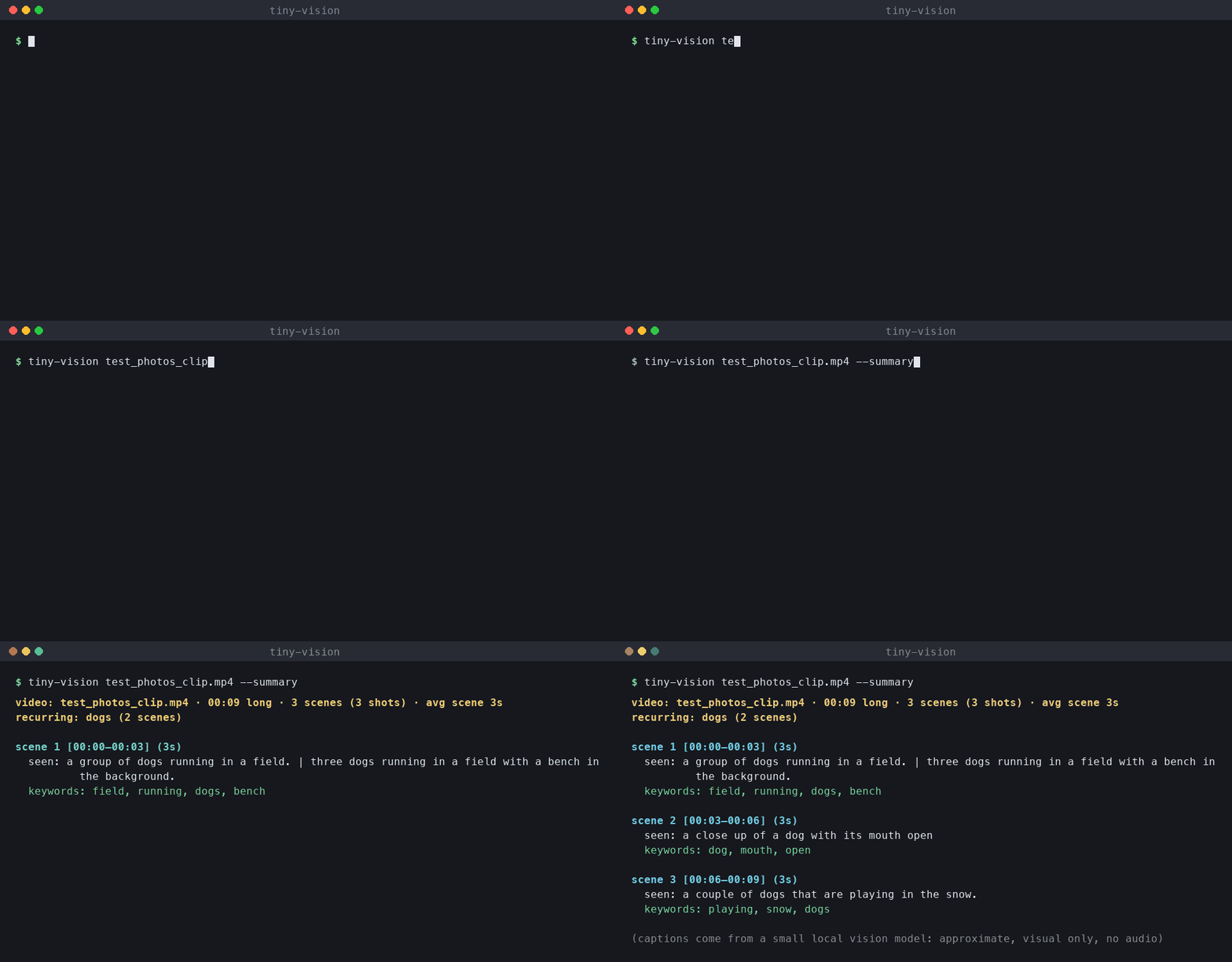
`--summary` splits the video into shots (hard cuts plus slow camera drift) and captions
the start, middle and end of each shot. It then groups consecutive shots that show the
same thing into scenes, so a back-and-forth conversation stays one scene. Each scene gets
its time range, what's seen and keywords, and the top of the breakdown lists what recurs
across the video:
```
video: trip.mp4 · 00:09 long · 3 scenes (3 shots) · avg scene 3s
recurring: dogs (2 scenes)
scene 1 [00:00–00:03] (3s)
seen: a group of dogs running in a field. | three dogs running in a field with a bench in the background.
keywords: dogs, running, field, bench
...
```
**Long videos.** The whole video is always covered, however long it is: shots are
captioned as they're found, so memory stays flat. Long or fast-cut videos are condensed by
merging similar neighbouring scenes, keeping the breakdown to at most 100 scenes
(`--max-scenes`, or `max_scenes` over MCP). Videos over 10 minutes caption 2 frames per
shot, and over 30 minutes 1. A 17.5-minute, 338-shot video takes about 50 seconds on an
Apple M5 and comes out as 100 scenes (about 20 KB of text).
`--summarize` passes that breakdown to a local LLM (default Qwen2.5-1.5B-Instruct, ~3 GB,
downloaded on first use; pick another with `--llm`) and prints a plain-English summary.
Over MCP you don't need it, because your assistant writes the summary itself. tiny-vision
is visual only for now: speech and audio are planned for a later release.
## Use it from an MCP client
`mcp_server.py` exposes three tools over stdio:
| Tool | Does |
|---|---|
| `summarize_video(path, scene_threshold=0.3, frames_per_shot=0, max_scenes=100, max_shots=0)` | Scene-by-scene breakdown of a whole local video, any length, for the assistant to summarize or answer questions about. `frames_per_shot=0` picks it by length; long videos are condensed to `max_scenes` |
| `caption_image(path)` | One-sentence caption of a local image |
| `describe_video(path, mode="scenes", scene_threshold=0.3, every_seconds=2, max_frames=120)` | Timestamped text timeline of a local video. `mode="scenes"` samples on scene changes; `mode="interval"` samples every `every_seconds` |
Add it to your MCP client's config. Easiest, with [uv](https://docs.astral.sh/uv/) (no clone):
```json
{
"mcpServers": {
"tiny-vision": {
"command": "uvx",
"args": ["--from", "git+https://github.com/amar683/tiny-vision", "tiny-vision-mcp"]
}
}
}
```
The first start installs dependencies and downloads the model, which can take longer than
some apps wait. Run `uvx --from git+https://github.com/amar683/tiny-vision tiny-vision --help` once in a terminal first. If the
app says `uvx` isn't found, use its full path (`which uvx`).
Long videos take a while (about 50 s for 17 minutes on an M5). `summarize_video` sends
progress updates as it works, which keeps most apps waiting. If yours still gives up early,
raise its tool timeout; in Claude Code, for example, set `MCP_TOOL_TIMEOUT=300000` (ms).
From a clone instead (use absolute paths):
```json
{
"mcpServers": {
"tiny-vision": {
"command": "/path/to/tiny-vision/.venv/bin/python",
"args": ["/path/to/tiny-vision/mcp_server.py"]
}
}
}
```
Then just ask, for example *"what happens in ~/Downloads/talk.mp4?"* or *"find the part of
this video where people are on the beach"*.
- **Model source:** the `TINY_VISION_MODEL` env var (local folder or HF repo id), else
`runs/coco_dinov2` if you trained locally, else the published v1.0 model.
- **Beam width:** `TINY_VISION_BEAMS` (default 3).
## Where it works
`mcp_server.py` is a standard local (stdio) MCP server, so it works in any app that can
run local MCP servers. Use the JSON config above, in that app's MCP settings file.
| App | Status |
|---|---|
| Claude Desktop, Claude Code | tested |
| Cursor, VS Code (GitHub Copilot agent mode), Windsurf, Cline, Zed, Goose | standard local MCP; not tested yet |
| LM Studio (0.3.17+) | standard local MCP; with a local model it's **fully offline**, video and LLM both on your machine |
| Codex (CLI, IDE, desktop app) | local MCP via Codex's config; not tested yet |
| ChatGPT chat, other web-only apps | they only connect to remote MCP servers, so use the CLI output instead |
No MCP? `caption.py clip.mp4 --summary` prints plain text, so you can paste it into any
chat or pipe it into a local model:
```bash
.venv/bin/python caption.py clip.mp4 --summary | ollama run qwen2.5 "Summarize this video:"
```
## Evaluate and compare
```bash
.venv/bin/python eval.py --run amartomar683/tiny-vision --dataset jxie/coco_captions --beams 3
.venv/bin/python bench.py --model tiny-vision --run amartomar683/tiny-vision
.venv/bin/python bench.py --model florence-2-base
.venv/bin/python bench.py --report
```
`eval.py` reports BLEU-4 and CIDEr-D on any Hugging Face caption test set, scoring one
generated caption per image against all of that image's references. `bench.py` runs other
small models on the same images with the same scorer, and also measures speed and memory.
## Train your own
```bash
.venv/bin/python smoke_test.py # ~1 min end-to-end check
# v1.0: frozen DINOv2-small encoder, adapter + decoder trained on COCO (~3 h on an M5)
.venv/bin/python train.py --dataset jxie/coco_captions --encoder dinov2-small --preset tiny \
--steps 40000 --warmup 1500 --eval-every 2000 --workers 6 --amp --out runs/coco_dinov2
# fully from scratch (our own ViT encoder)
.venv/bin/python train.py --dataset umaru97/flickr30k_train_val_test --preset tiny --steps 15000 \
--warmup 1000 --eval-every 1000 --amp --out runs/flickr30k
```
- `--dataset` takes any Hugging Face image-caption dataset; image and caption columns are
auto-detected. The best checkpoint by validation loss is kept.
- `--resume` continues an interrupted run from `<out>/last.pt`.
| Preset / encoder | Params | Use |
|---|---|---|
| nano, scratch | ~1.3M | smoke tests (64px) |
| tiny, scratch | ~25M | fully from-scratch model |
| tiny, `--encoder dinov2-small` | 36M (14M trained) | **v1.0** |
| small, scratch | ~56M | larger datasets / cloud GPU |
## Publish a model to Hugging Face
```bash
.venv/bin/python export_hf.py --run runs/coco_dinov2 --out hf_export/tiny-vision
hf upload <user>/tiny-vision hf_export/tiny-vision
```
The export writes `model.safetensors` (including the frozen encoder, so it runs offline),
`config.json`, `tokenizer.json` and the model card (`MODEL_CARD.md` → `README.md`).
## Layout
- `vlm/encoder.py`: from-scratch ViT, frozen DINOv2 wrapper, token pooling, per-frame time embedding
- `vlm/captioner.py`: adapter + prefix-LM caption decoder, greedy and beam search
- `vlm/video.py`: interval and scene-change frame sampling, text timeline
- `vlm/scenes.py`: shot detection, scene grouping and keywords for video summaries
- `vlm/summarize.py`: optional local-LLM summary for the CLI
- `vlm/metrics.py`: BLEU and CIDEr-D (pure Python)
- `vlm/data.py`: Hugging Face loader and a synthetic shapes dataset
- `vlm/tokenizer.py`: word-level tokenizer built from captions
- `caption.py`, `train.py`, `eval.py`, `bench.py`, `export_hf.py`, `mcp_server.py`, `smoke_test.py`
- `notebooks/demo.ipynb`: the Colab demo; `space/`: the same Gradio demo as a Hugging Face Space app
- `pyproject.toml`: packaging (`tiny-vision` and `tiny-vision-mcp` commands)
## Roadmap
- **Speech:** a per-scene transcript of what's said, so summaries cover audio too
- **v1.1:** embedding adapters for open LLMs (Qwen, Llama), exportable as llama.cpp `mmproj.gguf`
- Self-critical (CIDEr-reward) fine-tuning, subword tokenizer, COCO + Flickr30k mix
- Distil DINOv2 into a smaller encoder of our own
- Clip-level training for motion understanding
## License
- Code: Apache-2.0 (see `LICENSE`).
- v1.0 weights: Apache-2.0. The encoder is DINOv2-small (Meta AI, Apache-2.0).
- Training data: COCO captions (CC BY 4.0, images under Flickr licenses). See the model
card for details.
TDQS
Scored across 3 tools
caption_image is clearly separate, but describe_video and summarize_video share the same mechanics (shot splitting, frame captioning, merging) and the same `path`/`scene_threshold` arguments, differing mainly in output shape. The descriptions do spell out the timeline-vs-scene-summary distinction, but an agent could still reasonably pick the wrong one for a vague request like 'tell me about this video'.
All three names follow the same verb_noun snake_case pattern (caption_image, describe_video, summarize_video). The verb choice matches the action and the noun matches the resource type (image vs video).
Three tools is a well-scoped surface for a small vision server: one image entry point and two video entry points. It is on the thin side, but each tool clearly earns its place and nothing looks redundant.
Video coverage is thorough (timeline, scene summary, tunable sampling), but the image side is one caption tool with no way to ask questions about an image, extract text, or batch-process files, creating an asymmetry with the richer video surface. No obvious dead ends for the covered flows, but notable gaps for image understanding workflows.