
mcptoon
<!-- mcp-name: io.github.activeing123/mcptoon -->
<div align="center" markdown="1">
<picture>
<source media="(prefers-color-scheme: dark)" srcset="https://raw.githubusercontent.com/activeing123/mcptoon/main/docs/assets/lockup-h-split-dark.svg">
<img src="https://raw.githubusercontent.com/activeing123/mcptoon/main/docs/assets/lockup-h-split-light.svg" alt="mcptoon" height="88">
</picture>
<h3 align="center">Zero-Config Token Optimization & Unified Governance for MCP Tools and Agent Skills</h3>
<p align="center">
<b>Install 1,000 skills and 1,000 MCP tools locally — and never worry about context flooding.</b><br>
Cuts tool context by ~90% (99.2% on 255 tools) with zero config across <b>103+ desktop and CLI agents</b>.
</p>
<!-- Primary Status Badges -->
<p align="center">
<a href="https://pypi.org/project/mcptoon/"><img src="https://img.shields.io/pypi/v/mcptoon?style=flat-square&color=238636&logo=pypi&logoColor=white" alt="PyPI version"></a>
<a href="https://github.com/activeing123/mcptoon/stargazers"><img src="https://img.shields.io/github/stars/activeing123/mcptoon?style=flat-square&logo=github&color=58a6ff" alt="GitHub Stars"></a>
<a href="https://github.com/activeing123/mcptoon/actions"><img src="https://img.shields.io/github/actions/workflow/status/activeing123/mcptoon/ci.yml?branch=main&style=flat-square&logo=githubactions&logoColor=white" alt="CI Build"></a>
<a href="#contributing"><img src="https://img.shields.io/badge/tests-3010%20passed-success?style=flat-square&logo=pytest&logoColor=white" alt="Tests"></a>
<a href="https://github.com/activeing123/mcptoon"><img src="https://img.shields.io/badge/dependencies-0%20(stdlib%20only)-blue?style=flat-square" alt="Zero Dependencies"></a>
<a href="https://github.com/activeing123/mcptoon/blob/main/LICENSE"><img src="https://img.shields.io/badge/license-Apache%202.0-informational?style=flat-square" alt="License"></a>
</p>
<!-- Ecosystem & Directory Badges -->
<p align="center">
<a href="https://modelcontextprotocol.io"><img src="https://img.shields.io/badge/MCP_Spec-2026--07--28-blueviolet?style=flat-square" alt="MCP Spec"></a>
<a href="https://allmcps.com/mcp/mcptoon?verify=7eb0d0d6-5d4e-41a3-a048-2fe3c91a36ed"><img src="https://img.shields.io/badge/AllMCPs-Listed-orange?style=flat-square" alt="AllMCPs"></a>
<a href="https://mcpvault.io/servers/mcptoon/health"><img src="https://img.shields.io/badge/MCPVault-Verified-purple?style=flat-square" alt="MCPVault"></a>
<a href="https://mcpservers.org/servers/activeing123/mcptoon"><img src="https://img.shields.io/badge/mcpservers.org-Listed-blue?style=flat-square" alt="mcpservers.org"></a>
</p>
<p align="center">
<b><a href="https://mcptoon.github.io/">🌐 Official Website</a></b> ·
<b><a href="https://mcptoon.github.io/tools/token-tax/">🧮 30s Token Tax Calculator</a></b> ·
<b><a href="https://github.com/activeing123/mcptoon/blob/main/README.zh-CN.md">🇨🇳 中文文档</a></b> ·
<b><a href="https://github.com/activeing123/mcptoon/blob/main/DEVELOPERS.md">📖 Developer Docs</a></b>
</p>
<!-- Modern Benchmark SVG -->
<p align="center">
<img src="https://raw.githubusercontent.com/activeing123/mcptoon/main/assets/benchmark.svg" alt="mcptoon Benchmark: 71,929 to 581 tokens (-99.2%)" width="100%" style="max-width: 960px; border-radius: 12px; margin: 16px 0;">
</p>
<p align="center">
<sub>Skeptical of a synthetic 255-tool sample? <a href="https://github.com/activeing123/mcptoon/blob/main/docs/real-world-benchmark.md">Here are 7 real public MCP servers (209 tools) measured on a real machine →</a> — 640,606 → 905 tokens (−99.86%). Or run <code>mcptoon bench</code> on your own catalog.</sub>
</p>
<!-- Product promo video. Keep this as a BARE user-attachment URL on its own line:
GitHub rewrites that form into a signed, playable player. Wrapping it in an
explicit video HTML tag is NOT rewritten, and Chrome then rejects the raw
github.com URL (it 302-redirects, failing the media URL safety check). -->
https://github.com/user-attachments/assets/0272d3a8-c74f-428d-8559-fbf804ce0685
<table>
<tr>
<td align="center" width="33%" valign="top">
<br><b>① 💥 Tools, skills & docs eating your context — afraid to add more?</b><br><br>
Add as many as you like. Tool schemas <b>72k → 581 tokens</b>.<br>
<sub>Tools −99.2% · Skills −99.99% · Docs 40k→17k per question</sub>
</td>
<td align="center" width="33%" valign="top">
<br><b>② 🧩 Several agents — JSON configs and skills both a chore?</b><br><br>
It's a <b>native CLI</b>: any agent that can run a shell command gets <b>every feature</b> — no MCP server, no config. <code>sync</code> covers the GUI clients too (<b>103+</b>).<br>
<sub>No JSON editing, no restart</sub>
</td>
<td align="center" width="33%" valign="top">
<br><b>③ 🔍 Know there are 17,000+ — but not which one fits?</b><br><br>
It first <b>picks up the servers you already have</b> (nothing to reinstall), then finds the rest by plain words — install and call on the spot.<br>
<sub><code>mcptoon discover</code> → <code>search</code> → <code>call</code></sub>
</td>
</tr>
</table>
<p align="center">
<sub>Also: OpenAPI / GraphQL passthrough · OAuth · MCP resources & prompts · saved connections · code sandbox — <a href="#all-commands">see All commands</a>.</sub>
</p>
<p align="center">
<b><code>pip install mcptoon && mcptoon quickstart</code></b> — 534KB, zero dependencies, zero config.
</p>
<p align="center">
<sub>Stays current on its own: it tells you when a newer version is out, and <code>mcptoon upgrade</code> updates in one command.</sub>
</p>
</div>
---
### 🚀 Quick Start (Choose Your Way)
<table>
<tr>
<td width="50%" valign="top">
<h4>🤖 Modern Way: Just Talk to Your Agent (Zero Memorization)</h4>
When installed, mcptoon **automatically injects its own official skill (`/mcptoon`) into your agents**. You never need to memorize terminal commands — just ask directly in **Cursor, Claude Code, Windsurf, or DSH**:
```markdown
# Ask the built-in skill anytime:
"Load /mcptoon skill and check what MCP tools I currently have."
"Help me find an MCP tool that converts HTML to PDF and call it."
"The tool output was truncated, retrieve the full original copy."
"How many tokens did mcptoon save for me today?"
"Doctor self-check: are all my MCP servers connected properly?"
```
*Your agent loads `/mcptoon` and drives everything behind the scenes!*
</td>
<td width="50%" valign="top">
<h4>⚡ Terminal Way: 30-Second Setup</h4>
```bash
# 1. Install (zero dependencies, 534KB)
pip install mcptoon
# 2. One command: detect MCP servers & auto-configure agents
# (Also self-installs `/mcptoon` skill into all detected agents)
mcptoon quickstart
# 3. View compact tool catalog (-99.2% tokens)
mcptoon manifest
# 4. Route tasks to skills or doc chapters (<5ms)
mcptoon skills resolve "write git commit message"
mcptoon docs resolve "how does release gating work"
```
</td>
</tr>
</table>
**Is it actually saving you anything?** After a fresh install mcptoon can sit in
**direct** mode — installed but not wired into the agent — and save nothing. See
[Which mode is cheapest?](#which-mode-is-cheapest), or just run `mcptoon mode`.
### ⚡ Core Capabilities at a Glance
| 💥 Save context (why ①) | 🧩 One config, every agent (why ②) |
| :--- | :--- |
| • ✅ **Compact name index (−99.2%)**: 255 tools → **581 tokens**, full schema fetched on demand<br>• ✅ **Lossless result compression**: reversible, `retrieve` the original behind any handle<br>• ✅ **Session dedup**: byte-identical output in one turn becomes a reference<br>• ✅ **Skills the same way**: one 39-token pointer + one lookup replaces every `SKILL.md`<br>• ✅ **Docs too**: `docs` feeds 1 chapter, not 19 — **40k → 17k tokens per question**<br>• ✅ **Honest numbers**: real `tiktoken` accounting via `mcptoon bench` | • ✅ **Native CLI**: any shell-capable agent runs `mcptoon` and gets **every feature** — no MCP server, no config<br>• ✅ **GUI clients too**: `sync` writes the JSON for Claude, Cursor, Cline, Windsurf, VS Code, Claude Code — **6 here, 103+ supported**<br>• ✅ **Verified list**: 42 clients run the CLI directly, 61 mount one `mcptoon serve` entry<br>• ✅ **Skills too**: one catalog distributed to every agent's folder (`skills sync`)<br>• ✅ **Import what you have**: pull servers from Claude / Cursor / Cline / Windsurf<br>• ✅ **One-command setup**: `quickstart` = discover + configure + show tools<br>• ✅ **Fine control**: `toggle` on/off, `policy` sets each tool's output tier, `--version-gate` / `--tombstone` for skills |
| 🔍 Find & call (why ③) | 🔌 Drive any API, not just MCP |
| :--- | :--- |
| • ✅ **17,000+ registry**: plain-language `search` across servers<br>• ✅ **Discover what's already installed**: `discover` scans existing client configs — **nothing to reinstall**<br>• ✅ **Call anything**: `call` headless, or `call --auto` to auto-find the server<br>• ✅ **On-demand schema**: `inspect` only when a tool is actually used<br>• ✅ **Pick for a task**: `select "<task>"` returns just the top few<br>• ✅ **Export anywhere**: `manifest --format openai\|openapi\|mcp` | • ✅ **OpenAPI / Swagger**: any REST API as commands (`openapi list\|call`)<br>• ✅ **GraphQL**: any endpoint as commands (`graphql list\|call`)<br>• ✅ **OAuth built in**: PKCE login, client-credentials, Dynamic Client Registration<br>• ✅ **MCP resources & prompts**: `resources`, `prompts`, `complete`<br>• ✅ **Saved connections**: `bake` — secrets by reference only (`env:` / `file:`)<br>• ✅ **Code sandbox**: `exec` — only stdout enters context |
| 🛡️ Safe, small, private | 📚 Docs & doctor |
| :--- | :--- |
| • ✅ **Zero dependencies**: pure standard library, `pyproject.toml` clean<br>• ✅ **534KB, installs in 2s**<br>• ✅ **100% local & private**: no cloud, no telemetry, air-gap ready<br>• ✅ **Guards**: destructive-op + prompt-injection + credential-leak checks on every call<br>• ✅ **XDG compliant**: sandbox-friendly `--dir` isolation | • ✅ **Docs router**: `docs` indexes a Markdown tree, feeds 1 chapter instead of 19 (40k → 17k tokens)<br>• ✅ **Search inside docs**: `kb` returns passages, not whole files (95KB → 3 snippets)<br>• ✅ **Self-heal**: `doctor` repairs stdio pipes & environments; `health` probes every server<br>• ✅ **Live proof**: `bench` / `demo` show the real numbers on your machine<br>• ✅ **Transparent footer**: `footer-facts` prints live savings after each turn |
<sub>Every command, with flags, is in [All commands](#all-commands).</sub>
---
## Why mcptoon
Every MCP agent (Claude Code, Cursor, Codex, …) loads **the full description of every tool and every skill into its context window before it does any work** — and re-sends it every turn. On 255 tools that is **71,929 tokens**: more than half of a 128K window spent on descriptions, before the first question.
## How the token saving works
mcptoon keeps those descriptions **on disk, not in context**, and hands the agent a compact view instead:
- **A name index, not full schemas.** Picking a tool only needs its name — 255 tools become **581 tokens (−99.2%)**. The full schema is fetched on demand with `mcptoon inspect`, only when a tool is actually called.
- **Skills the same way.** One resident pointer (**39 tokens**) plus one lookup (**791 tokens**) replaces loading every `SKILL.md` in full — **1,572,330 → 39 + 791 (−99.99%)**.
- **Results too.** `--toon` re-encodes a tool's *result* as standard TOON.
Measured **5.7%** smaller on a mixed result sample, ranging **1.8%-48.6%** by
result shape — a list of records barely shrinks, a single record halves. Not a
flat 34%: see `assets/benchmark_results.json`.
Nothing is lost: the full schema and the full skill text stay one command away. Only the context window is spared.
mcptoon is a **534KB, zero-dependency native CLI** that manages every MCP tool and agent skill on your computer — and shares them across all your agents with no config written by you.
## This isn't just us talking
Those numbers are ours — but "loading every tool schema into context is expensive" is not
a claim only we make:
- **[Anthropic's engineering write-up](https://www.anthropic.com/engineering/code-execution-with-mcp)** — tool schemas flooding the context window is a real cost; one example drops from 150,000 tokens to 2,000
- **[Firecrawl's benchmark](https://firecrawl.dev/blog/mcp-vs-cli)** — the same task cost 1,365 tokens via CLI vs 44,026 via MCP (32×)
- **[Scalekit's benchmark](https://scalekit.com/blog/mcp-vs-cli-use)** — CLI 10–32× cheaper, 100% reliable vs MCP's 72%
- **[MCP-Zero (arXiv:2506.01056)](https://arxiv.org/abs/2506.01056)** — on-demand tool retrieval, near-constant cost regardless of tool count
mcptoon is the one you can use today: it covers any agent that can run a shell, and writes a single hookup line into the mainstream GUI clients it knows.
---
## Two ways in
<table>
<tr>
<td width="50%" valign="top">
<h3>🧑💻 I just use AI tools</h3>
Install once, and every AI you have — **Claude Desktop, Claude Code, Codex, Cursor, Windsurf, Cline, VS Code Copilot, Gemini CLI, Qwen Code, Zed, Crush, opencode and any other agent** — shares all the tools and skills you already have. You write nothing in any agent's config.
**[→ Install and go](#30-seconds-up-and-running)**
</td>
<td width="50%" valign="top">
<h3>🔧 I build with MCP / agents</h3>
Script it. `mcptoon` is a plain CLI with stable JSON output and an `mcptoon serve` MCP endpoint — wire it into your own agent, CI, or app.
**[→ Commands and formats](#all-commands)**
</td>
</tr>
</table>
Measure *your* numbers: `pip install mcptoon && mcptoon bench` — it reports your own
catalog, not the fixed 255-tool sample below (that sample's method is in
[docs/tiktoken-benchmarks.md](https://github.com/activeing123/mcptoon/blob/main/docs/tiktoken-benchmarks.md)).
| | Without mcptoon | With mcptoon |
|---|---|---|
| **Descriptions in context** | full description of every tool + skill, re-sent every turn | a compact view — **581 tokens** for 255 tools (−99.2%, lossless) |
| **Adding a tool or skill** | hand-write JSON in every agent | one command — no agent config touched |
| **Which agents get it** | only the ones you configured | every agent on the machine — they just run `mcptoon` |
| **Finding tools & skills** | hunt GitHub by hand | `install --search` (**17,000+ MCP servers**) + `skills search` |
| **Starting from scratch** | wire tools one by one | 4 built-in starter packs — one command to a working set |
Skills work the same way: **1,572,330 tokens** of `SKILL.md` text → **39** resident + **791** per lookup (−99.99%). Call results shrink a further **~6%** with `--toon` (shape-dependent).
---
## Path 1 · I just use AI tools
You have a desktop AI — Claude, Codex, Cursor, Windsurf, Cline, VS Code Copilot, and
**97 more** ([full list of 103 →](#works-with-every-ai-agent)). Today, adding a tool or a
skill means hand-editing that agent's JSON. mcptoon removes that step:
1. **Install once.**
```bash
pip install mcptoon && mcptoon quickstart
```
`quickstart` finds your MCP servers, writes your config, and registers mcptoon in every agent it detects.
(Skip `quickstart` and the first command you run still self-heals: it installs
mcptoon's own skill into each agent and builds the skill index, once per machine.)
2. **Add tools and skills in one place** — here, not in each agent.
```bash
mcptoon install --search github # find and install any MCP server
mcptoon skills search "make a PDF" # find a skill by what it does
```
3. **Use them from any agent.** Your agent runs `mcptoon` like any other command — no config, no restart. See [Works with every AI agent](#works-with-every-ai-agent).
**Want a head start?** Four built-in starter packs — `essentials`, `web-research`, `code-review`, `docs` — stand up a working toolset in one command:
```bash
mcptoon install --pack essentials
```
---
## Path 2 · I build with MCP / agents
mcptoon is a plain CLI with scriptable output, plus an MCP endpoint when you want one.
```bash
mcptoon manifest --format json # machine-readable tool index
mcptoon call <server> <tool> '{}' # call any tool, JSON or --toon output
mcptoon serve # expose every configured server behind one MCP endpoint
```
- **Stable output** — JSON by default, `--toon` for smaller results (shape-dependent,
5.7% on a mixed sample), `--format mcp` to export standard MCP JSON.
- **`mcptoon serve`** — stdio or HTTP, connection pooling, per-agent keys, for clients that insist on a proxy.
- **Zero dependencies** — pure Python standard library, so it drops into any environment (CI, containers, air-gapped).
Full reference: [DEVELOPERS.md](https://github.com/activeing123/mcptoon/blob/main/DEVELOPERS.md) and [All commands](#all-commands).
---
## Contents
- [Why mcptoon](#why-mcptoon)
- [How the token saving works](#how-the-token-saving-works)
- [This isn't just us talking](#this-isnt-just-us-talking)
- [Two ways in](#two-ways-in)
- [Path 1 · I just use AI tools](#path-1--i-just-use-ai-tools)
- [Path 2 · I build with MCP / agents](#path-2--i-build-with-mcp--agents)
- [30 seconds up and running](#30-seconds-up-and-running)
- [What it does](#what-it-does)
- [Where the tools come from](#where-the-tools-come-from--search-17000-install-with-one-command)
- [The three bills](#the-three-bills-and-why-you-must-not-mix-them)
- [Install](#install)
- [Works with every AI agent](#works-with-every-ai-agent) — **103 clients** (42 CLI · 61 serve)
- [Why a CLI, not a proxy](#why-a-cli-not-a-proxy)
- [Which mode is cheapest?](#which-mode-is-cheapest)
- [All commands](#all-commands)
- [Trust and safety](#trust-and-safety)
- [Credits and references](#credits-and-references)
- [Contributing](#contributing)
- [Troubleshooting & FAQ](https://github.com/activeing123/mcptoon/blob/main/docs/faq.md)
- [License](#license)
---
## 30 seconds up and running
```bash
pip install mcptoon # pure stdlib, 534KB, zero dependencies
# One command: find your MCP servers, write your config, register the gateway
# in every agent you have, and show you what it found:
mcptoon quickstart
# See every tool available (names-only by default; 255 tools cost 581 tokens):
mcptoon manifest
# Call a tool (JSON output by default; add --toon to save more).
# `everything` is only present if you already had it; otherwise add the built-in
# zero-dependency demo server first (no Node, no network) and call that:
mcptoon add demo --stdio python -m mcptoon demo-server
mcptoon call demo echo_message '{"message":"hi"}'
```
`quickstart` is also what makes mcptoon *visible*: it writes `mcptoon serve` into each
agent's config as the reserved server `mcptoon`, so your agent can see mcptoon itself.
Already synced? Re-register with `mcptoon sync --self` (plain `mcptoon sync` only writes
your servers); check the state any time with `mcptoon status`.
**Two ways in — and you don't pick one.** mcptoon is **a CLI first**: a shell-capable agent
runs `mcptoon` commands, and that is the cheapest path — the schemas never enter context.
`quickstart` also registers mcptoon's own MCP entry (`mcptoon serve`) with each agent that
takes one, so a client that can only see MCP servers still reaches your tools. The MCP entry
ships in `compact` mode: it keeps your upstream tool list out of the model's context and
sends it to `mcptoon_manifest → inspect → call` instead. `mcptoon status` shows both ledgers.
**And it is fully reversible.** The install registers the gateway, and by default
quickstart also *takes over* — it routes your existing servers through the gateway
and removes their direct entries (without that step your agent sees the same tools
twice, once direct and once through the gateway, which costs *more*, not less). It
is a listed, confirmed step, and it is undoable: **`mcptoon restore` drops the
gateway entry and puts your servers back exactly where they were.** Anything you
added to a config afterwards is left untouched. `mcptoon off` is the lighter
switch — it removes only the gateway entry and leaves your servers where they are.
Preview either with `--dry`, and preview the complete removal plan with
`mcptoon uninstall --dry` (it prints exactly what it will remove first).
Don't want to install yet? Watch it work instead (needs Node):
```bash
uvx mcptoon demo --quick
```
It boots the official "everything" reference server, calls one tool, and prints the token
math on your screen — no API key, none of your servers, nothing written to disk.
---
## What it does
### Tools: schema on demand
The full schema is compressed to a name index. When you need one, `mcptoon inspect`
fetches its real parameters, then `call` runs it. You pay for a listing, not for every
turn.
### Skills: one resident pointer
No more loading the whole catalog. A single pointer line stays resident (39 tokens) and
one lookup returns the most relevant skills (791 tokens). Views are **links** (a junction
on Windows, no admin needed), so one edit at the source is live everywhere and there is no
second copy to drift.
### Install once, share everywhere
Install mcptoon once and every AI on the machine gets all your tools and skills. Add more
later and it is live immediately — no agent restart, no per-agent JSON.
### Add tools your way
```bash
mcptoon install brave-search --npm @modelcontextprotocol/server-brave-search
mcptoon install my-tool --pip mcp-my-tool
mcptoon install remote-api --url https://example.com/mcp
mcptoon add my-server --stdio npx -y @any/mcp-package
mcptoon install --list # see what's installed
mcptoon install --remove brave-search # uninstall one
```
One command per server, from npm / pip / HTTP. Or let mcptoon scan what you already have:
`mcptoon discover`.
A remote server that needs a token reads it from the environment, so no credential is
ever written to disk:
```bash
mcptoon install remote-api --url https://example.com/mcp \
--header 'Authorization: Bearer ${BAIZHI_TOKEN}' # BAIZHI_TOKEN set in your environment
```
`${NAME}` is resolved at request time, so the config, the generated handler and every log
keep the template — rotate the variable and the next call uses the new value, with no
reinstall. A missing or empty variable fails loudly, naming it, never as an empty header.
---
## Where the tools come from — search 17,000+, install with one command
On a new machine the first question isn't "how do I save tokens", it's "which tools do I
even want". The old answer is to hunt GitHub for `mcpServers` snippets and hand-copy them
into JSON.
mcptoon **ships no tools and bundles no catalog**. It queries the upstream registries, so
you search for exactly what you need:
```bash
mcptoon install --search github # search, list only — nothing installed
mcptoon install --search postgres
mcptoon install github # search and install
```
Results carry a `✓` (registry-verified), a type tag (`npm` / `pypi` / `hosted` / `remote`)
and a call count. Data comes from two upstreams, queried live and never stored:
| Source | What it is | Scale |
|---|---|---|
| [Smithery](https://smithery.ai) | the largest MCP registry | **17,000+** entries |
| [Official MCP Registry](https://registry.modelcontextprotocol.io) | the official meta-registry | installable npm / pypi packages |
**Why nothing is bundled:** a built-in list would need a release to update and would pull
someone else's source into your supply chain. mcptoon stores only a **pointer** — the
search writes one line into your own `~/.mcptoon/config.json`; third-party source never
lands inside mcptoon.
Then distribute to every agent:
```bash
mcptoon sync # push the new tools to every detected agent
mcptoon manifest # see every tool (name index, the cheapest view)
```
**How to read a result:** the index mixes official `@modelcontextprotocol/*` servers with packages individuals publish. A `✓` means the registry verified the entry — your cue to read the source before you hand it credentials.
**The skills half:** `skills search <query>` queries the open skills index (skills.sh) — find a skill by what it does, then install it with `skills add <git-url>`. mcptoon installs the repos **you point it at** — the catalog is the open ecosystem itself.
**Starter packs:** if you'd rather not pick tool-by-tool, four built-in packs — `essentials`, `web-research`, `code-review`, `docs` — each bundle a few tools plus a ready-made prompt. `mcptoon install --packs` lists them; `mcptoon install --pack essentials` installs one. The two research packs need no API key.
---
## The three bills, and why you must not mix them
mcptoon saves tokens in three separate places. Comparing the numbers across them is
meaningless.
The figures below come from catalogs of three different sizes — a **255-tool synthetic
sample** (the fixed headline benchmark), a **1,109-tool** machine, and whatever your own
machine has. Do not compare a percentage from one against a token count from another;
each table states which catalog it measures.
There are two ways to read "how much does this save?", and they answer different
questions. **The gateway figure** — full schemas versus what the agent actually loads
under the default `compact` exposure — is what installing mcptoon buys, and it is the
honest headline (it scales with catalog size: the more tools you have, the larger it
gets). **The slim-schema figure** (same tools, terser descriptions) is the smaller,
secondary claim (88.5%), and it is what `manifest --slim` buys. `mcptoon status` prints
both, side by side, from one measurement, so the two can never drift apart.
### Bill 1 · Tool discovery (`manifest`): 99.2% smaller by default
`mcptoon manifest` with no flags is this tier. Want more? `--slim` (names plus param
types, 8,282 tokens, −88.5%) or `--full` (the complete schema).
### Bill 2 · Call results (`call`): optional, `--toon` saves ~6%
This bill comes due *after* a tool returns. `mcptoon call` prints JSON by default and
**saves nothing by default**. Add `--toon` to shrink the result.
### Bill 3 · Skill catalog (`skills`): 1,572,330 → 39 resident + 791 per lookup
```bash
mcptoon skills manifest # 39 tokens, resident
mcptoon skills resolve "make a PDF" --k 5 # 791 tokens, the 5 most relevant
```
**One table, all three, on the machine this README was written on:**
| Path | What the agent loads | Tokens | vs native |
|---|---|---:|---:|
| Tool schemas (212) | every full schema | 640,787 | — |
| | `manifest` (name index) | 914 | 99.85% |
| | `manifest --slim` | 3,056 | 99.52% |
| Skill files (480) | every `SKILL.md`, full text | 1,572,330 | — |
| | `skills manifest` (pointer) | 39 | 99.99% |
| | `skills resolve --k 5` | 791 | 99.94% |
The fixed headline benchmark — a **synthetic sample** of 255 tools across 50 servers,
`tiktoken cl100k_base`. It is not your catalog; run `mcptoon status` to see your own
numbers:
| Format | Tokens | Savings |
|---|---:|---:|
| JSON | 71,929 | — |
| TOON | 47,438 | 34% |
| SLIM | 8,282 | 88.5% |
| Compact | 581 | 99.2% |
Measure your own catalog with `mcptoon bench` (it reports *your* tools, not this fixed
sample). The exact three-format table above is reproducible too — no clone needed:
```bash
mcptoon manifest # populate the schema cache
python -m mcptoon.bench_tokens # the same JSON / --slim / --compact counts, your tools
```
Method and caliber:
[docs/tiktoken-benchmarks.md](https://github.com/activeing123/mcptoon/blob/main/docs/tiktoken-benchmarks.md).
---
## Install
```bash
pip install mcptoon
```
> **Linux (Debian/Ubuntu 23.04+, and any distro that follows PEP 668), and
> Homebrew Python on macOS.** A plain `pip install` into the *system* Python is
> refused there with `error: externally-managed-environment`. That is the distro
> protecting itself, not a problem with mcptoon. Install it the clean way instead:
>
> ```bash
> pipx install mcptoon # isolates the CLI; recommended
> # or, into a virtualenv you control:
> python3 -m venv ~/.mcptoon-venv && ~/.mcptoon-venv/bin/pip install mcptoon
> ```
>
> `pip install --break-system-packages mcptoon` also works, but it writes into the
> system Python — prefer `pipx` or a venv. On Windows, `pip install mcptoon` just works.
<details>
<summary>Other ways to install</summary>
```bash
# Run without installing (needs Node)
uvx mcptoon demo --quick
# Isolated CLI install (avoids the PEP 668 error on Linux / Homebrew Python)
pipx install mcptoon
# From source (for development)
git clone https://github.com/activeing123/mcptoon.git
cd mcptoon
pip install -e . --no-build-isolation
# Claude Code plugin
/plugin marketplace add activeing123/mcptoon
```
</details>
### Nix
Packaged by [numtide/llm-agents.nix](https://github.com/numtide/llm-agents.nix) — a bot follows
every PyPI release, so the flake is never a version behind by hand:
```bash
# Run straight from the flake, no install step
nix run github:numtide/llm-agents.nix#mcptoon -- --help
```
The plugin and the skill are both surfaced through
[sudosubin/agents.nix](https://github.com/sudosubin/agents.nix) as
`pkgs.agent-plugins.github.activeing123.mcptoon.<plugin-name>` and
`pkgs.agent-skills.github.activeing123.mcptoon.<skill-name>`.
---
## Works with every AI agent
mcptoon reaches an agent one of two ways, and every client below falls into one of them.
You don't pick — `quickstart` registers both, and each host takes whichever it can:
- **CLI leg — the agent runs `mcptoon` itself.** Anything with a shell (a CLI agent, or a
coding IDE with a terminal) needs **zero config**: it runs `mcptoon call`, `mcptoon search`,
`mcptoon skills resolve`. Nothing is written into it at all.
- **serve leg — the client can't run a shell.** A chat app or GUI mounts MCP instead, so it
gets **one entry**: `mcptoon serve` as a single MCP server. One line, one place.
**The market, covered.** 103 clients, taken from
[awesome-mcp-clients](https://github.com/punkpeye/awesome-mcp-clients) plus vendor docs for
the coding agents that postdate it; developer *libraries* (mcp-agent, mcp-client-go) are
excluded because a user does not run them. Evidence is per client — we name what we verified,
not what we assumed.
**CLI leg — 42 clients, zero config** (they run `mcptoon` themselves):
AdaL · Aider · Amazon Q Developer · auggie · Autohand Code CLI · Claude Code · Claude Code Open ·
ClaudeMind · Cline · Codex · ContextKit · Continue · Copilot CLI · Copilot-MCP · Crush · Cursor ·
Dexto · Dolphin-MCP · Enola · Gemini CLI · Goose · JDBCX · Junie · KiloCode · Kiro · McPico ·
MCPOmni Connect · mistral-vibe · Nerve · Octomind · opencode · OpenHands · PraisonAI · Qwen Code ·
Roo Code · Slack MCP Client · SwarmClaw · Trae · VS Code GitHub Copilot · Warp · Windsurf · Zed
**serve leg — 61 clients, one `mcptoon serve` entry** (no shell, so they mount MCP):
5ire · Agent Bridge · Agent-cli · AgentOne · AIaW · Ano · AnythingLLM · Argo-LocalAI · askit-mcp ·
AstrBot · BoltAI · BrowseWiz · Canvas MCP Client · CarrotAI · Chainlit · ChatMCP · Cherry Studio ·
Claude Desktop · console-chat-gpt · DeepChat · DocsGPT · eechat · Enconvo · Fastchat MCP · FLUJO ·
Glue · HyperChat · kibitz · Klavis AI · LangBot · LibreChat · LobeHub · Lutra · MCP Chatbot ·
MCP CLI client · MCP Playground · MCP Simple Slackbot · MCP SuperAssistant · MCPCLIHost · MCPHost ·
Memex · MindPal · NextChat · OpenClaw · oterm · Qordinate · Runbear · SeekChat · Simple AI ·
Superinterface · Tambo · Taskade · Tester MCP Client · Tiles Notebook · Tome · Vercade · WhatsMCP ·
Witsy · y-cli · Yume · Zin-MCP-Client
**Evidence status** — `sync --self` writes a hookup line into the 12 hosts we have verified
against their own docs; every other host above is reached by the CLI or by `mcptoon serve`
without a host-specific file, so there is nothing to verify per host.
### What mcptoon writes, host by host
mcptoon is a **CLI tool** — a manager, not a resident proxy or service, and not a client
library. Your agent never talks to your upstream MCP servers directly: it either runs
`mcptoon` commands, or reaches them through mcptoon's own MCP entry (`mcptoon serve`).
For the hosts that take a file, this is exactly what lands where:
| Agent | How it hooks up |
|---|---|
| Claude Desktop | `mcptoon sync --self` adds one `mcptoon` entry to `claude_desktop_config.json` |
| Claude Code | `mcptoon sync --self` writes its config and a pointer into `~/.claude/CLAUDE.md` |
| Codex | `mcptoon sync --self` writes a pointer into `~/.codex/AGENTS.md` |
| Gemini CLI | `mcptoon sync --self` writes a pointer into `~/.gemini/GEMINI.md` |
| Qwen Code | `mcptoon sync --self` writes a pointer into `~/.qwen/QWEN.md` |
| Zed | `mcptoon sync --self` writes a pointer into Zed's `AGENTS.md` |
| Crush | `mcptoon sync --self` writes a pointer into `~/.config/crush/CRUSH.md` |
| opencode | `mcptoon sync --self` writes a pointer into `~/.config/opencode/AGENTS.md` |
| Cursor | `mcptoon sync --self` adds it to Cursor's MCP config; or put it in `AGENTS.md` |
| Windsurf | `mcptoon sync --self` writes `mcp_config.json` |
| Cline | `mcptoon sync --self` writes Cline's MCP config |
| VS Code Copilot | `mcptoon sync --self` writes VS Code's MCP config |
| Any agent that can run a shell | call `mcptoon` directly — zero config |
```bash
# Agent needs GitHub access mid-task? It just runs:
mcptoon add github --url https://api.githubcopilot.com/mcp/
# Done. No JSON editing. No restart. No lost context.
```
`mcptoon serve` is the other direction: run all your configured servers behind one MCP
endpoint, with connection pooling and per-agent keys, for clients that insist on a proxy.
You don't have to choose between the two — the CLI stays the primary way in, and the bridge
is wired alongside it wherever the host can take one.
---
## Why a CLI, not a proxy
MCP's premise is that every capability is a *server* your agent must be configured to
reach — which is why one new tool means editing per-agent JSON in a different format for
each, restarting everything, and re-paying the full schema cost in every agent.
A command line is the one interface every agent already has. And the form factor is
measurably cheaper on its own, before mcptoon does anything:
- [Firecrawl](https://firecrawl.dev/blog/mcp-vs-cli): the same task cost **1,365 tokens via CLI vs 44,026 via MCP — 32×**
- [Scalekit](https://scalekit.com/blog/mcp-vs-cli-use): CLI **10–32× cheaper, 100% reliable vs MCP's 72%**
The proxy form exists too — `mcptoon serve` puts all configured servers behind one MCP
endpoint — and `quickstart` wires it alongside the CLI, so you never have to choose. This
section is about the shape mcptoon is built around, not a switch you have to flip.
---
## Which mode is cheapest?
There are three ways mcptoon can hand tools to an agent, and they cost very
differently. Only one is the cheapest, and it is not the state a fresh install
starts in. (The token figures below are from the 255-tool sample; your own catalog
differs — `mcptoon mode` prints your numbers.)
| Mode | What the agent loads | Fixed cost every turn | When to use |
|---|---|---|---|
| **CLI** (cheapest) | nothing until it runs a command — then a name index (**581 tokens** for 255 tools) plus the one schema it needs | **0** | any agent that can run a shell |
| **serve** | mcptoon's own gateway tools instead of every upstream schema (the gateway figure — scales with catalog size) | small, fixed | a client that can only see MCP servers |
| **direct** | every full schema of every tool (**71,929 tokens** on the 255-tool sample) | **largest** | never, once mcptoon is installed |
**CLI is cheapest because it is idle at zero.** It costs nothing on a turn that
uses no tool, and a few hundred tokens only on the turn it does. `serve` is a close
second — a small fixed bill every turn. `direct` is what you pay when mcptoon is
installed but not wired into the agent, and it is where a fresh install sits, which
is why mcptoon can feel invisible until you run `mcptoon quickstart`.
The "99%" in this README is the **definition-side** saving — from not loading every
schema. CLI and serve both get it; direct does not. Result compression is a separate,
much smaller bill (Bill 2 above) and is never the reason to install.
Find out which mode you are in — and what each costs on *your* catalog — with
`mcptoon mode`; print a one-line badge with `mcptoon statusline`.
---
## All commands
```bash
mcptoon quickstart # one-shot start (discover + configure + register the gateway)
mcptoon discover # scan this machine for MCP servers (--write to keep, --health to probe)
mcptoon import # import servers from Claude Desktop / Cursor / Cline / Windsurf
mcptoon init # create a sample config (--auto to discover and fill it)
mcptoon list # show configured servers
mcptoon manifest # all tool names (compact by default; 255 tools = 581 tokens)
mcptoon manifest --sort alpha|usage|recent # order the list (usage = your most-called first)
mcptoon manifest --top 3 --verbose # cap to N tools per server; --verbose adds descriptions
mcptoon inspect <server> <tool> # inspect one tool's schema
mcptoon search <query> # search tools across servers
mcptoon select "<task>" # top 3 tools for a task (past ~40 tools, models pick wrong)
mcptoon select "<task>" --top 5 # ...or how many you want
mcptoon call <server> <tool> '{"args":"here"}' # call a tool
mcptoon call <server> <tool> ... --transport sse|streamable # HTTP transport preference (default auto)
mcptoon exec python "print(len(open('big.log').readlines()))" # run code; only stdout enters context
mcptoon exec python --file analyze.py # same, from a script file
mcptoon exec --langs # what this machine can actually run
mcptoon openapi list <spec> # any OpenAPI/Swagger REST API as commands
mcptoon openapi call <spec> <cmd> pet-id=2 # call one operation (params: name=value)
mcptoon openapi call <spec> <cmd> --base-url U # override the server (prod vs staging)
mcptoon openapi call <spec> <cmd> --cache-ttl 0 --cache-key v2 # re-fetch the spec; keep versions apart
mcptoon graphql list <endpoint> # any GraphQL endpoint as commands
mcptoon graphql call <endpoint> <cmd> --fields "name id" # one query/mutation
mcptoon auth login <name> --auth-url U --token-url U --client-id ID # OAuth (PKCE)
mcptoon auth creds <name> --token-url U --client-id ID # OAuth client credentials
mcptoon auth login <name> ... --register REG_URL --client-name mine # DCR (RFC 7591) — no client-id needed
mcptoon openapi call <spec> <cmd> --auth oauth:<name> # use a stored token
mcptoon resources list [server] # list a server's MCP resources
mcptoon resources read <server> <uri> # read one resource by URI
mcptoon prompts list [server] # list a server's prompt templates
mcptoon prompts get <server> <name> a=1 # render a prompt with arguments
mcptoon complete <server> <ref>:<arg>=<prefix> # ask the server to finish a value
mcptoon bake create <name> --openapi <spec> # save a connection under a name
mcptoon bake create <name> --openapi <spec> --auth-header 'K: env:VAR' # secret by reference only (env:/file:)
mcptoon bake run <name> <action> ... # reuse a saved connection
mcptoon bake install <name> --bin ~/.local/bin # write a launcher that only carries the bake name
mcptoon add <name> --stdio|--http <cmd|url> # add any MCP server
mcptoon remove <name> # remove a server
mcptoon install <name> --npm|--pip|--url <pkg> # install + auto-generate handler
mcptoon install --search <kw> # search the live registries (nothing installed)
mcptoon update # refresh each server's cached tool surface; report what moved
mcptoon upgrade # update mcptoon itself to the latest PyPI release
mcptoon plugin install <dir> # install an Agent Plugins 1.0.0 plugin
mcptoon sync # sync native config to every detected agent
mcptoon health # health-check every MCP server
mcptoon serve # run as an MCP server (stdio/HTTP)
mcptoon skills list # list the skill catalog (--usage adds hit counts)
mcptoon skills sync <src> # distribute a skill catalog to every agent's folder
mcptoon skills resolve "<task>" # BM25 shortlist of skills (offline, no LLM)
mcptoon docs index <dir> # index a Markdown tree so agents stop reading it whole
mcptoon docs resolve "<query>" # best files for a query — returns paths (offline)
mcptoon docs list # every indexed document, by slug
mcptoon docs doctor # check the docs index against the disk
mcptoon kb index <path> # index documents so you can search INSIDE them
mcptoon kb fetch <url> # fetch a URL and index it (24h TTL cache)
mcptoon kb search "<query>" # ranked passages, not whole files (porter + trigram, RRF)
mcptoon kb list # indexed sources with size and age
mcptoon kb stats # chunks, DB size, trigram support
mcptoon session # what happened this session (catch up after a compaction)
mcptoon bench # prove the savings on this machine (tools + skills, one table)
mcptoon demo # one command, live demo on your machine
mcptoon demo-server # the same proof with zero downloads (11 stdlib tools)
mcptoon doctor # self-check: Python, config, connectivity
mcptoon status # one screen: what's configured, gateway wired, tokens saved
mcptoon stats # token-savings dashboard (vs raw JSON)
mcptoon report # the whole savings account: tools + skills + cumulative
mcptoon savings # milestones you've crossed (1B? ~12,000 novels?)
mcptoon credit # one screen: your mode, what it really saves, one action
mcptoon mode # which delivery mode you're in (cli/serve/direct) and what each costs
mcptoon statusline # one-line savings badge for a status bar or turn header
mcptoon usage # local call statistics
mcptoon activity # who used mcptoon, when, on what (last 20 calls)
mcptoon footer-facts # one line of savings for a chat footer (never blocks)
mcptoon retrieve <handle> # get back the original behind any --smart handle
mcptoon config # show gateway settings (footer, welcome, lang)
mcptoon toggle <server> <tool> # enable/disable a single tool (--list to show all)
mcptoon policy # per-tool compression policy (raw / toon / slim)
mcptoon completion ps # shell completion (bash/zsh/fish/powershell)
mcptoon off # remove the gateway entry from your agents (reversible)
mcptoon restore # drop the gateway and put your servers back
mcptoon uninstall # full cleanup — prints the plan first (--dry to preview)
```
Full reference in [DEVELOPERS.md](https://github.com/activeing123/mcptoon/blob/main/DEVELOPERS.md).
### Format family: four tiers, compact by default
All optional; the default is already the leanest tier.
| Tier | Output | vs native schema | Origin |
|---|---|---|---|
| **compact (default)** | names only `search_web` | **99.2% smaller** | common design |
| **slim** | name + param types `search_web\|query:s*` | 88.5% smaller | **mcptoon original** |
| **full** | full schema with params | baseline | native MCP |
| **toon** (results) | reversible structured encoding | 5.7% on a mixed sample (1.8-48.6% by shape) | open TOON standard |
**Why compact by default?** Choosing *which* tool to use only needs names (581 tokens for
255 tools); parameter detail matters at call time and is fetched on demand. Defaulting to
full schemas would hand the 99.2% right back.
**The rule for agents: use `manifest` to choose, `inspect` before you call.** Measured on
41 live tools: an agent guessing arguments from names alone lands ~10% valid calls, while
one that runs `inspect` once for the 2–3 tools a turn actually uses hits 100% — identical
to injecting every schema, at a fraction of the cost.
---
## Trust and safety
**It's just a 534KB native CLI — delete it anytime; keep it, and you never have to configure tools or skills for any agent again.** mcptoon touches your agent configs, so it is built to be transparent — and easy to walk away from.
Three guards run on every tool result before your agent sees it:
| Guard (on by default) | What it does |
|---|---|
| **Destructive-action block** | a dangerous call is refused unless you pass `--destructive` |
| **Prompt-injection guard** | results are scanned for injection patterns like "ignore previous instructions" and blocked |
| **Credential-leak detection** | a result carrying an API key or token is blocked before it enters context |
- **Reversible.** `mcptoon restore` undoes a takeover (drops the gateway and returns
your servers); `mcptoon off` removes only the gateway entry; `mcptoon uninstall
--dry` prints the full removal plan first. Your servers are never deleted unless you ask.
- **No telemetry.** No analytics, no crash reports, nothing phoned home.
- **Local-first.** Your tools, skills and files stay on your machine. The only thing that leaves is `install --search`, which asks the registries for a catalog listing — it never sends your data.
- **No stored credentials.** API keys pass straight from your config or environment.
- **No dependencies.** Pure Python standard library — nothing in the supply chain to audit.
CI enforces it with `scripts/check_zero_deps.py`.
- **No daemon.** Pure CLI — no resident process, no listening port.
- **Formats don't break compatibility.** The wire protocol is always standard JSON-RPC;
compact/slim/toon only affect mcptoon's output to the agent. If `--toon` decoding ever
fails it falls back to JSON, and one `--full` restores the native schema. No lock-in.
**Scope, in one line:** mcptoon is an index and a config manager — it points you to each tool's own source, which you can review on its own terms.
---
## Credits and references
- **[TOON standard](https://github.com/toon-format/toon)** — v4.1 (MIT), vendored from
python-toon and credited in NOTICE
- **[ToonDeck](https://github.com/activeing123/toondeck)** — a GUI console for mcptoon
(pre-alpha): same engine, point and click instead of typing commands
**Who builds this:** mcptoon is an independent third-party project maintained by
[@activeing123](https://github.com/activeing123). It is not affiliated with Anthropic.
---
## Contributing
```bash
git clone https://github.com/activeing123/mcptoon.git
cd mcptoon
pip install -e . --no-build-isolation
pip install pytest pytest-cov
python -m pytest tests/ -v # 3010 passed, 2 skipped
```
Three hard rules: zero dependencies (CI-enforced), new behavior ships with tests, Windows
is a first-class target. New here? Start with
[CONTRIBUTING.md](https://github.com/activeing123/mcptoon/blob/main/CONTRIBUTING.md) and
[DEVELOPERS.md](https://github.com/activeing123/mcptoon/blob/main/DEVELOPERS.md).
The codebase: **41,104 lines of Python across 56 modules**, zero third-party dependencies.
---
## Support
Hitting an error? [Troubleshooting & FAQ](https://github.com/activeing123/mcptoon/blob/main/docs/faq.md) covers the common ones
(`Server 'X' not configured`, the `skills sync` mis-delete gate, unknown
command/option exit codes, why a saving reads 99% not 100%, and a stale skills
count).
mcptoon is a one-person side project and stays free for individuals. If it cut your
context bill:
- **[Sponsor it on GitHub](https://github.com/sponsors/activeing123)** — one-off or monthly.
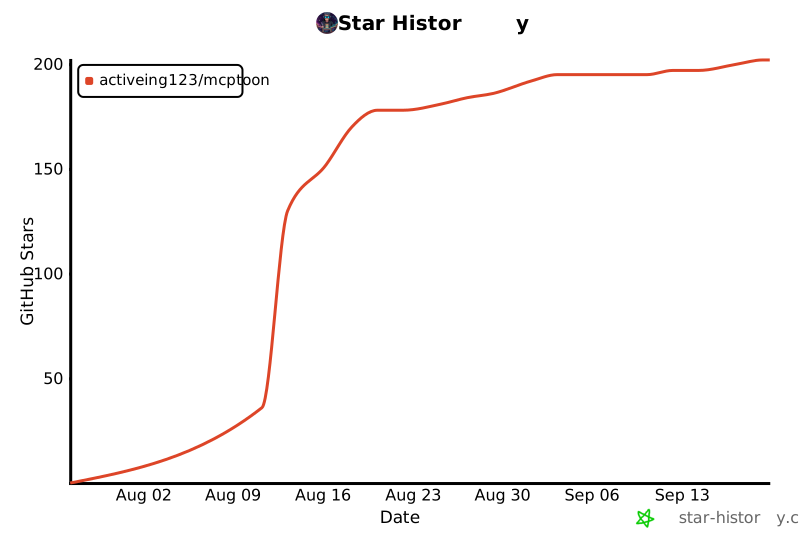
- **[Star the repo](https://github.com/activeing123/mcptoon)** — that's how other builders find small tools.
**Team features are not built yet.** One shared server list synced to every teammate's
machine; a log of what got hydrated when. No pricing and no waitlist page — mail
[activeing123@gmail.com](mailto:activeing123@gmail.com?subject=mcptoon%20team%20features)
and it moves up the list.
---
## License
Apache 2.0. See [LICENSE](https://github.com/activeing123/mcptoon/blob/main/LICENSE) and
[NOTICE](https://github.com/activeing123/mcptoon/blob/main/NOTICE).
---
<div align="center" markdown="1">
*mcptoon is an independent third-party MCP client, not affiliated with Anthropic.*
**If mcptoon cut your context bill, star it — that's how other builders find small tools.**
[](https://star-history.com/#activeing123/mcptoon&Date)
</div>
TDQS
Scored across 12 tools
Each tool has a describable job and the descriptions cross-reference each other (manifest→inspect→call, skills→resolve_skills, index→search→retrieve), which makes the intended chains clear. The weak spot is the meta/status cluster: health, servers, session and usage are all 'report something about the gateway', and an agent may briefly hesitate between health and servers or between session and usage.
Every tool shares the same mcptoon_ namespace prefix and snake_case, so the set reads as one family. The trailing segment mixes verbs (call, inspect, retrieve, resolve_skills) with bare nouns (manifest, session, health, servers, skills, usage), so there is no strict verb_noun grammar, but it is predictable and readable.
Twelve tools is squarely in the sweet spot for a gateway. Each one maps to a distinct need — discover, introspect, invoke, decompress, index, search, skills, and observability — and none looks like filler.
The invoke path (servers→manifest→inspect→call→retrieve) and the skills path are fully covered, with health and usage for diagnostics. The knowledge-base path is the gap: you can index and search, but there is no way to list what is indexed, delete or re-index a stale document, so an agent can create state it cannot clean up.