mcp_mysql_server_pro
Introduction
mcp_mysql_server_pro is not just about MySQL CRUD operations, but also includes database anomaly analysis capabilities and makes it easy for developers to extend with custom tools.
Supports all Model Context Protocol (MCP) transfer modes (STDIO, SSE, Streamable Http)
Supports OAuth2.0
Supports multiple SQL execution, separated by ";"
Supports querying database table names and fields based on table comments
Supports SQL execution plan analysis
Supports Chinese field to pinyin conversion
Supports table lock analysis
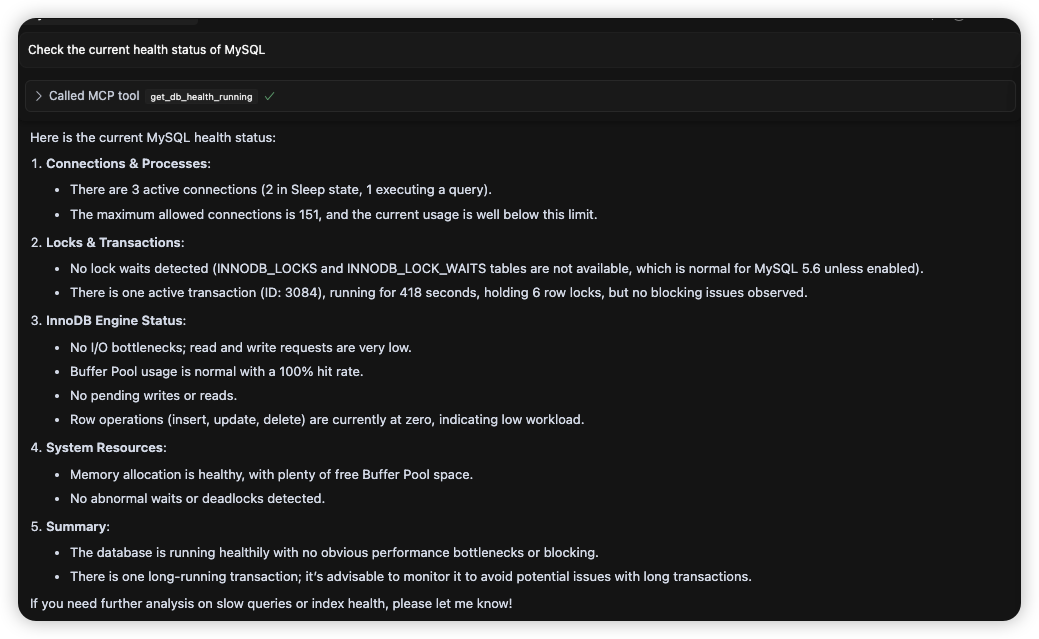
Supports database health status analysis
Supports permission control with three roles: readonly, writer, and admin
"readonly": ["SELECT", "SHOW", "DESCRIBE", "EXPLAIN"],  # Read-only permissions
"writer": ["SELECT", "SHOW", "DESCRIBE", "EXPLAIN", "INSERT", "UPDATE", "DELETE"],  # Read-write permissions
"admin": ["SELECT", "SHOW", "DESCRIBE", "EXPLAIN", "INSERT", "UPDATE", "DELETE",
         "CREATE", "ALTER", "DROP", "TRUNCATE"]  # Administrator permissions
Supports prompt template invocation
Related MCP server: MCP MySQL Server
Tool List
Tool Name | Description |
execute_sql | SQL execution tool that can execute ["SELECT", "SHOW", "DESCRIBE", "EXPLAIN", "INSERT", "UPDATE", "DELETE", "CREATE", "ALTER", "DROP", "TRUNCATE"] commands based on permission configuration |
get_chinese_initials | Convert Chinese field names to pinyin initials |
get_db_health_running | Analyze MySQL health status (connection status, transaction status, running status, lock status detection) |
get_table_desc | Search for table structures in the database based on table names, supporting multi-table queries |
get_table_index | Search for table indexes in the database based on table names, supporting multi-table queries |
get_table_lock | Check if there are row-level locks or table-level locks in the current MySQL server |
get_table_name | Search for table names in the database based on table comments and descriptions |
get_db_health_index_usage | Get the index usage of the currently connected mysql database, including redundant index situations, poorly performing index situations, and the top 5 unused index situations with query times greater than 30 seconds |
optimize_sql | Professional SQL performance optimization tool, providing expert optimization suggestions based on MySQL execution plans, table structure information, table data volume, and table indexes. |
use_prompt_queryTableData | Use built-in prompts to let the model construct a chain call of tools in mcp (not a commonly used fixed tool, you need to modify the code to enable it, see this class for details) |
Prompt List
Prompt Name | Description |
analyzing-mysql-prompt | This is a prompt for analyzing MySQL-related issues |
query-table-data-prompt | This is a prompt for querying table data using tools. If description is empty, it will be initialized as a MySQL database query assistant |
Usage Instructions
Installation and Configuration
Install Package
pip install mysql_mcp_server_pro
Configure Environment Variables
Create a .env file with the following content:
# MySQL Database Configuration
MYSQL_HOST=localhost
MYSQL_PORT=3306
MYSQL_USER=your_username
MYSQL_PASSWORD=your_password
MYSQL_DATABASE=your_database
# Optional, default is 'readonly'. Available values: readonly, writer, admin
MYSQL_ROLE=readonly
Run Service
# SSE mode
mysql_mcp_server_pro --mode sse --envfile /path/to/.env

## Streamable Http mode (default)
mysql_mcp_server_pro --envfile /path/to/.env

# Streamable Http  oauth Authentication
mysql_mcp_server_pro --oauth true
mcp client
go to see see "Use uv to start the service"
^_^
Note:
The .env file should be placed in the directory where you run the command or use --envfile parameter to specify the path
You can also set these variables directly in your environment
Make sure the database configuration is correct and can connect
Run with uvx, Client Configuration
This method can be used directly in MCP-supported clients, no need to download the source code. For example, Tongyi Qianwen plugin, trae editor, etc.
{
	"mcpServers": {
		"mysql": {
			"command": "uvx",
			"args": [
				"--from",
				"mysql_mcp_server_pro",
				"mysql_mcp_server_pro",
				"--mode",
				"stdio"
			],
			"env": {
				"MYSQL_HOST": "192.168.x.xxx",
				"MYSQL_PORT": "3306",
				"MYSQL_USER": "root",
				"MYSQL_PASSWORD": "root",
				"MYSQL_DATABASE": "a_llm",
				"MYSQL_ROLE": "admin"
			}
		}
	}
}
Local Development with Streamable Http mode
Add the following content to your mcp client tools, such as cursor, cline, etc.
mcp json as follows:
{
  "mcpServers": {
    "mysql_mcp_server_pro": {
      "name": "mysql_mcp_server_pro",
      "type": "streamableHttp",
      "description": "",
      "isActive": true,
      "url": "http://localhost:3000/mcp/"
    }
  }
}
Modify the .env file content to update the database connection information with your database details:
# MySQL Database Configuration
MYSQL_HOST=192.168.xxx.xxx
MYSQL_PORT=3306
MYSQL_USER=root
MYSQL_PASSWORD=root
MYSQL_DATABASE=a_llm
MYSQL_ROLE=admin
Start commands:
# Download dependencies
uv sync

# Start
uv run -m mysql_mcp_server_pro.server

# Custom env file location
uv run -m mysql_mcp_server_pro.server --envfile /path/to/.env

# oauth Authentication
uv run -m mysql_mcp_server_pro.server --oauth true
Local Development with SSE Mode
Add the following content to your mcp client tools, such as cursor, cline, etc.
mcp json as follows:
{
  "mcpServers": {
    "mysql_mcp_server_pro": {
      "name": "mysql_mcp_server_pro",
      "description": "",
      "isActive": true,
      "url": "http://localhost:9000/sse"
    }
  }
}
Modify the .env file content to update the database connection information with your database details:
# MySQL Database Configuration
MYSQL_HOST=192.168.xxx.xxx
MYSQL_PORT=3306
MYSQL_USER=root
MYSQL_PASSWORD=root
MYSQL_DATABASE=a_llm
MYSQL_ROLE=admin
Start commands:
# Download dependencies
uv sync

# Start
uv run -m mysql_mcp_server_pro.server --mode sse

# Custom env file location
uv run -m mysql_mcp_server_pro.server --mode sse --envfile /path/to/.env
Local Development with STDIO Mode
Add the following content to your mcp client tools, such as cursor, cline, etc.
mcp json as follows:
{
  "mcpServers": {
      "operateMysql": {
        "isActive": true,
        "name": "operateMysql",
        "command": "uv",
        "args": [
          "--directory",
          "/Volumes/mysql_mcp_server_pro/src/mysql_mcp_server_pro",    # Replace this with your project path
          "run",
          "-m",
          "mysql_mcp_server_pro.server",
          "--mode",
          "stdio"
        ],
        "env": {
          "MYSQL_HOST": "localhost",
          "MYSQL_PORT": "3306",
          "MYSQL_USER": "root",
          "MYSQL_PASSWORD": "123456",
          "MYSQL_DATABASE": "a_llm",
          "MYSQL_ROLE": "admin"
       }
    }
  }
}
Custom Tool Extensions
Add a new tool class in the handles package, inherit from BaseHandler, and implement get_tool_description and run_tool methods
Import the new tool in init.py to make it available in the server
OAuth2.0 Authentication
Start the authentication service. By default, it uses the built-in OAuth 2.0 password mode authentication. You can modify your own authentication service address in the env file.
uv run -m mysql_mcp_server_pro.server --oauth true
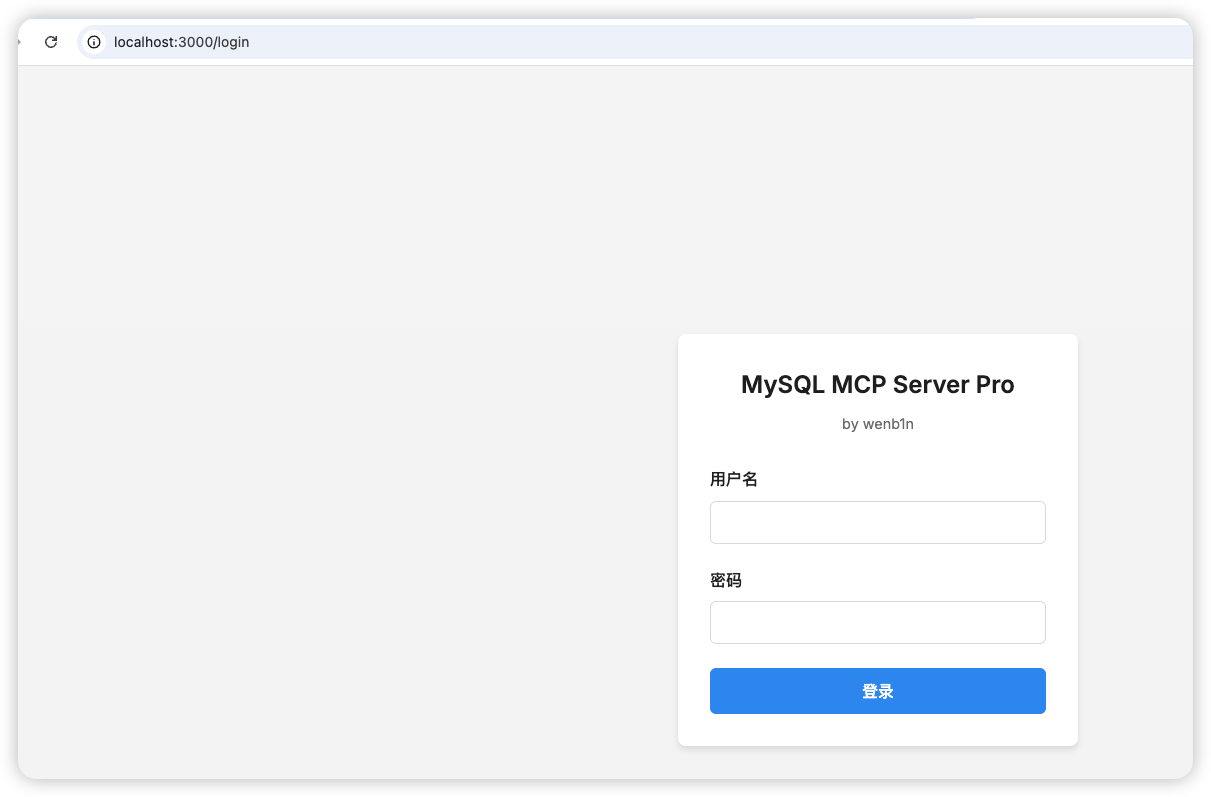
Visit the authentication service at http://localhost:3000/login. Default username and password are configured in the env file.
Copy the token and add it to the request headers, for example:
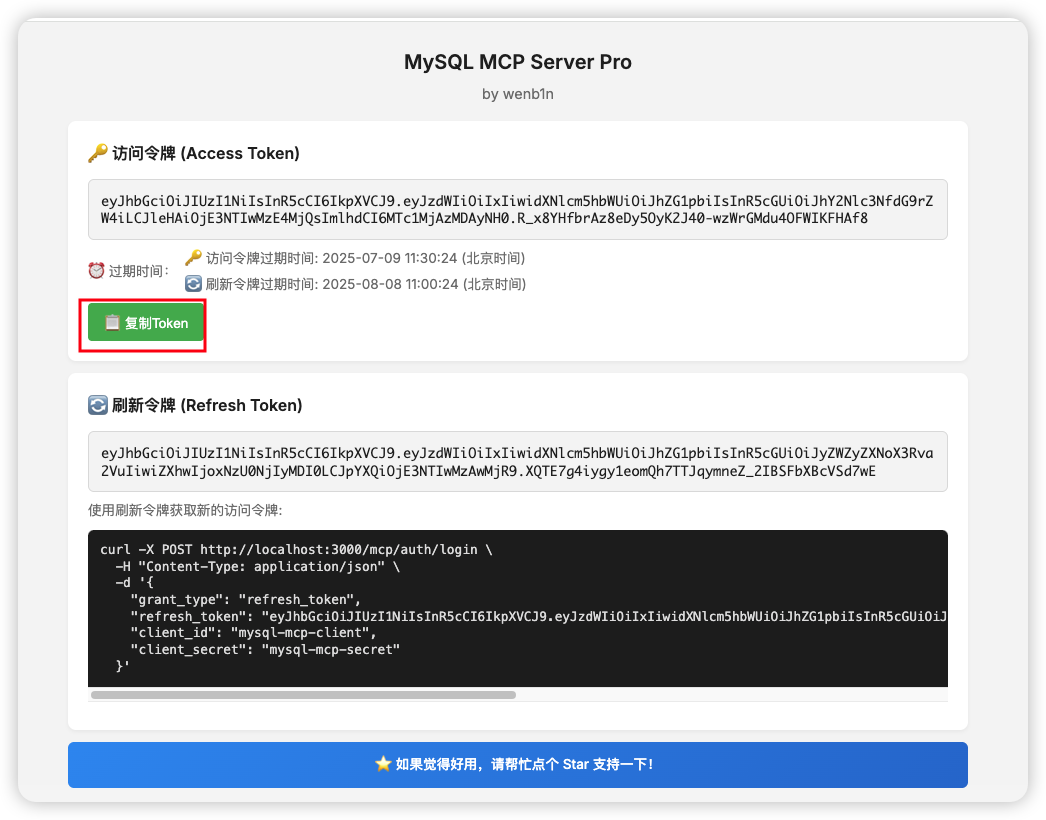
{
  "mcpServers": {
    "mysql_mcp_server_pro": {
      "name": "mysql_mcp_server_pro",
      "type": "streamableHttp",
      "description": "",
      "isActive": true,
      "url": "http://localhost:3000/mcp/",
      "headers": {
        "authorization": "bearer TOKEN_VALUE"
      }
    }
  }
}
Examples
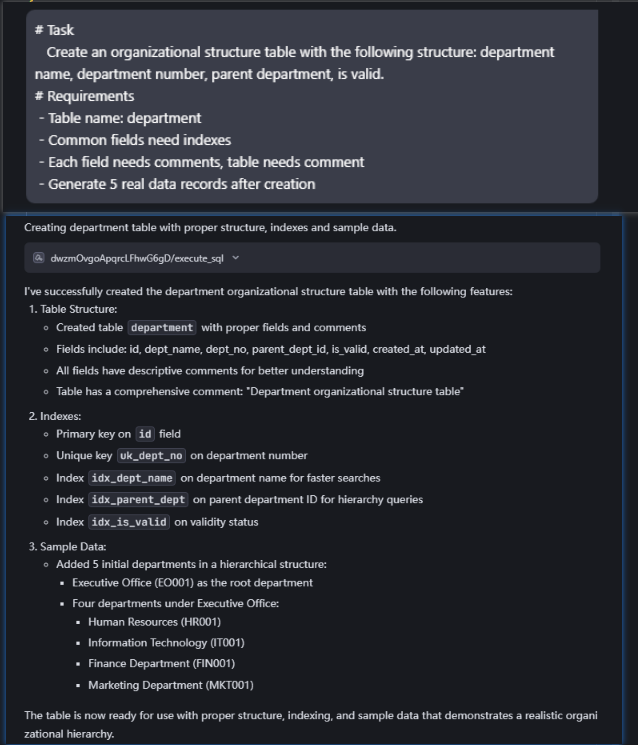
Create a new table and insert data, prompt format as follows:
# Task
   Create an organizational structure table with the following structure: department name, department number, parent department, is valid.
# Requirements
 - Table name: department
 - Common fields need indexes
 - Each field needs comments, table needs comment
 - Generate 5 real data records after creation

Query data based on table comments, prompt as follows:
Search for data with Department name 'Executive Office' in Department organizational structure table

Analyze slow SQL, prompt as follows:
select * from t_jcsjzx_hjkq_cd_xsz_sk xsz
left join t_jcsjzx_hjkq_jcd jcd on jcd.cddm = xsz.cddm
Based on current index situation, review execution plan and provide optimization suggestions in markdown format, including table index status, execution details, and optimization recommendations
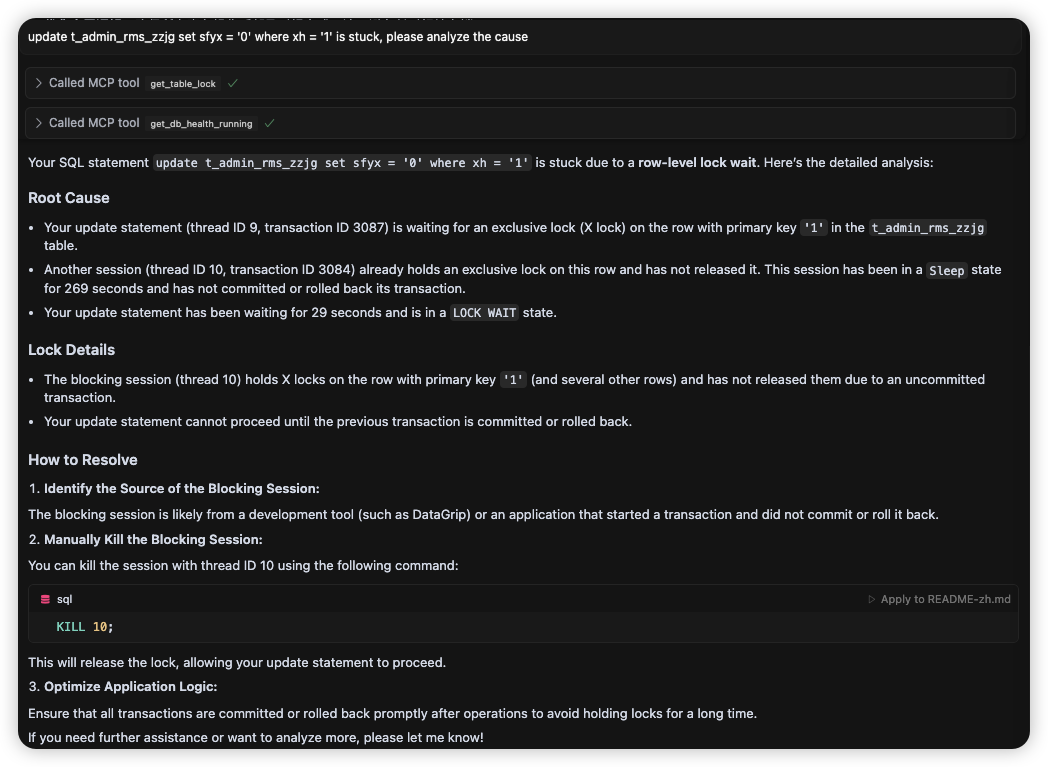
Analyze SQL deadlock issues, prompt as follows:
update t_admin_rms_zzjg set sfyx = '0' where xh = '1' is stuck, please analyze the cause
Analyze the health status prompt as follows
Check the current health status of MySQL