
mal-mcp
# myanimelist-mcp
[](https://pypi.org/project/myanimelist-mcp/)
[](https://pypi.org/project/myanimelist-mcp/)
[](https://github.com/UmutKDev/myanimelist-mcp/blob/main/LICENSE)
An [MCP](https://modelcontextprotocol.io) server that exposes your
[MyAnimeList](https://myanimelist.net) data — watch list, scores, progress, rankings,
recommendations — as tools, plus a premium **[MCP Apps](https://github.com/modelcontextprotocol/ext-apps)
UI** that renders those results as an interactive, anime-styled interface right inside the
chat. Any assistant that speaks MCP can analyze your taste, browse seasons, and edit your
list; on hosts that support MCP Apps it does so through the UI below.
Python 3.12 · [FastMCP 3](https://gofastmcp.com) (stdio) · React + Vite for the UI.
## Installation
Requires [uv](https://docs.astral.sh/uv/). No clone, no build, no Docker.
```bash
uvx myanimelist-mcp
```
The server speaks MCP over **stdio**: it prints nothing and waits on stdin for JSON-RPC, so
running it by hand looks like a hang — that is correct behaviour. Your MCP client is what
launches it. Add it to your client config — macOS
`~/Library/Application Support/Claude/claude_desktop_config.json`,
Windows `%APPDATA%\Claude\claude_desktop_config.json`:
```json
{
"mcpServers": {
"myanimelist": {
"command": "uvx",
"args": ["myanimelist-mcp"],
"env": {
"MAL_CLIENT_ID": "your-client-id",
"MAL_CLIENT_SECRET": "your-client-secret",
"MAL_REFRESH_TOKEN": "your-refresh-token",
"MAL_TIMEZONE": "Europe/Istanbul"
}
}
}
}
```
Then quit and reopen the client completely. See [Authentication](#authentication) for how to
get those credentials.
> **`spawn uvx ENOENT`?** Desktop clients launch servers with a minimal `PATH` that usually
> excludes `~/.local/bin`. Run `which uvx` and put the absolute path in `"command"`.
> **Your credentials live in that file in plaintext**, and stderr from this server is
> persisted by some clients (e.g. `~/Library/Logs/Claude/`). Consider `chmod 600` on the
> config, and revoke the MAL token if you ever share logs.
For Claude Code:
```bash
claude mcp add --env MAL_CLIENT_ID=… --env MAL_REFRESH_TOKEN=… \
--transport stdio myanimelist -- uvx myanimelist-mcp
```
Pinning a version, or installing with pip instead:
```bash
uvx --from 'myanimelist-mcp==X.Y.Z' myanimelist-mcp
pip install myanimelist-mcp # then "command": "myanimelist-mcp"
# or "command": "python", "args": ["-m", "mal_mcp"]
```
## The interface
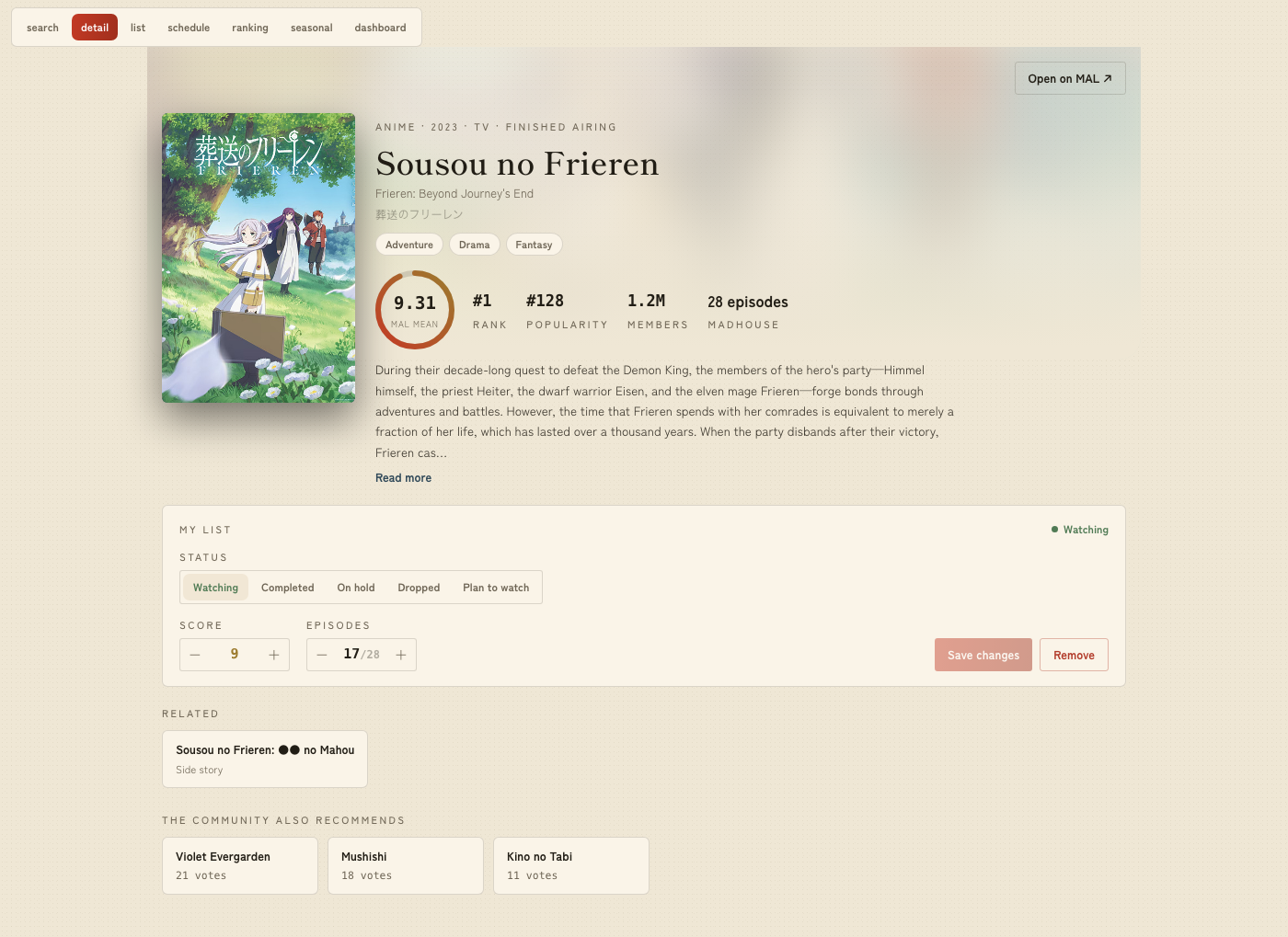
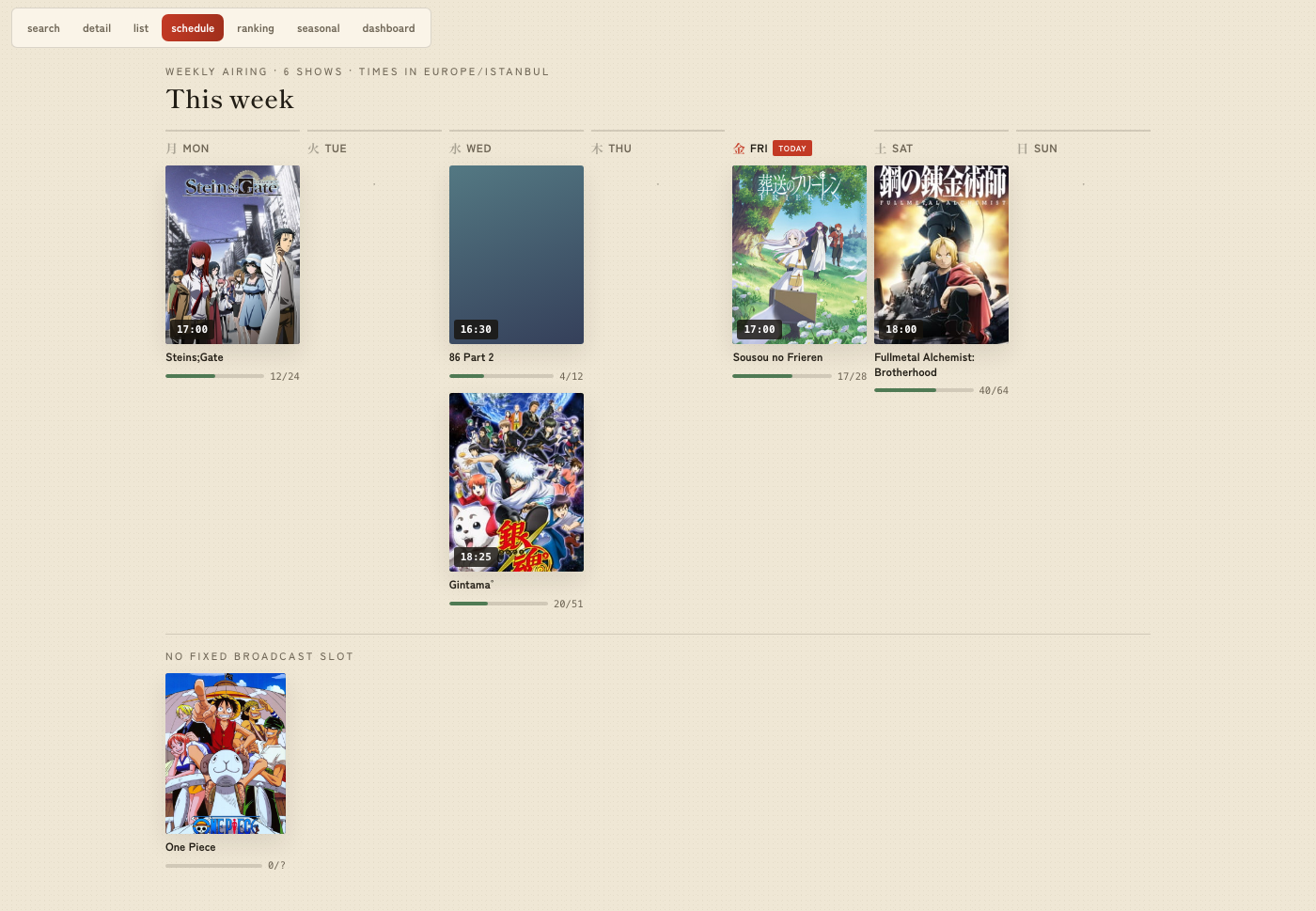
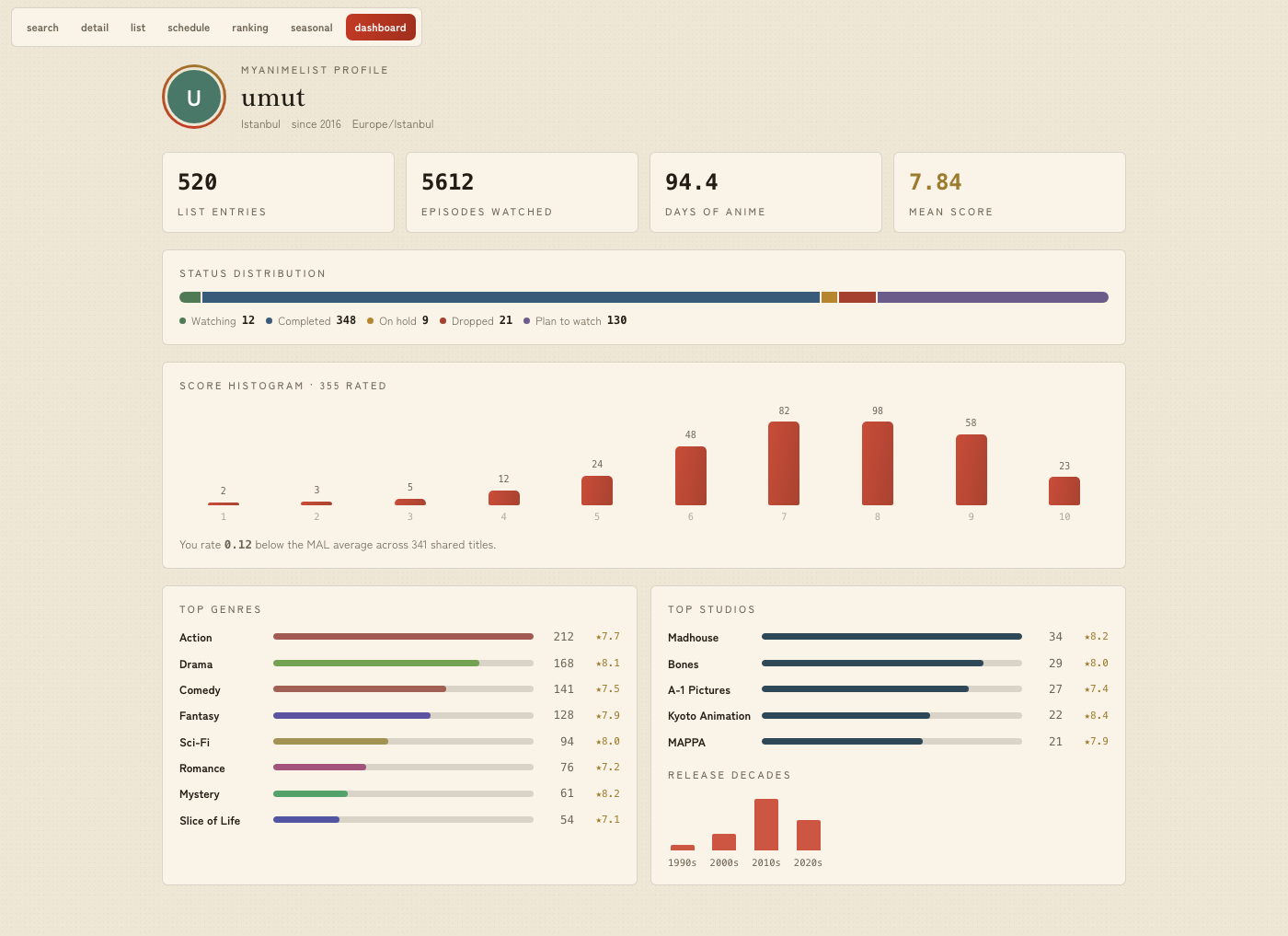
Each read tool ships a `ui://` app resource alongside its text summary, so hosts that support
[MCP Apps](https://modelcontextprotocol.io/extensions/client-matrix) render the result as a
live view. The model still receives the compact text summary; the full data travels to the
iframe as structured content. Where the host has no MCP Apps support, the tools degrade to
those text summaries and everything still works.

<table>
<tr>
<td width="50%"><img src="https://raw.githubusercontent.com/UmutKDev/myanimelist-mcp/main/docs/screenshots/list.png" alt="List browser with status tabs, filter/sort, and inline editing"></td>
<td width="50%"><img src="https://raw.githubusercontent.com/UmutKDev/myanimelist-mcp/main/docs/screenshots/ranking.png" alt="MAL rankings with rank-movement indicators"></td>
</tr>
</table>
The detail and list views edit your MAL entries in place (status / score / progress) and
navigate between titles — all through the same tools, so nothing UI-only happens behind the
model's back. The theme follows the host's light/dark mode; cover art loads from MAL's CDN.
## Tools
**Anime**
| Tool | Description |
|------|-------------|
| `get_my_anime_list(status_filter?, sort?, limit=100, offset=0)` | A page of your list: title, cover, watch status, score, episode progress, genres, community mean, studios. |
| `get_user_stats()` | Locally computed summary: status/score/genre/media-type/decade distributions, total episodes, estimated watch time, user-vs-community score deviation, top studios. |
| `search_anime(query, limit=10)` | Public catalog search (compact results with covers, truncated synopsis). |
| `get_anime_detail(anime_id)` | Full public detail incl. related anime, recommendations, statistics, and your own list entry if present. |
| `analyze_taste()` | Token-efficient raw export of the whole list (grouped by status, sorted by score) for the calling model to analyze — this tool itself performs **no** analysis. |
**Manga**
| Tool | Description |
|------|-------------|
| `search_manga(query, limit=10)` | Public manga catalog search (chapters/volumes, authors, genres). |
| `get_manga_detail(manga_id)` | Full manga detail incl. authors, serialization magazines, related works, recommendations, and your own entry if present. |
| `get_my_manga_list(status_filter?, sort?, limit=100, offset=0)` | A page of your manga list with chapter/volume progress. |
**Discovery**
| Tool | Description |
|------|-------------|
| `get_anime_ranking(ranking_type, limit=25)` | MAL's official rankings: all, airing, upcoming, tv, ova, movie, special, bypopularity, favorite. |
| `get_manga_ranking(ranking_type, limit=25)` | Manga rankings: all, manga, novels, oneshots, doujin, manhwa, manhua, bypopularity, favorite. |
| `get_seasonal_anime(year, season, sort?, limit=25)` | Anime of one broadcast season (winter/spring/summer/fall). |
| `get_suggested_anime(limit=25)` | MAL's personalized suggestions for the authenticated user. |
| `get_weekly_schedule(timezone?)` | Your personal weekly airing calendar: the currently-airing anime on your `watching` list, grouped by broadcast day. Uses the `timezone` argument, else the `MAL_TIMEZONE` env var, else MAL's native JST. |
**Users**
| Tool | Description |
|------|-------------|
| `get_my_profile()` | Your profile + lifetime anime statistics. MAL exposes this only for `@me`. |
| `get_user_anime_list(user_name, ...)` | Another user's **public** anime list (403 usually = private list or unknown user). |
| `get_user_manga_list(user_name, ...)` | Another user's **public** manga list. |
**Write tools — these modify your MAL list**
| Tool | Description |
|------|-------------|
| `update_my_anime_entry(anime_id, ...)` | Update score/status/episode progress/tags — or add the anime to the list. Only provided fields change. |
| `delete_my_anime_entry(anime_id)` | **Permanently** remove an anime from the list (cannot be undone). |
| `update_my_manga_entry(manga_id, ...)` | Same as the anime variant, with chapter/volume progress. |
| `delete_my_manga_entry(manga_id)` | **Permanently** remove a manga from the list. |
Aggregate tools (`get_user_stats`, `analyze_taste`) fetch the entire list in one paginated
pass (safety cap: 20,000 entries — beyond that a `truncated`/WARNING marker is included).
`paging.next` URLs are validated (`https` + `api.myanimelist.net`) before being followed, so
the bearer token can never be sent elsewhere. Verified MAL API facts (fields syntax,
pagination, limits, error shapes) are documented in [NOTES.md](https://github.com/UmutKDev/myanimelist-mcp/blob/main/NOTES.md).
## Development
```bash
uv sync # install Python dependencies
uv run pytest # unit tests (pure helpers, no network)
uv run myanimelist-mcp # run the server over stdio (waits on stdin for JSON-RPC)
```
### Building the UI
The server runs without the UI bundle (it serves a small placeholder), so a clone never needs
Node. To build the real interface:
```bash
cd ui
npm ci
npm run build # emits src/mal_mcp/ui/dist/index.html (a single self-contained file)
```
For UI development without a host, `npm run dev` in `ui/` renders every view with fixture
data and a view switcher — the screenshots above are those views.
Released wheels always ship a freshly built bundle: `.github/workflows/publish.yml` builds it
before `uv build` and fails the release if it is missing.
## Authentication
The server needs a MyAnimeList access token and stores nothing on disk. Set the credentials in
the `"env"` block of your MCP client config, in one of two ways (this is the precedence order):
1. **`MAL_REFRESH_TOKEN` (+ `MAL_CLIENT_ID`, `MAL_CLIENT_SECRET`)** — recommended. The server
mints and renews access tokens itself via the OAuth `refresh_token` grant, in memory only.
Set up once, no monthly re-pasting.
2. **`MAL_ACCESS_TOKEN`** — a static token (expires ~31 days); simplest for a quick test.
### Getting a MAL token
1. Create an API app at <https://myanimelist.net/apiconfig> → **Create ID**, **App Type: `Web`**
(this is what makes MAL issue a Client Secret). Set the redirect URL to your OAuth
callback, or a localhost URL like `http://localhost:8080/callback` for the manual flow.
2. MAL uses **`plain` PKCE only** (no `S256`), so the code verifier and challenge are the
same string. Obtain a token once:
```bash
# 1) code verifier (43-128 chars); challenge == verifier for plain PKCE
VERIFIER=$(python3 -c "import secrets; print(secrets.token_urlsafe(64)[:100])")
# 2) open in a browser, log in, approve — you get ?code=<CODE> at your redirect URL:
# https://myanimelist.net/v1/oauth2/authorize?response_type=code&client_id=<CLIENT_ID>&code_challenge=$VERIFIER&code_challenge_method=plain&state=x&redirect_uri=<URL_ENCODED_REDIRECT_URL>
# 3) exchange the code for tokens:
curl -s https://myanimelist.net/v1/oauth2/token \
-d client_id=<CLIENT_ID> -d client_secret=<CLIENT_SECRET> \
-d grant_type=authorization_code -d code=<CODE> \
-d code_verifier=$VERIFIER -d redirect_uri=<REDIRECT_URL>
# → {"token_type":"Bearer","expires_in":2678400,"access_token":"...","refresh_token":"..."}
```
Keep the **`refresh_token`** for `MAL_REFRESH_TOKEN` (option 1), or the `access_token` for
`MAL_ACCESS_TOKEN` (option 2).
### Environment variables
| Variable | Default | Purpose |
|----------|---------|---------|
| `MAL_REFRESH_TOKEN` | *(unset)* | Enables self-renewing tokens via the `refresh_token` grant (needs `MAL_CLIENT_ID`). In-memory only. |
| `MAL_CLIENT_ID` | *(unset)* | MAL app Client ID, for the refresh grant. |
| `MAL_CLIENT_SECRET` | *(unset)* | MAL app Client Secret — required for "Web"-type apps. |
| `MAL_ACCESS_TOKEN` | *(unset)* | Static fallback token (expires ~31 days). |
| `MAL_TIMEZONE` | *(unset → JST)* | Default IANA timezone for `get_weekly_schedule` (e.g. `Europe/Istanbul`). The tool's `timezone` argument overrides it. |
## Project layout
```
src/mal_mcp/
├── server.py # FastMCP app, token helper, 20 tools, stats/format/summary helpers
├── mal_client.py # MAL API wrapper: fields, pagination (paging.next), retries, error mapping
├── token_manager.py# self-renewing OAuth refresh_token grant (in-memory)
├── __main__.py # `python -m mal_mcp`
└── ui/ # MCP Apps layer: ui:// resource + meta/ToolResult helpers
└── dist/ # built single-file HTML bundle (gitignored; built by CI for releases)
ui/ # Vite + React + TypeScript app (motion animations, 6 views)
tests/ # offline unit tests (pure helpers, token manager, UI contract)
NOTES.md # verified MAL API / FastMCP facts
```
The PyPI distribution is `myanimelist-mcp`; the import package is `mal_mcp`.
## License
[MIT](https://github.com/UmutKDev/myanimelist-mcp/blob/main/LICENSE)
TDQS
Scored across 20 tools
Each tool targets a distinct operation (search, get detail, list user list, update entry, delete entry, etc.) with clear boundaries. Overlap between get_my_anime_list and analyze_taste is addressed by descriptions, with analyze_taste exporting raw data for model analysis.
All tools follow a consistent verb_noun pattern (e.g., search_anime, get_manga_detail, update_my_anime_entry). The few variations like get_my_anime_list vs get_user_anime_list are justified by different targets.
20 tools is well-scoped for a comprehensive MyAnimeList client, covering catalog queries, user list management, rankings, seasonal, suggestions, schedule, and profile. No excessive or missing tools for the domain.
The tool set covers virtually all major MAL operations: search/get detail for anime and manga, full CRUD on user lists, rankings, seasonal anime, suggestions, weekly schedule, user profiles, and other users' lists. No significant gaps for personal anime/manga tracking.