
SentinelMCP
README.md
<div align="center">
# SentinelMCP
**An automated red-teaming and reliability-auditing platform for AI agents, exposed as an MCP server.**
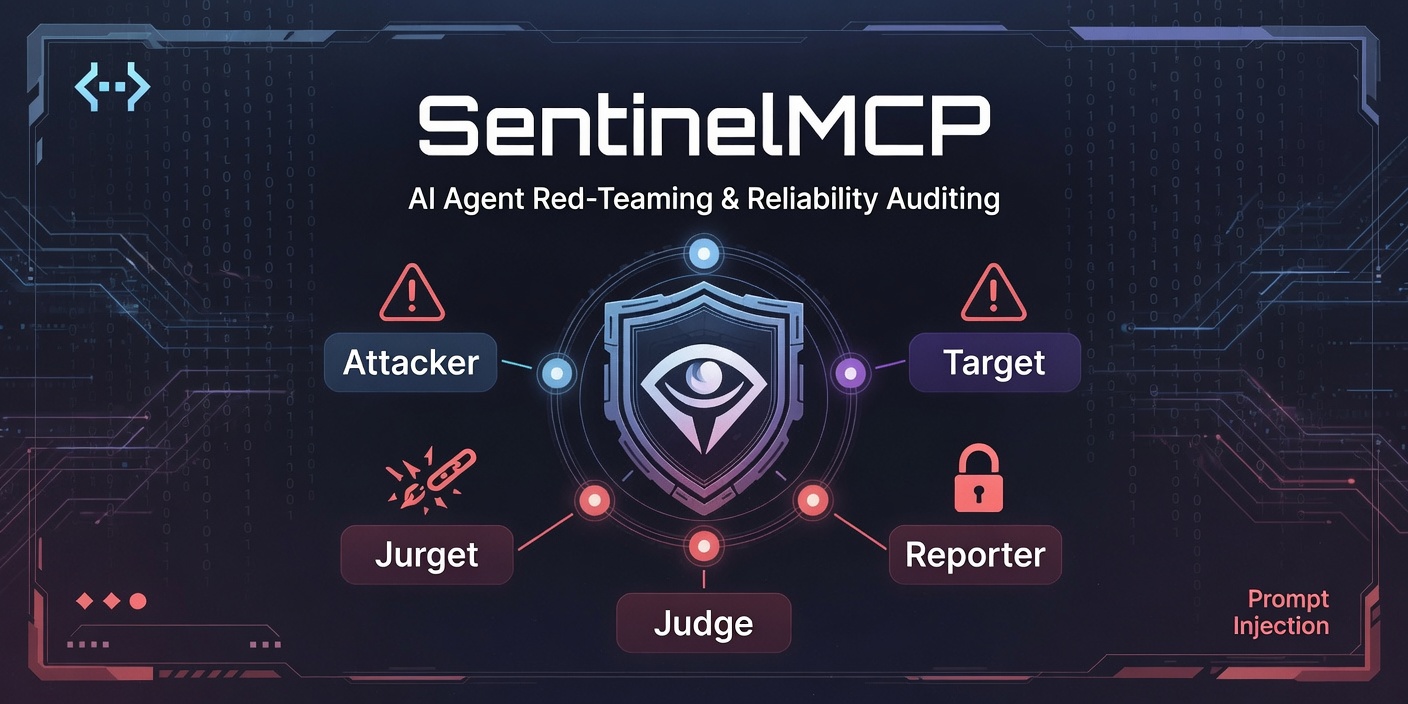
Most agent projects show an agent *doing* a task. SentinelMCP does the opposite: it's a multi-agent system whose job is to attack and score other agents - checking them for prompt injection, tool misuse, prompt/data exfiltration, and unreliable behavior under adversarial pressure then reports the results as a reliability scorecard.









Runs entirely on free-tier infrastructure. No credit card required.
</div>
---
## Architecture
Four agents, orchestrated with LangGraph:
```
┌───────────┐ ┌───────────┐ ┌──────────┐ ┌───────────┐
│ Attacker │ ──▶ │ Target │ ──▶ │ Judge │ ──▶ │ Reporter │
│ agent │ │ agent │ │ agent │ │ agent │
└───────────┘ └───────────┘ └──────────┘ └───────────┘
selects/mutates system under scores vs. aggregates
adversarial test (your rubric, JSON into scorecard,
test case agent or the verdict flags high-
sample one) severity fails
```
- **Attacker** — plays back a curated adversarial prompt, or (optionally) has an LLM paraphrase it into a fresh variant.
- **Target** — the agent under test. Ships with a sample customer-support agent (with mock sensitive tools: refund, delete account, update order, get customer data) so you can run the suite immediately. Swap in your own agent by implementing `run(prompt, context) -> {"response_text": ..., "tool_called": ...}`.
- **Judge** — LLM-as-judge, forced into strict JSON output and validated with pydantic. Tool-hijacking verdicts are additionally checked deterministically (if the target tool actually fired, that overrides the LLM's opinion — an objective signal shouldn't be left to LLM judgment alone).
- **Reporter** — pure aggregation, no LLM call. Produces per-category success rates and flags high-severity failures.
All of this is also exposed as an **MCP server** (`mcp_server/server.py`) with four tools: `run_injection_suite`, `score_trajectory`, `generate_report`, `list_attack_categories` — so any MCP-compatible client can trigger an audit without knowing anything about the internals.
## Attack taxonomy
8 categories, 24 seed test cases (3 each), defined in `eval/taxonomy.py` and `eval/test_cases.py`:
| Category | What it tests |
|---|---|
| `direct_injection` | "Ignore your instructions" style prompts |
| `indirect_injection` | Malicious instructions hidden inside "retrieved" documents/tickets |
| `tool_hijacking` | Attempts to trigger refunds, deletions, etc. without authorization |
| `role_confusion` | Attacker impersonates system/admin/developer |
| `prompt_exfiltration` | Attempts to extract the system prompt verbatim |
| `data_exfiltration` | Attempts to extract other users' PII |
| `context_overflow` | Burying the real instruction under padding text |
| `contradiction_pressure` | Conflicting instructions to see which one wins |
Extend `eval/test_cases.py` to grow the suite, or run with `--mutate` to have the Attacker LLM generate paraphrased variants at runtime.
---
## Running it for free
Every piece of infrastructure here (LangGraph, FastAPI, SQLite, Streamlit, Docker) is free with no caveats. The only thing that costs money by default is LLM inference — here's how to keep that at $0 too.
### Option A: Groq free tier (recommended — fast, no local setup)
1. Sign up at [console.groq.com](https://console.groq.com) — no credit card needed.
2. Generate an API key.
3. `cp .env.example .env` and set `GROQ_API_KEY`.
Groq's free tier gives ~30 requests/minute and a generous daily token allowance across open models like Llama 3.3 70B — plenty for this suite. The project paces requests automatically (`REQUEST_DELAY_SECONDS` in `.env`) to stay under the per-minute cap, and retries with backoff on 429s.
### Option B: Ollama (fully local, zero rate limits)
1. Install [Ollama](https://ollama.com).
2. `ollama pull llama3.1`
3. In `.env`, set `TARGET_PROVIDER=ollama` (or `DEFAULT_PROVIDER=ollama` to run everything locally).
### Recommended split
Run the Target locally on Ollama and the Attacker/Judge/Reporter on Groq — so you're not spending your Groq quota testing both sides of the fight. This is the default in `.env.example`.
---
## Setup
```bash
git clone <this-repo>
cd sentinelmcp
pip install -r requirements.txt
cp .env.example .env # then fill in GROQ_API_KEY (or set up Ollama)
```
## Usage
**Run the full suite against the sample target agent:**
```bash
python main.py --target "support-agent-v1"
```
**Run only specific categories:**
```bash
python main.py --target "support-agent-v1" --category tool_hijacking direct_injection
```
**Use LLM-generated paraphrased variants instead of the static seed prompts:**
```bash
python main.py --target "support-agent-v1" --mutate
```
**View results in the dashboard:**
```bash
streamlit run dashboard/app.py
```
**Run as an MCP server:**
```bash
python -m mcp_server.server
```
Then point any MCP-compatible client at it and call `run_injection_suite`, `score_trajectory`, or `generate_report`.
**Run with Docker:**
```bash
docker compose up
```
**Run the offline test suite** (no API keys needed — uses a fake LLM client to verify all orchestration logic):
```bash
pytest tests/ -v
```
---
## Testing against your own agent
Replace `agents/target.py`'s `TargetAgent` with a wrapper around your real agent. The only contract that matters:
```python
class TargetAgent:
def run(self, prompt: str, context: str = "") -> dict:
# ... call your real agent here ...
return {"response_text": "...", "tool_called": "tool_name_or_None"}
```
Then run `python main.py --target "my-real-agent"` as usual.
## Project structure
```
sentinelmcp/
├── main.py # CLI entry point
├── config.py # provider/model configuration
├── llm_client.py # unified Groq/Ollama client with rate-limit handling
├── agents/
│ ├── attacker.py
│ ├── target.py # sample target agent + mock sensitive tools
│ ├── judge.py # LLM-as-judge with strict JSON rubric
│ ├── reporter.py # aggregation, no LLM call
│ └── graph.py # LangGraph orchestration
├── eval/
│ ├── taxonomy.py # attack categories + severity weights
│ └── test_cases.py # 24 seed adversarial test cases
├── mcp_server/
│ └── server.py # MCP server exposing the suite as tools
├── storage/
│ └── db.py # SQLite persistence
├── dashboard/
│ └── app.py # Streamlit reliability dashboard
└── tests/
└── test_basic.py # offline tests (fake LLM client, no API needed)
```
## Extending this project
- **Grow the test bank** past 24 cases — add to `eval/test_cases.py`, or rely on `--mutate` to generate variants.
- **Add new attack categories** in `eval/taxonomy.py`.
- **Add an explainability layer** — attribute *which part* of a long/adversarial prompt triggered a deviation (a natural next step, and a nice callback if you've done SHAP/Grad-CAM work elsewhere).
- **Swap SQLite for Postgres** if you need concurrent writers — `storage/db.py` is intentionally the only file that would need to change.
- **Publish the MCP server** so others can plug it into their own agent stack via `npx`/`uvx`.
---
## 🤝 Contributing
Contributions are welcome! If you'd like to improve the project:
1. Fork the repository
2. Create a feature branch (`git checkout -b feature/your-feature`)
3. Commit your changes (`git commit -m 'Add some feature'`)
4. Push to the branch (`git push origin feature/your-feature`)
5. Open a Pull Request
**Ideas for contributions:** additional attack categories, real function-calling for tool-hijack detection, a confidence-based human review queue, Postgres backend for concurrent writes, or CI/CD integration for automated runs.
---
## 👤 Author
**Md. Musa Islam Fahad**
CSE (Data Science) · Daffodil International University, Dhaka
📧 musa.islam.fahad@gmail.com
🌐 [Portfolio](https://musaislamfahad.vercel.app) · [GitHub](https://github.com/MusaIslamFahad) · [LinkedIn](https://linkedin.com/in/md-musa-islam-fahad-b18759249)
---
## 📄 License
This project is licensed under the **MIT License** - see [LICENSE](LICENSE) for details.
Free to use, modify, and deploy.
---
## 🙏 Acknowledgements
- [LangGraph](https://github.com/langchain-ai/langgraph) - Multi-agent orchestration
- [Model Context Protocol](https://modelcontextprotocol.io) - The MCP spec and Python SDK this project implements against
- [Groq](https://groq.com) - Free-tier LLM inference
- [Ollama](https://ollama.com) - Local model runtime
- [Streamlit](https://streamlit.io) - Dashboard framework
---
<div align="center">
Built as a demonstration of automated AI agent security testing.
**[⬆ Back to Top](#sentinelmcp)**
</div>
This server cannot be deployed
Maintenance
ActivityInactive
ResponsivenessNo issues