NotebookLM MCP Server
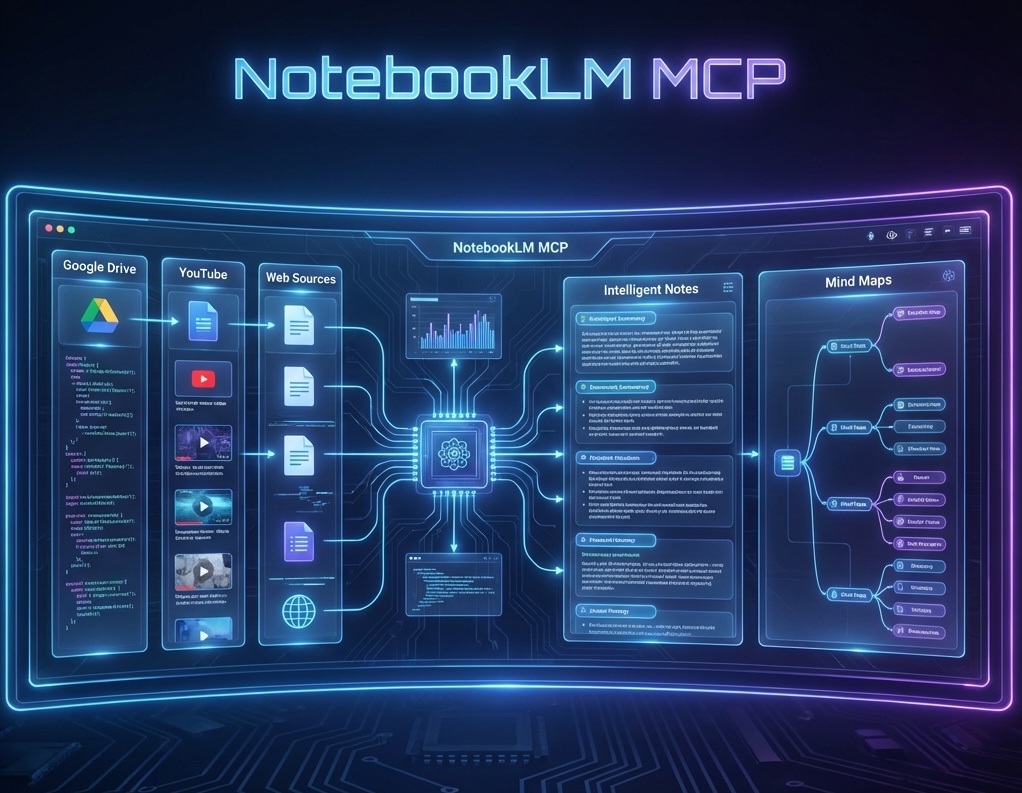
Allows adding Google Drive documents as sources to notebooks, listing source freshness status, and synchronizing stale Drive sources.
Supports adding YouTube videos as content sources to notebooks for AI-powered research and analysis.
Click on "Install Server".
Wait a few minutes for the server to deploy. Once ready, it will show a "Started" state.
In the chat, type
@followed by the MCP server name and your instructions, e.g., "@NotebookLM MCP ServerSummarize my AI Research notebook and generate an audio overview."
That's it! The server will respond to your query, and you can continue using it as needed.
Here is a step-by-step guide with screenshots.
NotebookLM MCP Server

An MCP server for NotebookLM (notebooklm.google.com).
Note: Tested with Pro/free tier accounts. May work with NotebookLM Enterprise accounts but has not been tested.
📺 Watch the Demos
General Overview | Claude Desktop | Perplexity Desktop | MCP Super Assistant |
|

|

|

|
Features
Tool | Description |
| List all notebooks |
| Create a new notebook |
| Get notebook details with sources |
| Get AI-generated summary of notebook content |
| Get AI-generated summary and keywords for a source |
| Get raw text content from a source (no AI processing) |
| Rename a notebook |
| Configure chat goal/style and response length |
| Delete a notebook (requires confirmation) |
| Add URL/YouTube as source |
| Add pasted text as source |
| Add Google Drive document as source |
| Ask questions and get AI answers |
| List sources with freshness status |
| Sync stale Drive sources (requires confirmation) |
| Delete a source from notebook (requires confirmation) |
| Start Web or Drive research to discover sources |
| Poll research progress with built-in wait |
| Import discovered sources into notebook |
| Generate audio podcasts (requires confirmation) |
| Generate video overviews (requires confirmation) |
| Generate infographics (requires confirmation) |
| Generate slide decks (requires confirmation) |
| Check studio artifact generation status |
| Delete studio artifacts (requires confirmation) |
| Reload auth tokens from disk or run headless re-auth |
| Save cookies for authentication |
Related MCP server: NotebookLM MCP Server
Important Disclaimer
This MCP uses internal APIs that:
Are undocumented and may change without notice
Require cookie extraction from your browser (I have a tool for that!)
Use at your own risk for personal/experimental purposes.
Installation
Install from PyPI using your preferred Python package manager:
Using uv (Recommended)
uv tool install notebooklm-mcp-serverUsing pip
pip install notebooklm-mcp-serverUsing pipx
pipx install notebooklm-mcp-server# Clone the repository
git clone https://github.com/jacob-bd/notebooklm-mcp.git
cd notebooklm-mcp
# Install with uv
uv tool install .Upgrading
# Using uv
uv tool upgrade notebooklm-mcp-server
# Using pip
pip install --upgrade notebooklm-mcp-server
# Using pipx
pipx upgrade notebooklm-mcp-serverAfter upgrading, restart your AI tool to reconnect to the updated MCP server:
Claude Code: Restart the application, or use
/mcpto reconnectCursor: Restart the application
Gemini CLI: Restart the CLI session
Uninstalling
To completely remove the MCP:
# Using uv
uv tool uninstall notebooklm-mcp-server
# Using pip
pip uninstall notebooklm-mcp-server
# Using pipx
pipx uninstall notebooklm-mcp-server
# Remove cached auth tokens (optional)
rm -rf ~/.notebooklm-mcpAlso remove from your AI tools:
Tool | Command |
Claude Code |
|
Gemini CLI |
|
Cursor/VS Code | Remove entry from |
Authentication
Before using the MCP, you need to authenticate with NotebookLM. Run:
# Recommended: Auto mode (launches Chrome, you log in)
notebooklm-mcp-auth
# Alternative: File mode (manual cookie extraction)
notebooklm-mcp-auth --fileAuto mode launches a dedicated Chrome profile, you log in to Google, and cookies are extracted automatically. Your login persists for future auth refreshes.
File mode shows instructions for manually extracting cookies from Chrome DevTools and saving them to a file.
After successful auth, add the MCP to your AI tool and restart.
For detailed instructions, troubleshooting, and how the authentication system works, see docs/AUTHENTICATION.md.
MCP Configuration
⚠️ Context Window Warning: This MCP provides 31 tools which consume a significant portion of your context window. It's recommended to disable the MCP when not actively using NotebookLM to preserve context for your other work. In Claude Code, use
@notebooklm-mcpto toggle it on/off, or use/mcpcommand.
⚠️ Context Window Warning: This MCP provides 31 tools which consume a significant portion of your context window. It's recommended to disable the MCP when not actively using NotebookLM to preserve context for your other work. In Claude Code, use
@notebooklm-mcpto toggle it on/off, or use/mcpcommand.
CLI Options
You can configure the server using command-line arguments:
Flag | Description | Default |
| Transport protocol ( |
|
| Port for HTTP/SSE transport |
|
| Host to bind for HTTP/SSE |
|
| Enable verbose logging (API requests/responses) |
|
| Timeout for queries in seconds |
|
Environment Variables
Alternatively, use environment variables:
Variable | Description |
| Transport type ( |
| Port to listen on |
| Host to bind |
|
|
| Query timeout in seconds |
HTTP Support (Open WebUI)
Run as an HTTP server for remote access or multi-user setups:
notebooklm-mcp --transport http --port 8000See docs/MULTI_USER_ANALYSIS.md for detailed multi-user deployment guides.
Claude Code (Recommended CLI Method)
Use the built-in CLI command to add the MCP server:
Add for all projects (recommended):
claude mcp add --scope user notebooklm-mcp notebooklm-mcpOr add for current project only:
claude mcp add notebooklm-mcp notebooklm-mcpThat's it! Restart Claude Code to use the MCP tools.
Verify installation:
claude mcp listIf you prefer to edit the config file manually, add to ~/.claude.json:
{
"mcpServers": {
"notebooklm-mcp": {
"command": "notebooklm-mcp"
}
}
}Restart Claude Code after editing.
Cursor, VS Code, Claude Desktop & Other IDEs
For tools that use JSON configuration files:
Tool | Config File Location |
Cursor |
|
VS Code |
|
Claude Desktop |
|
Step 1: Find your installed path:
which notebooklm-mcpThis typically returns /Users/<YOUR_USERNAME>/.local/bin/notebooklm-mcp on macOS.
Step 2: Add this configuration (replace the path with your result from Step 1):
{
"mcpServers": {
"notebooklm-mcp": {
"command": "/Users/<YOUR_USERNAME>/.local/bin/notebooklm-mcp"
}
}
}Restart the application after adding the configuration.
Other MCP-Compatible Tools
CLI tools with built-in MCP commands (AIDER, Codex, OpenCode, etc.):
<your-tool> mcp add notebooklm-mcp notebooklm-mcpTools using JSON config files — use the full path approach shown above.
Gemini CLI (Recommended CLI Method)
Use the built-in CLI command to add the MCP server:
Add for all projects (recommended):
gemini mcp add --scope user notebooklm-mcp notebooklm-mcpOr add for current project only:
gemini mcp add notebooklm-mcp notebooklm-mcpThat's it! Restart Gemini CLI to use the MCP tools.
Verify installation:
gemini mcp listAdd to ~/.gemini/settings.json under mcpServers (run which notebooklm-mcp to find your path):
"notebooklm-mcp": {
"command": "/Users/<YOUR_USERNAME>/.local/bin/notebooklm-mcp"
}Restart Gemini CLI after editing.
Managing Context Window Usage
Since this MCP has 31 tools, it's good practice to disable it when not in use:
Claude Code:
# Toggle on/off by @-mentioning in chat
@notebooklm-mcp
# Or use the /mcp command to enable/disable
/mcpCursor/Gemini CLI:
Comment out the server in your config file when not needed
Or use your tool's MCP management features if available
What You Can Do
Simply chat with your AI tool (Claude Code, Cursor, Gemini CLI) using natural language. Here are some examples:
Research & Discovery
"List all my NotebookLM notebooks"
"Create a new notebook called 'AI Strategy Research'"
"Start web research on 'enterprise AI ROI metrics' and show me what sources it finds"
"Do a deep research on 'cloud marketplace trends' and import the top 10 sources"
"Search my Google Drive for documents about 'product roadmap' and create a notebook"
Adding Content
"Add this URL to my notebook: https://example.com/article"
"Add this YouTube video about Kubernetes to the notebook"
"Add my meeting notes as a text source to this notebook"
"Import this Google Doc into my research notebook"
AI-Powered Analysis
"What are the key findings in this notebook?"
"Summarize the main arguments across all these sources"
"What does this source say about security best practices?"
"Get an AI summary of what this notebook is about"
"Configure the chat to use a learning guide style with longer responses"
Content Generation
"Create an audio podcast overview of this notebook in deep dive format"
"Generate a video explainer with classic visual style"
"Make a briefing doc from these sources"
"Create flashcards for studying, medium difficulty"
"Generate an infographic in landscape orientation"
"Build a mind map from my research sources"
"Create a slide deck presentation from this notebook"
Smart Management
"Check which Google Drive sources are out of date and sync them"
"Show me all the sources in this notebook with their freshness status"
"Delete this source from the notebook"
"Check the status of my audio overview generation"
Pro tip: After creating studio content (audio, video, reports, etc.), poll the status to get download URLs when generation completes.
Authentication Lifecycle
Component | Duration | Refresh |
Cookies | ~2-4 weeks | Auto-refresh via headless Chrome (if profile saved) |
CSRF Token | ~minutes | Auto-refreshed on every request failure |
Session ID | Per MCP session | Auto-extracted on MCP start |
v0.1.9+: The server now automatically handles token expiration:
Refreshes CSRF tokens immediately when expired
Reloads cookies from disk if updated externally
Runs headless Chrome auth if profile has saved login
You can also call refresh_auth() to explicitly reload tokens.
If automatic refresh fails (Google login fully expired), run notebooklm-mcp-auth again.
Troubleshooting
uv tool upgrade Not Installing Latest Version
Symptoms:
Running
uv tool upgrade notebooklm-mcp-serverinstalls an older version (e.g., 0.1.5 instead of 0.1.9)uv cache cleandoesn't fix the issue
Why this happens: uv tool upgrade respects version constraints from your original installation. If you initially installed an older version or with a constraint, upgrade stays within those bounds by design.
Fix — Force reinstall:
uv tool install --force notebooklm-mcp-serverThis bypasses any cached constraints and installs the absolute latest version from PyPI.
Verify:
uv tool list | grep notebooklm
# Should show: notebooklm-mcp-server v0.1.9 (or latest)Chrome DevTools MCP Not Working (Cursor/Gemini CLI)
If Chrome DevTools MCP shows "no tools, prompts or resources" or fails to start, it's likely due to a known npx bug with the puppeteer-core module.
Symptoms:
Cursor/Gemini CLI shows MCP as connected but with "No tools, prompts, or resources"
Process spawn errors in logs:
spawn pnpx ENOENTor module not found errorsCan't extract cookies for NotebookLM authentication
Fix:
Install pnpm (if not already installed):
npm install -g pnpmUpdate Chrome DevTools MCP configuration:
For Cursor (
~/.cursor/mcp.json):"chrome-devtools": { "command": "pnpm", "args": ["dlx", "chrome-devtools-mcp@latest", "--browser-url=http://127.0.0.1:9222"] }For Gemini CLI (
~/.gemini/settings.json):"chrome-devtools": { "command": "pnpm", "args": ["dlx", "chrome-devtools-mcp@latest"] }Restart your IDE/CLI for changes to take effect.
Why this happens: Chrome DevTools MCP uses puppeteer-core which changed its module path in v23+, but npx caching behavior causes module resolution failures. Using pnpm dlx avoids this issue.
Related Issues:
Limitations
Rate limits: Free tier has ~50 queries/day
No official support: API may change without notice
Cookie expiration: Need to re-extract cookies every few weeks
Contributing
See CLAUDE.md for detailed API documentation and how to add new features.
Vibe Coding Alert
Full transparency: this project was built by a non-developer using AI coding assistants. If you're an experienced Python developer, you might look at this codebase and wince. That's okay.
The goal here was to scratch an itch - programmatic access to NotebookLM - and learn along the way. The code works, but it's likely missing patterns, optimizations, or elegance that only years of experience can provide.
This is where you come in. If you see something that makes you cringe, please consider contributing rather than just closing the tab. This is open source specifically because human expertise is irreplaceable. Whether it's refactoring, better error handling, type hints, or architectural guidance - PRs and issues are welcome.
Think of it as a chance to mentor an AI-assisted developer through code review. We all benefit when experienced developers share their knowledge.
Credits
Special thanks to:
Le Anh Tuan (@latuannetnam) for contributing the HTTP transport, debug logging system, and performance optimizations.
David Szabo-Pele (@davidszp) for the
source_get_contenttool and Linux auth fixes.
License
MIT License
Available Tools
32 toolsaudio_overview_createA
Generate audio overview. Requires confirm=True after user approval.
Args: notebook_id: Notebook UUID source_ids: Source IDs (default: all) format: deep_dive|brief|critique|debate length: short|default|long language: BCP-47 code (en, es, fr, de, ja) focus_prompt: Optional focus text confirm: Must be True after user approval
| Name | Required | Description | Default |
|---|---|---|---|
| notebook_id | Yes | ||
| source_ids | No | ||
| format | No | deep_dive | |
| length | No | default | |
| language | No | en | |
| focus_prompt | No | ||
| confirm | No |
Output Schema
| Name | Required | Description |
|---|---|---|
No output parameters | ||
TDQS
Does the description disclose side effects, auth requirements, rate limits, or destructive behavior?
With no annotations provided, the description carries the full burden. It discloses the confirm requirement for user approval, which is a key behavioral trait. However, it lacks details on other behaviors like rate limits, error handling, or what the audio overview entails (e.g., duration, format specifics). This is adequate but has gaps.
Agents need to know what a tool does to the world before calling it. Descriptions should go beyond structured annotations to explain consequences.
Is the description appropriately sized, front-loaded, and free of redundancy?
The description is appropriately sized and front-loaded with the main purpose, followed by a structured Args section. Every sentence adds value, but the Args formatting could be more integrated into the flow rather than a separate block, slightly reducing efficiency.
Shorter descriptions cost fewer tokens and are easier for agents to parse. Every sentence should earn its place.
Given the tool's complexity, does the description cover enough for an agent to succeed on first attempt?
Given the tool's complexity (7 parameters, no annotations, but has output schema), the description is fairly complete. It covers purpose, usage guidelines, and parameter semantics. With an output schema present, it doesn't need to explain return values, but it could benefit from more behavioral context (e.g., what the audio output is like).
Complex tools with many parameters or behaviors need more documentation. Simple tools need less. This dimension scales expectations accordingly.
Does the description clarify parameter syntax, constraints, interactions, or defaults beyond what the schema provides?
Schema description coverage is 0%, so the description must compensate. It adds meaningful semantics for all parameters: notebook_id (Notebook UUID), source_ids (Source IDs with default), format (deep_dive|brief|critique|debate), length (short|default|long), language (BCP-47 code), focus_prompt (Optional focus text), and confirm (Must be True after user approval). This provides clear context beyond the bare schema, though it doesn't fully explain enum values or defaults, keeping it from a 5.
Input schemas describe structure but not intent. Descriptions should explain non-obvious parameter relationships and valid value ranges.
Does the description clearly state what the tool does and how it differs from similar tools?
The description clearly states the tool's purpose as 'Generate audio overview' with specific parameters like format, length, and language, making it clear this creates an audio summary. However, it doesn't explicitly differentiate from sibling tools like 'video_overview_create' or other content creation tools in the list, which would require a 5.
Agents choose between tools based on descriptions. A clear purpose with a specific verb and resource helps agents select the right tool.
Does the description explain when to use this tool, when not to, or what alternatives exist?
The description provides clear context with 'Requires confirm=True after user approval', indicating when to use this tool (after approval). It doesn't specify alternatives or exclusions (e.g., vs. other overview tools), so it's not a full 5, but the approval requirement is explicit guidance.
Agents often have multiple tools that could apply. Explicit usage guidance like "use X instead of Y when Z" prevents misuse.
chat_configureC
Configure notebook chat settings.
Args: notebook_id: Notebook UUID goal: default|learning_guide|custom custom_prompt: Required when goal=custom (max 10000 chars) response_length: default|longer|shorter
| Name | Required | Description | Default |
|---|---|---|---|
| notebook_id | Yes | ||
| goal | No | default | |
| custom_prompt | No | ||
| response_length | No | default |
Output Schema
| Name | Required | Description |
|---|---|---|
No output parameters | ||
TDQS
Does the description disclose side effects, auth requirements, rate limits, or destructive behavior?
No annotations are provided, so the description carries the full burden of behavioral disclosure. It mentions 'configure' (implying mutation) but doesn't specify permissions required, whether changes are reversible, rate limits, or what the output contains. The description lacks critical behavioral details for a mutation tool with zero annotation coverage.
Agents need to know what a tool does to the world before calling it. Descriptions should go beyond structured annotations to explain consequences.
Is the description appropriately sized, front-loaded, and free of redundancy?
The description is appropriately sized and front-loaded: the first sentence states the purpose clearly. The Args section is organized but could be more concise (e.g., combining lines). Overall, it's efficient with minimal waste, though slight improvements in formatting could achieve a 5.
Shorter descriptions cost fewer tokens and are easier for agents to parse. Every sentence should earn its place.
Given the tool's complexity, does the description cover enough for an agent to succeed on first attempt?
Given 4 parameters with 0% schema coverage and an output schema (which reduces need to explain returns), the description is moderately complete. It covers parameters but lacks behavioral context (e.g., mutation effects, error handling) and usage guidelines. For a configuration tool with no annotations, it should provide more context to be fully adequate.
Complex tools with many parameters or behaviors need more documentation. Simple tools need less. This dimension scales expectations accordingly.
Does the description clarify parameter syntax, constraints, interactions, or defaults beyond what the schema provides?
Schema description coverage is 0%, so the description must compensate. It lists all 4 parameters with brief explanations (e.g., 'Notebook UUID', 'default|learning_guide|custom'), adding meaning beyond the bare schema. However, it doesn't fully detail constraints like 'max 10000 chars' for custom_prompt or explain enum values thoroughly, leaving some gaps.
Input schemas describe structure but not intent. Descriptions should explain non-obvious parameter relationships and valid value ranges.
Does the description clearly state what the tool does and how it differs from similar tools?
The description clearly states the tool's purpose: 'Configure notebook chat settings.' It specifies the verb ('configure') and resource ('notebook chat settings'), making the function unambiguous. However, it doesn't explicitly differentiate from sibling tools like 'notebook_create' or 'notebook_configure' (if such existed), which would require a 5.
Agents choose between tools based on descriptions. A clear purpose with a specific verb and resource helps agents select the right tool.
Does the description explain when to use this tool, when not to, or what alternatives exist?
The description provides no guidance on when to use this tool versus alternatives. It doesn't mention prerequisites (e.g., needing an existing notebook), exclusions, or comparisons to sibling tools like 'notebook_get' or 'notebook_describe'. Usage is implied but not explicitly stated.
Agents often have multiple tools that could apply. Explicit usage guidance like "use X instead of Y when Z" prevents misuse.
data_table_createB
Generate data table. Requires confirm=True after user approval.
Args: notebook_id: Notebook UUID description: Description of the data table to create source_ids: Source IDs (default: all) language: Language code (default: "en") confirm: Must be True after user approval
| Name | Required | Description | Default |
|---|---|---|---|
| notebook_id | Yes | ||
| description | Yes | ||
| source_ids | No | ||
| language | No | en | |
| confirm | No |
Output Schema
| Name | Required | Description |
|---|---|---|
No output parameters | ||
TDQS
Does the description disclose side effects, auth requirements, rate limits, or destructive behavior?
With no annotations provided, the description carries the full burden of behavioral disclosure. It mentions the confirmation requirement, which is valuable context, but doesn't describe what 'Generate data table' actually does (e.g., creates a structured table in a notebook, potentially with data processing), what permissions are needed, whether it's reversible, or what happens on success/failure. For a mutation tool with zero annotation coverage, this leaves significant behavioral gaps.
Agents need to know what a tool does to the world before calling it. Descriptions should go beyond structured annotations to explain consequences.
Is the description appropriately sized, front-loaded, and free of redundancy?
The description is appropriately sized with a brief purpose statement followed by parameter explanations. However, it's not optimally front-loaded—the critical 'Requires confirm=True after user approval' is in the first sentence but buried after the purpose, and the Args section uses inconsistent formatting (e.g., mixing quotes and no quotes). Some sentences could be more efficient, like combining the confirmation requirement with the parameter explanation for 'confirm'.
Shorter descriptions cost fewer tokens and are easier for agents to parse. Every sentence should earn its place.
Given the tool's complexity, does the description cover enough for an agent to succeed on first attempt?
Given 5 parameters with 0% schema coverage and no annotations, but with an output schema present, the description provides basic coverage of parameters and a key behavioral constraint (confirmation). However, for a mutation tool that creates data tables, it lacks details on what the tool actually generates, error conditions, or how it interacts with the notebook system, making it minimally adequate but with clear gaps in context.
Complex tools with many parameters or behaviors need more documentation. Simple tools need less. This dimension scales expectations accordingly.
Does the description clarify parameter syntax, constraints, interactions, or defaults beyond what the schema provides?
Schema description coverage is 0%, so the description must compensate. It provides basic semantics for all 5 parameters in the Args section, explaining what each parameter represents (e.g., 'Notebook UUID', 'Description of the data table to create'). However, it doesn't add deeper meaning like format details for 'notebook_id' or what 'source_ids' actually refer to, leaving some ambiguity despite covering all parameters nominally.
Input schemas describe structure but not intent. Descriptions should explain non-obvious parameter relationships and valid value ranges.
Does the description clearly state what the tool does and how it differs from similar tools?
The description clearly states the verb 'Generate' and resource 'data table', making the purpose understandable. However, it doesn't differentiate from sibling tools like 'notebook_add_text' or 'report_create' that might also generate content, leaving some ambiguity about when this specific table creation tool is appropriate versus alternatives.
Agents choose between tools based on descriptions. A clear purpose with a specific verb and resource helps agents select the right tool.
Does the description explain when to use this tool, when not to, or what alternatives exist?
The description provides implied usage guidance through the 'Requires confirm=True after user approval' statement, which suggests this tool should be used only after explicit user confirmation. However, it doesn't explicitly state when to use this tool versus alternatives like 'notebook_add_text' for adding content or 'report_create' for structured output, nor does it mention prerequisites beyond the confirmation requirement.
Agents often have multiple tools that could apply. Explicit usage guidance like "use X instead of Y when Z" prevents misuse.
flashcards_createA
Generate flashcards. Requires confirm=True after user approval.
Args: notebook_id: Notebook UUID source_ids: Source IDs (default: all) difficulty: easy|medium|hard confirm: Must be True after user approval
| Name | Required | Description | Default |
|---|---|---|---|
| notebook_id | Yes | ||
| source_ids | No | ||
| difficulty | No | medium | |
| confirm | No |
Output Schema
| Name | Required | Description |
|---|---|---|
No output parameters | ||
TDQS
Does the description disclose side effects, auth requirements, rate limits, or destructive behavior?
With no annotations provided, the description carries the full burden of behavioral disclosure. It mentions the confirm requirement, which is a key behavioral constraint, but doesn't describe what 'Generate flashcards' entails operationally (e.g., how many flashcards, what content they contain, whether this is a one-time or batch process, or any rate limits). It adds some value but leaves significant gaps.
Agents need to know what a tool does to the world before calling it. Descriptions should go beyond structured annotations to explain consequences.
Is the description appropriately sized, front-loaded, and free of redundancy?
The description is appropriately sized and front-loaded with the core purpose and key requirement. The Args section is well-structured but includes some redundancy (e.g., repeating 'Requires confirm=True' in both the main description and parameter details). Every sentence earns its place, though minor trimming could improve efficiency.
Shorter descriptions cost fewer tokens and are easier for agents to parse. Every sentence should earn its place.
Given the tool's complexity, does the description cover enough for an agent to succeed on first attempt?
Given the tool's moderate complexity (4 parameters, 1 required), no annotations, and the presence of an output schema (which handles return values), the description is fairly complete. It covers the purpose, usage condition, and parameter meanings. However, it lacks details on what the generation process involves or any error conditions, leaving room for improvement in behavioral context.
Complex tools with many parameters or behaviors need more documentation. Simple tools need less. This dimension scales expectations accordingly.
Does the description clarify parameter syntax, constraints, interactions, or defaults beyond what the schema provides?
Schema description coverage is 0%, so the description must compensate. It provides meaningful semantics for all 4 parameters: notebook_id as 'Notebook UUID', source_ids as 'Source IDs (default: all)', difficulty with values 'easy|medium|hard', and confirm with the critical 'Must be True after user approval'. This adds substantial context beyond the bare schema, though it could elaborate on source_ids (e.g., what sources are).
Input schemas describe structure but not intent. Descriptions should explain non-obvious parameter relationships and valid value ranges.
Does the description clearly state what the tool does and how it differs from similar tools?
The description clearly states the tool's purpose with a specific verb ('Generate') and resource ('flashcards'), making it immediately understandable. However, it doesn't explicitly differentiate from sibling tools like 'quiz_create' or 'mind_map_create' which might also involve learning content creation, missing the opportunity to clarify its unique role.
Agents choose between tools based on descriptions. A clear purpose with a specific verb and resource helps agents select the right tool.
Does the description explain when to use this tool, when not to, or what alternatives exist?
The description provides explicit usage guidance by stating 'Requires confirm=True after user approval' and reiterating this in the confirm parameter description. This clearly indicates when to use the tool (after user approval) and includes a prerequisite condition, offering strong contextual direction.
Agents often have multiple tools that could apply. Explicit usage guidance like "use X instead of Y when Z" prevents misuse.
infographic_createA
Generate infographic. Requires confirm=True after user approval.
Args: notebook_id: Notebook UUID source_ids: Source IDs (default: all) orientation: landscape|portrait|square detail_level: concise|standard|detailed language: BCP-47 code (en, es, fr, de, ja) focus_prompt: Optional focus text confirm: Must be True after user approval
| Name | Required | Description | Default |
|---|---|---|---|
| notebook_id | Yes | ||
| source_ids | No | ||
| orientation | No | landscape | |
| detail_level | No | standard | |
| language | No | en | |
| focus_prompt | No | ||
| confirm | No |
Output Schema
| Name | Required | Description |
|---|---|---|
No output parameters | ||
TDQS
Does the description disclose side effects, auth requirements, rate limits, or destructive behavior?
With no annotations provided, the description carries the full burden of behavioral disclosure. It reveals the user approval requirement (important behavioral constraint) but doesn't describe what the tool actually produces (output format), potential side effects, or performance characteristics. The description adds some behavioral context but leaves significant gaps.
Agents need to know what a tool does to the world before calling it. Descriptions should go beyond structured annotations to explain consequences.
Is the description appropriately sized, front-loaded, and free of redundancy?
The description is efficiently structured with a brief purpose statement followed by parameter explanations. Every sentence adds value, though the confirm requirement is stated twice ('Requires confirm=True' and 'Must be True'), creating minor redundancy. The information is well-organized and appropriately sized for a 7-parameter tool.
Shorter descriptions cost fewer tokens and are easier for agents to parse. Every sentence should earn its place.
Given the tool's complexity, does the description cover enough for an agent to succeed on first attempt?
Given the complexity (7 parameters, no annotations, but has output schema), the description is moderately complete. It covers parameter semantics well and includes the critical user approval requirement. However, it doesn't explain what an 'infographic' output entails (format, content, size) or how the tool behaves operationally. The existence of an output schema reduces but doesn't eliminate the need for some behavioral context.
Complex tools with many parameters or behaviors need more documentation. Simple tools need less. This dimension scales expectations accordingly.
Does the description clarify parameter syntax, constraints, interactions, or defaults beyond what the schema provides?
Schema description coverage is 0%, so the description must compensate. It provides semantic meaning for all 7 parameters: notebook_id (Notebook UUID), source_ids (Source IDs with default behavior), orientation (landscape|portrait|square options), detail_level (concise|standard|detailed options), language (BCP-47 codes), focus_prompt (Optional focus text), and confirm (Must be True after user approval). This adds substantial value beyond the bare schema.
Input schemas describe structure but not intent. Descriptions should explain non-obvious parameter relationships and valid value ranges.
Does the description clearly state what the tool does and how it differs from similar tools?
The description clearly states the verb ('Generate') and resource ('infographic'), making the purpose unambiguous. It doesn't explicitly differentiate from sibling tools like 'slide_deck_create' or 'report_create', but the specific output type (infographic) provides reasonable distinction.
Agents choose between tools based on descriptions. A clear purpose with a specific verb and resource helps agents select the right tool.
Does the description explain when to use this tool, when not to, or what alternatives exist?
The description provides explicit usage guidance: 'Requires confirm=True after user approval' and 'Must be True after user approval' for the confirm parameter. This clearly indicates when the tool should be used (after obtaining user consent) and establishes a prerequisite condition.
Agents often have multiple tools that could apply. Explicit usage guidance like "use X instead of Y when Z" prevents misuse.
mind_map_createB
Generate and save mind map. Requires confirm=True after user approval.
Args: notebook_id: Notebook UUID source_ids: Source IDs (default: all) title: Display title confirm: Must be True after user approval
| Name | Required | Description | Default |
|---|---|---|---|
| notebook_id | Yes | ||
| source_ids | No | ||
| title | No | Mind Map | |
| confirm | No |
Output Schema
| Name | Required | Description |
|---|---|---|
No output parameters | ||
TDQS
Does the description disclose side effects, auth requirements, rate limits, or destructive behavior?
No annotations are provided, so the description carries the full burden. It mentions the confirmation requirement ('Requires confirm=True after user approval'), which adds some behavioral context, but it lacks details on permissions, side effects (e.g., if it modifies existing data), rate limits, or output format. For a tool that likely creates persistent content, this is insufficient disclosure.
Agents need to know what a tool does to the world before calling it. Descriptions should go beyond structured annotations to explain consequences.
Is the description appropriately sized, front-loaded, and free of redundancy?
The description is front-loaded with the main purpose, followed by a structured Args section. It's relatively concise with no wasted sentences, though the Args formatting could be more integrated into the flow. Overall, it's efficient but not perfectly polished.
Shorter descriptions cost fewer tokens and are easier for agents to parse. Every sentence should earn its place.
Given the tool's complexity, does the description cover enough for an agent to succeed on first attempt?
Given no annotations, 0% schema coverage, 4 parameters, and an output schema present, the description is moderately complete. It covers the basic purpose and parameters but lacks details on behavior, error handling, or output, relying on the output schema for return values. For a creation tool, it should provide more context on what 'saving' entails.
Complex tools with many parameters or behaviors need more documentation. Simple tools need less. This dimension scales expectations accordingly.
Does the description clarify parameter syntax, constraints, interactions, or defaults beyond what the schema provides?
Schema description coverage is 0%, so the description must compensate. It lists parameters with brief explanations (e.g., 'Notebook UUID', 'Source IDs (default: all)'), adding basic semantics beyond the schema. However, it doesn't fully clarify usage, such as what 'source_ids' refers to or the implications of 'confirm', leaving gaps for a tool with 4 parameters.
Input schemas describe structure but not intent. Descriptions should explain non-obvious parameter relationships and valid value ranges.
Does the description clearly state what the tool does and how it differs from similar tools?
The description clearly states the action ('Generate and save mind map') and resource ('mind map'), making the purpose understandable. It doesn't explicitly differentiate from sibling tools like 'infographic_create' or 'slide_deck_create', which might create similar visual outputs, so it misses the highest score for sibling differentiation.
Agents choose between tools based on descriptions. A clear purpose with a specific verb and resource helps agents select the right tool.
Does the description explain when to use this tool, when not to, or what alternatives exist?
The description implies usage context with 'Requires confirm=True after user approval,' suggesting a confirmation step, but it doesn't explicitly state when to use this tool versus alternatives like 'infographic_create' or other content-creation siblings. No clear exclusions or prerequisites are provided beyond the confirmation requirement.
Agents often have multiple tools that could apply. Explicit usage guidance like "use X instead of Y when Z" prevents misuse.
notebook_add_driveA
Add Google Drive document as source.
Args: notebook_id: Notebook UUID document_id: Drive document ID (from URL) title: Display title doc_type: doc|slides|sheets|pdf
| Name | Required | Description | Default |
|---|---|---|---|
| notebook_id | Yes | ||
| document_id | Yes | ||
| title | Yes | ||
| doc_type | No | doc |
Output Schema
| Name | Required | Description |
|---|---|---|
No output parameters | ||
TDQS
Does the description disclose side effects, auth requirements, rate limits, or destructive behavior?
No annotations are provided, so the description carries the full burden of behavioral disclosure. It states the action ('Add') which implies a write operation, but does not describe permissions needed, whether the operation is idempotent, error conditions, or what happens on success (e.g., if the document becomes linked or copied). This leaves significant gaps in understanding the tool's behavior.
Agents need to know what a tool does to the world before calling it. Descriptions should go beyond structured annotations to explain consequences.
Is the description appropriately sized, front-loaded, and free of redundancy?
The description is front-loaded with the core purpose in the first sentence, followed by a structured 'Args:' section that efficiently lists parameters with brief explanations. Every sentence adds value without redundancy, making it easy to scan and understand quickly.
Shorter descriptions cost fewer tokens and are easier for agents to parse. Every sentence should earn its place.
Given the tool's complexity, does the description cover enough for an agent to succeed on first attempt?
Given the tool has an output schema (which handles return values), no annotations, and 4 parameters with 0% schema coverage, the description does well by explaining all parameters and the tool's purpose. However, it lacks details on behavioral aspects like error handling or integration effects, which are important for a write operation with no annotation support.
Complex tools with many parameters or behaviors need more documentation. Simple tools need less. This dimension scales expectations accordingly.
Does the description clarify parameter syntax, constraints, interactions, or defaults beyond what the schema provides?
Schema description coverage is 0%, so the description must compensate. It adds meaningful context for all parameters: 'notebook_id' as Notebook UUID, 'document_id' as Drive document ID from URL, 'title' as display title, and 'doc_type' with enum values (doc|slides|sheets|pdf). This clarifies the purpose and format of each parameter beyond the basic schema types.
Input schemas describe structure but not intent. Descriptions should explain non-obvious parameter relationships and valid value ranges.
Does the description clearly state what the tool does and how it differs from similar tools?
The description clearly states the specific action ('Add Google Drive document as source'), identifies the resource (Google Drive document), and distinguishes it from siblings like 'notebook_add_text' and 'notebook_add_url' by specifying the document source type. It provides a verb+resource combination that is precise and unambiguous.
Agents choose between tools based on descriptions. A clear purpose with a specific verb and resource helps agents select the right tool.
Does the description explain when to use this tool, when not to, or what alternatives exist?
The description implies usage by specifying the tool adds a Google Drive document as a source, suggesting it's for integrating external documents into notebooks. However, it lacks explicit guidance on when to use this tool versus alternatives like 'notebook_add_url' or 'source_sync_drive', and does not mention prerequisites or exclusions.
Agents often have multiple tools that could apply. Explicit usage guidance like "use X instead of Y when Z" prevents misuse.
notebook_add_textC
Add pasted text as source.
Args: notebook_id: Notebook UUID text: Text content to add title: Optional title
| Name | Required | Description | Default |
|---|---|---|---|
| notebook_id | Yes | ||
| text | Yes | ||
| title | No | Pasted Text |
Output Schema
| Name | Required | Description |
|---|---|---|
No output parameters | ||
TDQS
Does the description disclose side effects, auth requirements, rate limits, or destructive behavior?
With no annotations provided, the description carries full burden but lacks behavioral details. It doesn't disclose permissions needed, whether this is a mutation (implied by 'Add'), what happens on success/failure, or any rate limits. The phrase 'as source' hints at context but is vague.
Agents need to know what a tool does to the world before calling it. Descriptions should go beyond structured annotations to explain consequences.
Is the description appropriately sized, front-loaded, and free of redundancy?
The description is brief and front-loaded with the core purpose, followed by parameter details. No wasted sentences, though the 'Args' formatting is slightly verbose. It efficiently conveys essential information in a compact form.
Shorter descriptions cost fewer tokens and are easier for agents to parse. Every sentence should earn its place.
Given the tool's complexity, does the description cover enough for an agent to succeed on first attempt?
Given no annotations, 0% schema coverage, but an output schema exists, the description is minimally adequate. It covers the purpose and parameters but misses behavioral context and usage guidelines. The output schema reduces need for return value explanation, but gaps remain for a mutation tool.
Complex tools with many parameters or behaviors need more documentation. Simple tools need less. This dimension scales expectations accordingly.
Does the description clarify parameter syntax, constraints, interactions, or defaults beyond what the schema provides?
Schema description coverage is 0%, but the description's 'Args' section documents all three parameters with basic semantics (e.g., 'Notebook UUID', 'Text content to add', 'Optional title'). This compensates partially, though it lacks format details or examples. With 0% coverage, baseline would be lower, but the description adds meaningful value.
Input schemas describe structure but not intent. Descriptions should explain non-obvious parameter relationships and valid value ranges.
Does the description clearly state what the tool does and how it differs from similar tools?
The description clearly states the action ('Add pasted text as source') and resource (notebook), making the purpose understandable. However, it doesn't differentiate from sibling tools like 'notebook_add_drive' or 'notebook_add_url' beyond implying text content vs. other source types.
Agents choose between tools based on descriptions. A clear purpose with a specific verb and resource helps agents select the right tool.
Does the description explain when to use this tool, when not to, or what alternatives exist?
No guidance is provided on when to use this tool versus alternatives like 'notebook_add_drive' or 'notebook_add_url'. The description only states what it does, not when it's appropriate or what distinguishes it from similar tools.
Agents often have multiple tools that could apply. Explicit usage guidance like "use X instead of Y when Z" prevents misuse.
notebook_add_urlC
Add URL (website or YouTube) as source.
Args: notebook_id: Notebook UUID url: URL to add
| Name | Required | Description | Default |
|---|---|---|---|
| notebook_id | Yes | ||
| url | Yes |
Output Schema
| Name | Required | Description |
|---|---|---|
No output parameters | ||
TDQS
Does the description disclose side effects, auth requirements, rate limits, or destructive behavior?
With no annotations provided, the description carries the full burden of behavioral disclosure. It states the action ('Add URL as source') but doesn't clarify whether this is a mutation (likely yes), what permissions are required, how errors are handled, or what the output contains. For a tool that modifies data, this is a significant gap in transparency.
Agents need to know what a tool does to the world before calling it. Descriptions should go beyond structured annotations to explain consequences.
Is the description appropriately sized, front-loaded, and free of redundancy?
The description is front-loaded with the core purpose in the first sentence, followed by a structured Args section. It avoids unnecessary fluff, but the Args formatting could be more integrated (e.g., as part of the narrative). Overall, it's efficient but not perfectly seamless.
Shorter descriptions cost fewer tokens and are easier for agents to parse. Every sentence should earn its place.
Given the tool's complexity, does the description cover enough for an agent to succeed on first attempt?
Given 2 parameters with 0% schema coverage, no annotations, but an output schema exists, the description is minimally adequate. It covers the basic what and parameters but lacks behavioral context, usage guidelines, and parameter details. The output schema mitigates some gaps, but for a mutation tool, more is needed.
Complex tools with many parameters or behaviors need more documentation. Simple tools need less. This dimension scales expectations accordingly.
Does the description clarify parameter syntax, constraints, interactions, or defaults beyond what the schema provides?
Schema description coverage is 0%, so the description must compensate. It lists both parameters (notebook_id, url) and provides minimal semantics ('Notebook UUID', 'URL to add'), which adds value beyond the bare schema. However, it doesn't explain format constraints (e.g., URL validation, UUID format) or provide examples, leaving gaps.
Input schemas describe structure but not intent. Descriptions should explain non-obvious parameter relationships and valid value ranges.
Does the description clearly state what the tool does and how it differs from similar tools?
The description clearly states the action ('Add URL as source') and specifies the resource type ('website or YouTube'), which distinguishes it from sibling tools like notebook_add_text or notebook_add_drive. However, it doesn't explicitly differentiate from all siblings (e.g., research_import might also handle URLs), so it's not a perfect 5.
Agents choose between tools based on descriptions. A clear purpose with a specific verb and resource helps agents select the right tool.
Does the description explain when to use this tool, when not to, or what alternatives exist?
The description provides no guidance on when to use this tool versus alternatives like notebook_add_text, notebook_add_drive, or research_import. It lacks context about prerequisites (e.g., notebook must exist) or exclusions, leaving the agent to infer usage from the name alone.
Agents often have multiple tools that could apply. Explicit usage guidance like "use X instead of Y when Z" prevents misuse.
notebook_createB
Create a new notebook.
Args: title: Optional title for the notebook
| Name | Required | Description | Default |
|---|---|---|---|
| title | No |
Output Schema
| Name | Required | Description |
|---|---|---|
No output parameters | ||
TDQS
Does the description disclose side effects, auth requirements, rate limits, or destructive behavior?
No annotations are provided, so the description carries the full burden of behavioral disclosure. It states 'Create a new notebook', implying a write operation, but does not disclose any behavioral traits like permissions needed, whether creation is idempotent, rate limits, or what happens on failure. This is a significant gap for a mutation tool with zero annotation coverage.
Agents need to know what a tool does to the world before calling it. Descriptions should go beyond structured annotations to explain consequences.
Is the description appropriately sized, front-loaded, and free of redundancy?
The description is appropriately sized and front-loaded, with the main purpose stated concisely in the first sentence and parameter details in a structured 'Args:' section. Every sentence earns its place without waste, making it efficient for an agent to parse.
Shorter descriptions cost fewer tokens and are easier for agents to parse. Every sentence should earn its place.
Given the tool's complexity, does the description cover enough for an agent to succeed on first attempt?
Given the tool's complexity (a simple creation tool with 1 parameter), the description is minimally complete but lacks depth. It has an output schema, so return values need not be explained, but with no annotations and incomplete behavioral context, it leaves gaps in understanding the tool's full behavior and usage scenarios.
Complex tools with many parameters or behaviors need more documentation. Simple tools need less. This dimension scales expectations accordingly.
Does the description clarify parameter syntax, constraints, interactions, or defaults beyond what the schema provides?
The description adds meaning beyond the input schema by explaining that 'title' is an 'Optional title for the notebook', which clarifies its purpose and optionality. With 0% schema description coverage and only 1 parameter, this compensates well, though it could provide more detail like format constraints or default behavior.
Input schemas describe structure but not intent. Descriptions should explain non-obvious parameter relationships and valid value ranges.
Does the description clearly state what the tool does and how it differs from similar tools?
The description clearly states the verb 'Create' and the resource 'a new notebook', which is specific and unambiguous. However, it does not differentiate from sibling tools like 'notebook_add_drive' or 'notebook_add_text', which also involve notebooks but for different purposes, so it lacks explicit sibling distinction.
Agents choose between tools based on descriptions. A clear purpose with a specific verb and resource helps agents select the right tool.
Does the description explain when to use this tool, when not to, or what alternatives exist?
The description provides no guidance on when to use this tool versus alternatives. It does not mention any context, prerequisites, or exclusions, such as when to choose this over 'notebook_list' or 'notebook_get', leaving the agent without usage direction.
Agents often have multiple tools that could apply. Explicit usage guidance like "use X instead of Y when Z" prevents misuse.
notebook_deleteA
Delete notebook permanently. IRREVERSIBLE. Requires confirm=True.
Args: notebook_id: Notebook UUID confirm: Must be True after user approval
| Name | Required | Description | Default |
|---|---|---|---|
| notebook_id | Yes | ||
| confirm | No |
Output Schema
| Name | Required | Description |
|---|---|---|
No output parameters | ||
TDQS
Does the description disclose side effects, auth requirements, rate limits, or destructive behavior?
With no annotations provided, the description carries the full burden of behavioral disclosure. It effectively communicates critical traits: the action is 'IRREVERSIBLE' (destructive), requires user confirmation via 'confirm=True,' and targets a specific resource ('Notebook UUID'). However, it lacks details on permissions, error handling, or rate limits, which would elevate it to a 5.
Agents need to know what a tool does to the world before calling it. Descriptions should go beyond structured annotations to explain consequences.
Is the description appropriately sized, front-loaded, and free of redundancy?
The description is front-loaded with the core action ('Delete notebook permanently. IRREVERSIBLE. Requires confirm=True.') and uses a structured Args section for parameters. Every sentence adds value without redundancy, making it highly efficient and easy to parse.
Shorter descriptions cost fewer tokens and are easier for agents to parse. Every sentence should earn its place.
Given the tool's complexity, does the description cover enough for an agent to succeed on first attempt?
Given the tool's complexity (destructive operation with 2 parameters), no annotations, and an output schema present (which reduces need to explain returns), the description is mostly complete. It covers purpose, usage, and parameters well but omits details like authentication needs or error cases, which could be beneficial for full context.
Complex tools with many parameters or behaviors need more documentation. Simple tools need less. This dimension scales expectations accordingly.
Does the description clarify parameter syntax, constraints, interactions, or defaults beyond what the schema provides?
The schema description coverage is 0%, so the description must compensate fully. It does so by explaining both parameters: 'notebook_id' as 'Notebook UUID' and 'confirm' as 'Must be True after user approval,' adding essential meaning beyond the bare schema. This clarifies the purpose and constraints of each parameter effectively.
Input schemas describe structure but not intent. Descriptions should explain non-obvious parameter relationships and valid value ranges.
Does the description clearly state what the tool does and how it differs from similar tools?
The description clearly states the action ('Delete'), target resource ('notebook'), and scope ('permanently'), distinguishing it from sibling tools like notebook_rename, notebook_describe, or notebook_list. It uses specific language that leaves no ambiguity about the tool's function.
Agents choose between tools based on descriptions. A clear purpose with a specific verb and resource helps agents select the right tool.
Does the description explain when to use this tool, when not to, or what alternatives exist?
The description explicitly states 'Requires confirm=True' and 'Must be True after user approval,' providing clear conditions for when to use this tool. It implies this is for irreversible deletion, distinguishing it from less destructive alternatives like notebook_rename or notebook_describe among siblings.
Agents often have multiple tools that could apply. Explicit usage guidance like "use X instead of Y when Z" prevents misuse.
notebook_describeB
Get AI-generated notebook summary with suggested topics.
Args: notebook_id: Notebook UUID
Returns: summary (markdown), suggested_topics list
| Name | Required | Description | Default |
|---|---|---|---|
| notebook_id | Yes |
Output Schema
| Name | Required | Description |
|---|---|---|
No output parameters | ||
TDQS
Does the description disclose side effects, auth requirements, rate limits, or destructive behavior?
With no annotations provided, the description carries the full burden of behavioral disclosure. It states the tool 'Get's data (implying a read operation) and returns specific outputs, but lacks details on permissions, rate limits, or whether it's idempotent. For a tool with zero annotation coverage, this is insufficient for safe invocation.
Agents need to know what a tool does to the world before calling it. Descriptions should go beyond structured annotations to explain consequences.
Is the description appropriately sized, front-loaded, and free of redundancy?
The description is front-loaded with the core purpose, followed by clear sections for args and returns, making it efficient and well-structured. However, the 'Args' and 'Returns' labels are slightly redundant since the schema and output schema cover this, but they don't significantly detract from conciseness.
Shorter descriptions cost fewer tokens and are easier for agents to parse. Every sentence should earn its place.
Given the tool's complexity, does the description cover enough for an agent to succeed on first attempt?
Given the tool's low complexity (one parameter), the presence of an output schema (which handles return values), and no annotations, the description is reasonably complete. It covers the purpose, parameter semantics, and return structure, though it could benefit from more behavioral context to fully compensate for the lack of annotations.
Complex tools with many parameters or behaviors need more documentation. Simple tools need less. This dimension scales expectations accordingly.
Does the description clarify parameter syntax, constraints, interactions, or defaults beyond what the schema provides?
The description adds meaningful context beyond the schema: it specifies that 'notebook_id' is a 'Notebook UUID', clarifying the format and purpose of the single parameter. With 0% schema description coverage and only one parameter, this adequately compensates, though it could note if the UUID must be valid or from a specific source.
Input schemas describe structure but not intent. Descriptions should explain non-obvious parameter relationships and valid value ranges.
Does the description clearly state what the tool does and how it differs from similar tools?
The description clearly states the verb 'Get' and the resource 'AI-generated notebook summary with suggested topics', making the purpose specific and understandable. However, it doesn't explicitly differentiate from sibling tools like 'notebook_get' or 'notebook_query', which likely retrieve raw notebook data rather than AI-generated summaries.
Agents choose between tools based on descriptions. A clear purpose with a specific verb and resource helps agents select the right tool.
Does the description explain when to use this tool, when not to, or what alternatives exist?
The description provides no guidance on when to use this tool versus alternatives like 'notebook_get' or 'notebook_query'. It mentions what it returns but doesn't specify use cases, prerequisites, or exclusions, leaving the agent to infer usage from context alone.
Agents often have multiple tools that could apply. Explicit usage guidance like "use X instead of Y when Z" prevents misuse.
notebook_getB
Get notebook details with sources.
Args: notebook_id: Notebook UUID
| Name | Required | Description | Default |
|---|---|---|---|
| notebook_id | Yes |
Output Schema
| Name | Required | Description |
|---|---|---|
No output parameters | ||
TDQS
Does the description disclose side effects, auth requirements, rate limits, or destructive behavior?
No annotations are provided, so the description carries full burden. It states 'Get notebook details with sources', which implies a read-only operation, but doesn't disclose behavioral traits such as permissions needed, rate limits, or what 'sources' entails. This is a significant gap for a tool with no annotation coverage.
Agents need to know what a tool does to the world before calling it. Descriptions should go beyond structured annotations to explain consequences.
Is the description appropriately sized, front-loaded, and free of redundancy?
The description is appropriately sized and front-loaded with the core purpose in the first sentence, followed by a brief parameter note. Every sentence earns its place with no wasted words.
Shorter descriptions cost fewer tokens and are easier for agents to parse. Every sentence should earn its place.
Given the tool's complexity, does the description cover enough for an agent to succeed on first attempt?
Given the tool has an output schema (which handles return values), 1 parameter, and no annotations, the description is reasonably complete for a simple retrieval tool. It covers the purpose and parameter meaning, though more behavioral context would improve it.
Complex tools with many parameters or behaviors need more documentation. Simple tools need less. This dimension scales expectations accordingly.
Does the description clarify parameter syntax, constraints, interactions, or defaults beyond what the schema provides?
Schema description coverage is 0%, but the description adds minimal semantics by specifying 'Notebook UUID' for the notebook_id parameter. However, with only 1 parameter and no schema descriptions, this provides basic clarification but doesn't fully compensate for the coverage gap.
Input schemas describe structure but not intent. Descriptions should explain non-obvious parameter relationships and valid value ranges.
Does the description clearly state what the tool does and how it differs from similar tools?
The description clearly states the verb 'Get' and resource 'notebook details with sources', making the purpose understandable. It distinguishes from siblings like notebook_list (which lists notebooks) and notebook_describe (which might describe without sources), though the distinction could be more explicit.
Agents choose between tools based on descriptions. A clear purpose with a specific verb and resource helps agents select the right tool.
Does the description explain when to use this tool, when not to, or what alternatives exist?
No guidance is provided on when to use this tool versus alternatives like notebook_describe or notebook_query. The description implies retrieval of details with sources, but lacks explicit context or exclusions for usage.
Agents often have multiple tools that could apply. Explicit usage guidance like "use X instead of Y when Z" prevents misuse.
notebook_listC
List all notebooks.
Args: max_results: Maximum number of notebooks to return (default: 100)
| Name | Required | Description | Default |
|---|---|---|---|
| max_results | No |
Output Schema
| Name | Required | Description |
|---|---|---|
No output parameters | ||
TDQS
Does the description disclose side effects, auth requirements, rate limits, or destructive behavior?
No annotations are provided, so the description carries full burden. It states this is a list operation, implying read-only behavior, but doesn't disclose important behavioral traits like pagination, sorting, authentication requirements, rate limits, or what happens when max_results is exceeded. For a tool with no annotation coverage, this leaves significant gaps in understanding its behavior.
Agents need to know what a tool does to the world before calling it. Descriptions should go beyond structured annotations to explain consequences.
Is the description appropriately sized, front-loaded, and free of redundancy?
The description is appropriately sized with two sentences that each serve a purpose: the first states the core functionality, the second explains the parameter. It's front-loaded with the main purpose. However, the 'Args:' formatting is slightly redundant with the schema and could be more integrated, preventing a perfect score.
Shorter descriptions cost fewer tokens and are easier for agents to parse. Every sentence should earn its place.
Given the tool's complexity, does the description cover enough for an agent to succeed on first attempt?
Given the tool's low complexity (single optional parameter) and the presence of an output schema (which handles return values), the description is minimally adequate. However, with no annotations and siblings offering similar functionality, it should provide more context about when to use this versus notebook_query or about behavioral aspects like ordering. It meets basic requirements but has clear gaps.
Complex tools with many parameters or behaviors need more documentation. Simple tools need less. This dimension scales expectations accordingly.
Does the description clarify parameter syntax, constraints, interactions, or defaults beyond what the schema provides?
Schema description coverage is 0%, so the description must compensate. It documents the single parameter 'max_results' with its default value, which adds meaning beyond the bare schema. However, it doesn't explain parameter constraints (e.g., minimum/maximum values) or how the parameter affects the listing behavior. With one parameter documented but not fully, this meets the baseline for adequate coverage.
Input schemas describe structure but not intent. Descriptions should explain non-obvious parameter relationships and valid value ranges.
Does the description clearly state what the tool does and how it differs from similar tools?
The description clearly states the verb 'List' and the resource 'notebooks', making the purpose immediately understandable. It distinguishes from siblings like notebook_create, notebook_delete, and notebook_describe by indicating this is a listing operation. However, it doesn't specify whether this lists all notebooks globally or within a specific scope, which prevents a perfect score.
Agents choose between tools based on descriptions. A clear purpose with a specific verb and resource helps agents select the right tool.
Does the description explain when to use this tool, when not to, or what alternatives exist?
The description provides no guidance on when to use this tool versus alternatives. With siblings like notebook_query (which likely offers filtering capabilities) and notebook_get (which retrieves a specific notebook), there's no indication of when this unfiltered list is preferred over those more targeted tools. No exclusions or prerequisites are mentioned.
Agents often have multiple tools that could apply. Explicit usage guidance like "use X instead of Y when Z" prevents misuse.
notebook_queryA
Ask AI about EXISTING sources already in notebook. NOT for finding new sources.
Use research_start instead for: deep research, web search, find new sources, Drive search.
Args: notebook_id: Notebook UUID query: Question to ask source_ids: Source IDs to query (default: all) conversation_id: For follow-up questions timeout: Request timeout in seconds (default: from env NOTEBOOKLM_QUERY_TIMEOUT or 120.0)
| Name | Required | Description | Default |
|---|---|---|---|
| notebook_id | Yes | ||
| query | Yes | ||
| source_ids | No | ||
| conversation_id | No | ||
| timeout | No |
Output Schema
| Name | Required | Description |
|---|---|---|
No output parameters | ||
TDQS
Does the description disclose side effects, auth requirements, rate limits, or destructive behavior?
With no annotations provided, the description carries the full burden of behavioral disclosure. It describes the core function (querying existing sources) and mentions timeout behavior with environment variable fallback, but doesn't cover other important aspects like authentication needs, rate limits, error handling, or what the AI response format looks like. It adds some context but leaves gaps for a tool with 5 parameters.
Agents need to know what a tool does to the world before calling it. Descriptions should go beyond structured annotations to explain consequences.
Is the description appropriately sized, front-loaded, and free of redundancy?
The description is efficiently structured with a clear purpose statement, usage guidelines, and parameter explanations in a bullet-like format. Every sentence earns its place, with no wasted words. The information is front-loaded with the most important guidance first.
Shorter descriptions cost fewer tokens and are easier for agents to parse. Every sentence should earn its place.
Given the tool's complexity, does the description cover enough for an agent to succeed on first attempt?
Given the tool's complexity (5 parameters, no annotations, but with output schema), the description provides good coverage of purpose, usage guidelines, and parameter semantics. The presence of an output schema means the description doesn't need to explain return values. However, it could provide more behavioral context about the AI interaction aspect.
Complex tools with many parameters or behaviors need more documentation. Simple tools need less. This dimension scales expectations accordingly.
Does the description clarify parameter syntax, constraints, interactions, or defaults beyond what the schema provides?
With 0% schema description coverage, the description must compensate for the lack of parameter documentation in the schema. It provides clear explanations for all 5 parameters: notebook_id (Notebook UUID), query (Question to ask), source_ids (Source IDs to query with default behavior), conversation_id (For follow-up questions), and timeout (Request timeout with default logic). This adds substantial meaning beyond the bare schema.
Input schemas describe structure but not intent. Descriptions should explain non-obvious parameter relationships and valid value ranges.
Does the description clearly state what the tool does and how it differs from similar tools?
The description clearly states the tool's purpose: 'Ask AI about EXISTING sources already in notebook.' It specifies the verb ('Ask AI about'), resource ('EXISTING sources'), and scope ('already in notebook'), and explicitly distinguishes it from sibling 'research_start' for finding new sources.
Agents choose between tools based on descriptions. A clear purpose with a specific verb and resource helps agents select the right tool.
Does the description explain when to use this tool, when not to, or what alternatives exist?
The description provides explicit usage guidelines: 'NOT for finding new sources' and 'Use research_start instead for: deep research, web search, find new sources, Drive search.' This clearly defines when to use this tool versus alternatives, including specific exclusions and named alternatives.
Agents often have multiple tools that could apply. Explicit usage guidance like "use X instead of Y when Z" prevents misuse.
notebook_renameB
Rename a notebook.
Args: notebook_id: Notebook UUID new_title: New title
| Name | Required | Description | Default |
|---|---|---|---|
| notebook_id | Yes | ||
| new_title | Yes |
Output Schema
| Name | Required | Description |
|---|---|---|
No output parameters | ||
TDQS
Does the description disclose side effects, auth requirements, rate limits, or destructive behavior?
No annotations are provided, so the description carries the full burden of behavioral disclosure. 'Rename' implies a mutation operation, but the description doesn't state whether this requires specific permissions, if the change is reversible, what happens to the old title, or any rate limits. It lacks critical context for a write operation with zero annotation coverage.
Agents need to know what a tool does to the world before calling it. Descriptions should go beyond structured annotations to explain consequences.
Is the description appropriately sized, front-loaded, and free of redundancy?
The description is extremely concise and front-loaded: the first sentence states the core purpose, followed by a clear Args section. Every sentence earns its place with no wasted words, making it easy for an agent to parse quickly.
Shorter descriptions cost fewer tokens and are easier for agents to parse. Every sentence should earn its place.
Given the tool's complexity, does the description cover enough for an agent to succeed on first attempt?
Given the tool has an output schema (which handles return values), 2 parameters with 0% schema coverage (compensated by description), and no annotations, the description is minimally adequate. It covers the basic operation and parameters but lacks behavioral details for a mutation tool, leaving gaps in permissions, effects, and error handling.
Complex tools with many parameters or behaviors need more documentation. Simple tools need less. This dimension scales expectations accordingly.
Does the description clarify parameter syntax, constraints, interactions, or defaults beyond what the schema provides?
The description explicitly lists both parameters (notebook_id and new_title) with brief explanations, adding meaningful semantics beyond the schema. Since schema description coverage is 0% (no descriptions in schema properties), this compensates well by clarifying what each parameter represents, though it doesn't provide format details like UUID structure or title constraints.
Input schemas describe structure but not intent. Descriptions should explain non-obvious parameter relationships and valid value ranges.
Does the description clearly state what the tool does and how it differs from similar tools?
The description clearly states the verb 'rename' and the resource 'notebook', making the purpose immediately understandable. It distinguishes from siblings like notebook_create, notebook_delete, and notebook_describe by focusing specifically on renaming. However, it doesn't explicitly differentiate from all siblings (e.g., notebook_add_text could be seen as modifying content).
Agents choose between tools based on descriptions. A clear purpose with a specific verb and resource helps agents select the right tool.
Does the description explain when to use this tool, when not to, or what alternatives exist?
The description provides no guidance on when to use this tool versus alternatives. It doesn't mention prerequisites (e.g., needing an existing notebook), exclusions, or comparisons to similar tools like notebook_describe (which might retrieve metadata) or notebook_create (which creates new notebooks). The agent must infer usage from the name alone.
Agents often have multiple tools that could apply. Explicit usage guidance like "use X instead of Y when Z" prevents misuse.
quiz_createA
Generate quiz. Requires confirm=True after user approval.
Args: notebook_id: Notebook UUID source_ids: Source IDs (default: all) question_count: Number of questions (default: 2) difficulty: Difficulty level (default: medium) confirm: Must be True after user approval
| Name | Required | Description | Default |
|---|---|---|---|
| notebook_id | Yes | ||
| source_ids | No | ||
| question_count | No | ||
| difficulty | No | medium | |
| confirm | No |
Output Schema
| Name | Required | Description |
|---|---|---|
No output parameters | ||
TDQS
Does the description disclose side effects, auth requirements, rate limits, or destructive behavior?
No annotations are provided, so the description carries full burden. It discloses the confirm requirement, which is a behavioral trait, but lacks details on permissions, rate limits, what happens on failure, or the quiz generation process. It's adequate but has gaps for a mutation tool.
Agents need to know what a tool does to the world before calling it. Descriptions should go beyond structured annotations to explain consequences.
Is the description appropriately sized, front-loaded, and free of redundancy?
The description is appropriately sized with a front-loaded main sentence and a structured Args section. Every sentence adds value, though the Args formatting could be slightly more integrated for better flow.
Shorter descriptions cost fewer tokens and are easier for agents to parse. Every sentence should earn its place.
Given the tool's complexity, does the description cover enough for an agent to succeed on first attempt?
Given 5 parameters with 0% schema coverage and no annotations, the description does well by explaining all parameters and including a usage guideline. An output schema exists, so return values needn't be described. It's mostly complete but could benefit from more behavioral context for a mutation tool.
Complex tools with many parameters or behaviors need more documentation. Simple tools need less. This dimension scales expectations accordingly.
Does the description clarify parameter syntax, constraints, interactions, or defaults beyond what the schema provides?
Schema description coverage is 0%, so the description must compensate. It adds meaning for all 5 parameters by explaining their purposes (e.g., 'Notebook UUID', 'Source IDs (default: all)'), which goes beyond the bare schema. However, it doesn't detail formats like UUID structure or difficulty enum values, keeping it from a perfect score.
Input schemas describe structure but not intent. Descriptions should explain non-obvious parameter relationships and valid value ranges.
Does the description clearly state what the tool does and how it differs from similar tools?
The description clearly states the verb 'Generate' and resource 'quiz', making the purpose specific and understandable. However, it doesn't explicitly differentiate from sibling tools like 'flashcards_create' or 'report_create' which might also generate educational content, so it misses full sibling differentiation.
Agents choose between tools based on descriptions. A clear purpose with a specific verb and resource helps agents select the right tool.
Does the description explain when to use this tool, when not to, or what alternatives exist?
The description provides explicit usage guidance with 'Requires confirm=True after user approval', indicating when to use this tool (after user approval) and a prerequisite condition. This is clear and actionable for an AI agent.
Agents often have multiple tools that could apply. Explicit usage guidance like "use X instead of Y when Z" prevents misuse.
refresh_authA
Reload auth tokens from disk or run headless re-authentication.
Call this after running notebooklm-mcp-auth to pick up new tokens, or to attempt automatic re-authentication if Chrome profile has saved login.
Returns status indicating if tokens were refreshed successfully.
| Name | Required | Description | Default |
|---|---|---|---|
No parameters | |||
Output Schema
| Name | Required | Description |
|---|---|---|
No output parameters | ||
TDQS
Does the description disclose side effects, auth requirements, rate limits, or destructive behavior?
With no annotations provided, the description carries the full burden of behavioral disclosure. It effectively describes what the tool does (reloads tokens, attempts re-authentication), the trigger conditions (after running auth command or saved login), and the outcome (returns status). However, it lacks details on error handling or specific authentication mechanisms, which could be useful for an agent.
Agents need to know what a tool does to the world before calling it. Descriptions should go beyond structured annotations to explain consequences.
Is the description appropriately sized, front-loaded, and free of redundancy?
The description is front-loaded with the core purpose in the first sentence, followed by specific usage scenarios and outcome information. Every sentence adds essential context without waste, making it efficient and well-structured for an AI agent to parse.
Shorter descriptions cost fewer tokens and are easier for agents to parse. Every sentence should earn its place.
Given the tool's complexity, does the description cover enough for an agent to succeed on first attempt?
Given the tool's complexity (authentication management with 0 parameters), the description is complete. It explains the purpose, usage guidelines, and behavioral aspects, and with an output schema present, it doesn't need to detail return values. The context is fully covered for effective agent use.
Complex tools with many parameters or behaviors need more documentation. Simple tools need less. This dimension scales expectations accordingly.
Does the description clarify parameter syntax, constraints, interactions, or defaults beyond what the schema provides?
The input schema has 0 parameters with 100% coverage, so no parameter documentation is needed. The description appropriately focuses on usage context rather than parameters, earning a high baseline score. It adds value by explaining the tool's purpose and when to use it without redundant parameter details.
Input schemas describe structure but not intent. Descriptions should explain non-obvious parameter relationships and valid value ranges.
Does the description clearly state what the tool does and how it differs from similar tools?
The description clearly states the tool's purpose with specific verbs ('reload auth tokens', 'run headless re-authentication') and distinguishes it from sibling tools by focusing on authentication management rather than content creation or notebook operations. It explicitly mentions the relationship with 'notebooklm-mcp-auth' for context.
Agents choose between tools based on descriptions. A clear purpose with a specific verb and resource helps agents select the right tool.
Does the description explain when to use this tool, when not to, or what alternatives exist?
The description provides explicit guidance on when to use this tool: 'Call this after running notebooklm-mcp-auth to pick up new tokens' and 'to attempt automatic re-authentication if Chrome profile has saved login.' It also distinguishes it from alternatives by not overlapping with sibling tools like 'save_auth_tokens' or other authentication-related functions.
Agents often have multiple tools that could apply. Explicit usage guidance like "use X instead of Y when Z" prevents misuse.
report_createA
Generate report. Requires confirm=True after user approval.
Args: notebook_id: Notebook UUID source_ids: Source IDs (default: all) report_format: "Briefing Doc"|"Study Guide"|"Blog Post"|"Create Your Own" custom_prompt: Required for "Create Your Own" language: BCP-47 code (en, es, fr, de, ja) confirm: Must be True after user approval
| Name | Required | Description | Default |
|---|---|---|---|
| notebook_id | Yes | ||
| source_ids | No | ||
| report_format | No | Briefing Doc | |
| custom_prompt | No | ||
| language | No | en | |
| confirm | No |
Output Schema
| Name | Required | Description |
|---|---|---|
No output parameters | ||
TDQS
Does the description disclose side effects, auth requirements, rate limits, or destructive behavior?
With no annotations provided, the description carries the full burden of behavioral disclosure. It effectively reveals key behavioral traits: the tool requires user approval (via 'confirm=True'), implies a generation process that might be resource-intensive or irreversible, and hints at a safety mechanism. However, it doesn't disclose rate limits, authentication needs, error conditions, or what happens to existing reports, leaving some gaps for a mutation tool.
Agents need to know what a tool does to the world before calling it. Descriptions should go beyond structured annotations to explain consequences.
Is the description appropriately sized, front-loaded, and free of redundancy?
The description is appropriately sized and front-loaded: the first sentence states the purpose and key requirement, followed by a structured Args section. Every sentence earns its place by providing essential parameter details. However, the Args formatting is slightly verbose, and the purpose statement could be more specific (e.g., 'Generate a report from notebook sources').
Shorter descriptions cost fewer tokens and are easier for agents to parse. Every sentence should earn its place.
Given the tool's complexity, does the description cover enough for an agent to succeed on first attempt?
Given the tool's complexity (6 parameters, mutation operation, no annotations) and the presence of an output schema (which handles return values), the description is largely complete. It covers purpose, usage guidelines, and parameter semantics thoroughly. The main gap is the lack of behavioral details like side effects or error handling, but the output schema mitigates this for return values. For a tool with this parameter count and no annotations, it does well but isn't exhaustive.
Complex tools with many parameters or behaviors need more documentation. Simple tools need less. This dimension scales expectations accordingly.
Does the description clarify parameter syntax, constraints, interactions, or defaults beyond what the schema provides?
The schema description coverage is 0%, so the description must compensate fully. It adds significant meaning beyond the bare schema: it explains that 'notebook_id' is a UUID, 'source_ids' defaults to all sources, 'report_format' has specific options including 'Create Your Own', 'custom_prompt' is required for that format, 'language' uses BCP-47 codes, and 'confirm' must be True after user approval. This covers all 6 parameters with clear semantics and constraints.
Input schemas describe structure but not intent. Descriptions should explain non-obvious parameter relationships and valid value ranges.
Does the description clearly state what the tool does and how it differs from similar tools?
The description clearly states the tool's purpose: 'Generate report.' It specifies the resource (report) and implies the action (generation). While it doesn't explicitly differentiate from siblings like 'slide_deck_create' or 'infographic_create,' the term 'report' suggests a distinct output format. However, it lacks specificity about what kind of report (e.g., content summary, analysis) or from what data beyond the notebook context.
Agents choose between tools based on descriptions. A clear purpose with a specific verb and resource helps agents select the right tool.
Does the description explain when to use this tool, when not to, or what alternatives exist?
The description provides explicit usage guidelines: 'Requires confirm=True after user approval.' This clearly indicates when to use the tool (after user approval) and includes a prerequisite condition. It also implies a workflow step (user approval before invocation), though it doesn't name alternatives or specify when-not-to-use scenarios beyond the confirmation requirement.
Agents often have multiple tools that could apply. Explicit usage guidance like "use X instead of Y when Z" prevents misuse.
research_importA
Import discovered sources into notebook.
Call after research_status shows status="completed".
Args: notebook_id: Notebook UUID task_id: Research task ID source_indices: Source indices to import (default: all)
| Name | Required | Description | Default |
|---|---|---|---|
| notebook_id | Yes | ||
| task_id | Yes | ||
| source_indices | No |
Output Schema
| Name | Required | Description |
|---|---|---|
No output parameters | ||
TDQS
Does the description disclose side effects, auth requirements, rate limits, or destructive behavior?
With no annotations provided, the description carries the full burden of behavioral disclosure. It indicates this is a write operation ('Import') and specifies a prerequisite condition, but doesn't describe what happens during import (e.g., whether it overwrites existing content, how sources are formatted in the notebook, or what permissions are required). The description adds some behavioral context but leaves significant gaps for a mutation tool.
Agents need to know what a tool does to the world before calling it. Descriptions should go beyond structured annotations to explain consequences.
Is the description appropriately sized, front-loaded, and free of redundancy?
The description is perfectly structured and concise. The first sentence states the core purpose, the second provides crucial usage guidance, and the Args section efficiently documents parameters. Every sentence earns its place with no wasted words, making it easy for an agent to parse and understand.
Shorter descriptions cost fewer tokens and are easier for agents to parse. Every sentence should earn its place.
Given the tool's complexity, does the description cover enough for an agent to succeed on first attempt?
Given that this is a mutation tool with no annotations but with an output schema (which handles return values), the description provides good contextual coverage. It explains the purpose, usage prerequisites, and parameter meanings. The main gap is insufficient behavioral transparency about what the import operation actually does, but the presence of an output schema means the description doesn't need to explain return values.
Complex tools with many parameters or behaviors need more documentation. Simple tools need less. This dimension scales expectations accordingly.
Does the description clarify parameter syntax, constraints, interactions, or defaults beyond what the schema provides?
With 0% schema description coverage, the description compensates well by explaining all three parameters in the Args section. It clarifies that notebook_id is a 'Notebook UUID', task_id is a 'Research task ID', and source_indices are 'Source indices to import' with a default of 'all'. This adds meaningful semantic context beyond the bare schema types, though it doesn't explain what format source indices should be in or provide examples.
Input schemas describe structure but not intent. Descriptions should explain non-obvious parameter relationships and valid value ranges.
Does the description clearly state what the tool does and how it differs from similar tools?
The description clearly states the action ('Import discovered sources') and target ('into notebook'), making the purpose understandable. It distinguishes this tool from siblings like research_start or research_status by focusing on the import phase. However, it doesn't explicitly differentiate from other notebook-related tools like notebook_add_text or notebook_add_url, which could also add content to notebooks.
Agents choose between tools based on descriptions. A clear purpose with a specific verb and resource helps agents select the right tool.
Does the description explain when to use this tool, when not to, or what alternatives exist?
The description provides explicit guidance on when to use this tool: 'Call after research_status shows status="completed".' This creates a clear prerequisite condition and establishes a workflow relationship with the research_status sibling tool, which is exactly what usage guidelines should accomplish.
Agents often have multiple tools that could apply. Explicit usage guidance like "use X instead of Y when Z" prevents misuse.
research_startA
Deep research / fast research: Search web or Google Drive to FIND NEW sources.
Use this for: "deep research on X", "find sources about Y", "search web for Z", "search Drive". Workflow: research_start -> poll research_status -> research_import.
Args: query: What to search for (e.g. "quantum computing advances") source: web|drive (where to search) mode: fast (~30s, ~10 sources) | deep (~5min, ~40 sources, web only) notebook_id: Existing notebook (creates new if not provided) title: Title for new notebook
| Name | Required | Description | Default |
|---|---|---|---|
| query | Yes | ||
| source | No | web | |
| mode | No | fast | |
| notebook_id | No | ||
| title | No |
Output Schema
| Name | Required | Description |
|---|---|---|
No output parameters | ||
TDQS
Does the description disclose side effects, auth requirements, rate limits, or destructive behavior?
With no annotations provided, the description carries the full burden of behavioral disclosure. It effectively describes key behavioral traits: it's a search operation that initiates research, specifies time and result estimates for modes (fast: ~30s, ~10 sources; deep: ~5min, ~40 sources), notes that deep mode is web-only, and explains notebook creation behavior ('creates new if not provided'). However, it doesn't mention error conditions, rate limits, or authentication needs, leaving some gaps.
Agents need to know what a tool does to the world before calling it. Descriptions should go beyond structured annotations to explain consequences.
Is the description appropriately sized, front-loaded, and free of redundancy?
The description is well-structured and front-loaded, starting with the core purpose, followed by usage guidelines, workflow context, and parameter details. Every sentence adds value without redundancy, and it efficiently covers essential information in a compact format, making it easy for an AI agent to parse and understand.
Shorter descriptions cost fewer tokens and are easier for agents to parse. Every sentence should earn its place.
Given the tool's complexity, does the description cover enough for an agent to succeed on first attempt?
Given the tool's complexity (initiates research with multiple parameters), no annotations, and an output schema (which handles return values), the description is complete enough. It covers purpose, usage, workflow, and all parameter semantics, providing a comprehensive understanding without needing to explain output details, which are handled by the output schema.
Complex tools with many parameters or behaviors need more documentation. Simple tools need less. This dimension scales expectations accordingly.
Does the description clarify parameter syntax, constraints, interactions, or defaults beyond what the schema provides?
The description adds significant meaning beyond the input schema, which has 0% description coverage. It explains all 5 parameters: 'query' with an example ('quantum computing advances'), 'source' with allowed values (web|drive), 'mode' with details on fast vs deep, 'notebook_id' behavior ('Existing notebook (creates new if not provided)'), and 'title' purpose ('Title for new notebook'). This fully compensates for the schema's lack of descriptions.
Input schemas describe structure but not intent. Descriptions should explain non-obvious parameter relationships and valid value ranges.
Does the description clearly state what the tool does and how it differs from similar tools?
The description clearly states the tool's purpose with specific verbs ('search web or Google Drive to FIND NEW sources') and distinguishes it from siblings by explicitly naming the research workflow (research_start → poll research_status → research_import). It provides concrete examples of use cases ('deep research on X', 'find sources about Y'), making the purpose unambiguous and differentiated.
Agents choose between tools based on descriptions. A clear purpose with a specific verb and resource helps agents select the right tool.
Does the description explain when to use this tool, when not to, or what alternatives exist?
The description explicitly states when to use this tool ('Use this for: "deep research on X", "find sources about Y", "search web for Z", "search Drive"') and provides a workflow context ('Workflow: research_start -> poll research_status -> research_import'), which helps differentiate it from sibling tools like notebook_query or source_list_drive. It also clarifies mode restrictions ('deep (~5min, ~40 sources, web only)'), offering clear usage guidance.
Agents often have multiple tools that could apply. Explicit usage guidance like "use X instead of Y when Z" prevents misuse.
research_statusA
Poll research progress. Blocks until complete or timeout.
Args: notebook_id: Notebook UUID poll_interval: Seconds between polls (default: 30) max_wait: Max seconds to wait (default: 300, 0=single poll) compact: If True (default), truncate report and limit sources shown to save tokens. Use compact=False to get full details. task_id: Optional Task ID to poll for a specific research task.
| Name | Required | Description | Default |
|---|---|---|---|
| notebook_id | Yes | ||
| poll_interval | No | ||
| max_wait | No | ||
| compact | No | ||
| task_id | No |
Output Schema
| Name | Required | Description |
|---|---|---|
No output parameters | ||
TDQS
Does the description disclose side effects, auth requirements, rate limits, or destructive behavior?
With no annotations provided, the description carries full burden and does an excellent job disclosing key behavioral traits: it blocks execution, has timeout behavior, provides polling intervals, and explains the compact parameter's effect on token usage and output truncation. The only minor gap is lack of explicit rate limit or authentication requirement disclosure.
Agents need to know what a tool does to the world before calling it. Descriptions should go beyond structured annotations to explain consequences.
Is the description appropriately sized, front-loaded, and free of redundancy?
The description is perfectly structured and concise: a clear purpose statement followed by well-organized parameter explanations. Every sentence adds value, with no redundant information. The use of bullet-like formatting in the Args section makes it easily scannable while maintaining completeness.
Shorter descriptions cost fewer tokens and are easier for agents to parse. Every sentence should earn its place.
Given the tool's complexity, does the description cover enough for an agent to succeed on first attempt?
Given the tool's polling complexity, 5 parameters with 0% schema coverage, no annotations, but with an output schema, the description is remarkably complete. It covers all parameters' meanings, explains the blocking/timeout behavior, provides usage guidance, and mentions the output schema handles return values, leaving no significant gaps.
Complex tools with many parameters or behaviors need more documentation. Simple tools need less. This dimension scales expectations accordingly.
Does the description clarify parameter syntax, constraints, interactions, or defaults beyond what the schema provides?
With 0% schema description coverage, the description fully compensates by explaining all 5 parameters' semantics beyond their types: notebook_id is a UUID, poll_interval is seconds between polls with default, max_wait is maximum seconds with special 0 value meaning single poll, compact controls truncation to save tokens, and task_id is optional for specific task polling.
Input schemas describe structure but not intent. Descriptions should explain non-obvious parameter relationships and valid value ranges.
Does the description clearly state what the tool does and how it differs from similar tools?
The description clearly states the tool's purpose with specific verbs ('Poll research progress') and resource ('research'), distinguishing it from siblings like research_start (initiates research) or studio_status (checks studio status). It explicitly mentions blocking behavior and timeout conditions, making the purpose unambiguous.
Agents choose between tools based on descriptions. A clear purpose with a specific verb and resource helps agents select the right tool.
Does the description explain when to use this tool, when not to, or what alternatives exist?
The description provides explicit guidance on when to use this tool: to monitor research completion after starting it, with clear alternatives implied (e.g., use compact=False for full details). It also specifies when not to use it (if you only want a single poll without waiting, set max_wait=0), making usage context very clear.
Agents often have multiple tools that could apply. Explicit usage guidance like "use X instead of Y when Z" prevents misuse.
save_auth_tokensA
Save NotebookLM cookies (FALLBACK method - try notebooklm-mcp-auth first!).
IMPORTANT FOR AI ASSISTANTS:
First, run
notebooklm-mcp-authvia Bash/terminal (automated, preferred)Only use this tool if the automated CLI fails
Args: cookies: Cookie header from Chrome DevTools (only needed if CLI fails) csrf_token: Deprecated - auto-extracted session_id: Deprecated - auto-extracted request_body: Optional - contains CSRF if extracting manually request_url: Optional - contains session ID if extracting manually
| Name | Required | Description | Default |
|---|---|---|---|
| cookies | Yes | ||
| csrf_token | No | ||
| session_id | No | ||
| request_body | No | ||
| request_url | No |
Output Schema
| Name | Required | Description |
|---|---|---|
No output parameters | ||
TDQS
Does the description disclose side effects, auth requirements, rate limits, or destructive behavior?
No annotations are provided, so the description carries the full burden. It discloses that this is a fallback method and mentions deprecated parameters (csrf_token, session_id) that are auto-extracted, adding useful context. However, it doesn't describe authentication requirements, error handling, or what 'save' entails (e.g., persistence, security implications), leaving behavioral gaps for a tool handling sensitive cookies.
Agents need to know what a tool does to the world before calling it. Descriptions should go beyond structured annotations to explain consequences.
Is the description appropriately sized, front-loaded, and free of redundancy?
The description is appropriately sized and front-loaded with the core purpose and critical usage warnings. Every sentence adds value: the first states the purpose and fallback nature, the next two provide usage guidelines, and the parameter explanations are necessary for clarity. Minor redundancy in 'Deprecated' notes could be streamlined, but overall it's efficient.
Shorter descriptions cost fewer tokens and are easier for agents to parse. Every sentence should earn its place.
Given the tool's complexity, does the description cover enough for an agent to succeed on first attempt?
Given the complexity (authentication tool with 5 parameters, 0% schema coverage, no annotations, but with an output schema), the description is largely complete. It covers purpose, usage context, and parameter roles effectively. The output schema likely handles return values, so the description doesn't need to explain those. It could improve by addressing security or error details, but it's sufficient for informed tool selection.
Complex tools with many parameters or behaviors need more documentation. Simple tools need less. This dimension scales expectations accordingly.
Does the description clarify parameter syntax, constraints, interactions, or defaults beyond what the schema provides?
Schema description coverage is 0%, so the description must compensate. It adds significant semantic value: it explains that 'cookies' is the 'Cookie header from Chrome DevTools (only needed if CLI fails)', clarifies that csrf_token and session_id are 'Deprecated - auto-extracted', and notes that request_body and request_url are 'Optional' with specific extraction purposes. This goes well beyond the bare schema, though it doesn't fully detail all parameter formats or constraints.
Input schemas describe structure but not intent. Descriptions should explain non-obvious parameter relationships and valid value ranges.
Does the description clearly state what the tool does and how it differs from similar tools?
The description clearly states the tool's purpose: 'Save NotebookLM cookies (FALLBACK method - try notebooklm-mcp-auth first!)'. It specifies the exact action (save cookies) and resource (NotebookLM authentication tokens), distinguishing it from sibling tools like refresh_auth by being a fallback method for authentication setup rather than a refresh operation.
Agents choose between tools based on descriptions. A clear purpose with a specific verb and resource helps agents select the right tool.
Does the description explain when to use this tool, when not to, or what alternatives exist?
The description provides explicit usage guidelines: 'First, run `notebooklm-mcp-auth` via Bash/terminal (automated, preferred)' and 'Only use this tool if the automated CLI fails'. It clearly states when to use this tool (as a fallback) versus the preferred alternative (the CLI tool), including specific conditions for invocation.
Agents often have multiple tools that could apply. Explicit usage guidance like "use X instead of Y when Z" prevents misuse.
slide_deck_createA
Generate slide deck. Requires confirm=True after user approval.
Args: notebook_id: Notebook UUID source_ids: Source IDs (default: all) format: detailed_deck|presenter_slides length: short|default language: BCP-47 code (en, es, fr, de, ja) focus_prompt: Optional focus text confirm: Must be True after user approval
| Name | Required | Description | Default |
|---|---|---|---|
| notebook_id | Yes | ||
| source_ids | No | ||
| format | No | detailed_deck | |
| length | No | default | |
| language | No | en | |
| focus_prompt | No | ||
| confirm | No |
Output Schema
| Name | Required | Description |
|---|---|---|
No output parameters | ||
TDQS
Does the description disclose side effects, auth requirements, rate limits, or destructive behavior?
With no annotations provided, the description carries full burden. It discloses the critical behavioral trait that user approval is required (confirm parameter), which is valuable. However, it doesn't mention other important behaviors like whether this is a destructive operation, what permissions are needed, rate limits, or what the output looks like. The description adds some context but leaves significant gaps.
Agents need to know what a tool does to the world before calling it. Descriptions should go beyond structured annotations to explain consequences.
Is the description appropriately sized, front-loaded, and free of redundancy?
The description is appropriately sized but not optimally structured. The first sentence is front-loaded with the core purpose and key requirement. However, the parameter documentation uses a separate 'Args:' section which breaks flow. Some sentences could be more concise, like 'Must be True after user approval' could be simplified to 'Set to True after user approval.'
Shorter descriptions cost fewer tokens and are easier for agents to parse. Every sentence should earn its place.
Given the tool's complexity, does the description cover enough for an agent to succeed on first attempt?
Given the tool's complexity (7 parameters, generation operation) and the presence of an output schema, the description provides good coverage. It explains all parameters meaningfully and includes the critical user approval requirement. The output schema existence means the description doesn't need to explain return values. However, for a generation tool with no annotations, it could benefit from more behavioral context about what 'generate' entails.
Complex tools with many parameters or behaviors need more documentation. Simple tools need less. This dimension scales expectations accordingly.
Does the description clarify parameter syntax, constraints, interactions, or defaults beyond what the schema provides?
Schema description coverage is 0%, so the description must compensate. It provides meaningful semantic information for all 7 parameters: notebook_id context (Notebook UUID), source_ids meaning (Source IDs with default behavior), format options (detailed_deck|presenter_slides), length options (short|default), language specification (BCP-47 code with examples), focus_prompt purpose (Optional focus text), and confirm requirement (Must be True after user approval). This significantly enhances understanding beyond the bare schema.
Input schemas describe structure but not intent. Descriptions should explain non-obvious parameter relationships and valid value ranges.
Does the description clearly state what the tool does and how it differs from similar tools?
The description clearly states the tool's purpose: 'Generate slide deck' specifies both the verb (generate) and resource (slide deck). It distinguishes from siblings like 'infographic_create' or 'report_create' by focusing on slide decks specifically. However, it doesn't explicitly differentiate from 'presentation' tools that might exist elsewhere.
Agents choose between tools based on descriptions. A clear purpose with a specific verb and resource helps agents select the right tool.
Does the description explain when to use this tool, when not to, or what alternatives exist?
The description provides clear context with 'Requires confirm=True after user approval' which indicates when to use this tool (after user approval). It doesn't explicitly mention when NOT to use it or name specific alternatives among the sibling tools, but the approval requirement provides meaningful guidance.
Agents often have multiple tools that could apply. Explicit usage guidance like "use X instead of Y when Z" prevents misuse.
source_deleteA
Delete source permanently. IRREVERSIBLE. Requires confirm=True.
Args: source_id: Source UUID to delete confirm: Must be True after user approval
| Name | Required | Description | Default |
|---|---|---|---|
| source_id | Yes | ||
| confirm | No |
Output Schema
| Name | Required | Description |
|---|---|---|
No output parameters | ||
TDQS
Does the description disclose side effects, auth requirements, rate limits, or destructive behavior?
With no annotations provided, the description carries the full burden of behavioral disclosure. It effectively describes key traits: the action is destructive ('Delete permanently'), irreversible ('IRREVERSIBLE'), and has a safety mechanism ('Requires confirm=True'). This covers critical behavioral aspects beyond what the input schema provides.
Agents need to know what a tool does to the world before calling it. Descriptions should go beyond structured annotations to explain consequences.
Is the description appropriately sized, front-loaded, and free of redundancy?
The description is front-loaded with the core action and warnings, followed by a concise Args section that explains parameters without redundancy. Every sentence adds value, such as emphasizing irreversibility and confirmation requirements, making it efficient and well-structured.
Shorter descriptions cost fewer tokens and are easier for agents to parse. Every sentence should earn its place.
Given the tool's complexity, does the description cover enough for an agent to succeed on first attempt?
Given the tool's complexity (destructive operation) and no annotations, the description is mostly complete, covering purpose, behavior, and parameters. However, it does not mention the output schema's content (e.g., success/failure response), which could be helpful. Siblings like source_describe or source_list_drive provide context, but the description stands well on its own.
Complex tools with many parameters or behaviors need more documentation. Simple tools need less. This dimension scales expectations accordingly.
Does the description clarify parameter syntax, constraints, interactions, or defaults beyond what the schema provides?
Schema description coverage is 0%, so the description must compensate. It adds meaningful semantics for both parameters: 'source_id' is explained as 'Source UUID to delete,' and 'confirm' is clarified with 'Must be True after user approval,' which provides context beyond the schema's basic types. This fully addresses the parameters' purposes and constraints.
Input schemas describe structure but not intent. Descriptions should explain non-obvious parameter relationships and valid value ranges.
Does the description clearly state what the tool does and how it differs from similar tools?
The description clearly states the action ('Delete'), the resource ('source'), and the permanence ('permanently'), which distinguishes it from siblings like notebook_delete or studio_delete that delete different resources. The verb+resource combination is specific and unambiguous.
Agents choose between tools based on descriptions. A clear purpose with a specific verb and resource helps agents select the right tool.
Does the description explain when to use this tool, when not to, or what alternatives exist?
The description provides clear context for usage by specifying 'Requires confirm=True' and 'after user approval,' which indicates when to use it (after confirmation). However, it does not explicitly state when not to use it or name alternatives, such as whether there are soft-delete options or other deletion tools.
Agents often have multiple tools that could apply. Explicit usage guidance like "use X instead of Y when Z" prevents misuse.
source_describeB
Get AI-generated source summary with keyword chips.
Args: source_id: Source UUID
Returns: summary (markdown with bold keywords), keywords list
| Name | Required | Description | Default |
|---|---|---|---|
| source_id | Yes |
Output Schema
| Name | Required | Description |
|---|---|---|
No output parameters | ||
TDQS
Does the description disclose side effects, auth requirements, rate limits, or destructive behavior?
No annotations are provided, so the description carries the full burden of behavioral disclosure. It mentions the tool generates an AI summary and returns specific output formats, but lacks critical details: whether this is a read-only operation, if it requires authentication, potential rate limits, or error conditions. For a tool with no annotations, this leaves significant behavioral gaps.
Agents need to know what a tool does to the world before calling it. Descriptions should go beyond structured annotations to explain consequences.
Is the description appropriately sized, front-loaded, and free of redundancy?
The description is extremely concise and well-structured: a clear purpose statement followed by brief but informative sections for Args and Returns. Every sentence earns its place, with no redundant information, making it easy for an agent to parse quickly.
Shorter descriptions cost fewer tokens and are easier for agents to parse. Every sentence should earn its place.
Given the tool's complexity, does the description cover enough for an agent to succeed on first attempt?
Given the tool's moderate complexity (AI-generated summary), no annotations, and the presence of an output schema (implied by 'Returns'), the description is reasonably complete. It covers the purpose, parameter semantics, and output format. However, it lacks behavioral context like authentication needs or error handling, which slightly reduces completeness for a tool with no annotations.
Complex tools with many parameters or behaviors need more documentation. Simple tools need less. This dimension scales expectations accordingly.
Does the description clarify parameter syntax, constraints, interactions, or defaults beyond what the schema provides?
The description adds meaningful context for the single parameter: it specifies that 'source_id' is a 'Source UUID', clarifying the expected format beyond the schema's generic string type. With 0% schema description coverage and only one parameter, this compensation is effective, though it doesn't detail UUID validation or examples.
Input schemas describe structure but not intent. Descriptions should explain non-obvious parameter relationships and valid value ranges.
Does the description clearly state what the tool does and how it differs from similar tools?
The description clearly states the tool's purpose: 'Get AI-generated source summary with keyword chips.' It specifies the action ('Get'), resource ('source'), and output characteristics ('summary with keyword chips'). However, it doesn't explicitly differentiate from sibling tools like 'source_get_content' or 'notebook_describe', which prevents a perfect score.
Agents choose between tools based on descriptions. A clear purpose with a specific verb and resource helps agents select the right tool.
Does the description explain when to use this tool, when not to, or what alternatives exist?
The description provides no guidance on when to use this tool versus alternatives. It doesn't mention sibling tools like 'source_get_content' (which might retrieve raw content) or 'notebook_describe' (which might describe notebooks), leaving the agent without context for tool selection. The only implied usage is for summarizing sources, but no exclusions or comparisons are provided.
Agents often have multiple tools that could apply. Explicit usage guidance like "use X instead of Y when Z" prevents misuse.
source_get_contentA
Get raw text content of a source (no AI processing).
Returns the original indexed text from PDFs, web pages, pasted text, or YouTube transcripts. Much faster than notebook_query for content export.
Args: source_id: Source UUID
Returns: content (str), title (str), source_type (str), char_count (int)
| Name | Required | Description | Default |
|---|---|---|---|
| source_id | Yes |
Output Schema
| Name | Required | Description |
|---|---|---|
No output parameters | ||
TDQS
Does the description disclose side effects, auth requirements, rate limits, or destructive behavior?
With no annotations provided, the description carries the full burden of behavioral disclosure. It does well by stating the tool returns 'original indexed text' and is 'much faster' than alternatives, but doesn't mention potential limitations like file size constraints, rate limits, or authentication requirements that would be helpful for a read operation.
Agents need to know what a tool does to the world before calling it. Descriptions should go beyond structured annotations to explain consequences.
Is the description appropriately sized, front-loaded, and free of redundancy?
The description is perfectly structured and front-loaded: first sentence states purpose, second explains performance advantage, third lists supported sources, then clearly separated Args and Returns sections. Every sentence earns its place with no wasted words.
Shorter descriptions cost fewer tokens and are easier for agents to parse. Every sentence should earn its place.
Given the tool's complexity, does the description cover enough for an agent to succeed on first attempt?
For a single-parameter read operation with an output schema (implied by the Returns section), the description provides excellent completeness. It covers purpose, usage guidance, performance characteristics, parameter semantics, and return values - everything needed for effective tool selection and invocation.
Complex tools with many parameters or behaviors need more documentation. Simple tools need less. This dimension scales expectations accordingly.
Does the description clarify parameter syntax, constraints, interactions, or defaults beyond what the schema provides?
The description explicitly documents the single parameter 'source_id' as a 'Source UUID', adding crucial semantic meaning beyond the schema's basic string type. With 0% schema description coverage and only one parameter, this provides excellent compensation and clarity.
Input schemas describe structure but not intent. Descriptions should explain non-obvious parameter relationships and valid value ranges.
Does the description clearly state what the tool does and how it differs from similar tools?
The description clearly states the specific action ('Get raw text content'), target resource ('of a source'), and scope ('no AI processing'). It explicitly distinguishes from sibling 'notebook_query' by stating it's 'much faster' for content export, providing clear differentiation.
Agents choose between tools based on descriptions. A clear purpose with a specific verb and resource helps agents select the right tool.
Does the description explain when to use this tool, when not to, or what alternatives exist?
The description provides explicit guidance on when to use this tool ('for content export') and when to use an alternative ('much faster than notebook_query'). It also implies usage context by listing supported source types (PDFs, web pages, etc.).
Agents often have multiple tools that could apply. Explicit usage guidance like "use X instead of Y when Z" prevents misuse.
source_list_driveA
List sources with types and Drive freshness status.
Use before source_sync_drive to identify stale sources.
Args: notebook_id: Notebook UUID
| Name | Required | Description | Default |
|---|---|---|---|
| notebook_id | Yes |
Output Schema
| Name | Required | Description |
|---|---|---|
No output parameters | ||
TDQS
Does the description disclose side effects, auth requirements, rate limits, or destructive behavior?
No annotations are provided, so the description carries full burden. It implies this is a read operation (listing) and hints at behavioral context by mentioning 'freshness status' and its role in identifying stale sources. However, it doesn't disclose permissions needed, rate limits, pagination, or what 'freshness status' entails (e.g., timestamps, sync states). The description adds some value but lacks comprehensive behavioral details for a tool with no annotations.
Agents need to know what a tool does to the world before calling it. Descriptions should go beyond structured annotations to explain consequences.
Is the description appropriately sized, front-loaded, and free of redundancy?
The description is appropriately sized and front-loaded: the first sentence states the purpose, the second provides usage guidelines, and the third documents the parameter. Every sentence earns its place with no wasted words, making it efficient and well-structured.
Shorter descriptions cost fewer tokens and are easier for agents to parse. Every sentence should earn its place.
Given the tool's complexity, does the description cover enough for an agent to succeed on first attempt?
Given 1 parameter with 0% schema coverage, no annotations, but an output schema exists, the description is fairly complete. It covers purpose, usage, and parameter semantics. The output schema likely handles return values, so the description doesn't need to explain them. However, for a tool with no annotations, it could benefit from more behavioral context (e.g., permissions, data format).
Complex tools with many parameters or behaviors need more documentation. Simple tools need less. This dimension scales expectations accordingly.
Does the description clarify parameter syntax, constraints, interactions, or defaults beyond what the schema provides?
Schema description coverage is 0%, but the description compensates by explaining the single parameter: 'notebook_id: Notebook UUID'. This adds meaning beyond the schema's basic type/requirement, clarifying it's a UUID for a notebook. With 0% coverage and 1 parameter, the description fully documents the parameter, earning a high score.
Input schemas describe structure but not intent. Descriptions should explain non-obvious parameter relationships and valid value ranges.
Does the description clearly state what the tool does and how it differs from similar tools?
The description clearly states the verb 'List' and resource 'sources', specifying they include 'types and Drive freshness status'. It distinguishes from siblings like source_describe or source_get_content by focusing on listing with freshness status rather than detailed information or content retrieval. However, it doesn't explicitly differentiate from notebook_list or other list tools beyond the resource type.
Agents choose between tools based on descriptions. A clear purpose with a specific verb and resource helps agents select the right tool.
Does the description explain when to use this tool, when not to, or what alternatives exist?
The description provides explicit guidance: 'Use before source_sync_drive to identify stale sources.' This gives a clear when-to-use context (as a precursor to syncing) and implies an alternative (source_sync_drive). However, it doesn't specify when NOT to use it or compare to other listing tools like notebook_list.
Agents often have multiple tools that could apply. Explicit usage guidance like "use X instead of Y when Z" prevents misuse.
source_sync_driveA
Sync Drive sources with latest content. Requires confirm=True.
Call source_list_drive first to identify stale sources.
Args: source_ids: Source UUIDs to sync confirm: Must be True after user approval
| Name | Required | Description | Default |
|---|---|---|---|
| source_ids | Yes | ||
| confirm | No |
Output Schema
| Name | Required | Description |
|---|---|---|
No output parameters | ||
TDQS
Does the description disclose side effects, auth requirements, rate limits, or destructive behavior?
No annotations are provided, so the description carries the full burden. It discloses that this is a sync operation (implying mutation) and requires user confirmation, which is useful behavioral context. However, it doesn't mention potential side effects (e.g., data overwrites), performance impacts, or error handling, leaving gaps for a tool that modifies data.
Agents need to know what a tool does to the world before calling it. Descriptions should go beyond structured annotations to explain consequences.
Is the description appropriately sized, front-loaded, and free of redundancy?
The description is front-loaded with the core purpose, followed by concise usage guidelines and parameter explanations in a structured format. Every sentence adds value without redundancy, making it efficient and easy to parse.
Shorter descriptions cost fewer tokens and are easier for agents to parse. Every sentence should earn its place.
Given the tool's complexity, does the description cover enough for an agent to succeed on first attempt?
Given no annotations, 0% schema coverage, but an output schema exists, the description does well by covering purpose, usage, and parameters. It lacks details on behavioral risks (e.g., data loss) and doesn't explain return values, but the output schema mitigates the latter. For a mutation tool, more safety disclosures would improve completeness.
Complex tools with many parameters or behaviors need more documentation. Simple tools need less. This dimension scales expectations accordingly.
Does the description clarify parameter syntax, constraints, interactions, or defaults beyond what the schema provides?
Schema description coverage is 0%, so the description must compensate. It explains both parameters: 'source_ids' as 'Source UUIDs to sync' and 'confirm' as requiring user approval and being 'Must be True.' This adds meaningful context beyond the bare schema, though it could detail format constraints for UUIDs or confirm's default behavior more explicitly.
Input schemas describe structure but not intent. Descriptions should explain non-obvious parameter relationships and valid value ranges.
Does the description clearly state what the tool does and how it differs from similar tools?
The description clearly states the action ('Sync Drive sources with latest content') and resource ('Drive sources'), making the purpose understandable. However, it doesn't explicitly differentiate this tool from sibling tools like 'source_list_drive' or 'source_get_content' beyond mentioning a prerequisite relationship.
Agents choose between tools based on descriptions. A clear purpose with a specific verb and resource helps agents select the right tool.
Does the description explain when to use this tool, when not to, or what alternatives exist?
The description provides explicit guidance on when to use this tool: 'Call source_list_drive first to identify stale sources.' It also specifies a prerequisite condition: 'Requires confirm=True' and 'Must be True after user approval,' clearly indicating the context and approval needed before invocation.
Agents often have multiple tools that could apply. Explicit usage guidance like "use X instead of Y when Z" prevents misuse.
studio_deleteA
Delete studio artifact. IRREVERSIBLE. Requires confirm=True.
Args: notebook_id: Notebook UUID artifact_id: Artifact UUID (from studio_status) confirm: Must be True after user approval
| Name | Required | Description | Default |
|---|---|---|---|
| notebook_id | Yes | ||
| artifact_id | Yes | ||
| confirm | No |
Output Schema
| Name | Required | Description |
|---|---|---|
No output parameters | ||
TDQS
Does the description disclose side effects, auth requirements, rate limits, or destructive behavior?
With no annotations provided, the description carries the full burden of behavioral disclosure. It clearly states the irreversible nature of the operation ('IRREVERSIBLE') and the confirmation requirement, which are critical behavioral traits for a destructive operation that aren't captured in the input schema.
Agents need to know what a tool does to the world before calling it. Descriptions should go beyond structured annotations to explain consequences.
Is the description appropriately sized, front-loaded, and free of redundancy?
The description is extremely efficient with zero wasted words. The first sentence states purpose and critical warnings, followed by a clean parameter explanation section. Every sentence earns its place by providing essential information.
Shorter descriptions cost fewer tokens and are easier for agents to parse. Every sentence should earn its place.
Given the tool's complexity, does the description cover enough for an agent to succeed on first attempt?
For a destructive tool with no annotations, the description does an excellent job covering purpose, warnings, and parameters. The existence of an output schema means return values don't need explanation. One minor gap is not mentioning what 'studio artifact' specifically refers to in this context.
Complex tools with many parameters or behaviors need more documentation. Simple tools need less. This dimension scales expectations accordingly.
Does the description clarify parameter syntax, constraints, interactions, or defaults beyond what the schema provides?
With 0% schema description coverage, the description fully compensates by explaining all three parameters: notebook_id is described as 'Notebook UUID', artifact_id as 'Artifact UUID (from studio_status)', and confirm as 'Must be True after user approval'. This provides essential semantic context beyond the bare schema types.
Input schemas describe structure but not intent. Descriptions should explain non-obvious parameter relationships and valid value ranges.
Does the description clearly state what the tool does and how it differs from similar tools?
The description clearly states the specific action ('Delete') and resource ('studio artifact'), distinguishing it from siblings like notebook_delete or source_delete by specifying the exact type of artifact being deleted. It provides precise scope information that differentiates it from other deletion tools.
Agents choose between tools based on descriptions. A clear purpose with a specific verb and resource helps agents select the right tool.
Does the description explain when to use this tool, when not to, or what alternatives exist?
The description explicitly states when to use this tool ('Delete studio artifact') and includes critical prerequisites ('Requires confirm=True after user approval'), providing clear guidance on the confirmation requirement that must be met before invocation.
Agents often have multiple tools that could apply. Explicit usage guidance like "use X instead of Y when Z" prevents misuse.
studio_statusB
Check studio content generation status and get URLs.
Args: notebook_id: Notebook UUID
| Name | Required | Description | Default |
|---|---|---|---|
| notebook_id | Yes |
Output Schema
| Name | Required | Description |
|---|---|---|
No output parameters | ||
TDQS
Does the description disclose side effects, auth requirements, rate limits, or destructive behavior?
With no annotations provided, the description carries the full burden of behavioral disclosure. It states the tool checks status and gets URLs, implying a read-only operation, but doesn't specify whether it requires authentication, has rate limits, returns paginated results, or details error conditions. For a tool with no annotation coverage, this leaves significant behavioral gaps.
Agents need to know what a tool does to the world before calling it. Descriptions should go beyond structured annotations to explain consequences.
Is the description appropriately sized, front-loaded, and free of redundancy?
The description is concise and front-loaded, with the core purpose stated first ('Check studio content generation status and get URLs.') followed by a brief parameter note. It avoids unnecessary elaboration, but the parameter section could be more integrated into the main text for better flow.
Shorter descriptions cost fewer tokens and are easier for agents to parse. Every sentence should earn its place.
Given the tool's complexity, does the description cover enough for an agent to succeed on first attempt?
Given the tool's low complexity (1 parameter, no nested objects) and the presence of an output schema (which handles return values), the description is reasonably complete. It covers the purpose and parameter meaning adequately, though it lacks behavioral details and usage guidelines, which are minor gaps in this context.
Complex tools with many parameters or behaviors need more documentation. Simple tools need less. This dimension scales expectations accordingly.
Does the description clarify parameter syntax, constraints, interactions, or defaults beyond what the schema provides?
The description adds minimal parameter semantics: it notes 'notebook_id: Notebook UUID', which clarifies the parameter's purpose beyond the schema's basic type (string). However, with 0% schema description coverage and only 1 parameter, this provides some value but doesn't fully compensate for the lack of schema details (e.g., format constraints). The baseline is appropriate given the low parameter count.
Input schemas describe structure but not intent. Descriptions should explain non-obvious parameter relationships and valid value ranges.
Does the description clearly state what the tool does and how it differs from similar tools?
The description clearly states the tool's purpose: 'Check studio content generation status and get URLs.' It specifies the verb ('Check') and resource ('studio content generation status'), and distinguishes it from siblings like 'research_status' by focusing on 'studio' content. However, it doesn't explicitly differentiate from 'studio_delete' or other studio-related tools, keeping it from a perfect score.
Agents choose between tools based on descriptions. A clear purpose with a specific verb and resource helps agents select the right tool.
Does the description explain when to use this tool, when not to, or what alternatives exist?
The description provides no guidance on when to use this tool versus alternatives. It mentions 'notebook_id' as a required argument, implying usage after notebook creation, but offers no explicit context, exclusions, or comparisons to sibling tools like 'research_status' or 'studio_delete'. This lack of usage guidance limits its effectiveness for an AI agent.
Agents often have multiple tools that could apply. Explicit usage guidance like "use X instead of Y when Z" prevents misuse.
video_overview_createA
Generate video overview. Requires confirm=True after user approval.
Args: notebook_id: Notebook UUID source_ids: Source IDs (default: all) format: explainer|brief visual_style: auto_select|classic|whiteboard|kawaii|anime|watercolor|retro_print|heritage|paper_craft language: BCP-47 code (en, es, fr, de, ja) focus_prompt: Optional focus text confirm: Must be True after user approval
| Name | Required | Description | Default |
|---|---|---|---|
| notebook_id | Yes | ||
| source_ids | No | ||
| format | No | explainer | |
| visual_style | No | auto_select | |
| language | No | en | |
| focus_prompt | No | ||
| confirm | No |
Output Schema
| Name | Required | Description |
|---|---|---|
No output parameters | ||
TDQS
Does the description disclose side effects, auth requirements, rate limits, or destructive behavior?
No annotations are provided, so the description carries the full burden. It discloses a key behavioral trait: the need for user approval via 'confirm=True,' which is crucial for a generative tool. However, it lacks details on other behaviors like rate limits, error handling, or what the output entails (though an output schema exists). The description adds value but is incomplete for a tool with no annotations.
Agents need to know what a tool does to the world before calling it. Descriptions should go beyond structured annotations to explain consequences.
Is the description appropriately sized, front-loaded, and free of redundancy?
The description is well-structured and front-loaded: the first sentence states the purpose and key requirement, followed by a bullet-style 'Args' section. Every sentence earns its place by providing essential information without redundancy. It's appropriately sized for a tool with 7 parameters and no annotations.
Shorter descriptions cost fewer tokens and are easier for agents to parse. Every sentence should earn its place.
Given the tool's complexity, does the description cover enough for an agent to succeed on first attempt?
Given the tool's complexity (7 parameters, generative function) and lack of annotations, the description does a solid job. It covers purpose, usage guidelines, and parameter semantics. With an output schema present, it doesn't need to explain return values. However, it could improve by mentioning sibling tools or more behavioral details, but it's largely complete for effective use.
Complex tools with many parameters or behaviors need more documentation. Simple tools need less. This dimension scales expectations accordingly.
Does the description clarify parameter syntax, constraints, interactions, or defaults beyond what the schema provides?
Schema description coverage is 0%, so the description must compensate. It adds meaningful semantics for all 7 parameters, explaining their purposes (e.g., 'notebook_id: Notebook UUID,' 'format: explainer|brief'). This goes beyond the bare schema, providing context like enum values for 'visual_style' and language codes. The description effectively clarifies parameter roles, though it could note defaults or optionality more explicitly.
Input schemas describe structure but not intent. Descriptions should explain non-obvious parameter relationships and valid value ranges.
Does the description clearly state what the tool does and how it differs from similar tools?
The description clearly states the tool's purpose: 'Generate video overview.' It specifies the resource (video overview) and verb (generate), making it distinct from siblings like 'audio_overview_create' or 'slide_deck_create.' However, it doesn't explicitly differentiate from all siblings (e.g., 'report_create' might also generate content), so it's not a perfect 5.
Agents choose between tools based on descriptions. A clear purpose with a specific verb and resource helps agents select the right tool.
Does the description explain when to use this tool, when not to, or what alternatives exist?
The description provides clear context for usage: 'Requires confirm=True after user approval.' This indicates when to use it (after approval) and implies a prerequisite (user consent). It doesn't explicitly state when not to use it or name alternatives among siblings, but the guidance is practical and helpful for safe invocation.
Agents often have multiple tools that could apply. Explicit usage guidance like "use X instead of Y when Z" prevents misuse.
TDQS
Most tools have distinct purposes, but there is some overlap between creation tools (e.g., audio_overview_create, video_overview_create, slide_deck_create) that could cause confusion due to similar naming and parameters. However, the descriptions clarify their specific output formats, preventing major misselection.
Tool names follow a consistent snake_case pattern with clear verb_noun structure (e.g., notebook_create, source_delete, research_start). There are no deviations in naming conventions, making the set predictable and easy to parse.
With 32 tools, the count is borderline high for the domain of notebook management and content generation. While the tools cover many features, the number may feel heavy and could overwhelm agents, though it aligns with a comprehensive feature set.
The toolset provides complete CRUD/lifecycle coverage for notebooks and sources, along with extensive content generation, research, and authentication workflows. There are no obvious gaps, and the surface supports all core operations for the domain.
Maintenance
Resources
Unclaimed servers have limited discoverability.
Looking for Admin?
If you are the server author, to access and configure the admin panel.
Related MCP Connectors
Google NotebookLM via natural language: create notebooks, add sources (PDF, URL, YouTube) and ask gr
A comprehensive Model Context Protocol (MCP) server that enables AI assistants to interact with yo…
Create, search, and update notes in an xNotepad AI notebook, with semantic search and AI Q&A.
Create, search and manage Knowtis collaborative notes from AI assistants.
Related MCP Servers
- AlicenseAqualityNot gradedmaintenanceEnables interaction with Google's NotebookLM through natural language, allowing users to create and manage notebooks, add sources from URLs/YouTube/Google Drive, query AI for insights, generate audio podcasts and other studio content, and perform AI-powered research and analysis.323
- AlicenseAqualityDmaintenanceEnables interaction with Google NotebookLM through natural language to create and manage notebooks, add sources from URLs/YouTube/Google Drive, perform AI-powered research and analysis, generate audio podcasts, videos, infographics, and slide decks from notebook content.32MIT
- AlicenseAqualityFmaintenanceEnables interaction with Google's NotebookLM through natural language to create and manage notebooks, add sources from URLs/YouTube/Drive, perform AI-powered research and analysis, and generate audio overviews, videos, infographics, and slide decks from research content.326MIT
- FlicenseNot gradedqualityDmaintenanceEnables AI assistants to interact with Google NotebookLM to manage notebooks, sources, and conversations via the Model Context Protocol. It allows for querying sources using NotebookLM's AI and automatically saving responses as notes.
Appeared in Searches
Latest Blog Posts
- Who's Calling? MCP Hosts Are an Identity Blind Spot (And the Spec Knows It)By Om-Shree-0709 on .mcpAgent IdentityOAuth 2.1
- Your AI Chatbot Just Exposed Your CEO's Salary to an InternBy Om-Shree-0709 on .Agent IdentityMCP SecurityOAuth Delegation
- Why MCP Servers Need Execution Sandboxing (And Why Your Current Stack Isn't Enough)By Om-Shree-0709 on .Agentic AiPrompt InjectionWebAssembly
MCP directory API
We provide all the information about MCP servers via our MCP API.
curl -X GET 'https://glama.ai/api/mcp/v1/servers/Morfeu333/notebooklm-mcp'
If you have feedback or need assistance with the MCP directory API, please join our Discord server


