Glama
MarcoYou
by MarcoYou

OpenProxy MCP

License: PolyForm Noncommercial 1.0.0 Python 3.10+ MCP Tools Release Sponsor

English · 简体中文

빠른 시작 · 주요 기능 · 도구 구조 · 데이터 출처

Why OpenProxy?

안건은 한 줄이지만, 판단에는 회사 전체가 필요합니다.

OpenProxy는 주주총회 의결권 분석에서 시작했습니다. 재무제표, 지분 구조, 배당 이력, 이사회와 관련 법령을 함께 읽기 위해 만든 기능은 DART 공시 전반을 분석하는 범용 엔진으로 확장됐습니다. 재무 분석부터 의결권 권고까지, AI가 판단과 원문 근거를 함께 제시합니다.

Related MCP server: OpenDART MCP Server

빠른 시작

설치 없이 DART API 키 하나로 연결합니다.

1. 무료 API 키 받기

DART는 한국 기업의 전자공시 시스템입니다. DART OpenAPI에서 회원가입 후 무료 인증키를 신청합니다.

2. AI 서비스에 연결하기

커넥터 또는 앱 추가 화면의 서버 주소에 아래 URL을 입력합니다.

https://open-proxy-mcp.fly.dev/mcp?opendart=발급받은_OpenDART_API_키

서버 주소는 커넥터 설정에만 입력하세요. OpenProxy는 키 원문을 저장하지 않으며 로그에서도 가립니다.

서비스

연결 경로

이용 범위

Claude

Customize → Connectors → + → Add custom connector

Free(1개)·Pro·Max. Team/Enterprise는 관리자 추가

ChatGPT

Settings → Security and login → Developer mode, 이후 Plugins → +

웹 Plus·Pro·Business·Enterprise·Education

Perplexity

Account settings → Connectors → + Custom connector → Remote

Pro·Max·Enterprise

이름은 open-proxy-mcp로 지정하고 새 채팅에서 선택합니다. 메뉴 제공 범위는 계정 설정에 따라 달라질 수 있습니다.

Claude에서 프롬프트와 리소스 불러오기

채팅 입력창의 +를 누르고 커넥터 → open-proxy-mcp에서 추가를 선택합니다.

Claude 한국어 화면에서 메뉴 위치 보기

  • Company Snapshot — 회사명이나 종목코드로 분석 흐름을 시작하는 MCP 프롬프트

  • OpenProxy Feature Guide — 현재 등록된 도구와 기능을 보여주는 tools_guide 리소스

  • Open Proxy Guideline — 의결권 판단 정책 원문 리소스

3. 첫 질문 보내기

먼저 삼성전자 회사 정보와 최근 공시 3건을 보여줘라고 물어보세요. 회사와 공시 목록이 나오면 연결된 것입니다. 도구 이름을 알 필요 없이 이어서 질문할 수 있습니다.

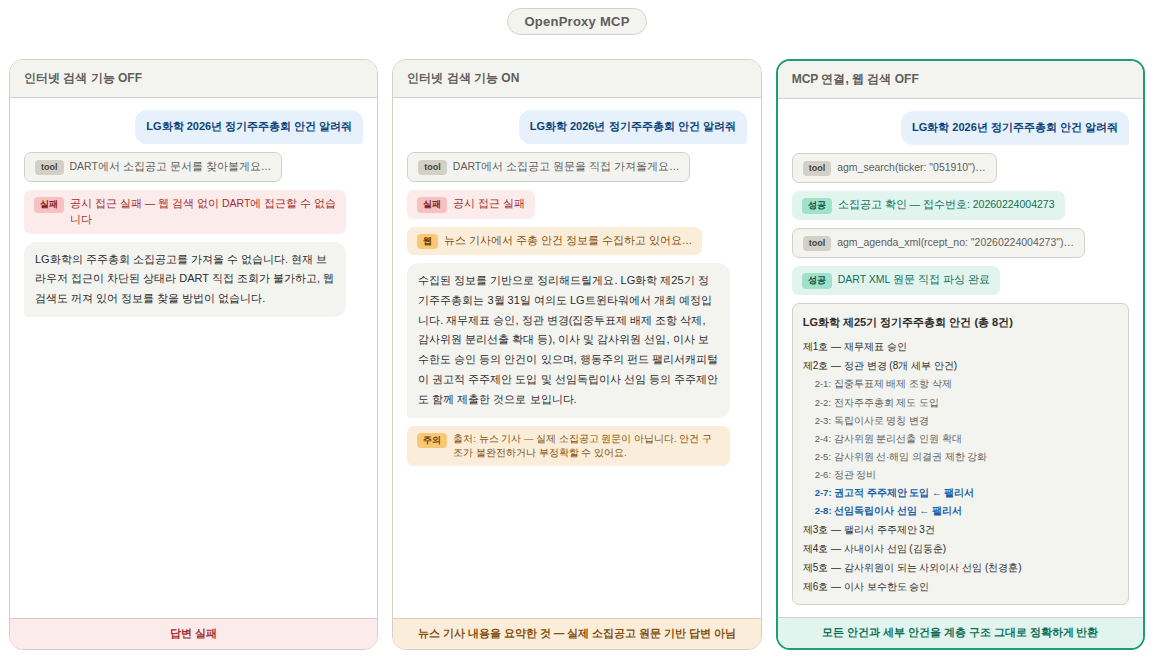
  • LG화학의 다음 정기 주주총회 안건과 안건별 의결권 의견을 근거와 함께 알려줘

  • 삼성전자 최근 3년 실적과 향후 2개년 컨센서스를 비교해줘

더 많은 질문 예시는 도구 카탈로그의 각 도구 페이지에서 확인할 수 있습니다.

OpenProxy Feature Guide는 서버에 등록된 도구 목록에서 자동으로 구성됩니다. Company Snapshot은 사업 구조·3년 확정 실적·제공되는 연간 예상치 최대 2년·가격·지분·배당·최근 공시를 연결하고, 더 확인할 질문까지 정리하도록 안내합니다. 표에서 확정(A)과 예상(E)을 구분하며, 시각화가 가능한 클라이언트에는 매출 막대·영업이익 선 차트를 요청합니다.


주요 기능

공시를 읽고, 숫자를 연결하고, 판단 근거까지 남깁니다.

분석 영역

핵심 질문

OpenProxy가 제공하는 답

🗳️ 주총·의결권

이 안건에 어떻게 투표할까?

찬성·반대·검토 필요 의견과 공시·정책·법령 근거. 표결 대상이 아닌 안건과 자료가 부족한 안건도 구분

📊 재무·실적

실적은 어떻게 변했나?

확정·잠정·컨센서스 비교, 수익성·현금흐름·듀퐁 분석

💹 가치평가·추정치

현재 가격에 무엇이 반영됐나?

과거·선행 PER/PBR/PSR, 배당수익률, 내년·내후년 추정치

🏭 사업·보유자산

무엇으로 벌고 무엇을 보유하나?

사업부문·가동률·원가·수주잔고와 잉여자산·보유지분 NAV

🧭 지분·주주환원

누가 지배하고 자본은 어디로 가나?

소유구조, 배당·자사주 소각, 밸류업 약속과 실제 집행

🔔 시장·리스크

오늘 무엇이 달라졌나?

시장 공시 디제스트, 경영권 분쟁·거래·희석·리스크 이벤트 추적

이 여섯 가지 분석 흐름을 출처 추적과 정관↔법령 조회까지 총 32개 도구가 뒷받침합니다. 전체 목록은 도구 구조에서 확인할 수 있습니다.

거버넌스 검토 파일럿governance_screen은 지정한 최대 30개사의 공시 원문을 모아 연결된 AI가 소수주주 대우·이해상충·이사회 책임 등을 판독하고, 근거와 중요도에 따라 검토 순서를 정리합니다. 공개매수·행동주의·소송이 있다는 사실만으로 부정 평가하지 않습니다. 결과는 부분 근거에 대한 LLM 평가 · 사람 미검토로 표시하며, 누락은 해당 항목만 알리고 다른 검토를 계속합니다. since·known_receipts로 새 공시 목록을 좁혀 다시 호출할 수 있습니다. 예약 실행이나 실제 투표는 만들지 않습니다. 이 브랜치의 파일럿 기능이며 운영 배포 여부는 별도로 확인해야 합니다.


도구 구조 (32개)

분류는 wiki/tools 카탈로그의 「무엇을 알고 싶을 때 무엇을 쓰나」 표와 같다 — 그 표가 정본이다.

분류

Tools

역할

🏢 기본 — 회사 찾기

company

회사 식별 + 최근 공시 목록 — 모든 분석의 출발점

🔔 공시 스캔·검토

screener, governance_screen

전체시장 공시 디제스트 · 지정 기업 공시 원문과 LLM 거버넌스 검토 순서(파일럿)

🗳️ 주주총회·의결권

shareholder_meeting_notice, shareholder_meeting_results, proxy_advise_before_meeting, proxy_guideline

소집공고(전)·결과(후) · 안건별 찬성/반대/검토 보조 · 판단 기준 문서 원문

💰 지분·재무·지배구조

ownership_structure, financial_metrics, provisional_earnings, business_details, asset_holdings, price_multiple_data, forward_estimates_data, trading_data, corp_gov_report, director_board

지분 구조 · 확정/잠정 실적 · 사업의 내용 · 자산주 · PER/PBR · 컨센서스 · 시세·시총 · 지배구조보고서 · 이사회

🎁 주주환원·자본

dividend_disclosure, dividend_data, treasury_share, value_up, shareholder_commitment, corporate_restructuring, dilutive_issuance

배당 공시·시계열 · 자기주식 · 밸류업 · 약속 vs 이행 · 합병/분할 · 증자/CB/BW/감자

⚔️ 분쟁·거래·리스크

proxy_contest, corporate_deals, order_contracts, risk_events, financial_notes, director_news

경영권 분쟁 신호 · 지분 인수/매각 · 수주·공급계약 · 리스크 사건 · 금융사 주석 · 이사 후보 뉴스

🔗 근거·참조

evidence, law_lookup

접수번호 → 원문 열람 URL · 정관↔법령 양방향 조회 (API 0콜)

도구별 예시 질문·상세 스키마·데이터 출처 → wiki/tools 카탈로그 (각 도구 페이지의 「사용법」 절에 자연어 예시)

의결권 정책

정책의 반대 기준이 곧 엔진의 자동 반대 조건은 아닙니다. 기본 엔진은 추가 판단이 필요한 우려를 검토 필요(REVIEW)로 두며 출석률을 판정 조건에 반영하지 않습니다. 별도로 선택하는 v2 파일럿은 원문에 연결된 LLM 평가로 직전 완료 사업연도 출석·독립성을 후보 권고에 적용합니다. 파일럿 입력·적용 범위를 확인하세요. proxy_guideline에서 인용된 절을, 0-A에서 기본 정책과 엔진의 대응표를 확인할 수 있습니다. 판정·회차·정보 기준일 읽는 법.

proxy_advise_before_meeting은 OPM 자체 Open Proxy Guideline을 기본 정책으로 사용합니다. 판단 기준은 소수주주 보호, 거버넌스 투명성, 장기 가치, 추적 가능성입니다. 주요 자산운용사의 거래소 공시 의결권 행사 내역과 국민연금의 공개 행사 내역을 교차 검토에 활용합니다. 모든 응답에는 DART와 도구 호출 수를 담은 data.usage가 포함됩니다(DART 분당 1,000회 한도, 서버 안전 제한 910회).

재무 기준 확인 — 승인 대상 연도의 확정치와 소집공고 잠정치, 직전 확정치를 구분해 읽습니다. 잠정치가 모든 지표를 대체하는 것은 아니므로 응답의 연도·출처·잠정 여부를 확인하세요. 잠정치에 따른 자본잠식 평가는 감사 후 재무제표를 요구하는 규정 판정을 대신하지 않습니다. 정보 기준일과 사후 자료 포함 여부는 기능 안내를 따릅니다.


데이터 소스

소스

용도

비고

DART OpenAPI

정기·주요 공시 메타 + 재무 API + 배당·자사주·지분 등 정형 데이터

필수 — 무료 API 키. 분당 최대 1,000회, 서버 안전 제한 910회

DART 웹 (dart.fss.or.kr)

공시 본문 파싱 (소집공고·주요사항보고서 등)

요청 간 1–2초 무작위 대기

KRX KIND

거래소 공시 보조 확인

보조 소스

국가법령정보센터 기반 법령 원문

정관 변경·의결권 판단의 법령 근거 조회

legalize-kr에서 주간 동기화

주요 자산운용사의 거래소 공시 의결권 행사 내역과 국민연금 공개 행사 내역

의결권 판단 교차 검토

사전 수집·구조화한 공개 자료


릴리즈 노트

버전별 변경 이력 → docs/RELEASE_NOTES.md


보안

취약점은 공개 이슈 대신 SECURITY.md 의 절차로 알려 주세요 — 특히 API 키가 새는 경로.


Disclaimer

OpenProxy는 DART 공시 데이터를 구조화하여 AI에게 제공하는 도구입니다. AI는 할루시네이션을 일으킬 수 있고 부정확한 분석을 제공할 수 있습니다. AI가 제시하는 의견은 개발자 또는 소속 단체의 의견이 아닙니다. 분석 결과는 참고 목적으로만 사용하고, 투자 결정이나 의결권 행사의 최종 판단은 반드시 원문 공시와 전문가 검토를 거쳐야 합니다.


라이선스

PolyForm Noncommercial License 1.0.0 — 비상업적 사용만 허용 (전문: 루트 LICENSE)

  • 비상업적 사용(개인 연구·학습·비영리·공공기관)은 자유롭게 허용됩니다.

  • 상업적 사용은 별도 라이선스 계약이 필요합니다 (OpenProxy AI).

  • 재배포 시 출처 표기: Copyright (c) 2026 OpenProxy AI (https://github.com/MarcoYou/open-proxy-mcp) 유지 (PolyForm 'Notices' 조항).

상업 라이선스·기타 문의: gunhoqw20@gmail.com

Available Tools

16 tools
business_detailsA

desc: DART 정기보고서 **"II. 사업의 내용"**에서 사업부문별 매출·영업이익, 사업장·생산설비, 생산실적·가동률, 연구개발, 수주현황, 주요 고객·매출처를 추출. SOTP·부문 수익성·생산능력·수주·고객집중 분석의 1차 소스. when: 회사의 사업부문·생산·수주·고객 구조가 필요할 때. 전사 재무는 financial_metrics, 밸류는 valuation. 금융/증권/보험/지주는 financial_ops·financial_soundness, REIT/보험은 investment_property 로 커버(segments 대신). 여러 분기/연도 추이가 필요하면 bsns_year+reprt_code를 지정해 과거 시점을 하나씩 반복 호출. rule: segments는 정형→저신뢰 시 원문 마크다운. 나머지 필드는 해당 소절 원문을 마크다운으로 반환 — 그 표를 읽어 값 추출(단위·정의 회사별 상이, 비교 주의). context_mode=candidate는 strict가 NOT_COLLECTED일 때만 저신뢰 고정 윈도우 문맥을 별도 candidate_context로 반환하며, 공식 결과·hint로 사용하면 안 됨. 이 모드는 표준 필드 하나를 지정할 때만 사용. 금융/REIT 필드는 표준사에선 자동 N/A. 유형자산 장부가 표를 사업장으로 오독 금지. 응답 report.report_nm으로 어느 보고서인지 확인(분기/반기/사업). bsns_year/reprt_code반드시 둘 다 지정(하나만 주면 에러) — 지정 시 period는 무시됨. period: latest(기본, 사업·반기·분기 중 가장 최신 제출분=최신 데이터) / annual(연간 사업보고서 고정) / quarterly(분기·반기 고정). II.사업의내용은 분기/반기도 완전구조라 동일 필드. bsns_year+reprt_code 지정 시 이 파라미터는 무시. fields: 쉼표구분 — 표준: segments,sites,utilization,rnd,backlog,customers / 금융·REIT: financial_ops,financial_soundness,investment_property. (미지정 시 회사에 맞는 표준·금융 필드만). 자산(토지·투자부동산·지분증권 원가vs공정가치)은 별도 tool asset_holdings. bsns_year: 특정 과거 사업연도 조회(예: "2025"). reprt_code와 함께 지정해야 함 — 추이 조회용(한 번에 여러 분기 반환 아님, 분기마다 반복 호출). reprt_code: DART 표준 보고서유형 — 11011(사업/연간) 11012(반기) 11013(1분기) 11014(3분기). bsns_year와 함께 지정. context_mode: strict(기본) / candidate. candidate는 strict NOT_COLLECTED일 때만 단일 표준 필드의 저신뢰 보조 문맥을 별도 반환. context_chars: candidate 고정 문맥 길이(기본 20000, 최대 60000). strict에서는 사용하지 않음. ref: financial_metrics, valuation, order_contracts, company

ParametersJSON Schema
NameRequiredDescriptionDefault
fieldsNo
formatNomd
periodNolatest
companyYes
bsns_yearNo
reprt_codeNo
context_modeNostrict
context_charsNo

Output Schema

ParametersJSON Schema
NameRequiredDescription
resultYes

TDQS

A4.9/5.0
Behavior5/5

Does the description disclose side effects, auth requirements, rate limits, or destructive behavior?

Even without annotations, the description covers critical behavioral traits: it warns about low-reliability segment data falling back to raw markdown, explains context_mode behavior with candidate mode, cautions against misreading fixed asset tables, instructs to verify report name, and details parameter interactions (bsns_year+reprt_code overriding period). This goes well beyond basic disclosure.

Agents need to know what a tool does to the world before calling it. Descriptions should go beyond structured annotations to explain consequences.

Conciseness4/5

Is the description appropriately sized, front-loaded, and free of redundancy?

The description is very long but well-structured with clear sections (desc, when, rule, period, fields, etc.) and front-loads the core purpose. While verbose, every part adds necessary detail for a complex tool. A more concise organization could improve readability, but it remains serviceable.

Shorter descriptions cost fewer tokens and are easier for agents to parse. Every sentence should earn its place.

Completeness5/5

Given the tool's complexity, does the description cover enough for an agent to succeed on first attempt?

Given the tool's complexity (8 parameters, multiple conditional behaviors, interaction with siblings), the description is remarkably complete. It covers purpose, usage context, parameter semantics, behavioral nuances, and warnings. The presence of an output schema reduces the need to detail return values, allowing the description to focus on input and behavior.

Complex tools with many parameters or behaviors need more documentation. Simple tools need less. This dimension scales expectations accordingly.

Parameters5/5

Does the description clarify parameter syntax, constraints, interactions, or defaults beyond what the schema provides?

With 0% schema coverage, the description takes full responsibility for parameter meaning. It explains each parameter in detail: fields as comma-separated list with standard vs financial options, period with 'latest'/'annual'/'quarterly' and interaction with bsns_year/reprt_code, bsns_year and reprt_code with explicit DART codes and usage, context_mode and context_chars with behavior. All parameters are adequately described.

Input schemas describe structure but not intent. Descriptions should explain non-obvious parameter relationships and valid value ranges.

Purpose5/5

Does the description clearly state what the tool does and how it differs from similar tools?

The description clearly states the tool's purpose: extracting business segment details (sales, profit, production, R&D, orders, customers) from a specific Korean regulatory report (DART). It distinguishes itself from sibling tools like financial_metrics (for company-wide financials) and valuation, making its unique role evident.

Agents choose between tools based on descriptions. A clear purpose with a specific verb and resource helps agents select the right tool.

Usage Guidelines5/5

Does the description explain when to use this tool, when not to, or what alternatives exist?

The description provides explicit when-to-use guidance ('회사의 사업부문·생산·수주·고객 구조가 필요할 때'), when-not-to-use (for financials use financial_metrics, for valuation use valuation, for financial institutions use other tools), and how to handle historical data via repeated calls. It also mentions alternative tools explicitly.

Agents often have multiple tools that could apply. Explicit usage guidance like "use X instead of Y when Z" prevents misuse.

companyA

desc: 기업 식별 + 최근 공시 인덱스. 모든 data tool 공통 입구. 회사명/ticker/corp_code → 시장·업종·최근 공시. when: 검색 시작 → ticker/corp_code 확정 후속 tool에 전달. 최근 공시 종류·빈도 훑을 때. rule: 비상장 법인 자동 제외 (상장사 전용). 공식 한글·영문명과 별칭을 우선하고, 부분명은 활성 상장·시총 격차가 충분할 때만 자동 추론. 공식명 exact는 시총보다 우선. params: query, max_recent_filings(1-20), start_date/end_date(YYYYMMDD), language(auto|ko|en) ref: shareholder_meeting_notice, ownership_structure, dividend, proxy_contest, value_up

ParametersJSON Schema
NameRequiredDescriptionDefault
queryYes
formatNomd
end_dateNo
languageNoauto
start_dateNo
max_recent_filingsNo

Output Schema

ParametersJSON Schema
NameRequiredDescription
resultYes

TDQS

A4.5/5.0
Behavior4/5

Does the description disclose side effects, auth requirements, rate limits, or destructive behavior?

No annotations present, so description carries full burden. Discloses automatic exclusion of unlisted companies, name matching logic, and parameter constraints. Lacks rate limit or auth details but still good.

Agents need to know what a tool does to the world before calling it. Descriptions should go beyond structured annotations to explain consequences.

Conciseness5/5

Is the description appropriately sized, front-loaded, and free of redundancy?

Very concise with purpose, usage, rules, and parameters all in a few lines. No wasted words.

Shorter descriptions cost fewer tokens and are easier for agents to parse. Every sentence should earn its place.

Completeness5/5

Given the tool's complexity, does the description cover enough for an agent to succeed on first attempt?

Given the tool's complexity (6 parameters, many siblings) and presence of output schema, the description provides sufficient guidance for an AI agent to use it effectively.

Complex tools with many parameters or behaviors need more documentation. Simple tools need less. This dimension scales expectations accordingly.

Parameters3/5

Does the description clarify parameter syntax, constraints, interactions, or defaults beyond what the schema provides?

Schema description coverage is 0%, but description adds context for max_recent_filings (range 1-20), date format YYYYMMDD, and language options. However, it omits the 'format' parameter and doesn't explain the 'query' parameter's expected input.

Input schemas describe structure but not intent. Descriptions should explain non-obvious parameter relationships and valid value ranges.

Purpose5/5

Does the description clearly state what the tool does and how it differs from similar tools?

Clearly states the tool identifies companies and provides recent filing index, and it's the common entry point for all data tools. Distinguishes from siblings by being the entry tool.

Agents choose between tools based on descriptions. A clear purpose with a specific verb and resource helps agents select the right tool.

Usage Guidelines5/5

Does the description explain when to use this tool, when not to, or what alternatives exist?

Explicitly tells when to use (start of search, to get identifiers for subsequent tools, to browse recent filings) and provides a rule about excluding unlisted companies and name matching priority.

Agents often have multiple tools that could apply. Explicit usage guidance like "use X instead of Y when Z" prevents misuse.

corporate_dealsA

desc: 회사·지분 인수/매각(타법인주식·출자증권 취득/처분) 공시. 계열사 출자·회수, 일감몰아주기·내부거래·특수관계자 거래 모니터링. include_details=True면 거래 상대방/금액/자산대비비율/특수관계 힌트. when: 어떤 회사를 인수했나/팔았나(지분 취득·처분·양수도), 계열사·자회사 출자와 회수, 투자 포트폴리오 재편, 자회사 주요경영사항 흐름, 일감몰아주기 신호. 단일판매·공급계약(수주/해지·매출대비)은 order_contracts. 합병·분할·주식교환은 corporate_restructuring. rule: DART list.json — 타법인주식: B/I + 양수/양도/취득/처분결정 키워드. 자회사 주요경영사항/자율공시/[기재정정] 플래그 별도 표시. 기본 lookback 24개월. include_details=True 시 최근 N건 원문 파싱(상대방·관계·금액·비율·목적). scope: summary 통합 timeline / equity_deal 타법인주식 (단일공급계약은 order_contracts로 분리됨) include_details: True면 원문 파싱 추가 (DART 호출 N회 증가). details_limit: 원문 파싱 건수 (기본 5, 최대 10). ref: order_contracts (단일공급계약 수주/해지/일감), corporate_restructuring (합병/분할/주식교환), ownership_structure (지분 변화), evidence (원문 확인)

ParametersJSON Schema
NameRequiredDescriptionDefault
scopeNosummary
formatNomd
companyYes
end_dateNo
start_dateNo
details_limitNo
include_detailsNo

Output Schema

ParametersJSON Schema
NameRequiredDescription
resultYes

TDQS

A4.3/5.0
Behavior4/5

Does the description disclose side effects, auth requirements, rate limits, or destructive behavior?

Despite no annotations, the description reveals behavioral aspects: it uses DART list.json with keyword filtering, defaults to 24-month lookback, and explains that include_details triggers additional DART calls. It does not cover destructive behavior (likely read-only) but is transparent about data sourcing and processing.

Agents need to know what a tool does to the world before calling it. Descriptions should go beyond structured annotations to explain consequences.

Conciseness4/5

Is the description appropriately sized, front-loaded, and free of redundancy?

The description is structured into labeled sections (desc, when, rule, etc.) and front-loads the purpose. It is somewhat lengthy but well-organized, allowing quick scanning.

Shorter descriptions cost fewer tokens and are easier for agents to parse. Every sentence should earn its place.

Completeness4/5

Given the tool's complexity, does the description cover enough for an agent to succeed on first attempt?

Given the complexity, no annotations, and 0% schema coverage, the description provides substantial context: data source, rules, parameter behavior, and cross-references to sibling tools. It lacks detail on output structure but is sufficient for an agent to understand usage.

Complex tools with many parameters or behaviors need more documentation. Simple tools need less. This dimension scales expectations accordingly.

Parameters3/5

Does the description clarify parameter syntax, constraints, interactions, or defaults beyond what the schema provides?

The description explains scope, include_details, and details_limit with defaults and limits, but does not cover company, start_date, end_date, or format. Since schema coverage is 0%, the description partially compensates but leaves gaps.

Input schemas describe structure but not intent. Descriptions should explain non-obvious parameter relationships and valid value ranges.

Purpose5/5

Does the description clearly state what the tool does and how it differs from similar tools?

The description explicitly states it handles corporate deals such as equity acquisitions/disposals and subsidiary investments, and distinguishes from siblings like order_contracts and corporate_restructuring. The verb '공시' (disclose) and the listed scenarios clarify the tool's purpose.

Agents choose between tools based on descriptions. A clear purpose with a specific verb and resource helps agents select the right tool.

Usage Guidelines5/5

Does the description explain when to use this tool, when not to, or what alternatives exist?

The description provides a clear 'when' section listing use cases and explicitly points to alternative tools (order_contracts, corporate_restructuring) for different transaction types, helping the agent choose correctly.

Agents often have multiple tools that could apply. Explicit usage guidance like "use X instead of Y when Z" prevents misuse.

corporate_restructuringA

desc: 지배구조 재편 4종(합병/분할/분할합병/주식교환·이전) 결정 통합. 합병비율·상대방 재무·신주발행·외부평가·주식매수청구권 + timeline + detail card. when: M&A 중 합병·분할·주식교환 형태, 지주회사 전환, 자회사 흡수 분석. 주식매수청구권 가격, 합병비율, 상대방 재무 비교. 단순 지분 인수·매각(주식 양수도)은 corporate_deals. rule: DART DS005 4 API 병렬 — cmpMgDecsn/cmpDvDecsn/cmpDvmgDecsn/stkExtrDecsn. 기본 lookback 24개월. ref: corporate_deals (지분 인수·매각), ownership_structure, shareholder_meeting_notice, evidence

ParametersJSON Schema
NameRequiredDescriptionDefault
formatNomd
companyYes
end_dateNo
start_dateNo

Output Schema

ParametersJSON Schema
NameRequiredDescription
resultYes

TDQS

A3.8/5.0
Behavior3/5

Does the description disclose side effects, auth requirements, rate limits, or destructive behavior?

No annotations provided. The description mentions it uses 4 APIs in parallel and default 24-month lookback, which gives some insight. However, it does not explicitly state if the tool is read-only, authentication requirements, or any side effects. The term '결정 통합' implies data gathering, but behavioral constraints are not fully disclosed.

Agents need to know what a tool does to the world before calling it. Descriptions should go beyond structured annotations to explain consequences.

Conciseness3/5

Is the description appropriately sized, front-loaded, and free of redundancy?

The description is compact with sections (desc, when, rule, ref). It mixes Korean and English, which may reduce clarity. It is relatively efficient but could be more readable with better structure and separation of concerns.

Shorter descriptions cost fewer tokens and are easier for agents to parse. Every sentence should earn its place.

Completeness3/5

Given the tool's complexity, does the description cover enough for an agent to succeed on first attempt?

Covers purpose, usage, and API references. However, it does not describe the output schema (which exists) or parameter details. Given the tool has 4 parameters and references multiple APIs, more detail on inputs and outputs would improve completeness.

Complex tools with many parameters or behaviors need more documentation. Simple tools need less. This dimension scales expectations accordingly.

Parameters2/5

Does the description clarify parameter syntax, constraints, interactions, or defaults beyond what the schema provides?

Schema coverage is 0%, meaning no parameter descriptions in the schema. The tool description does not explain each parameter individually. 'company' is implied, 'start_date' and 'end_date' are likely date range but not explained, 'format' defaults to 'md' but its meaning is unclear. The description adds minimal value beyond the parameter names.

Input schemas describe structure but not intent. Descriptions should explain non-obvious parameter relationships and valid value ranges.

Purpose5/5

Does the description clearly state what the tool does and how it differs from similar tools?

The description clearly states it integrates 4 types of governance restructuring decisions (merger/division/divisional merger/stock exchange). It lists specific outputs like merger ratio, counterparty financials, etc. It distinguishes from sibling tool corporate_deals for simple equity transactions.

Agents choose between tools based on descriptions. A clear purpose with a specific verb and resource helps agents select the right tool.

Usage Guidelines5/5

Does the description explain when to use this tool, when not to, or what alternatives exist?

The 'when' section explicitly describes when to use (M&A restructuring, holding company conversion) and when not to (simple equity acquisition/sale, which should use corporate_deals). It provides clear context and alternative.

Agents often have multiple tools that could apply. Explicit usage guidance like "use X instead of Y when Z" prevents misuse.

director_boardA

desc: 개별 이사 단위 정보 — 이사 인당 보수, 보수한도 소진율(연도별 rm 비고 원문 포함), 임원 재직/사퇴 변동(연도 diff + DART 공식 사외이사 변동 집계로 교차검증), 개인별(5억+) 보수와 RSA/스톡옵션 등 미확정 주식보상, 미등기임원 보수, 경영진-직원 보수 배수(부문별 세부 포함) — 전부 lookback_years만큼 연도별(YoY) 비교 가능. corp_gov_report가 '회사 15지표 준수'라면 이건 '누가 얼마 받고 인원이 어떻게 바뀌었나'. 가치판단(적절/과다)은 하지 않고 수치·전년비 변동·flag만. when: 이사 보수 안건 판단, 스튜어드십 engagement — 예: "이사 보수한도 소진율 얼마야"(compensation), "작년에 이사 누가 오고 나갔어"(roster), "대표이사들 각각 얼마 받아·스톡옵션 있나"(individual), "임원-직원 보수 격차 몇 배"(pay_gap), "이번 주총 한도 왜 올려달래"(pay_agenda). rule: exctvSttus+drctrAdtAllMendngSttus 2종+hmvAuditIndvdlBySttus+unrstExctvMendngSttus+ empSttus+outcmpnyDrctrNdChangeSttus 정형 API 6종 전부 재사용. 소진율 분자는 감사위원 포함 이사류 실지급 합(순수 감사만 별도 한도), 한도 공백해는 최근 유효연도 lookback. 재직/사퇴 diff는 2-pass 매칭(이름 정확일치로 먼저 확정 → 나머지만 생년월로, 남은 후보군에서 유일할 때만)으로 로마자표기 변동·동일 생년월 동명이인 오탐 둘 다 억제 — 사외이사 변동현황 API의 공식 집계 (선임/해임/중도퇴임 수, 사외이사 신규선임만 필터링해 비교)로 규모감 교차검증. attendance는 사업보고서 원문에서 개별 이사 출석률을 파싱하되, 회사가 일부(주로 사외이사)만 '(출석률:%)'로 기재하면 전체가 아님을 data_quality_flags(attendance_partial)로 표시. 원문 fetch(8MB)라 summary 기본엔 미포함 — on-demand scope로 조회. scope: compensation | roster | individual(5억+ 실명, RSA/스톡옵션 노트 포함) | unregistered(미등기임원) | pay_gap(경영진 vs 직원 배수, 부문별 세부) | pay_agenda(보수한도 주총안건 올해vs작년) | attendance(개별 이사 출석률·원문, summary 제외) | pay_criteria(보수 산정기준·개인별 급여/상여 분해·KPI 가중치, 사업보고서 VIII-2 원문, summary 제외) | summary(기본) 각주 마커('(주1)' 등 정형 API가 본문을 안 주는 비고)는 resolve_footnotes=True(기본)면 해당 사업보고서 원문에서 각주 본문을 자동 복구(마커 뜬 공시만 1회 fetch·캐시) — 실패 시 원문 발췌 폴백. year: 기준 사업연도(0=최근 확정 전년). lookback_years: 조회 기간(년), 기본 3 — 대부분 scope에서 YoY 적용 resolve_footnotes: 각주 마커를 원문에서 해소할지(기본 True). False면 원문 fetch 없이 마커만 플래그. ref: corp_gov_report, director_evaluation, shareholder_meeting

ParametersJSON Schema
NameRequiredDescriptionDefault
yearNo
scopeNosummary
formatNomd
companyYes
lookback_yearsNo
resolve_footnotesNo

Output Schema

ParametersJSON Schema
NameRequiredDescription
resultYes

TDQS

A4.7/5.0
Behavior5/5

Does the description disclose side effects, auth requirements, rate limits, or destructive behavior?

With no annotations, the description fully discloses behavioral traits: it uses 6 standardized APIs, employs a 2-pass matching algorithm for roster changes, marks partial attendance data with quality flags, resolves footnotes by fetching 8MB documents, and caches results. It also states that no value judgments are made, only numerical data and flags.

Agents need to know what a tool does to the world before calling it. Descriptions should go beyond structured annotations to explain consequences.

Conciseness4/5

Is the description appropriately sized, front-loaded, and free of redundancy?

The description is lengthy but well-structured with sections (desc, when, rule, scope, year, etc.). It front-loads the core purpose, and every section adds necessary detail for a complex tool. While some technical details could be trimmed, the structure earns a 4 for clarity and organization.

Shorter descriptions cost fewer tokens and are easier for agents to parse. Every sentence should earn its place.

Completeness5/5

Given the tool's complexity, does the description cover enough for an agent to succeed on first attempt?

Given the tool's complexity, the description is remarkably complete. It covers all scopes, explains data sources, matching algorithms, quality flags, and footnote resolution. It even references companion tools for context. The presence of an output schema (not shown) further reduces the need to describe return values. No gaps are apparent.

Complex tools with many parameters or behaviors need more documentation. Simple tools need less. This dimension scales expectations accordingly.

Parameters5/5

Does the description clarify parameter syntax, constraints, interactions, or defaults beyond what the schema provides?

Schema description coverage is 0%, so the description must add meaning. It does so extensively: it defines all scope values (compensation, roster, individual, etc.), explains year and lookback_years, and describes the resolve_footnotes parameter. Each parameter's purpose and behavior is clearly explained beyond the schema.

Input schemas describe structure but not intent. Descriptions should explain non-obvious parameter relationships and valid value ranges.

Purpose5/5

Does the description clearly state what the tool does and how it differs from similar tools?

The description clearly states that the tool provides individual director-level information including compensation, utilization rates, roster changes, and pay gaps. It differentiates from sibling tools by focusing on detailed board compensation and membership data, as opposed to corporate governance reports or meeting notices.

Agents choose between tools based on descriptions. A clear purpose with a specific verb and resource helps agents select the right tool.

Usage Guidelines4/5

Does the description explain when to use this tool, when not to, or what alternatives exist?

The description explicitly lists use cases under 'when', such as evaluating director compensation, stewardship engagement, and analyzing pay gaps. It references related tools like corp_gov_report and director_evaluation, but does not explicitly state when not to use this tool versus all siblings. The examples provide strong guidance.

Agents often have multiple tools that could apply. Explicit usage guidance like "use X instead of Y when Z" prevents misuse.

dividendA

desc: 실지급·확정된 배당 사실. DPS, 총액, 배당성향, 시가배당률(결의 당시)+현재가 기준 배당수익률(최신 종가, krx_weekly), 분기별 추이. 미래 정책·약속 X. when: 실제 지급된 배당 확인. 분기배당 회사는 history로 분기별 breakdown. 미래 정책/약속은 value_up. rule: source 2단 — (1) 사업보고서 alotMatter(공식값) (2) 현금ㆍ현물배당결정 합산(alotMatter 빈 경우 fallback). 결산배당은 record_date 기준 fiscal year bucket (선배당-후결의 신법). 정정공시 is_superseded 표시. 미래 약속 추가 금지. scope: summary 선배당-후결의+감액배당 메타 / detail 요약+최근 결정 50건 / history N년 추이+분기 breakdown+policy_signals ref: value_up, treasury_share, shareholder_meeting_notice, company, ownership_structure, evidence

ParametersJSON Schema
NameRequiredDescriptionDefault
yearNo
scopeNosummary
yearsNo
formatNomd
companyYes
end_dateNo
start_dateNo

Output Schema

ParametersJSON Schema
NameRequiredDescription
resultYes

TDQS

A4.6/5.0
Behavior5/5

Does the description disclose side effects, auth requirements, rate limits, or destructive behavior?

Discloses data sources (business report alotMatter, cash/stock decisions), fallback logic, handling of corrective disclosures (is_superseded flag), and rules against adding future promises. This is comprehensive beyond what annotations typically provide.

Agents need to know what a tool does to the world before calling it. Descriptions should go beyond structured annotations to explain consequences.

Conciseness4/5

Is the description appropriately sized, front-loaded, and free of redundancy?

Well-structured with tags (desc, when, rule, scope, ref) and front-loaded with key information. A bit dense but every sentence adds value. Could be slightly more concise.

Shorter descriptions cost fewer tokens and are easier for agents to parse. Every sentence should earn its place.

Completeness5/5

Given the tool's complexity, does the description cover enough for an agent to succeed on first attempt?

Given the complexity (7 params, no annotations, output schema exists), the description covers data sources, behavioral rules, scope options, and references to related tools. It is fully adequate for an agent to understand usage and constraints.

Complex tools with many parameters or behaviors need more documentation. Simple tools need less. This dimension scales expectations accordingly.

Parameters3/5

Does the description clarify parameter syntax, constraints, interactions, or defaults beyond what the schema provides?

With 0% schema description coverage, the description carries the burden. It explains the scope parameter well (summary, detail, history) but does not clarify year, years, start_date, end_date, or format. Overall adds partial value but not complete.

Input schemas describe structure but not intent. Descriptions should explain non-obvious parameter relationships and valid value ranges.

Purpose5/5

Does the description clearly state what the tool does and how it differs from similar tools?

The description clearly states the tool provides actual paid dividend facts (DPS, total amount, payout ratio, etc.) and explicitly distinguishes it from sibling tools like value_up for future policies. The verb 'check' and resource 'dividend facts' are specific.

Agents choose between tools based on descriptions. A clear purpose with a specific verb and resource helps agents select the right tool.

Usage Guidelines5/5

Does the description explain when to use this tool, when not to, or what alternatives exist?

Explicitly states when to use (check actual paid dividends) and when not to (use value_up for future policies). Also provides guidance for quarterly companies to use history scope. No ambiguity.

Agents often have multiple tools that could apply. Explicit usage guidance like "use X instead of Y when Z" prevents misuse.

financial_metricsA

desc: DART 재무 4 endpoint 통합 — 수익성/안정성/현금흐름/회계 risk. 한국 표준(연결, 지배주주 귀속). 듀퐁·FCF·NWC·accruals_gap·감사의견 자동 산출. when: 재무 펀더멘탈 + 회계 risk 진단 / 적자전환·턴어라운드·이자보상배율 alert / 사외이사 후보 재직 시점 회계 사건 cross-check. rule: source = fnlttSinglAcnt(BS+IS 30행, 요청 fs_div로 행 필터) + fnlttSinglIndx(보조 ROE) + fnlttSinglAcntAll(CF+213행) + accnutAdtorNmNdAdtOpinion(감사의견 3년). 금액 raw KRW int(_krw), %는 float(_pct), 비율 decimal(_ratio). 연결 default, 적자/0 분모 graceful. 금융사(은행·지주)는 매출액 계정이 없어 None — 영업이익·순이익 기준 해석. 분기 합≠연간이면 기중 분할·재작성 warning 자동 부착. 이자보상배율 분모 = IS 이자비용, 없으면 CF '이자의 지급' (금융비용 총액 사용 안 함). EBITDA는 CF에서 D&A가 추출된 회사만 산출 (조정 합계 공시 회사는 None). period: DART 기간 의미가 항목별로 다름 — 손익 thstrm=당기3개월/누적은 thstrm_add, 현금흐름=누적, 재무상태=잔액. summary가 분기보고서면 ① 손익은 누적(YTD) 기준 primary + 당기 분기(standalone)를 standalone에 별도 동봉(반기/3분기), ② 회전일수(DSO/DIO/CCC)는 TTM(최근 4분기) 분모로 산출(단일분기 연환산 왜곡 제거), ③ ROE/ROA/자산회전율은 연환산 안 함(분기값). 기준은 항상 period_basis/turnover_basis/basis_note로 명시. year 미지정 시 quarterly·qoq는 당해 연도(최신 분기 포함), summary·yearly·yoy는 직전 사업연도. scope: summary 핵심 지표 1년(분기보고서면 누적+standalone) / yearly N년 추이 / quarterly 12분기 standalone 손익 + QoQ·YoY(마진은 %p) 기본 동봉 (Q4는 연간−3분기 누적 차분 — 연간치 혼입 없음) / yoy 전년+alert / qoq 전분기 (standalone 기준) / audit_opinion 3년 추이 ref: dividend, corp_gov_report, shareholder_meeting_notice, evidence

ParametersJSON Schema
NameRequiredDescriptionDefault
yearNo
scopeNosummary
yearsNo
formatNomd
companyYes
consolidatedNo

Output Schema

ParametersJSON Schema
NameRequiredDescription
resultYes

TDQS

A4.2/5.0
Behavior5/5

Does the description disclose side effects, auth requirements, rate limits, or destructive behavior?

With no annotations provided, the description fully covers behavioral details: data sources, unit handling (raw KRW, percentages, ratios), edge cases (financial companies with no revenue, bankruptcy situations), period semantics (quarterly vs cumulative vs balance), automatic warnings, and calculation specifics (EBITDA, interest coverage). This is exhaustive.

Agents need to know what a tool does to the world before calling it. Descriptions should go beyond structured annotations to explain consequences.

Conciseness3/5

Is the description appropriately sized, front-loaded, and free of redundancy?

The description is very long and dense, mixing technical details with usage guidance in a single paragraph. It uses sections (desc, when, rule, period, scope, ref) but without clear structure or line breaks, making parsing difficult. It could be restructured for clarity and brevity.

Shorter descriptions cost fewer tokens and are easier for agents to parse. Every sentence should earn its place.

Completeness5/5

Given the tool's complexity, does the description cover enough for an agent to succeed on first attempt?

Despite the complexity (6 parameters, 0% schema coverage, no annotations), the description provides comprehensive context: data sources, unit conventions, edge cases, period handling, scope definitions, and cross-references to related tools. It adequately supports correct invocation and interpretation.

Complex tools with many parameters or behaviors need more documentation. Simple tools need less. This dimension scales expectations accordingly.

Parameters4/5

Does the description clarify parameter syntax, constraints, interactions, or defaults beyond what the schema provides?

Schema description coverage is 0%, so the description must compensate. The description explains the 'scope' parameter in detail with all options (summary, yearly, quarterly, yoy, qoq, audit_opinion) and their behavior. Other parameters like year, consolidated, years are implicitly addressed (e.g., year default and meaning). The format parameter is not discussed, and mapping to schema could be clearer.

Input schemas describe structure but not intent. Descriptions should explain non-obvious parameter relationships and valid value ranges.

Purpose4/5

Does the description clearly state what the tool does and how it differs from similar tools?

The description clearly states the tool integrates four financial endpoints and provides profitability, stability, cash flow, and accounting risk metrics. While it lacks a concise verb like 'retrieve' or 'get', the purpose is well-defined and distinguishes from siblings by specifying Korean standard and metrics computed.

Agents choose between tools based on descriptions. A clear purpose with a specific verb and resource helps agents select the right tool.

Usage Guidelines4/5

Does the description explain when to use this tool, when not to, or what alternatives exist?

The description includes a 'when' section listing three specific use cases (fundamental and accounting risk diagnosis, alerts for net loss/turnaround/interest coverage, cross-check on outside director service) and references other tools. However, it does not explicitly state when not to use this tool or provide direct comparisons to siblings.

Agents often have multiple tools that could apply. Explicit usage guidance like "use X instead of Y when Z" prevents misuse.

order_contractsA

desc: 회사의 수주(단일판매·공급계약체결) 추적 — 계약금액·매출액 대비%·상대방·계약기간. 적자 디폴트인 코스닥 바이오/기술주에서 수주 = 미래 매출 가시성 시그널. 기재정정(변경계약) 자동 dedup + 증액/감액 diff. when: 얼마짜리 수주를 따냈나, 수주가 매출 대비 얼마나 큰가(적자기업 가시성), 최근 수주 모멘텀, 외부 수주 vs 계열 일감(공시 관계필드 기준), 계약 해지, 수주 증액/감액 변경. 지분 인수/매각(타법인주식)은 corporate_deals. rule: DART list.json I001 — 단일판매ㆍ공급계약체결/해지 (일반+자율공시 모두 I001, 자회사 변형 포함). 본문 파싱: 계약금액(단위 원/천원/백만원 환산)·최근매출액·매출액대비%·상대방·관계(외부/계열)·계약기간. dedup: (계약명+상대방) 그룹 + 정정본 정정전금액으로 원본↔정정 매칭(같은 키라도 금액 체인 불일치 시 별개). 기본 lookback 24개월. max_documents: 본문 파싱 상한 (기본 30). ref: corporate_deals (타법인주식 지분 인수/매각), financial_metrics (매출·수익성), evidence (원문 확인)

ParametersJSON Schema
NameRequiredDescriptionDefault
formatNomd
companyYes
end_dateNo
start_dateNo
max_documentsNo

Output Schema

ParametersJSON Schema
NameRequiredDescription
resultYes

TDQS

A4.8/5.0
Behavior5/5

Does the description disclose side effects, auth requirements, rate limits, or destructive behavior?

No annotations provided, but description fully carries the burden: discloses data source (DART list.json I001), parsing logic, dedup mechanism, lookback period (24 months), and max_documents limit. No contradictions.

Agents need to know what a tool does to the world before calling it. Descriptions should go beyond structured annotations to explain consequences.

Conciseness4/5

Is the description appropriately sized, front-loaded, and free of redundancy?

Description is long but well-structured with sections (desc, when, rule, ref). Every sentence adds value, though slightly verbose.

Shorter descriptions cost fewer tokens and are easier for agents to parse. Every sentence should earn its place.

Completeness5/5

Given the tool's complexity, does the description cover enough for an agent to succeed on first attempt?

Given complexity and presence of output schema, description covers purpose, usage, behavioral details, and references sibling tools. No major gaps.

Complex tools with many parameters or behaviors need more documentation. Simple tools need less. This dimension scales expectations accordingly.

Parameters4/5

Does the description clarify parameter syntax, constraints, interactions, or defaults beyond what the schema provides?

Schema description coverage is 0%, so description must compensate. It explains 'max_documents' and implicitly covers date parameters via lookback. However, 'company' and 'format' are not explicitly described, leaving a minor gap.

Input schemas describe structure but not intent. Descriptions should explain non-obvious parameter relationships and valid value ranges.

Purpose5/5

Does the description clearly state what the tool does and how it differs from similar tools?

Description clearly states it tracks contracts (수주) with specific details. It distinguishes from sibling tool 'corporate_deals' which covers equity investments.

Agents choose between tools based on descriptions. A clear purpose with a specific verb and resource helps agents select the right tool.

Usage Guidelines5/5

Does the description explain when to use this tool, when not to, or what alternatives exist?

The 'when:' section lists explicit usage scenarios, and contraindications are provided (e.g., equity investments use 'corporate_deals'). Provides clear guidance on when to use.

Agents often have multiple tools that could apply. Explicit usage guidance like "use X instead of Y when Z" prevents misuse.

ownership_structureA

desc: 최대주주·특수관계인·5% 대량보유 지분 구조 + 공동보유자 분해. 자사주 detail은 treasury_share 별도. when: 지배력 구조, 최대주주 비중, 특수관계인 지분 합, 5% 활성 시그널, "OO의 N% 지분이 누구누구 공동보유냐 / 보고자 본인 지분은 얼마냐" 질의. rule: 사업보고서 DART 공식 API 우선. 5% 대량보유 목적은 최신 원문 보강. 변동신고서는 DART API 우선, KIND fallback. 5% 보고 헤드라인 지분율(ownership_pct)은 보고자 본인 + 특별관계자 합산임 — 본인만 보려면 reporter_self_pct, 공동보유자 내역은 co_holders[{name, ownership_pct, is_registry_holder}] 사용. co_holders_verified=False면 합계 미검증이라 원문 대조 필요(확정 인용 금지). 합계표 없는 약식보고(기관 단순투자 등)는 co_holders=None. scope: summary 최대주주+5%블록(+공동보유자 분해)+자사주 snapshot / major_holders 특수관계인 detail / blocks 5% 대량보유 최신+이력+공동보유자 분해 / control_map 3대 카테고리(명부 등재/외부 능동/수동)+공동보유자 / changes 최대주주변동신고서(I004) + 5% 대량보유 변동(D001) 통합 ref: treasury_share, proxy_contest, evidence

ParametersJSON Schema
NameRequiredDescriptionDefault
yearNo
scopeNosummary
formatNomd
companyYes
end_dateNo
as_of_dateNo
start_dateNo

Output Schema

ParametersJSON Schema
NameRequiredDescription
resultYes

TDQS

A4.4/5.0
Behavior5/5

Does the description disclose side effects, auth requirements, rate limits, or destructive behavior?

No annotations are provided, so the description fully discloses behavioral traits: it explains data source prioritization (DART API, KIND fallback), the meaning of ownership_pct as combined with special relations, the co_holders_verified flag indicating need for manual verification, and scope options. This is comprehensive.

Agents need to know what a tool does to the world before calling it. Descriptions should go beyond structured annotations to explain consequences.

Conciseness4/5

Is the description appropriately sized, front-loaded, and free of redundancy?

The description is structured with headers (desc, when, rule, scope, ref) and is front-loaded with the core purpose. While it is verbose, each sentence adds value. It could be slightly more concise but is well-organized.

Shorter descriptions cost fewer tokens and are easier for agents to parse. Every sentence should earn its place.

Completeness5/5

Given the tool's complexity, does the description cover enough for an agent to succeed on first attempt?

Given the tool's complexity (multiple scope options, data source rules, verification details) and the existence of an output schema, the description is comprehensive. It covers all critical aspects for correct usage, including caveats about data verification.

Complex tools with many parameters or behaviors need more documentation. Simple tools need less. This dimension scales expectations accordingly.

Parameters3/5

Does the description clarify parameter syntax, constraints, interactions, or defaults beyond what the schema provides?

Schema description coverage is 0%, so the description must add meaning. It explains the 'scope' parameter with detailed options (summary, major_holders, blocks, etc.), but other parameters like year, format, dates are not described. The partial coverage compensates somewhat but not fully.

Input schemas describe structure but not intent. Descriptions should explain non-obvious parameter relationships and valid value ranges.

Purpose5/5

Does the description clearly state what the tool does and how it differs from similar tools?

The description clearly states the tool provides ownership structure for major shareholders, special relations, and 5% blockholders, with co-holder decomposition. It distinguishes itself from the sibling tool 'treasury_share' by noting treasury stock details are separate. The resource and action are specific.

Agents choose between tools based on descriptions. A clear purpose with a specific verb and resource helps agents select the right tool.

Usage Guidelines4/5

Does the description explain when to use this tool, when not to, or what alternatives exist?

The 'when:' section explicitly describes use cases such as controlling share structure and co-holder decomposition. It references related tools but does not explicitly state when not to use this tool. However, the guidance is clear and context-rich.

Agents often have multiple tools that could apply. Explicit usage guidance like "use X instead of Y when Z" prevents misuse.

proxy_advise_before_meetingA

desc: 주총 소집 전 안건별 의결권 권고. 1회 호출로: 안건별 FOR/AGAINST/REVIEW/NO_DATA + facts + risk_factors + policy_citation + 근거 공고 + 후보 평가 + 재무/거버넌스 summary. ⛔ CRITICAL: 응답의 decision 컬럼은 한국 상법 강행규정 (A1/A2 tag 🛡️) + 운용사 정책 (vote_style) + Open Proxy Guideline 통합 결과. 사용자에게 그대로 제시 — 안건명 키워드(배제·제한·축소·강화)만 보고 자체 판단으로 변경 금지. 자주 misread: '집중투표 배제 조항 삭제' = FOR(의무화 정합), '의결권 제한 강화' = FOR(합산 3% 룰). when: 소집공고 후 ~ 주총 직전. 의결권 행사 결정 + 내부 보고. 사후 결과는 shareholder_meeting_results. rule: 운용사 의결권 행사 보고서 스타일. hard-fail(형사 처벌/사적 관계/동명이인) 자동 검증 가능 항목만 표기. soft-fail(후보 약력/정관 본문) raw 노출 — LLM 판단. vote_style: open_proxy (default — OPM 자체 가이드라인). 다른 옵션은 internal cross-reference용 check_audit_history: True 시 후보 과거 회사 × 회계 risk overlap cross-check (+30s) meeting_type: annual(default) / extraordinary / auto ref: shareholder_meeting_notice, financial_metrics, corp_gov_report, ownership_structure, proxy_contest, value_up, shareholder_meeting_results

ParametersJSON Schema
NameRequiredDescriptionDefault
yearNo
formatNomd
companyYes
vote_styleNoopen_proxy
meeting_typeNoannual
check_audit_historyNo

Output Schema

ParametersJSON Schema
NameRequiredDescription
resultYes

TDQS

A4.6/5.0
Behavior5/5

Does the description disclose side effects, auth requirements, rate limits, or destructive behavior?

With no annotations, the description fully covers behavioral traits: integrates multiple sources, warns about not altering decisions, explains hard-fail/soft-fail distinction, and notes the time impact of check_audit_history. No contradictions.

Agents need to know what a tool does to the world before calling it. Descriptions should go beyond structured annotations to explain consequences.

Conciseness4/5

Is the description appropriately sized, front-loaded, and free of redundancy?

Relatively long but well-organized with labeled sections (desc, when, rule, etc.). Every sentence adds value; could be slightly more concise but appropriate for complexity.

Shorter descriptions cost fewer tokens and are easier for agents to parse. Every sentence should earn its place.

Completeness5/5

Given the tool's complexity, does the description cover enough for an agent to succeed on first attempt?

Covers purpose, usage, behavioral details, parameter explanations, and references related tools. Output schema exists, so return values are not needed. Complete for a complex tool.

Complex tools with many parameters or behaviors need more documentation. Simple tools need less. This dimension scales expectations accordingly.

Parameters3/5

Does the description clarify parameter syntax, constraints, interactions, or defaults beyond what the schema provides?

Schema description coverage is 0%, so description must compensate. It explains vote_style (default open_proxy), check_audit_history (timing), and meeting_type (options). However, year (default 0 meaning unclear) and format (md not explained) are insufficiently described.

Input schemas describe structure but not intent. Descriptions should explain non-obvious parameter relationships and valid value ranges.

Purpose5/5

Does the description clearly state what the tool does and how it differs from similar tools?

Clearly states the tool provides pre-meeting voting recommendations per agenda item. Differentiates from post-meeting tool and siblings by specifying the timing ('소집 전').

Agents choose between tools based on descriptions. A clear purpose with a specific verb and resource helps agents select the right tool.

Usage Guidelines5/5

Does the description explain when to use this tool, when not to, or what alternatives exist?

Explicitly states when to use: after notice but before the meeting, for voting decisions and internal reporting. Provides alternative 'shareholder_meeting_results' for post-meeting results and includes rules about hard-fail vs soft-fail items.

Agents often have multiple tools that could apply. Explicit usage guidance like "use X instead of Y when Z" prevents misuse.

proxy_contestA

desc: 위임장·소송·5% 경영참여 시그널 통합. 자동 분류 X 힌트 제공 (filer_has_5pct_active_block 등). 애널리스트 종합 판단. when: 경영권 분쟁, 주주 캠페인, 소송, 능동적 5% 보유, 표 대결 신호. rule: DART D/B/I만 (KIND false match 위험). 위임장 filer 3-way: company/shareholder/retail_activism(컨두잇·헤이홀더 등). has_contest_signal은 shareholder OR litigation OR external_active_block만. vote_math는 보수적, 승패 예측 X. scope: summary / fight 위임장+힌트 / litigation / signals 5% 대량보유 / timeline 전 이벤트 / vote_math 표 구조 ref: shareholder_meeting_notice, ownership_structure, company, evidence

ParametersJSON Schema
NameRequiredDescriptionDefault
yearNo
scopeNosummary
formatNomd
companyYes
end_dateNo
start_dateNo
lookback_monthsNo

Output Schema

ParametersJSON Schema
NameRequiredDescription
resultYes

TDQS

A4.4/5.0
Behavior5/5

Does the description disclose side effects, auth requirements, rate limits, or destructive behavior?

No annotations are provided, so the description must fully disclose behavior. It explains that auto-classification is not performed, hints are provided instead, and that vote_math is conservative and not predictive. It also describes the 3-way filer classification and signal logic. This comprehensively covers behavioral traits.

Agents need to know what a tool does to the world before calling it. Descriptions should go beyond structured annotations to explain consequences.

Conciseness4/5

Is the description appropriately sized, front-loaded, and free of redundancy?

The description is well-structured with labeled sections (desc, when, rule, scope, ref) but is somewhat verbose and includes redundant information (e.g., repeating '위임장' multiple times). It is adequately concise given the complexity, but could be streamlined slightly.

Shorter descriptions cost fewer tokens and are easier for agents to parse. Every sentence should earn its place.

Completeness4/5

Given the tool's complexity, does the description cover enough for an agent to succeed on first attempt?

With 7 parameters, no schema coverage, and no annotations, the description is fairly complete in covering purpose, usage, behavioral rules, and output scopes. However, it does not explain all parameters, and the output schema is present but not referenced. Still, it provides sufficient context for an agent to use the tool correctly.

Complex tools with many parameters or behaviors need more documentation. Simple tools need less. This dimension scales expectations accordingly.

Parameters2/5

Does the description clarify parameter syntax, constraints, interactions, or defaults beyond what the schema provides?

Schema coverage is 0%, and the description does not describe individual parameters such as 'year', 'format', 'end_date', 'start_date', or 'lookback_months'. It mentions scope values in the context of the description, but does not explain the other parameters, leaving the agent to rely on parameter names alone.

Input schemas describe structure but not intent. Descriptions should explain non-obvious parameter relationships and valid value ranges.

Purpose5/5

Does the description clearly state what the tool does and how it differs from similar tools?

The description clearly states the tool's purpose: aggregating signals for proxy contests, litigation, and 5% active ownership. It provides a specific verb ('integrate' implied) and resource, and distinguishes from sibling tools like 'ownership_structure' and 'proxy_advise_before_meeting' by focusing on contest signals and litigation.

Agents choose between tools based on descriptions. A clear purpose with a specific verb and resource helps agents select the right tool.

Usage Guidelines5/5

Does the description explain when to use this tool, when not to, or what alternatives exist?

Explicitly lists when to use ('경영권 분쟁, 주주 캠페인, 소송...') and provides a rule ('DART D/B/I만 (KIND false match 위험)') that warns against using with KIND data. Also specifies scope options, giving clear guidance on selecting the appropriate output.

Agents often have multiple tools that could apply. Explicit usage guidance like "use X instead of Y when Z" prevents misuse.

shareholder_commitmentA

desc: 밸류업 계획·배당·자사주 소각 약속 vs 실제 이행 추적. proxy_advise_before_meeting이 주총 시점 1회성 판단이라면, 이 tool은 주총과 무관하게 연중 스튜어드십 관여용 — "작년에 공표한 계획을 실제로 지켰나"를 본다. 자사주 소각 사이클마다 매입시점 BPS 대비 실제 매입가를 비교해 장부가(BPS) 기준 손익을 원화로 계산(내재가치 판단은 하지 않음, 장부가 사실만). when: 스튜어드십/기관투자자 engagement, 연례 보유종목 점검, "이 회사 약속 지켰나" 질문. rule: value_up(계획)+corp_gov_report(준수변화)+dividend(실제배당)+treasury_share(실제소각, 260707 원문단위버그 수정 완료)를 조합. 결정↔실행 매칭 오탐 의심 사이클은 sanity 필터로 제외하고 data_quality_flags에 남김(알려진 treasury_share _link_cycles 별개 이슈 대응). lookback_years: 조회 기간(년), 기본 3 ref: value_up, corp_gov_report, dividend, treasury_share

ParametersJSON Schema
NameRequiredDescriptionDefault
formatNomd
companyYes
lookback_yearsNo

Output Schema

ParametersJSON Schema
NameRequiredDescription
resultYes

TDQS

A4.6/5.0
Behavior5/5

Does the description disclose side effects, auth requirements, rate limits, or destructive behavior?

The description thoroughly discloses behavioral traits: it combines data from value_up, corp_gov_report, dividend, and treasury_share; it computes a book-value-based P&L by comparing actual treasury share buy price against BPS; it explicitly states it does not assess intrinsic value; it uses a sanity filter for false positives and notes a known data issue (treasury_share _link_cycles bug fix).

Agents need to know what a tool does to the world before calling it. Descriptions should go beyond structured annotations to explain consequences.

Conciseness4/5

Is the description appropriately sized, front-loaded, and free of redundancy?

The description is moderately verbose but front-loads key purpose and usage information. Each sentence adds value, covering purpose, usage, behavior, and parameters. Minor improvement could be structuring parameter details more clearly.

Shorter descriptions cost fewer tokens and are easier for agents to parse. Every sentence should earn its place.

Completeness5/5

Given the tool's complexity, does the description cover enough for an agent to succeed on first attempt?

Given the presence of an output schema (not shown but indicated), the description provides comprehensive context: it explains the tool's rationale, distinguishes from siblings, details data sources and calculations, addresses data quality, and covers usage. The description is complete for an agent to use the tool correctly.

Complex tools with many parameters or behaviors need more documentation. Simple tools need less. This dimension scales expectations accordingly.

Parameters3/5

Does the description clarify parameter syntax, constraints, interactions, or defaults beyond what the schema provides?

Schema description coverage is 0%, so the description must compensate. It explains lookback_years (period, default 3) but does not clarify the 'company' parameter (e.g., identifier format) or the 'format' parameter (default 'md'). While the description adds some value, it leaves two of three parameters partially explained.

Input schemas describe structure but not intent. Descriptions should explain non-obvious parameter relationships and valid value ranges.

Purpose5/5

Does the description clearly state what the tool does and how it differs from similar tools?

The description clearly states the tool's purpose: tracking whether a company has fulfilled its commitments (value-up plans, dividends, treasury share actions) on an ongoing basis. It contrasts with proxy_advise_before_meeting, which is one-time at AGM, thereby distinguishing its role.

Agents choose between tools based on descriptions. A clear purpose with a specific verb and resource helps agents select the right tool.

Usage Guidelines5/5

Does the description explain when to use this tool, when not to, or what alternatives exist?

The description explicitly provides usage context: stewardship engagement, institutional investor interactions, annual portfolio reviews, and answering 'did the company keep its promise?'. It also explains when not to use the sibling tool proxy_advise_before_meeting, offering clear when-to-use vs. when-not-to-use guidance.

Agents often have multiple tools that could apply. Explicit usage guidance like "use X instead of Y when Z" prevents misuse.

shareholder_meeting_noticeA

desc: 주주총회 소집공고 (사전, DART API/XML). 안건·이사 후보·보수한도·정관변경. when: 주총 일정·안건·후보·보수·정관 확인. 결과는 shareholder_meeting_results, 종합 분석은 proxy_advise_before_meeting. rule: 회사 식별 exact만 자동 선택. 정정공시 있으면 최신 정정본 자동 선택. meeting_type: auto(정기/임시 최신 회차 자동) / annual / extraordinary scope: summary 메타+안건+1호 메타 / board 이사·감사 후보 / compensation 보수한도 / aoi_change 정관+퇴직금 변경 raw / prov_financials 잠정 재무제표 4 quadrant include_coverage: true면 조회 구간 내 정기/임시 주총 존재 여부를 추가 계산(느려질 수 있음). 기본 false. rcept_no: 이미 소집공고 접수번호를 알면 회사/후보 검색을 건너뛰고 직접 파싱. ref: company, ownership_structure, proxy_contest, shareholder_meeting_results, proxy_advise_before_meeting, evidence

ParametersJSON Schema
NameRequiredDescriptionDefault
yearNo
scopeNosummary
formatNomd
companyYes
end_dateNo
rcept_noNo
start_dateNo
meeting_typeNoauto
lookback_monthsNo
include_coverageNo

Output Schema

ParametersJSON Schema
NameRequiredDescription
resultYes

TDQS

A3.6/5.0
Behavior3/5

Does the description disclose side effects, auth requirements, rate limits, or destructive behavior?

No annotations are provided, so the description carries full burden. It discloses that include_coverage can slow things down, that it automatically selects the latest corrected filing, and that providing rcept_no skips searches. However, it does not explicitly state read-only behavior, authentication needs, or rate limits. Adequate but not exhaustive.

Agents need to know what a tool does to the world before calling it. Descriptions should go beyond structured annotations to explain consequences.

Conciseness4/5

Is the description appropriately sized, front-loaded, and free of redundancy?

The description is structured with clearly labeled sections (desc, when, rule, parameter details, ref). It front-loads the purpose. While somewhat verbose, it efficiently conveys necessary information for a tool with many parameters.

Shorter descriptions cost fewer tokens and are easier for agents to parse. Every sentence should earn its place.

Completeness4/5

Given the tool's complexity, does the description cover enough for an agent to succeed on first attempt?

Given the presence of an output schema, the description does not need to detail return values. It covers purpose, usage context, key parameter behaviors, and relationships with sibling tools. Missing parameter explanations for 6 out of 10 parameters is a gap, but the explained ones are thorough.

Complex tools with many parameters or behaviors need more documentation. Simple tools need less. This dimension scales expectations accordingly.

Parameters3/5

Does the description clarify parameter syntax, constraints, interactions, or defaults beyond what the schema provides?

Schema coverage is 0% per context, but the description explains semantics for meeting_type, scope, include_coverage, and rcept_no, adding value beyond the schema. However, it misses explanations for year, format, end_date, start_date, lookback_months, and company, which are important for date ranges and input validation.

Input schemas describe structure but not intent. Descriptions should explain non-obvious parameter relationships and valid value ranges.

Purpose4/5

Does the description clearly state what the tool does and how it differs from similar tools?

The description clearly states the tool retrieves shareholder meeting notices (소집공고) including agenda, director candidates, compensation limits, and articles changes. It distinguishes from siblings by mentioning that results feed into shareholder_meeting_results and proxy_advise_before_meeting, but does not explicitly contrast with all siblings.

Agents choose between tools based on descriptions. A clear purpose with a specific verb and resource helps agents select the right tool.

Usage Guidelines4/5

Does the description explain when to use this tool, when not to, or what alternatives exist?

The description includes a 'when' section indicating when to use ('주총 일정·안건·후보·보수·정관 확인') and directs to sibling tools for results and comprehensive analysis. It also provides rules (exact company identification, automatic latest corrected filing selection). This gives clear context but lacks explicit exclusions.

Agents often have multiple tools that could apply. Explicit usage guidance like "use X instead of Y when Z" prevents misuse.

treasury_shareA

desc: 자기주식 이벤트 통합. 결정 5종(사전 의도) + 결과보고서 4종(사후 집행) 통합 집계. 주주환원 검증 = 결정만 X, 실제 집행 cross-check. when: 자사주 취득·처분·소각·신탁 이력·규모. 결정↔결과 사이클 매칭으로 집행 검증. rule: 9 source 병렬 — Decisions: tsstkAqDecsn(취득)/tsstkDpDecsn(처분)/tsstkAqTrctrCnsDecsn(신탁체결)/tsstkAqTrctrCcDecsn(신탁해지)/소각결정. Executions: 취득결과/처분결과/신탁취득상황/신탁해지결과 보고서. ACODE 본문 파싱. 사이클 매칭은 "주요사항보고서 제출일" / "신탁계약 체결일" ↔ decision rcept_dt. 종류별: 보통주 vs 종류주식(우선주·기타주식·RCPS 등 통합) — 결정/결과 모두 amount_common_krw/amount_preferred_krw로 분리(결과는 복수 종류 시 ACODE가 보통주만 잡는 것을 일별 합산 보정). scope: summary 모든 events + breakdown + cycle 매칭 / annual 사업보고서 연간 누적 잔고 ref: value_up, ownership_structure, dividend, evidence

ParametersJSON Schema
NameRequiredDescriptionDefault
yearNo
scopeNosummary
formatNomd
companyYes
end_dateNo
start_dateNo
lookback_monthsNo

Output Schema

ParametersJSON Schema
NameRequiredDescription
resultYes

TDQS

A3.8/5.0
Behavior4/5

Does the description disclose side effects, auth requirements, rate limits, or destructive behavior?

Without annotations, the description discloses the tool's behavior: it integrates 9 source types, splits by common/preferred shares, performs cycle matching, and offers two scopes. It does not mention rate limits or auth needs, but covers key behavioral traits.

Agents need to know what a tool does to the world before calling it. Descriptions should go beyond structured annotations to explain consequences.

Conciseness3/5

Is the description appropriately sized, front-loaded, and free of redundancy?

The description is long and detailed, mixing languages and some redundancy. It is front-loaded with the purpose but includes extensive technical detail that could be streamlined for clarity.

Shorter descriptions cost fewer tokens and are easier for agents to parse. Every sentence should earn its place.

Completeness3/5

Given the tool's complexity, does the description cover enough for an agent to succeed on first attempt?

Given the complexity (7 params, no annotations, output schema exists), the description covers the tool's data sources and scope but lacks parameter-specific guidance and interaction details, leaving some gaps for effective use.

Complex tools with many parameters or behaviors need more documentation. Simple tools need less. This dimension scales expectations accordingly.

Parameters2/5

Does the description clarify parameter syntax, constraints, interactions, or defaults beyond what the schema provides?

Schema description coverage is 0%, so the description must compensate. Only the 'scope' parameter is explained ('summary' vs 'annual'). Other parameters (year, dates, lookback_months, format) are not described, leaving significant gaps.

Input schemas describe structure but not intent. Descriptions should explain non-obvious parameter relationships and valid value ranges.

Purpose5/5

Does the description clearly state what the tool does and how it differs from similar tools?

The description clearly states the tool integrates treasury share events, listing 5 decisions and 4 executions with cross-checking. It distinguishes from siblings like dividend, ownership_structure, and value_up by mentioning them as references.

Agents choose between tools based on descriptions. A clear purpose with a specific verb and resource helps agents select the right tool.

Usage Guidelines4/5

Does the description explain when to use this tool, when not to, or what alternatives exist?

The 'when' section specifies use cases: treasury stock acquisition, disposal, cancellation, trust history, and cycle matching for execution verification. However, it does not explicitly state when not to use the tool or suggest alternative tools.

Agents often have multiple tools that could apply. Explicit usage guidance like "use X instead of Y when Z" prevents misuse.

valuationA

desc: 상대가치 밸류에이션 — 기업 심층(PER·PBR·배당수익률) + 시장 전체·산업별·종목 히스토리(주간 스냅샷). 한국 표준(연결, 지배주주 귀속). 비KRW 기능통화 자동 KRW 환산(ECOS), 스케일가드, N/M 게이팅. when: "PER/PBR 얼마"·"싼가 비싼가"(scope=firm) / "코스피·코스닥 전체 밸류"(market) / "업종별 PER·PBR"·"섹터 대비 어디"(sector, company 지정 시 소속 섹터 비교) / "밸류 추이"(firm_history) / "이 수치 근거·계산 과정이 뭐야?"(explain — company 지정 시 실제 값 대입 계산, 미지정 시 방법론·기준·출처 전문). 재무 펀더멘탈 자체는 financial_metrics, 배당 상세는 dividend. rule: scope=firm(기본, company 필수) = 실시간 DART 재무 × krx_weekly 시세 — EPS(FY0)=공시 기본주당이익(가중평균, 없으면 지배순이익÷보통주 폴백), EPS(TTM)=TTM 지배순이익÷보통주, BPS=지배자본(MRQ)÷합계주식수, 분모≤0·완전자본잠식=N/M. scope=market/sector/firm_history = Supabase 주간 스냅샷(mkt_val_history·mkt_val_history·firm_valuation_snapshot, market_val_weekly 배치가 갱신) — PER=Σ보통주 시총÷Σ지배순이익(시총가중 조화평균, 우선주 시총은 제외·cap_pref 별도 노출), 시총 기반이라 수정주가 조정 불변. 섹터 분류=KSIC 하이브리드. firm과 스냅샷 방법론 차이(보통주 주가 vs 총시총) 有 — 각 출력에 명시. 값 raw KRW int(_krw), % float(_pct). status: ok / invalid / not_found(우선주는 보통주 코드로) / unlisted / no_financials / no_data(배치 미실행). note: lean v1 — RIM·EV/EBITDA·PSR·FCF·5년밴드·PIT·주당 수정주가 시계열은 v1.1. ref: financial_metrics, dividend, corp_gov_report, evidence

ParametersJSON Schema
NameRequiredDescriptionDefault
scopeNofirm
formatNomd
companyNo

Output Schema

ParametersJSON Schema
NameRequiredDescription
resultYes

TDQS

A4.5/5.0
Behavior5/5

Does the description disclose side effects, auth requirements, rate limits, or destructive behavior?

No annotations provided, but the description fully reveals computation methodology, data sources, handling of edge cases (e.g., negative equity, preferred shares), status codes, and limitations (v1.1 features omitted).

Agents need to know what a tool does to the world before calling it. Descriptions should go beyond structured annotations to explain consequences.

Conciseness4/5

Is the description appropriately sized, front-loaded, and free of redundancy?

The description is lengthy but well-organized with clear sections (desc, when, rule, status, note, ref). Every sentence adds value, though some redundancy could be trimmed.

Shorter descriptions cost fewer tokens and are easier for agents to parse. Every sentence should earn its place.

Completeness4/5

Given the tool's complexity, does the description cover enough for an agent to succeed on first attempt?

Given the tool's complexity and lack of annotations, the description is highly comprehensive, covering purpose, usage, behavior, parameters (except format), status codes, limitations, and sibling references. Only minor gap is the missing format explanation.

Complex tools with many parameters or behaviors need more documentation. Simple tools need less. This dimension scales expectations accordingly.

Parameters3/5

Does the description clarify parameter syntax, constraints, interactions, or defaults beyond what the schema provides?

Schema coverage is 0%, so description must explain all parameters. It explains 'scope' values (firm, market, sector, etc.) and 'company's role, but fails to describe 'format' (e.g., md vs json). Partial compensation.

Input schemas describe structure but not intent. Descriptions should explain non-obvious parameter relationships and valid value ranges.

Purpose5/5

Does the description clearly state what the tool does and how it differs from similar tools?

Description explicitly states it covers relative valuation metrics (PER, PBR, dividend yield) for firms, markets, sectors, and history. It distinguishes from sibling tools like financial_metrics and dividend, clearly setting it apart.

Agents choose between tools based on descriptions. A clear purpose with a specific verb and resource helps agents select the right tool.

Usage Guidelines5/5

Does the description explain when to use this tool, when not to, or what alternatives exist?

The 'when:' section maps specific queries (e.g., 'PER/PBR 얼마', '코스피 전체 밸류') to appropriate scopes. It explicitly tells when to use siblings: financial_metrics for fundamentals, dividend for detailed dividends.

Agents often have multiple tools that could apply. Explicit usage guidance like "use X instead of Y when Z" prevents misuse.

value_upA

desc: 기업가치제고계획(밸류업) 공시 + commitment 문장. 주주환원 정책·미래 약속. 자사주 소각 이행 교차참조 포함. when: 밸류업 계획, ROE/PBR/배당성향 목표, 자사주 소각 계획 등 미래 약속. 실제 배당은 dividend, 자사주 사실은 treasury_share. rule: DART I 밸류업 키워드 → 없으면 KIND 0184 fallback. 공시 카테고리: plan/progress/meta_amendment(고배당기업 재공시). 최신이 meta_amendment면 실계획 본문을 latest_plan으로 별도. summary/commitments에 24개월 자사주 이벤트 treasury_cross_ref 포함. scope: summary / plan 원문 발췌 / commitments 핵심 약속+이행 교차참조 / timeline 공시 이력 ref: dividend, treasury_share, ownership_structure, company, evidence

ParametersJSON Schema
NameRequiredDescriptionDefault
yearNo
scopeNosummary
formatNomd
companyYes
end_dateNo
start_dateNo

Output Schema

ParametersJSON Schema
NameRequiredDescription
resultYes

TDQS

A4.3/5.0
Behavior5/5

Does the description disclose side effects, auth requirements, rate limits, or destructive behavior?

With no annotations provided, the description fully describes behavioral traits including data source fallback rules ('DART I value-up keyword → KIND 0184 fallback'), categorization of disclosures (plan/progress/meta_amendment), special handling for meta_amendment, and inclusion of 24-month treasury share cross-references in summary/commitments.

Agents need to know what a tool does to the world before calling it. Descriptions should go beyond structured annotations to explain consequences.

Conciseness3/5

Is the description appropriately sized, front-loaded, and free of redundancy?

The description is structured with labeled sections ('desc', 'when', 'rule', 'scope', 'ref'), but it is somewhat verbose and could be more concise. The first sentence is dense and could be clearer. Each section adds value, but the overall length could be reduced without losing essential information.

Shorter descriptions cost fewer tokens and are easier for agents to parse. Every sentence should earn its place.

Completeness4/5

Given the tool's complexity, does the description cover enough for an agent to succeed on first attempt?

The description covers purpose, usage, behavioral rules, and output structure comprehensively. It references related tools and provides context for the agent. However, the lack of parameter descriptions leaves a gap in completeness for actually invoking the tool correctly.

Complex tools with many parameters or behaviors need more documentation. Simple tools need less. This dimension scales expectations accordingly.

Parameters2/5

Does the description clarify parameter syntax, constraints, interactions, or defaults beyond what the schema provides?

Schema description coverage is 0%, but the description does not explain the meaning or usage of most parameters such as 'scope', 'format', 'start_date', 'end_date', or 'year'. Only 'company' is implicitly understood as required. The description focuses on output structure, not parameter details, so it fails to compensate for the lack of schema documentation.

Input schemas describe structure but not intent. Descriptions should explain non-obvious parameter relationships and valid value ranges.

Purpose5/5

Does the description clearly state what the tool does and how it differs from similar tools?

The description starts with a specific purpose: retrieving value-up disclosures (기업가치제고계획) and commitment text, including treasury share cancellation cross-references. It explicitly distinguishes from sibling tools like 'dividend' and 'treasury_share' by stating that actual dividends and treasury share facts are handled by those tools.

Agents choose between tools based on descriptions. A clear purpose with a specific verb and resource helps agents select the right tool.

Usage Guidelines5/5

Does the description explain when to use this tool, when not to, or what alternatives exist?

The 'when' section clearly states that this tool is for future promises like value-up plans, ROE/PBR/dividend payout targets, and treasury share cancellation plans. It explicitly names alternative tools ('dividend' for actual dividends, 'treasury_share' for treasury share facts) for different use cases.

Agents often have multiple tools that could apply. Explicit usage guidance like "use X instead of Y when Z" prevents misuse.

Tool Schema Changelog

Recent tool additions, removals, and schema changes observed during successful MCP inspections.

  1. 52 tool updatesv2.3.0
    • Removedagm_agenda_xml
    • Removedagm_aoi_change_xml
    • Removedagm_capital_reserve_xml
    • Removedagm_compensation_xml
    • Removedagm_corrections
    • Removedagm_financials_xml
    • Removedagm_items
    • Removedagm_parse_fallback
    • Removedagm_personnel_xml
    • Removedagm_post_analysis
    • Removedagm_pre_analysis
    • Removedagm_result
    • Removedagm_retirement_pay_xml
    • Removedagm_search
    • Removedagm_treasury_share_xml
    • Addedbusiness_details
    • Addedcompany
    • Removedcorp_identifier
    • Addedcorporate_deals
    • Addedcorporate_restructuring
    • Addeddirector_board
    • Removeddiv_detail
    • Removeddiv_full_analysis
    • Removeddiv_history
    • Removeddiv_search
    • Addeddividend
    • Addedfinancial_metrics
    • Removedgovernance_report
    • Removednews_check
    • Addedorder_contracts
    • Removedownership_block
    • Removedownership_full_analysis
    • Removedownership_major
    • Addedownership_structure
    • Removedownership_total
    • Removedownership_treasury
    • Removedownership_treasury_tx
    • Addedproxy_advise_before_meeting
    • Addedproxy_contest
    • Removedproxy_detail
    • Removedproxy_direction
    • Removedproxy_fight
    • Removedproxy_full_analysis
    • Removedproxy_litigation
    • Removedproxy_search
    • Addedshareholder_commitment
    • Addedshareholder_meeting_notice
    • Removedtool_guide
    • Addedtreasury_share
    • Addedvaluation
    • Addedvalue_up
    • Removedvalue_up_plan
  2. 36 tool updatesv2.0.0
    • First observedagm_agenda_xml
    • First observedagm_aoi_change_xml
    • First observedagm_capital_reserve_xml
    • First observedagm_compensation_xml
    • First observedagm_corrections
    • First observedagm_financials_xml
    • First observedagm_items
    • First observedagm_parse_fallback
    • First observedagm_personnel_xml
    • First observedagm_post_analysis
    • First observedagm_pre_analysis
    • First observedagm_result
    • First observedagm_retirement_pay_xml
    • First observedagm_search
    • First observedagm_treasury_share_xml
    • First observedcorp_identifier
    • First observeddiv_detail
    • First observeddiv_full_analysis
    • First observeddiv_history
    • First observeddiv_search
    • First observedgovernance_report
    • First observednews_check
    • First observedownership_block
    • First observedownership_full_analysis
    • First observedownership_major
    • First observedownership_total
    • First observedownership_treasury
    • First observedownership_treasury_tx
    • First observedproxy_detail
    • First observedproxy_direction
    • First observedproxy_fight
    • First observedproxy_full_analysis
    • First observedproxy_litigation
    • First observedproxy_search
    • First observedtool_guide
    • First observedvalue_up_plan

TDQS

A4/5.0

Scored across 16 tools

Disambiguation5/5

Each tool targets a distinct disclosure or analysis task, and the extensive when/ref guidance actively routes users away from adjacent tools (e.g., value_up vs dividend, proxy_advise vs meeting notice). No two tools appear to serve the same purpose, despite the broad domain.

Naming Consistency4/5

All names are lower_snake_case and mostly follow a descriptive noun-phrase pattern, which is readable and predictable. However, proxy_advise_before_meeting is verb-phrase styled, value_up is somewhat cryptic, and company is a bare noun among compound names, so the convention is not fully uniform.

Tool Count4/5

Sixteen tools is just above the ideal 3-15 range, but each tool covers a distinct, substantive area of Korean corporate governance, financial, and proxy analysis. The scope is broad enough that the count feels slightly heavy yet justified.

Completeness2/5

The tool set repeatedly references tools that are not exposed, including shareholder_meeting_results, corp_gov_report, evidence, asset_holdings, and director_evaluation. These dangling cross-references create dead ends, most notably the absence of any post-meeting results tool despite proxy_advise_before_meeting directing users to one.

Maintenance

ActivityActive
ResponsivenessResponsive

Related MCP Connectors

Related MCP Servers

  • A
    license
    Not graded
    quality
    D
    maintenance
    Provides access to South Korea's DART (Data Analysis, Retrieval and Transfer System) financial disclosure system, enabling users to retrieve corporate information, financial statements, debt summaries, subsidiary investments, employee data, and stock information for Korean companies.
    4
    MIT
  • A
    license
    B
    quality
    D
    maintenance
    Provides natural language access to South Korean corporate disclosure data, financial statements, and shareholder information through the DART Open API. It enables users to query 83 different tools for real-time reporting and regulatory filings from Korean listed companies.
    83
    3
    MIT
  • A
    license
    A
    quality
    D
    maintenance
    English-first Korean equity intelligence MCP — translates Korean DART filings, foreign-holder 5%-rule flows (BlackRock / Vanguard / Norges / GIC plus 16 more), activist filings (KCGI / Align / ValueAct / Elliott), and KRX industry news to English on demand. 7 MCP tools, OSS self-host under AGPL-3.0.
    7
    3
    AGPL 3.0
  • A
    license
    Not graded
    quality
    D
    maintenance
    Enables AI-powered analysis of Korean stock market data and corporate disclosures using official DART and KRX APIs.
    121
    ISC