
dropsuite-mcp
README.md
# dropsuite-mcp
MCP server for **Dropsuite** (NinjaOne SaaS Backup) — a cloud backup
platform for Microsoft 365 / Google Workspace data. Exposes its reseller
REST API as MCP tools.
> Naming note: MSPbots' own integration is registered as "Dropsuite"
> (`subjectCode=DROPSUITE`); the vendor rebranded to "NinjaOne SaaS Backup"
> after being acquired by NinjaOne, but the API and credential fields are
> unchanged. This MCP covers exactly the 8 GET endpoints MSPbots itself has
> configured — see **Known Gaps** below for why the scope stops there.
<div align="center">
## MSPbots Connector
**The MCP Gateway built for MSPs: visible, controlled, and your data stays where it belongs.**
[**Get started at connect.mspbots.ai →**](https://connect.mspbots.ai)
</div>
---
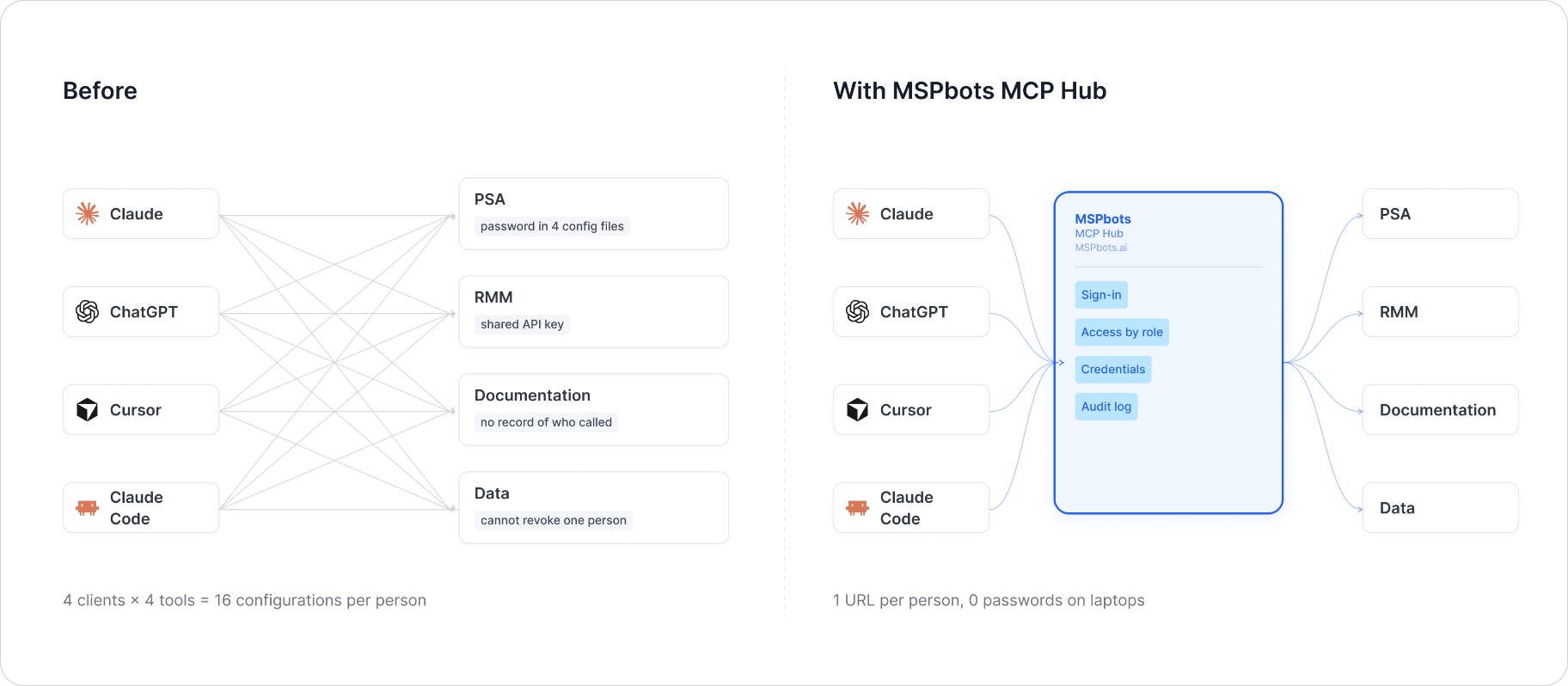
MSPbots Connector gives your AI clients one MCP URL to reach your entire MSP stack (RMM, PSA, documentation, security, finance), and gives you control over who can call which tool and a record of everything that was called.
**Hosted service: [connect.mspbots.ai](https://connect.mspbots.ai)** · Free to use.
### Why Connector
| | |
|---|---|
| **Visible** | Every tool call is logged: who, which vendor, when. Usage dashboard, CSV export, SIEM streaming. |
| **Controlled** | Role-based, per-tool allowlist. Deny by default. |
| **Protected** | Credentials encrypted per record. AI clients never see your vendor passwords or tokens. |
| **MSP-native** | Built for the MSP stack only: RMM, PSA, documentation, security, finance. |
### Quick start
1. **Sign up** at [connect.mspbots.ai](https://connect.mspbots.ai).
2. **Connect your vendors.** Pick from 150+ connectors and authorize each one on the vendor's own page, or bring your own API keys. No extra vendor accounts needed.
3. **Set access.** Create roles and decide which tools each role may call. Nothing is allowed until you allow it.
4. **Add your MCP URL to your AI client.** Copy the URL from your Connector dashboard into Claude, ChatGPT, Cursor, VS Code, Gemini, Codex, or any MCP-capable client.
5. **Ask your AI to do real work**, and watch every call appear in the audit log.
### Features
**Unified gateway**
- One MCP URL for all your AI clients
- 150+ connectors across the MSP stack
- Custom MCP servers supported, free
- Authorization happens on each vendor's own page; the AI never sees passwords or tokens
- Bring your own credentials: use the vendor API keys you already have
- Multiple accounts per app; connect once, reuse across AI clients
- Tool search: finds the right action for the task
- One sign-in; vendor credentials are injected behind the scenes and OAuth tokens refresh automatically
**Visibility**
- Audit log for every tool call (who, which vendor, when)
- Usage dashboard: call volume, top vendors, error rate, per-user activity
- Export audit logs to CSV, or stream to Loki, Graylog, or LogScale (SIEM)
- Optional recording of tool arguments and result summaries (off by default, enabled per organization)
**Control**
- Per-role, per-tool allowlist, deny by default
- owner / admin / member roles
- SCIM provisioning with Entra ID, Okta, JumpCloud, and Google Workspace
**Security**
- Credentials encrypted one record at a time (AES-256-GCM, per-record key)
- AI clients authenticate with OAuth 2.1 + PKCE
- Vendor responses are scanned for prompt-injection patterns and returned as structured data. This is one layer of defense, not a guarantee against every attack.
- Static egress IP for customer firewall and API allowlisting
### Pricing
**Free.**
Links: [connect.mspbots.ai](https://connect.mspbots.ai) · [mspbots.ai](https://mspbots.ai)
---
## Overview
- Stateless HTTP service. No credentials are ever persisted — each request
supplies its own credentials via headers, used only for the lifetime of
that single request.
- Supports concurrent requests; per-request credential isolation is done via
Python `contextvars`, not a global/shared client instance.
- Entry points: `POST /mcp` (MCP protocol) and `GET /health` (health check).
- Default port: `8080` (configurable via `MCP_HTTP_PORT`).
## Authentication
Dropsuite authenticates with two static tokens (an **Access Token** and a
**Reseller Token**, both found on the "API Settings" page in the Dropsuite/
NinjaOne SaaS Backup dashboard). Since every reseller/partner has its own
site host, the base URL is also per-request rather than fixed.
Per the vendor's own documentation: **"Sub-partners and resellers can use
GET API calls to retrieve information about their organizations and
users"** — write access is restricted to Direct Partners/Distributors, so a
reseller-scoped credential (like MSPbots' own) is inherently read-only.
### HEADER authentication parameters
| Header | Type | Required | Default | Allowed values | Description | Example |
|---|---|---|---|---|---|---|
| `X-Dropsuite-Access-Token` | string | Yes | None | None | Dropsuite Authentication Token, forwarded as the upstream `X-Access-Token` request header | `a1b2c3d4-e5f6-7890-abcd-ef1234567890` |
| `X-Dropsuite-Reseller-Token` | string | Yes | None | None | Dropsuite Reseller Token, forwarded as the upstream `X-Reseller-Token` request header | `12345678-90ab-cdef-1234-567890abcdef` |
| `X-Dropsuite-Site` | string | Yes | None | None | API host address of this reseller (each reseller has its own) | `https://dropsuite.us` |
Missing any of the three headers returns `401`:
```json
{
"error": "Missing credentials",
"message": "This server requires the X-Dropsuite-Access-Token, X-Dropsuite-Reseller-Token, and X-Dropsuite-Site headers",
"required_headers": ["X-Dropsuite-Access-Token", "X-Dropsuite-Reseller-Token", "X-Dropsuite-Site"],
"optional_headers": []
}
```
## Environment Variables
| Variable | Type | Required | Default | Description |
|---|---|---|---|---|
| `MCP_HTTP_PORT` | int | No | `8080` | HTTP listen port |
| `MCP_HTTP_HOST` | string | No | `0.0.0.0` | HTTP listen address |
(No `*_BASE_URL` env var — the site host is per-reseller and always
supplied via the `X-Dropsuite-Site` header, never a fixed default.)
## MCP Endpoint
- `POST /mcp` — MCP protocol (streamable HTTP transport)
- `GET /health` — health check, returns `{"status": "ok"}` (pure local probe, does not depend on the upstream Dropsuite API)
## Tool List
All 8 tools are plain `GET` calls with **no required parameters** — this
matches exactly how MSPbots itself calls this integration today. Each tool
accepts an optional `extra_params` pass-through dict for any additional
query-string filters, since Dropsuite's full filter reference is only
available through a partner-portal-gated PDF/Browsable API (see
**Known Gaps**).
| Tool | Function | Parameters |
|---|---|---|
| `dropsuite_get_accounts` | List backup accounts (customers/organizations) under this reseller | `extra_params: dict[str,str] \| None` |
| `dropsuite_get_users` | List backed-up mailboxes/users | `extra_params: dict[str,str] \| None` |
| `dropsuite_get_contacts` | List backed-up contacts | `extra_params: dict[str,str] \| None` |
| `dropsuite_get_calendars` | List backed-up calendars | `extra_params: dict[str,str] \| None` |
| `dropsuite_get_tasks` | List backed-up tasks | `extra_params: dict[str,str] \| None` |
| `dropsuite_get_onedrives` | List backed-up OneDrive accounts | `extra_params: dict[str,str] \| None` |
| `dropsuite_get_sharepoints_domains` | List backed-up SharePoint domains | `extra_params: dict[str,str] \| None` |
| `dropsuite_get_teams_and_groups_domains` | List backed-up Teams/Groups domains | `extra_params: dict[str,str] \| None` |
## Test Example
```bash
# Health check
curl -s http://localhost:8080/health
# Call a tool via the MCP protocol (streamable HTTP) — requires an
# initialize handshake first per the MCP spec; abbreviated example below
# shows the tool-call request body only:
curl -s -X POST http://localhost:8080/mcp \
-H "X-Dropsuite-Access-Token: <your-access-token>" \
-H "X-Dropsuite-Reseller-Token: <your-reseller-token>" \
-H "X-Dropsuite-Site: https://dropsuite.us" \
-H "Content-Type: application/json" \
-H "Accept: application/json, text/event-stream" \
-H "mcp-session-id: <session-id-from-initialize>" \
-d '{
"jsonrpc": "2.0",
"id": 1,
"method": "tools/call",
"params": {
"name": "dropsuite_get_accounts",
"arguments": {}
}
}'
```
**Live-verified** (2026-07-29) against a real reseller test account: 6 of
the 8 tools (`get_accounts`, `get_users`, `get_contacts`, `get_calendars`,
`get_tasks`, `get_onedrives`) returned `200` with real data (an empty `[]`
list, since this test reseller currently has no linked accounts) called
through the actual running MCP server. See Known Gaps for the other 2.
## API Reference
- Vendor overview: https://help.dropsuite.com/hc/en-us/articles/20422080552855-API-Settings
- The full method/parameter reference ("REST API - for subreseller ver
1.00.pdf") is attached to a NinjaOne KB article
(https://www.ninjaone.com/docs/backup/saas-backup/getting-started/rest-api-reference/)
that redirects to a NinjaOne account login — not accessible without a
portal login, only an API token. The vendor's own "Browsable API" (a
live, self-documenting endpoint list) is likewise only reachable from
inside an authenticated Dropsuite/NinjaOne SaaS Backup dashboard session.
## Known Gaps
- **Scope is exactly MSPbots' 8 configured endpoints, not the vendor's full
API surface** — same situation as `bvoip-mcp`/`contactscience-mcp`
earlier in this program: the vendor's fuller API reference is gated
behind a portal login this session doesn't have, so there was no larger
accessible spec to weigh a broader scope against. The vendor's own docs
additionally confirm resellers are restricted to GET calls only, so a
reseller credential (like MSPbots' own) couldn't reach write endpoints
even if they were documented.
- **`dropsuite_get_sharepoints_domains` and
`dropsuite_get_teams_and_groups_domains` returned a generic vendor-side
`500 {"errors":{"System":["Internal Server Error"]}}`** in live testing
against the provided test account, while the other 6 endpoints returned
`200` (with empty `[]` results, since the test reseller has no linked
accounts). This looks like a vendor-side issue with enumerating
SharePoint/Teams domains when there's no linked data to return, rather
than a request-format problem on this server's side — both tools are
implemented identically to the other 6 working ones. Not independently
confirmed against an account that actually has SharePoint/Teams-enabled
backups.
This server cannot be deployed
Maintenance
ActivityMaintained
ResponsivenessNo issues