
nightward
Official# nightward
**A regression gate for AI-made changes. Your AI agent can run the gate; opening it takes a human-approved baseline diff.**
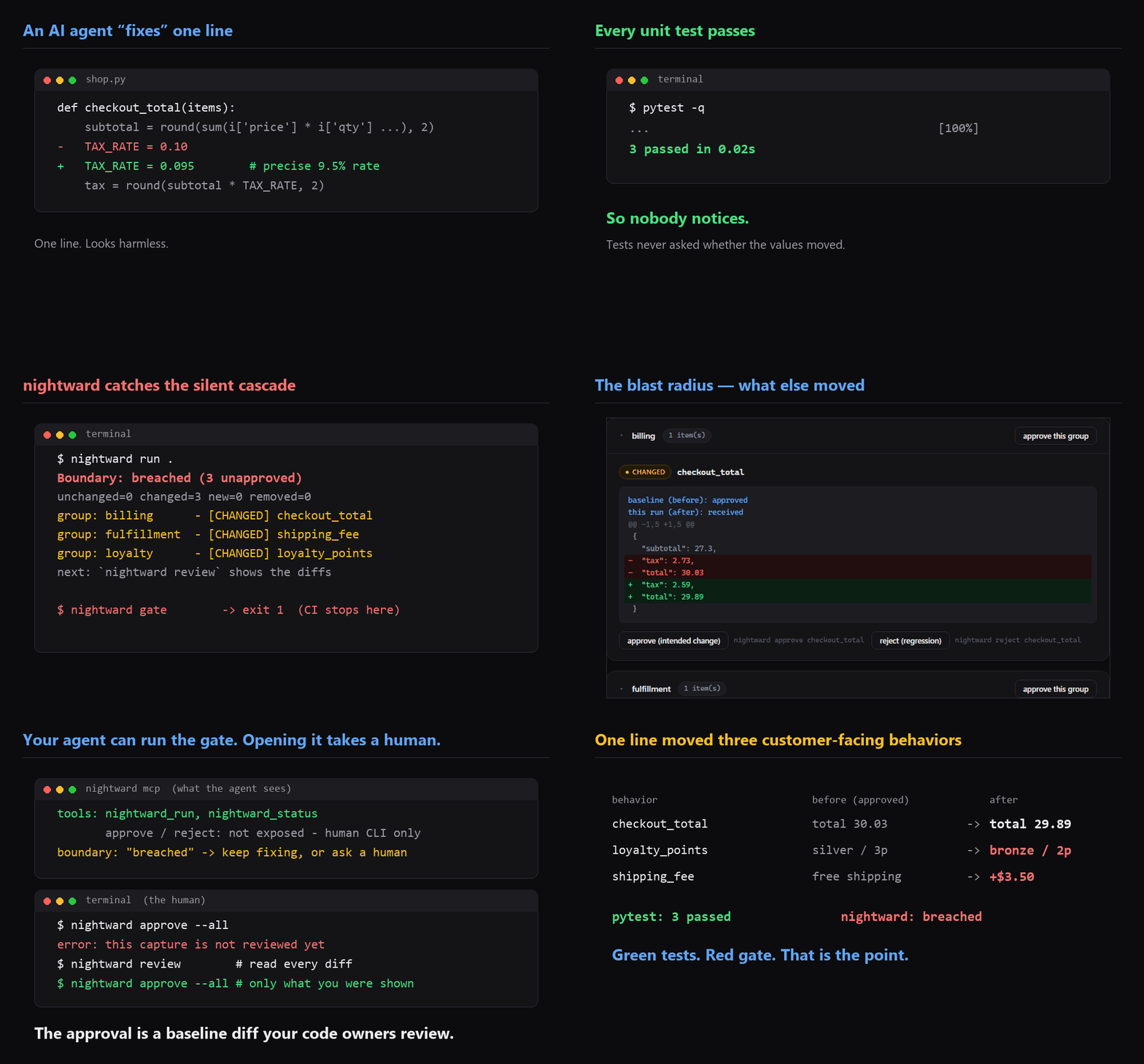
When an AI agent fixes A, it often moves B, C and D too, and the test suite stays
green because no test pins down B, C or D. You find the side effects later, fix
them, and the fixes move something else. An agent loop has no reliable way to know
when it is done.
nightward gives that loop a definition of "done" that the agent can check but not
change:
1. Your tests capture what the code does today with a `behavior(...)` pytest
fixture. You don't write expected values.
2. A human reviews those captures and approves them once. That baseline is a set
of JSON files committed next to your code.
3. After every change, nightward captures again and lists everything that moved,
grouped by feature (the *blast radius*). The gate stays closed until a human
approves each change as intended or the code is fixed.
The agent gets `run` and `status`, on the command line or as MCP tools. Approving
is a human CLI command, and its result is a file diff that goes through code review.
```text
nightward run # capture behaviors and compare them with the approved baseline
nightward review # a human reads the diffs
nightward approve # the human accepts what review showed (intended changes only)
nightward gate # exit 0 only when nothing unapproved remains (CI, agent loops)
```
nightward is **not** a test generator, and it has no idea what is *correct*. It
only makes sure that no change to a captured behavior passes silently.
| Compared with | How nightward differs |
|---|---|
| NL→test generators | nightward **gates** changes, it doesn't author tests |
| snapshot libraries (syrupy, inline-snapshot, ApprovalTests) | approval is a separate, review-gated step that never removes anything in bulk, and one run lists every moved behavior by feature with a verdict an agent can read. [Detailed comparison](#how-it-compares-with-snapshot-testing) |
| ordinary regression tests | no hand-written expected values, and a semantic judge can gate nondeterministic AI text |
What's new in 0.3, and what changes for 0.2 users: see the [CHANGELOG](https://github.com/LunenLabs/nightward/blob/main/CHANGELOG.md).
## How a project uses it
Setup happens once. After that, every change goes around the loop, and only a
human can take an "approve" edge:
```mermaid
flowchart TD
subgraph setup["Once per project"]
A["Write capture tests<br/>behavior(name, value, group=)"] --> B["nightward run"]
B --> C{"A human reads the first capture<br/>nightward review"}
C -- "a value is wrong" --> D["Fix the code"] --> B
C -- "this is what it should do" --> E["nightward approve<br/>commit .nightward/baseline/"]
end
E --> F
subgraph loop["Every change, by an agent or a human"]
F["Edit the code"] --> G["nightward run<br/>(MCP: nightward_run)"]
G --> H{"boundary"}
H -- "intact" --> I["Done: open the PR"]
H -- "breached, not intended" --> F
H -- "breached, intended" --> J["The agent stops and lists the changes"]
J --> K{"A human runs nightward review"}
K -- "approve" --> L["Baseline diff in the PR,<br/>reviewed by code owners"]
K -- "reject: a regression" --> F
end
I --> M["CI: nightward gate<br/>exit 0 only when intact"]
L --> M
```
The same loop as a timeline, for an agent change that moves something it shouldn't:
```mermaid
sequenceDiagram
actor Human
participant Agent
participant NW as nightward
participant CI
Human->>Agent: "add a coupon to checkout"
Agent->>Agent: edits the code
Agent->>NW: nightward_run
NW-->>Agent: breached: checkout_total (intended), loyalty_points (not intended)
Agent->>Agent: fixes the loyalty side effect
Agent->>NW: nightward_run
NW-->>Agent: breached: checkout_total only
Agent-->>Human: "checkout_total changed as asked - please review"
Human->>NW: nightward review, then nightward approve
Human->>CI: push (the baseline diff is in the PR)
CI->>NW: nightward gate
NW-->>CI: exit 0 (intact)
```
## Install
nightward needs Python 3.10+. Installing it also registers its pytest plugin, so
the `behavior` fixture is available in every test.
```bash
pip install nightward
pip install "nightward[mcp]" # + MCP server for AI agents
```
Other extras: `[judge]` (the Anthropic SDK, for the LLM judge) and `[docs]` (the
PDF, Word and Excel adapters).
## Quickstart (5 minutes)
In an empty directory, create a tiny app and a test that captures its behavior.
`app.py`:
```python
def checkout_total(items):
subtotal = sum(i["price"] * i["qty"] for i in items)
tax = round(subtotal * 0.1, 2)
return {"subtotal": subtotal, "tax": tax, "total": round(subtotal + tax, 2)}
def user_login(username):
return {"user": username, "status": "ok", "roles": ["member"]}
```
`test_app.py` writes no expected values. It captures what the code returns
(for anything bigger than this, shape the payload so a human can review it:
[payload design](https://github.com/LunenLabs/nightward/blob/main/docs/payload-design.md)):
```python
from app import checkout_total, user_login
CART = [{"price": 10.0, "qty": 2}, {"price": 5.5, "qty": 1}]
def test_checkout(behavior):
behavior("checkout_total", checkout_total(CART), group="billing")
def test_login(behavior):
behavior("user_login", user_login("alice"), group="auth")
```
A test that captures one value can return it instead. `@capture` names the
behavior after the test (or `name=`), and each parametrized case keeps its id:
```python
from nightward import capture
@capture(name="checkout_total", group="billing")
def test_checkout():
return checkout_total(CART)
```
**1. Approve the current behavior as the baseline.**
```bash
git init # skip in an existing repo
nightward init # creates .nightward/ and git-ignores its per-run files
nightward run . # runs pytest and captures; lists what moved (names only)
nightward review # shows each diff; approve covers only what review showed
nightward approve --all
git add .gitignore .nightward # commit baseline/, rejected/, judge/ (init ignores per-run files)
git add app.py test_app.py && git commit -m "nightward baseline"
```
`run` finds two NEW behaviors, `review` prints their JSON, and `approve` makes them
the baseline:
```text
Boundary: breached (2 unapproved)
unchanged=0 changed=0 new=2 removed=0
...
approved checkout_total (c9ff6ed9)
approved user_login (b86be5a5)
Boundary: intact
unchanged=2 changed=0 new=0 removed=0
```
**2. Make the kind of change an agent makes.** In `app.py`, change the tax rate
`0.1` to `0.2` (in bash: `sed -i 's/subtotal \* 0.1/subtotal * 0.2/' app.py`).
Then:
```bash
nightward run . # the tests still pass
nightward gate # exit code 1: not done
nightward status --json # the same verdict, for a script or an agent
nightward approve --all # refused: nobody has reviewed this change yet
nightward review # the diff a human decides on
```
```text
Boundary: breached (1 unapproved)
unchanged=1 changed=1 new=0 removed=0
group: billing
- [CHANGED] checkout_total
boundary breached (1 unapproved) (as of the last run, ...)
{"boundary": "breached", "unapproved": 1, "changes": [{"name": "checkout_total", "kind": "CHANGED", "group": "billing"}], ...}
error: checkout_total changed since your review (the capture now in the store was taken by `nightward run` at ...). Run `nightward review checkout_total`, then approve what it shows.
[CHANGED] checkout_total
--- approved
+++ received
@@ -1,5 +1,5 @@
{
"subtotal": 25.5,
- "tax": 2.55,
- "total": 28.05
+ "tax": 5.1,
+ "total": 30.6
}
```
**3. Decide.** If the change is a regression, fix the code: put `0.1` back, run
`nightward run .` again, and it reports `Boundary: intact`, so `nightward gate`
exits 0. If the change is intended, run `nightward approve --all` (it now
succeeds, because `review` showed you this diff) and commit the updated
`.nightward/baseline/checkout_total.approved.json`.
**4. Optional: see the blast radius in a browser.** `nightward view` builds a
static, read-only dashboard and serves it on localhost. `nightward view
--no-serve` only builds `nightward-site/`, which `init` already git-ignored.
For a bigger cascade (one tax tweak moves three customer-facing behaviors), run
the [petshop example](https://github.com/LunenLabs/nightward/tree/main/examples/petshop) from a clone of this repo.
## What to commit
| path | commit? | what it is |
|---|---|---|
| `.nightward/baseline/` | yes | the approved behaviors: the boundary |
| `.nightward/rejected/` | yes | changes a human confirmed as regressions |
| `.nightward/judge/` | yes | the semantic judge's rulings (review them like the baseline) |
| `pending/`, `report.json`, `run_meta.json`, `reviewed.json`, `.lock` | no | per-run state, ignored by `nightward init` |
| `nightward-site/` | no | the dashboard build: it contains your captured data |
## In CI: the GitHub Action
Set up Python and your project's dependencies, then gate the PR with one step.
It runs your tests, writes the verdict and the diffs that moved to the job
summary, and fails the job unless the boundary is intact. It never approves:
intended changes are approved locally (`nightward review`, `nightward approve`)
and arrive in the PR as a baseline diff.
```yaml
- uses: actions/checkout@v4
- uses: actions/setup-python@v5
with:
python-version: "3.12"
- run: pip install -e . # your project and its test dependencies
- uses: LunenLabs/nightward@v0.3.4
with:
path: tests # what pytest runs; default: [tool.nightward] path, else "."
```
Inputs: `path`, `dir` (default `.nightward`), `pytest-args` (one per line),
`allow-not-run`, `version`, `install`, `summary`; output: `boundary`. A full
workflow with the dashboard artifact is in the
[CI recipe](https://github.com/LunenLabs/nightward/blob/main/docs/recipes/ci-github-actions.md).
## Commands
| command | what it does |
|---|---|
| `nightward init` | create the store and the `.gitignore` rules (once per repo, and again after upgrading) |
| `nightward run [PATH] [-- PYTEST ARGS]` | run pytest, capture, compute the blast radius. Exit 1 if a capture test failed (the run is incomplete) |
| `nightward review [NAME...] [--group G] [--summary]` | show the diffs, or with `--summary` each changed path once with its old -> new values counted. Only `review` and `view` mark changes as reviewed |
| `nightward approve --all` / `NAME...` / `--group G` | promote reviewed NEW/CHANGED behaviors into the baseline. Bulk approval never removes anything |
| `nightward approve --remove NAME...` / `--remove-group G` | drop REMOVED behaviors: removal is always this explicit act |
| `nightward reject NAME` | confirm a reviewed change as a regression. The gate stays breached |
| `nightward gate [--allow-not-run] [--run]` | the verdict as an exit code: 0 intact; 1 breached, partial, stale or incomplete; 2 no store, no report, or an error. `--run` captures first, so the verdict covers the code as it is now |
| `nightward status [--json]` | the verdict with the change list. `--json` is the machine signal |
| `nightward doctor [NAME...]` | explain what moved, and suggest scrub rules only for values that are volatile by evidence |
| `nightward report` | the verdict from a capture that `pytest --nightward-record` already wrote in your CI job |
| `nightward view` | build and serve the read-only dashboard |
| `nightward mcp` | stdio MCP server for AI agents: run and status, never approve |
| `nightward --version` | the installed version |
`gate` and `status` report the **last run**, so run `nightward run` again after
every code edit (or use `nightward gate --run`). The full reference (removals, stale reports, merge conflicts,
locking, and using the plugin inside an existing pytest job) is in
[docs/commands.md](https://github.com/LunenLabs/nightward/blob/main/docs/commands.md).
## AI agents (`nightward mcp`)
An agent loop needs a definition of "done" that it can check but not change.
`nightward mcp` is a stdio [MCP](https://modelcontextprotocol.io) server with two
tools: `nightward_run` (run the tests, capture, recompute the verdict) and
`nightward_status` (read the last verdict). `approve` and `reject` are not
exposed: if the agent that makes a change could also approve it, the gate would
turn into a changelog. The judge and the store are the humans' committed choices,
so the agent can't pick a lenient judge or point the server at another store.
In Claude Code, install the plugin. It adds the MCP server and a skill that
tells Claude to run the gate after its edits and to hand intended changes to
you instead of approving them. A second skill, `onboard`, puts new code under the
gate: Claude reads the code without changing it, writes a
[domain map](https://github.com/LunenLabs/nightward/blob/main/docs/domain-maps.md)
and the capture tests, and hands you the suspected defects and the first review. nightward itself must be installed in the
environment you start `claude` from (your project's virtualenv):
```bash
pip install "nightward[mcp]" # in the project's environment
```
```text
/plugin install nightward --marketplace LunenLabs/nightward
```
`/nightward:status` then shows the verdict and what you need to review. Any other
MCP host can run the server directly:
```bash
claude mcp add nightward -- nightward mcp # or your host's equivalent; run it in the project root
```
Both tools return the `status --json` shape. The agent is done only when
`boundary` is `intact` and `stale` is false:
| `boundary` | meaning | what the agent should do |
|---|---|---|
| `intact` | no unapproved change | done |
| `breached` | unapproved changes | fix the code, or stop and ask a human to approve |
| `partial` | nothing unapproved among what ran, but approved behaviors were not checked (deselected, see `not_run`) | run them: remove the `-k`/`-m` selection (it can't be waived over MCP) |
| `incomplete` | nothing unapproved, but capture tests failed or errored | fix the failing tests (see `incomplete` and `pytest_output_tail`) |
| `stale` | the baseline, capture or rejections moved since the report | call `nightward_run` again |
| `unknown` | no report yet | call `nightward_run` |
Setup for other MCP hosts, every argument and returned field, and the rules for
the loop are in [docs/mcp.md](https://github.com/LunenLabs/nightward/blob/main/docs/mcp.md).
## Gating AI text: the semantic judge
Free-text AI output changes its wording on every run, so an exact comparison
breaches every time. Mark such a behavior `semantic=True` and commit a judge in
`pyproject.toml`: `[tool.nightward] judge = "anthropic:claude-haiku-5-5"`. The
key-free `persona:*` judges are deterministic stand-ins for tests and CI: they
forgive changes of case, whitespace and punctuation in prose, not a reworded
sentence, so reworded AI text needs the LLM judge. The judge only decides whether two outputs mean the
same thing; approval stays human. Every ruling is recorded in the committed
ledger `.nightward/judge/`, and a judge that can't rule falls back to the exact
comparison. Details are in
[docs/semantic-judge.md](https://github.com/LunenLabs/nightward/blob/main/docs/semantic-judge.md).
## How it compares with snapshot testing
nightward is snapshot testing underneath: capture, approve, compare. If you already
use [syrupy](https://github.com/syrupy-project/syrupy),
[inline-snapshot](https://github.com/15r10nk/inline-snapshot) or
[ApprovalTests](https://github.com/approvals/ApprovalTests.Python) and people make
your changes, they may be all you need. nightward is built for the loop where an
agent makes the change:
| | snapshot libraries | nightward |
|---|---|---|
| a mismatch | fails the test; a test stops at its first failing assertion | is recorded; one run lists every moved behavior, grouped by feature |
| accepting changes | an update flag rewrites snapshots (syrupy's `--snapshot-update` also deletes unused ones), or you edit the approved file | `approve` accepts only what `review` showed you, and never removes a behavior in bulk |
| a machine verdict | the pytest exit code | `status --json`, MCP tools, a GitHub Action; never `intact` when tests were deselected (`partial`), failed (`incomplete`) or the store moved since (`stale`) |
| reworded AI text | a mismatch every run | optional semantic judge with a committed ledger |
Where they're better: inline-snapshot keeps the value next to the assertion,
syrupy has serializers for many types and needs no extra command, and ApprovalTests
exists for many languages. They can run side by side with nightward in one suite.
## What "intact" means
"Boundary intact" means no **captured** behavior changed, nothing more:
- The gate sees only what `behavior()` captures, so capture the behaviors you
care about.
- The gate is a convention, not a sandbox. An agent with a shell could run
`approve` or edit the baseline, but every bypass leaves a trace in git. Make
that trace need a human: own the store with CODEOWNERS, require code-owner
review on `main`, and let CI run the gate from source
([recipe](https://github.com/LunenLabs/nightward/blob/main/docs/recipes/protect-the-baseline.md)).
- A semantic judge can be wrong, so its rulings are recorded for review.
- Normalization defines "the same": timestamps and UUIDs are masked by default
(opt out with `scrub=False`), and dict key order is ignored.
Read the [threat model](https://github.com/LunenLabs/nightward/blob/main/docs/threat-model.md)
and [what nightward normalizes](https://github.com/LunenLabs/nightward/blob/main/docs/normalization.md)
before you rely on a green gate.
## Documentation
- [CHANGELOG](https://github.com/LunenLabs/nightward/blob/main/CHANGELOG.md): what's new in 0.3.0, and **upgrading from 0.2**
- [Commands and workflow](https://github.com/LunenLabs/nightward/blob/main/docs/commands.md):
every command, removals, stale reports, merge conflicts, and the plugin in an
existing pytest job
- [Designing payloads a human can review](https://github.com/LunenLabs/nightward/blob/main/docs/payload-design.md):
aggregate by cause, record each input once, keep the machine out - read it before
your first capture
- [What nightward normalizes](https://github.com/LunenLabs/nightward/blob/main/docs/normalization.md):
scrubbing, custom scrub rules, names, non-JSON values, and `doctor`
- [Review depth](https://github.com/LunenLabs/nightward/blob/main/docs/review-depth.md):
per group, how much a review shows and when the agent asks - never whether a
human approves
- [Domain maps](https://github.com/LunenLabs/nightward/blob/main/docs/domain-maps.md):
the rules each behavior guards, shown next to its diff; the onboard skill writes them
- [Semantic judge](https://github.com/LunenLabs/nightward/blob/main/docs/semantic-judge.md)
- [AI agents (MCP)](https://github.com/LunenLabs/nightward/blob/main/docs/mcp.md)
- [Dashboard](https://github.com/LunenLabs/nightward/blob/main/docs/dashboard.md)
- [Document & artifact inputs](https://github.com/LunenLabs/nightward/blob/main/docs/adapters.md):
PDF, Word, Excel, text and raw bytes
- [Threat model](https://github.com/LunenLabs/nightward/blob/main/docs/threat-model.md)
- [CI recipe: GitHub Actions](https://github.com/LunenLabs/nightward/blob/main/docs/recipes/ci-github-actions.md)
- [Recipe: make "only a human approves" hold on GitHub](https://github.com/LunenLabs/nightward/blob/main/docs/recipes/protect-the-baseline.md):
CODEOWNERS for the store, code-owner review, and an agent identity that isn't an owner
## Scope
In scope: pytest capture, the blast-radius diff, the gate, the loop signal,
scrubbing and `doctor`, the static dashboard, the MCP agent gate (run and status,
never approve), and the semantic judge. Out for now: PR-comment summaries,
call-graph grouping, and other languages. See [CONTRIBUTING.md](https://github.com/LunenLabs/nightward/blob/main/CONTRIBUTING.md).
MIT licensed.
TDQS
Scored across 2 tools
nightward_run executes pytest and produces a fresh verdict, while nightward_status only reads the last persisted report; the two are mutually exclusive in intent. Both descriptions explicitly warn against the classic confusion (status does not see newer code edits), which removes any residual ambiguity.
Both tools share the same `nightward_` prefix with snake_case suffixes, so the set reads as one family. The only minor wrinkle is that `run` is a verb while `status` is a noun, so the pattern is prefix+action rather than a strict verb_noun scheme.
Two tools is genuinely thin, even for a narrow boundary-gating server; the surface could plausibly expose behavior listing or store inspection. It is defensible because the toolset is deliberate and minimal, and approval is intentionally delegated to a human using the CLI.
The core loop (run, then re-read the last verdict) is covered end to end, including rich diagnostics about unapproved and unchecked behaviors. However, there is no way to enumerate stored behaviors, inspect a single behavior, initialize or refresh a baseline, and no approval path at all — the agent must fall back to asking a human for any state-changing operation.