
tshark-mcp
# tshark-mcp: Wireshark analysis for AI assistants
<!-- mcp-name: io.github.Kx96xx/tshark-mcp -->
[](https://github.com/Kx96xx/tshark-mcp/actions/workflows/ci.yml)
[](https://pypi.org/project/tshark-mcp-server/)

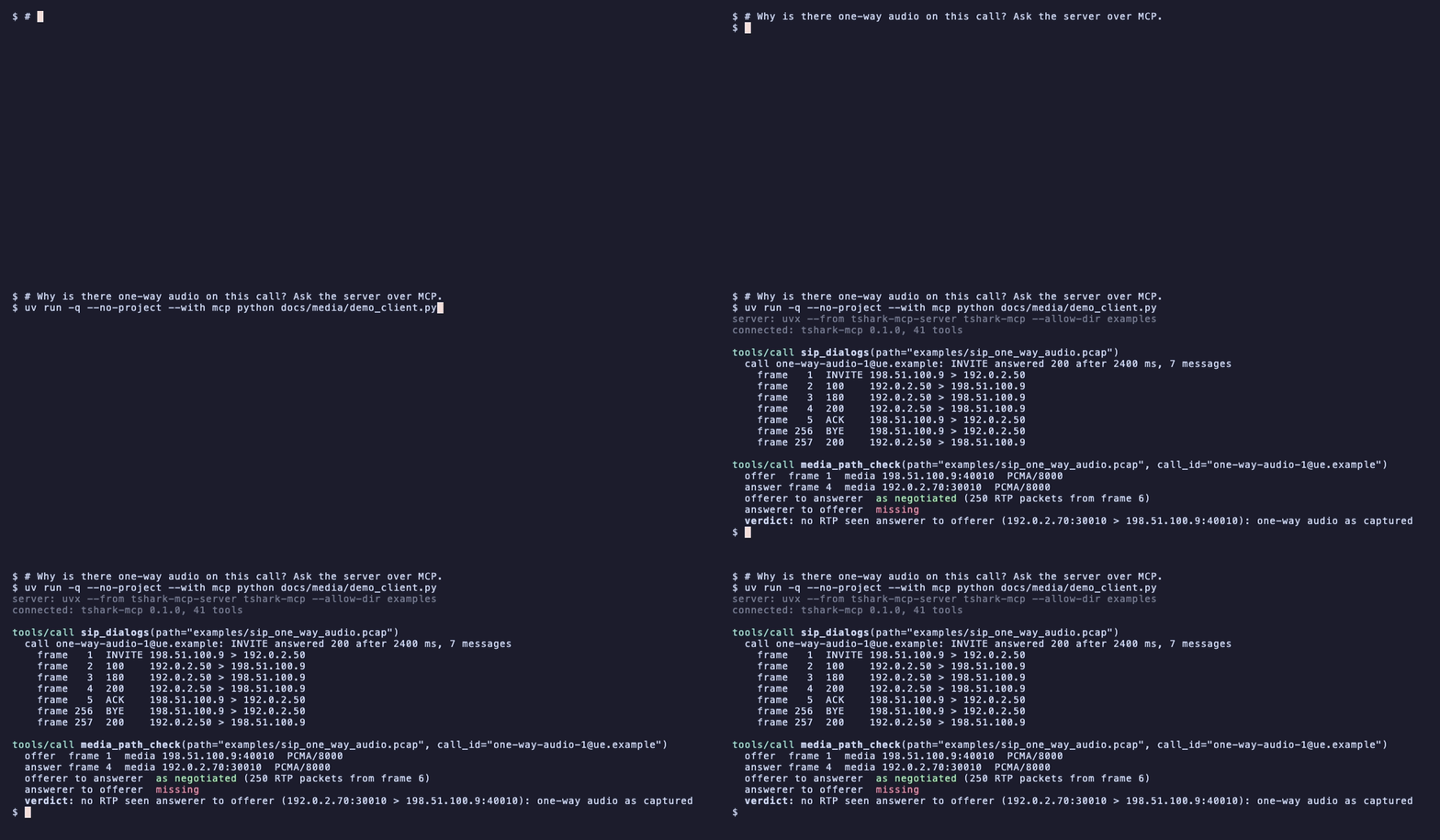
**Drop a pcap, ask your AI assistant what went wrong, get an answer with frame numbers.**
tshark-mcp is a read-only MCP server that runs `tshark -r` on captures you allow and turns
them into answers: failed connections, slow servers, DNS and TLS errors, one-way audio, and
the telecom failures generic tools miss (Diameter, GTP, SIP/IMS, SIGTRAN, 5G).
```sh
claude mcp add tshark-mcp -- uvx --from tshark-mcp-server tshark-mcp --allow-dir /path/to/pcaps
```
Needs [uv](https://docs.astral.sh/uv/) and tshark (comes with Wireshark). Cursor, Claude Desktop,
VS Code, Docker and the Claude Code plugin: [the guide](https://github.com/Kx96xx/tshark-mcp/blob/main/docs/GUIDE.md#install-and-connect).
## Why this one
- **Answers, not packet dumps.** Ask "what is wrong in this capture?" and `incident_summary`
runs every check the capture's protocols allow, ranks the findings and names the next call.
Every claim carries frame numbers you can open in Wireshark.
- **Built by a mobile core engineer.** It pairs requests with answers across Diameter, GTP,
PFCP, SIP, RTP and MAP, names the cause codes with their 3GPP reference, and follows one
subscriber across all of them.
- **Safe to hand to an agent.** No shell, no live capture, no writes: only `tshark -r` on files
inside directories you allow, under hard caps on size, packets, output and time. Optional
redaction hides IMSIs, phone numbers and IPs.
- **Checked against public captures.** 102 public sample captures, 1,064 tool calls; every
wrong answer found was fixed and is re-tested ([results](https://github.com/Kx96xx/tshark-mcp/blob/main/docs/VALIDATION.md)).
<!-- tool-count -->Sixty-three<!-- /tool-count --> tools in all; a default set of 34 keeps the tool list small.
## Learn more
- [Guide](https://github.com/Kx96xx/tshark-mcp/blob/main/docs/GUIDE.md): install, example questions, tool list, prompts, safety, limits
- [Tool reference](https://github.com/Kx96xx/tshark-mcp/blob/main/docs/TOOLS.md) and a [worked investigation](https://github.com/Kx96xx/tshark-mcp/blob/main/docs/EXAMPLE.md)
- [Report a wrong answer or a bug](https://github.com/Kx96xx/tshark-mcp/issues/new/choose)
MIT licence, Copyright (c) 2026 Karl Hulse.
TDQS
Scored across 34 tools
Nearly every tool has a clearly bounded job, and the descriptions actively route the agent ("for calls use sip_dialogs, for SMS over IMS sms_over_ims"; tcp_connections vs tcp_health; diameter_transactions vs diameter_sessions vs diameter_avps). The only real overlap is between the capture-overview family (pcap_info, capture_metadata, capture_quality, capture_index, incident_summary), where incident_summary explicitly says "start here" and calls the others, so an agent may hesitate over which entry point to use but not misselect a protocol tool.
All names are snake_case and consistently descriptive: protocol tools are named resource-first (diameter_sessions, gtp_ies, dns_transactions, tls_handshakes) and action tools verb-first (filter_packets, find_fields, check_filter, open_capture, compare_captures). The mix of noun-phrase and verb_noun patterns is a minor deviation from a single convention, but it is predictable and never ambiguous.
34 tools is above the comfortable range, but the surface is genuinely broad (Diameter, GTPv2-C, SIP/IMS, RTP, DNS, TLS, HTTP plus capture hygiene and cross-protocol correlation), and each tool appears to cover a distinct protocol+view. The meta-tools (incident_summary, trace_subscriber, roaming_attach_check, compare_captures) and open_capture handle caching help keep the set navigable, but it is still at the heavy end.
Coverage is unusually complete: capture discovery and indexing, quality/trust assessment, raw filter and per-frame fallbacks, filter authoring helpers, cause decoding, and deep per-protocol transaction/IE tools with cross-protocol subscriber tracing and A/B comparison. Remaining gaps are minor — no follow-stream payload extraction or export-objects tool, no dedicated PFCP or MAP transaction tool (only reachable through trace_subscriber/roaming_attach_check), and no decryption path for TLS/HTTP.