
A
licenseB
qualityNot graded
maintenanceMCP server for structured reasoning with cognitive trap detection, verification, and context compression
5
41 npm
1
-

Enables execution of JavaScript code within literate programming notebooks with isolated execution environments and package management
Runs JavaScript/TypeScript code in notebook environments using Node.js runtime with package.json support
Provides caching capabilities through Redis cluster integration with connection pooling and LRU eviction for high-traffic API scenarios
Supports TypeScript code execution in interactive notebooks with full dependency management and output capture
Click on "Deploy Server".
Wait a few minutes for the server to deploy. Once ready, it will show a "Started" state.
In the chat, type @ followed by the MCP server name and your instructions, e.g., "@Thoughtbox use the five-whys model to analyze why our deployment failed"
That's it! The server will respond to your query, and you can continue using it as needed.
Here is a step-by-step guide with screenshots.
Multi-agent collaborative reasoning that's auditable. Thoughtbox is an MCP server for structured, multi-agent reasoning, with a companion web app for workspace and inspection flows. Every step is recorded as a structured thought in a persistent reasoning ledger that can be visualized, exported, and analyzed.
Runtime modes: Local development can use filesystem or in-memory storage. Deployed mode uses Supabase-backed storage, and the current production MCP server runs on Cloud Run.
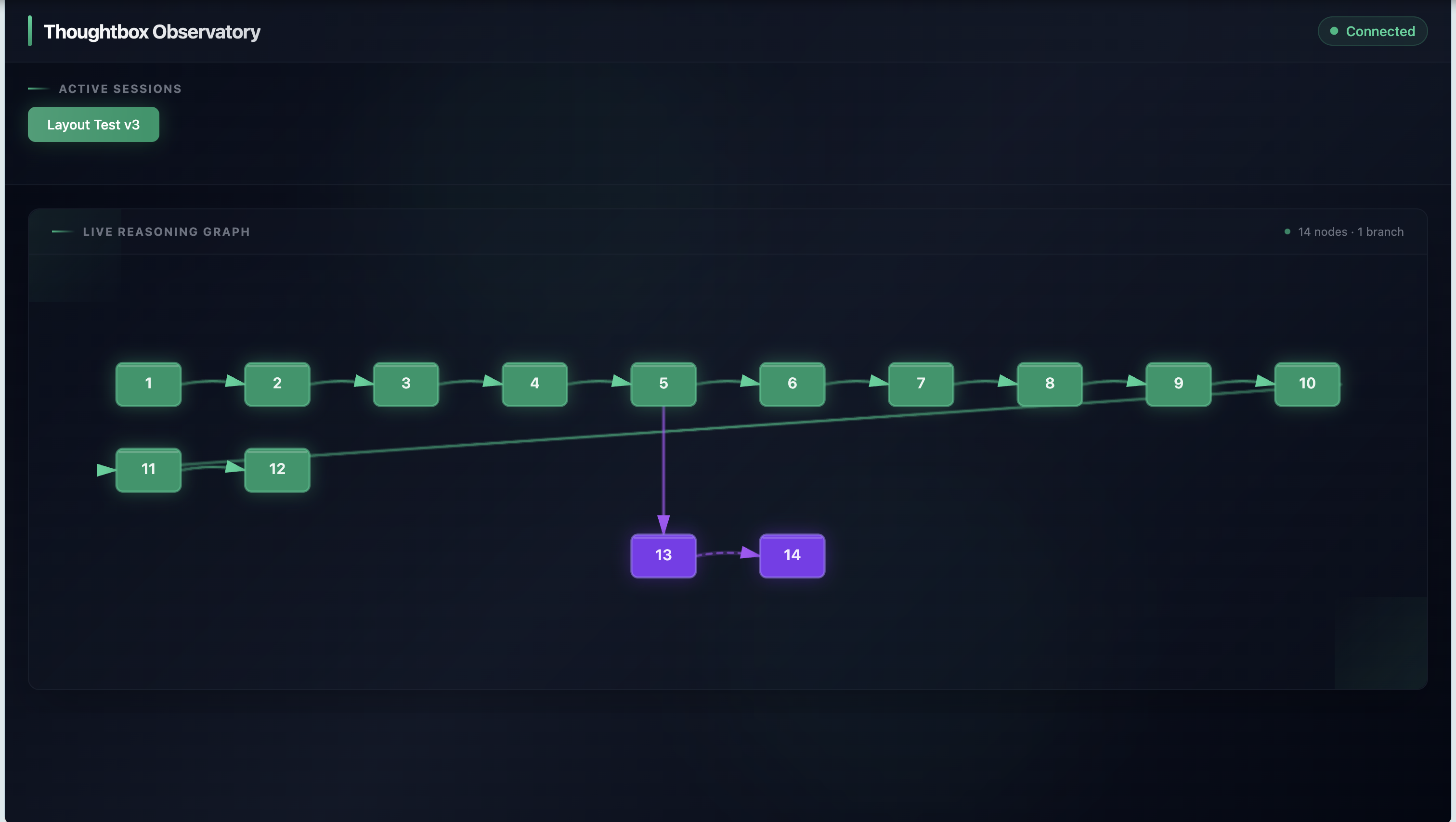 Observatory UI showing a reasoning session with 14 thoughts and a branch exploration (purple nodes 13-14) forking from thought 5.
Thoughtbox exposes exactly two MCP tools using the Code Mode pattern:
thoughtbox_search — Write JavaScript to query the operation/prompt/resource catalog. The LLM has full programmatic filtering power over the catalog.
thoughtbox_execute — Write JavaScript using the tb SDK to chain operations. Access thoughts, sessions, knowledge, notebooks, hub, observability, and protocol tools through a unified namespace.
Workflow: search to discover available operations, then execute code against them. Use console.log() for debugging — output is captured in response logs.
This replaces per-operation tool registration with a two-tool surface that scales without context window bloat.
Related MCP server: deep-thinker
The Hub is the coordination layer. Agents register with role-specific profiles, join shared workspaces, and work through a structured problem-solving workflow — all via thoughtbox_execute.
The workflow: register → create workspace → create problem → claim → work → propose solution → peer review → merge → consensus
Workspace primitives:
Problem — A unit of work with dependencies, sub-problems, and status tracking (open → in-progress → resolved → closed)
Proposal — A proposed solution with a source branch reference and review workflow
Consensus — A decision marker tied to a thought reference for traceability
Channel — A message stream scoped to a problem for discussion
Agent Profiles: MANAGER, ARCHITECT, DEBUGGER, SECURITY, RESEARCHER, REVIEWER — each provides domain-specific mental models and behavioral priming.
28 operations across identity, workspace management, problems, proposals, consensus, channels, and status reporting.
Every thought is a node in a graph — numbered, timestamped, linked to its predecessors, and persisted across sessions. This creates an auditable trail of how conclusions were reached.
Agents can think forward, plan backward, branch into parallel explorations, and revise earlier conclusions. Each pattern is a first-class operation:
Pattern | Description | Use Case |
Forward | Sequential 1→2→3→N progression | Exploration, discovery, open-ended analysis |
Backward | Start at goal (N), work back to start (1) | Planning, system design, working from known goals |
Branching | Fork into parallel explorations (A, B, C...) | Comparing alternatives, A/B scenarios |
Revision | Update earlier thoughts with new information | Error correction, refined understanding |
Each thought carries a semantic thoughtType (reasoning, decision_frame, action_report, belief_snapshot, assumption_update, context_snapshot, progress) that classifies what kind of thought it is, orthogonal to the process pattern used.
See the Patterns Cookbook for comprehensive examples.
The Observatory is a built-in web UI at http://localhost:1729 for watching reasoning unfold live.
Live Graph — thoughts appear as nodes in real-time via WebSocket
Branch Navigation — branches collapse into clickable stubs; drill in and back out
Detail Panel — click any node to view full thought content
Multi-Session — switch between active reasoning sessions
Deep Analysis — analyze sessions for reasoning patterns, cognitive load, and decision points
The full observability stack includes OpenTelemetry tracing, Prometheus metrics, and Grafana dashboards.
Knowledge Graph — Persistent memory across sessions. Capture insights, concepts, workflows, and decisions as typed entities with typed relations (BUILDS_ON, CONTRADICTS, SUPERSEDES, etc.) and visibility controls (public, agent-private, team-private).
Notebooks — Interactive literate programming combining documentation with executable JavaScript/TypeScript in isolated environments.
Thoughtbox is currently optimized for Claude Code. We are actively working on supporting additional MCP clients. Due to variation in capability support across the MCP ecosystem — server features (prompts, resources, tools), client features (roots, sampling, elicitation), and behaviors like
listChangednotifications — we implement custom adaptations for many clients.
If you're using a client other than Claude Code and encounter issues, please open an issue describing your client and the problem.
Thoughtbox runs as a Docker-based MCP server. It requires Docker and Docker Compose.
git clone https://github.com/Kastalien-Research/thoughtbox.git
cd thoughtbox
docker compose up --build
This starts Thoughtbox and the full observability stack. The MCP server listens on port 1731 and the Observatory UI is available at http://localhost:1729.
Since Thoughtbox uses HTTP transport, configure your MCP client to connect via URL.
Add to your ~/.claude/settings.json or project .claude/settings.json:
{
  "mcpServers": {
    "thoughtbox": {
      "url": "http://localhost:1731/mcp"
    }
  }
}
To connect through the observability sidecar (adds OpenTelemetry tracing):
{
  "mcpServers": {
    "thoughtbox": {
      "url": "http://localhost:4000/mcp"
    }
  }
}Add to your MCP settings or .vscode/mcp.json:
{
  "servers": {
    "thoughtbox": {
      "url": "http://localhost:1731/mcp"
    }
  }
}Thought 1: "Users report slow checkout. Let's analyze..."
Thought 2: "Data shows 45s average, target is 10s..."
Thought 3: "Root causes: 3 API calls, no caching..."
Thought 4: "Options: Redis cache, query optimization, parallel calls..."
Thought 5: "Recommendation: Implement Redis cache for product data"Thought 8: [GOAL] "System handles 10k req/s with <100ms latency"
Thought 7: "Before that: monitoring and alerting operational"
Thought 6: "Before that: resilience patterns implemented"
Thought 5: "Before that: caching layer with invalidation"
...
Thought 1: [START] "Current state: 1k req/s, 500ms latency"Thought 4: "Need to choose database architecture..."
Branch A (thought 5): branchId="sql-path"
"PostgreSQL: ACID compliance, mature tooling, relational integrity"
Branch B (thought 5): branchId="nosql-path"
"MongoDB: Flexible schema, horizontal scaling, document model"
Thought 6: [SYNTHESIS] "Use PostgreSQL for transactions, MongoDB for analytics"Variable | Description | Default |
| Suppress thought logging to stderr |
|
| Base directory for persistent storage |
|
| Project scope for session isolation |
|
| Transport type ( |
|
| Storage backend ( |
|
| Enable Observatory web UI |
|
| Observatory UI port |
|
| CORS origins for Observatory (comma-separated) | (none) |
| Pre-assigned Hub agent ID | (none) |
| Pre-assigned Hub agent name | (none) |
| Supabase project URL (required for | (none) |
| Supabase service role key (required for | (none) |
| HTTP server port |
|
| HTTP server bind address |
|
| Node environment | (none) |
| Prometheus endpoint (Docker) |
|
| Grafana endpoint (Docker) |
|
For local development (requires Node.js 22+):
pnpm install
pnpm build
pnpm dev # Development with hot reloadnpx vitest run # Unit tests
pnpm test # Full suite (build + vitest)
pnpm test:agentic # Agentic tests — full suite (build + run)
pnpm test:agentic:tool # Agentic tests — tool-level only
pnpm test:agentic:quick # Agentic tests — quick (no build)
pnpm test:behavioral # Behavioral contract testsdocker compose up --build starts the full stack:
Service | Port | Description |
thoughtbox | 1731 (MCP), 1729 (Observatory) | Core MCP server + Observatory UI |
mcp-sidecar | 4000 | Observability proxy with OpenTelemetry |
otel-collector | 4318 (HTTP), 8889 (metrics) | OpenTelemetry Collector |
prometheus | 9090 | Metrics storage + alerting |
grafana | 3001 | Dashboards and visualization |
Persistent data is stored in named volumes: thoughtbox-data, prometheus-data, grafana-data.
src/
├── index.ts                # Entry point (Streamable HTTP transport)
├── server-factory.ts       # MCP server factory with tool registration
├── thought-handler.ts      # Core thought recording logic
├── types.ts                # Shared type definitions
├── database.types.ts       # Supabase generated types
├── code-mode/              # Code Mode tool surface
│   ├── search-tool.ts      # thoughtbox_search — catalog query via JS
│   ├── execute-tool.ts     # thoughtbox_execute — operation chaining via tb SDK
│   ├── search-index.ts     # Frozen catalog of operations/prompts/resources
│   └── sdk-types.ts        # TypeScript definitions for the tb SDK
├── thought/                # Thought operations and tool definitions
├── sessions/               # Session management
├── persistence/            # Storage layer
│   ├── storage.ts          # InMemoryStorage with LinkedThoughtStore
│   ├── filesystem-storage.ts  # FileSystemStorage with atomic writes
│   └── supabase-storage.ts # SupabaseStorage for deployed/cloud usage
├── observatory/            # Real-time visualization
│   ├── ui/                 # Self-contained HTML/CSS/JS
│   └── ws-server.ts        # WebSocket server for live updates
├── hub/                    # Multi-agent collaboration
│   ├── identity.ts         # Agent registration
│   ├── workspace.ts        # Workspace management
│   ├── problems.ts         # Problem tracking with dependencies
│   ├── proposals.ts        # Solution proposals with reviews
│   ├── consensus.ts        # Decision recording
│   ├── channels.ts         # Problem-scoped messaging
│   ├── hub-handler.ts      # Hub operation dispatcher
│   └── operations.ts       # 28-operation catalog
├── channel/                # Hub event channels and SSE streaming
├── protocol/               # Ulysses and Theseus protocol tools
├── knowledge/              # Knowledge graph memory
├── auth/                   # API key authentication
├── audit/                  # Audit manifest generation
├── evaluation/             # LangSmith evaluation and online monitoring
├── notebook/               # Literate programming engine
├── events/                 # Event emission system
├── observability/          # Prometheus/Grafana integration
├── prompts/                # MCP prompt definitions
├── references/             # Anchor parsing and resolution
├── revision/               # Revision indexing
├── operations-tool/        # Operations tool handler
└── resources/ # Documentation and patterns cookbookThoughtbox supports three storage backends:
InMemoryStorage: Volatile storage for testing, uses LinkedThoughtStore for O(1) thought lookups
FileSystemStorage: Persistent storage with atomic writes and project isolation (default)
SupabaseStorage: Cloud-native storage backed by Supabase Postgres for deployed instances
Data is stored at ~/.thoughtbox/ by default (FileSystemStorage):
~/.thoughtbox/
├── config.json           # Global configuration
└── projects/
    └── {project}/
        └── sessions/
            └── {date}/
                └── {session-id}/
                    ├── manifest.json
└── {thought-number}.jsonWe welcome contributions! See CONTRIBUTING.md for:
Development setup
Commit conventions (optimized for thick_read code comprehension)
Testing with vitest and agentic scripts
Pull request process
MIT License — free to use, modify, and distribute.
This server cannot be deployed
AI Reasoning Cache & Consensus Layer with 11 MCP tools via Streamable HTTP.
NeuralBrain MCP Server - RAG, Vector Memory, LLM Routing, Agent Identity, x402 Payments
Real-time planetary signal engine and Model Context Protocol (MCP) server for autonomous AI agents.
MCP server for your apps' tools and custom tools, plus hosted AI agents and approval-gated workflows