
ghostpaw-grimoire
by GhostPawJS
README.md
<a href="https://grimoire.ghostpaw.dev/"><img src="https://raw.githubusercontent.com/GhostPawJS/grimoire/main/.github/social-preview.png" alt="GhostPaw grimoire: Your agent edits its SKILL.md. Who keeps the history?" width="100%"></a>
# @ghostpaw/grimoire
[](https://www.npmjs.com/package/@ghostpaw/grimoire) [](https://github.com/GhostPawJS/grimoire/actions/workflows/ci.yml) [](https://grimoire.ghostpaw.dev/) [](package.json) [](https://registry.modelcontextprotocol.io/v0.1/servers/io.github.GhostPawJS%2Fgrimoire/versions/latest) [](https://nodejs.org) [](LICENSE)
**Agent skills as SKILL.md folders, every improvement sealed as a git commit you can roll back.**
A procedural knowledge engine for Node.js, built on Git, SQLite, and the filesystem.
Grimoire treats spells (learned procedures), evidence, versioning, and health
as one coherent model instead of separate systems. It ships as a single
prebundled blob with zero runtime dependencies, designed for two audiences at
once: human developers working directly in code, and LLM agents operating
through a structured `soul` / `tools` / `skills` runtime.
## Install
### Release binary (default)
The installers verify the archive against SHA256SUMS before installing. The Unix
lines below install the latest release to `~/.local/bin` and add that directory
to PATH for the current shell only; they do not edit `~/.profile` or any other
file. The Windows installer updates the user PATH. Choose the line for your
target.
Linux x64:
```sh
curl -fsSL https://raw.githubusercontent.com/GhostPawJS/grimoire/main/install.sh | sh -s -- --target linux-x64 && export PATH="$HOME/.local/bin:$PATH"
```
Linux arm64:
```sh
curl -fsSL https://raw.githubusercontent.com/GhostPawJS/grimoire/main/install.sh | sh -s -- --target linux-arm64 && export PATH="$HOME/.local/bin:$PATH"
```
macOS arm64:
```sh
curl -fsSL https://raw.githubusercontent.com/GhostPawJS/grimoire/main/install.sh | sh -s -- --target darwin-arm64 && export PATH="$HOME/.local/bin:$PATH"
```
macOS x64:
```sh
curl -fsSL https://raw.githubusercontent.com/GhostPawJS/grimoire/main/install.sh | sh -s -- --target darwin-x64 && export PATH="$HOME/.local/bin:$PATH"
```
Windows x64:
```powershell
irm https://raw.githubusercontent.com/GhostPawJS/grimoire/main/install.ps1 | iex
```
To keep `~/.local/bin` on PATH in new shells, this variant also appends one
line to `~/.profile` (skip it if that directory is already on your PATH):
```sh
curl -fsSL https://raw.githubusercontent.com/GhostPawJS/grimoire/main/install.sh | sh -s -- --target linux-x64 && echo 'export PATH="$HOME/.local/bin:$PATH"' >> ~/.profile && export PATH="$HOME/.local/bin:$PATH"
```
To pin a version instead of taking the latest release, pass `--version`
(replace the target as needed):
```sh
curl -fsSL https://raw.githubusercontent.com/GhostPawJS/grimoire/main/install.sh | sh -s -- --target linux-x64 --version 0.6.0 && export PATH="$HOME/.local/bin:$PATH"
```
`ghostpaw-grimoire --version` prints the version and variant,
`--version --short` the bare semver, and `--version --json` a
`{name, version, variant, target}` record.
The binary includes its runtime. `ghostpaw-grimoire skill --list` lists the
bundled workflow guides; `ghostpaw-grimoire skill <guide>` prints one.
#### MCP configuration
```sh
claude mcp add ghostpaw-grimoire -- "$HOME/.local/bin/ghostpaw-grimoire" mcp
/plugin marketplace add GhostPawJS/grimoire
/plugin install ghostpaw-grimoire@ghostpaw-grimoire
```
Codex CLI (`~/.codex/config.toml`):
```toml
[mcp_servers.ghostpaw-grimoire]
command = "/absolute/home/.local/bin/ghostpaw-grimoire"
args = ["mcp"]
```
Cursor, Claude Desktop, or a project `.mcp.json`:
```json
{"mcpServers":{"ghostpaw-grimoire":{"command":"/absolute/home/.local/bin/ghostpaw-grimoire","args":["mcp"]}}}
```
Download `server.mcpb` from [releases](https://github.com/GhostPawJS/grimoire/releases) for clients supporting MCP Bundles. Build the supplied Dockerfile with `docker build -t ghostpaw-grimoire .` and mount `/data` for persistence.
Supports MCP 2026-07-28 and initialize-based protocol versions (2025-11-25, 2025-06-18, 2025-03-26, 2024-11-05). The database defaults to `~/.ghostpaw/grimoire.db`; `--db` overrides `GHOSTPAW_GRIMOIRE_DB`. Spell root selection follows the [state precedence](#state). No credentials are required for local tools.
### npx / npm (for npm-based environments)
Requires Node 24 or newer:
```sh
npm install -g @ghostpaw/grimoire
npx -y @ghostpaw/grimoire --help
```
For an npm-based MCP configuration:
```json
{"mcpServers":{"ghostpaw-grimoire":{"command":"npx","args":["-y","@ghostpaw/grimoire","mcp"]}}}
```
### Library (for harnesses embedding it in code)
```sh
npm install @ghostpaw/grimoire
```
```ts
import { DatabaseSync } from 'node:sqlite';
import { initGrimoireTables, write, read } from '@ghostpaw/grimoire';
const db = new DatabaseSync(':memory:');
initGrimoireTables(db);
write.dropNote(db, { source: 'practice', content: 'Verify the build before release.' });
const notes = read.pendingNotes(db);
db.close();
```
A session with a linux-x64 release binary against a fresh database and spell directory (output piped through `jq` to keep it short):
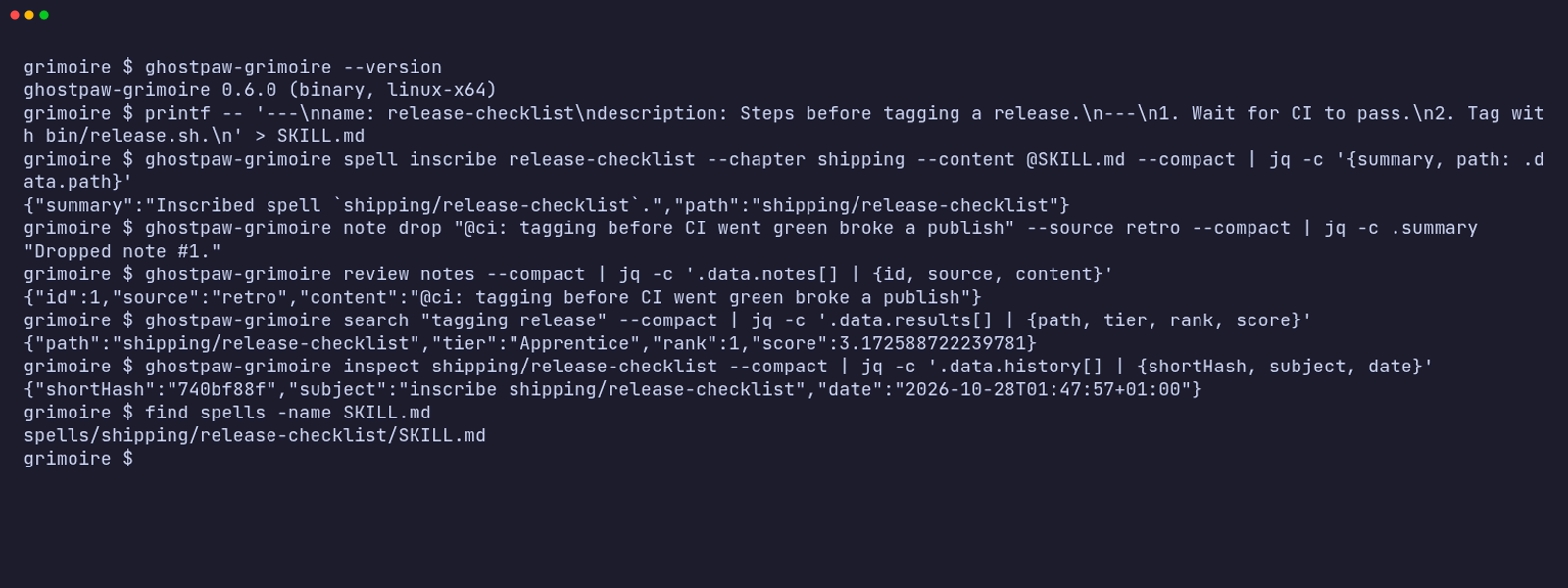
The same session as an [animated GIF](https://raw.githubusercontent.com/GhostPawJS/grimoire/main/docs/assets/cli.gif).
Other release installers:
```sh
mise use -g github:GhostPawJS/grimoire
ubi --project GhostPawJS/grimoire --exe ghostpaw-grimoire --in ~/.local/bin
eget GhostPawJS/grimoire
```
For [aqua](https://aquaproj.github.io/docs/reference/registry-config/), define a
`github_release` package in `aqua.yaml`:
```yaml
registries:
- name: grimoire
type: local
path: grimoire-registry.yaml
packages:
- name: GhostPawJS/grimoire@v0.4.3
registry: grimoire
```
`grimoire-registry.yaml`:
```yaml
packages:
- type: github_release
repo_owner: GhostPawJS
repo_name: grimoire
asset: ghostpaw-grimoire-{{trimV .Version}}-{{.OS}}-{{.Arch}}.tar.gz
format: tar.gz
replacements: { amd64: x64 }
overrides:
- goos: windows
asset: ghostpaw-grimoire-{{trimV .Version}}-windows-{{.Arch}}.zip
format: zip
files:
- name: ghostpaw-grimoire
```
Install scripts verify SHA256SUMS. To verify a downloaded archive's
[build attestation](https://cli.github.com/manual/gh_attestation_verify):
```sh
gh attestation verify <archive> -R GhostPawJS/grimoire
```
Set `GHOSTPAW_VERIFY=attestation` for attestation verification in `install.sh`.
Binaries are unsigned; macOS binaries carry an ad-hoc signature. For a browser
download on macOS, remove quarantine with
`xattr -d com.apple.quarantine /path/to/ghostpaw-grimoire`.
Linux binaries require glibc 2.28+; use npx on Alpine.
See the [binary build workflow](.github/workflows/release-binaries.yml).
Archive and binary sizes vary by release; see the assets on the release page.
The install check runs on ubuntu-24.04, macos-15 and windows-2025.
## Running inside sandboxed agent harnesses
Inside a Codex CLI `--sandbox workspace-write` session, the database and its
parent directory must be inside a writable root, including SQLite's `-wal` and
`-shm` side files. A default DB under `~/.ghostpaw` outside those roots can fail
with `SQLITE_CANTOPEN` or `EPERM` (often exit 70; directory creation failures
may exit 2), even when normal shell permissions allow access. Put the DB inside the workspace with `--db ./state/grimoire.db`,
or set `GHOSTPAW_GRIMOIRE_DB="$PWD/state/grimoire.db"` for CLI/MCP use.
To use an external DB directory, add it when starting the OpenAI Codex CLI
(replace `<dir-with-db>` with its absolute path):
```sh
codex exec --sandbox workspace-write --add-dir <dir-with-db> "Run the GhostPaw CLI"
```
Alternatively, set `sandbox_workspace_write.writable_roots` in
`~/.codex/config.toml` before starting the session:
```toml
[sandbox_workspace_write]
writable_roots = ["/absolute/dir-with-db"]
```
The spell root and Git directory must also be inside writable roots. Select
`--root ./state/spells` (or `GHOSTPAW_GRIMOIRE_ROOT`) as well as `--db`;
`--db` alone does not relocate the spell root. Git defaults to
`<root>/.grimoire-git`; keep it there or select a writable directory with
`--git-dir ./state/spell-history` / `GHOSTPAW_GRIMOIRE_GIT_DIR`. Add each
external directory with another `--add-dir` or writable_roots entry. Avoid a
protected workspace `.git` directory; use the dedicated spell history directory.
## State
The database defaults to `~/.ghostpaw/grimoire.db`; select it with `--db` or
`GHOSTPAW_GRIMOIRE_DB`. Spell root precedence is `--root`, `GHOSTPAW_GRIMOIRE_ROOT`, then
`<parent of GHOSTPAW_GRIMOIRE_DB>/grimoire` when that variable names a file,
then `~/.ghostpaw/grimoire`. Relative DB paths resolve against the current directory.
Empty environment values count as unset; `:memory:` retains the home root default.
`--db` overrides the database only; the environment DB still supplies the default root.
Explicit root and Git settings always win.
Explicit `--git-dir` or `GHOSTPAW_GRIMOIRE_GIT_DIR` configuration suppresses the ignored-parent-history warning.
Each root stores Git history in `<ROOT>/.grimoire-git`, excluded from discovery.
`--git-dir` overrides `GHOSTPAW_GRIMOIRE_GIT_DIR`, which overrides this default.
A legacy `<parent>/.grimoire-git` is copied into the root only when its configured
work tree or HEAD tree identifies this root. The original stays in place, with a
`MIGRATED_TO` marker. Shared or uncertain legacy repositories stay at their old
location and produce one `shared_git_dir` warning per result; new writes use
the root-local repository. Git writes use a per-repository advisory
lock and path-scoped commits. File databases use WAL and a five-second busy timeout.
Library callers supply their database and should configure those pragmas before use.
## CLI
```text
ghostpaw-grimoire search <query>
ghostpaw-grimoire review <check|chapters|health|resonance|notes|drafts|validation|provenance|index>
ghostpaw-grimoire inspect <path>
ghostpaw-grimoire spell inscribe <name> --content TEXT
ghostpaw-grimoire spell update|hone <path> [flags]
ghostpaw-grimoire spell shelve|unshelve|delete|repair <path>
ghostpaw-grimoire spell move <path> <target>
ghostpaw-grimoire spell rollback <path> <ref>
ghostpaw-grimoire spell repair-all
ghostpaw-grimoire note drop <content> --source SOURCE
ghostpaw-grimoire draft submit <title> --rationale TEXT --note-ids ID --chapter NAME
ghostpaw-grimoire draft approve|dismiss <draftId>
ghostpaw-grimoire catalogue run
ghostpaw-grimoire scout adopt <source>
ghostpaw-grimoire scout search <query>
ghostpaw-grimoire scout check-updates
ghostpaw-grimoire scout apply-update <path>
ghostpaw-grimoire mcp|skill|tools|describe|call|completions|version|help
```
Global flags can appear anywhere: `--db <path>`, `--root <path>`, `--git-dir <path>`, `--json`, `-q, --quiet`,
`--compact`, `--help`/`-h`, `--version`/`-V`/`-v`, `--no-color`.
`NO_COLOR` is accepted; output uses no terminal colors.
Noun-verb commands print the full tool result as JSON with `--json` or when
stdout is piped. Write results contain compact metadata by default; `--verbose` includes full spell content.
`-q, --quiet` suppresses stdout. `--compact` removes JSON indentation.
Use `help spell`, bare `spell`, or `spell update --help` for schema-derived help.
`skill --list` lists bundled guides; `skill <guide>` prints the guide.
Search tokenizes multiple terms, removes common English stopwords, stems common
suffixes, and scores name/description/body matches with weights 3/2/1 and inverse
document frequency. Trigram Jaccard similarity of at least 0.3 adds fuzzy metadata
matches. Results expose `score` and sort by score, rank, then path. Legacy name
and description substring matches remain supported. Uncheckpointed spells remain visible.
Inscribe conflicts unless `--force` is supplied; identical forced content returns
`no_op` when it also matches committed content. Hone accepts positional paths and
returns `no_op` without a diff; supplied note IDs are still marked distilled. `--note-ids` and `--note_ids` both work for hone and draft submit.
Inspect includes commit hashes, short hashes, subjects, and ISO dates for rollback.
`--now` accepts epoch milliseconds, ISO 8601 date-time, or YYYY-MM-DD. Values more
than one minute ahead return a projection with a `projected` warning and preserve
stored health and notes.
`review index --format prompt` returns only the formatted prompt block in `data`.
Catalogue health fields measure honing pressure, rather than a quality rating:
a fresh seal can have zero pressure. Dormancy has a 14-day grace period after
the first seal. Catalogue expires pending notes older than 90 days and keeps at
most 50 pending notes, expiring the oldest first with a `notes_expired` count warning. Deleting a spell purges its events.
Array flags repeat and a final `-` reads JSON stdin (`spell inscribe <name> -` is supported). Spell `--content`, `--replace`, `--with`, and `--body` read files: `@path` reads the file, `@-` reads stdin, and `@@text` passes a literal `@text`. Every other value, including note text and positionals, is taken literally even if it starts with `@`.
Flags use kebab-case and override stdin fields. `--` ends flags.
All value flags accept `--flag=value`; use this form for dash-leading text, for example
`spell update general/example --replace="--soul <A>:owner" --with="--soul <B>:owner"`.
Use `--` to end flag parsing before dash-leading positional arguments.
`--replace` and `--with` accept UTF-8 `@file` values, `@-` for stdin, and `@@` for a literal leading `@`.
`ghostpaw-grimoire check` (also `review check`) combines current resonance with the
latest saved catalogue in `data.resonance` and `data.snapshot` (null if none exists).
It reads an existing database without initialization, migrations, Git migration,
note routing, or snapshot writes. Missing databases fail without creating files.
The facade and MCP expose the same operation as `review_grimoire({ view: 'check' })`;
`--now` and `--limit` apply to resonance. The saved snapshot retains its original timestamp.
Database selection uses `--db`, `GHOSTPAW_GRIMOIRE_DB`, then `~/.ghostpaw/grimoire.db`.
Spell files and Git history follow the full precedence in [State](#state).
Context initialization may run Git. Scout remote operations need network access;
local sources can stay offline.
| Exit | Noun-verb result |
|---|---|
| 0 | Success, including no_op |
| 1 | Tool error |
| 2 | Usage or input validation error |
| 3 | Clarification needed or not found |
| 4 | Conflict or version mismatch |
| 70 | Internal error |
Frontmatter validation warns about invalid YAML values and unknown fields by default.
Use `{ strict: true }` with `read.validateSkillMd`, `read.validate`, or `read.validateAll`
to treat those warnings as errors; other warnings stay warnings. Write and scouting
APIs that validate frontmatter also accept `strict` in their input or options.
On the CLI, use `review validation --strict` or `inspect <path> --strict`;
`spell inscribe`, `spell update`, `scout adopt`, and `scout apply-update` accept it too.
Strict validation failures exit with code 2 and identify the field and value.
The matching MCP tools accept an optional `strict` boolean. Hone only seals files;
validate with `inspect <path> --strict` before honing manual edits.
Errors go to stderr. With `--json`, usage and internal errors also print
`{ok:false,error:{code,message}}` to stdout. Tool results retain their full
shape. Legacy `tools [--json]`, `describe <tool>`, `call <tool> [JSON|-]`
and `<tool_name> --parameter value` use the same exit codes.
`completion` aliases `completions`. Bash and Zsh scripts complete command groups,
verbs, and command flags for both `ghostpaw-grimoire` and `grimoire`.
`completions fish` prints a Fish script.
```sh
ghostpaw-grimoire note drop "Verify the build" --source practice --db /tmp/grimoire.db --json
ghostpaw-grimoire review notes --db /tmp/grimoire.db --json
ghostpaw-grimoire spell update --help
```
Set `GHOSTPAW_GRIMOIRE_ROOT` to a temporary directory for an isolated session.
Agent Skill: see [SKILL.md](SKILL.md) or install the `skills/grimoire` directory with its references.
## Quick Start
```ts
import { DatabaseSync } from 'node:sqlite';
import { init, read, write } from '@ghostpaw/grimoire';
const db = new DatabaseSync(':memory:');
const root = '/path/to/my-grimoire';
// Bootstrap: filesystem + SQLite tables + bare git repo with initial commit
init(root, db);
// Inscribe a new spell (content is a spec-compliant SKILL.md string)
const { spell } = write.inscribe(root, db, {
name: 'deploy-service',
chapter: 'engineering',
content: '---\nname: deploy-service\ndescription: Deploy a service to production\n---\n\n# deploy-service\n\n## Steps\n\n1. Run `npm run build`\n2. Push to registry\n3. Apply manifests\n',
});
// Drop an observation note as evidence
write.dropNote(db, {
source: 'practice',
content: 'Build step fails if DOCKER_REGISTRY is not exported first.',
});
// Seal the improvement into a git commit, advancing rank
write.seal({ root }, db, [`engineering/${spell.name}`], 'Fix: document required env var for build step');
// Read back the enriched spell
const detail = read.getSpell(root, 'engineering/deploy-service', db);
const chapters = read.listChapters(root);
```
## Docs
The live demo runs the library in your browser against an in-memory SQLite database. Each view below opens a different part of it:
- [Dashboard](https://grimoire.ghostpaw.dev/docs/): overview and actions
- [Chapters](https://grimoire.ghostpaw.dev/docs/#/chapters): spells grouped by chapter
- [Inscribe](https://grimoire.ghostpaw.dev/docs/#/inscribe): write a new spell
- [Notes](https://grimoire.ghostpaw.dev/docs/#/notes): the observations inbox
- [Catalogue](https://grimoire.ghostpaw.dev/docs/#/catalogue): health analysis of every spell
- [Scout](https://grimoire.ghostpaw.dev/docs/#/scout): search and adopt spells
## The Model
Eight concepts, strict separation of concerns:
| Concept | Purpose |
|---|---|
| **Spell** | A learned procedure stored as `SKILL.md` with YAML frontmatter and a markdown body |
| **Chapter** | A folder grouping related spells into a focused collection |
| **Seal** | A git commit marking a verified improvement — rank equals seal count |
| **Tier** | Mastery level computed from rank: Uncheckpointed → Apprentice → Journeyman → Expert → Master |
| **Note** | Raw evidence (observation, failure path, correction) awaiting distillation into a spell |
| **Resonance** | Read-time signal indicating which spells have the highest return on honing effort |
| **Draft** | A proposed new spell submitted for review before inscription |
| **Catalogue** | A health snapshot: staleness, dormancy, oversizing, velocity, and clustering |
The model means each kind of truth has its own home:
| What it looks like | What it actually is |
|---|---|
| A how-to guide or runbook | A Spell |
| Related spells grouped by domain | A Chapter |
| "This procedure is proven — preserve it" | A Seal |
| "We got burned by this edge case" | A Note |
| "This spell hasn't been touched in months" | A Catalogue health signal |
| "This spell is ready to hone next" | Resonance |
State is derived, not hand-toggled. Tier, resonance color, staleness, dormancy,
and health scores are computed from evidence and commit history at read time,
never stored as caller-written flags.
### Tier progression at a glance
Grimoire computes tier markers on every read. They advance as spells accumulate
sealed improvements:
> **Inscription**
>
> | | | |
> |:---:|---|---|
> | $\color{Gray}{\textsf{◎}}$ | *deploy-service* | `uncheckpointed · no seals yet` |
> | | ↓   seal a validated improvement | |
>
> **Honing**
>
> | | | |
> |:---:|---|---|
> | $\color{SteelBlue}{\textsf{◎}}$ | *deploy-service* | `apprentice · rank 1–2` |
> | $\color{MediumSeaGreen}{\textsf{◎}}$ | *deploy-service* | `journeyman · rank 3–5` |
> | $\color{Goldenrod}{\textsf{◎}}$ | *deploy-service* | `expert · rank 6–9` |
> | $\color{Orchid}{\textsf{◎}}$ | *deploy-service* | `master · rank 10+` |
>
> **Attention signals**
>
> | | | |
> |:---:|---|---|
> | $\color{OrangeRed}{\textsf{●}}$ | *deploy-service* | `resonance · hone now` |
> | $\color{Gray}{\textsf{●}}$ | *deploy-service* | `dormant · low return on effort` |
Rank is the only experience counter. Each tier raises the validation bar:
from Journeyman on, a spell is expected to include failure and recovery paths;
from Expert on, edge cases; at Master, a compiled summary.
## Two Audiences
### Human developers
Use the `read` and `write` namespaces for direct-code access to the domain:
```ts
import { read, write } from '@ghostpaw/grimoire';
// Inscribe and evolve a spell
write.inscribe(root, db, { name: 'lint-fix', chapter: 'general', content: '---\nname: lint-fix\ndescription: Run lint with autofix\n---\n\n# lint-fix\n\nRun `npx biome check --fix .`\n' });
write.dropNote(db, { source: 'practice', content: 'Biome needs --unsafe for some rules.' });
write.seal({ root }, db, ['general/lint-fix'], 'Add note about unsafe flag');
// Read derived state
const spell = read.getSpell(root, 'general/lint-fix', db);
const resonance = read.allResonance(db);
const catalogue = read.readCatalogue(db);
```
See [HUMAN.md](docs/HUMAN.md) for the full direct-code guide with worked
examples and modeling boundaries.
### LLM agents
Use the `tools`, `skills`, and `soul` namespaces for a structured runtime
surface designed to minimize LLM cognitive load:
```ts
import { tools, skills, soul } from '@ghostpaw/grimoire';
// 10 intent-shaped tools with JSON Schema inputs and structured results
const allTools = tools.grimoireTools;
const searchTool = tools.getGrimoireToolByName('search_grimoire')!;
const result = await searchTool.handler({ root, db }, { query: 'deploy' });
// Workflow skills for common multi-step scenarios
const allSkills = skills.grimoireSkills;
// Thinking foundation for system prompts
const prompt = soul.renderGrimoireSoulPromptFoundation();
```
Every tool returns a discriminated result with `outcome: 'success' | 'no_op' |
'needs_clarification' | 'error'`, structured entities, next-step hints, and
actionable recovery signals.
See [LLM.md](docs/LLM.md) for the full AI-facing guide covering soul, tools,
and skills.
## Tools
Eleven tools shaped around operator intent, not raw storage operations:
| Tool | What it does |
|---|---|
| `search_grimoire` | Search spells by name or description |
| `review_grimoire` | Dashboard views: chapters, health, resonance, notes, drafts, validation, provenance |
| `inspect_grimoire_item` | Detailed inspection of one spell: tier, resonance, validation, provenance, history |
| `inscribe_spell` | Create a new spell in the grimoire |
| `update_spell` | Write new content to an existing spell, leaving it uncommitted for `hone_spell` |
| `hone_spell` | Seal pending changes into a git commit, advancing rank; optionally distill absorbed notes |
| `manage_spell` | Shelve, unshelve, move, delete, repair, or rollback a spell |
| `drop_note` | Drop an observation note for later cataloguing |
| `manage_draft` | Submit, approve, or dismiss proposed spells |
| `run_catalogue` | Full maintenance pass: staleness, dormancy, oversizing, note routing, health |
| `scout_skills` | Scout, search, adopt, and update spells from external sources |
Each tool exports runtime metadata, JSON Schema inputs, and structured outputs
so harnesses can wire them without parsing vague prose.
## Key Properties
- **Zero runtime dependencies.** Only `node:sqlite` (built into Node 24+) for the SQLite layer.
- **Single prebundled blob.** One ESM + one CJS entry in `dist/`. No subpath exports, no code splitting.
- **Three storage backends.** Filesystem for spell content, git for versioning and rank, SQLite for metadata. Each is optional — the package degrades gracefully without any of them.
- **Evidence-first progression.** Rank is earned by sealing validated improvements. Speculative edits do not count as experience. Higher tiers raise what validation expects of a spell.
- **Derived health signals.** Resonance, staleness, dormancy, and health scores are computed at read time from evidence and commit history — never stored as flags.
- **Intention-shaped writes.** `inscribe`, `seal`, `hone`, `dropNote`, `distill`, `adoptSpell`: operations that say what happened, not generic CRUD.
- **Additive AI runtime.** `soul` for posture, `tools` for actions, `skills` for workflow guidance — layered over the same direct-code API.
- **Colocated tests.** Every non-type module has a colocated `.test.ts` file. The documented behavior is backed by executable coverage.
## Package Surface
```ts
import {
init, // bootstrap: filesystem + SQLite setup
initGrimoireTables, // SQLite schema only
read, // all query functions
write, // all mutation functions
tools, // LLM tool definitions + registry
skills, // LLM workflow skills + registry
soul, // thinking foundation for system prompts
} from '@ghostpaw/grimoire';
```
All domain and runtime types are also available at the root for TypeScript
consumers:
```ts
import type {
GrimoireDb,
GrimoireToolDefinition,
GrimoireSkill,
GrimoireSoul,
GrimoireErrorCode,
} from '@ghostpaw/grimoire';
```
## Documentation
| Document | Audience |
|---|---|
| [HUMAN.md](docs/HUMAN.md) | Human developers using the low-level `read` / `write` API |
| [LLM.md](docs/LLM.md) | Agent builders wiring `soul`, `tools`, and `skills` into LLM systems |
| [docs/README.md](docs/README.md) | Architecture overview: model, storage topology, and source layout |
| [docs/entities/](docs/entities/) | Per-concept manuals: spells, notes, events, health, drafts, provenance, registry |
## Development
```bash
npm install
npm test # node:test runner
npm run typecheck # tsc --noEmit
npm run lint # biome check
npm run build # ESM + CJS + declarations via tsup
npm run demo:serve # build and serve the browser demo
```
The repo is pinned to **Node 24.14.0** via `.nvmrc` / `.node-version` /
`.tool-versions` / `mise.toml` / Volta. Use whichever version manager you
prefer.
### Support
If this package helps your project, consider sponsoring its maintenance:
[](https://github.com/sponsors/Anonyfox)
---
**[Anonyfox](https://anonyfox.com) • [MIT License](LICENSE)**
The CLI and MCP print `using default db <absolute path>` on stderr when opening
the built-in `~/.ghostpaw/grimoire.db`. Suppress the notice with `-q`/`--quiet`
or `GHOSTPAW_QUIET=1`; help, version and skill commands do not open the DB.
Set `GHOSTPAW_GRIMOIRE_REQUIRE_EXPLICIT=1` to refuse default DB opens (exit 2
before creating files). Set `--db` or `GHOSTPAW_GRIMOIRE_DB` explicitly;
`--root`/`--git-dir` and `GHOSTPAW_GRIMOIRE_ROOT`/`GHOSTPAW_GRIMOIRE_GIT_DIR`
select spell storage separately and do not make the DB explicit.
`spell hone <path...>` seals selected spells; `spell hone --all` seals every
pending edit. Bare `spell hone` still seals all but warns on stderr and lists
the paths: pass spell paths or --all; bare hone will require --all in a future
minor. Strict mode refuses bare hone with exit 2 and leaves edits pending.
Combining `--all` with paths is a usage error (exit 2).
This server cannot be deployed
Maintenance
ActivityMaintained
ResponsivenessOutdated data