
ghostpaw-affinity
by GhostPawJS
README.md
<a href="https://affinity.ghostpaw.dev/"><img src="https://raw.githubusercontent.com/GhostPawJS/affinity/main/.github/social-preview.png" alt="GhostPaw affinity: Who have you been meaning to call?" width="100%"></a>
# @ghostpaw/affinity
[](https://www.npmjs.com/package/@ghostpaw/affinity) [](https://github.com/GhostPawJS/affinity/actions/workflows/ci.yml) [](https://affinity.ghostpaw.dev/) [](package.json) [](https://registry.modelcontextprotocol.io/v0.1/servers/io.github.GhostPawJS%2Faffinity/versions/latest) [](https://nodejs.org) [](LICENSE) [](https://hookmcp.com)
**Agent contacts: people, promises and yearly dates, with a radar for who is drifting.**
A local social CRM: contacts, identities, relationships, journal events,
commitments and recurring dates in one SQLite file. One self-contained binary
per platform, an MCP server, and a zero-dependency TypeScript library.
## Install
Each line downloads the latest release for one platform, checks it against
`SHA256SUMS`, puts `ghostpaw-affinity` on your `PATH` and prints the version.
**Linux x64**
```sh
cd "$(mktemp -d)" && T=linux-x64 && V=$(curl -fsSLI -o /dev/null -w '%{url_effective}' https://github.com/GhostPawJS/affinity/releases/latest | sed 's|.*/v||') && F=ghostpaw-affinity-$V-$T.tar.gz && U=https://github.com/GhostPawJS/affinity/releases/download/v$V && curl -fsSL -O "$U/$F" -O "$U/SHA256SUMS" && grep " $F\$" SHA256SUMS | sha256sum -c - && tar -xzf "$F" ghostpaw-affinity && mkdir -p ~/.local/bin && mv ghostpaw-affinity ~/.local/bin/ && { case ":$PATH:" in *":$HOME/.local/bin:"*) ;; *) echo 'export PATH="$HOME/.local/bin:$PATH"' >> ~/.profile; export PATH="$HOME/.local/bin:$PATH";; esac; } && ghostpaw-affinity --version
```
**Linux arm64**
```sh
cd "$(mktemp -d)" && T=linux-arm64 && V=$(curl -fsSLI -o /dev/null -w '%{url_effective}' https://github.com/GhostPawJS/affinity/releases/latest | sed 's|.*/v||') && F=ghostpaw-affinity-$V-$T.tar.gz && U=https://github.com/GhostPawJS/affinity/releases/download/v$V && curl -fsSL -O "$U/$F" -O "$U/SHA256SUMS" && grep " $F\$" SHA256SUMS | sha256sum -c - && tar -xzf "$F" ghostpaw-affinity && mkdir -p ~/.local/bin && mv ghostpaw-affinity ~/.local/bin/ && { case ":$PATH:" in *":$HOME/.local/bin:"*) ;; *) echo 'export PATH="$HOME/.local/bin:$PATH"' >> ~/.profile; export PATH="$HOME/.local/bin:$PATH";; esac; } && ghostpaw-affinity --version
```
**macOS Apple silicon**
```sh
cd "$(mktemp -d)" && T=darwin-arm64 && V=$(curl -fsSLI -o /dev/null -w '%{url_effective}' https://github.com/GhostPawJS/affinity/releases/latest | sed 's|.*/v||') && F=ghostpaw-affinity-$V-$T.tar.gz && U=https://github.com/GhostPawJS/affinity/releases/download/v$V && curl -fsSL -O "$U/$F" -O "$U/SHA256SUMS" && grep " $F\$" SHA256SUMS | shasum -a 256 -c - && tar -xzf "$F" ghostpaw-affinity && sudo mkdir -p /usr/local/bin && sudo mv ghostpaw-affinity /usr/local/bin/ && ghostpaw-affinity --version
```
**macOS Intel**
```sh
cd "$(mktemp -d)" && T=darwin-x64 && V=$(curl -fsSLI -o /dev/null -w '%{url_effective}' https://github.com/GhostPawJS/affinity/releases/latest | sed 's|.*/v||') && F=ghostpaw-affinity-$V-$T.tar.gz && U=https://github.com/GhostPawJS/affinity/releases/download/v$V && curl -fsSL -O "$U/$F" -O "$U/SHA256SUMS" && grep " $F\$" SHA256SUMS | shasum -a 256 -c - && tar -xzf "$F" ghostpaw-affinity && sudo mkdir -p /usr/local/bin && sudo mv ghostpaw-affinity /usr/local/bin/ && ghostpaw-affinity --version
```
**Windows x64 (PowerShell)**
```powershell
$r='GhostPawJS/affinity'; $v=(irm "https://api.github.com/repos/$r/releases/latest").tag_name; $f="ghostpaw-affinity-$($v.TrimStart('v'))-windows-x64.zip"; $u="https://github.com/$r/releases/download/$v"; $t=(New-Item -ItemType Directory (Join-Path $env:TEMP ([guid]::NewGuid()))).FullName; iwr "$u/$f" -OutFile "$t\$f" -UseBasicParsing; iwr "$u/SHA256SUMS" -OutFile "$t\SHA256SUMS" -UseBasicParsing; $want=((Get-Content "$t\SHA256SUMS" | Where-Object { $_ -like "* $f" }) -split '\s+')[0]; if (-not $want -or (Get-FileHash "$t\$f" -Algorithm SHA256).Hash -ne $want) { throw "checksum mismatch for $f" }; $d=Join-Path $env:LOCALAPPDATA 'Programs\ghostpaw\bin'; Expand-Archive "$t\$f" $t -Force; New-Item -ItemType Directory -Force $d | Out-Null; Copy-Item "$t\ghostpaw-affinity.exe" $d -Force; $p=[Environment]::GetEnvironmentVariable('Path','User'); if (";$p;" -notlike "*;$d;*") { [Environment]::SetEnvironmentVariable('Path',"$p;$d",'User') }; $env:Path="$d;$env:Path"; ghostpaw-affinity --version
```
These commands install the latest release in `~/.local/bin` on Linux, `/usr/local/bin` on macOS (asks for sudo), or `%LOCALAPPDATA%\Programs\ghostpaw\bin` on Windows; Linux adds it to PATH via `~/.profile` only if missing, and Windows adds it to the user PATH (open a new terminal afterwards). To pin a version, set `V=0.6.0` instead of resolving latest (`$v='v0.6.0'` in PowerShell).
For a pinned Linux/macOS download to the current directory with no profile or PATH edits, choose the matching `T` (`linux-x64`, `linux-arm64`, `darwin-arm64`, or `darwin-x64`):
```sh
V=0.6.0
T=linux-x64
F=ghostpaw-affinity-$V-$T.tar.gz
U=https://github.com/GhostPawJS/affinity/releases/download/v$V
curl -fsSL -O "$U/$F" -O "$U/SHA256SUMS" &&
{ case "$T" in darwin-*) grep " $F\$" SHA256SUMS | shasum -a 256 -c - ;; *) grep " $F\$" SHA256SUMS | sha256sum -c - ;; esac; } &&
tar -xzf "$F" ghostpaw-affinity && ./ghostpaw-affinity --version
```
Then:
```sh
ghostpaw-affinity contact create '{"name":"Owner","kind":"agent"}' --bootstrap-owner
ghostpaw-affinity contact create '{"name":"Sam","kind":"human"}' --json | jq .id
ghostpaw-affinity search sam
ghostpaw-affinity skill # cheat sheet and tool reference
```
Contacts live in `~/.ghostpaw/affinity.db` unless `--db <path>` or the
`GHOSTPAW_AFFINITY_DB` environment variable says otherwise; relative paths
resolve against the current directory.
A session with the linux-x64 binary against a fresh database:
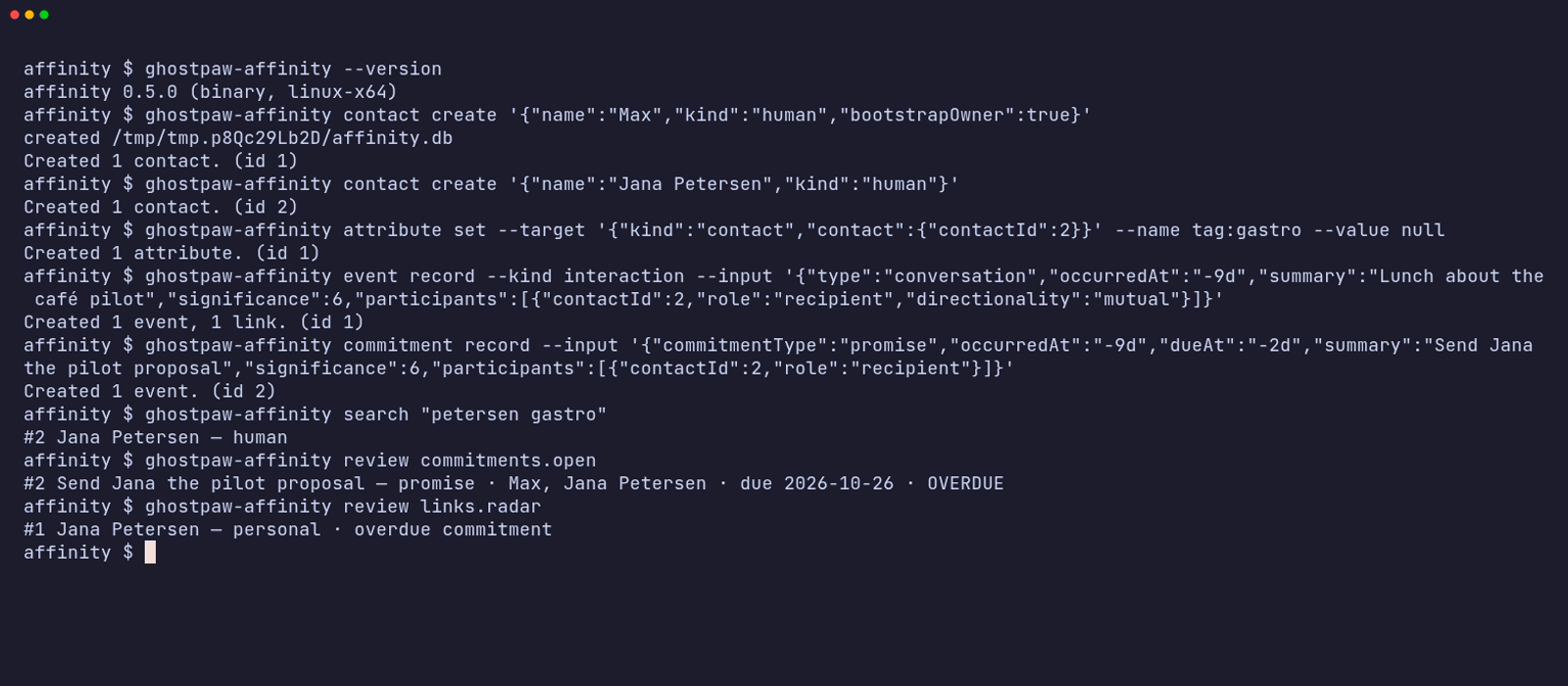
The same session as an [animated GIF](https://raw.githubusercontent.com/GhostPawJS/affinity/main/docs/assets/cli.gif).
### npx / npm (for npm-based environments)
The [npm package](https://www.npmjs.com/package/@ghostpaw/affinity) needs Node 24+
and has zero runtime dependencies:
```sh
npx -y @ghostpaw/affinity --help
npm install -g @ghostpaw/affinity # provides ghostpaw-affinity
```
### Library (for harnesses)
```sh
npm install @ghostpaw/affinity
```
```ts
import { DatabaseSync } from "node:sqlite";
import { initAffinityTables, read, write, tools } from "@ghostpaw/affinity";
```
See [Quick Start](#quick-start) and [docs/LLM.md](docs/LLM.md) for the tool facade.
### Other installers and verification
Interactive installers (also verify `SHA256SUMS`):
```sh
curl -fsSL https://raw.githubusercontent.com/GhostPawJS/affinity/main/install.sh | sh
```
```powershell
irm https://raw.githubusercontent.com/GhostPawJS/affinity/main/install.ps1 | iex
```
```sh
mise use -g github:GhostPawJS/affinity
ubi --project GhostPawJS/affinity --exe ghostpaw-affinity --in ~/.local/bin
eget GhostPawJS/affinity
```
For [aqua](https://aquaproj.github.io/docs/reference/registry-config/), define a
`github_release` package in `aqua.yaml`:
```yaml
registries:
- name: affinity
type: local
path: affinity-registry.yaml
packages:
- name: GhostPawJS/affinity@v<VERSION>
registry: affinity
```
`affinity-registry.yaml`:
```yaml
packages:
- type: github_release
repo_owner: GhostPawJS
repo_name: affinity
asset: ghostpaw-affinity-{{trimV .Version}}-{{.OS}}-{{.Arch}}.tar.gz
format: tar.gz
replacements: { amd64: x64 }
overrides:
- goos: windows
asset: ghostpaw-affinity-{{trimV .Version}}-windows-{{.Arch}}.zip
format: zip
files:
- name: ghostpaw-affinity
```
`SHA256SUMS` covers every archive and `server.mcpb`. To verify a downloaded
archive's [build attestation](https://cli.github.com/manual/gh_attestation_verify):
```sh
gh attestation verify <archive> -R GhostPawJS/affinity
```
Set `GHOSTPAW_VERIFY=attestation` for attestation verification in `install.sh`.
Binaries are unsigned; macOS binaries carry an ad-hoc signature. For a browser
download on macOS, remove quarantine with
`xattr -d com.apple.quarantine /path/to/ghostpaw-affinity`.
Linux binaries require glibc 2.28+; use npx on Alpine.
See the [binary build workflow](.github/workflows/release-binaries.yml).
Each archive is roughly 40-46 MB (the binary embeds the Node runtime, 105-150 MB
unpacked); the npm package is about 2 MB unpacked. Every release, including the
one-liners above, is installed and run on ubuntu-24.04, macos-15 and
windows-2025 by the [install check](.github/workflows/install-check.yml).
## Running inside sandboxed agent harnesses
Inside a Codex CLI `--sandbox workspace-write` session, the database and its
parent directory must be inside a writable root, including SQLite's `-wal` and
`-shm` side files. A default DB under `~/.ghostpaw` outside those roots can fail
with `SQLITE_CANTOPEN` or `EPERM` (often exit 70; directory creation failures
may exit 2), even when normal shell permissions allow access. Put the DB inside the workspace with `--db ./state/affinity.db`,
or set `GHOSTPAW_AFFINITY_DB="$PWD/state/affinity.db"` for CLI/MCP use.
To use an external DB directory, add it when starting the OpenAI Codex CLI
(replace `<dir-with-db>` with its absolute path):
```sh
codex exec --sandbox workspace-write --add-dir <dir-with-db> "Run the GhostPaw CLI"
```
Alternatively, set `sandbox_workspace_write.writable_roots` in
`~/.codex/config.toml` before starting the session:
```toml
[sandbox_workspace_write]
writable_roots = ["/absolute/dir-with-db"]
```
## MCP server
Every client below starts the same stdio server: `ghostpaw-affinity mcp`.
Without the binary, use `npx -y @ghostpaw/affinity mcp` as the command instead.
**Claude Code**
```bash
claude mcp add ghostpaw-affinity -- ghostpaw-affinity mcp
```
or as a plugin, which also installs the skill:
```bash
/plugin marketplace add GhostPawJS/affinity
/plugin install ghostpaw-affinity@ghostpaw-affinity
```
**Codex CLI** (`~/.codex/config.toml`)
```toml
[mcp_servers.ghostpaw-affinity]
command = "ghostpaw-affinity"
args = ["mcp"]
```
**Cursor** (`.cursor/mcp.json`), **Claude Desktop** (`claude_desktop_config.json`)
or a project `.mcp.json`:
```json
{
"mcpServers": {
"ghostpaw-affinity": {
"command": "ghostpaw-affinity",
"args": ["mcp"]
}
}
}
```
Claude Desktop users can also install `server.mcpb` from the
[latest GitHub release](https://github.com/GhostPawJS/affinity/releases/latest).
A Dockerfile is included for container hosts:
`docker build -t ghostpaw-affinity . && docker run -i --rm -v affinity:/data ghostpaw-affinity`.
The server speaks MCP 2026-07-28 (stateless, `server/discover`) and the
initialize-based revisions 2025-11-25, 2025-06-18, 2025-03-26 and 2024-11-05.
### Agent Skill
`SKILL.md` (repo root) and `skills/affinity/SKILL.md` follow the
[Agent Skills](https://agentskills.io) format and ship in the npm package.
Copy `skills/affinity/` into your agent's skills folder, or print it:
```bash
ghostpaw-affinity skill > SKILL.md
ghostpaw-affinity skill --list # workflow guides
ghostpaw-affinity skill bootstrap-and-cold-start
```
## Events
Record events and commitments with an optional `externalRef: {source, id}`.
Both values are trimmed and non-empty; source is lowercased. The pair is unique
across the database. Repeated intake returns the original event and `no_op`,
without creating rows or relationship effects.
`content` preserves text exactly, including whitespace, empty strings and NUL,
up to 1 MB (1,048,576 UTF-8 bytes). Supply a short `summary`, or omit it to derive
one from the first non-empty content line (at most 140 characters; empty text
becomes `(no text)`). Unknown event fields and moment kinds are validation errors.
Journal/timeline rows omit content by default; use `{includeContent: true}` in
library/tool options or CLI `--with-content`. Content appears once in review JSON.
Events support a free-text `channel` (trimmed, lowercased, at most 40 characters),
`parentRef`, `parentEventId`, and a root `threadRef`. Journal, timeline, moments,
and open commitment reviews accept a channel filter. Set event attributes with
`write.setAttribute(db, {kind: "event", eventId}, name, value)`; unset and replace
use the same target and validation as contact/link attributes.
Read exact events with `read.getEventById(db, eventId)` or
`read.getEventByExternalRef(db, source, id)`. `read.searchEvents` searches folded
summary, content, reference and channel text. The search tool's `scope` is
`contacts` by default, with additive `events` and `all` modes.
`read.getEventThread(db, source, id)` returns a root and its descendants in time
order, including parents imported after their children.
`write.reviseEvent(db, eventIdOrTarget, patch)` accepts summary, content,
occurredAt, significance, channel, type within the same event family, and an
externalRef only when absent. `write.deleteEvent(db, eventIdOrTarget,
{confirm: true})` removes evidence, participants, attributes and link effects,
then replays surviving effects and refreshes rollups. Targets can also be
`{ref: {source, id}}`. Existing 0.5.x databases migrate through
`initAffinityTables`. Historical affinity/trust/rank baselines are recovered
from saved deltas; historical cadence and state before evidence were not stored
and use the default cadence and active state during replay.
## CLI
```sh
export GHOSTPAW_AFFINITY_DB=~/crm/affinity.db # or --db <path>
ghostpaw-affinity contact create '{"name":"Fox","kind":"human","bootstrapOwner":true}'
ghostpaw-affinity search "jana" # names, identities, tags, attributes, roles, events
ghostpaw-affinity contact create '{"name":"Jana Petersen","kind":"human"}'
ghostpaw-affinity identity add --contact '{"contactId":2}' --input '{"type":"email","value":"jana@example.com"}'
ghostpaw-affinity event record --kind interaction --input '{"type":"conversation","occurredAt":"today","summary":"Call re pilot","significance":6,"participants":[{"contactId":2,"role":"recipient","directionality":"mutual"}]}'
ghostpaw-affinity commitment record --input '{"commitmentType":"promise","occurredAt":"today","dueAt":"+3d","summary":"Send proposal","significance":6,"participants":[{"contactId":2,"role":"recipient"}]}'
ghostpaw-affinity attribute set --target '{"kind":"contact","contact":{"contactId":2}}' --name tag:gastro --value null
ghostpaw-affinity review contacts.list --tag gastro
ghostpaw-affinity review contacts.list --attribute pipeline_stage=proposal
ghostpaw-affinity review commitments.open # overdue promises are flagged
ghostpaw-affinity review links.radar # who is drifting, with reasons
ghostpaw-affinity show contact_profile --contact '{"contactId":2}'
ghostpaw-affinity contact export --contact '{"contactId":2}' # omit --contact for the whole database
ghostpaw-affinity contact delete --contact '{"contactId":2}' --confirm
```
`ghostpaw-affinity skill` prints the full cheat sheet; `skill --list` and
`skill <guide>` print the workflow guides.
```text
ghostpaw-affinity search <query> [--tag T] [--attribute name[=value]]
ghostpaw-affinity review <view> [--tag T] [--attribute name[=value]]
ghostpaw-affinity show <owner_profile|contact_profile|link> [--contact JSON --link JSON]
ghostpaw-affinity contact create|revise|lifecycle|export|delete|merge
ghostpaw-affinity identity add|revise|verify|remove [flags]
ghostpaw-affinity relationship add|bond|state|tie|untie [flags]
ghostpaw-affinity commitment record|resolve [flags]
ghostpaw-affinity attribute set|unset|replace [flags]
ghostpaw-affinity date add|revise|remove [flags]
ghostpaw-affinity event record [flags]
ghostpaw-affinity show event --event-id 12
ghostpaw-affinity show event --ref-source bluesky --ref-id at://record
ghostpaw-affinity search --scope events "text or record id"
ghostpaw-affinity review events.contact_journal --contact '{"contactId":2}' --with-content --channel bluesky
ghostpaw-affinity review events.thread --ref-source bluesky --ref-id at://root
ghostpaw-affinity event revise --event-id 12 --patch '{"summary":"Corrected"}'
ghostpaw-affinity event delete --event-id 12 --confirm
ghostpaw-affinity duplicate dismiss|undismiss [flags]
ghostpaw-affinity mcp|skill|tools|describe|call|completions|version|help
```
There are 29 domain commands. `review` accepts the existing view names,
including `contacts.list`, `contacts.duplicates` and `dates.upcoming`.
`show` selects an inspection kind; contact and link locators are JSON objects.
Use `help contact` or `contact create --help` for schema-derived help; a
mistyped command suggests the closest one. Nested payloads use JSON or `@path`
to read a file; repeated array flags accept JSON objects
(`--entries '{"name":"a","value":"x"}'`) or one JSON array.
Every time field accepts epoch milliseconds, ISO 8601 with `Z` or an offset,
`YYYY-MM-DD`, `DD.MM.YYYY`, `today`, `tomorrow`, `yesterday` and signed day offsets
such as `+3d` or `-2d`, with the same grammar in CLI, MCP and direct tool calls.
Date-only values preserve their calendar day: timestamps use UTC midnight, or
23:59:59.999Z for `dueAt`. Keywords first resolve against the process local
calendar date; this is the only time-zone-dependent parsing step. `occurredOn`
and `dueOn` retain the input day (the written offset day for ISO inputs; UTC day
for epoch inputs). Existing rows derive these fields from their UTC timestamps.
Review rows for dates include `occursOn`, the anchor occurrence day; the library
keeps its numeric `occursOn` sorting key and adds `occursOnDate`.
The existing `*Iso` fields remain UTC. Overdue commitments compare the local
date to `dueOn`. Future events carry a `future_event` warning and do not count
as contact until their timestamp and day arrive. Commitments and their
resolutions do not reset recency or cadence. Radar marks `drift` after a gap
exceeds 1.5 times the expected cadence and explains its reasons in the snippet.
Global flags: `--db <path>`, `--json`, `-q, --quiet`, `--compact`,
`--help`/`-h`, `--version`/`-V`/`-v`, `--no-color`.
`NO_COLOR` is accepted. In a terminal, commands print a readable summary with
names and dates. With `--json` or piped stdout they print the tool result as
JSON with ISO date siblings and floats rounded to three decimals. Journal review rows
keep one summary and compact `{id,name,role}` participants. Radar rows keep one link
id, counterparty name, reasons and rounded scores; upcoming link dates omit radar
scores. Default piped writes and `--compact` keep primary and changed ids plus
warnings; explicit `--json` retains full mutation detail. `--compact`
removes indentation and empty receipt arrays. `-q, --quiet` suppresses stdout.
When a command opens the default database, the CLI prints `using default db <path>`
to stderr. Suppress this notice with `-q, --quiet` or `GHOSTPAW_QUIET=1`.
Writes list what changed in `data.changes`, and creates warn about likely
duplicates. Kebab-case flags map to schema properties. `--` ends flags.
A positional `-`, or piped stdin when no other arguments are given, reads a
JSON object (`echo '{"name":"Sam","kind":"human"}' | ghostpaw-affinity contact create`).
Explicit flags override stdin fields.
Database selection uses `--db`, `GHOSTPAW_AFFINITY_DB`, then
`~/.ghostpaw/affinity.db`; relative paths resolve against the current
directory, and `--help` shows the resolved path. A new database is reported on
stderr. These commands work offline.
| Exit | Result |
|---|---|
| 0 | Success, including no_op |
| 1 | Other tool error |
| 2 | Usage, schema or invalid input |
| 3 | Clarification needed or not found |
| 4 | Conflict, already resolved or version mismatch |
| 70 | Internal error |
Errors go to stderr. With `--json`, errors also print to stdout.
`--version` names the variant: `affinity 0.5.0 (binary, linux-x64)`,
`(npm)` or `(library)`. Use `--version --short` in scripts for exact semver
matching. `--version --json` returns `name`, `version`, `variant` and `target`
(the target is null outside a binary). `version --short` and `version --json`
are equivalent.
Read commands (search, show, review and contact export, including direct tool
calls) exit 3 on a missing database without creating files:
`Database not found: <path> (it is created by the first write)`.
The first write creates the database and reports `created <path>` on stderr.
Read commands open SQLite read-only: they never initialize or migrate the schema
or switch journal mode. Explicit `:memory:` stores retain transient initialization
and then enable query-only mode. This also applies to read-only facade tools over MCP.
Writes upgrade older schemas and print `Affinity database schema upgraded.` to
stderr when the schema changes. Run `ghostpaw-affinity migrate --db <path>` to
upgrade explicitly. Reads that require a newer schema suggest this command.
MCP opens the database per tool call; its first write creates the database.
String-valued flags such as `--value Hamburg`, `--bond 'Warm lead'` and
`--reason 'Different people'` accept plain strings or JSON strings/null.
Object and array flags still require JSON. Tag filters accept both
`--tag gastro-radar` and `--tag tag:gastro-radar`.
Per-command `--help` lists the fields used by that action. Unknown subcommands
suggest a valid command, including with `--help`: `contact update` suggests
`contact revise`, which accepts contact patches such as `doNotContact`.
Legacy `tools [--json]`, `describe <tool>`,
`call <tool> [JSON|-]` and `<tool_name> --parameter value` remain available.
`completions bash|zsh|fish` prints shell scripts.
## Quick Start
```ts
import { DatabaseSync } from "node:sqlite";
import { initAffinityTables, read, write } from "@ghostpaw/affinity";
const db = new DatabaseSync(":memory:");
db.exec("PRAGMA foreign_keys = ON");
initAffinityTables(db);
const { primary: owner } = write.createContact(db, {
name: "Mika",
kind: "human",
bootstrapOwner: true,
});
const { primary: ada } = write.createContact(db, {
name: "Ada Lovelace",
kind: "human",
});
write.addIdentity(db, ada.id, {
type: "email",
value: "ada@example.com",
});
write.recordInteraction(db, {
type: "conversation",
occurredAt: Date.now(),
summary: "Coffee together",
significance: 6,
participants: [
{ contactId: owner.id, role: "actor", directionality: "mutual" },
{ contactId: ada.id, role: "recipient", directionality: "mutual" },
],
});
const profile = read.getContactProfile(db, ada.id);
const radar = read.listRadar(db);
```
## Docs
The live demo runs the library in your browser against an in-memory SQLite database. Each view below opens a different part of it:
- [Dashboard](https://affinity.ghostpaw.dev/docs/): overview and session
- [Contacts](https://affinity.ghostpaw.dev/docs/#/contacts): people, companies, groups and pets you track
- [Relationships](https://affinity.ghostpaw.dev/docs/#/relationships): links, rank and bonds
- [Timeline](https://affinity.ghostpaw.dev/docs/#/timeline): events, commitments and date anchors
- [Insights](https://affinity.ghostpaw.dev/docs/#/insights): radar and analytics
## The Model
Eight concepts, strict separation of concerns:
| Concept | Purpose |
|---|---|
| **Contact** | Any tracked entity: person, company, team, service, pet, household, or group |
| **Identity** | Exact recognition and routing handle such as email, phone, URL, or account id |
| **Social Link** | A live relationship track with Rank, Affinity, Trust, cadence, Bond, and state |
| **Tie** | A structural fact such as `works_at`, `belongs_to`, `reports_to`, or kinship |
| **Journal Entry** | Recorded evidence: interaction, observation, milestone, transaction, or commitment |
| **Date Anchor** | A recurring yearly date such as a birthday, anniversary, renewal, or memorial |
| **Attribute** | Flexible metadata and preference layer for contacts and links |
| **Affinity Chart** | Derived graph view of the active relationship network |
The model means each kind of truth has its own home:
| What it looks like | What it actually is |
|---|---|
| A person, company, team, service, or household | A Contact |
| An email address or handle | An Identity |
| A friendship or business relationship that changes over time | A Social Link |
| Employment, hierarchy, family, or membership | A Tie |
| “We talked yesterday” | A Journal entry |
| “I promised to send the recap” | A commitment-shaped Journal entry |
| “Their birthday is important every year” | A Date Anchor |
State is derived, not hand-toggled. Rank, hidden Affinity, Trust movement,
Moments, drift, readiness, and graph bridge significance are computed from
evidence and explicit structural truth, not caller-written status flags.
## Two Audiences
### Human developers
Use the `read` and `write` namespaces for direct-code access to the domain:
```ts
import { read, write } from "@ghostpaw/affinity";
write.createContact(db, { name: "Ada", kind: "human" });
write.addIdentity(db, contactId, { type: "email", value: "ada@example.com" });
write.recordInteraction(db, {
type: "support",
occurredAt: now,
summary: "Helped prepare for a difficult meeting",
significance: 7,
participants: [
{ contactId: ownerId, role: "actor", directionality: "mutual" },
{ contactId, role: "recipient", directionality: "mutual" },
],
});
const profile = read.getContactProfile(db, contactId);
const radar = read.listRadar(db);
```
See [HUMAN.md](docs/HUMAN.md) for the full direct-code guide with modeling
boundaries and worked examples.
### LLM agents
Use the `tools`, `skills`, and `soul` namespaces for a structured runtime
surface designed to minimize LLM cognitive load:
```ts
import { tools, skills, soul } from "@ghostpaw/affinity";
const allTools = tools.affinityTools;
const searchTool = tools.getAffinityToolByName("search_affinity")!;
const result = searchTool.handler(db, { query: "email:ada@example.com" });
const allSkills = skills.affinitySkills;
const prompt = soul.renderAffinitySoulPromptFoundation();
```
Every tool returns a discriminated result with `outcome: "success" | "no_op" |
"needs_clarification" | "error"`, structured entities, next-step hints, and
actionable recovery signals.
See [LLM.md](docs/LLM.md) for the full AI-facing guide covering soul, tools,
and skills.
## Tools
Twelve tools shaped around operator intent, not raw storage operations:
| Tool | What it does |
|---|---|
| `search_affinity` | Search contacts by natural key or name |
| `review_affinity` | Dashboard-style list and graph review views |
| `inspect_affinity_item` | Open one exact profile or link detail |
| `manage_contact` | Create, revise, or change contact lifecycle |
| `merge_contacts` | Merge duplicate contacts safely |
| `manage_duplicate_dismissal` | Dismiss or restore a suspected duplicate pair |
| `manage_identity` | Add, revise, verify, or remove identities |
| `manage_relationship` | Seed social links, revise bond/state, manage structural ties |
| `record_event` | Record direct evidence, observations, milestones, or transactions |
| `manage_commitment` | Record or resolve obligations |
| `manage_date_anchor` | Add, revise, or remove recurring important dates |
| `manage_attribute` | Set, unset, or replace contact/link metadata |
Each tool exports runtime metadata, JSON-Schema-compatible inputs, and
structured outputs so harnesses can wire them without parsing vague prose.
## Key Properties
- **Zero runtime dependencies.** Only `node:sqlite` (built into Node 24+).
- **Single prebundled blob.** One ESM + one CJS entry in `dist/`. No subpath
exports, no code splitting.
- **Pure SQLite storage.** CHECK-constrained state, trigger-maintained support
tables, and deterministic derived reads. Bring your own `DatabaseSync`.
- **Derived mechanics.** Rank, hidden Affinity, Trust, cadence, Moments, Radar,
and bridge significance are computed from evidence and structure, never
directly caller-set.
- **Intention-shaped writes.** `createContact`, `setStructuralTie`,
`recordInteraction`, `recordCommitment`, `addDateAnchor`, `mergeContacts`:
operations that say what happened or what truth changed, not generic CRUD.
- **Additive AI runtime.** `soul` for posture, `tools` for actions, `skills` for
workflow guidance.
- **Colocated tests.** Every non-type module has a colocated `.test.ts` file.
The documented behavior is backed by executable coverage.
## Package Surface
```ts
import {
initAffinityTables, // schema setup
read, // all query functions
write, // all mutation functions
tools, // LLM tool definitions + registry
skills, // LLM workflow skills + registry
soul, // thinking foundation for system prompts
} from "@ghostpaw/affinity";
```
All domain and runtime types are also available at the root for TypeScript
consumers:
```ts
import type {
AffinityDb,
ContactKind,
LinkState,
ContactProfileRecord,
AffinityChartRecord,
AffinityToolDefinition,
AffinitySkill,
AffinitySoul,
} from "@ghostpaw/affinity";
```
## Documentation
| Document | Audience |
|---|---|
| [HUMAN.md](docs/HUMAN.md) | Human developers using the low-level `read` / `write` API |
| [LLM.md](docs/LLM.md) | Agent builders wiring `soul`, `tools`, and `skills` into LLM systems |
| [docs/README.md](docs/README.md) | Architecture overview: model, invariants, mechanics, and source layout |
| [docs/entities/](docs/entities/) | Per-concept manuals with exact inlined public API listings |
| [docs/USECASES.md](docs/USECASES.md) | Long-form lifecycle narratives across personal, business, and AI-memory angles |
## Development
```bash
npm install
npm test # node:test runner
npm run typecheck # tsc --noEmit
npm run lint # biome check
npm run build # ESM + CJS + declarations via tsup
```
The repo is pinned to **Node 24.14.0** via `.nvmrc` / `.node-version` /
`.tool-versions` / `mise.toml` / Volta. Use whichever version manager you
prefer.
### Support
If this package helps your project, consider sponsoring its maintenance:
[](https://github.com/sponsors/Anonyfox)
---
**[Anonyfox](https://anonyfox.com) • [MIT License](LICENSE)**
### Social imports and batch writes
Contact creation accepts `identities` and `ifExists: "error" | "return"` in the
library and tools. Identity ownership conflicts fail atomically (CLI exit 4),
including `data.existingContactId` and `error.details.existingContactId` in tool
results. `contact create '<JSON>' --if-exists return` returns the existing contact
with `outcome: "no_op"` and `matchedIdentities`; it attaches nothing, including
other free identities. Name-only duplicates still receive a possible-duplicate
warning. Links can opt into `input.ifExists: "return"` when seeding repeatedly. Identity
addition supports the same opt-in policy for an identity already on that contact;
another contact still conflicts. Importers add changed handles separately after
contact creation.
Handle identities strip a leading `@` and lowercase on add, revise and lookup.
Bluesky handles must be domain-like, X/Twitter handles have 1–15 letters, digits
or underscores, and Mastodon handles use `user@host.tld`. Use native `did` (alias
`atproto_did`) for stable AT Protocol identities. Locators also find legacy
`custom:atproto-did` rows. Keep former handles as additional identities.
`search @handle` works because CLI values are literal.
Only the JSON payload arguments (`--input`, the positional `<input>`, `--patch`
and the `call` argument) read files. Their help line ends with
`(@file, @- stdin, @@ literal @)`: `@path` reads the file as UTF-8 relative to
the current directory, `@-` reads stdin, and `@@text` passes the literal
`@text`. An empty path (`@`) or an unreadable file exits 2. Every other value,
including names, notes, attribute values and search queries, is taken byte for
byte, even with a leading `@` or `@@`.
For large payloads use stdin or `@file` to avoid the operating system's argv
size limit (`E2BIG`). JSON flag values support `-` too:
```sh
ghostpaw-affinity event record --kind interaction --input - < event.json
ghostpaw-affinity event record --kind interaction --input @event.json
ghostpaw-affinity review events.contact_journal --contact '{"contactId":2}' --event-types '["conversation","observation"]'
```
Array flags accept JSON arrays, comma lists, or repeated flags. Unknown event
types fail with exit 2 and allowed values. SQLite timestamps such as
`2026-10-27 17:51:33` use UTC; explicit offsets are honored. Sub-millisecond
fractions are truncated to milliseconds. CLI/MCP and tool intake preserve
high-precision occurredAt/dueAt strings in provenance.rawOccurredAt/rawDueAt.
Inspect an event to read its provenance. Null `occurredAt` is invalid.
Record likes, reposts and follows as observations with `affectsBond: false`.
Labels beginning with like/liked, follow/followed/following or repost/reposted
(case insensitive, followed by a word boundary, hyphen or underscore) default to
false for activity, milestone and observation events (except “follow up”). Observations with significance <= 2 also default to
false; other events default to true. Explicit affectsBond:true opts in. These ambient records stay in the journal without changing affinity or
recency. `provenance.ambient: true` also suppresses bond effects. Explicitly
outbound-only evidence contributes much less and does not reset radar recency;
without reciprocal contact it generates no routine check-in or drift prompt.
Include the owner explicitly with the correct actor/recipient role and use
`owner_initiated`, `other_initiated`, or `mutual` directionality. Observations and
follow-like milestones never derive breakthroughs; low-significance milestones
do not derive moments. An explicit `momentKind` is honored.
List reviews default to 50 rows, accept `--limit` (up to 10,000) and `--offset`,
and include `total` and `hasMore`. Follow `hasMore` rather than assuming the
first page is complete.
Thread reviews honor `--event-types` before paging. `--with-content` includes
verbatim text once in CLI JSON; `--include-content` remains a deprecated alias.
Duplicate reviews default to `--min-score 0.5`; pass `--min-score 0` for weaker
candidates. Library duplicate candidate reads retain their existing default.
Event attribute tool targets accept `{kind:"event",ref:{source:"bsky",id:"uri"}}`
as an alternative to `{kind:"event",eventId:1}`. Setting an unchanged attribute
returns `no_op` without changing its timestamp; batch retries count as `noOp`.
Exports resolve parent references to `parentEventId`, including parents imported
later. Existing stored IDs and external-reference fields remain available.
`batch` reads one tool invocation per JSONL line, with one transaction for the
whole input by default, or one per `--chunk N` lines. Each line has its own
savepoint: failed lines roll back and later lines continue. `--stop-on-error`
stops at the first failure. Results are JSONL `{line, ok, outcome, id, error?}`
plus `{done, created, noOp, failed}`; created counts successful non-no-op lines.
Exit status is 0 for success, 1 for failures, or 2 if a line is invalid JSON.
Committed chunks remain committed if a later chunk fails.
```jsonl
{"tool":"manage_contact","args":{"action":"create","input":{"name":"Owner","kind":"human","bootstrapOwner":true,"ifExists":"return","identities":[{"type":"did","value":"did:plc:owner"}]}}}
{"op":"event","kind":"observation","input":{"occurredAt":"2026-10-27","content":"","significance":1,"affectsBond":false,"externalRef":{"source":"bluesky","id":"at://example/like/1"},"participants":[{"contactId":1,"role":"actor"}]}}
```
```sh
ghostpaw-affinity batch --chunk 500 < import.jsonl
node scripts/examples/import_social_jsonl.mjs scripts/examples/fixtures/social_sample.json | ghostpaw-affinity --db /tmp/social-demo.db batch
node scripts/examples/import_dry_run.mjs
```
The dependency-free example consumes a JSON export shaped as accounts, posts,
interactions and follows; it never opens the source database. It resolves handle
aliases to DIDs, deduplicates record URIs, keeps content verbatim, sets channel,
parent references and directionality, and uses first_seen for undated follows
or counts a skipped timestamp. The dry run checks two imports, DID uniqueness
and byte-identical content, and reports journal JSON bytes versus raw text bytes.
Examples and synthetic fixtures are development files, outside the npm package.
`ghostpaw-affinity skill --short` prints the compact command reference without
frontmatter or an appendix. `skill --list` lists guides; `skill <guide>` reads one.
### Agent relationships
Contacts also support kind `agent` for a non-human operator or bot. Use a stable
identity type `custom:<system>-agent` with the agent id as its value.
Read `ghostpaw-affinity skill operate-agent-relationships` for the coaching workflow:
record each 1:1 as an interaction, track agreed changes as agent-actor promises due
at the next slot, and resolve kept or broken at verification. Track owner decisions
without due dates on the owner-side contact. Scheduling stays in a task tool.
Pin a fixed rhythm with `manage_relationship` action `seed_social_link`,
`input: {kind: "professional", cadenceDays: 7}`. Revise existing links with action
`revise`, `link: {linkId}`, `patch: {cadenceDays: 7}`; `cadenceDays: null`
unpins and restores derived cadence. Positive fractional days are accepted.
When upgrading a database with the previous contact-kind constraint, initialize
outside a caller transaction so SQLite can preserve foreign-key references while
rebuilding the contacts table. CLI and MCP handle this during startup.
Link results expose effective `cadenceDays` and `cadencePinned`.
Contact profiles include open commitments with id (eventId), type, summary, due and
overdue status. `describe manage_relationship` lists nested seed and revise fields.
Payload fields and examples are included in each command's `--help`. Inspect the
JSON schema with `ghostpaw-affinity describe event record` (or `describe "event record"`),
and select a variant with `--kind interaction`. `describe <tool>` retains its tool details.
JSON patches and other object arguments are documented in command help; batch
accepts JSONL `{tool,args}` or `{op:"event",kind,input}` records using the same tool schemas.
### Owner bootstrap and contact safety
Create the owner **before recording events**. For a bot use kind `agent`:
```sh
ghostpaw-affinity contact create '{"name":"Desk bot","kind":"agent"}' --bootstrap-owner --json | jq .id
ghostpaw-affinity contact create '{"name":"Sam","kind":"human","doNotContact":true}' --json | jq .id
ghostpaw-affinity contact revise '{"contactId":2}' --patch '{"doNotContact":false}'
```
The tool equivalent is `manage_contact` with
`{action:"create", input:{name:"Desk bot", kind:"agent", bootstrapOwner:true}}`.
Create results expose `.id` at the top level; `.entities[]` remains available
(`jq '.entities[] | select(.kind == "contact") | .id'`).
`doNotContact` defaults to false. Set it on create or revise. True refuses
outbound and mutual interactions, transactions, commitments and milestones
with that contact (unspecified direction is treated as outbound). Incoming
`other_initiated` and observed evidence remain recordable. Explicitly override
one recording with input `overrideDoNotContact:true`, or the CLI
`event record --override-do-not-contact` / `commitment record --override-do-not-contact`.
Reads omit `doNotContact` when false to preserve existing JSON. A merge retains
the block if either contact is blocked.
Change a contact kind in place with `contact migrate-kind '{"contactId":2}' --kind agent`, or
`manage_contact` action `migrate_kind`, `contact: {contactId: 2}, kind: "agent"` (library:
`write.migrateContactKind(db, contactId, kind)`). Supported kinds remain human, agent, group, company,
team, pet, service and other. IDs, identities, links and existing events stay
attached. Each changed kind records a zero-significance correction event with
old/new kinds and no bond mechanics; repeating the current kind is a no-op.
Merged contacts are read-only; owners may only change between human and agent.
Event payloads require `occurredAt`, `significance` (1–10), and `participants`; each participant requires `role`.
This server cannot be deployed
Maintenance
ActivityMaintained
ResponsivenessNo recent community issues