
Strata
# Strata — Agentic BI Toolkit for Looker and BigQuery
<div align="center">
<img src="https://raw.githubusercontent.com/G-Schumacher44/strata-oss/main/docs/assets/strata_banner.png" alt="Strata — Agentic BI Toolkit for Looker and BigQuery" width="100%"/>
</div>
<div align="center">
[](https://github.com/G-Schumacher44/strata-oss/actions/workflows/strata-ci.yml)
[](LICENSE)
[](https://www.python.org/)
[](https://modelcontextprotocol.io)
[](#quick-start)
</div>
If you're a BI engineer or analyst running Looker on BigQuery, your existing tools validate syntax
and catch broken SQL. They usually do not answer the governance questions that decide whether a
semantic-layer change is safe:
- Which explores had zero queries in the last 30 days?
- Which PDTs are rebuilding nightly at ~$45,000/month in estimated BQ compute to serve nobody?
- Which BigQuery column drops will silently break LookML before users find out at query time?
> **Naming, in short:**
> - The tool is **Strata**. The PyPI package is [`strata-lookml`](https://pypi.org/project/strata-lookml/) — the PyPI names `strata` and `strata-mcp` belong to unrelated projects.
> - The commands you type are unchanged: `strata`, `strata-mcp`, `strata-chart`.
> - **`pipx` users:** one of those unrelated packages also installs a command named `strata`. If it's on your machine, `pipx install strata-lookml` will refuse the duplicate name.
> - The `uvx` form below sidesteps this entirely — it runs in an ephemeral environment, so nothing collides.
## What Strata Is
Strata is a local **MCP** server and **CLI** toolkit. Point it at your **LookML** repo. Your AI client
gets **18 analysis tools — 17 read-only, 1 sandboxed chart renderer**, and **15 domain skills** with structured investigation procedures,
and a pre-built graph of your resolved LookML dependency structure — enriched with BigQuery usage
and schema facts. Offline-first: connecting to your Looker instance is preferred but optional; no credentials are required to start.
---
## Installation
```bash
# Run without installing (recommended) — the console scripts are strata,
# strata-mcp, and strata-chart, not strata-lookml, so pass --from:
uvx --from strata-lookml strata --help
# Or install the CLI + MCP server persistently
pipx install strata-lookml
strata --help
```
Wire it into an MCP client — the server entry point is `strata-mcp`, resolved from the
`strata-lookml` distribution via `uvx --from strata-lookml strata-mcp`:
```json
{
"mcpServers": {
"strata": {
"command": "uvx",
"args": ["--from", "strata-lookml", "strata-mcp"],
"env": { "STRATA_REPO_PATH": "/path/to/your/lookml" }
}
}
}
```
<p>
<a href="cursor://anysphere.cursor-deeplink/mcp/install?name=strata&config=eyJjb21tYW5kIjoidXZ4IiwiYXJncyI6WyItLWZyb20iLCJzdHJhdGEtbG9va21sIiwic3RyYXRhLW1jcCJdLCJlbnYiOnsiU1RSQVRBX1JFUE9fUEFUSCI6Ii9wYXRoL3RvL3lvdXIvbG9va21sIn19">
<img src="https://img.shields.io/badge/Cursor-Add_MCP_Server-000000?style=flat-square&logo=cursor&logoColor=white" alt="Add strata MCP server to Cursor"/>
</a>
<a href="vscode:mcp/install?%7B%22name%22%3A%22strata%22%2C%22command%22%3A%22uvx%22%2C%22args%22%3A%5B%22--from%22%2C%22strata-lookml%22%2C%22strata-mcp%22%5D%2C%22env%22%3A%7B%22STRATA_REPO_PATH%22%3A%22%2Fpath%2Fto%2Fyour%2Flookml%22%7D%7D">
<img src="https://img.shields.io/badge/VS_Code-Install_Server-0098FF?style=flat-square&logo=visualstudiocode&logoColor=white" alt="Install strata MCP server in VS Code"/>
</a>
</p>
Both badges embed the same `uvx --from strata-lookml strata-mcp` config above; edit
`STRATA_REPO_PATH` to your repo after installing. A prebuilt `.mcpb` bundle for one-click
install in Claude Desktop is attached to each [GitHub Release](https://github.com/G-Schumacher44/strata-oss/releases).
## Quick Start
```bash
# Install
pip install -e ".[dev]"
# Bootstrap your repo — creates conductor/, .mcp.json, and config
strata bootstrap --repo /path/to/your/lookml
# Wire your AI client (Claude Code, Cursor, Gemini)
# .mcp.json is written by bootstrap, or add manually:
```
```json
{
"mcpServers": {
"strata": {
"command": "strata-mcp",
"env": { "STRATA_REPO_PATH": "/path/to/your/lookml" }
}
}
}
```
Verify everything is wired before opening your AI client:
```bash
STRATA_REPO_PATH=/path/to/your/lookml strata mcp validate
```
Live Looker enrichment is opt-in — start with offline fixtures, add `strata auth login` when ready.
See [Looker OAuth and Token Management](#looker-oauth-and-token-management).
<details>
<summary>Try it now with bundled playgrounds</summary>
Three LookML repos and matching fixture JSON ship in the repo. Run the full
analysis stack offline in under a minute:
```bash
git clone https://github.com/G-Schumacher44/strata-oss.git
cd strata-oss
pip install -e ".[dev]"
```
```bash
export STRATA_REPO_PATH=tests/lookml/enterprise_mono
export STRATA_USAGE_FIXTURE=tests/fixtures/enterprise_usage_facts.json
export STRATA_SCHEMA_FIXTURE=tests/fixtures/enterprise_schema_facts.json
```
```bash
$ strata check
Strata scenario gates passed.
$ strata query status
{
"node_counts": {"explore": 34, "view": 20, "field": 196, "pdt": 5},
"edge_count": 378
}
$ strata outputs --out /tmp/strata-demo
{
"catalog": "/tmp/strata-demo/catalog.json",
"dead_code_register": "/tmp/strata-demo/dead_code_register.json",
"pdt_ledger": "/tmp/strata-demo/pdt_ledger.json",
"schema_drift": "/tmp/strata-demo/schema_drift.json",
"usage_summary": "/tmp/strata-demo/usage_summary.json",
"cleanup_roadmap": "/tmp/strata-demo/cleanup_roadmap.json",
"migration_impact": "/tmp/strata-demo/migration_impact.json",
"validation_scope": "/tmp/strata-demo/validation_scope.json"
}
$ strata mcp validate
repo: .../tests/lookml/enterprise_mono (from STRATA_REPO_PATH env)
✓ repo path exists
✓ IR cache found (age: 2235s)
✓ skills: 15 found
✓ chart templates: 4 found
~ BQ project: not set (gcloud default will be used; set bq_project in ~/.strata/config.json for 2-part table names)
✗ Looker token missing — run `strata auth login`
MCP server is ready.
```
All three included playgrounds (`enterprise_mono`, `gcs_analytics`, `thelook`) have matching
usage and schema fixture JSON in `tests/fixtures/` — swap `--repo` and `--*-fixture` to run
against any of them.
</details>
<details>
<summary>Developer workflow</summary>
Strata utilizes **Ruff** for linting/formatting and **Mypy** for type checking.
**Linting and type checking:**
```bash
# Run both ruff and mypy
strata lint
# Fix safe violations automatically
strata lint --fix --format
```
Install pre-commit hooks to run checks automatically on every commit:
```bash
pre-commit install
```
Every PR is gated by:
- `ruff check src/ tests/`
- `ruff format --check src/ tests/`
- `mypy src/strata --ignore-missing-imports`
- `python -m pytest`
See [`.github/workflows/strata-ci.yml`](.github/workflows/strata-ci.yml) for details.
</details>
---
## LookML Governance
The flagship analysis. Runs fully offline from your LookML files and fixture JSON —
no Looker instance, no BQ credentials, no flaky API calls.
### Dead Code Campaigns
Strata builds a resolved dependency graph covering explores, views, joins, extends chains,
fields, PDTs, and physical tables. Cross-reference against 30 days of Looker System Activity
and content usage data, and you get exact dead code with dual evidence: the explore exists in
the resolved IR *and* has zero queries with no dashboard references. Dual evidence is designed to
eliminate false positives before you deprecate — see
[`docs/testing-findings.md`](docs/testing-findings.md) for the false-positive classes caught
and fixed during testing (CTE names misread as physical tables, zombie views invisible to the
orphan-only check).
From the `enterprise_mono` playground:
- **6 dead explores** across 3 legacy connection clusters
- **5 zombie views** — referenced only by those dead explores
- **~$765,000/year** in compute serving no users
### PDT Cost Visibility
Surface which PDTs are building on schedule but backing dead explores. Cross-reference build
cost against query volume to identify zombie compute. Get the annualized number before you walk
into the conversation with the team.
```
pdt_attribution_full_funnel → ~$45,000/30d → dead_finance_v2 (0 queries)
pdt_customer_value_score → ~$18,750/30d → dead_orders_v2 (0 queries)
──────────────────────────────────────────────────────────────────
Zombie PDT cost: ~$63,750/30d (~$765,000/year) [estimated]
```
> Costs are estimated from BigQuery scan volume (`bytes_processed` from Looker System Activity)
> at the standard on-demand rate ($5/TB). This is disk I/O — the data BQ reads from storage
> to build the PDT — not memory or output size. Flat-rate and committed-use customers will see
> different actual billing.
> The demo dollar figures above are hand-authored values baked into the `enterprise_mono`
> fixture (`tests/fixtures/enterprise_usage_facts.json`) for illustration — they are not
> computed by applying the $5/TB formula to that fixture. The formula itself is real and runs
> against live BigQuery scan bytes (`src/strata/l1/looker.py`) whenever `strata auth login` is
> used against a real Looker/BQ instance.
### Schema Drift Detection
LookML that references a column the warehouse dropped compiles fine in Looker — it fails
silently at query time. Strata catches these before your users do, with column-level traceability
from field definition back to the physical BQ table.
14 drift hits found across 3 tables in `enterprise_mono` — 9 from a real `int_inventory_risk`
schema migration that LookML was never updated to reflect.
### Safe Migrations and Blast Radius
Before dropping a BQ column or renaming a table, run impact analysis across the full LookML
graph. Every view, explore, and field that depends on it — with content reference counts.
### CI Gate
```bash
strata check --repo . --usage-fixture usage_facts.json
```
Exits 0 if all gates pass. No Looker instance, no credentials, no flaky API calls. Every PR
gets deterministic coverage: extends chains resolved, dead code counted, drift checked,
validation scope computed.
<details>
<summary>How does Strata fit with existing tools?</summary>
| Tool | What it does | Where it stops |
|---|---|---|
| **LookML IDE / Extension** | Syntax validation, autocomplete, inline errors | Doesn't know query history, cost, or which explores are actually used |
| **Looker MCP Server** | Gives Client(Claude, Gemini, Codex, Cursor) live API access to Looker objects and system activity | A bridge for agents — surfaces data, doesn't analyze it |
| **Spectacles / content validation** | Runs explores in Looker to catch SQL compile errors | Reactive — tests what exists, doesn't surface what should be removed |
| **Looker native alerting** | Flags broken dashboards and scheduled query failures | Catches failures after they happen, not structural risk before it does |
Strata consumes what the Looker MCP Server surfaces (usage facts, system activity) and produces
what a Looker Extension could display (cost ledger, cleanup roadmap, drift report). The three
tools are complementary layers, not competitors.
</details>
---
### Dashboard
`strata dashboard` builds all 8 output artifacts and serves a self-contained HTML observability
panel at `localhost:8765`. No JavaScript framework, no CDN — all JS is bundled locally so it
works in air-gapped or corp-network environments.
The dashboard has four panels:
- **Overview** — KPI tiles (active explores, dead artifacts, total PDT cost, schema drift hits) + the full dependency graph
- **Dead Code Register** — every flagged explore and view with dual-evidence badges (structural + usage). Click any node to see what backs it.
- **PDT Ledger** — cost per PDT per period, zombie vs. active status, which explores reference each PDT
- **Schema Drift** — missing columns/tables per view, mapped back to physical table and connection
```bash
strata dashboard \
--repo tests/lookml/enterprise_mono \
--usage-fixture tests/fixtures/enterprise_usage_facts.json \
--schema-fixture tests/fixtures/enterprise_schema_facts.json
```
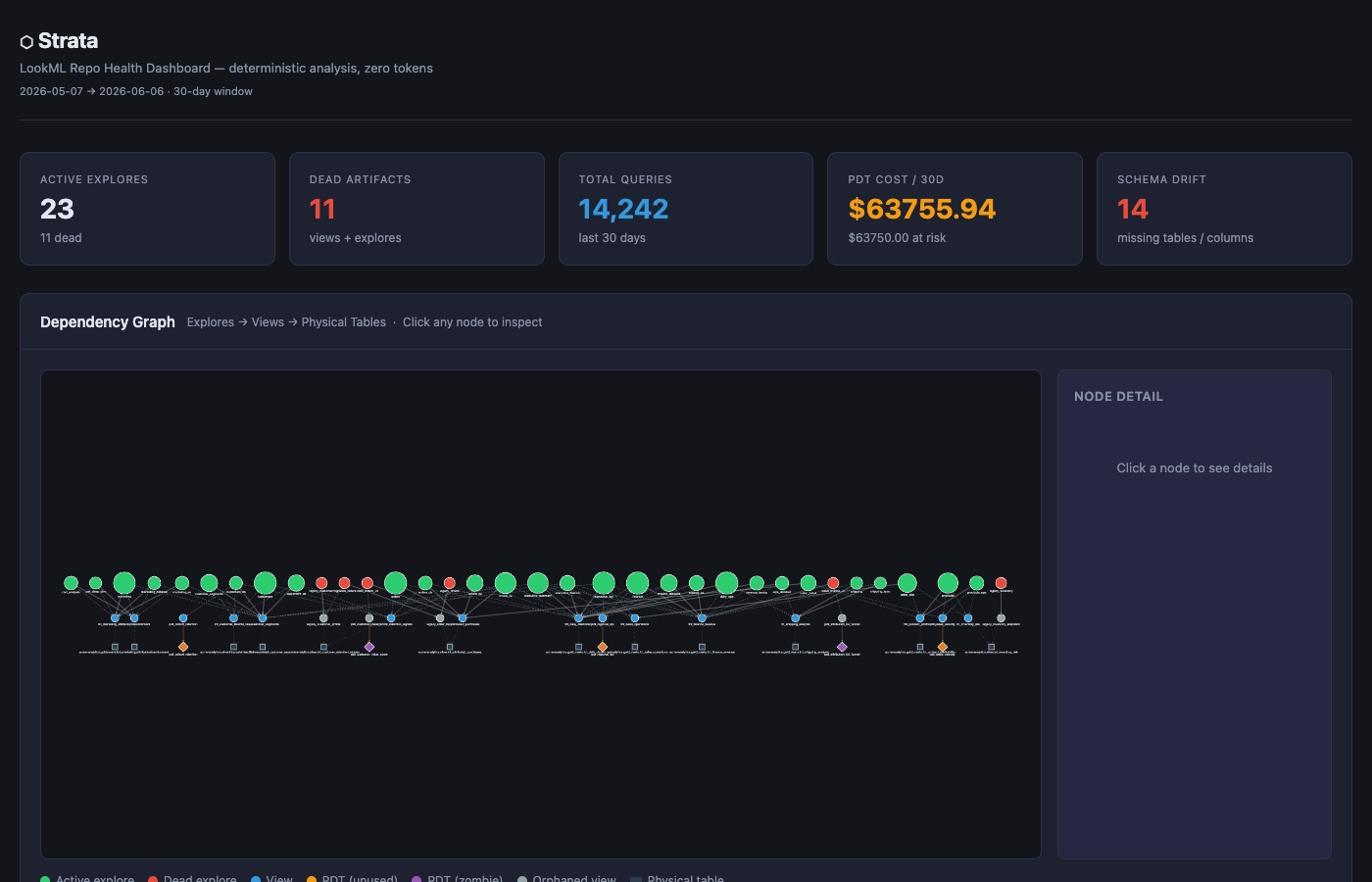
*enterprise_mono — 34 explores, 19 models, 30-day window. Green = active explore, red = dead explore, blue = view, orange = unused PDT, **purple = zombie PDT**, gray = physical table.*
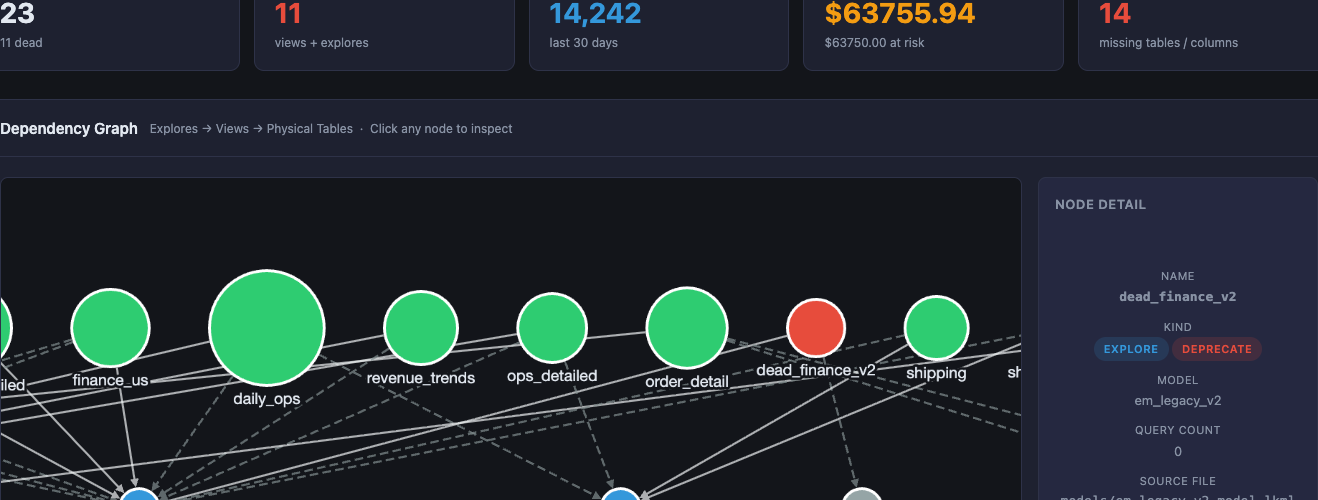
*`dead_finance_v2` selected — rendered dead-red with a **deprecate** verdict and QUERY COUNT: 0 in the node detail. Its backing PDT, `pdt_attribution_full_funnel`, is the purple zombie diamond in the full graph above, rebuilding at ~$45,000/month (estimated fixture data) to serve it.*
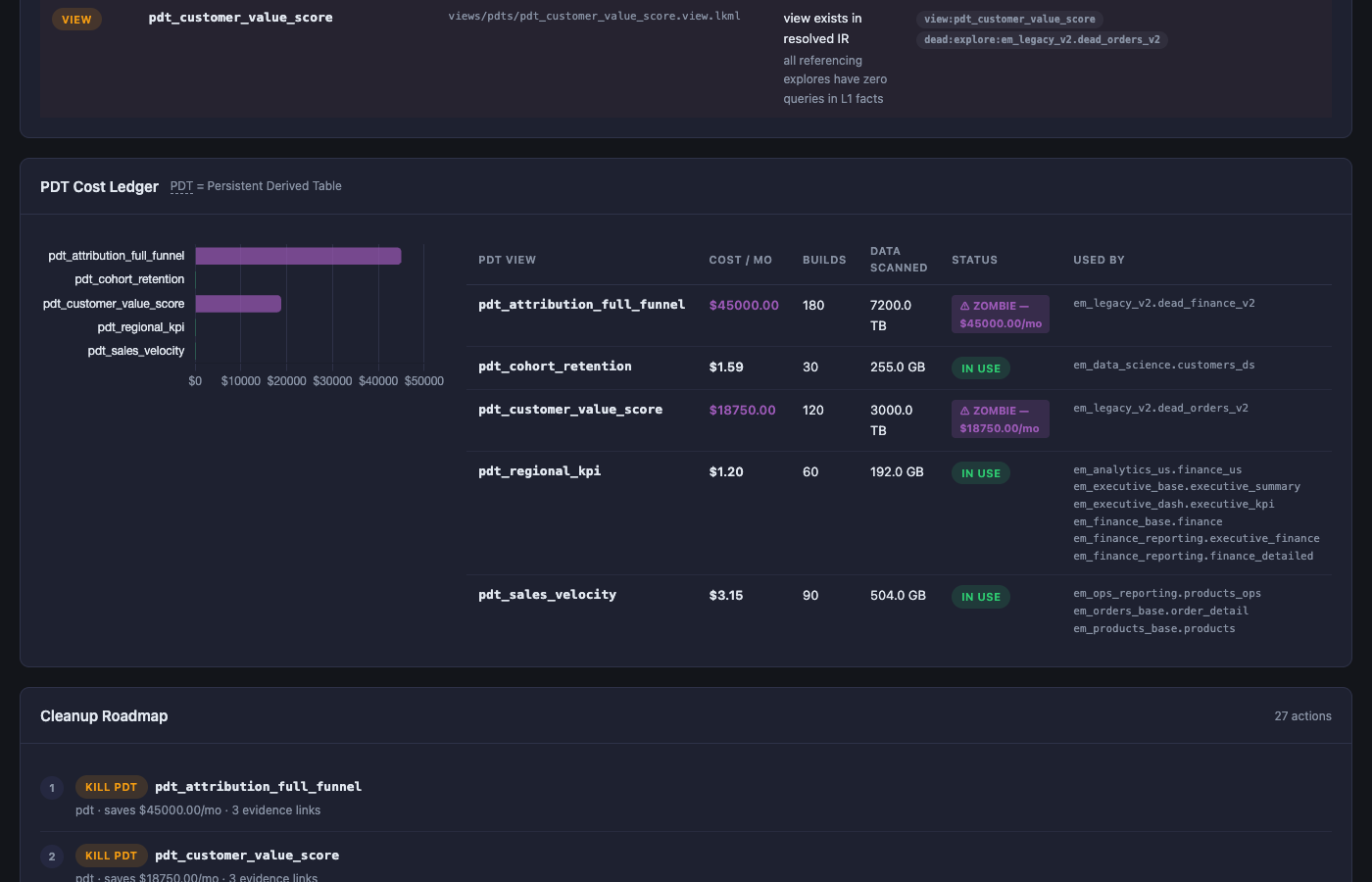
*PDT Cost Ledger — both zombie PDTs flagged ⚠ with their monthly cost and the dead explores that consume them, above the Cleanup Roadmap's KILL actions. Every verdict carries evidence links; the Dead Code Register panel (visible at top) applies the same dual-evidence rule — structural and usage tags both required before anything is flagged.*
<details>
<summary>How it works — L0 → L1 → L2 pipeline</summary>
```
LookML repo (read-only clone)
│
▼
L0 — IR Builder
Parse all .lkml files → canonical node/edge graph
Resolve extends chains, refinements, cross-model dependencies
No LLM. No network. Pure deterministic Python.
│
▼
L1 — Enrichment
Join IR against usage facts (explore queries, PDT builds)
Join IR against schema facts (warehouse column inventory)
Produces: dead code evidence, PDT cost ledger, schema drift records
Offline: fixture JSON | Live: Looker OAuth → System Activity API
│
▼
L2 — Synthesis
One explore = one verdict with evidence
Lightweight model, clean structured context
Outputs: cleanup roadmap, migration impact, validation scope
│
├── JSON artifacts catalog / dead code / PDT ledger / drift / impact
├── HTML dashboard strata dashboard
├── MCP server 18 tools (17 read-only + 1 sandboxed render), stdio, any MCP client
└── CLI strata check / outputs / build / validate
```
L0 never calls any LLM or external API — pure offline deterministic Python. L1 enrichment
is offline by default (fixture JSON); live Looker System Activity API access is opt-in via
`strata auth login`. The MCP server transport is stdio-only — no HTTP server, no cloud
dependency. All analysis runs against a read-only clone.
</details>
<details>
<summary>Philosophy — why deterministic first?</summary>
Parsing LookML, resolving extends chains, detecting dead code, computing PDT cost — these are
deterministic problems. They cost zero tokens. The structure doesn't need an LLM to understand
it; it needs to be mapped.
Strata maps it first. Then a lightweight model reasons over a clean, structured context. This gets
more capable as models improve and more efficient over time. The deterministic layer never changes.
LookML's declarative model — explicit `explore:`, `join:`, `view:`, `extends:` — makes this
possible. Every dependency is named and resolvable without executing a query. Most BI tools
don't have this. A dbt project has a DAG but no semantic layer. A Tableau workbook has implicit
dependencies that are hard to traverse programmatically. LookML's structure is what makes
"what breaks if I change this?" answerable with certainty, not heuristics.
</details>
---
## MCP, Skills, and Agent Workflow
### The MCP Layer
18 tools over stdio — 17 read-only, plus `strata_render_chart`, which writes only to
`~/.strata/output` or `/tmp` (sandboxed, never your LookML repo). Works with any MCP client.
All tools run against the local IR cache — no live Looker connection required. For live usage
enrichment, see [Looker OAuth](#looker-oauth-and-token-management) below.
```
Agent calls: strata_dead_code_register
→ 6 dead explores, 2 zombie PDTs, ~$63,750/mo estimated in unused compute
Agent calls: strata_explore_deps("dead_finance_v2", "em_legacy_v2")
→ full join graph: 4 views, 1 zombie PDT backing this explore
Agent calls: strata_schema_drift
→ 14 drift hits across 3 tables — column drops not reflected in LookML
Agent calls: strata_validation_scope(["views/orders.view.lkml"])
→ 3 explores affected — minimum revalidation set for this PR
```
<details>
<summary>All 18 tools</summary>
| Tool | Returns |
|---|---|
| `strata_ir_status` | Graph summary: node counts, model list, resolution errors |
| `strata_dead_code_register` | Dead explores + zombie views with dual evidence |
| `strata_pdt_costs` | PDT ledger: cost/mo, build count, bytes, status |
| `strata_schema_drift` | Column-level drift: field exists in LookML, missing in warehouse |
| `strata_explore_deps` | Full join graph for an explore |
| `strata_query_field` | Field definition: type, SQL, tags, usage |
| `strata_list_orphans` | Orphaned views, explores, and fields by kind |
| `strata_usage_summary` | Query counts, top explores, usage gaps |
| `strata_validation_scope` | Impact set for a set of changed .lkml files |
| `strata_impact` | Views, explores, and fields affected by a physical table change |
| `strata_find_field` | Search fields by name, SQL, label, description, or tag |
| `strata_view_sources` | All views with backing BQ table, field count, orphan flag |
| `strata_navigate` | One-call ticket brief: views/explores/fields for an anchor, cited as file:line |
| `strata_list_skills` | Compact metadata for all bundled skills |
| `strata_skill` | Full skill content — loaded only when requested |
| `strata_render_chart` | Vega-Lite spec + data → self-contained HTML |
| `strata_chart_templates` | Available chart types |
| `strata_conductor_status` | Active workflow slice and next steps |
</details>
### LLM Cost Controls
L0 and L1 analysis costs zero tokens — pure deterministic Python, no model calls. Tool responses
return structured JSON, not prose, so each MCP call adds ~200–500 tokens to context rather than
paragraphs of explanation. Skills are lazy-loaded: `strata_skill("name")` pulls one skill on
demand; the rest cost nothing. L2 synthesis does use tokens, but against clean structured
context. Composite tools keep round-trips low: `strata_navigate` returns a full ticket brief
(views, explores, fields, `file:line` citations) in **one call** instead of an agent hand-
orchestrating several separate lookup primitives — a single structured payload in place of
stitching those calls together, and far fewer context-carrying round-trips.
For long-running investigations, Conductor's slice-based handoffs let an agent resume from a
single targeted file load (index + handoff-log) rather than re-deriving state from scratch —
keeping per-session context lean without measuring token counts explicitly.
### Looker OAuth and Token Management
All 18 tools (17 read-only, 1 sandboxed chart renderer) work fully offline against the local
IR cache. Live Looker enrichment is opt-in:
```bash
strata auth login --looker-url https://your-instance.looker.com
strata auth status
```
Token stored at `~/.strata/tokens.json` (0600 permissions, 0700 parent directory). HTTPS enforced —
`http://` rejected except for `localhost` OAuth callback. Token permissions checked on every read;
loose permissions surface a warning before any tool call.
For enterprise: ADC, OIDC for GitHub Actions, and Google Workspace IAM path in
[`docs/enterprise-deployment.md`](docs/enterprise-deployment.md).
### Skills — Structured Investigation Procedures
15 domain skills bundled with the package. Zero tokens until an agent calls `strata_skill("name")`.
Each skill defines trigger conditions, allowed tools, a step-by-step procedure, stop conditions,
output format, and escalation scripts. `lookml_ticket_navigator` is the day-to-day ticket entry
point: give it a BQ table, field, view, explore, or `.lkml` file and it returns the source-cited
brief an agent needs before editing.
Designed to run with smaller, task-appropriate models — `[JUDGMENT]` marks the few steps that require reasoning;
everything else is mechanical. A typical BigQuery investigation chains skills like this:
```
Agent reads skill: bq_schema_probe
→ procedure: which BQ datasets to check, how to validate grain, stop conditions
→ agent queries information_schema to map physical tables to LookML views
Agent reads skill: grain_validator
→ detects fan-out risk in joins, missing relationship: declarations
Agent reads skill: sql_builder
→ structured SQL construction for BQ with cost guardrails applied first
Agent reads skill: sql_optimizer
→ optimization rules flagged against the built query
Agent reads skill: bq_query_guardrail
→ final cost and safety gate before any query executes
```
<details>
<summary>All 15 skills</summary>
| Domain | Skills | Use when |
|---|---|---|
| BigQuery | `bq_schema_probe`, `grain_validator`, `sql_builder`, `sql_optimizer`, `bq_query_guardrail` | Inspect warehouse schema, draft SQL, validate grain, and keep queries cost-safe |
| LookML | `lookml_ticket_navigator`, `lookml_view_reviewer`, `lookml_explore_join_reviewer` | Find what to touch, review fields/views, and verify explore joins |
| Looker | `semantic_layer_audit` | Audit semantic-layer health across usage, drift, and dependency evidence |
| Delivery | `jira_to_bi_spec`, `bi_incident_responder`, `release_notes_generator` | Turn tickets/incidents/merged changes into scoped BI artifacts |
| Visualization | `chart_composer`, `dashboard_composer` | Compose charts and dashboards from governed fields and evidence |
| Governance | `conductor_manager` | Manage Conductor slices, phases, and handoffs |
</details>
### Conductor — Agent Workflow Management
Conductor is the session continuity system for agent work. It tracks active slices (bounded
work units), acceptance criteria, and handoff state across sessions — so an agent picking up
where another left off has full context without re-deriving it.
**Deploy Conductor into your repo:**
```bash
strata bootstrap --repo /path/to/your/lookml
# Creates: conductor/index.md, conductor/handoff-log.md, .mcp.json
```
**During an investigation:**
```bash
strata conductor new-slice "Audit dead explores in gcs_analytics"
strata conductor status
strata conductor log-handoff --completed "dead code register" --next "PDT cost review"
```
The handoff log records commit hash, what was completed, and exact next steps. `strata validate`
checks the log format and verifies the referenced commit exists in git — catching hallucinated
handoffs before they compound.
For the full investigation workflow — gate verification, findings format, stop conditions,
live enrichment options — see the **[Governance Runbook](docs/runbook.md)**.
### Vega-Lite Charts — Built In
```bash
strata chart bar data.json --title "Revenue by Region" --open
strata chart line trend.json --open
strata chart scatter correlation.csv --open
strata chart heatmap activity.json --open
```
<table>
<tr>
<td align="center"><img src="https://raw.githubusercontent.com/G-Schumacher44/strata-oss/main/docs/assets/chart-bar.png" width="420" alt="Bar chart: Revenue by Region"/><br/><sub><b>bar</b> — categorical comparison</sub></td>
<td align="center"><img src="https://raw.githubusercontent.com/G-Schumacher44/strata-oss/main/docs/assets/chart-line.png" width="420" alt="Line chart: Revenue Trend"/><br/><sub><b>line</b> — trend over time</sub></td>
</tr>
<tr>
<td align="center"><img src="https://raw.githubusercontent.com/G-Schumacher44/strata-oss/main/docs/assets/chart-scatter.png" width="420" alt="Scatter: Query Count vs PDT Build Time"/><br/><sub><b>scatter</b> — correlation</sub></td>
<td align="center"><img src="https://raw.githubusercontent.com/G-Schumacher44/strata-oss/main/docs/assets/chart-heatmap.png" width="420" alt="Heatmap: Explore Query Activity by Day"/><br/><sub><b>heatmap</b> — two-dimensional breakdown</sub></td>
</tr>
</table>
4 chart types. JS bundled locally — charts are self-contained HTML files that render offline.
Built on [Vega-Lite](https://vega.github.io/vega-lite/) by the [UW Interactive Data Lab](https://idl.cs.washington.edu/) ([@uwdata](https://github.com/vega)).
---
## CLI
15 commands. Full reference: [`docs/cli-guide.md`](docs/cli-guide.md).
| Command | What it does |
|---|---|
| `strata auth` | Authenticate with Looker and manage local OAuth tokens |
| `strata bootstrap` | Scaffold Strata into a repo — conductor/, .mcp.json, config |
| `strata build` | Parse LookML and write the IR cache (`strata_ir.db`) |
| `strata chart` | Render charts to self-contained HTML |
| `strata check` | Offline governance gates — dead code, drift, PDT, verdict validation |
| `strata clean` | Remove `output/`, `strata_ir.db`, `__pycache__` |
| `strata conductor` | Manage slice-based agent workflow and handoffs |
| `strata dashboard` | Build artifacts and serve the local HTML dashboard |
| `strata generate-schema` | Pull BigQuery INFORMATION_SCHEMA facts for drift checks |
| `strata lint` | Run ruff and mypy checks |
| `strata mcp` | Run, validate, and inspect MCP server configuration |
| `strata outputs` | Write 8 JSON artifacts to an output directory |
| `strata query` | Inspect the IR from the terminal |
| `strata skill` | List bundled skills or print a skill procedure |
| `strata validate` | Conductor spine check — handoff format, active slice, replay facts |
---
## CI and Bot Deployment
Strata ships two decoupled CI workflows: a **hard gate** that blocks the build on
test failures, and a **soft gate** that posts advisory PR review without breaking it.
<details>
<summary>1. PR Comment Bot (soft gate)</summary>
`strata-pr.yml` runs on **every PR** and posts a single, self-updating comment with
impact analysis — which explores break, validation scope, blast radius — plus the
Conductor spine check (`strata validate`). The comment is upserted in place on each
push (no duplicate comments), and a failing `strata validate` is surfaced in the
comment **without** failing the build, so quick human fixes aren't blocked.
```yaml
# .github/workflows/strata-pr.yml (included in repo)
on:
pull_request:
```
See [`.github/workflows/strata-pr.yml`](.github/workflows/strata-pr.yml) and
[`scripts/pr_comment.py`](scripts/pr_comment.py) for the full workflow.
</details>
<details>
<summary>2. CI Test Pipeline (hard gate)</summary>
`strata-ci.yml` runs lint (`ruff`), types (`mypy`), the test suite (`pytest`), and
offline `strata check` / `strata outputs` across the bundled playgrounds — verifying
dead code, schema drift, and PDT findings deterministically.
```yaml
# .github/workflows/strata-ci.yml
- name: Strata offline analysis
run: |
strata check \
--repo . \
--usage-fixture usage_facts.json \
--schema-fixture schema_facts.json
```
Exits 0 if all gates pass. No Looker instance, no credentials, no flaky API calls.
</details>
### Output Artifacts
`strata outputs` writes 8 JSON files per run: `catalog`, `usage_summary`, `dead_code_register`,
`pdt_ledger`, `schema_drift`, `migration_impact`, `cleanup_roadmap`, `validation_scope`. All
deterministic — same fixtures produce identical output. Feed them to downstream reporting or
consume them in your AI client via the MCP layer.
---
## How We Validated
Three offline playgrounds, all findings sourced from actual output artifacts.
Full breakdown: [`docs/testing.md`](docs/testing.md).
<details>
<summary>Playground findings — enterprise_mono · gcs_analytics · thelook</summary>
**enterprise_mono** — 19 models, 34 explores, cross-model extends, 3 legacy connection clusters:
- 6 dead explores (0 queries over 30 days) — all flagged with dual evidence
- 5 zombie views — referenced only by dead explores
- 2 zombie PDTs rebuilding at ~$63,750/month estimated — backed exclusively by dead explores
- **~$765,000/year** in compute serving no users
- 14 schema drift hits across 3 tables (9 from a real `int_inventory_risk` migration)
**gcs_analytics** — gold/silver BQ layer, mixed active and legacy:
- 6 dead items (2 orphan views, 2 zombie views, 2 dead explores)
- 1 unused PDT (~$156/month estimated, no explore backer)
- 1 schema drift hit
**thelook** — Looker's public demo repo, structural baseline:
- 6 dead items (1 orphan view, 1 zombie view, 4 dead explores)
- 1 schema drift hit
Each playground ships with matching fixture JSON files (`tests/fixtures/`) that simulate
Looker System Activity API responses — so the full analysis runs offline with no credentials.
</details>
---
## Docs
Full index: [**docs/README.md**](docs/README.md)
<details>
<summary>Quick links</summary>
| | |
|---|---|
| [`docs/runbook.md`](docs/runbook.md) | Governance investigation playbook — gate, workflow patterns, findings format |
| [`docs/cli-guide.md`](docs/cli-guide.md) | Full CLI reference — all commands, env vars, output artifacts |
| [`docs/testing.md`](docs/testing.md) | Playgrounds, scenarios, how to run them |
| [`docs/testing-findings.md`](docs/testing-findings.md) | Full findings — real numbers, drift breakdowns, agentic benchmarks |
| [`docs/security-hardening.md`](docs/security-hardening.md) | Read-only enforcement, credential handling, MCP security model |
| [`docs/enterprise-deployment.md`](docs/enterprise-deployment.md) | IAM, ADC, OIDC for GH Actions, Google Workspace path |
| [`docs/CONTRIBUTING.md`](docs/CONTRIBUTING.md) | Contribution guide |
</details>
---
## License
[Apache 2.0](LICENSE) — © 2026 Garrett Schumacher
<!-- MCP registry identity — verified at publish time by the official registry -->
mcp-name: io.github.g-schumacher44/strata
TDQS
Scored across 18 tools
Several tools occupy overlapping impact/navigation territory: strata_impact, strata_validation_scope, and strata_navigate all return affected views/explores/fields, while strata_find_field and strata_query_field have similar search/query semantics. strata_list_orphans and strata_dead_code_register also blur together. Without more detailed descriptions, an agent could easily select the wrong tool.
All tools share the strata_ prefix and use snake_case, which provides a consistent namespace. However, the verb_noun pattern is not maintained: list_orphans and find_field sit alongside bare noun phrases like ir_status, pdt_costs, schema_drift, and conductor_status. The singular strata_skill also breaks the list/detail convention established by strata_list_skills.
18 tools is above the typical 3-15 well-scoped range and mixes core data-model analysis tools with meta utilities like skills, conductor status, and chart templates. It is not extreme, but the set feels heavier and broader than necessary for a focused server.
For a read-only data-model navigation and impact-analysis server, the surface covers discovery, dependency exploration, impact assessment, orphan/dead-code detection, schema drift, usage, costs, and even rendering charts. Minor gaps exist, such as no explicit per-explore detail tool and no apply flow after validation_scope, but agents can generally work around these.