BigGo MCP Server
The BigGo MCP Server is a powerful tool that provides access to BigGo APIs for:
Product Discovery: Search for products across multiple e-commerce platforms including Amazon, Aliexpress, and Ebay
Price History Tracking: Track and visualize price history of products using URLs or history IDs with different time ranges (90, 180, 365, or 730 days)
Data Visualization: Access links to visualize product price history graphs
Product Specification Comparison: Compare product specifications using Elasticsearch queries (disabled in versions >= v0.1.28)
Elasticsearch Integration: Explore indexes, mappings, and perform complex queries on product specifications
Regional Settings: Configure and retrieve the current region for product searches
Enables product search and price tracking for items listed on AliExpress through BigGo's comparison service
Allows product discovery and price comparison across Amazon platform through BigGo's API
Provides product discovery and price history tracking for eBay listings via BigGo's search API
Provides product specification search capabilities through Elasticsearch indexes, allowing for detailed product comparisons based on technical specifications
Facilitates product discovery and price history tracking for Shopee listings via BigGo's comparison service
Supports product search and price comparison for Taobao items through BigGo's platform
Click on "Install Server".
Wait a few minutes for the server to deploy. Once ready, it will show a "Started" state.
In the chat, type
@followed by the MCP server name and your instructions, e.g., "@BigGo MCP Serverfind wireless earbuds under $100 with noise cancellation"
That's it! The server will respond to your query, and you can continue using it as needed.
Here is a step-by-step guide with screenshots.
BigGo MCP Server
Introduction
BigGo MCP Server utilizes APIs from BigGo, a professional price comparison website.
Related MCP server: E-commerce MCP Server
Features
Supports
stdioandSSEtransports
Product Discovery: Search for products across multiple e-commerce platforms (Amazon, Aliexpress, Ebay, Taobao, Shopee ... etc.)
Price History Tracking: Track product price history by supplying product url or related terms.
Spec Comparison [Disabled on versions >= v0.1.28]: Compare and find products based on their specifications, from basic infos to more complex technical specs.
Installation
Prerequisites
Python >= 3.10
BigGo Certification (
client_idandclient_secret) for specification search.
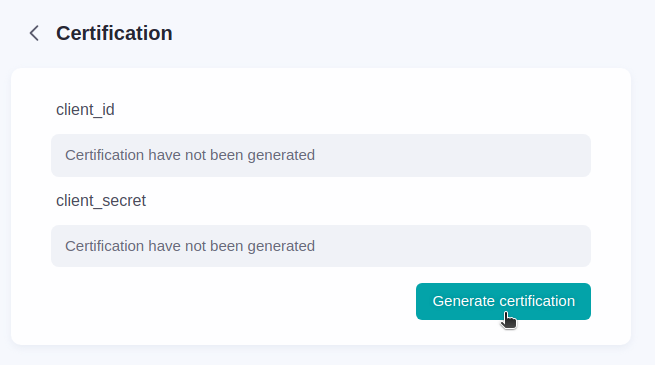
How to obtain BigGo certification?
Register a BigGo account if you don't have one.
Go to BigGo Certification Page
Click "Generate certification" button

Copy the
client_idandclient_secretUse them in the MCP Server configuration (
BIGGO_MCP_SERVER_CLIENT_IDandBIGGO_MCP_SERVER_CLIENT_SECRET)
Installation Config
{
"mcpServers": {
"biggo-mcp-server": {
"command": "uvx",
"args": [ "BigGo-MCP-Server@latest"],
"env": {
"BIGGO_MCP_SERVER_CLIENT_ID": "CLIENT_ID",
"BIGGO_MCP_SERVER_CLIENT_SECRET": "CLIENT_SECRET",
"BIGGO_MCP_SERVER_REGION": "REGION"
}
}
}
}For specific version use
BigGo-MCP-Server@VERSION, ex:BigGo-MCP-Server@0.1.1
Environment Variables
Variable | Description | Default | Choices |
| Client ID | None | Required for specification search |
| Client Secret | None | Required for specification search |
| Region for product search | TW | US, TW, JP, HK, SG, MY, IN, PH, TH, VN, ID |
| Port for SSE server | 9876 | Any available port number |
| Server transport type | stdio | stdio, sse |
Default SSE URL: http://localhost:9876/sse
Available Tools
product_search: Product search with BigGo search apiprice_history_graph: Link that visualizes product price historyprice_history_with_history_id: Uses history IDs from product search resultsprice_history_with_url: Tracks price history using product URLsspec_indexes: Lists available Elasticsearch indexes for product specificationsspec_mapping: Shows Elasticsearch index mapping with example documentsspec_search: Query product specifications from Elasticsearchget_current_region: Get the current region
FAQ
How to trigger tool usage?
For Product Discovery related:
Look for Nike running shoesFor Price History Tracking related:
Show me the price history of this product: https://some-product-urlFor Spec Comparison related:
Find me phones with 16GB RAM and 1TB storagePlease show me diving watches that can withstand the most water pressureBuild
See build.md for more details.
License
This project is licensed under the MIT License. See the LICENSE file for details.
Available Tools
2 toolsprice_history_with_urlD
Product Price History With URL
| Name | Required | Description | Default |
|---|---|---|---|
| url | Yes | Product URL |
Output Schema
| Name | Required | Description |
|---|---|---|
| result | Yes |
TDQS
Does the description disclose side effects, auth requirements, rate limits, or destructive behavior?
With no annotations, the description must disclose behavioral traits. It does not mention whether the operation is read-only, safe, or destructive, nor does it describe any side effects, authentication needs, or rate limits. The agent gets zero behavioral insight.
Agents need to know what a tool does to the world before calling it. Descriptions should go beyond structured annotations to explain consequences.
Is the description appropriately sized, front-loaded, and free of redundancy?
The description is extremely short (5 words) but under-specified, not concise. It lacks structure and fails to provide essential information, making it inadequate for clear communication.
Shorter descriptions cost fewer tokens and are easier for agents to parse. Every sentence should earn its place.
Given the tool's complexity, does the description cover enough for an agent to succeed on first attempt?
Despite the tool's simplicity (1 parameter, output schema present), the description is severely incomplete. It does not explain the tool's purpose, behavior, or return value, leaving significant gaps for an agent to infer.
Complex tools with many parameters or behaviors need more documentation. Simple tools need less. This dimension scales expectations accordingly.
Does the description clarify parameter syntax, constraints, interactions, or defaults beyond what the schema provides?
Schema description coverage is 100%, so the baseline is 3. The description adds no additional meaning beyond the schema's 'Product URL' for the 'url' parameter. It does not specify format, constraints, or examples, but the schema already covers the parameter adequately.
Input schemas describe structure but not intent. Descriptions should explain non-obvious parameter relationships and valid value ranges.
Does the description clearly state what the tool does and how it differs from similar tools?
The description 'Product Price History With URL' is a noun phrase that merely echoes the tool name without specifying a verb or action. It does not clearly state what the tool does (e.g., retrieve, update, display), leaving the agent uncertain about its function.
Agents choose between tools based on descriptions. A clear purpose with a specific verb and resource helps agents select the right tool.
Does the description explain when to use this tool, when not to, or what alternatives exist?
No guidance is provided on when to use this tool versus the sibling 'product_search'. There is no mention of contexts, alternatives, or when not to use it, making it hard for an agent to choose correctly.
Agents often have multiple tools that could apply. Explicit usage guidance like "use X instead of Y when Z" prevents misuse.
product_searchD
Product Search
| Name | Required | Description | Default |
|---|---|---|---|
| query | Yes | Search query |
Output Schema
| Name | Required | Description |
|---|---|---|
| result | Yes |
TDQS
Does the description disclose side effects, auth requirements, rate limits, or destructive behavior?
No annotations are provided, and the description does not disclose any behavioral traits (e.g., request limits, authentication needs, side effects). The description is minimal and adds no transparency.
Agents need to know what a tool does to the world before calling it. Descriptions should go beyond structured annotations to explain consequences.
Is the description appropriately sized, front-loaded, and free of redundancy?
The description is two words, which is not an appropriate size. It is under-specification rather than conciseness, as it fails to provide any useful information beyond the tool name.
Shorter descriptions cost fewer tokens and are easier for agents to parse. Every sentence should earn its place.
Given the tool's complexity, does the description cover enough for an agent to succeed on first attempt?
Despite having an output schema, the description gives no context about the tool's behavior, return values, or when to use it. It is completely inadequate for a tool with 1 parameter and a sibling tool.
Complex tools with many parameters or behaviors need more documentation. Simple tools need less. This dimension scales expectations accordingly.
Does the description clarify parameter syntax, constraints, interactions, or defaults beyond what the schema provides?
Schema coverage is 100% with a single parameter 'query' described as 'Search query' with examples. The description adds no extra meaning beyond the schema, so the baseline score of 3 applies.
Input schemas describe structure but not intent. Descriptions should explain non-obvious parameter relationships and valid value ranges.
Does the description clearly state what the tool does and how it differs from similar tools?
The description is just 'Product Search', which is a tautology of the tool name. It does not specify a verb or resource, and does not distinguish it from the sibling tool 'price_history_with_url'.
Agents choose between tools based on descriptions. A clear purpose with a specific verb and resource helps agents select the right tool.
Does the description explain when to use this tool, when not to, or what alternatives exist?
The description provides no guidance on when to use this tool or when to avoid it. No alternatives or context are mentioned.
Agents often have multiple tools that could apply. Explicit usage guidance like "use X instead of Y when Z" prevents misuse.
TDQS
The two tools have clearly distinct purposes: one for product search and one for price history. There is no overlap or ambiguity.
Both tools use snake_case and are descriptive, but 'price_history_with_url' includes a preposition while 'product_search' is simpler, showing slight inconsistency in structure.
With only 2 tools, the server feels under-scoped for a product search domain, limiting its utility. Typically at least 3-5 tools are expected.
Missing essential tools like product detail, category listing, or filters. The surface only covers search and price history, leaving significant gaps.
Maintenance
Resources
Unclaimed servers have limited discoverability.
Looking for Admin?
If you are the server author, to access and configure the admin panel.
Related MCP Connectors
A comprehensive Model Context Protocol (MCP) server that enables AI assistants to interact with yo…
Cross-merchant product search with real price history, comparisons, and demand signals.
The Mercado Pago MCP Server implements the Model Context Protocol to provide AI agents and LLMs with access to Mercado Pago's APIs and tools within compatible development environments. It acts as an intermediary that translates Mercado Pago resources into executable functions (tools) that AI applications can invoke to perform actions and automate flows. The server simplifies integration, enables using documentation to implement or improve code, and optimizes operations through natural language interactions without manual implementations.
Hosted MCP for e-commerce: live product catalog, stock, and pricing for AI agents.
Related MCP Servers
- FlicenseNot gradedqualityDmaintenanceA Model Context Protocol server that enables AI assistants to interact with a complete e-commerce application, providing authentication, product browsing, and shopping cart management through standardized MCP tools.
- FlicenseNot gradedqualityDmaintenanceA Model Context Protocol server that provides real-time access to MongoDB product data, enabling sophisticated e-commerce queries with price range filters, category searching, and product recommendations through a conversational interface.
- AlicenseBqualityFmaintenanceA Model Context Protocol server that aggregates and compares deals from multiple sources including Slickdeals, RapidAPI marketplace, and web scraping, enabling users to search, filter, and compare deals through a chat interface.66MIT
- FlicenseCqualityDmaintenanceA Model Context Protocol server for querying Turkish market prices, comparing products, and getting AI-powered shopping recommendations.105
Latest Blog Posts
- Who's Calling? MCP Hosts Are an Identity Blind Spot (And the Spec Knows It)By Om-Shree-0709 on .mcpAgent IdentityOAuth 2.1
- Your AI Chatbot Just Exposed Your CEO's Salary to an InternBy Om-Shree-0709 on .Agent IdentityMCP SecurityOAuth Delegation
- Why MCP Servers Need Execution Sandboxing (And Why Your Current Stack Isn't Enough)By Om-Shree-0709 on .Agentic AiPrompt InjectionWebAssembly
MCP directory API
We provide all the information about MCP servers via our MCP API.
curl -X GET 'https://glama.ai/api/mcp/v1/servers/Funmula-Corp/BigGo-MCP-Server'
If you have feedback or need assistance with the MCP directory API, please join our Discord server