
Design Constraint Validator MCP Server
by CseperkePapp
README.md
# Design Constraint Validator (DCV)
> Mathematical constraint validator for design systems — ensuring consistency, accessibility, and logical coherence.
[](https://www.npmjs.com/package/design-constraint-validator)
[](https://www.npmjs.com/package/design-constraint-validator)
[](https://github.com/CseperkePapp/design-constraint-validator/actions/workflows/ci.yml)
[](https://github.com/CseperkePapp/design-constraint-validator/actions/workflows/sbom.yml)
[](SECURITY.md)
[](LICENSE)
[](#)
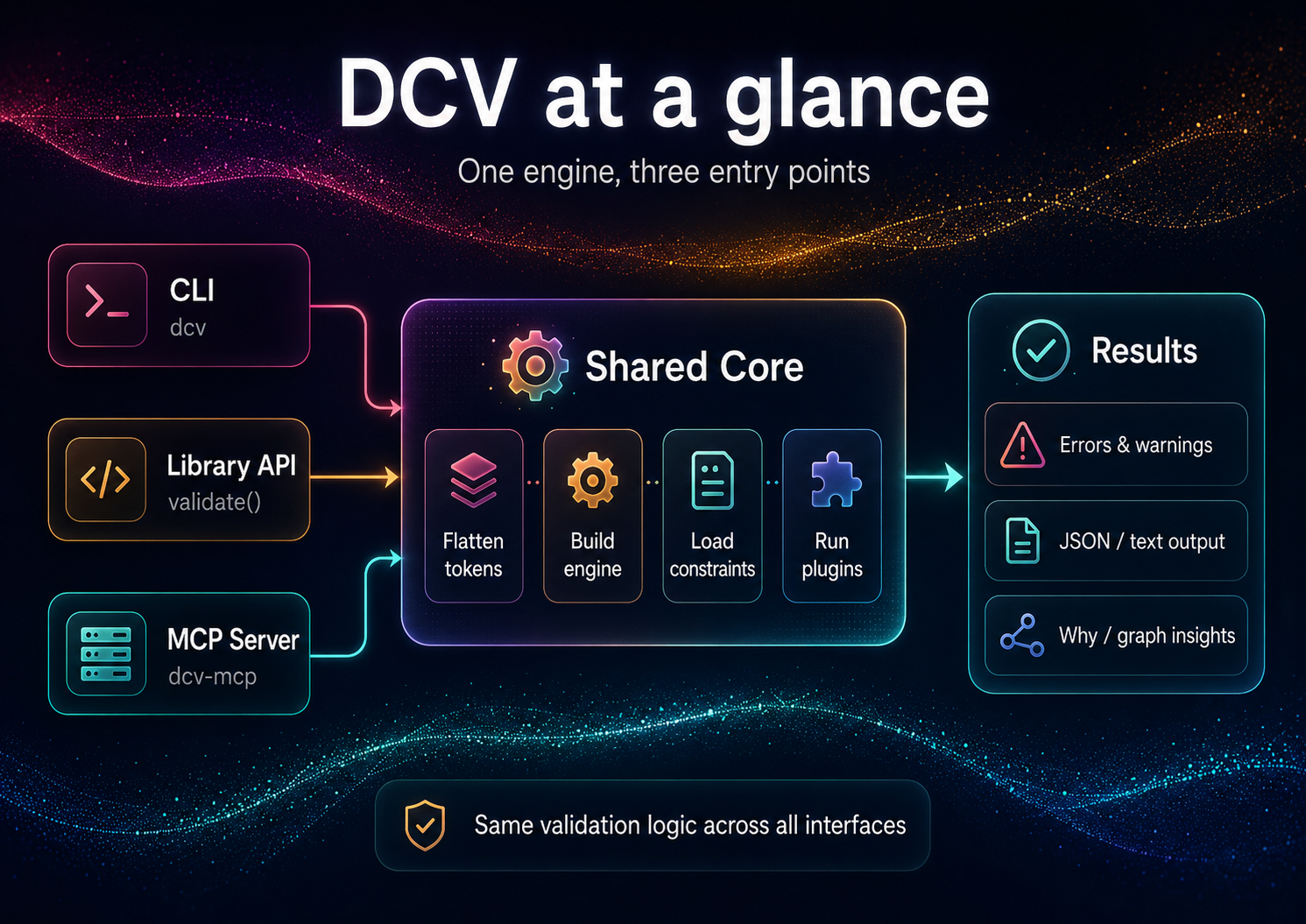
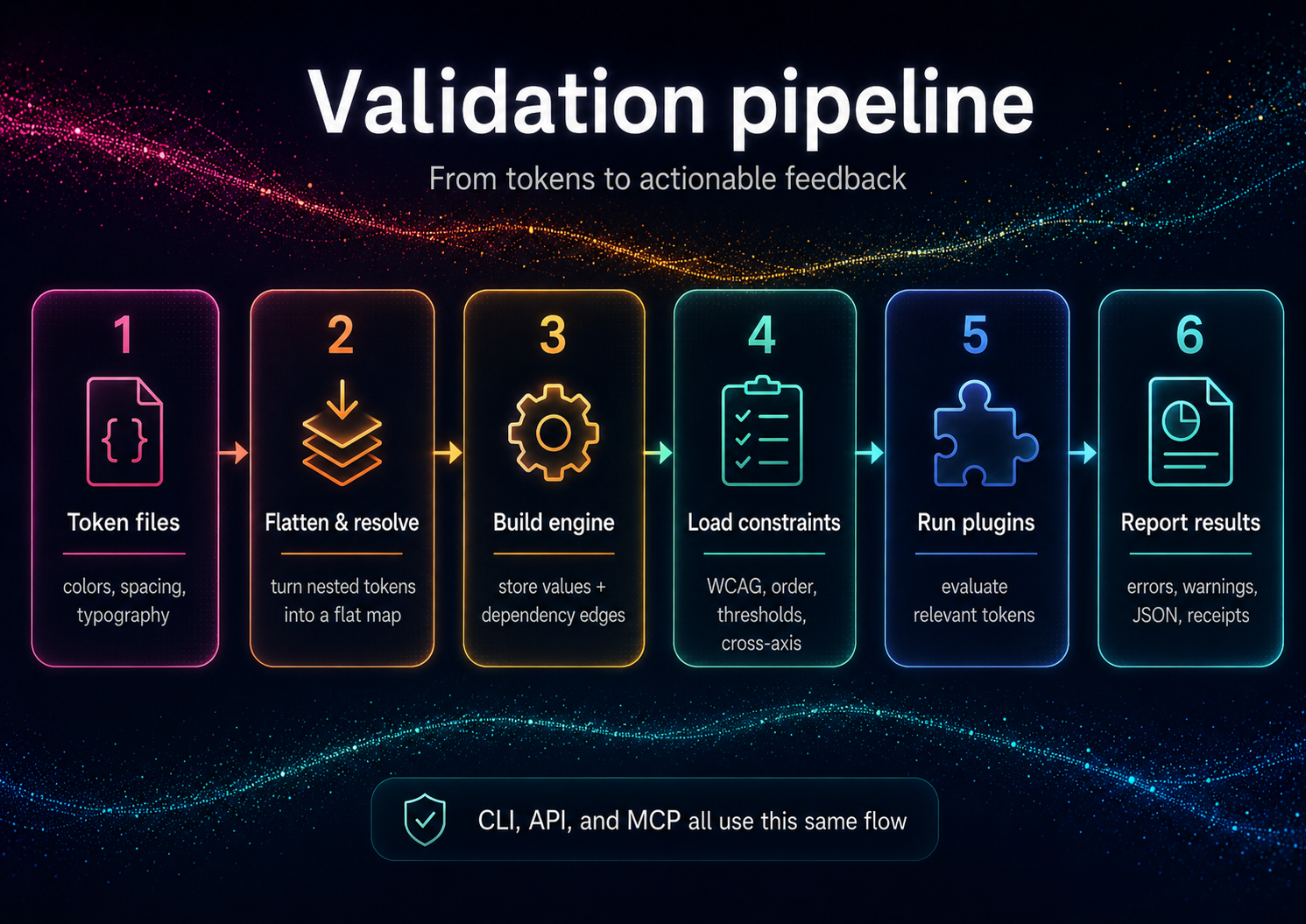
**Design Constraint Validator (DCV)** validates design constraints across token sets and styles:
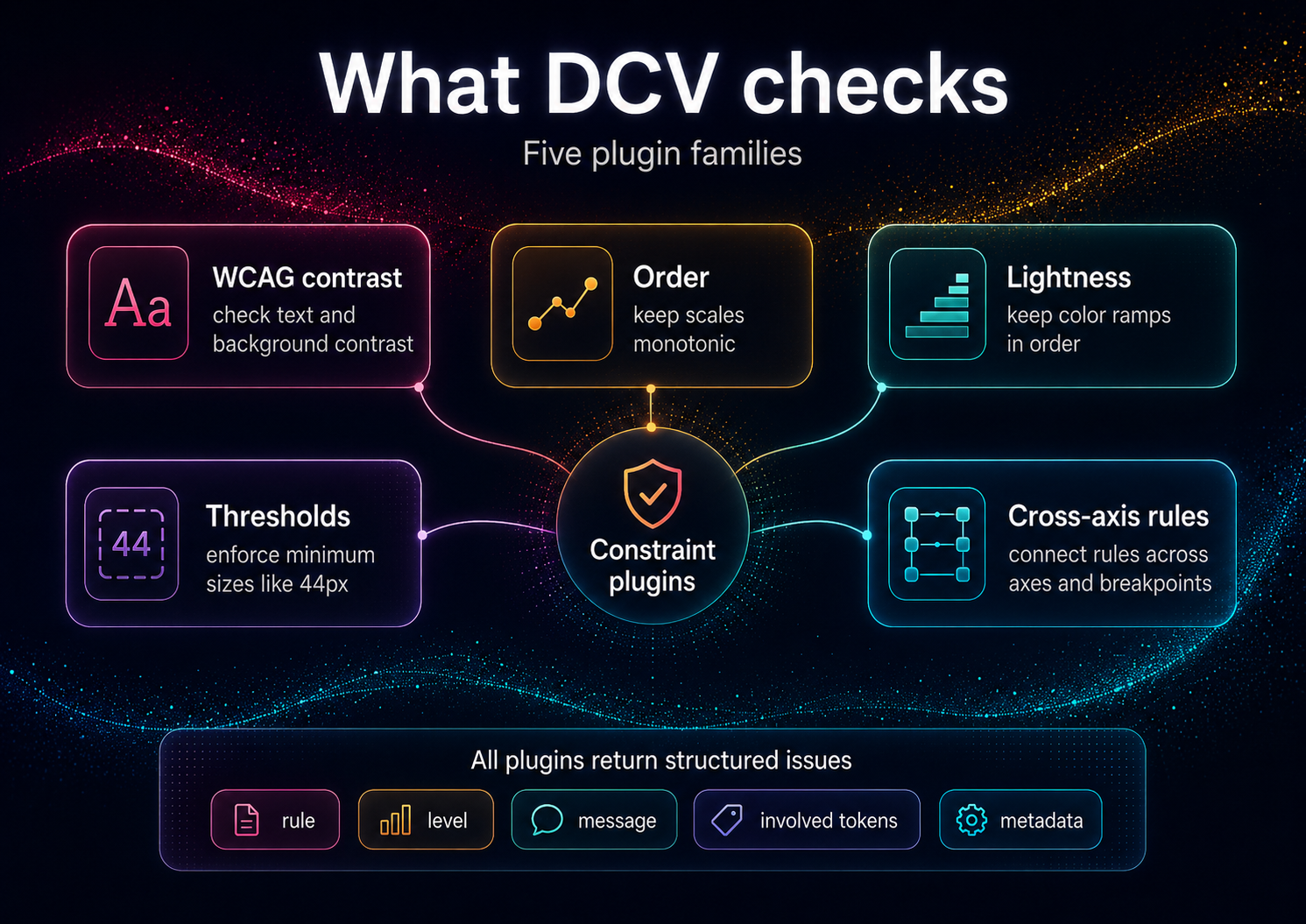
- ✅ **Accessibility:** WCAG text contrast, perceptual lightness floor/ceilings
- ✅ **Order & Monotonicity:** increasing typography scales, spacing hierarchies
- ✅ **Thresholds & Policies:** min/max ranges, cross-axis guards (size × weight × contrast)
- ✅ **Graph Intelligence:** Hasse/poset graph export; "why" explanations with implicated edges
This is **not** a schema linter; it's a **reasoning validator** for values and relationships.
---
## Installation
```bash
# Local (recommended)
npm i -D design-constraint-validator
# One-off run, no install (the bin name `dcv` belongs to an unrelated package)
npx design-constraint-validator --help
```
After a local install, the shorter `dcv` bin is available (e.g. `npx dcv --help`).
**Requirements:** Node.js ≥ 18.x (ESM)
---
## Quick Start
DCV validates **your** tokens against **your** constraints. From an empty directory:
```bash
# 1. Your design tokens (DTCG-style "$value")
cat > tokens.json <<'JSON'
{
"color": {
"text": { "$value": "#888888" },
"bg": { "$value": "#999999" }
}
}
JSON
# 2. Your constraints — auto-discovered as dcv.config.json in the cwd
cat > dcv.config.json <<'JSON'
{
"constraints": {
"enableBuiltInWcagDefaults": false,
"enableBuiltInThreshold": false,
"wcag": [
{ "foreground": "color.text", "background": "color.bg", "ratio": 4.5, "description": "Body text on background" }
]
}
}
JSON
# 3. Validate (positional path or --tokens; exits non-zero on violations)
npx design-constraint-validator validate tokens.json --summary table
# Explain one token (the tokenId is required)
npx design-constraint-validator why color.text --tokens tokens.json --format table
# Export the dependency graph
npx design-constraint-validator graph --tokens tokens.json --format mermaid > graph.mmd
```
> These one-offs use the full package name because the bare `dcv` bin name on npm
> belongs to an unrelated package. After `npm i -D design-constraint-validator`,
> use the shorter `npx dcv …`.
**Example output** (`validate`):
```text
validate: 1 error(s), 0 warning(s)
ERROR wcag-contrast color.text|color.bg @ Body text on background — Contrast 1.24:1 < 4.5:1
scope rules warnings errors
------ ----- -------- ------
global 1 0 1
```
Exit code is `1` when violations are found, `0` when clean (use `--fail-on off` to always exit `0`). The built-in WCAG/threshold defaults target the bundled example token ids, so disable them (as above) when validating your own token names.
---
## Programmatic API
```ts
import { validate } from 'design-constraint-validator';
// Synchronous. Point at files, or pass `tokens` / `constraints` inline.
const result = validate({
tokensPath: './tokens.json',
configPath: './dcv.config.json', // omit to auto-discover dcv.config.json in the cwd
});
if (!result.ok) {
for (const v of result.violations) {
console.log(`[${v.ruleId}] ${v.message}`);
}
process.exitCode = 1;
}
```
See **[API Reference](docs/API.md)** for complete programmatic usage.
---
## Use from AI agents (MCP)
DCV ships a second binary, `dcv-mcp`, that exposes the validator over MCP stdio for agent clients. Add it to a Claude Desktop or generic MCP client config like this:
```json
{
"mcpServers": {
"dcv": {
"command": "npx",
"args": ["-y", "--package", "design-constraint-validator", "dcv-mcp"]
}
}
}
```
The server exposes six read-only, JSON-returning tools:
- `validate` - validate inline `tokens` or a `tokensPath` against inline `constraints` or a config file.
- `why` - explain provenance, aliases, dependencies, dependents, and alias chain for one token id.
- `graph` - return token dependency `nodes` and `edges`.
- `list-constraints` - enumerate the active constraints (WCAG pairs, thresholds, order/lightness scales, cross-axis) for the given input.
- `explain` - turn a violation into plain-English text plus machine-readable facts.
- `suggest-fix` - compute a verified satisfying value for a violation (WCAG color, threshold/monotonic boundary) without writing anything.
The three derivation tools (`list-constraints`, `explain`, `suggest-fix`) stay read-only — they return suggestions; applying them is up to you (`dcv set` / `dcv patch`). See **[AI Guide](docs/AI-GUIDE.md)** for the full agent loop.
Tool failures are returned as structured JSON: `{ "ok": false, "error": { "code": "...", "message": "..." } }`.
---
## Documentation
### For Everyone
- **[Getting Started](docs/Getting-Started.md)** - 5-minute tutorial
- **[Features & Complete Guide](docs/Features.md)** - All features, examples, and FAQ
- **[Examples](docs/Examples.md)** - Sample projects and use cases
### For Users
- **[Constraints](docs/Constraints.md)** - All 5 constraint types in detail
- **[CLI Reference](docs/CLI.md)** - Complete command documentation
- **[Configuration](docs/Configuration.md)** - Config file options
- **[Concepts](docs/Concepts.md)** - Core terminology and defaults
### For Developers
- **[API Reference](docs/API.md)** - Programmatic usage
- **[Architecture](docs/Architecture.md)** - Internal design
- **[Adapters](docs/Adapters.md)** - Input/output formats
### Additional Resources
- **[Prior Art / Method](docs/prior-art/)** - Design rationale (Decision Themes, receipts)
- **[AI Guide](docs/AI-GUIDE.md)** - Using DCV with ChatGPT/Claude/Copilot
- **[Contributing](CONTRIBUTING.md)** - Contribution guidelines
- **[Security](SECURITY.md)** - Supply chain security measures
---
## Why Constraints, Not Conventions?
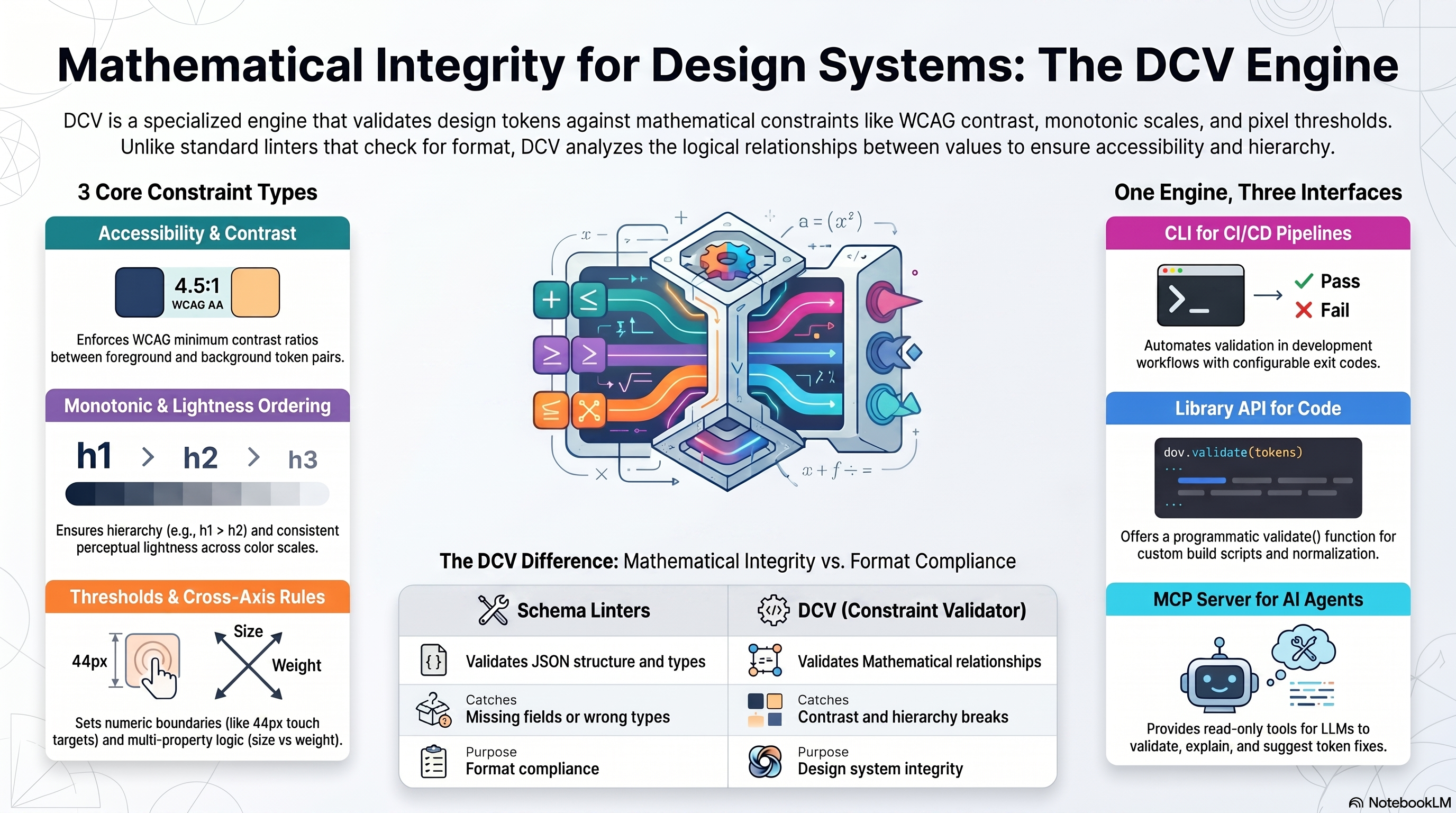
Conventional linters catch **schema** issues ("has a value, has a type").
**DCV** enforces **relationships** that matter to users and brand integrity:
- Legible contrast under all themes and states
- Proper hierarchical spacing/typography (monotonic scales)
- Coherent cross-axis behavior (e.g., weight increases with size where needed)
- Policy conformance (AA/AAA, internal thresholds)
This transforms tokens from "bags of numbers" into a **formal design system**.
---
## Comparison: Schema Linters vs DCV
| Feature | Schema Linters | DCV |
|---------|----------------|-----|
| **Validates** | JSON structure, types | Mathematical relationships, accessibility |
| **Catches** | Missing fields, wrong types | Contrast violations, hierarchy breaks |
| **Purpose** | Format compliance | Design system integrity |
| **Examples** | DTCG schema validator | WCAG checks, monotonic scales |
> DCV is not affiliated with Anima's `design-tokens-validator` (schema-focused).
---
## Input Formats
DCV accepts **token JSON** (flat or nested) and optional **policy JSON**.
Adapters normalize common ecosystems:
- **Style Dictionary** - See [examples/style-dictionary/](examples/style-dictionary/)
- **Tokens Studio JSON** - See [examples/tokens-studio/](examples/tokens-studio/)
- **DTCG** (Design Tokens Community Group) — reads the **2025.10 stable spec** (structured sRGB colors, structured dimensions, `{alias}` references, `$extensions` passthrough; non-sRGB spaces warn rather than mis-calculate; composite types out of scope). See [examples/dtcg/](examples/dtcg/)
Full adapter documentation: **[Adapters](docs/Adapters.md)**
---
## DCV & DecisionThemes
DCV is the **standalone validation engine** — use it for any token system.
**DecisionThemes** (coming 2026) is a complete design system framework built on DCV:
- **5-axis decision model** (Tone, Emphasis, Size, Density, Shape)
- **VT/DT pipeline** (Value Themes + Decision Themes → deterministic CSS configs)
- **Studio UI** + **Hub marketplace** for sharing Decision Systems
DCV powers DecisionThemes' validation layer — but works perfectly standalone.
Preview: [www.decisionthemes.com](https://www.decisionthemes.com)
---
## Method & Prior Art
The Design Constraint Validator engine is based on a theming and validation method published as **defensive prior art**.
To understand the underlying architecture (Decision Themes / Value Themes, deterministic compute, post-compute validation and receipts):
- [Decision Themes Method](docs/prior-art/Decision-Themes-Deterministic-Compute-and-Dual-Namespaces.md)
- [DCV Validation & Receipts](docs/prior-art/DCV-Post-Compute-Validation-and-Receipts.md)
These documents keep the method openly implementable and prevent patent lock-up.
---
## Security & Supply Chain
### SBOM (Software Bill of Materials)
DCV generates CycloneDX-compliant SBOMs for supply chain transparency:
- **CI Builds:** SBOM artifacts on every CI run (90-day retention)
- **Version tags:** SBOM artifacts for release tags
- **GitHub Releases:** SBOM files (JSON + XML) attached when a GitHub Release is created
- **Manual:** Run `npx @cyclonedx/cyclonedx-npm` in project root
**Download:**
- [GitHub Actions Artifacts](https://github.com/CseperkePapp/design-constraint-validator/actions/workflows/sbom.yml)
- [Latest Release](https://github.com/CseperkePapp/design-constraint-validator/releases/latest)
---
## Roadmap
- Plugin API for **custom constraints**
- **VS Code** diagnostics (inline explain)
- **Cross-axis packs** (typography × weight × contrast)
- **Signed / attestable receipts** — `dcv validate --receipt` already emits environment + input content hashes today; cryptographic **signing** is the roadmap part
- UI graph explorer (node inspector, violations focus)
---
## Philosophy
> **Constraints, not conventions.**
Design systems need mathematical guarantees. This validator:
1. **Enforces relationships** - Typography hierarchies, color progressions
2. **Validates accessibility** - WCAG contrast with alpha compositing
3. **Explains violations** - Provenance tracing shows why rules fail
4. **Scales with complexity** - Incremental validation of 1000s of tokens
---
## Related Projects
This is the **core validation engine**. For a complete decision-driven design system with a 5-axis framework (Tone, Emphasis, Size, Density, Shape) and theme configurator UI, see **DecisionThemes** (coming soon).
---
## Contributing
Contributions welcome! See **[CONTRIBUTING.md](CONTRIBUTING.md)**
---
## License
[MIT](LICENSE) © Cseperke Papp
This server cannot be deployed
Maintenance
ActivityInactive
ResponsivenessNo issues