Text-to-GraphQL MCP Server
Transform natural language queries into GraphQL queries using an MCP (Model Context Protocol) server that integrates seamlessly with AI assistants like Claude Desktop and Cursor.

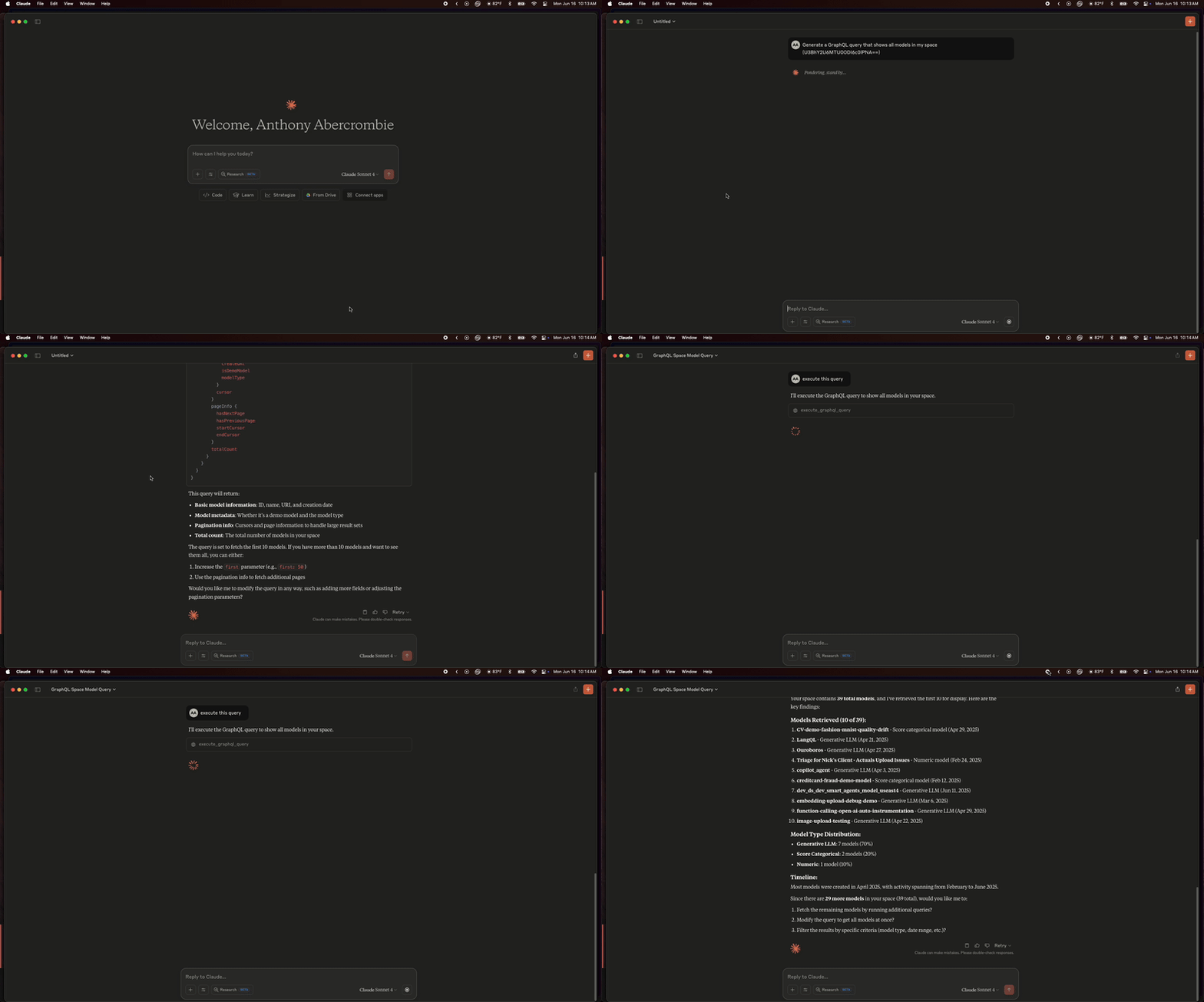
🚀 Overview
The Text-to-GraphQL MCP Server converts natural language descriptions into valid GraphQL queries using an AI agent built with LangGraph. It provides a bridge between human language and GraphQL APIs, making database and API interactions more intuitive for developers and non-technical users alike.
Related MCP server: mcp-graphql-tools
✨ Features
Natural Language to GraphQL: Convert plain English queries to valid GraphQL
Schema Management: Load and introspect GraphQL schemas automatically
Query Validation: Validate generated queries against loaded schemas
Query Execution: Execute queries against GraphQL endpoints with authentication
Query History: Track and manage query history across sessions
MCP Protocol: Full compatibility with Claude Desktop, Cursor, and other MCP clients
Error Handling: Graceful error handling with detailed debugging information
Caching: Built-in caching for schemas and frequently used queries
🛠 Installation
Prerequisites: Install UV (Recommended)
UV is a fast Python package installer and resolver. Install it first:
macOS/Linux:
curl -LsSf https://astral.sh/uv/install.sh | sh
Windows:
powershell -c "irm https://astral.sh/uv/install.ps1 | iex"
Find your UV installation path:
# Find where uv is installed
which uv

# Common locations:
# macOS/Linux: ~/.local/bin/uv
# Windows: %APPDATA%\uv\bin\uv.exe
Important: You'll need the UV path for MCP configuration. The typical path is ~/.local/bin on macOS/Linux, which translates to /Users/yourusername/.local/bin (replace yourusername with your actual username).
Setup for MCP Usage
# Clone the repository
git clone https://github.com/Arize-ai/text-to-graphql-mcp.git
cd text-to-graphql-mcp

# Install dependencies (UV automatically creates virtual environment)
uv sync

# Test the installation
uv run text-to-graphql-mcp --help
Note: The uv run pattern automatically handles virtual environments, making MCP configuration cleaner and more reliable than traditional pip installations.
Alternative Installation Methods
From PyPI (when published):
pip install text-to-graphql-mcp
Development Setup:
# For contributing to the project
uv sync --dev
🏃♂️ Quick Start
1. Configure with Cursor (Recommended)
Add to your .cursor/mcp.json:
{
  "text-to-graphql": {
    "command": "uv",
    "args": [
      "--directory",
      "/path/to/text-to-graphql-mcp",
      "run",
      "text-to-graphql-mcp"
    ],
    "env": {
      "PATH": "/path/to/uv/bin:/usr/bin:/bin",
      "OPENAI_API_KEY": "your_openai_api_key_here",
      "GRAPHQL_ENDPOINT": "https://your-graphql-api.com/graphql",
      "GRAPHQL_API_KEY": "your_api_key_here",
      "GRAPHQL_AUTH_TYPE": "bearer"
    }
  }
}
Important Setup Notes:
Replace /path/to/text-to-graphql-mcp with the actual path to your cloned repository
Replace /path/to/uv/bin with your actual UV installation path (typically /Users/yourusername/.local/bin on macOS)
The PATH environment variable is required for MCP clients to find the uv command
2. Configure with Claude Desktop
Add to your Claude Desktop MCP configuration file:
macOS: ~/Library/Application Support/Claude/claude_desktop_config.json
Windows: %APPDATA%\Claude\claude_desktop_config.json
{
  "mcpServers": {
    "text-to-graphql": {
      "command": "uv",
      "args": [
        "--directory",
        "/path/to/text-to-graphql-mcp",
        "run",
        "text-to-graphql-mcp"
      ],
      "env": {
        "PATH": "/path/to/uv/bin:/usr/bin:/bin",
        "OPENAI_API_KEY": "your_openai_api_key_here",
        "GRAPHQL_ENDPOINT": "https://your-graphql-api.com/graphql",
        "GRAPHQL_API_KEY": "your_api_key_here",
        "GRAPHQL_AUTH_TYPE": "bearer"
      }
    }
  }
}
Setup Instructions:
Find your UV path: Run which uv in terminal (typically /Users/yourusername/.local/bin/uv)
Set the PATH: Use the directory containing uv (e.g., /Users/yourusername/.local/bin)
Replace paths: Update both the --directory argument and PATH environment variable with your actual paths
Add your API keys: Replace the placeholder values with your actual API keys
3. Common UV Path Examples
# Find your UV installation
which uv

# Common paths by OS:
# macOS: /Users/yourusername/.local/bin/uv
# Linux: /home/yourusername/.local/bin/uv
# Windows: C:\Users\yourusername\AppData\Roaming\uv\bin\uv.exe

# For MCP config, use the directory path:
# macOS: /Users/yourusername/.local/bin
# Linux: /home/yourusername/.local/bin
# Windows: C:\Users\yourusername\AppData\Roaming\uv\bin
4. Alternative: Use Environment Variables
If you prefer using a .env file (useful for local development):
# Required
OPENAI_API_KEY=your_openai_api_key_here
GRAPHQL_ENDPOINT=https://your-graphql-api.com/graphql
GRAPHQL_API_KEY=your_api_key_here

# Optional - Authentication method (bearer|apikey|direct)
GRAPHQL_AUTH_TYPE=bearer

# Optional - Model settings
MODEL_NAME=gpt-4o
MODEL_TEMPERATURE=0
Then use a simplified MCP configuration (still requires PATH):
{
  "text-to-graphql": {
    "command": "uv",
    "args": [
      "--directory",
      "/path/to/text-to-graphql-mcp",
      "run",
      "text-to-graphql-mcp"
    ],
    "env": {
      "PATH": "/path/to/uv/bin:/usr/bin:/bin"
    }
  }
}
5. Run the MCP Server (Optional - for testing)
# Run the server directly for testing
text-to-graphql-mcp

# Or run as a module
python -m text_to_graphql_mcp.mcp_server
🔧 Usage
Available MCP Tools
generate_graphql_query
Convert natural language to GraphQL queries.
Input: "Get all users with their names and emails"
Output: query { users { id name email } }
validate_graphql_query
Validate GraphQL queries against the loaded schema.
execute_graphql_query
Execute GraphQL queries and return formatted results.
get_query_history
Retrieve the history of all queries in the current session.
get_query_examples
Get example queries to understand the system's capabilities.
Example Interactions
Natural Language Input:
"Show me all blog posts from the last week with their authors and comment counts"
Generated GraphQL:
query {
  posts(where: { createdAt: { gte: "2024-06-05T00:00:00Z" } }) {
    id
    title
    content
    createdAt
    author {
      id
      name
      email
    }
    comments {
      id
    }
    _count {
      comments
    }
  }
}
🐳 Deploying with Docker
💡 Key Concept: When using Docker with MCP clients (Claude/Cursor), environment variables are set during container startup (docker run), not in the MCP client configuration. The MCP clients simply connect to the already-running container.
Building the Docker Image
# Clone the repository
git clone https://github.com/Arize-ai/text-to-graphql-mcp.git
cd text-to-graphql-mcp

# Build the Docker image
docker build -t text-to-graphql-mcp .
Running the Container
Method 1: Using Environment Variables Directly
docker run -d \
  --name text-to-graphql-mcp \
  -p 8000:8000 \
  -e OPENAI_API_KEY="your_openai_api_key_here" \
  -e GRAPHQL_ENDPOINT="https://your-graphql-api.com/graphql" \
  -e GRAPHQL_API_KEY="your_api_key_here" \
  -e GRAPHQL_AUTH_TYPE="bearer" \
  -e MODEL_NAME="gpt-4o" \
  text-to-graphql-mcp
Method 2: Using an Environment File
Create a .env file:
OPENAI_API_KEY=your_openai_api_key_here
GRAPHQL_ENDPOINT=https://your-graphql-api.com/graphql
GRAPHQL_API_KEY=your_api_key_here
GRAPHQL_AUTH_TYPE=bearer
MODEL_NAME=gpt-4o
MODEL_TEMPERATURE=0
Run the container:
docker run -d \
  --name text-to-graphql-mcp \
  -p 8000:8000 \
  --env-file .env \
  text-to-graphql-mcp
Method 3: Using Docker Compose
Create a docker-compose.yml file:
version: '3.8'

services:
  text-to-graphql-mcp:
    build: .
    container_name: text-to-graphql-mcp
    ports:
      - "8000:8000"
    environment:
      - OPENAI_API_KEY=${OPENAI_API_KEY}
      - GRAPHQL_ENDPOINT=${GRAPHQL_ENDPOINT}
      - GRAPHQL_API_KEY=${GRAPHQL_API_KEY}
      - GRAPHQL_AUTH_TYPE=${GRAPHQL_AUTH_TYPE:-bearer}
      - MODEL_NAME=${MODEL_NAME:-gpt-4o}
      - MODEL_TEMPERATURE=${MODEL_TEMPERATURE:-0}
      - API_HOST=0.0.0.0  # Important: bind to all interfaces in container
    restart: unless-stopped
    healthcheck:
      test: ["CMD", "curl", "-f", "http://localhost:8000/health"]
      interval: 30s
      timeout: 10s
      retries: 3
Then run:
# Start the service
docker-compose up -d

# View logs
docker-compose logs -f

# Stop the service
docker-compose down
Using Docker with MCP Clients
When running the MCP server in Docker, you need to use docker exec to communicate with the container:
Important: The environment variables (OPENAI_API_KEY, GRAPHQL_ENDPOINT, etc.) must be set when you first run the container using one of the methods above. The MCP client configurations below only connect to an already-running container.
Step 1: First, ensure your container is running with environment variables
# Example: Make sure the container is running with your environment variables
docker run -d \
  --name text-to-graphql-mcp \
  -p 8000:8000 \
  --env-file .env \
  text-to-graphql-mcp

# Verify the container is running
docker ps | grep text-to-graphql-mcp
Step 2: Configure Cursor
Add to .cursor/mcp.json:
{
  "text-to-graphql": {
    "command": "docker",
    "args": [
      "exec",
      "-i",
      "text-to-graphql-mcp",
      "uv",
      "run",
      "python",
      "-m",
      "src.text_to_graphql_mcp.mcp_server"
    ]
  }
}
Step 2: Configure Claude Desktop
Add to your Claude Desktop configuration:
{
  "mcpServers": {
    "text-to-graphql": {
      "command": "docker",
      "args": [
        "exec",
        "-i",
        "text-to-graphql-mcp",
        "uv",
        "run",
        "python",
        "-m",
        "src.text_to_graphql_mcp.mcp_server"
      ]
    }
  }
}
Note: The MCP client configurations don't need environment variables because they're connecting to a container that already has them set. If you restart the container, make sure to include the environment variables again.
🏗 Architecture
The system uses a multi-agent architecture built with LangGraph:
Intent Recognition: Understands what the user wants to accomplish
Schema Management: Loads and manages GraphQL schema information
Query Construction: Builds GraphQL queries from natural language
Query Validation: Ensures queries are valid against the schema
Query Execution: Executes queries against the GraphQL endpoint
Data Visualization: Provides recommendations for visualizing results
⚙️ Configuration
Environment Variables
Variable | Description | Default |
OPENAI_API_KEY
| OpenAI API key for LLM operations | Required |
GRAPHQL_ENDPOINT
| GraphQL API endpoint URL | Required |
GRAPHQL_API_KEY
| API key for your GraphQL service | Required |
GRAPHQL_AUTH_TYPE
| Authentication method: bearer, apikey, or direct | bearer
|
GRAPHQL_HEADERS
| Custom headers as JSON (overrides auto-auth) | {}
|
MODEL_NAME
| OpenAI model to use | gpt-4o
|
MODEL_TEMPERATURE
| Model temperature for responses | 0
|
API_HOST
| Server host address | 127.0.0.1
|
API_PORT
| Server port | 8000
|
RECURSION_LIMIT
| Max recursion for agent workflow | 10
|
Authentication Types
bearer (default): Uses Authorization: Bearer <token> - standard for most GraphQL APIs
apikey: Uses X-API-Key: <key> - used by some APIs like Arize
direct: Uses Authorization: <token> - direct token without Bearer prefix
Custom: Set GRAPHQL_HEADERS to override with any custom authentication format
Common GraphQL API Examples
GitHub GraphQL API:
GRAPHQL_ENDPOINT=https://api.github.com/graphql
GRAPHQL_API_KEY=ghp_your_github_personal_access_token
GRAPHQL_AUTH_TYPE=bearer
Shopify GraphQL API:
GRAPHQL_ENDPOINT=https://your-shop.myshopify.com/admin/api/2023-10/graphql.json
GRAPHQL_API_KEY=your_shopify_access_token
GRAPHQL_AUTH_TYPE=bearer
Arize GraphQL API:
GRAPHQL_ENDPOINT=https://app.arize.com/graphql
GRAPHQL_API_KEY=your_arize_developer_api_key
# Auth type auto-detected for Arize
Hasura:
GRAPHQL_ENDPOINT=https://your-app.hasura.app/v1/graphql
GRAPHQL_HEADERS={"x-hasura-admin-secret": "your_admin_secret"}
🔍 Observability & Agent Development
Want to build better AI agents quickly? Check out Arize Phoenix - an open-source observability platform specifically designed for LLM applications and agents. Phoenix provides:
Real-time monitoring of your agent's performance and behavior
Trace visualization to understand complex agent workflows
Evaluation frameworks for testing and improving agent responses
Data quality insights to identify issues with your training data
Cost tracking for LLM API usage optimization
Phoenix integrates seamlessly with LangChain and LangGraph (which this project uses) and can help you:
Debug agent behavior when queries aren't generated correctly
Monitor GraphQL query quality and success rates
Track user satisfaction and query complexity
Optimize your agent's prompt engineering
Get started with Phoenix:
pip install arize-phoenix
phoenix serve
Visit docs.arize.com/phoenix for comprehensive guides on agent observability and development best practices.
🧪 Development
Setup Development Environment
# Install development dependencies
uv pip install -e ".[dev]"

# Run tests
pytest

# Format code
black .
isort .

# Type checking
mypy src/
Project Structure
text-to-graphql-mcp/
├── src/text_to_graphql_mcp/     # Main package
│   ├── mcp_server.py            # MCP server implementation
│   ├── agent.py                 # LangGraph agent logic
│   ├── config.py                # Configuration management
│   ├── logger.py                # Logging utilities
│   ├── tools/                   # Agent tools
│   └── ...
├── tests/                       # Test suite
├── docs/                        # Documentation
├── pyproject.toml              # Package configuration
└── README.md
🤝 Contributing
We welcome contributions! Please see our contributing guidelines for details.
Fork the repository
Create a feature branch (git checkout -b feature/amazing-feature)
Commit your changes (git commit -m 'Add some amazing feature')
Push to the branch (git push origin feature/amazing-feature)
Open a Pull Request
📝 License
This project is licensed under the Elastic License 2.0 (ELv2) - see the LICENSE file for details.
🐛 Troubleshooting
Common Issues
"No module named 'text_to_graphql_mcp'"
"OpenAI API key not found"
"GraphQL endpoint not reachable"
"Schema introspection failed"
🔗 Links
🙏 Acknowledgments